
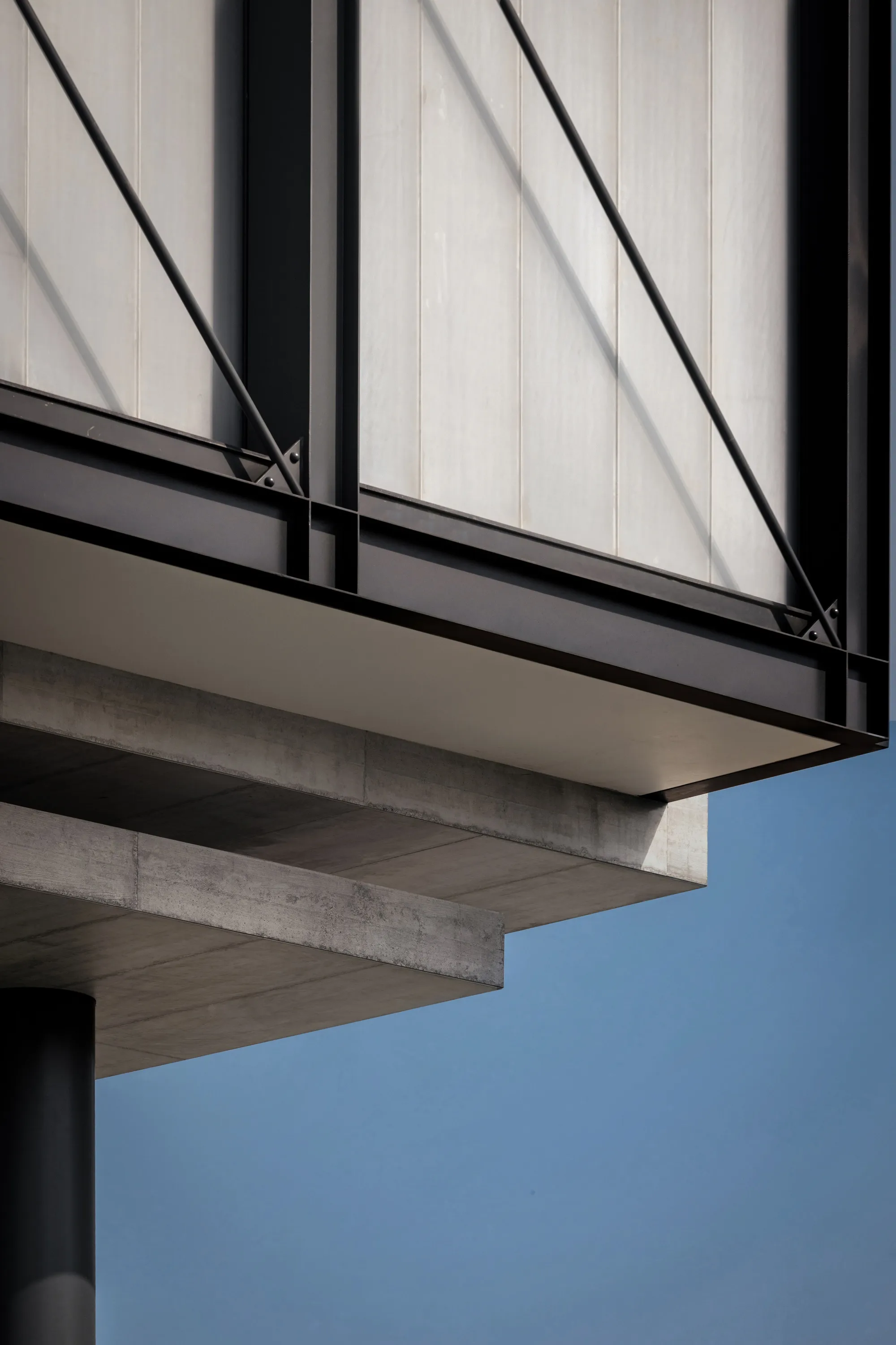
Minimalist Architecture and Design Studio Float a Concrete House Above Ludhiana's Streetscape
Residence T20 uses deep cantilevers, board-formed concrete, and diagonal-braced glazing to build lightness into mass in northern India.


A concrete house should not look weightless. That contradiction is the central provocation of Residence T20, a collaboration between Minimalist Architecture and Design Studio in Ludhiana, India. Completed in 2025, the house stacks broad horizontal slabs that push well past their supporting structure, creating deep cantilevers that make the upper volume appear to drift free of the ground. The effect is deliberate, even theatrical, but the architectural logic behind it is rigorous: each projecting plane shelters the level below, controls solar gain, and carves out terraces where planting softens hard edges.
What makes the project genuinely interesting is how it resolves the tension between exposed concrete and transparency. Diagonal steel bracing turns the glazed walls into a visible structural diagram, giving the facade a graphic intensity that reads clearly from the street. Rather than hiding the means by which gravity is resisted, the architects celebrate it. The result is a house that feels simultaneously heavy and buoyant, raw and precise, and that earns its drama through construction rather than decoration.
Cantilever as Thesis
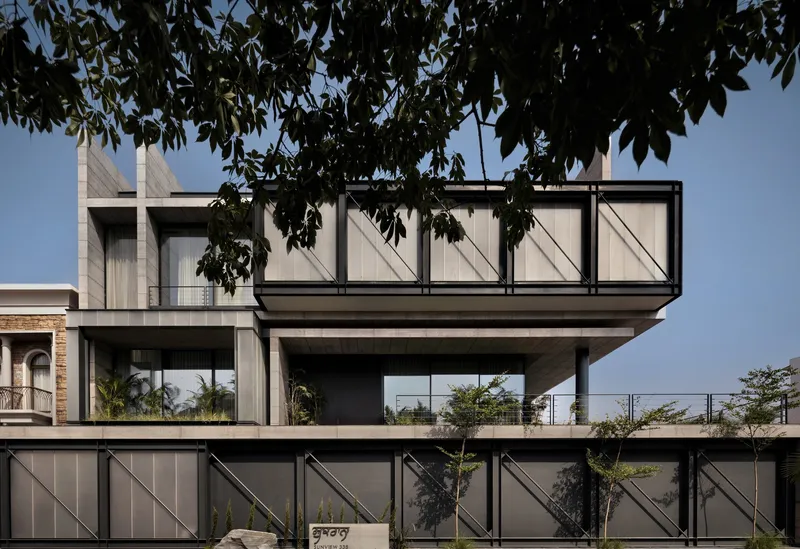
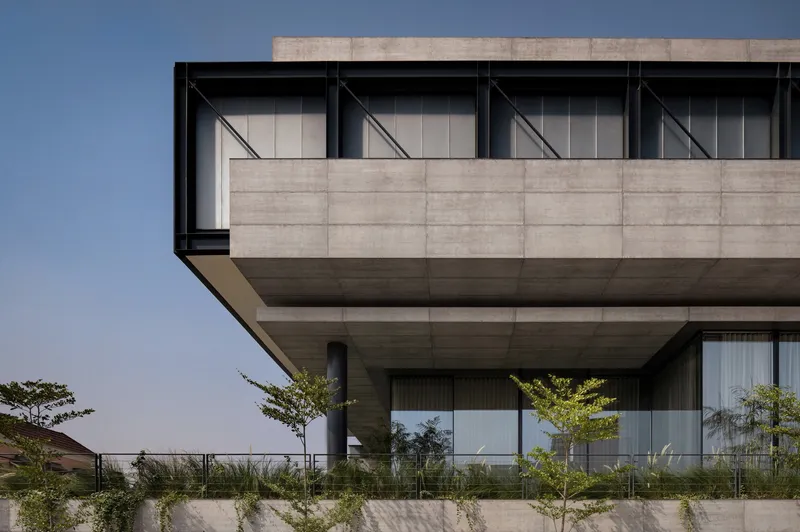
From the street, the house announces itself through a single architectural move: the upper concrete volume projects outward with enough conviction to reframe the entire facade as an act of structural daring. The soffit of the cantilever is left in raw board-formed concrete, its grain and tie-hole pattern becoming ornament. Below, full-height glazing recedes behind young trees planted on a raised terrace, so the mass above appears to float over a screen of foliage and glass.
The cantilever is not merely sculptural. It shelters the lower living spaces from Punjab's intense sun while opening them to daylight through the diagonal-braced glass panels. It also pushes usable floor area beyond the building's footprint, gaining private outdoor space on the upper levels without consuming additional ground coverage. The overhanging tree branches in the street view suggest a house that, over time, will settle into a dialogue with its landscape rather than standing apart from it.
Diagonal Bracing and the Honest Facade
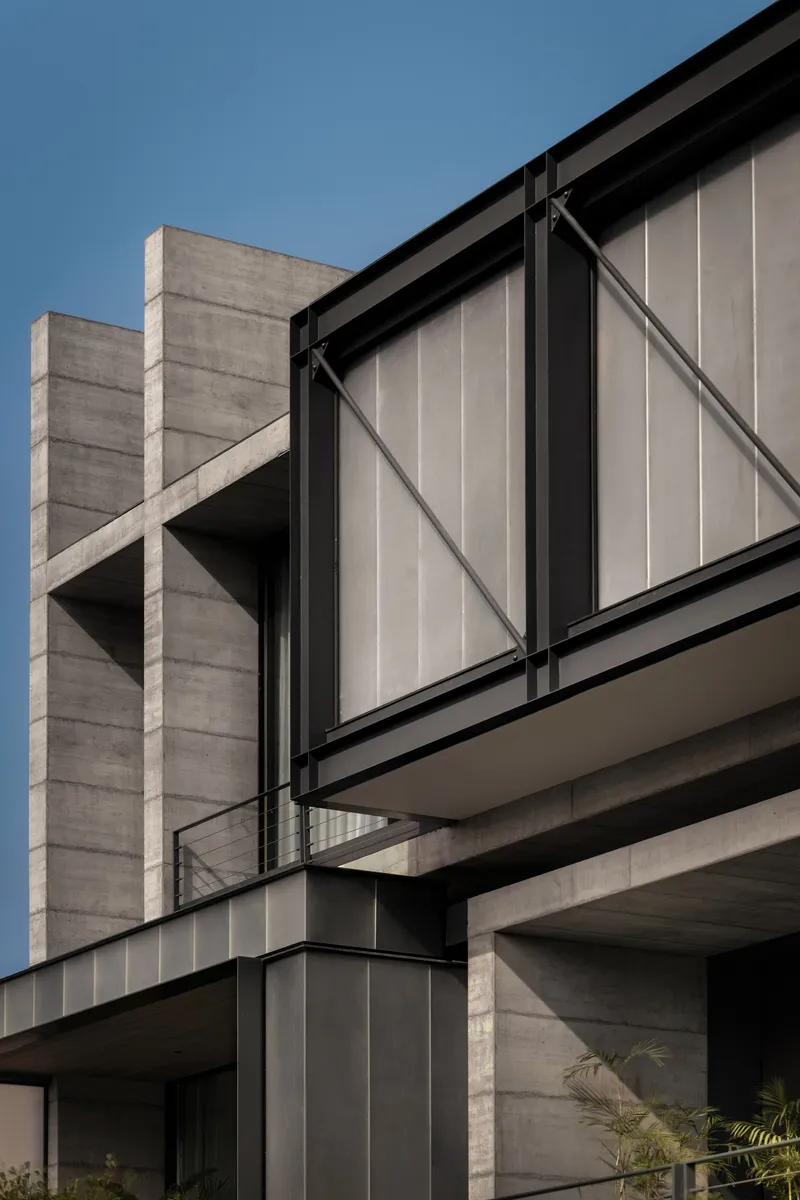
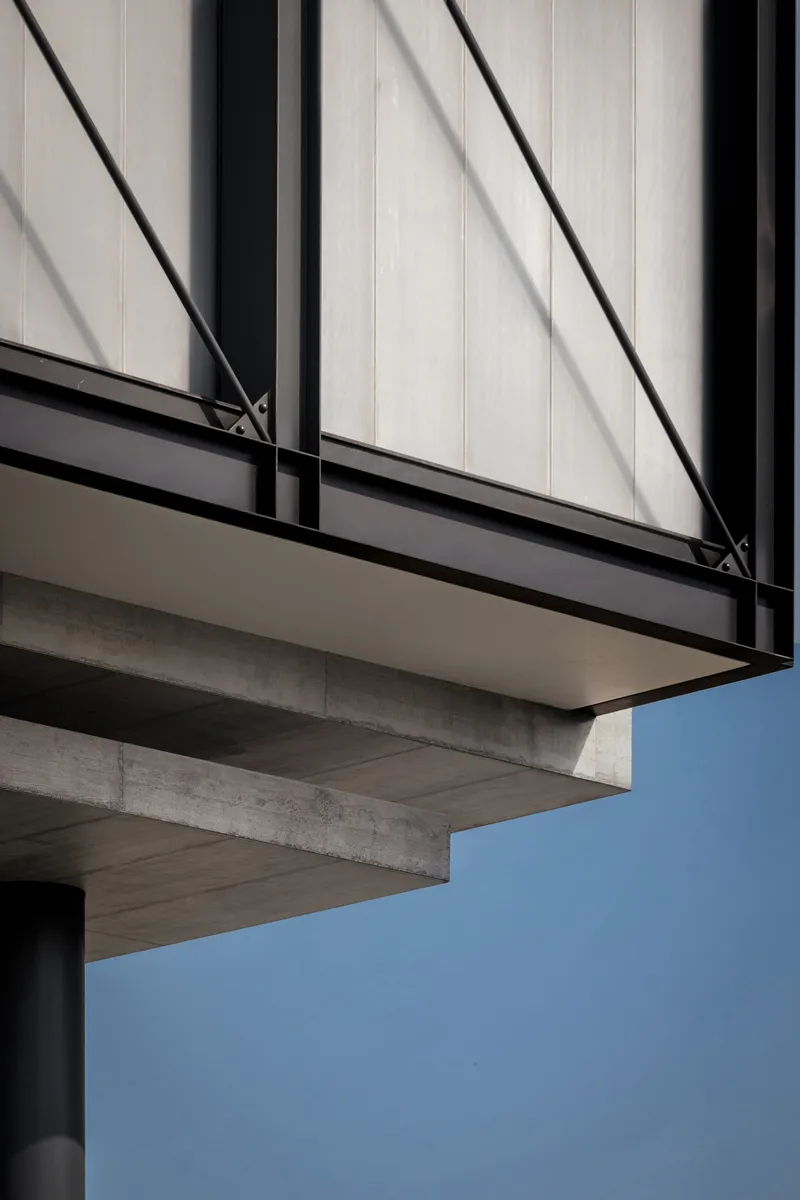
The diagonal steel braces that crisscross the glazed walls are the most distinctive detail of Residence T20. Structurally, they stiffen the tall glass panels against lateral loads. Visually, they turn each bay into a geometric composition that changes character depending on the angle of view and the quality of light. Photographed from below against a blue sky, the bracing reads as a taut web stretched between concrete slabs, reinforcing the impression that the house is held together by tension as much as by compression.
Board-formed concrete columns at the lower levels anchor the composition vertically, their rough texture contrasting with the precision of the steel and glass. The architects layer these materials without hierarchy: concrete, steel, and glass each do visible work, and none is concealed for the sake of a cleaner image. The honesty is refreshing, particularly in a residential context where structure is typically buried behind finishes.
Threshold and Transition
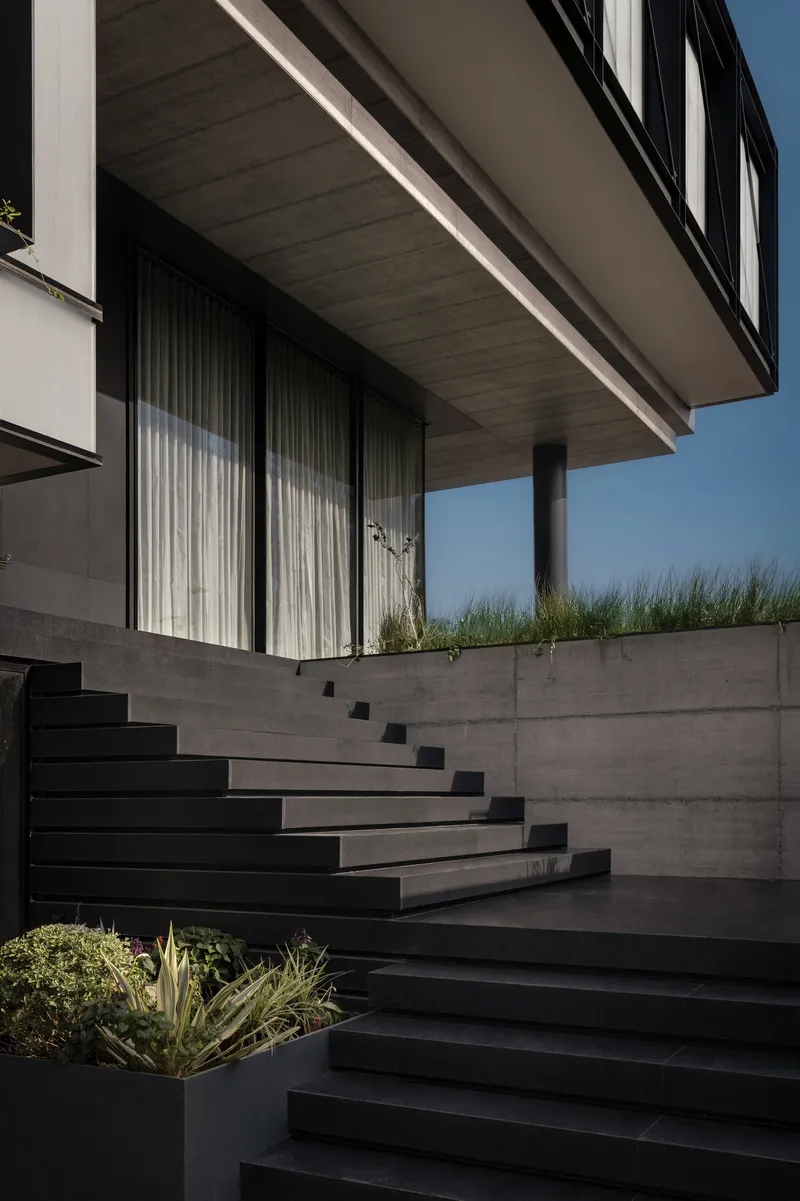
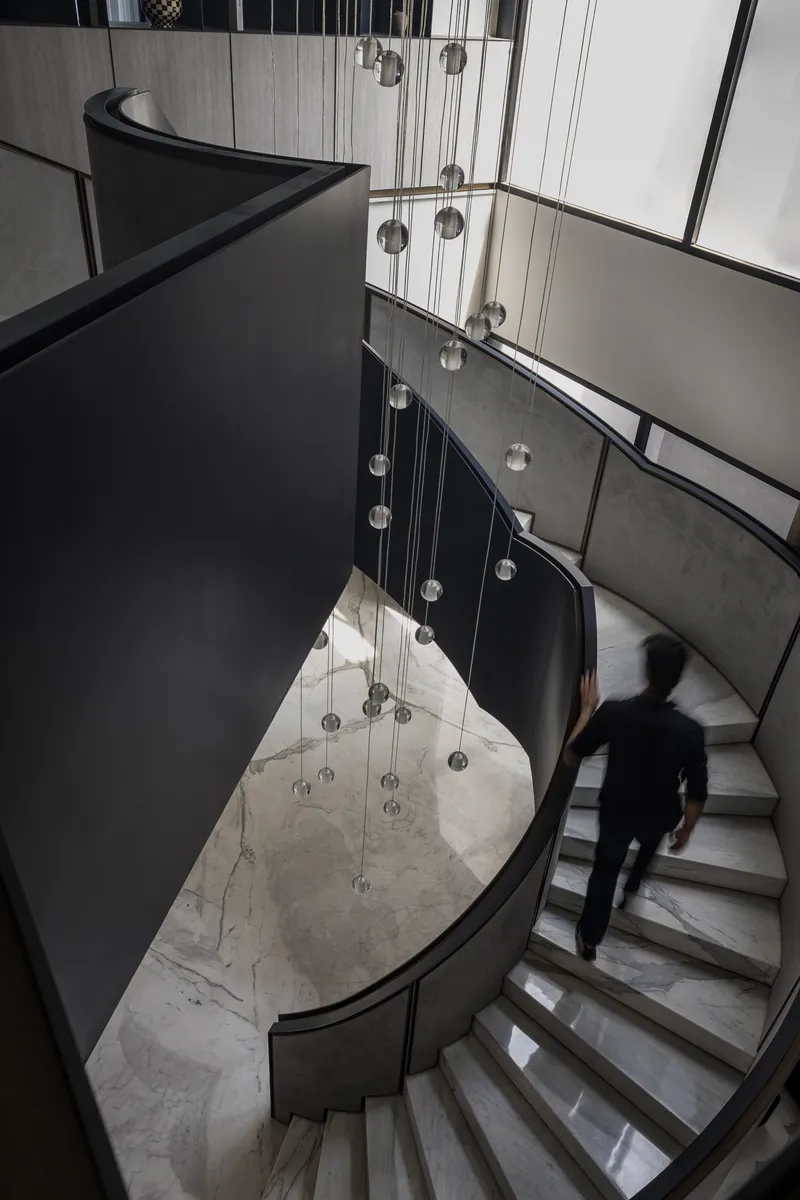
Circulation through the house is choreographed to heighten the experience of moving between weight and light. A black steel stair climbs along a concrete retaining wall, flanked by ornamental grasses, creating a compressed, almost subterranean passage before arriving at the open living levels above. The transition from shade to brightness, from the narrow slot beside the wall to the generous cantilever overhead, gives the journey through the house a narrative rhythm.
Inside, a curved marble staircase takes over as the primary vertical connector. Its sweeping geometry contrasts with the angular steel and concrete elsewhere, offering a moment of softness at the core of the plan. A cluster of globe pendant lights drops through the stair void, marking the vertical axis and drawing the eye upward through successive levels. The staircase is clearly meant to be experienced from above as well as from within: the overhead view captures both the spiral form and the human figure ascending, reinforcing the architects' interest in movement as a design subject.
Interior Character
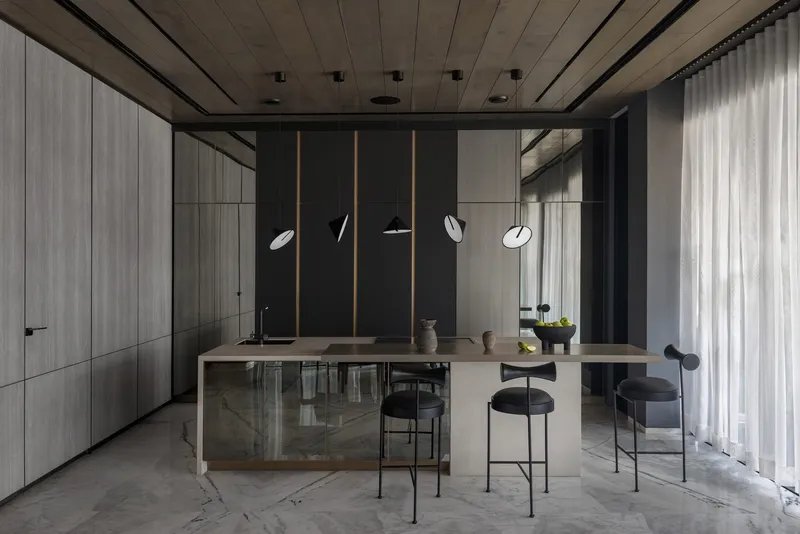
The interiors dial back the tectonic intensity of the exterior. The kitchen pairs a pale timber island with black bar stools and suspended disc pendants beneath an exposed concrete ceiling, achieving a warmth that never tips into domesticated blandness. Materials are kept to a tight palette: timber, concrete, and black metal. The proportions are generous without being gratuitously oversized, a balance that many large Indian houses struggle to maintain.
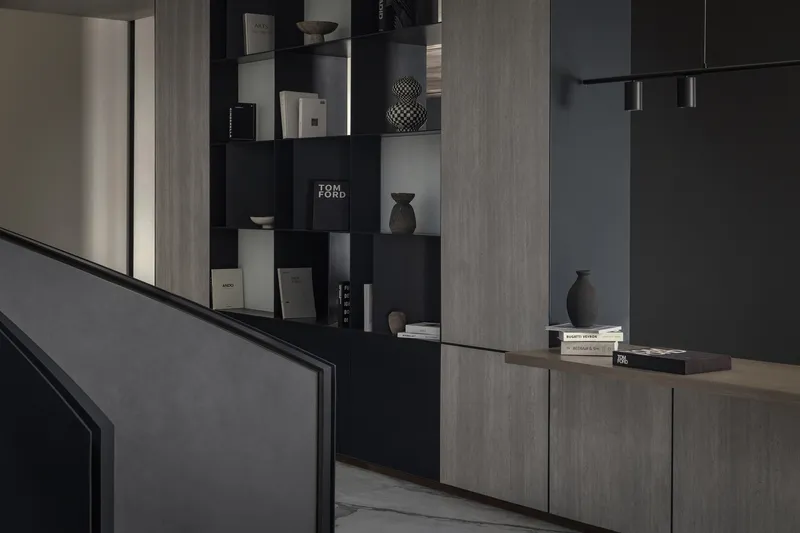
A display wall of black recessed shelving, set beside wood-paneled cabinetry, illustrates the same discipline. Objects and books are given precise slots within a modular grid; the wall itself becomes furniture, dissolving the boundary between architecture and interior design. It is a quiet detail, but it reinforces the project's broader commitment to treating every surface as an opportunity for controlled composition.
Plans and Drawings
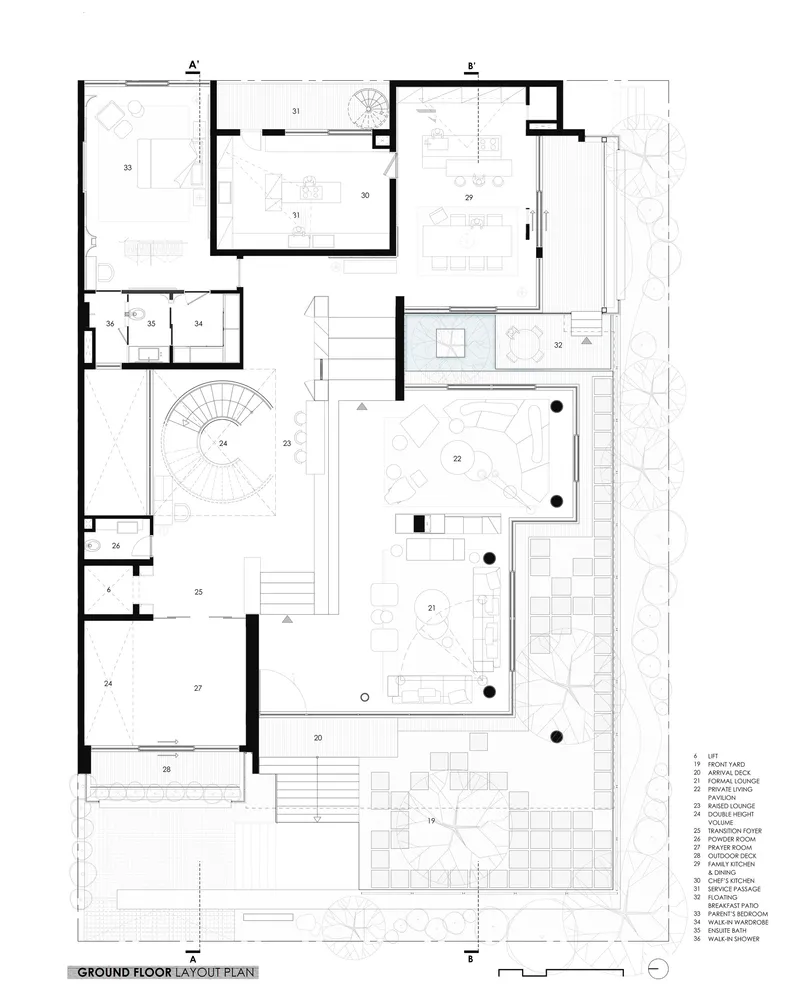
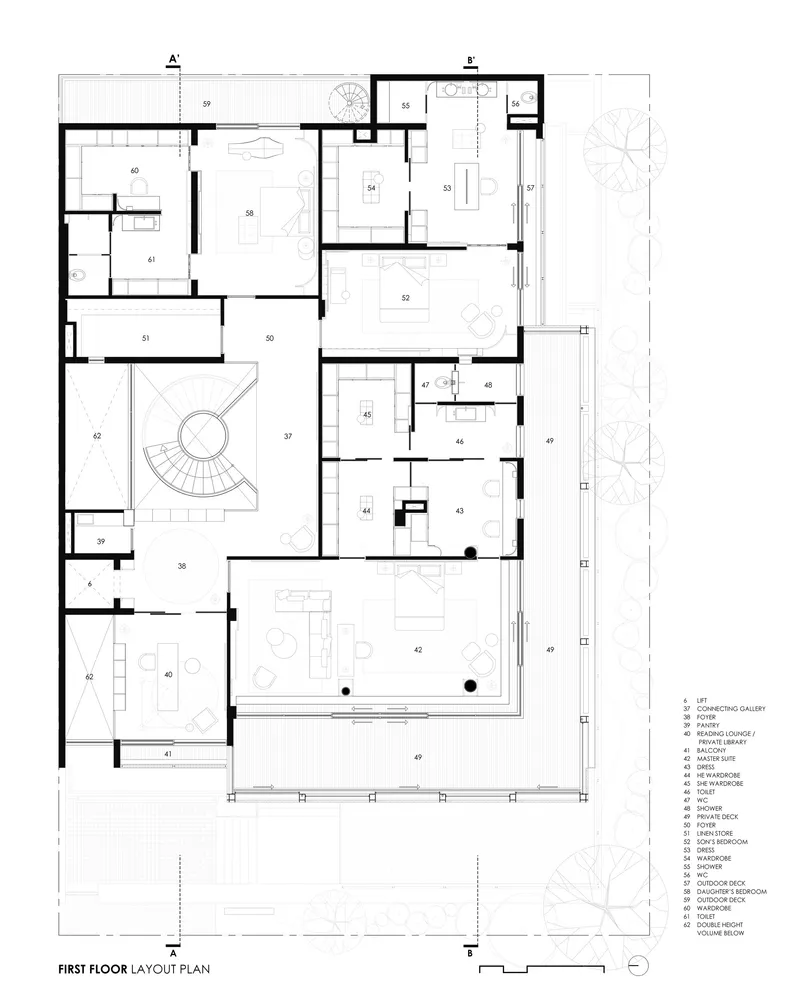
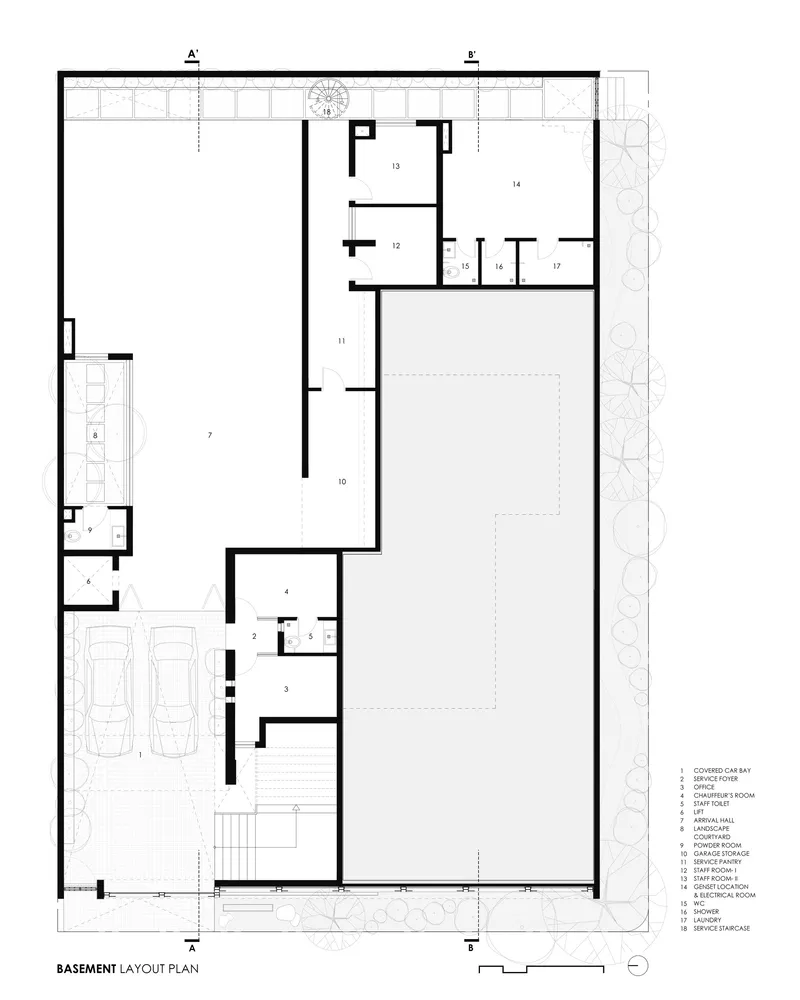
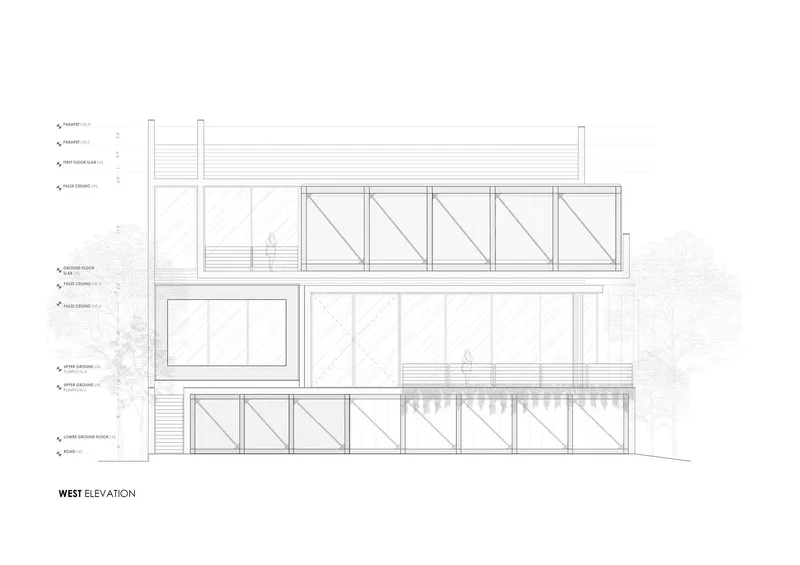
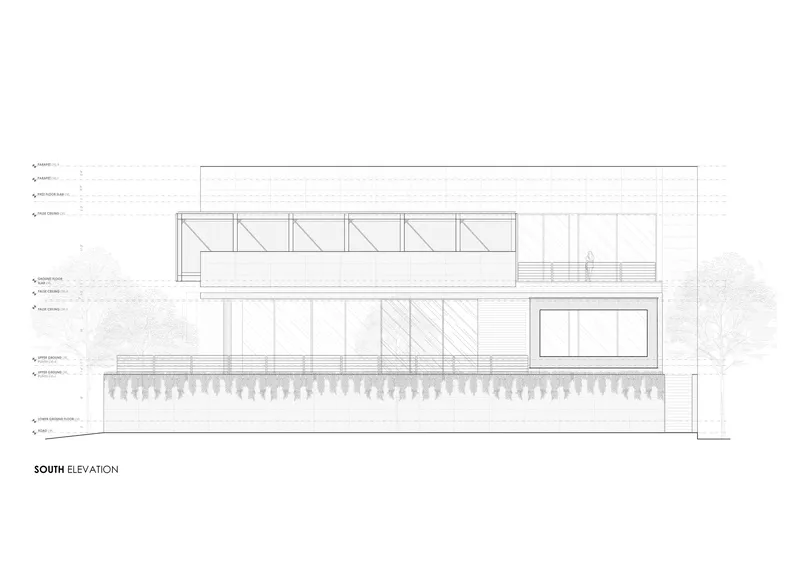
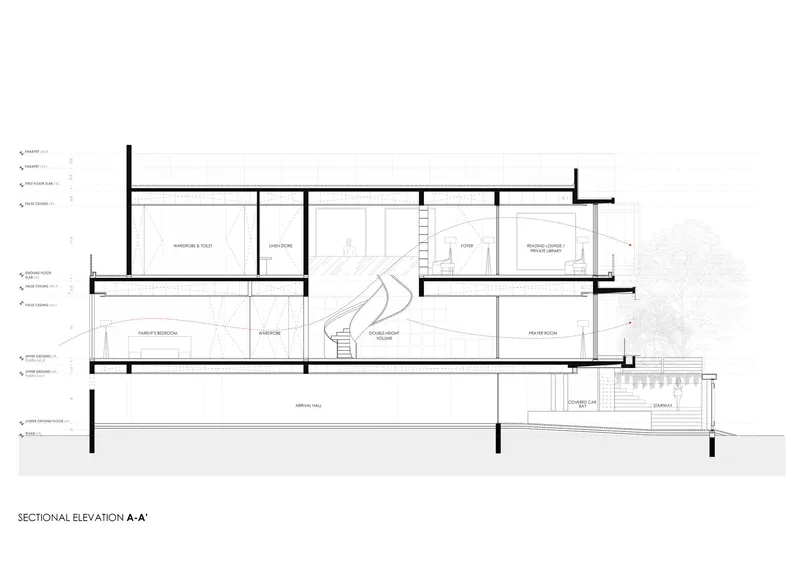
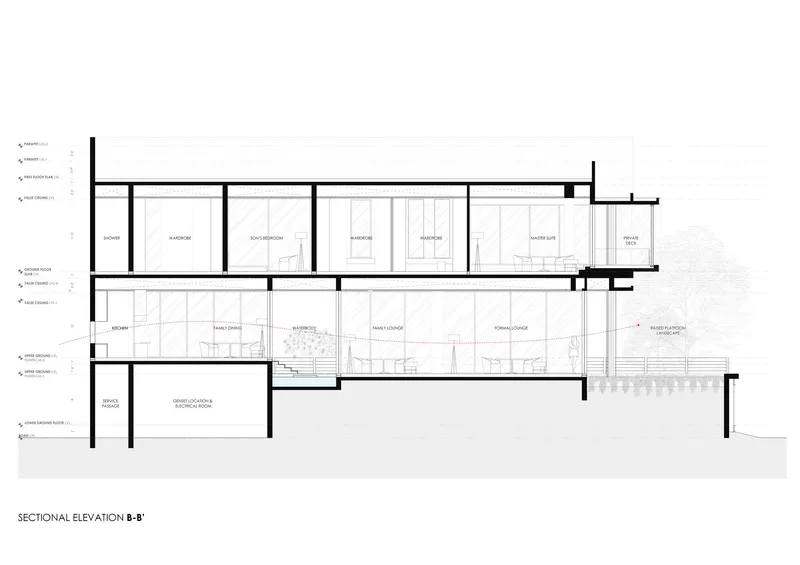
The floor plans reveal a three-level organization, with a basement containing a two-car garage and a large recreation area, a ground floor arranged around courtyards and outdoor terraces, and a first floor given over to bedrooms that open onto sheltered terraces. The spiral stair appears consistently across all levels, acting as the spatial spine of the plan. Courtyards punctuate the ground floor layout, pulling light and air into the center of the house and creating a layered relationship between interior rooms and planted outdoor spaces.
The west elevation drawing confirms what the photographs suggest: the diagonal-braced glazing is the primary compositional element of the street-facing facade, organized in a regular rhythm across three stories. The south elevation, by contrast, presents a quieter face of timber framing and solid walls. Section drawings cut through the split-level interior, exposing the curved staircase as it winds between floors and demonstrating how the cantilever extends living space over the courtyard below. Upper bedrooms sit above the more public zones, with each level slightly offset to create spatial variety within a compact vertical envelope.
Why This Project Matters
Residence T20 is a serious attempt to bring structural expression back to the center of residential design. In a market where facade cladding often does all the talking, the decision to let cantilevers, bracing, and board-formed concrete carry the aesthetic argument feels both principled and bold. The house does not rely on imported materials or unusual technologies; it uses the standard vocabulary of reinforced concrete construction and simply pushes it toward greater legibility and drama.
Minimalist Architecture and Design Studio have produced a house that rewards close looking. From the street, the cantilever is the headline. Up close, the grain of the formwork, the rhythm of the diagonal braces, and the play of light through planted terraces tell a more nuanced story. In Ludhiana, a city where residential architecture rarely aspires to this level of tectonic clarity, the project sets a marker for what concrete can do when architects treat structure not as something to conceal but as the very subject of their design.
Residence T20, Ludhiana, India. Completed 2025. Architecture by Minimalist Architecture and Design Studio. Photography by Purnesh Dev Nikhanj.
About the Studio
Share Your Own Work on uni.xyz
If projects like this are the kind of work you want to make, uni.xyz is a place to publish your own, find collaborators, and enter design competitions.


Popular Articles
Popular articles from the community


Conexión: Biophilic Design Reimagines High-Rise Living in Hong Kong
Conexión reimagines high-rise living in Hong Kong through biophilic design, green facades, shared spaces, daylight, water and nature within.

The Musturak Paradise: Senior Living Architecture for a Connected Future in Temara, Morocco
The Musturak Paradise reimagines senior living architecture in Temara via private homes, social spaces, culture, community, and shared care.

Co-life: Sustainable Architecture for Age-Friendly Community Living
Co-life reimagines sustainable architecture for seniors through courtyards, rammed earth, shared gardens, and spaces designed for belonging.

Co-Life: Senior Housing Design That Reconnects Older Adults With the City
Co-Life reimagines senior housing design through healing gardens, shared streets, workshops, and a sustainable community across generations.


Similar Reads
You might also enjoy these articles

Bao Huynh Watercolor Atelier: A Serene Art Retreat in Hội An
Bao Huynh Watercolor Atelier in Hội An blends multifunctional art spaces, sustainable design, local materials, and family-friendly living in a serene environment.

Atelier Macri Concept Store Interior Design by CASE-REAL
Atelier Macri store features a "ko" counter, walnut wood details, cork displays, blending retail, gallery, and seamless customer experiences.

Manuel Vargas Izquierdo Stadium and High-Performance Sports Center: Architectural Excellence in Jalpa de Méndez
The Manuel Vargas Izquierdo Stadium blends sustainable design, inclusive sports facilities, and cultural-inspired architecture, revitalizing Jalpa de Méndez’s public spaces.
KAKR Buluh Awar Hall: Revitalizing Community and Ecology Through Bamboo Architecture
Community built bamboo hall revitalizes Buluh Awar village, empowering youth, restoring ecology, celebrating vernacular craftsmanship through sustainable architecture and culture.

Explore Residence Competitions
Discover active competitions in this discipline


Challenge to design mud housing for contemporary communities


Challenge to reimagine the Iron Throne


Photograph architecture without architects


Illustrate the lost glory of Angkor Wat - Render Challenge
Comments (0)
Please login or sign up to add comments
No comments yet. Be the first to comment!