
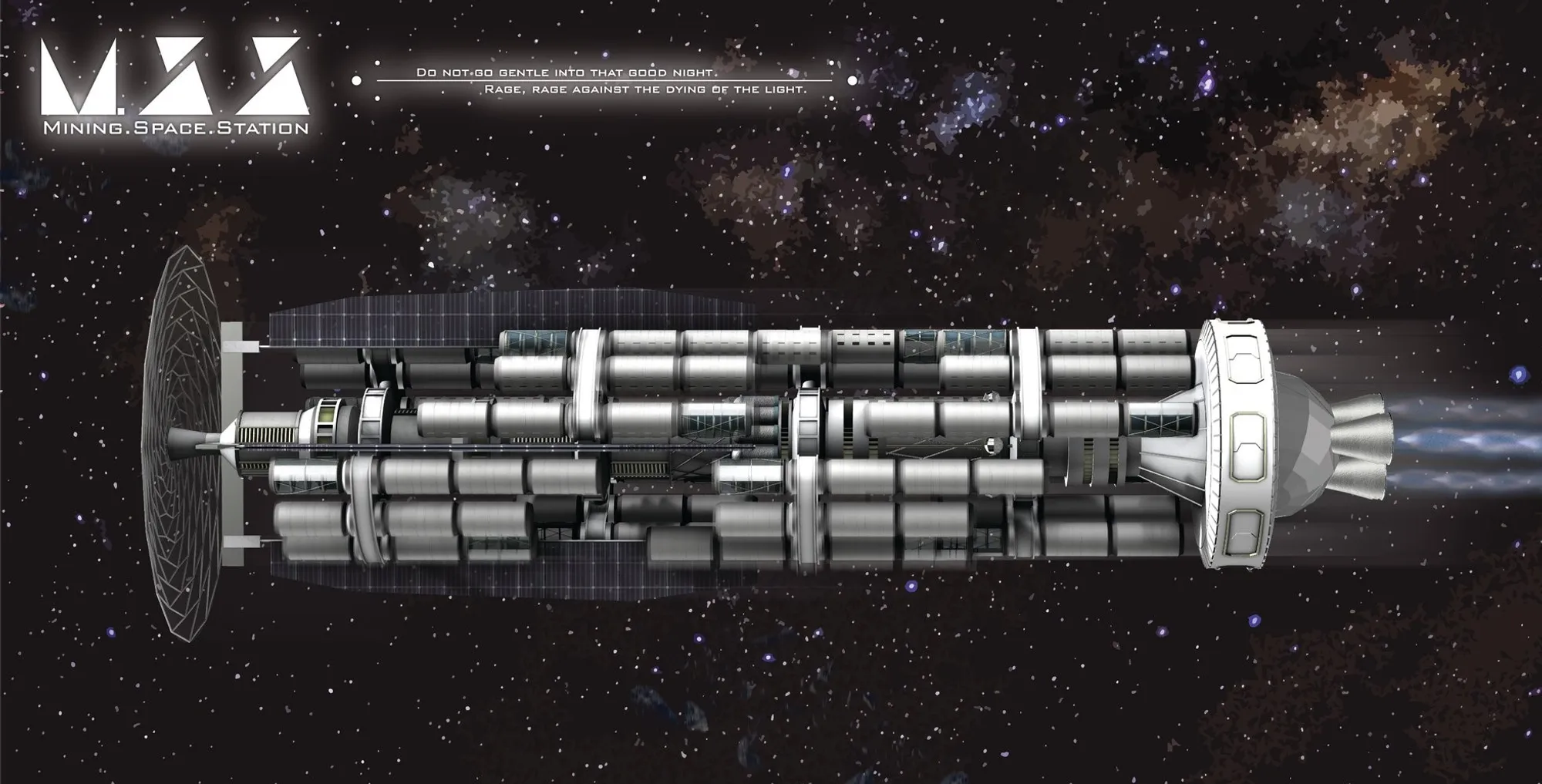
Mining Space Station: Advancing Space Architecture Through Orbital Resource Infrastructure
A visionary space architecture proposal that merges habitation, mining, and artificial gravity to redefine human expansion beyond Earth.


The evolution of space architecture is no longer confined to speculative imagination. It is rapidly transitioning into a discipline that integrates engineering, habitation science, and planetary resource management. Mining Space Station, a project by Bo Yan You and 一節 陳, shortlisted in the Leap competition, positions itself within this emerging paradigm by proposing a scalable orbital infrastructure designed to support long-term human presence beyond Earth.
Drawing parallels to the Age of Discovery, the project reframes space not as an abstract void but as an active frontier for human expansion. The ambition is not merely exploration, but the establishment of a sustainable system that combines habitation, mining, and research into a cohesive architectural framework.

Conceptual Framework: Space Architecture as Infrastructure
At its core, the project operates within the domain of space architecture, where design must respond simultaneously to extreme environmental constraints and human physiological needs. The proposal outlines a phased strategy:
- Initial deployment of robotic systems for asteroid mining
- Establishment of a basic orbital station
- Gradual introduction of human habitation
- Expansion through resource-driven growth
This sequence reflects a shift from static architectural objects to dynamic, evolving systems. The architecture is not a finished form but a continuously adapting infrastructure.
Orbital Mining as a Driver of Architectural Growth
A defining aspect of this space architecture proposal is its integration of resource extraction into the architectural logic. Asteroid mining is not treated as a separate industrial process but as a foundational component of the station’s growth.
Robotic systems initiate drilling and excavation to confirm material viability. Once validated, these resources are used both for construction and economic return, enabling further expansion. This establishes a feedback loop where architecture and resource extraction are mutually reinforcing.
The project proposes:
- Continuous extraction of high-value materials
- Transportation back to Earth for funding cycles
- Incremental scaling of station volume and capacity
This approach situates the project within a broader discourse of extraterrestrial resource urbanism, where architecture becomes an active participant in economic and material systems.
Artificial Gravity and Spatial Organization
One of the critical challenges in space architecture is the absence of gravity. The project addresses this through a rotational system that separates living and working environments.
- Rotating living modules simulate Earth-like gravity
- Non-rotating workspaces support precision operations and research
This dual-condition spatial organization ensures both physiological comfort and operational efficiency. The transition between these zones is facilitated through a transfer layer incorporating magnetic levitation elevators and controlled movement systems.
The result is a hybrid spatial condition that balances human comfort with technological performance.
Modular Habitat Design
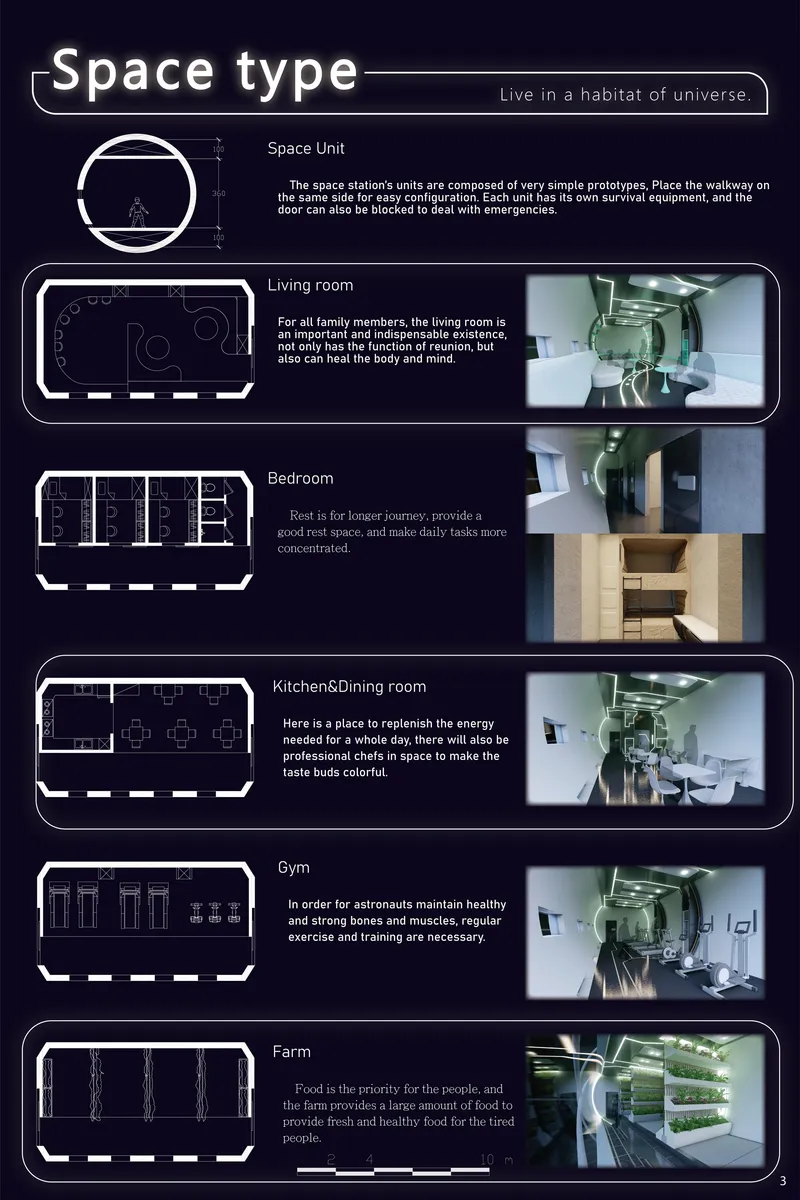
The station is composed of cylindrical modules, each functioning as a self-contained unit. This modularity allows for flexibility, scalability, and redundancy.
Key Spatial Typologies:
- Living Units: Designed for psychological comfort and social interaction
- Bedrooms: Compact, efficient spaces supporting rest cycles
- Kitchen and Dining Areas: Centralized communal zones enhancing social cohesion
- Gym Facilities: Essential for maintaining physical health in low-gravity conditions
- Agricultural Modules (Farm): Providing fresh food through controlled cultivation systems
Each unit is equipped with independent survival systems, reinforcing resilience in extreme conditions. The modular strategy aligns with contemporary trends in space architecture that prioritize adaptability and incremental growth.
Structural Configuration and Assembly Logic
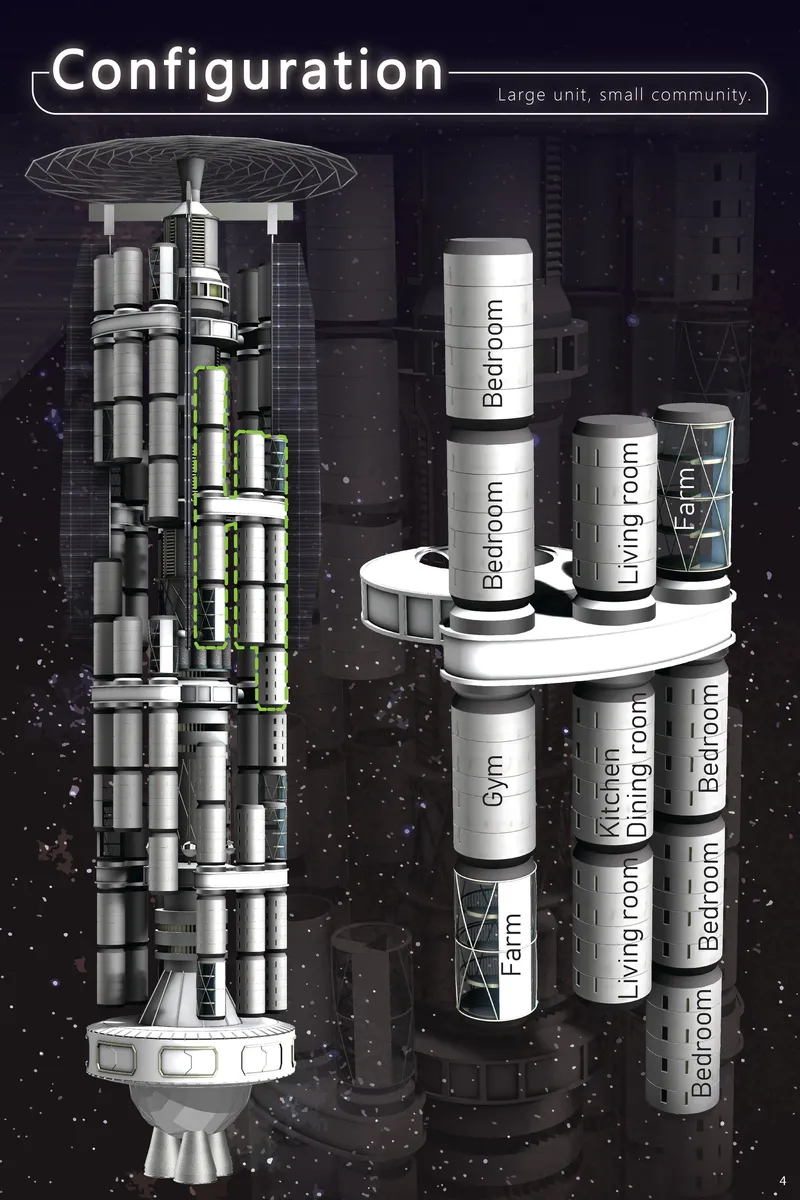
The overall configuration of the station reflects a vertical aggregation of modular units anchored by a केंद्रीय structural spine. This spine integrates:
- Circulation systems
- Energy distribution networks
- Structural stability mechanisms
Surrounding this core, habitable modules are arranged in clusters, forming a dense yet organized spatial network. The addition of a large protective shield at the top ensures defense against high-velocity debris, a critical requirement in orbital environments.
The configuration embodies a megastructure approach, where architecture operates at both micro (unit) and macro (station) scales simultaneously.
Sectional Logic and Program Distribution
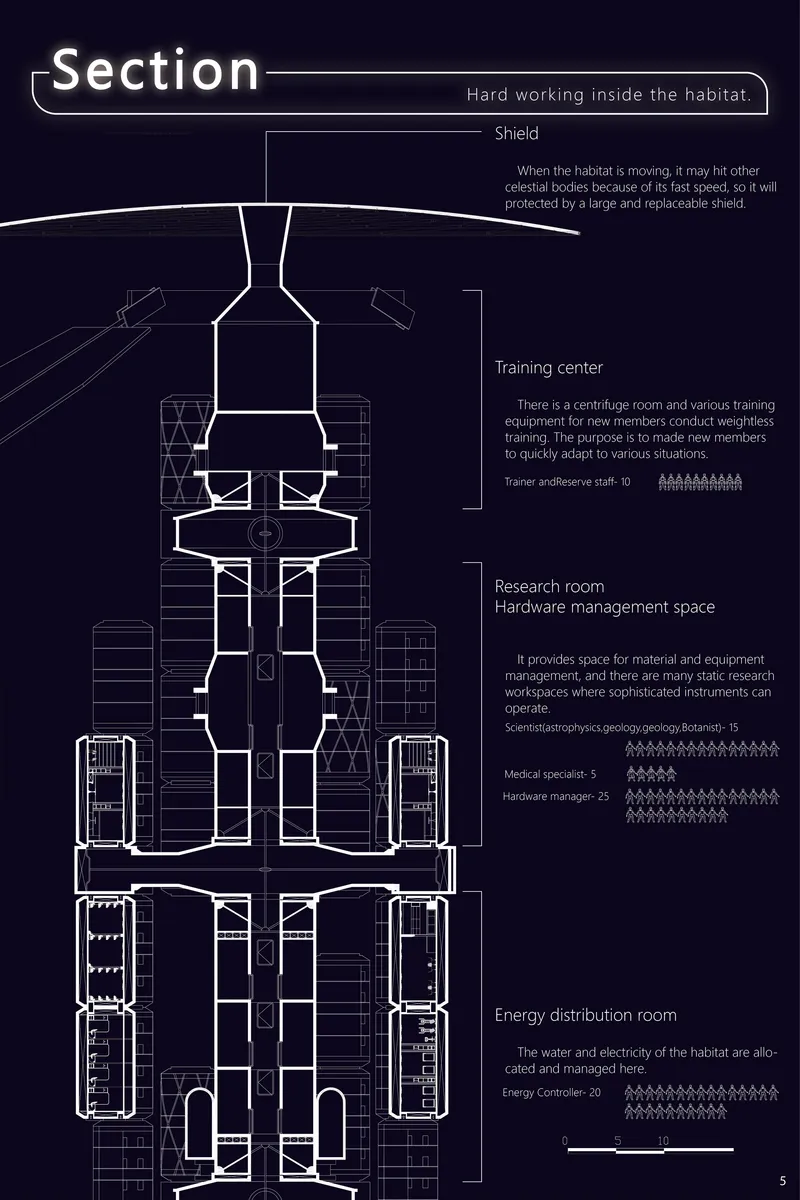
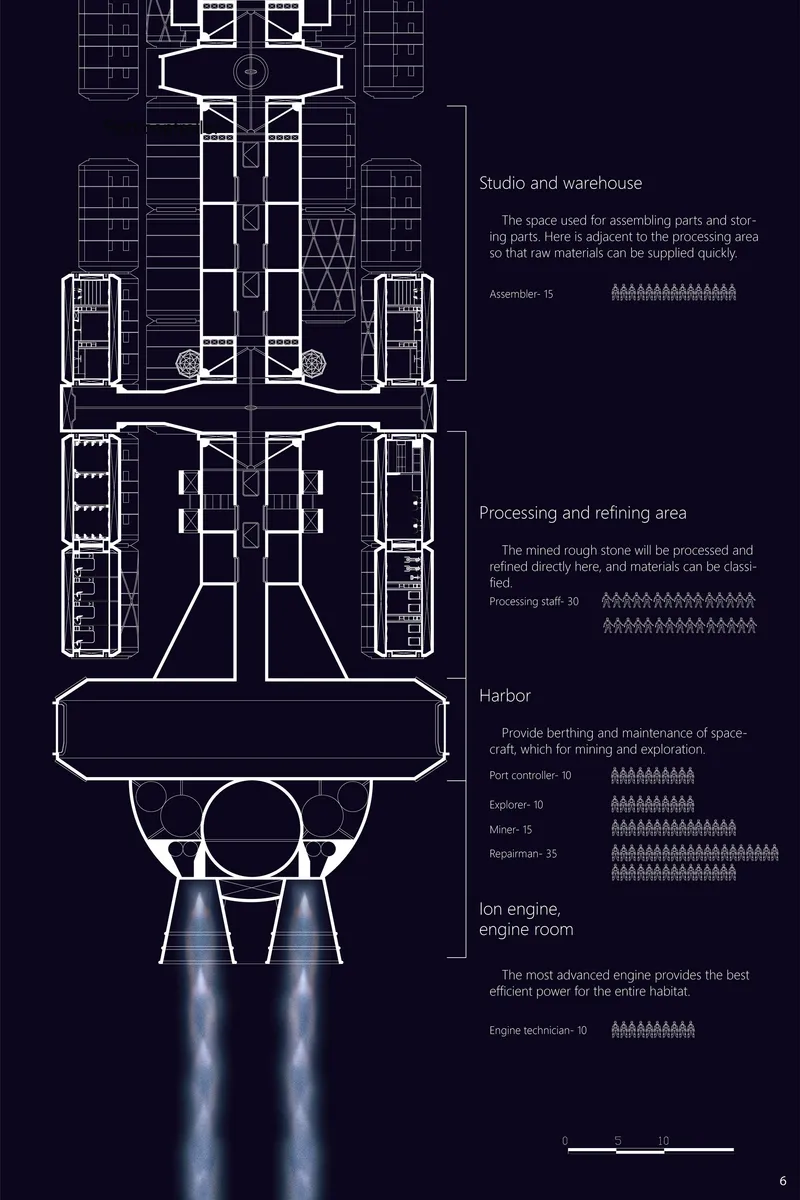
The sectional organization of the station reveals a highly structured programmatic hierarchy:
- Training Center: Preparing new inhabitants for space conditions
- Research Laboratories: Supporting scientific exploration across disciplines
- Hardware Management Zones: Facilitating maintenance and operations
- Energy Distribution Systems: Managing power and water resources
This vertical stratification ensures operational clarity while maintaining spatial efficiency. Each layer is optimized for specific functions, contributing to the overall performance of the station.
Construction Phases and Implementation Strategy
The project outlines a pragmatic, phased construction approach:
- Robotic Deployment: Autonomous systems establish initial infrastructure
- Human Training: Astronauts are prepared in lunar environments
- Initial Habitation: Limited human presence begins operations
- Expansion Phase: Increased mining output supports growth
This staged development reflects a realistic understanding of logistical constraints and technological readiness. It aligns with current trajectories in aerospace development and space architecture research.
Form Derivation and Spatial Efficiency
The formal language of the station is derived from efficiency and modular optimization. The base module of 3×3 meters is expanded to accommodate storage and circulation, resulting in a compact yet functional spatial system.
The cylindrical geometry enables:
- Efficient pressure distribution
- Ease of replication
- Structural integrity in vacuum conditions
This rational approach to form generation reinforces the project’s emphasis on performance-driven design.
Space Architecture and the Future of Human Expansion
Mining Space Station positions itself as more than a speculative proposal. It is a framework for understanding how architecture can operate beyond Earth, integrating habitation, economy, and technology into a unified system.
By embedding resource extraction within the architectural process, the project challenges conventional boundaries between building and infrastructure. It suggests a future where space architecture is not only about survival, but about growth, adaptation, and continuity of human civilization.
This project demonstrates how space architecture can evolve into a multidisciplinary field that bridges design, engineering, and planetary science. Through its integration of artificial gravity, modular systems, and resource-driven expansion, the Mining Space Station offers a compelling vision for the next phase of human development.
As humanity extends its reach into the cosmos, such proposals provide critical insight into how we might live, work, and build in environments far beyond our planet.




Popular Articles
Popular articles from the community

A Reinforced Cocoon: Vernacular Architecture for Security, Healing and Community in Qandahar
A Reinforced Cocoon reimagines Afghan vernacular architecture as secure community space for widowed women, families, healing and resilience.

How Henri Picq's 1889 Paris Pavilion Traveled 11,000 Kilometers to Become Santiago's Artequín Museum
A prefabricated iron and glass pavilion built for the Paris Universal Exposition found a second life as a children's art museum in Chile.
Garden of Hope: Sustainable Architecture for a Resilient Community in Qandahar
Garden of Hope reimagines sustainable architecture as secure, organic community where women rebuild lives through housing, work, and nature.
EW PARK: Sustainable Architecture Reimagines the Future of Urban Parking
EW PARK reimagines city parking as a modular wooden tower combining automation, solar energy, electric mobility, and adaptable urban design.


Similar Reads
You might also enjoy these articles
Eco Chapel: A Green Architecture Pavilion Designed in Symbiosis with the Forest
Eco Chapel uses green architecture to weave prayer, learning and reuse into a forest pavilion shaped by modular hexagonal canopies for life.
Kaffeebühnen: Coffee Shop Architecture Designed as a Civic Stage Between Vienna’s City and Park
Kaffeebühnen turns coffee shop architecture into a civic stage, linking Vienna’s park edge, urban life, warm timber yards, and coffee craft.
Healing Façade: Sustainable Architecture for Reforestation, Community, and Sacred Ecology in Ethiopia
Healing Façade reimagines sustainable architecture as a living wall that restores soil, catches water and renews Ethiopia's forest churches.


Urban Forest: A Vertical Ecosystem for 5,000 Workers in Singapore's Changi Business Park
Radially stacked pods and layered green decks turn a 7-acre plot into 47 acres of ecological workspace projected for 2040.





Comments (0)
Please login or sign up to add comments
No comments yet. Be the first to comment!