

MIRIN House by Ayutt and Associates Design: A Multi-Sensory Sanctuary Redefining Urban Living in Nonthaburi
MIRIN House is a sensory-driven Thai retreat blending light, landscape, and texture to create a tranquil, immersive living experience connected to nature.


Nestled on the outskirts of Bangkok, MIRIN House by Ayutt and Associates Design (AAd) transforms the conventional idea of a home into a profound sensory experience. Rather than asking how a house should function, the architects approached the project with a more intimate question: How can architecture awaken all five senses and create an emotional journey? Completed in 2024, this 600 m² residence in Nonthaburi stands as a peaceful sanctuary designed to slow time, soften the mind, and reconnect its inhabitant with nature.
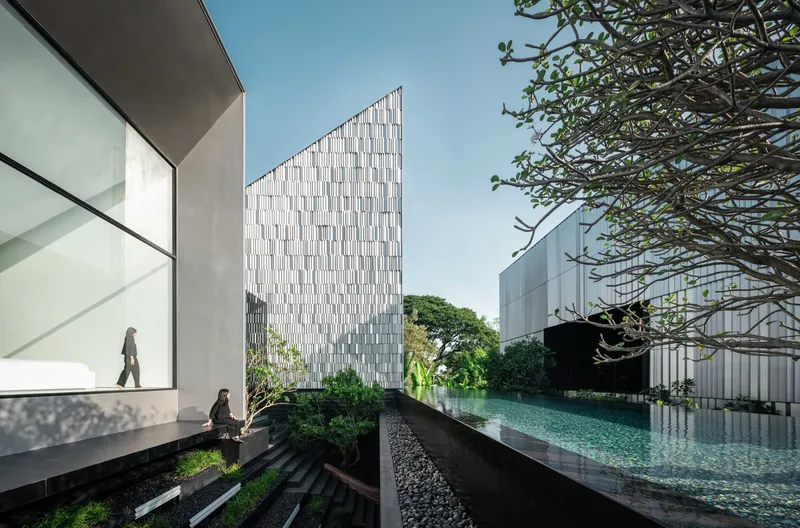

A Home Designed as a Sensory Journey
Inspired by the life of the homeowner’s daughter—a dedicated medical specialist whose busy urban lifestyle rarely allows deep rest—the house was envisioned as a personal retreat. The newly acquired plot beside the family’s existing home offered the perfect canvas for AAd to design a dwelling that is not just lived in, but felt.
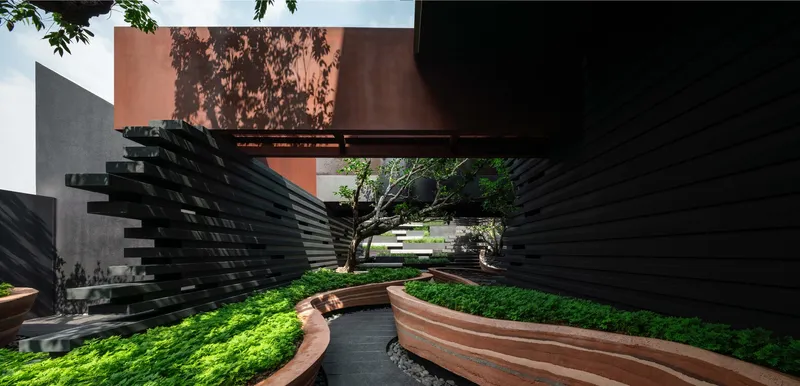
MIRIN House unfolds through an immersive narrative of light, sound, texture, landscape, and movement. A gently ascending curved pathway marks the beginning of this journey, guiding visitors away from the noisy city and into a world of calm. Every element—terrain, greenery, wind, shadow, the sound of water—works together to create a soothing psychological transition.


Curated Landscape for Sensory Resonance
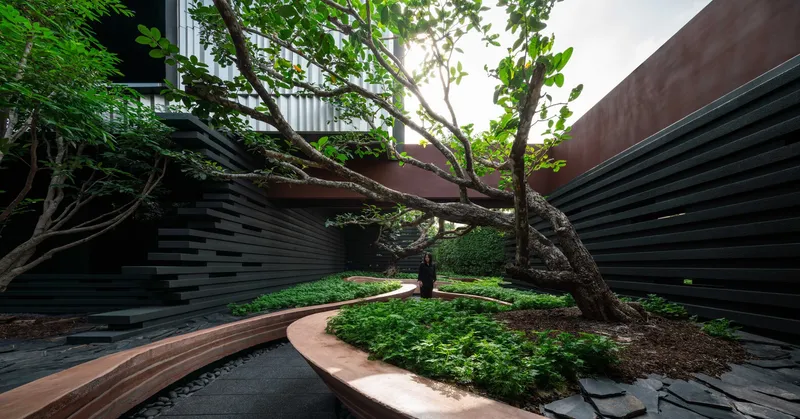
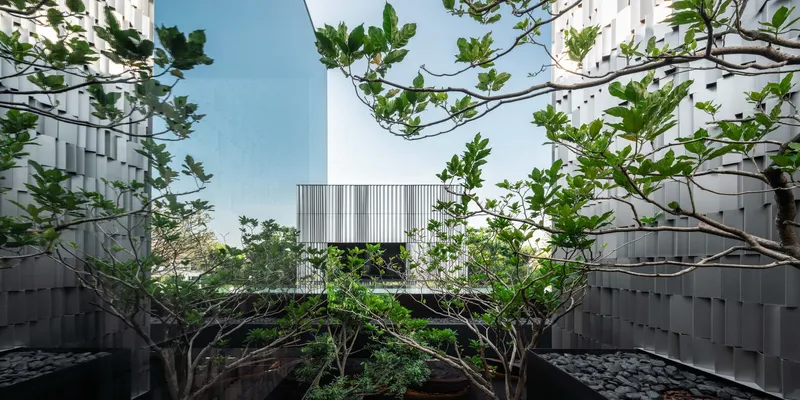
The subtly sloped terrain increases planting space, enabling a lush garden that envelops the home. Compressed rammed-earth walls, doubling as planters and seating, invite physical touch and emotional grounding. The pathway itself transforms into a natural water channel during rain, creating tranquil soundscapes as droplets meet stone and leaves.
The entrance remains intentionally concealed, prompting visitors to follow the landscape’s cues intuitively. This creates a worm’s-eye spatial experience, amplifying the perceived scale of the one-bedroom residence and making the architecture feel expansive yet intimate.
Three Layers of Perspective: From Earth to Tree Canopies
MIRIN House is structured around three perceptual layers:
- Worm’s-eye view during arrival through the garden promenade
- Normal eye-level view within interior living spaces
- Bird’s-eye view from the elevated second-floor living quarters
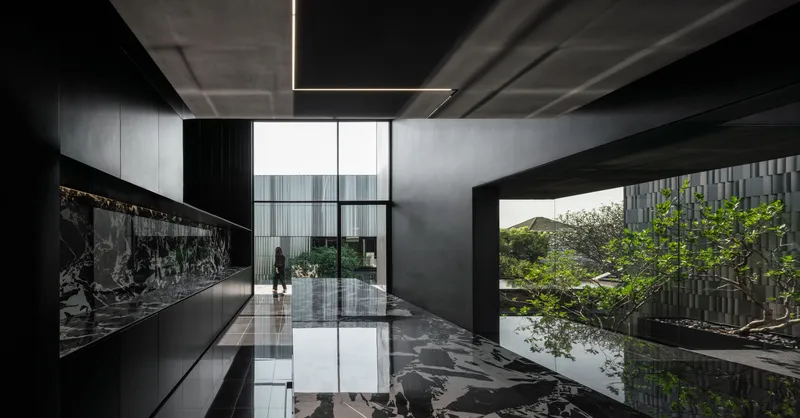
This multi-perspective design transforms a compact home into a spatially rich environment. The main living areas are lifted above ground level, allowing residents to gaze into the surrounding treetops and pool. Underneath, shaded open spaces reference traditional Thai architecture, encouraging airflow and visual permeability.

Light, Shadow, and Emotion
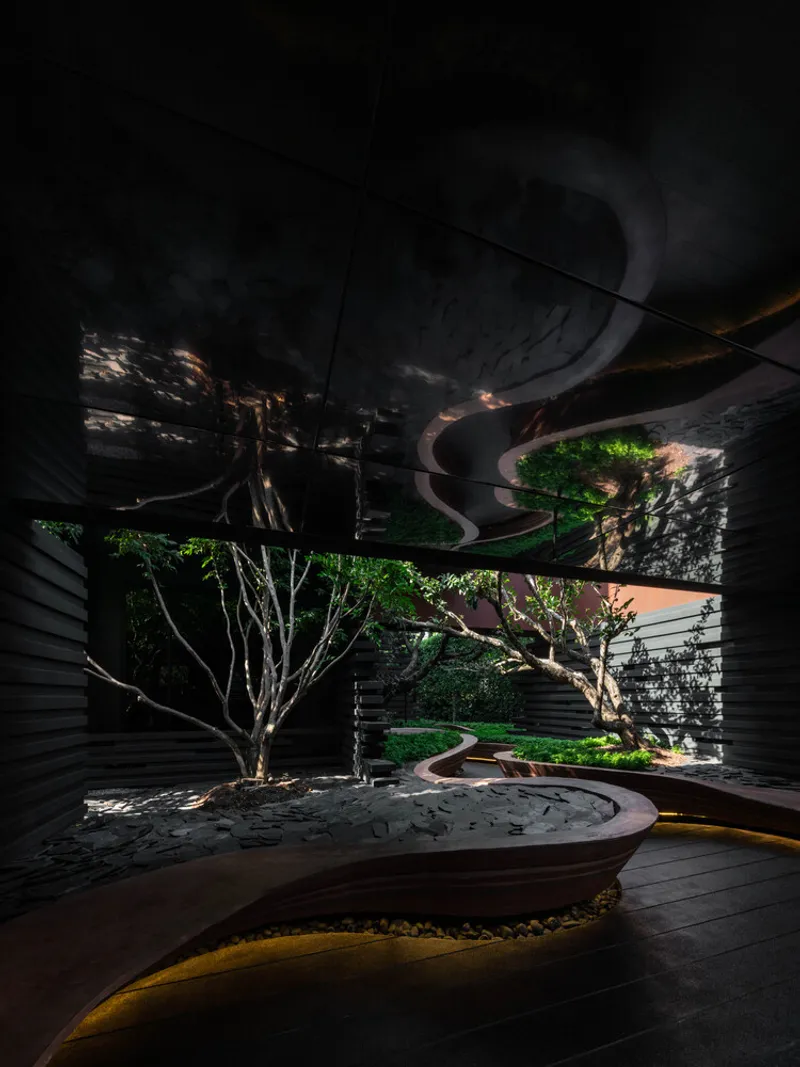
AAd choreographs light with the precision of stage designers. From the carport to the interior, lighting gently transitions from bright to dim, conditioning the eyes and preparing residents for a restful environment. Deep shadows and indirect illumination create a meditative ambiance, dramatically contrasting with the animated brightness of the garden outside.
Inside, dark materials absorb heat and sound, forming a cool, quiet refuge from Bangkok’s climate. Full-height glass openings blur boundaries with nature, turning daily life into a series of shifting natural artworks.


Interior as a Cooling Cocoon
The interiors use:
- Dark-toned finishes
- Full-height glazing
- Soft mood lighting
- Natural materials
These elements envelop residents in a calm, atmospheric environment. Bedrooms and bathrooms open to greenery and sky views, enhancing the sensory connection that is central to the home’s design ethos.

Architecture that Respects and Enhances its Community
Although designed as a private retreat, MIRIN House also considers its surrounding neighborhood. The sloped roof avoids blocking sky views for nearby homes, while layers of visible greenery contribute to the street experience. The house becomes a gentle contributor to the community—not a barrier, but a bridge—offering shared visual access to nature.
By borrowing views of neighboring mature trees and giving back through rooftop gardens and vertical landscaping, the home fosters a more biodiverse micro-ecosystem. It embodies a new model of suburban living where architecture, environment, and community coexist harmoniously.
A Living Bond Between Home, Nature, and City
MIRIN House is much more than a beautiful retreat. It represents a shift in urban living—toward architecture that restores, reconnects, and nurtures a deeper relationship with the world around us. Through its masterful orchestration of sensory elements, it becomes a place where life is not only lived but felt. In its essence, MIRIN House reminds us that a home is not just a structure—it is a living bond between people, community, and nature.

All photographs are works of Chalermwat Wongchompoo (Sofography)




Popular Articles
Popular articles from the community


Hill & Cross Opera: Sculptural Opera House Architecture Shaped by Tallinn’s Landscape and Identity
Hill & Cross Opera reimagines opera house architecture in Tallinn through its sculptural hill, civic plaza, glass wave and a luminous cross.

Co-life: Sustainable Architecture for Age-Friendly Community Living
Co-life reimagines sustainable architecture for seniors through courtyards, rammed earth, shared gardens, and spaces designed for belonging.

The Musturak Paradise: Senior Living Architecture for a Connected Future in Temara, Morocco
The Musturak Paradise reimagines senior living architecture in Temara via private homes, social spaces, culture, community, and shared care.

AL-JANNAH: Sustainable Architecture and Permaculture for Afghan Widows
AL-JANNAH uses sustainable architecture and permaculture to create resilient oasis of housing, learning, work and renewal for Afghan widows.


Similar Reads
You might also enjoy these articles


Hodi-Mandai Geram
Project Function: Preservation and revitalization of the Intangible heritage and socio-spatial identity of the Hodi by Housing, Cultural Memory Center, Sacred Grove, landscape, local tourism economy


Olio Towers: A Mid-Rise for Performers That Fuses Housing, Rehearsal, and Stage
Located blocks from Houston's Theater District, this modular tower stacks living units around a central performance atrium.

Oasis: Modular Green Housing Carved into Dhaka's Urban Fabric
A shortlisted Plugin Housing entry reclaims unauthorized settlements in Dhaka with stepped concrete volumes, green roofs, and ventilation-driven design.

Black Hole: A Floating Megastructure for the Post-Physical Era
Emiliano Mazzarotto envisions a spherical, self-scaling arena where e-sports, digital hotels, and holographic stadiums replace traditional public space.


Explore Housing Competitions
Discover active competitions in this discipline



Challenge to reimagine the Iron Throne


Photograph architecture without architects


Illustrate the lost glory of Angkor Wat - Render Challenge


Design challenge to reuse E-waste
Comments (0)
Please login or sign up to add comments
No comments yet. Be the first to comment!