
APDI Weaves Courtyards Through a Three-Level Hanoi Villa to Cool It from the Inside Out
BT5 Villa in Hanoi's Lakeside Splendora district turns deep porches and planted courts into micro-climate filters for tropical living.


Most villas in Hanoi's suburban developments wear minimalism as a finish: white walls, flat roofs, clean lines, done. BT5 Villa, designed by APDI under founding architect Nham Chi Kien, treats minimalism as a thermal strategy. Every stripped-back surface, every deep overhang, every courtyard punched into the 400-square-meter plan serves a second purpose as a passive cooling device. The result is a house that looks restrained but works hard, turning Hanoi's punishing humidity into a design driver rather than a problem to be buried under mechanical systems.
Situated in the Lakeside Splendora villa complex, surrounded by water features and established landscaping, the house could have defaulted to a sealed glass box with a view. Instead, APDI broke the massing apart. Planted courts, sheltered walkways, and deep porches cut through the volume on every level, creating what the architects call "micro-climate filters" that coax air through the plan, temper direct sunlight, and hold pockets of green close to every inhabited room. The owner, a professional in audio and lighting, pushed the design further still: the top floor doubles as a calibrated entertainment space with multi-layered acoustic walls and a fiber-optic ceiling that simulates a night sky. BT5 is a house built for someone who pays attention to atmosphere in every sense of the word.
Weathered Steel and Timber: A Layered Street Presence
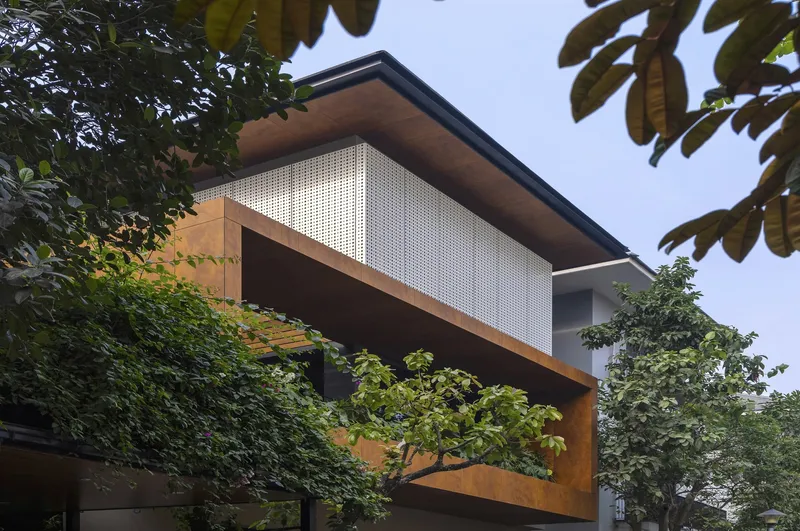
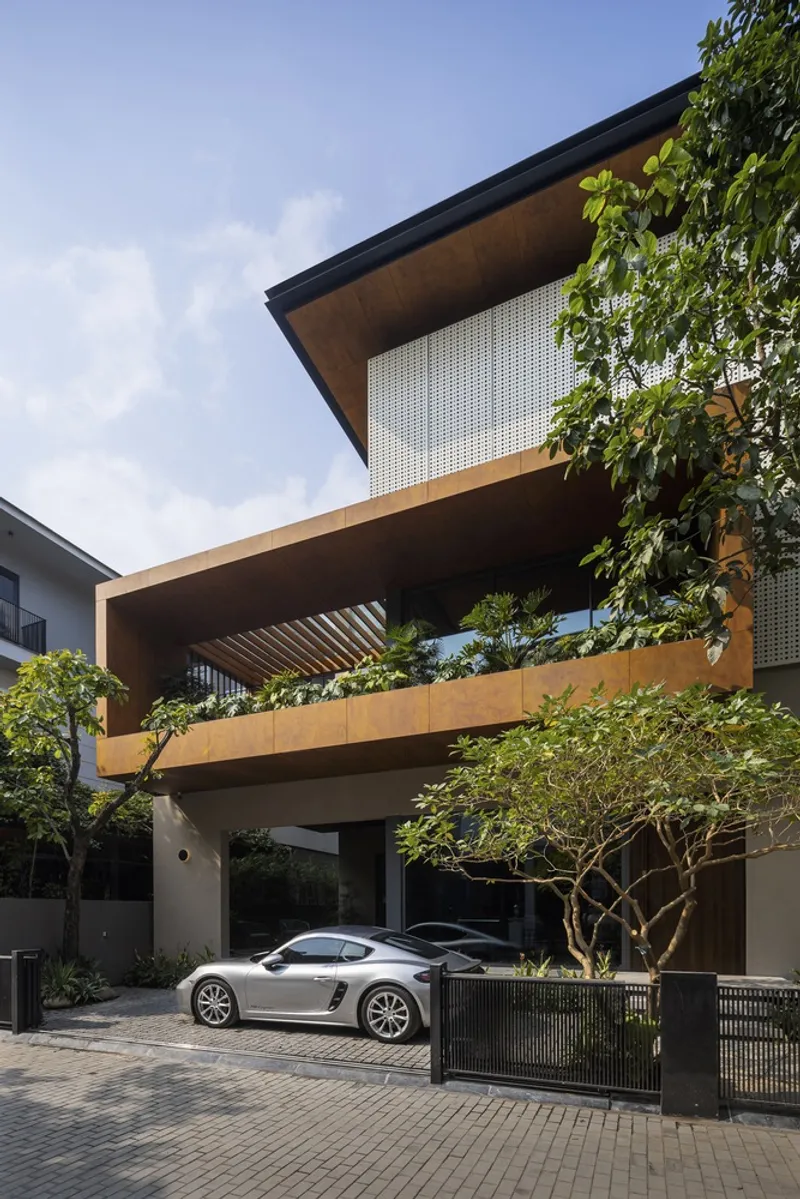
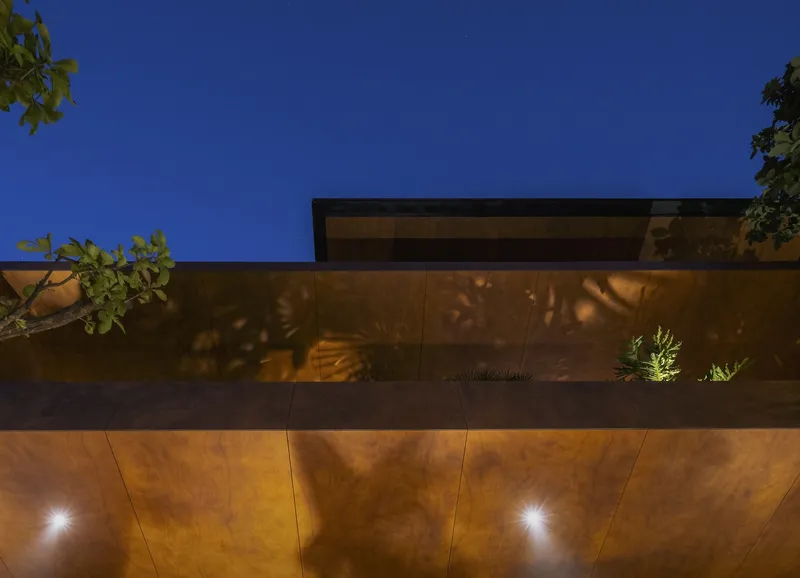
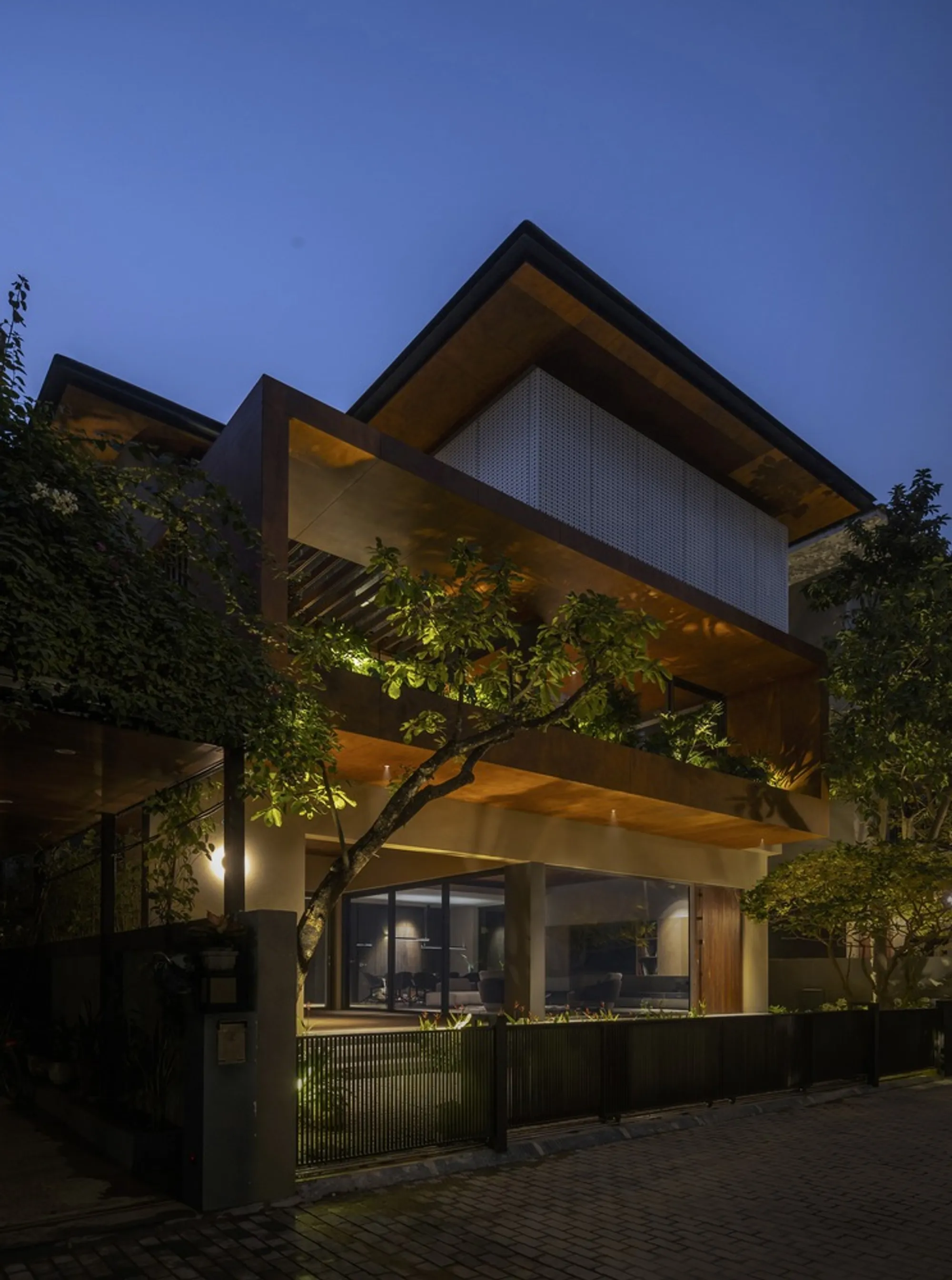
From the street, BT5 Villa reads as a stack of horizontal planes: weathered steel panels, perforated metal screens, and timber soffits layered above a planted boundary wall. The cantilevered upper volume projects over the entry zone, creating shade and visual weight without mass. At twilight, recessed uplighting washes the copper-toned cladding from below, revealing the material's patina and turning the facade into something closer to a lantern than a fortress.
The perforated screens do real work here. They filter light into the walkways behind, reduce solar gain on the western exposure, and provide privacy from neighboring houses without sealing the interior off. Mature trees planted along the street edge and on the balconies soften the industrial palette, reinforcing the tension between raw material and living landscape that runs through the entire project.
Arrival and Threshold
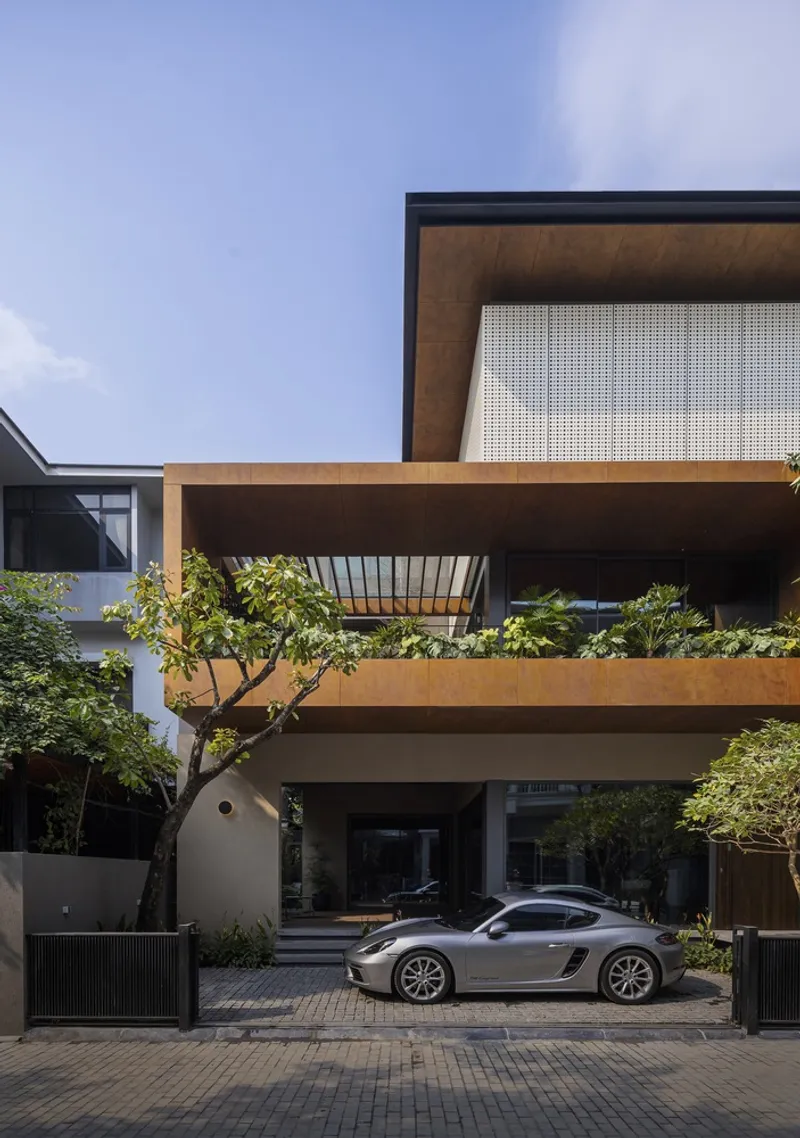
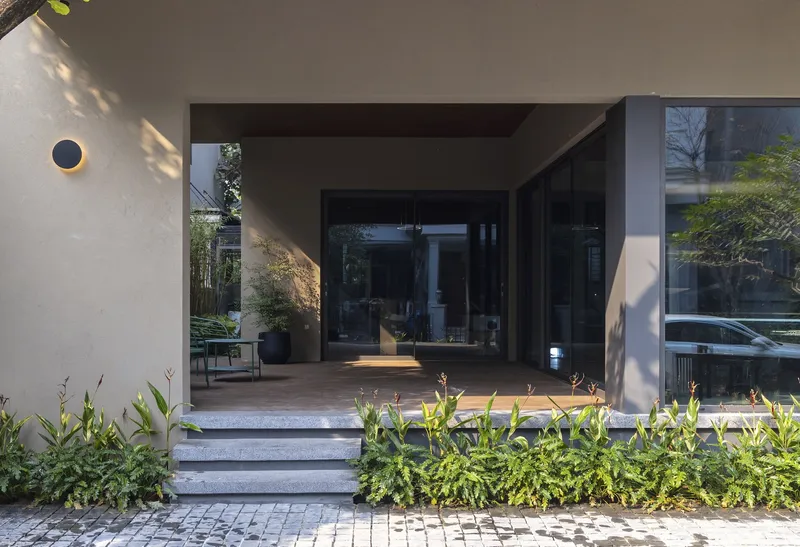
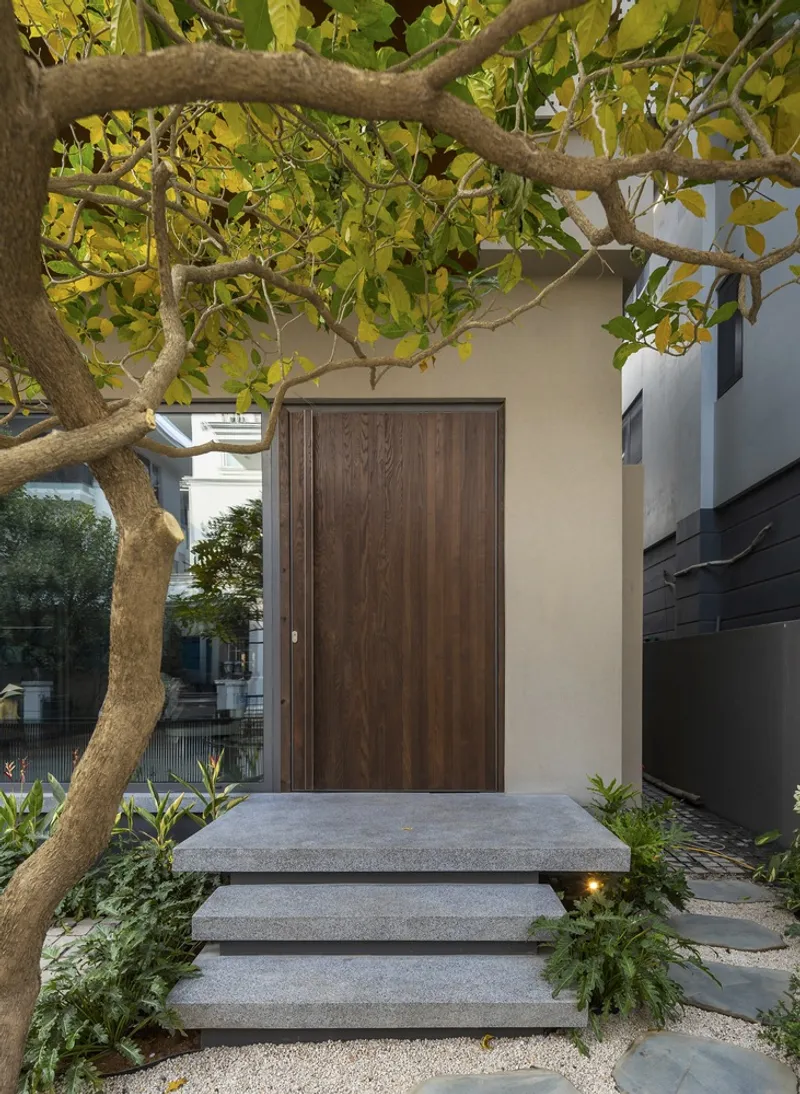
Entering BT5 involves a deliberate compression. You pass beneath the cantilevered steel balcony, step across concrete pads set in gravel, and arrive at a recessed timber door flanked by planted beds. Dappled light filters through overhanging branches onto the concrete steps. The sequence is intentionally slow: it downshifts your pace from car to courtyard before you reach the living spaces.
The entry court doubles as a carport, but its proportions and plantings prevent it from feeling like one. The underside of the cantilevered volume above is clad in weathered steel, casting a warm reflected tone onto the ground plane. It is a small move, but it sets the material temperature for everything that follows.
Ground Floor: Open Plan as Climate Strategy
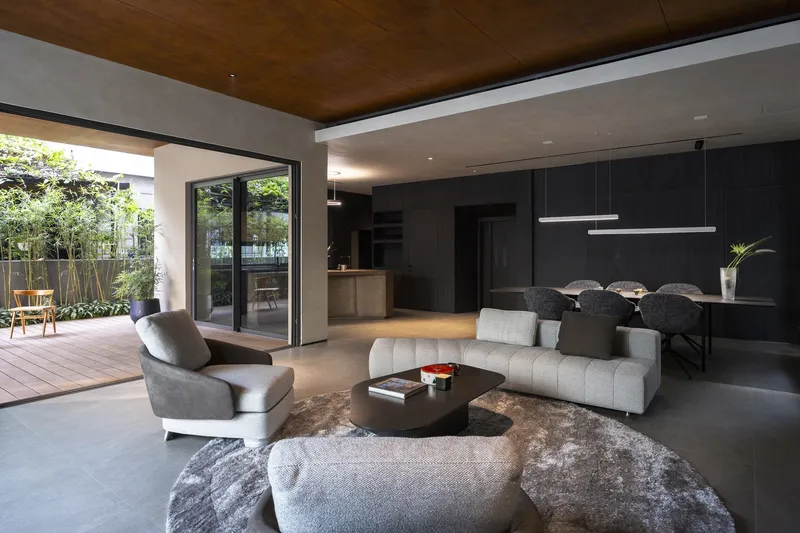
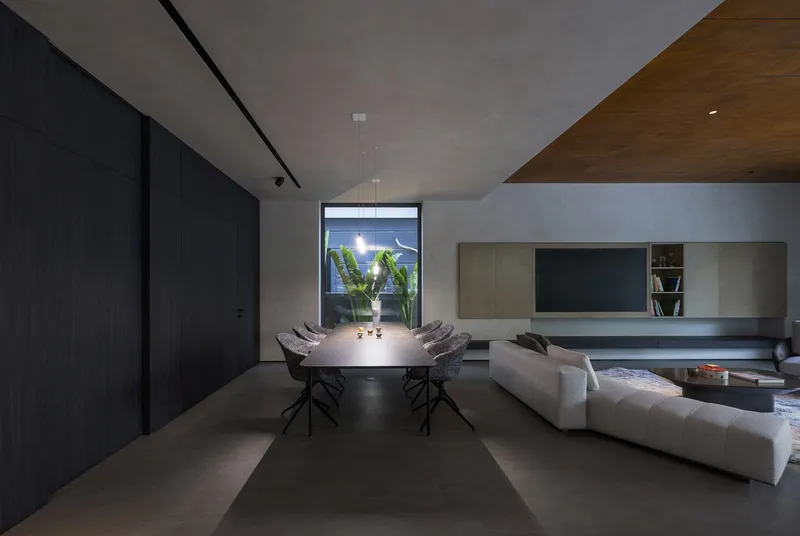
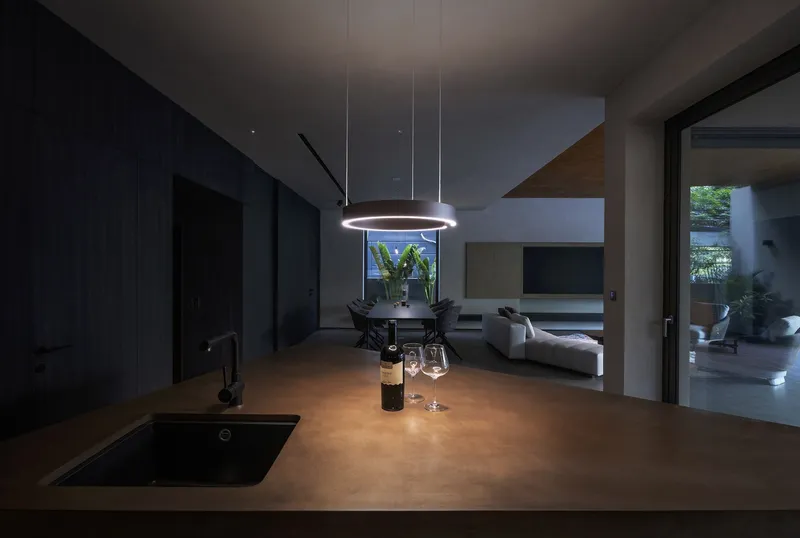
The ground floor removes as many walls as possible. Living, dining, and kitchen zones flow into one another beneath a continuous timber ceiling, with sliding glass doors opening onto decks and planted courts on both sides. The cross-ventilation path is legible in section: air enters through the courtyard, moves through the open plan, and exits through the opposite garden. It is a traditional Vietnamese passive strategy expressed in a contemporary material language.
At night the space shifts register. A circular pendant lamp anchors the kitchen island, suspended linear fixtures trace the ceiling line, and the concrete floor picks up warm tones from the timber above. The slot window behind the kitchen frames a bamboo courtyard, a controlled view that gives the cook something green to look at without exposing the workspace to the street.
Kitchen and Interior Courts
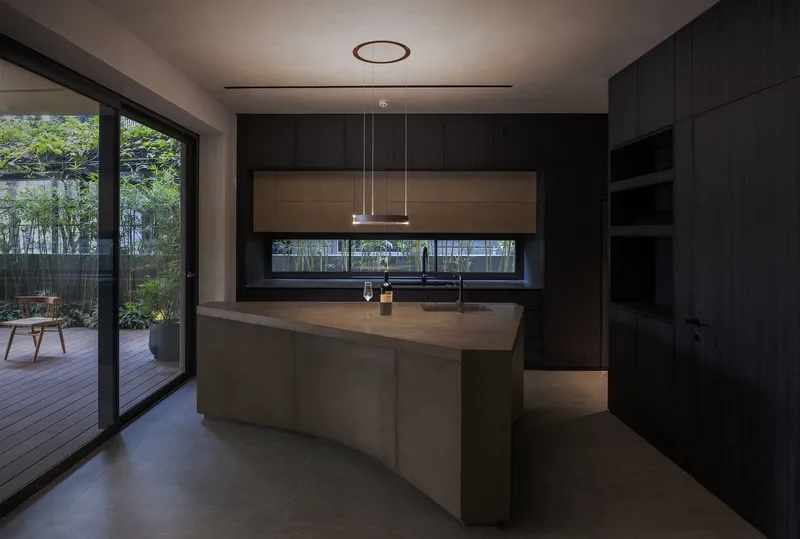
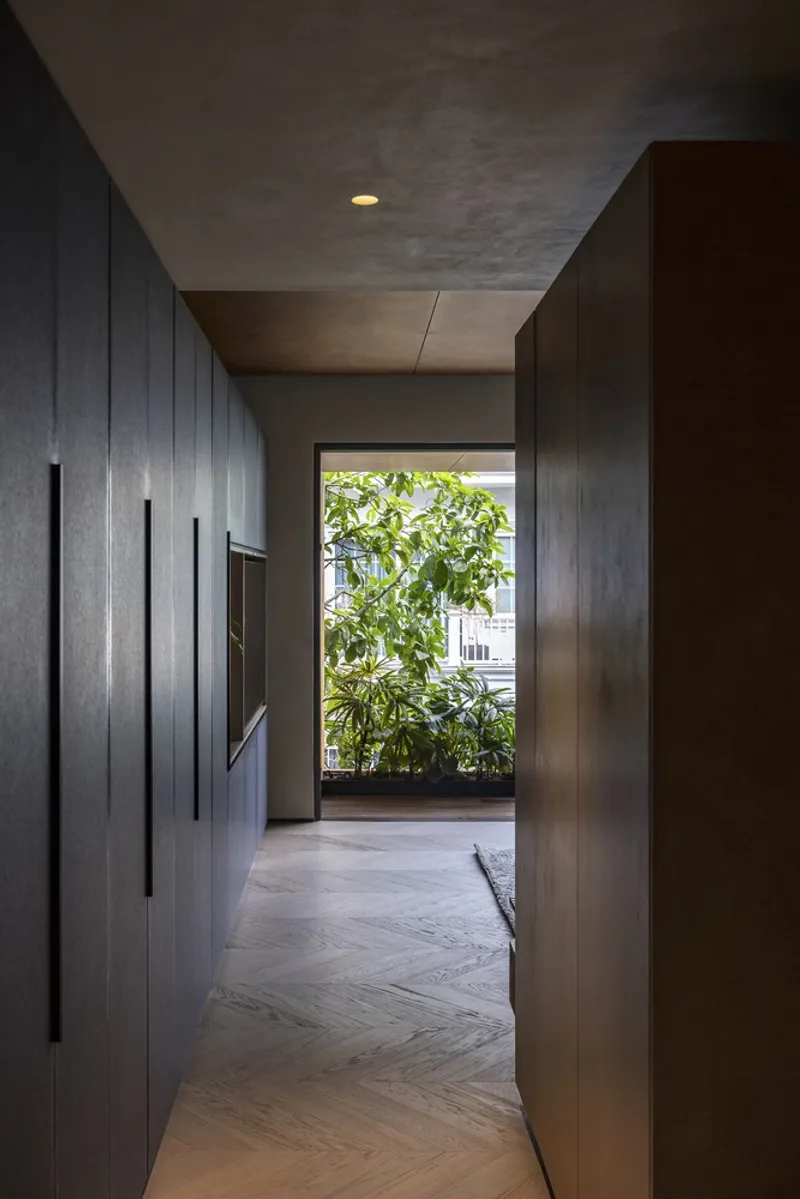
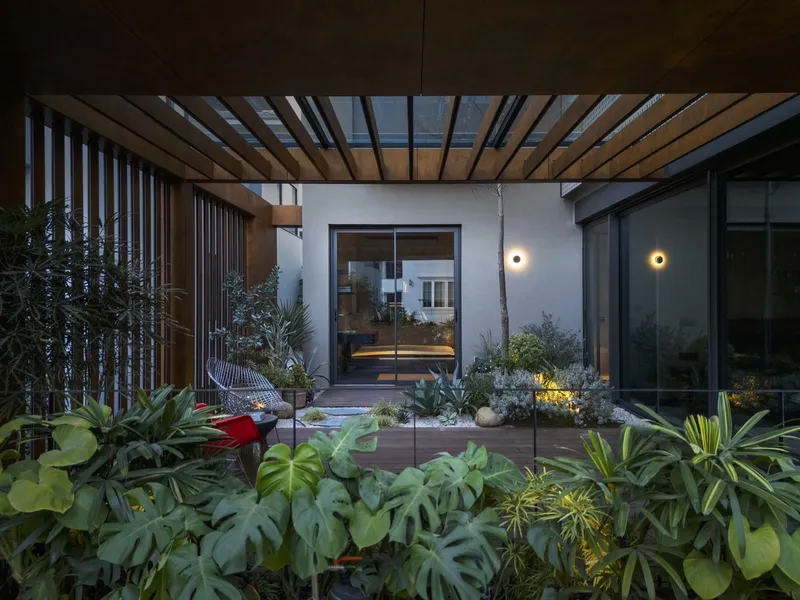
APDI treats landscape not as an accessory but as connective tissue. The bamboo courtyard visible through the kitchen's horizontal slot window reappears as a theme in the internal garden viewed through slatted timber beams from the upper walkway. A dark herringbone corridor on the ground floor terminates in a glass door that frames a planted terrace, rewarding the walk with a moment of release.
These courts are not decorative. They bring daylight into the center of the plan, create stack-effect ventilation paths between floors, and provide acoustic separation between rooms. Each one is planted with species calibrated to the light conditions at its depth: tropical palms in the open courts, shade-tolerant ground cover in the narrower slots.
Upper Terraces and Screened Walkways
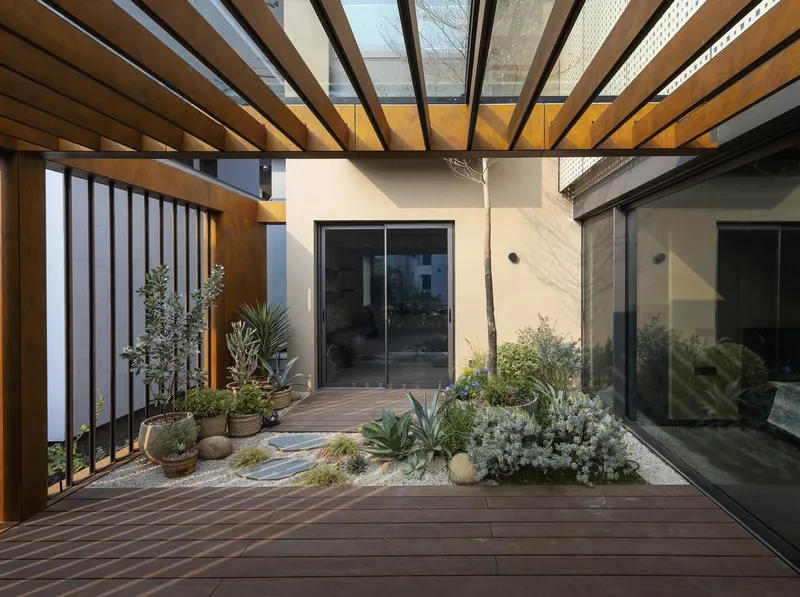
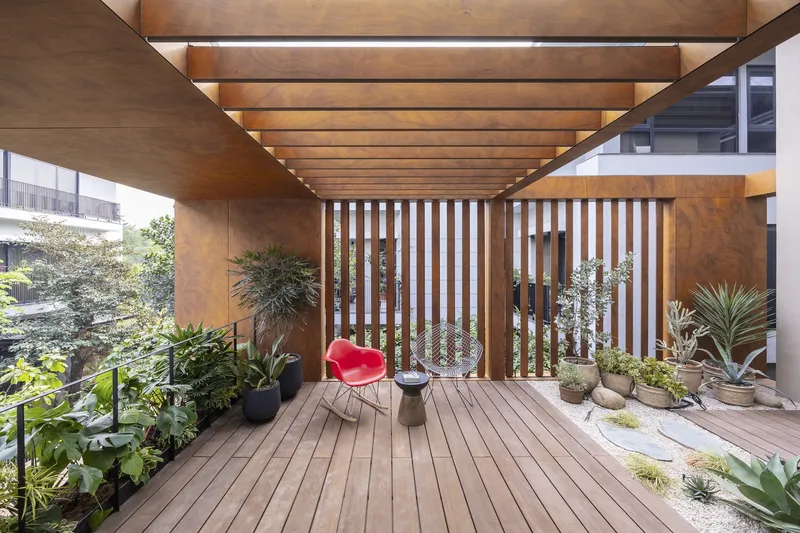
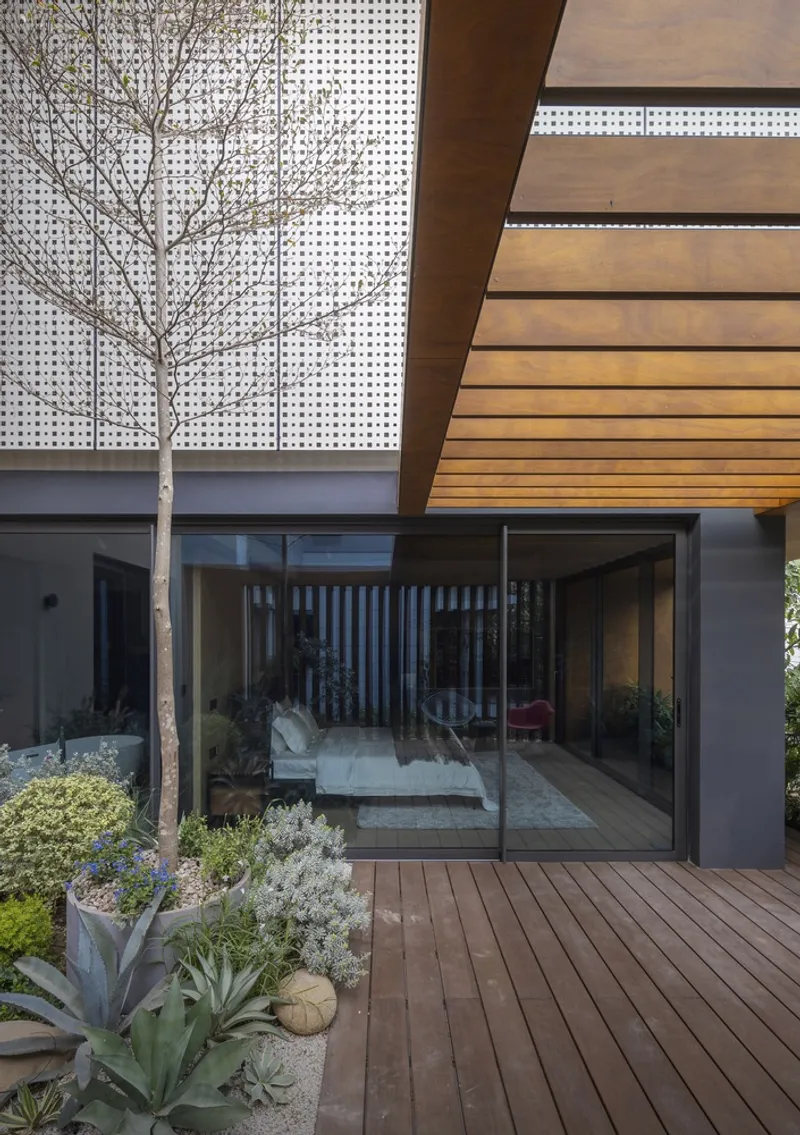
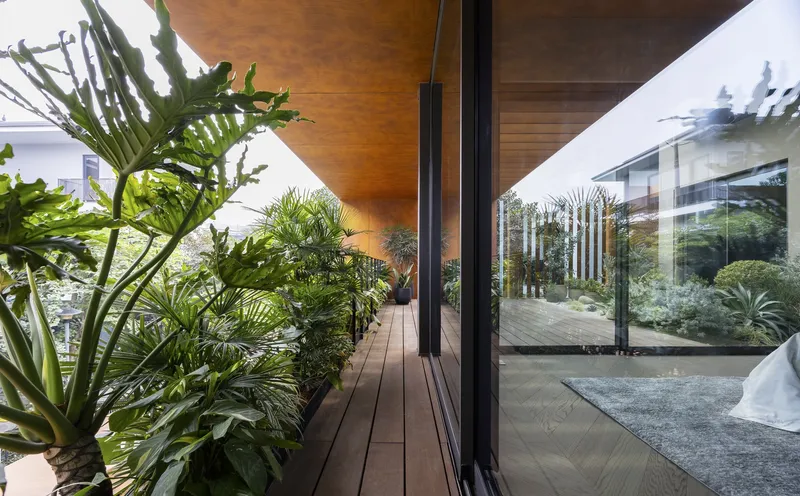
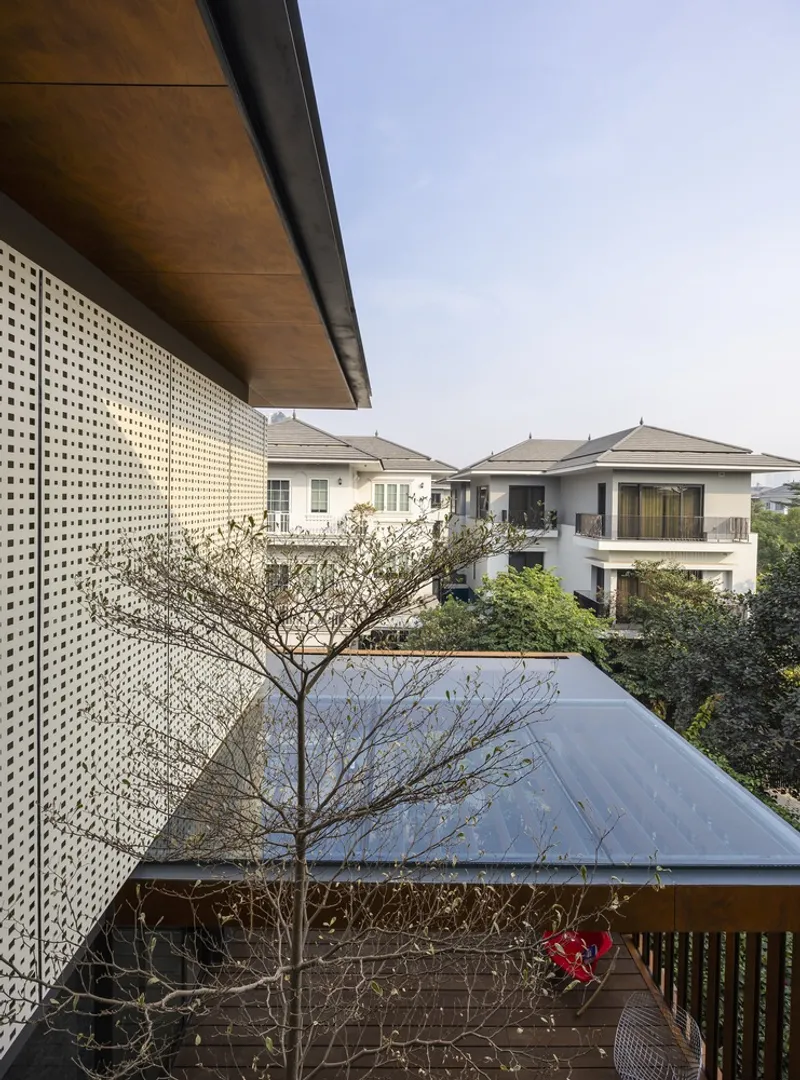
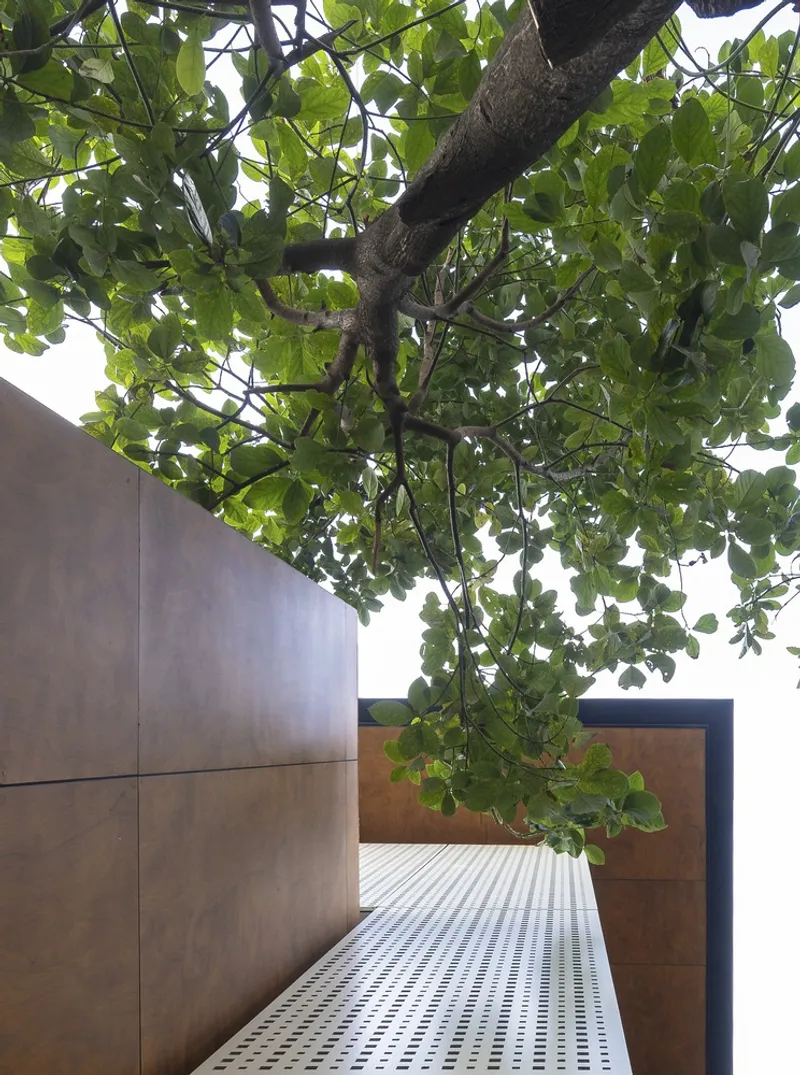
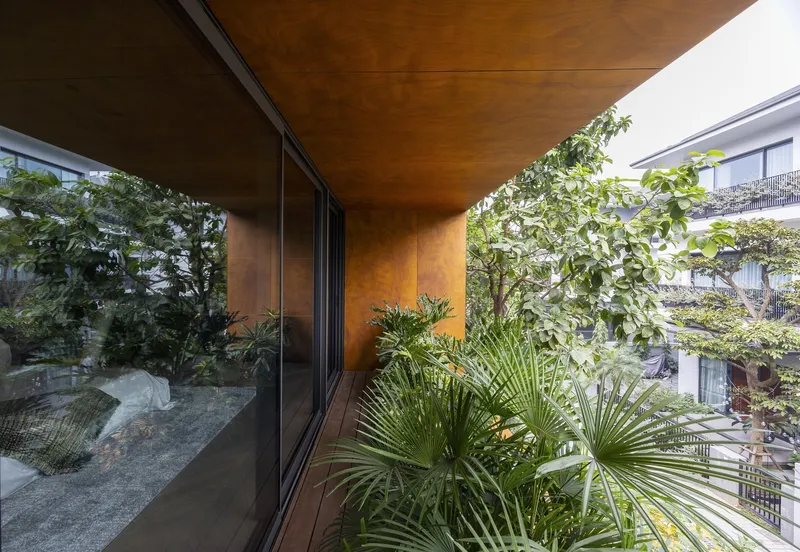
The second and third levels extend the ground-floor logic upward. Timber-decked terraces wrap around planted beds, shaded by pergola beams and perforated metal screens. Vertical wood slat panels provide privacy while allowing air to pass through. The result is a series of outdoor rooms that function somewhere between balcony and garden, usable in Hanoi's climate for a larger portion of the year than a fully exposed terrace would be.
A perforated metal walkway beneath the tree canopy on the upper level is one of the project's strongest moments. It compresses the passage, filters light into geometric patterns on the floor, and frames a view through to a timber-paneled volume beyond. These circulation moments are where APDI's spatial intelligence is most visible: transitions that reward attention.
Private Quarters and the Green Edge
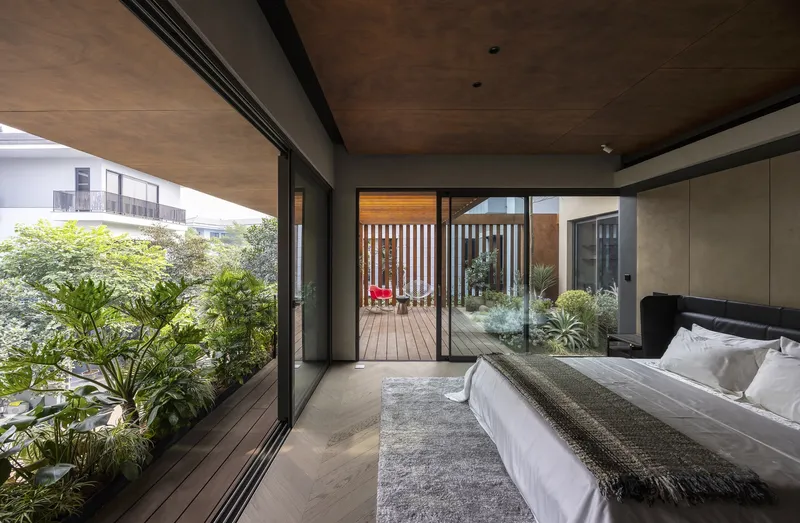
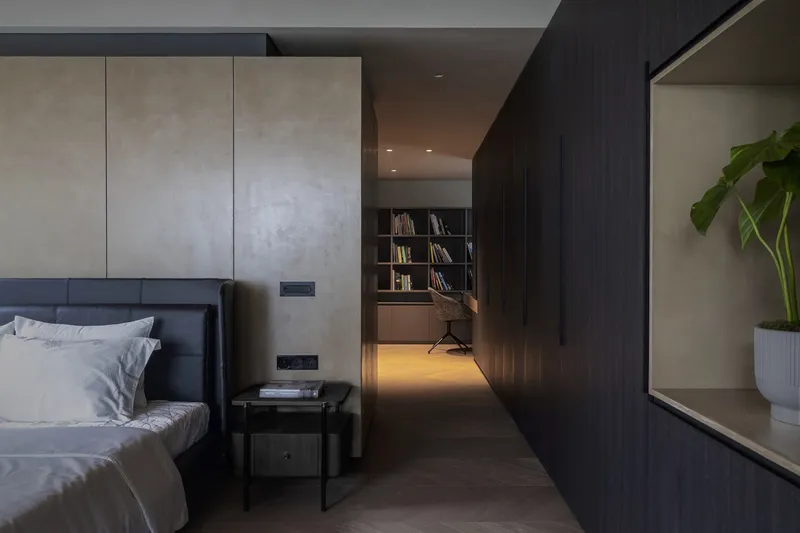
The bedrooms on the second floor open through sliding glass doors onto a landscaped rooftop garden, placing greenery at eye level from the bed. Dark timber millwork wraps the interiors, creating a tonal shift from the lighter ground floor that signals rest. One bedroom connects to an illuminated study through a framed aperture, maintaining visual continuity without sacrificing acoustic privacy.
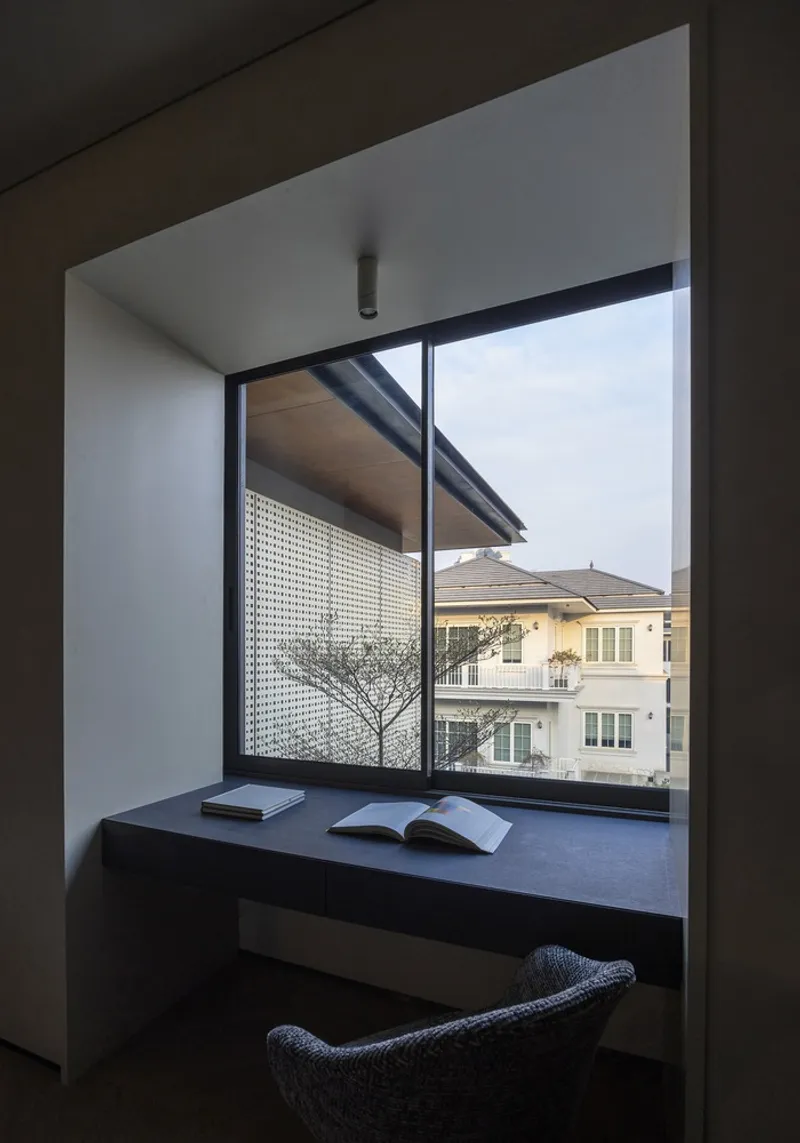
A window seat nook on the upper level, sheltered by a perforated screen overhang, offers a view across neighboring rooftops. It is a deliberately modest space, scaled for one person, a reading corner that borrows the panorama without needing a grand gesture to do so.
The Starfield Room: Sound, Light, and Immersion



The third-floor entertainment room is where the owner's professional expertise in audio and lighting becomes architecture. Multi-layered wall construction delivers serious soundproofing. The ceiling features an oval aperture embedded with fiber-optic points that simulate a star field, edged with warm illumination that shifts through programmable RGB LED scenarios. In blue ambient mode, the room feels like a planetarium; in warmer tones, it becomes an intimate cinema.
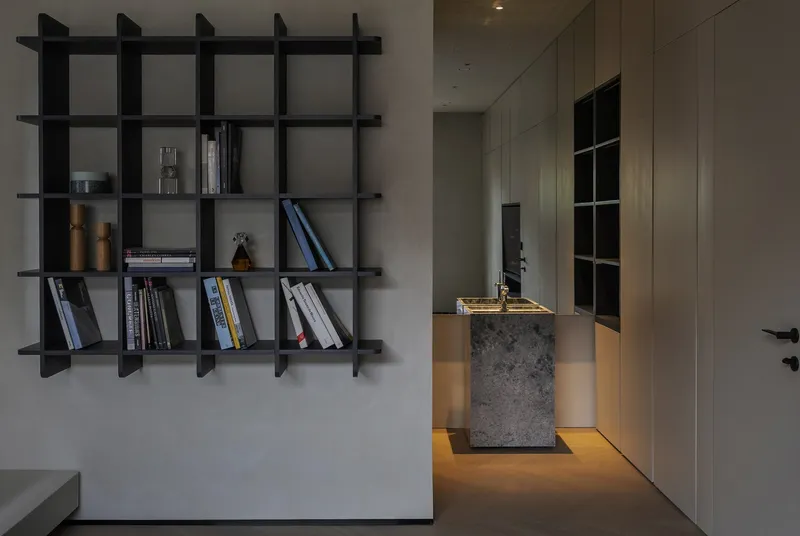
A backlit stone bench beneath the oculus anchors the space, while black grid shelving and a concrete bar on the adjacent terrace level extend the entertainment zone outward. Recessed floor lighting washes the thresholds at dusk, making the transition from social bar to immersive screening room feel continuous. It is an indulgent space, but it is also technically precise, built by someone who understands that atmosphere is a measurable thing.
Plans and Drawings
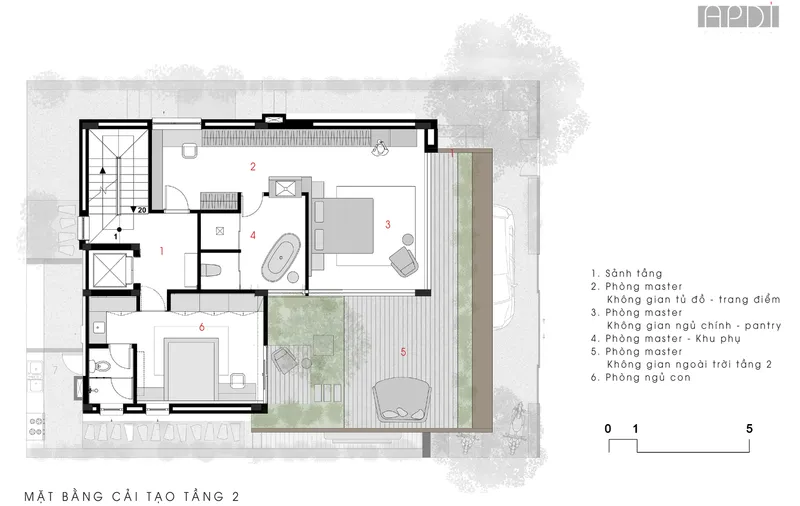
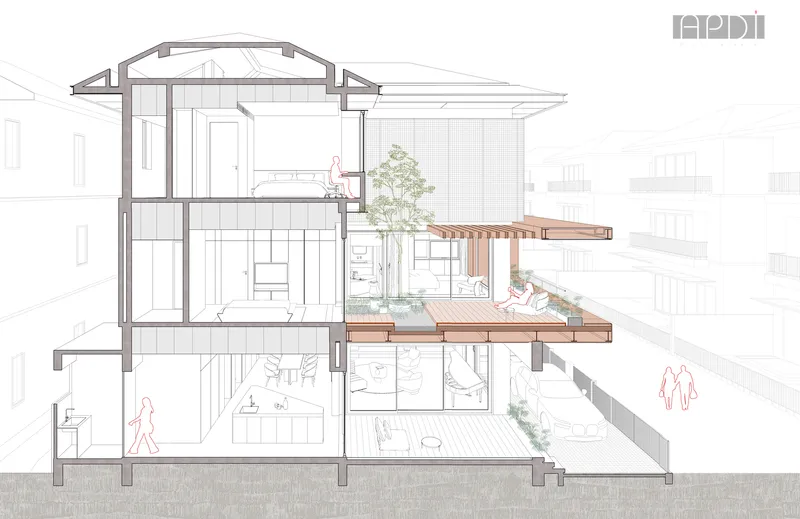
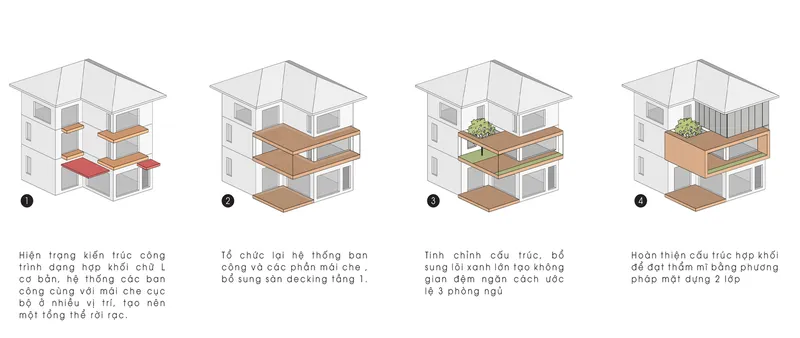
The second-level floor plan reveals the organizing logic: bedrooms and service spaces occupy the solid edges while terraces and an interior courtyard claim the center, ensuring that every habitable room touches a planted zone. The section drawing cuts through the full height of the villa, exposing the stacked courtyards, the arched skylight above the third floor, and the timber deck extensions that push living space outward at each level.
The axonometric sequence is particularly instructive. It breaks the design into four stages of spatial organization, showing how APDI carved voids out of a dense rectangular footprint to create the courtyard network. The subtraction is systematic: each removed volume opens a ventilation path, a light well, or a garden, turning a suburban plot into a breathing organism.
Why This Project Matters
BT5 Villa is not the first house to use courtyards as climate regulators, and it will not be the last. What makes it worth studying is the precision with which APDI calibrates each void: every porch depth, every screen perforation, every planting choice serves a measurable environmental purpose while also shaping the spatial experience. In a market where suburban villas often default to sealed, air-conditioned boxes dressed in fashionable cladding, this house argues that traditional passive strategies can produce architecture that is both more comfortable and more interesting.
The project also demonstrates what happens when a client's expertise becomes a genuine design input. The third-floor starfield room could easily have been a gimmick, but because the owner understands acoustics and illumination at a professional level, it achieves a technical rigor that elevates it beyond novelty. BT5 is a house that takes its pleasures seriously, from the filtered light on a herringbone corridor to the fiber-optic constellations overhead, and it rewards that seriousness with spaces that feel both precise and alive.
BT5 Villa by APDI, Hanoi, Vietnam. 400 m². Completed 2024. Design team: Nhâm Chí Kiên, Phùng Tiến Đạt, Nguyễn Hoàng Sơn, Nguyễn Hữu Sáng, Phạm Minh Nghĩa, Nhâm Thành Đông, Hà Thu Hương. Photography by Trieu Chien.
About the Studio
Share Your Own Work on uni.xyz
If projects like this are the kind of work you want to make, uni.xyz is a place to publish your own, find collaborators, and enter design competitions.




Popular Articles
Popular articles from the community


Conexión: Biophilic Design Reimagines High-Rise Living in Hong Kong
Conexión reimagines high-rise living in Hong Kong through biophilic design, green facades, shared spaces, daylight, water and nature within.

The Earth Pod: 3D Printed Homes for Resilient Refugee Communities
The Earth Pod reimagines refugee housing through 3D printed homes made from clay, combining resilience, self-sufficiency, and rapid shelter.

Co-life: Sustainable Architecture for Age-Friendly Community Living
Co-life reimagines sustainable architecture for seniors through courtyards, rammed earth, shared gardens, and spaces designed for belonging.

Riyadh For All: Intergenerational Urban Design for Active Aging in Rabat
Riyadh For All reimagines urban design in Rabat with intergenerational co-living, adaptive courtyards, and Moroccan cultural exchange today.


Similar Reads
You might also enjoy these articles


Hodi-Mandai Geram
Project Function: Preservation and revitalization of the Intangible heritage and socio-spatial identity of the Hodi by Housing, Cultural Memory Center, Sacred Grove, landscape, local tourism economy


Olio Towers: A Mid-Rise for Performers That Fuses Housing, Rehearsal, and Stage
Located blocks from Houston's Theater District, this modular tower stacks living units around a central performance atrium.

Oasis: Modular Green Housing Carved into Dhaka's Urban Fabric
A shortlisted Plugin Housing entry reclaims unauthorized settlements in Dhaka with stepped concrete volumes, green roofs, and ventilation-driven design.

Black Hole: A Floating Megastructure for the Post-Physical Era
Emiliano Mazzarotto envisions a spherical, self-scaling arena where e-sports, digital hotels, and holographic stadiums replace traditional public space.


Explore Architecture Competitions
Discover active competitions in this discipline



Challenge to reimagine the Iron Throne


Photograph architecture without architects


Illustrate the lost glory of Angkor Wat - Render Challenge


Design challenge to reuse E-waste
Comments (0)
Please login or sign up to add comments
No comments yet. Be the first to comment!