

Fabian Tan Architect Builds a Three-Story Family House Around a Skylit Timber Void in Kuala Lumpur
Lapatoo House in Taman Tun Dr Ismail uses a central atrium, cantilevered overhangs, and deep eaves to connect family life with tropical landscape.


The semi-detached house is not a glamorous typology. In dense Southeast Asian suburbs, it tends to produce formulaic layouts: a party wall on one side, a narrow setback on the other, a car porch up front. Fabian Tan Architect has been quietly pushing against those conventions in Malaysia for years, and Lapatoo House, completed in 2024 in Kuala Lumpur's Taman Tun Dr Ismail, is the firmest statement yet. The previous two-story structure on this 6,000 sqft plot was demolished entirely to make room for a residence that treats the square geometry of the land as both constraint and opportunity.
What makes the project worth studying is not its scale, which at 5,000 sqft of built-up area is generous but not extravagant, but the rigor of its sectional idea. A three-story void sits at the center of the plan, crowned by a steeply pitched timber-clad ceiling and a skylight that turns the core of the house into a light well. Every major decision follows from that void: the cantilevered first floor that shades the decks below, the looping corridor that connects bedrooms on the upper level, the sunken foyer that compresses space before releasing it upward. It is a house organized around a single spatial gesture, and the discipline holds.
Approaching the House

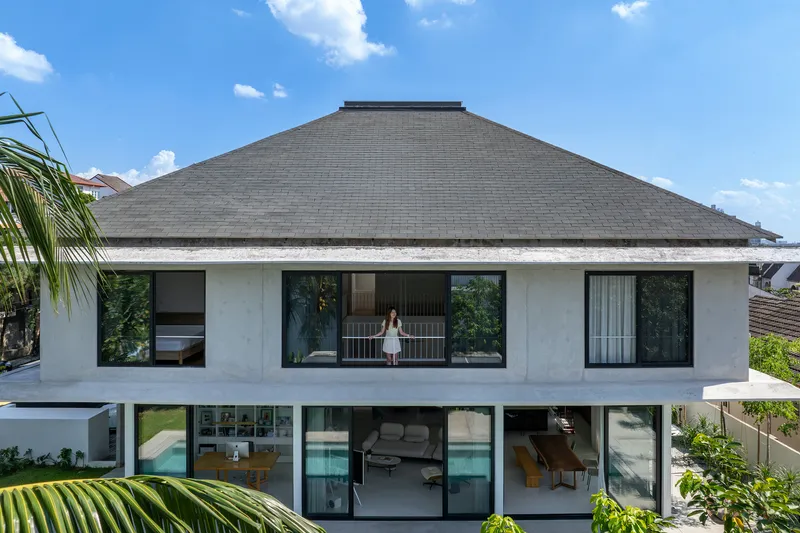
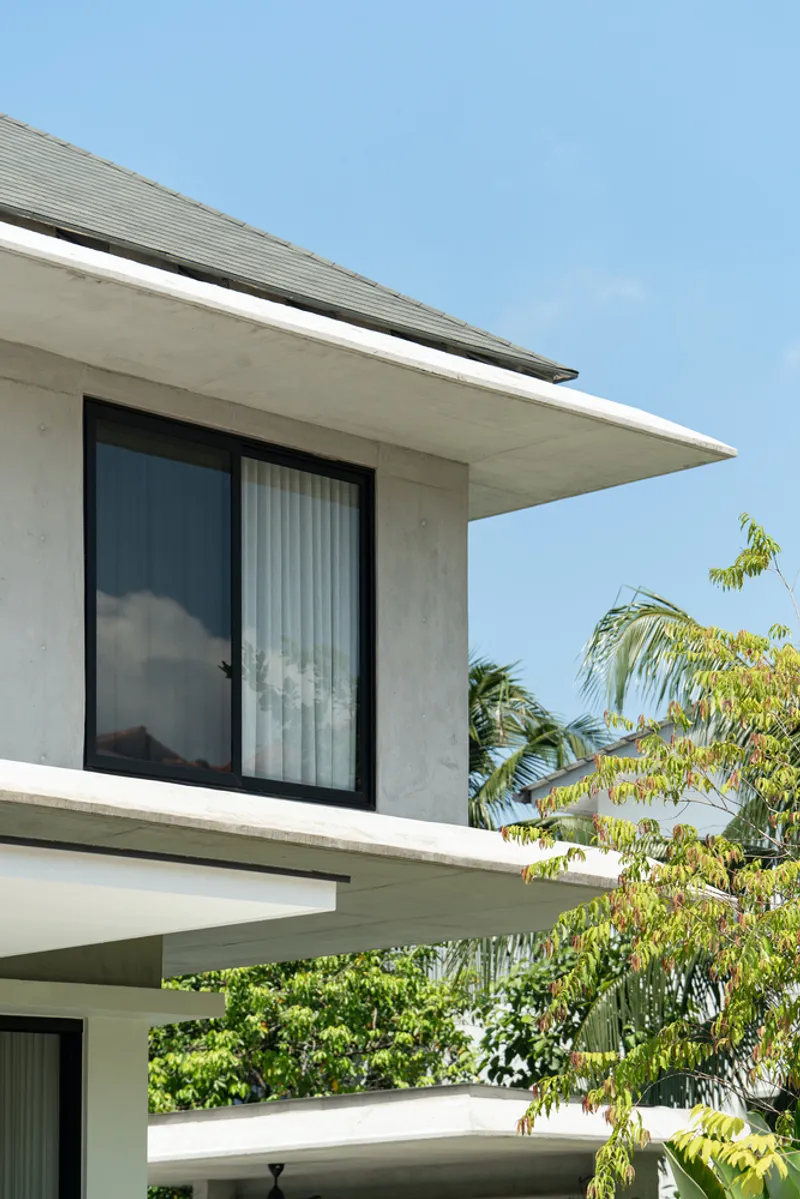
From the street, Lapatoo House reads as a restrained volume with a pronounced pyramidal roof. Vertical slat fencing and a deep carport overhang create a filtered threshold between the public realm and the domestic interior. The rear facade, clad in concrete with a tiled pitched roof, reveals the actual mass of the building: the first floor cantilevers outward on three sides, its concrete soffit casting shade over the decks and pool terrace below. That cantilever is the house's primary exterior move, giving the upper volume a floating quality while solving the practical problem of solar shading in Kuala Lumpur's equatorial climate.
The slender edge detail of the roof, which extends consistently on three sides, gives the silhouette a crispness that keeps it from reading as heavy. It is a house that manages to look both grounded and light, depending on the angle.
The Central Void as Spatial Engine


The three-story void is the heart of the project, and it earns that cliché. Timber-clad on its pitched ceiling, punctuated by a skylight at the apex, the void pulls natural light deep into the plan and creates visual connections between the open-plan ground floor and the private bedrooms above. A pendant light fixture drops through the double-height space, marking the vertical axis. The timber cladding is warm without being saccharine, its grain and tone balancing the white-painted balustrades and concrete surfaces that frame the void.
Fabian Tan has cited the client's strong family ties as the impetus for this central volume, and it functions exactly as intended: standing in the living room, you can see the upper corridor; sitting in a bedroom, you can hear the life of the house below. Privacy exists, but isolation does not. The void also works as a passive cooling device, with the oculus above the main staircase drawing warm air upward and allowing cooler air to circulate at the lower levels.
Upper Circulation and the Corridor Loop
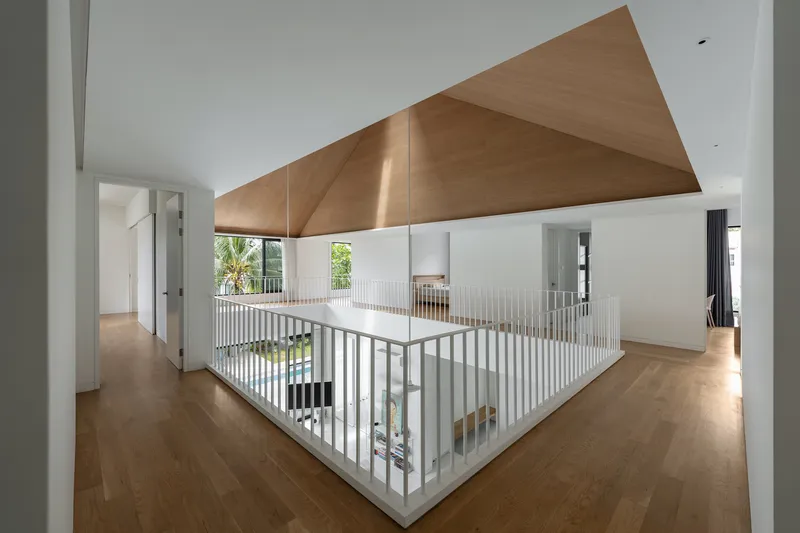

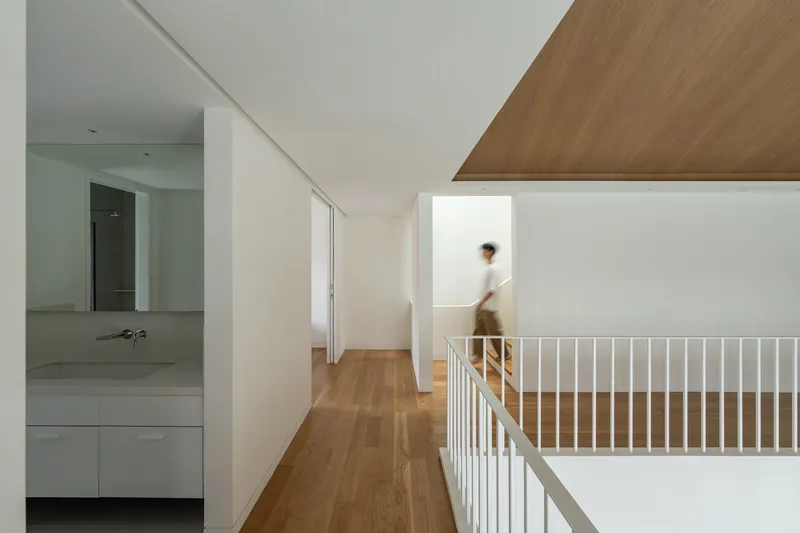
The first floor borrows from Japanese residential planning. A corridor loops around the central void, connecting the master bedroom and three children's bedrooms through large sliding doors. The arrangement recalls the engawa-like circulation of traditional Japanese houses, where movement through the dwelling is continuous rather than terminal. You walk around the void, not away from it. Each bedroom opens to the corridor and, by extension, to the shared family space below.
White vertical balustrades line the void edge, filtering views without blocking them. The timber flooring of the upper level and the vaulted timber ceiling above create a warm envelope that wraps the circulation route, making what could be a stark gallery into something more intimate. Light from the skylight shifts through the day, changing the character of this corridor from bright and open at noon to softer and more directional in the afternoon.
Ground Floor: From Sunken Foyer to Open Plan
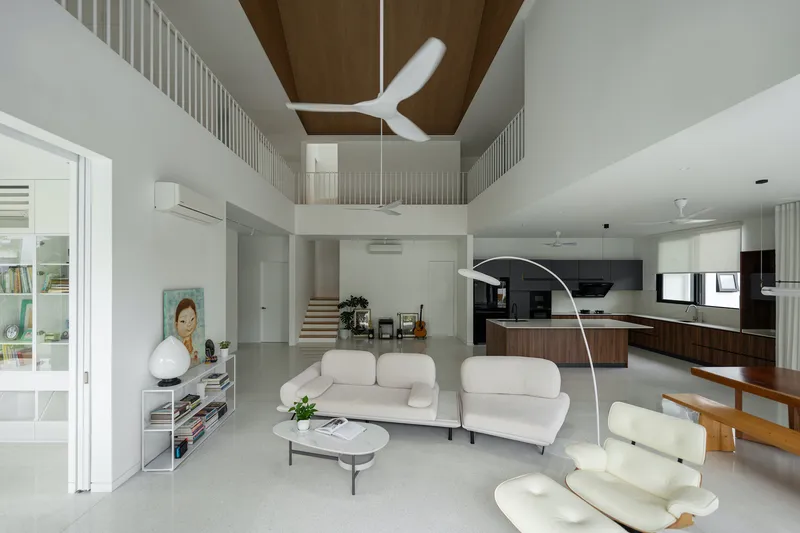

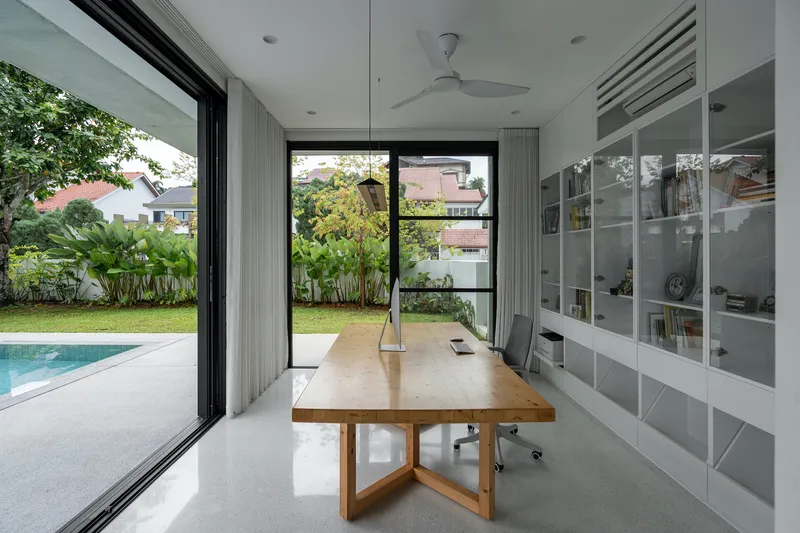
Entry begins with descent. The sunken foyer, an echo of the Japanese genkan, drops visitors down before the floor level rises again into the open-plan living, dining, and kitchen zone. It is a small move with outsized psychological effect: you are aware of crossing a threshold, of leaving the street behind. To the left, a guest bedroom sits just off the entry, accessible but separate from the social core.
The open plan itself is generous without being cavernous, organized beneath the double-height timber ceiling. A floating timber staircase connects to the upper level along the angular party wall. The kitchen features walnut cabinetry that continues the material palette's bias toward natural tones. Floor-to-ceiling glazed sliding doors dissolve the boundary between the dining area and the rear garden, so the lawn and pool become a visual extension of the interior even when the doors are closed.
Pool, Pavilion, and Landscape
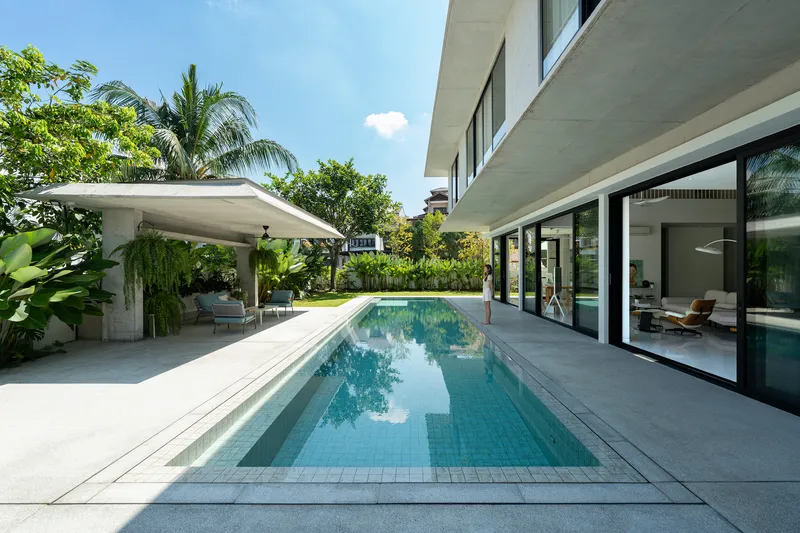

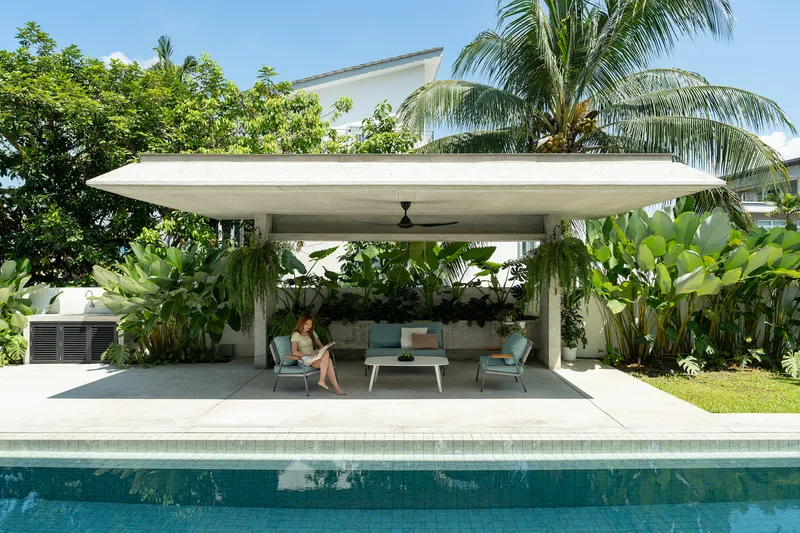
The outdoor spaces are not an afterthought. An infinity pool runs along one edge of the rear garden, its water level meeting the deck surface to create a seamless plane. Tropical planting, including palms and dense understory, frames the pool terrace and softens the concrete surfaces. A covered lounge pavilion with a curved concrete canopy sits poolside, offering shade for outdoor living that is genuinely usable in Kuala Lumpur's heat.
The cantilevered first floor does real work here, casting a deep shadow over the side and rear decks during the hottest hours. Combined with the strategic placement of large windows and the cross-ventilation enabled by the open plan, the house employs passive cooling strategies that reduce reliance on mechanical systems. It is tropical architecture that takes the tropics seriously, not as an aesthetic motif but as a set of environmental conditions to negotiate.
Staircase Geometry and Interior Details
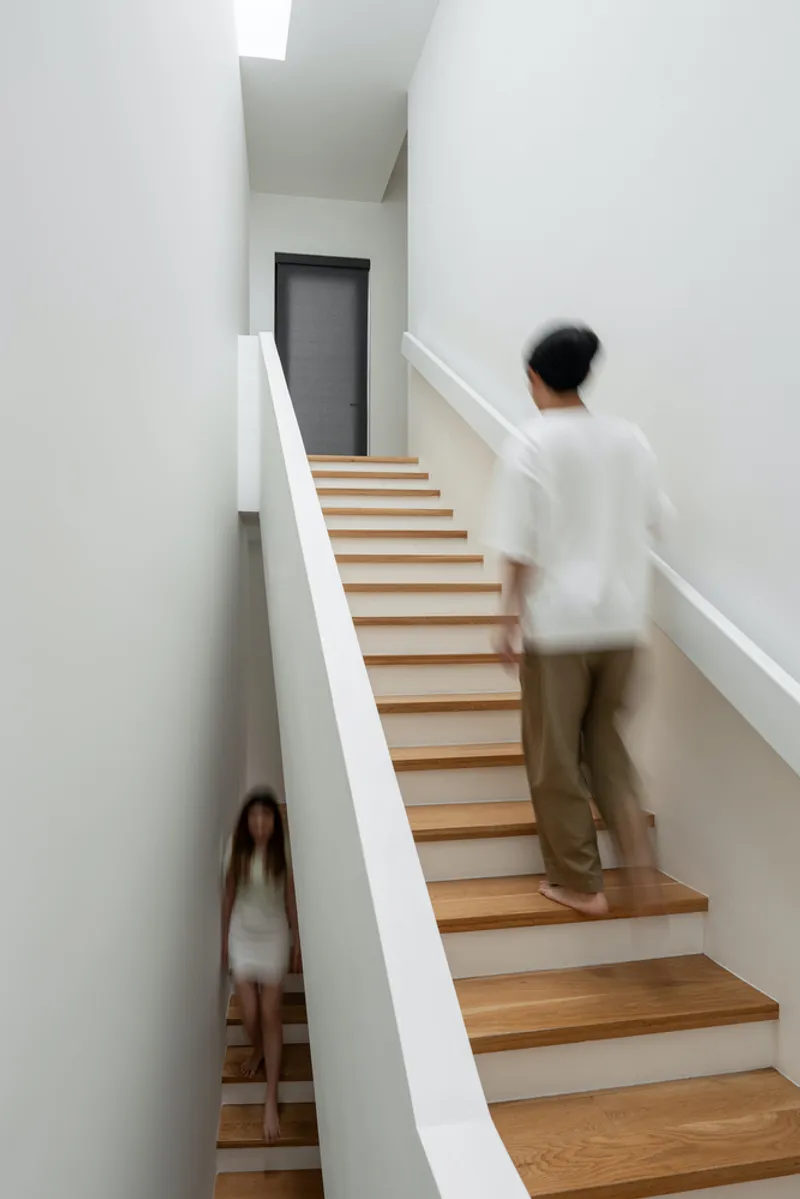

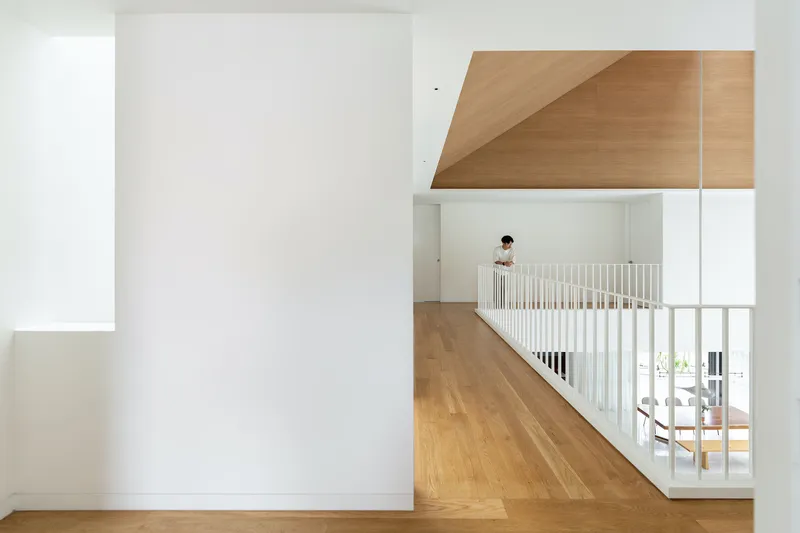
Two staircases handle vertical circulation, and their relationship is deliberate. The primary staircase follows the angular boundary wall from ground to first floor, its white walls and timber treads forming a clean, narrow slot. The secondary staircase, connecting first floor to rooftop, runs perpendicular to the first. This rotation opens up voids in the stairwell that admit light from different directions, so the journey upward is never dark or monotonous.
The precision of detailing is visible in the way interior spaces meet exterior ones. Sliding glass doors align with floor finishes; the concrete cantilever soffit reads as a continuous plane rather than a series of discrete elements. These are not flashy details, but they hold the house together as a coherent architectural statement.
The Rooftop

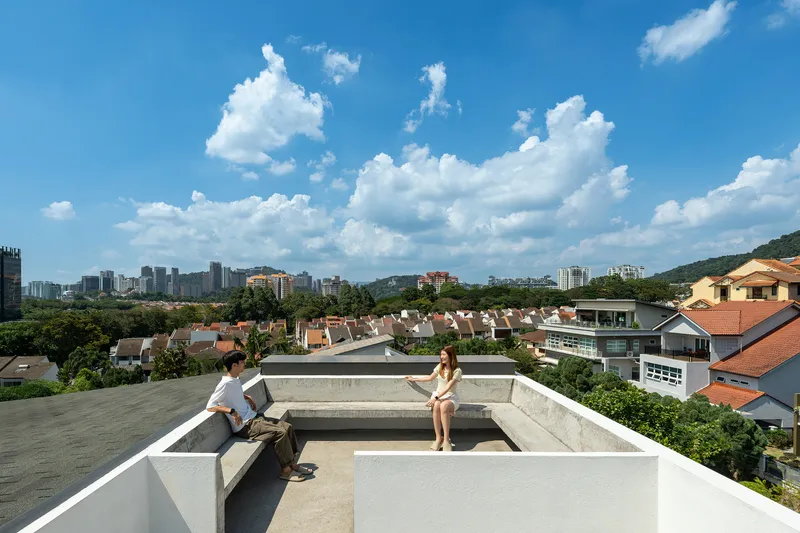
At the apex of the pitched roof, a private entertainment room and a concealed rooftop space occupy the third level. The rooftop terrace, with raised concrete planters overlooking the surrounding residential neighborhood, is the quietest zone in the house. It is a retreat within a retreat, detached from the communal life of the lower floors. The steeply pitched roof, which reads so prominently from the exterior, creates usable volume at this level that a flat roof would not.
Plans and Drawings
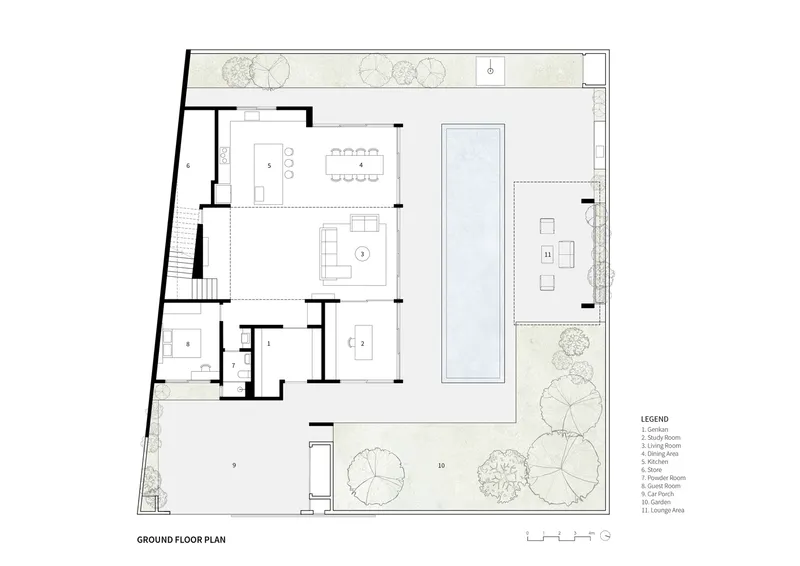
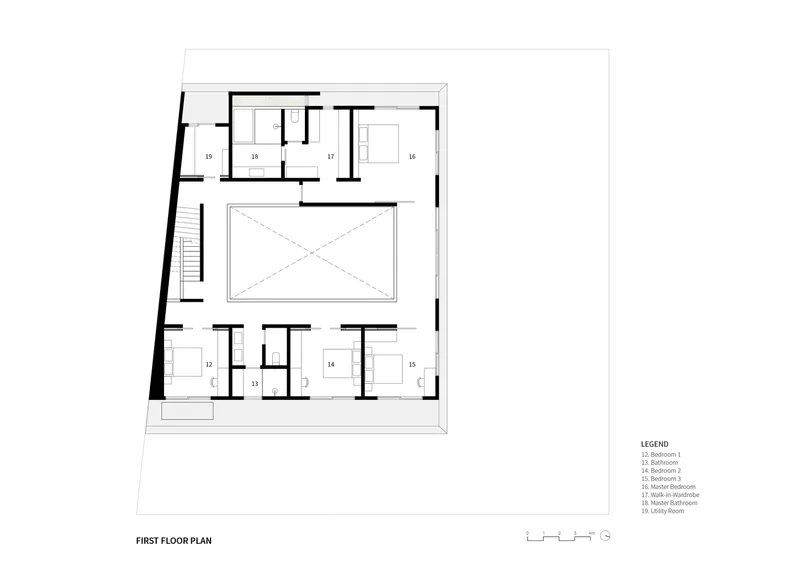
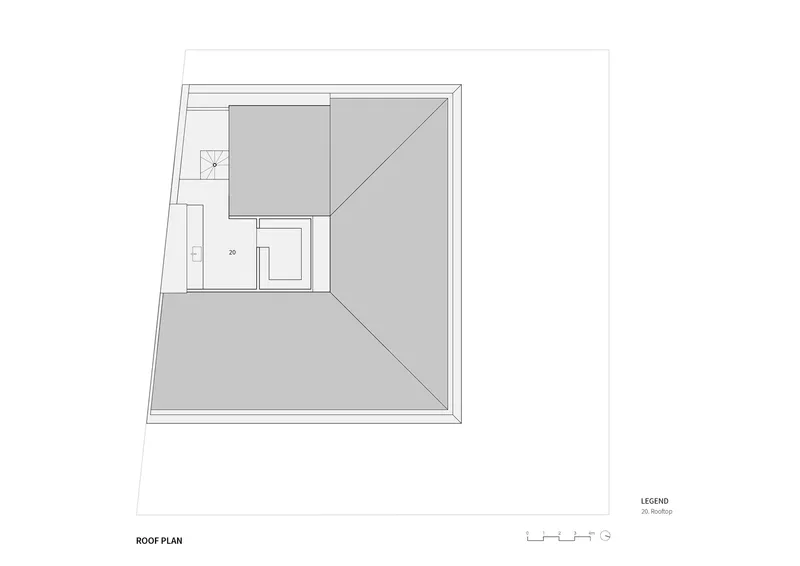
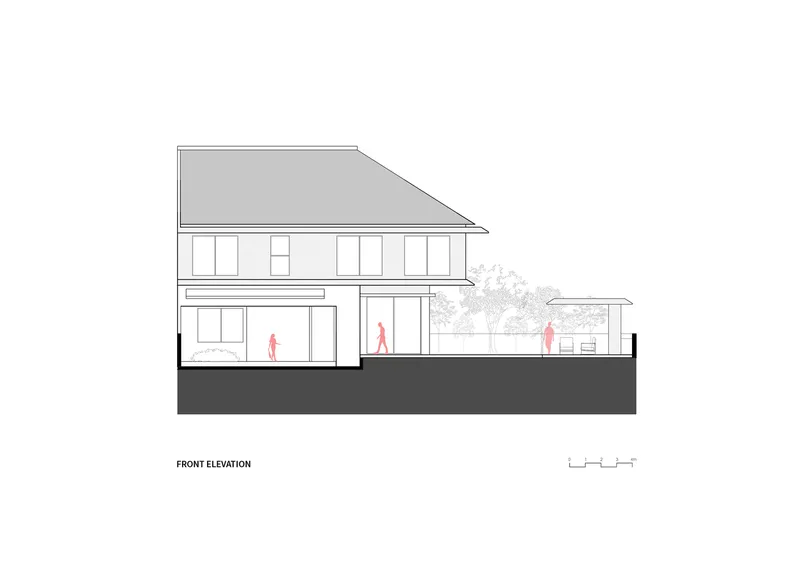
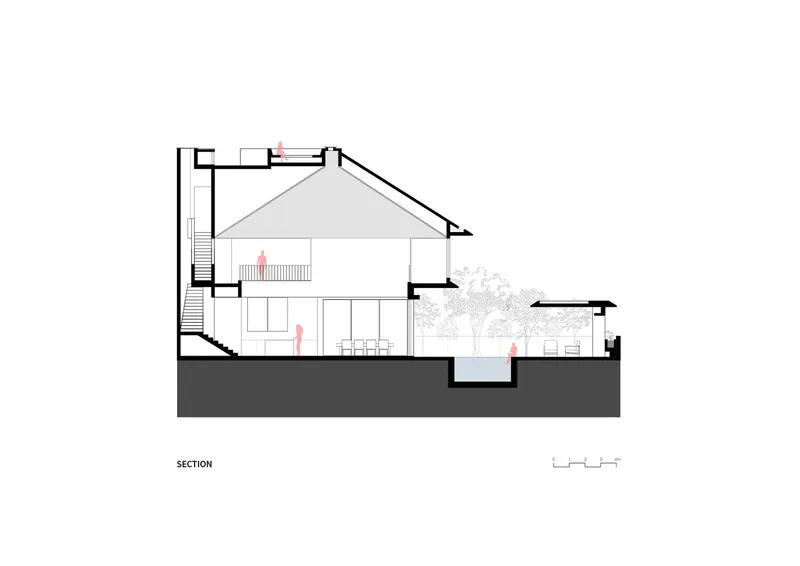
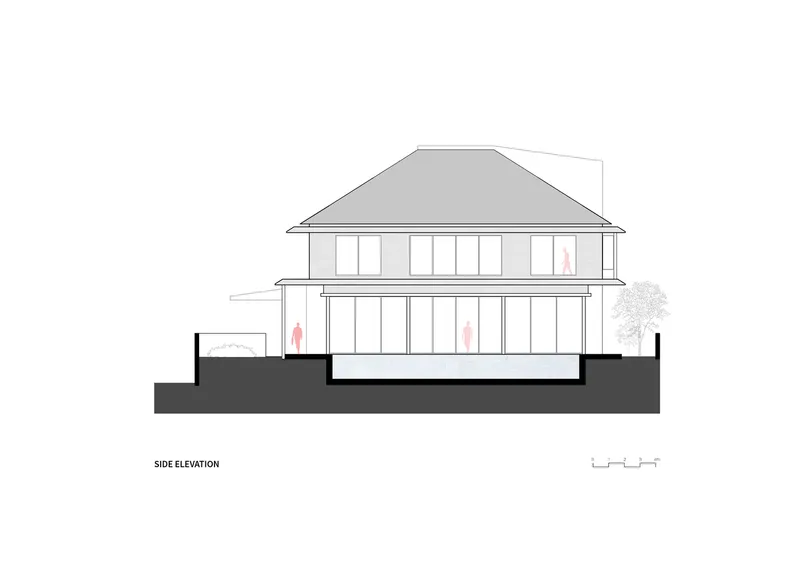
The plan drawings confirm the square-on-square logic: the house's footprint mirrors the 81ft by 80ft plot almost exactly. The ground floor plan shows the open living areas wrapping the central pool and garden, with the guest bedroom tucked to one side. The first floor plan reveals the corridor loop around the central void, bedrooms radiating outward to access light and air from multiple orientations. The section drawing is the most revealing, exposing the full three-story void, the relationship between the pitched roof volume and the flat-roofed pavilion, and the way the cantilever creates a shadow line across the facade.
Why This Project Matters
Lapatoo House does not attempt to reinvent the semi-detached typology. It works within the constraints of a suburban plot, a party wall condition, and a tropical climate, and it finds architectural ambition in the section rather than in formal gymnastics. The central void is a genuinely powerful space, not because it is large but because every other decision in the house defers to it. Circulation, structure, climate strategy, and family life all converge on that single vertical volume.
Fabian Tan's practice has been building a body of work in Malaysia that treats residential architecture as serious design territory. Lapatoo House is evidence that a suburban family home, on a standard plot, in a familiar neighborhood, can hold ideas that are worth arguing about. The cantilever, the void, the looping corridor, the sunken entry: these are not luxury gestures. They are architectural propositions about how a family can live together in a hot climate, connected but not crowded, open to the sky but shaded from the sun.
Lapatoo House by Fabian Tan Architect, located in Taman Tun Dr Ismail, Kuala Lumpur, Malaysia. Built-up area: 5,000 sqft on a 6,000 sqft plot. Completed in 2024. Photography by Bricksbegin.
About the Studio
Share Your Own Work on uni.xyz
If projects like this are the kind of work you want to make, uni.xyz is a place to publish your own, find collaborators, and enter design competitions.




Popular Articles
Popular articles from the community

EW PARK: Sustainable Architecture Reimagines the Future of Urban Parking
EW PARK reimagines city parking as a modular wooden tower combining automation, solar energy, electric mobility, and adaptable urban design.

The Earth Pod: 3D Printed Homes for Resilient Refugee Communities
The Earth Pod reimagines refugee housing through 3D printed homes made from clay, combining resilience, self-sufficiency, and rapid shelter.

Co-Life: Senior Housing Design That Reconnects Older Adults With the City
Co-Life reimagines senior housing design through healing gardens, shared streets, workshops, and a sustainable community across generations.

Conexión: Biophilic Design Reimagines High-Rise Living in Hong Kong
Conexión reimagines high-rise living in Hong Kong through biophilic design, green facades, shared spaces, daylight, water and nature within.


Similar Reads
You might also enjoy these articles


Hodi-Mandai Geram
Project Function: Preservation and revitalization of the Intangible heritage and socio-spatial identity of the Hodi by Housing, Cultural Memory Center, Sacred Grove, landscape, local tourism economy


Olio Towers: A Mid-Rise for Performers That Fuses Housing, Rehearsal, and Stage
Located blocks from Houston's Theater District, this modular tower stacks living units around a central performance atrium.

Oasis: Modular Green Housing Carved into Dhaka's Urban Fabric
A shortlisted Plugin Housing entry reclaims unauthorized settlements in Dhaka with stepped concrete volumes, green roofs, and ventilation-driven design.

Black Hole: A Floating Megastructure for the Post-Physical Era
Emiliano Mazzarotto envisions a spherical, self-scaling arena where e-sports, digital hotels, and holographic stadiums replace traditional public space.


Explore Lashop Architecture Competitions
Discover active competitions in this discipline



Challenge to reimagine the Iron Throne


Photograph architecture without architects


Illustrate the lost glory of Angkor Wat - Render Challenge


Design challenge to reuse E-waste
Comments (0)
Please login or sign up to add comments
No comments yet. Be the first to comment!