
Modular Housing Architecture for Seasonal Agricultural Workers in Sanliurfa
Modular housing architecture creates climate-responsive, community-driven living spaces for seasonal workers in Sanliurfa.


The ATRIUM project proposes a forward-thinking model of modular housing architecture designed specifically for seasonal agricultural workers in Sanliurfa. In regions where labor migration is cyclical and temporary, architecture must respond not only to climate and site conditions but also to social belonging, adaptability, and dignity. Designed by Kubra Yalnizgul, Senanur Akdemir, and Gizem Unal, the project addresses the urgent need for flexible, expandable, and climate-sensitive living environments for workers who move seasonally to support agricultural production.
Sanliurfa’s warm climate and agricultural landscape create both opportunity and challenge. While the region sustains large-scale farming activities, housing conditions for seasonal workers often remain temporary, inadequate, and disconnected from community life. ATRIUM redefines this condition through a carefully structured modular housing system that integrates spatial flexibility, social cohesion, and environmental adaptation.
A Modular Housing System Rooted in Adaptability
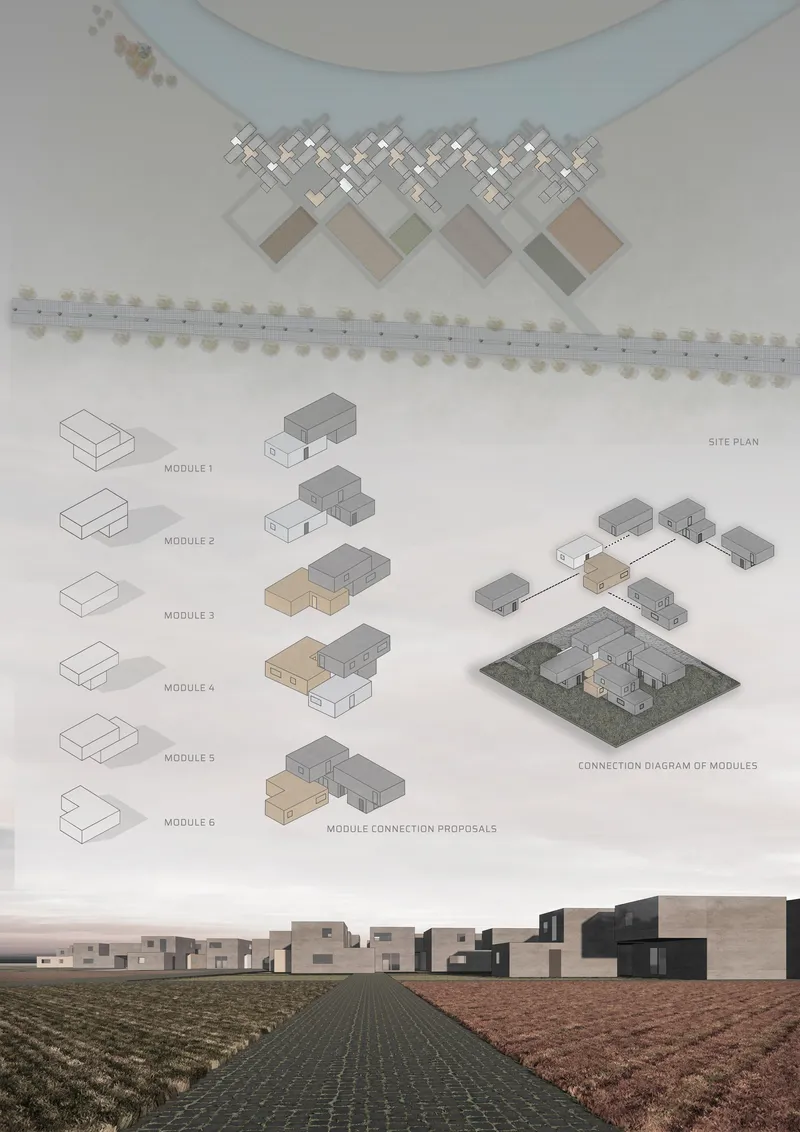
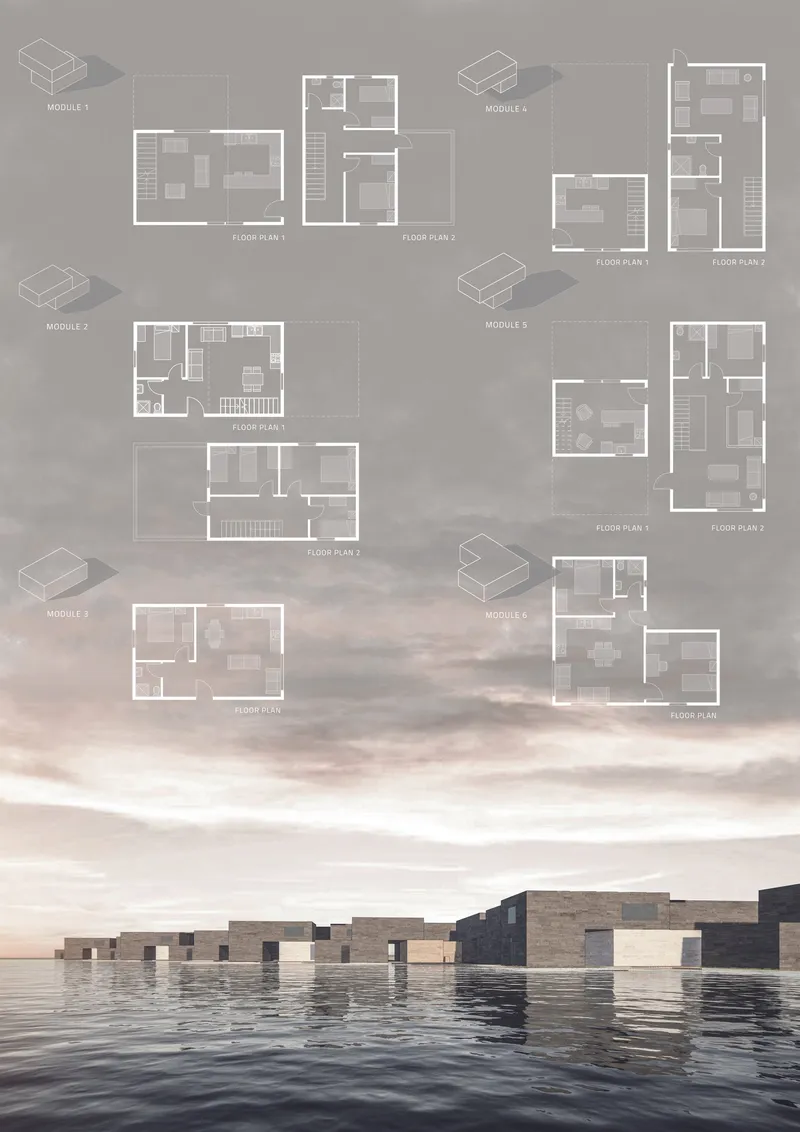
At the core of the project lies a modular housing architecture strategy composed of six adaptable building modules. These modules function as individual residential units while also allowing multiple configurations through strategic connections. The diagrams illustrate how each module can expand, merge, and respond to varying family sizes and social needs.
Rather than imposing a rigid housing grid, the system enables organic growth. Modules interlock to form clusters, narrow streets, and shared squares. This incremental approach reflects the migratory nature of seasonal workers, housing can evolve as needs shift over time.
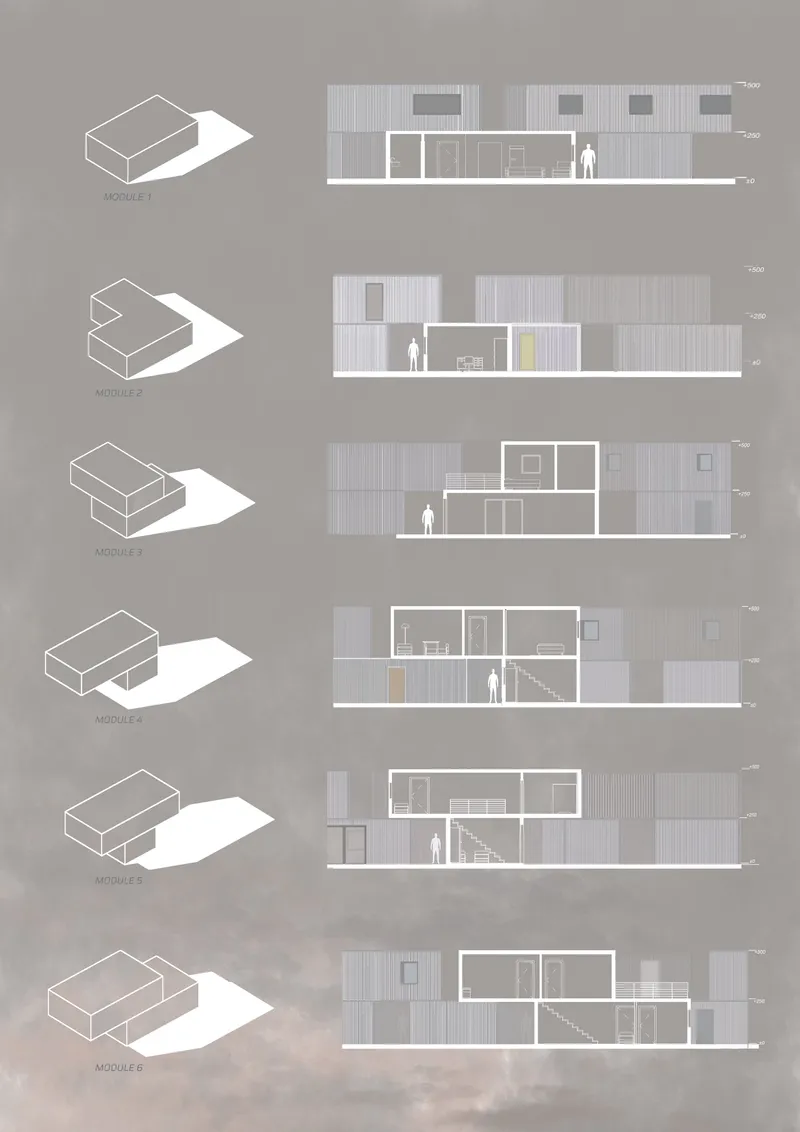
The modular connection proposals demonstrate how units combine vertically and horizontally. Some modules extend to create shaded transitional areas, while others incorporate terraces or upper-level expansions. This architectural flexibility supports different household structures and ensures long-term usability.
Climate-Responsive Architecture in a Warm Region
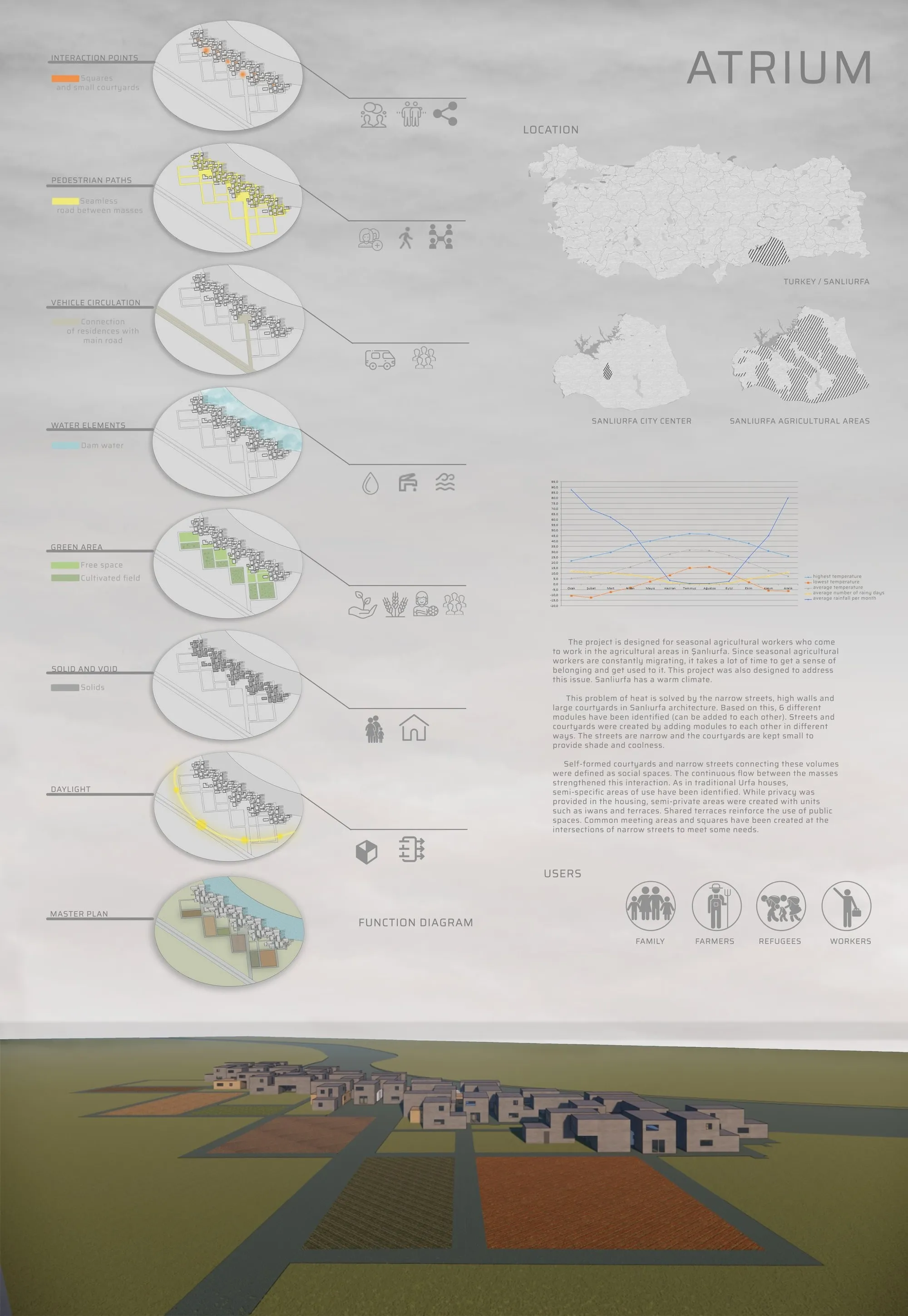
Sanliurfa’s hot climate heavily influences the architectural strategy. The project positions structures along the water’s edge, taking advantage of microclimatic cooling effects. Narrow streets between modules create shaded pathways, reducing direct solar exposure and improving outdoor comfort.
The function diagrams reveal how certain parcels were removed to establish circulation corridors and open agricultural fields. These agricultural zones are not merely background landscapes, they are integrated into the settlement structure. As roads extend, specific parcels are designated as farming areas, reinforcing the relationship between living and working environments.
The use of simple geometric volumes enhances thermal performance. Compact forms reduce surface exposure, while courtyards and atrium-like voids facilitate cross-ventilation. The section drawings indicate layered interior spaces that promote airflow and daylight penetration.
The Social Atrium: Architecture for Belonging
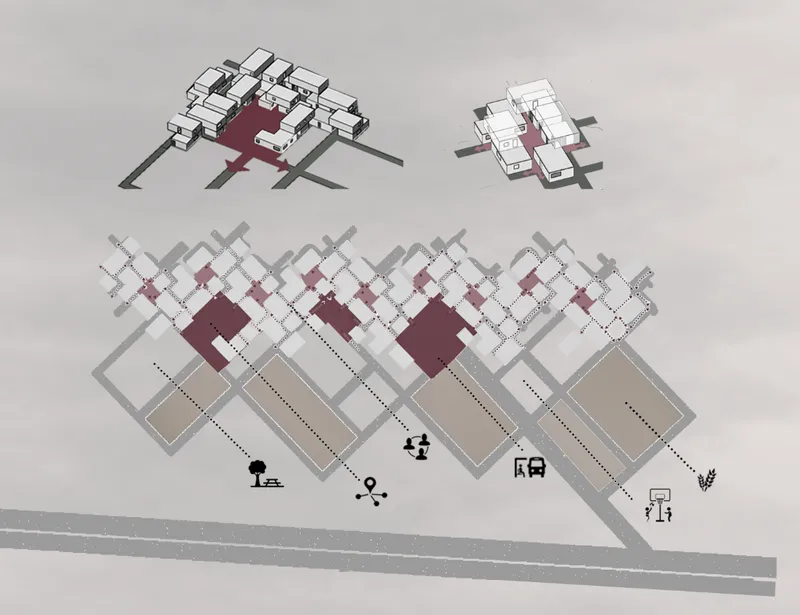
The name ATRIUM reflects the project’s central social concept. Beyond housing units, the design fosters shared communal spaces where interaction can flourish. Migrant workers often struggle to establish belonging due to constant movement. By organizing modules around shared courtyards and public nodes, the project creates opportunities for gathering, exchange, and collective life.
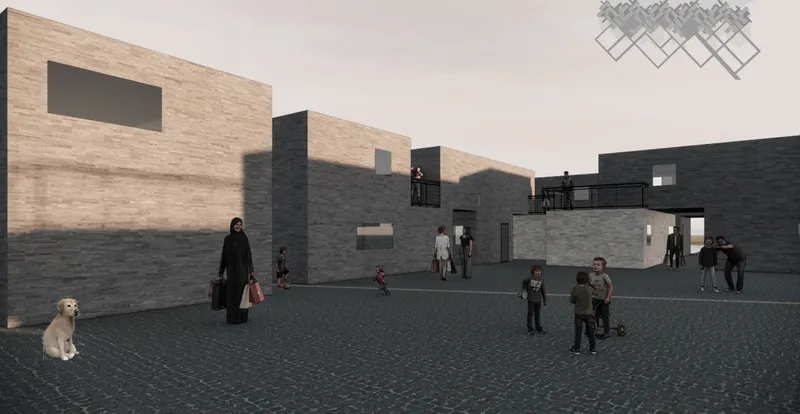
The narrow streets serve multiple roles: they are circulation paths, social connectors, and extensions of private space. These semi-public zones blur the boundary between inside and outside, reinforcing neighborhood identity.
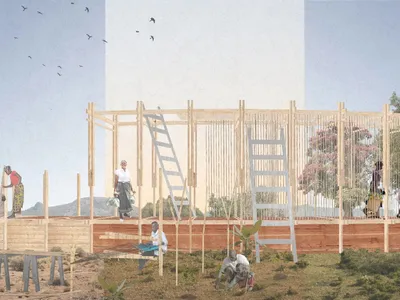
In the rendered perspectives, children play in open courtyards while adults interact on terraces and walkways. The architecture supports daily rituals and informal encounters, transforming temporary settlement into meaningful community space.
Functional Diversity Within a Unified System
The project carefully integrates multiple functions within the settlement. The function diagram indicates zones allocated for social facilities, education, gathering spaces, and agricultural production. This layered organization produces three distinct spatial experiences within a single cohesive framework.
Floor plans show variations in internal layouts across modules. Some units prioritize compact living arrangements, while others include expanded living areas, multi-bedroom configurations, or dual-level organization. This diversity ensures that the modular housing architecture does not become monotonous or restrictive.
Each module maintains a clear structural logic, allowing efficient construction and potential prefabrication. The repetitive geometry ensures cost-effectiveness while maintaining architectural clarity.
Urban Structure and Agricultural Integration
One of the most compelling aspects of ATRIUM is its integration of settlement and farmland. As circulation routes extend outward, agricultural plots emerge in alignment with the module grid. This creates a direct spatial dialogue between home and work.
The design respects existing land patterns and uses the extension of narrow streets to define new parcels. Over time, the settlement can expand logically without disrupting agricultural productivity.
This approach positions modular housing architecture not as isolated shelter but as an infrastructural framework supporting economic and social systems simultaneously.
Materiality and Architectural Identity
The architectural language is intentionally minimal. Rectilinear volumes, subtle façade articulations, and restrained openings establish a cohesive identity. The simplicity reinforces the modular logic and allows the spatial organization to remain the primary design expression.
Elevational studies demonstrate how modules maintain consistency while accommodating variation. Subtle differences in height, terrace placement, and void integration prevent visual monotony.
The material palette appears neutral and durable, suitable for harsh climate conditions. The emphasis on robustness ensures longevity despite the settlement’s seasonal occupancy patterns.
Toward a Sustainable Housing Model
ATRIUM proposes a scalable and sustainable model for worker housing. By using modular housing architecture principles, the project achieves:
- Adaptability to changing family structures
- Incremental expansion capacity
- Climate-responsive spatial design
- Integration of agricultural land and living space
- Social cohesion through shared courtyards
- Cost-effective repetition and prefabrication potential
This system can serve as a replicable model for other regions facing similar migratory labor conditions.
The ATRIUM project by Kubra Yalnizgul, Senanur Akdemir, and Gizem Unal demonstrates how modular housing architecture can transcend mere shelter provision. It becomes a social infrastructure: supporting identity, economic productivity, and environmental responsiveness.
In a context where temporary living often equates to instability, ATRIUM introduces permanence through adaptability. It transforms seasonal migration into an opportunity for structured, dignified, and community-oriented living.
By merging modular design, climate sensitivity, and agricultural integration, the project presents a powerful architectural response to one of the region’s most pressing housing challenges.



Popular Articles
Popular articles from the community


Hill & Cross Opera: Sculptural Opera House Architecture Shaped by Tallinn’s Landscape and Identity
Hill & Cross Opera reimagines opera house architecture in Tallinn through its sculptural hill, civic plaza, glass wave and a luminous cross.

The Ocean Hive: Sustainable Architecture for a Self-Sufficient Civilization at Sea
The Ocean Hive imagines sustainable architecture at sea, where modular habitats, algae, wave power and ocean waste sustain a growing colony.

Riyadh For All: Intergenerational Urban Design for Active Aging in Rabat
Riyadh For All reimagines urban design in Rabat with intergenerational co-living, adaptive courtyards, and Moroccan cultural exchange today.

Play: Fragments of Their World
Familiar architecture becomes modular playground design, creating safe spaces where displaced children can learn, connect, imagine and play.


Similar Reads
You might also enjoy these articles

Eco Chapel: A Green Architecture Pavilion Designed in Symbiosis with the Forest
Eco Chapel uses green architecture to weave prayer, learning and reuse into a forest pavilion shaped by modular hexagonal canopies for life.
Kaffeebühnen: Coffee Shop Architecture Designed as a Civic Stage Between Vienna’s City and Park
Kaffeebühnen turns coffee shop architecture into a civic stage, linking Vienna’s park edge, urban life, warm timber yards, and coffee craft.
Healing Façade: Sustainable Architecture for Reforestation, Community, and Sacred Ecology in Ethiopia
Healing Façade reimagines sustainable architecture as a living wall that restores soil, catches water and renews Ethiopia's forest churches.


Urban Forest: A Vertical Ecosystem for 5,000 Workers in Singapore's Changi Business Park
Radially stacked pods and layered green decks turn a 7-acre plot into 47 acres of ecological workspace projected for 2040.
Comments (0)
Please login or sign up to add comments
No comments yet. Be the first to comment!