

The Plug-In House: LEGO-Inspired Modular Housing for Dense Urban Futures
A shortlisted prefabricated housing prototype where crane-assembled living units snap into a structural core like building blocks.


What if your apartment arrived on a truck, fully built, and a crane simply slotted it into a waiting frame? The Plug-In House treats housing units like cartridges: prefabricated off-site, customized online, and plugged into a shared structural core with mechanical precision. The result is a building that grows on demand, shaped not by a developer's spreadsheet but by the specific needs of each occupant.
Designed by Enid Sun and Biying Yuan, The Plug-In House was shortlisted in the Plugin Housing Challenge 2020. The proposal takes the logic of LEGO blocks and applies it to condensed urban environments where housing accessibility and construction speed are critical. Single-occupancy and double-occupancy modules clip into vertical and horizontal configurations, turning a conventional apartment building into something closer to a living, expandable organism.
Multicoloured Modules Against the Urban Skyline
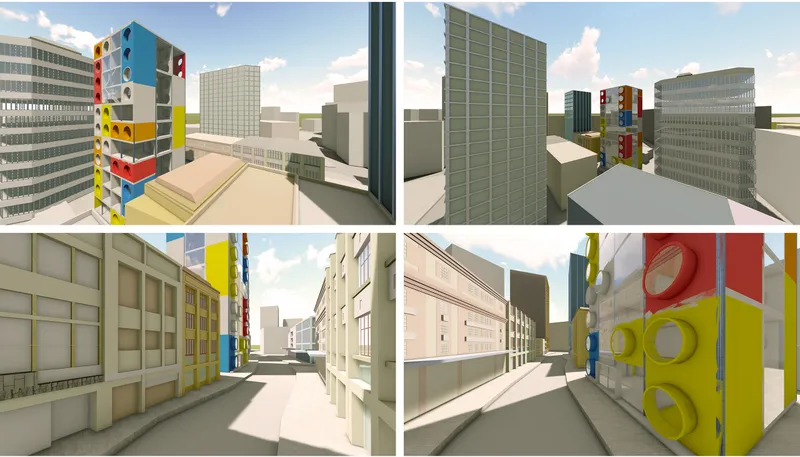
Four rendered views of the building's massing reveal a facade composed of vibrantly coloured panels, each one corresponding to an individual housing module. The visual language is deliberate: clearly defined module joints and varied hues give the building a playful, almost toylike character that reads as warmth rather than repetition. At street level, volumes engage the sidewalk directly, grounding what could be a purely abstract system in a recognizable urban context. The effect is mass housing with genuine personality, a skyline presence that signals diversity of inhabitants rather than uniformity of product.
Shared Cores of Pink Tile and Timber
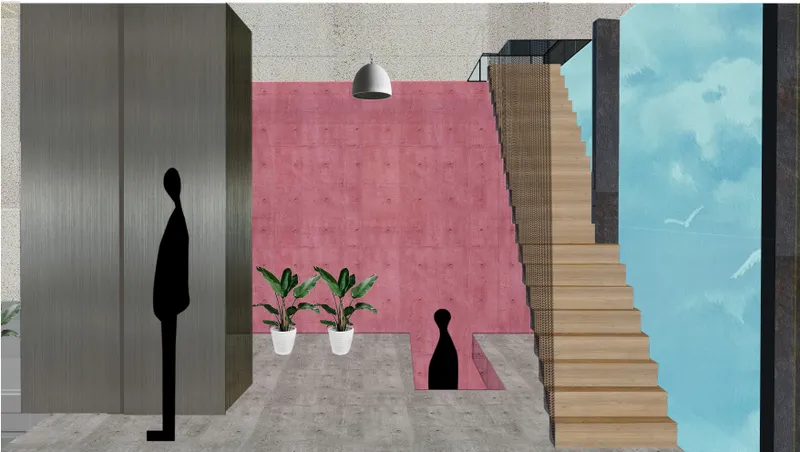
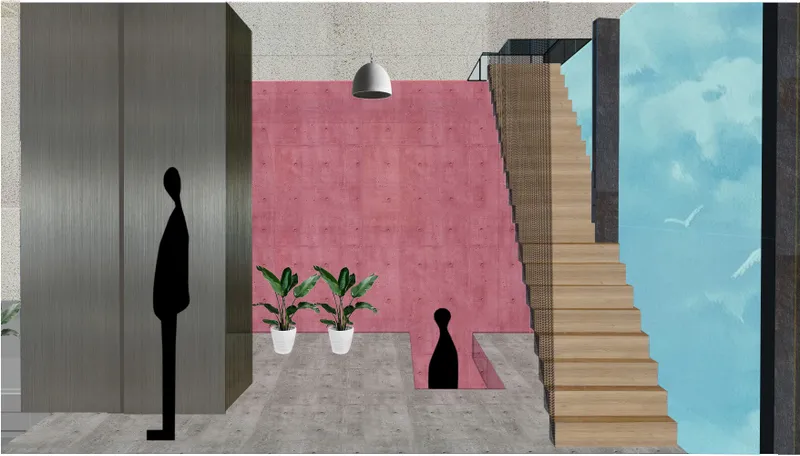
The interior renderings show the communal circulation spine: a vertical core finished in pink tile walls with timber stairs, potted plants, and an elevator. Silhouetted figures move through a space that feels more like a well-kept co-living lobby than a utilitarian service corridor. The material palette, warm timber against the saturated tile, establishes a domestic register that counterbalances the industrial reality of crane-assembled modules. These shared zones do serious architectural work, providing the social glue that holds a plug-in system together and preventing the building from reading as a warehouse of isolated capsules.
Crane, Core, Cartridge: The Assembly Sequence
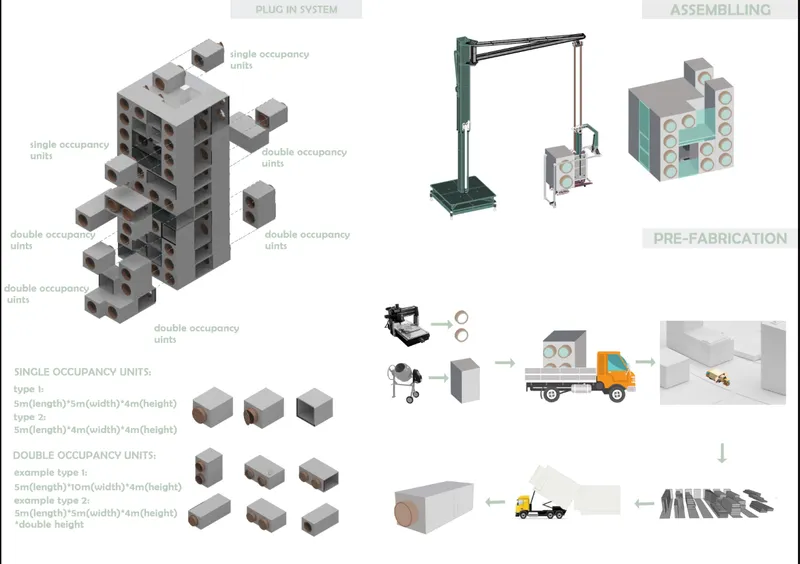
A clear diagrammatic sequence lays out the plug-in workflow. Units are fabricated off-site to occupant specifications entered through a digital design portal. They arrive at the site fully finished and are lifted by crane into an existing structural framework, locking into place with the help of on-site assembly teams. The process collapses the conventional construction timeline and drastically reduces on-site labor and material waste. It also reframes housing delivery as a kind of on-demand service: order, fabricate, transport, plug in.
What makes this system more than a logistics exercise is its accommodation of diverse occupant profiles. A working professional can specify a quiet, acoustically isolated unit. A student might order a compact study-sleep module. A single parent could request a child-friendly layout with safety features. The mass-customization model adapts architecture to life stages rather than forcing inhabitants to adapt to a fixed plan.
Eleven Levels of Stacked Living
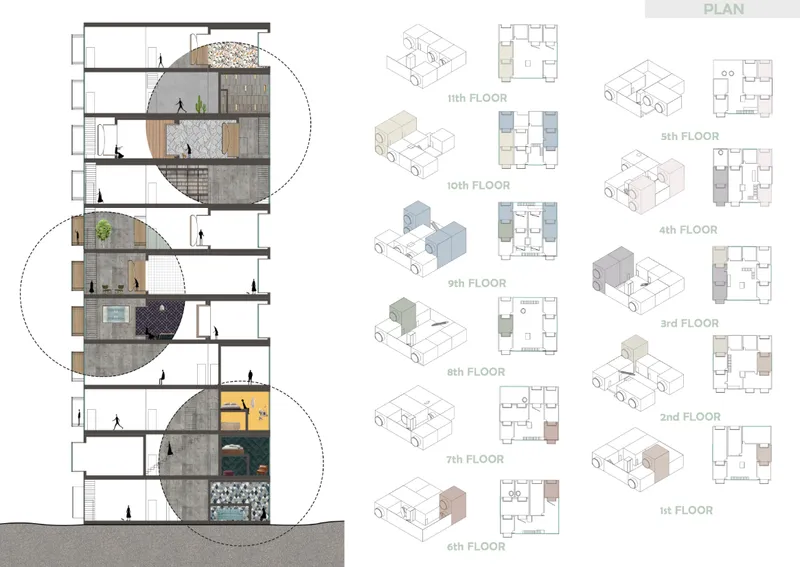
A sectional drawing paired with axonometric floor plans reveals how residential units stack across eleven levels, each floor accommodating varying unit sizes. The section makes legible the relationship between the fixed structural core and the interchangeable modules that attach to it. Individual layouts are compact but complete, organized around the circular window motif that becomes the building's architectural signature. The drawing communicates scalability: the same structural logic could accommodate fewer or more levels depending on site constraints and urban density requirements.
Concentric Circles as Framing Device
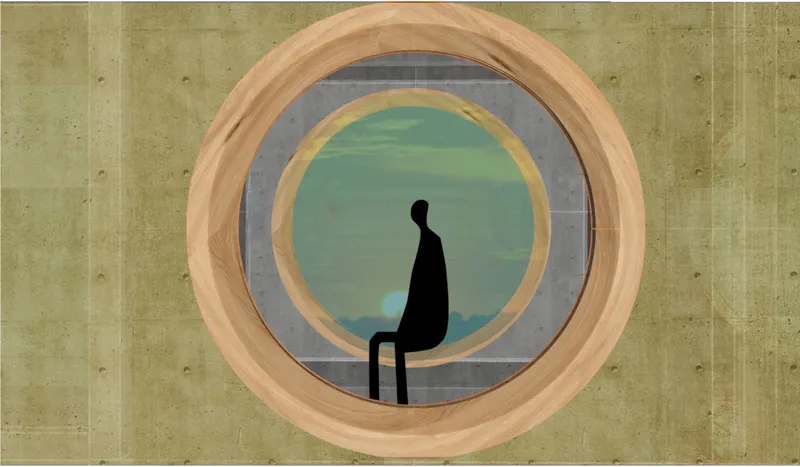
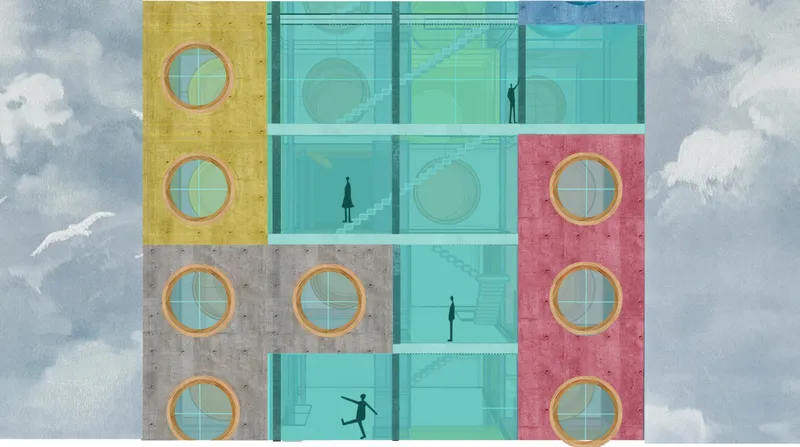
The circular window detail is perhaps the project's most memorable image. Concentric rings of timber and tile frame a silhouetted seated figure, turning a window into a thick, inhabitable threshold between interior and city. It is a small move with outsized effect: in a building assembled from standardized components, this window gives each unit a distinctive moment of craft and intimacy. The accompanying section drawing through the full building height shows these circular openings punctuating the facade at every level, with translucent glass floors allowing light to filter between stacked units. The detail reinforces that modularity need not mean monotony.
Why This Project Matters
The Plug-In House operates at the intersection of logistics, personalization, and urban density. Its strength lies in treating these as inseparable problems rather than addressing them sequentially. The digital portal, the prefabrication pipeline, and the crane-assembly system form a single integrated workflow that collapses the distance between an occupant's stated needs and a physically realized dwelling. That integration is the real innovation here, not any single component.
Sun and Yuan also demonstrate something that modular housing proposals often neglect: visual identity. The coloured facades, concentric windows, and carefully detailed shared cores give the building a character that resists the sterile, pod-hotel aesthetic that haunts much prefab discourse. If modular construction is going to gain public trust, it needs projects like this one that prove efficiency and warmth can coexist in the same frame.
View the Full Project
About the Designers
Designer: Enid Sun
Enter a Design Competition on uni.xyz
uni.xyz runs architecture and design competitions year-round that reward proposals with spatial conviction and real site intelligence.
Project credits: The Plug-In House by Enid Sun Plugin Housing Challenge 2020 (uni.xyz).




Popular Articles
Popular articles from the community


Conexión: Biophilic Design Reimagines High-Rise Living in Hong Kong
Conexión reimagines high-rise living in Hong Kong through biophilic design, green facades, shared spaces, daylight, water and nature within.

Lunar Spiral: Space Architecture Shaped by the Mathematics of the Universe
Lunar Spiral reimagines space architecture through Fibonacci geometry, lunar regolith, levitating habitats, and self-sustaining Moon living.

The Earth Pod: 3D Printed Homes for Resilient Refugee Communities
The Earth Pod reimagines refugee housing through 3D printed homes made from clay, combining resilience, self-sufficiency, and rapid shelter.

Co-life: Sustainable Architecture for Age-Friendly Community Living
Co-life reimagines sustainable architecture for seniors through courtyards, rammed earth, shared gardens, and spaces designed for belonging.

Similar Reads
You might also enjoy these articles

Day and Night Park: A Time-Based Urban Newsstand in Beijing
A temporary urban newsstand in Beijing blending travel, light, and reading through poetic colors, compact form, and community-focused design.

Modernist Patio Renovation in El Masnou, Barcelona by Oliver Segura Arquitectura + Cebrià Arquitectura
Modernist patio renovation blending tradition and innovation with a movable pool, leveled floors, and Catalan materials in El Masnou.

Alto Residencial Coop: Cooperative Housing Development in Santiago de Compostela by Carbajo Barrios Arquitectos
A linear cooperative housing complex blending white volumes and perforated metal façades, enhancing community living, natural light, privacy, and urban integration.
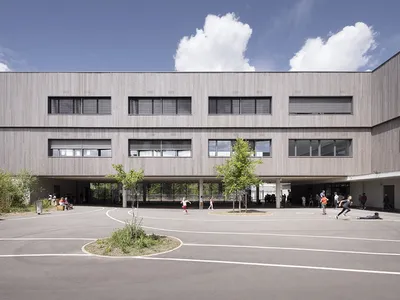
Vil Genis School by BPA ARCHITECTURE – Massy, France
Vil Genis School in Massy, France, features sustainable design, south-facing classrooms, community integration, accessible spaces, and modern educational architecture.

Explore Modular Housing Competitions
Discover active competitions in this discipline



Challenge to design a portable theatre


Challenge to design a portable music platform


Challenge to design an open learning module for the elderly
Comments (0)
Please login or sign up to add comments
No comments yet. Be the first to comment!