
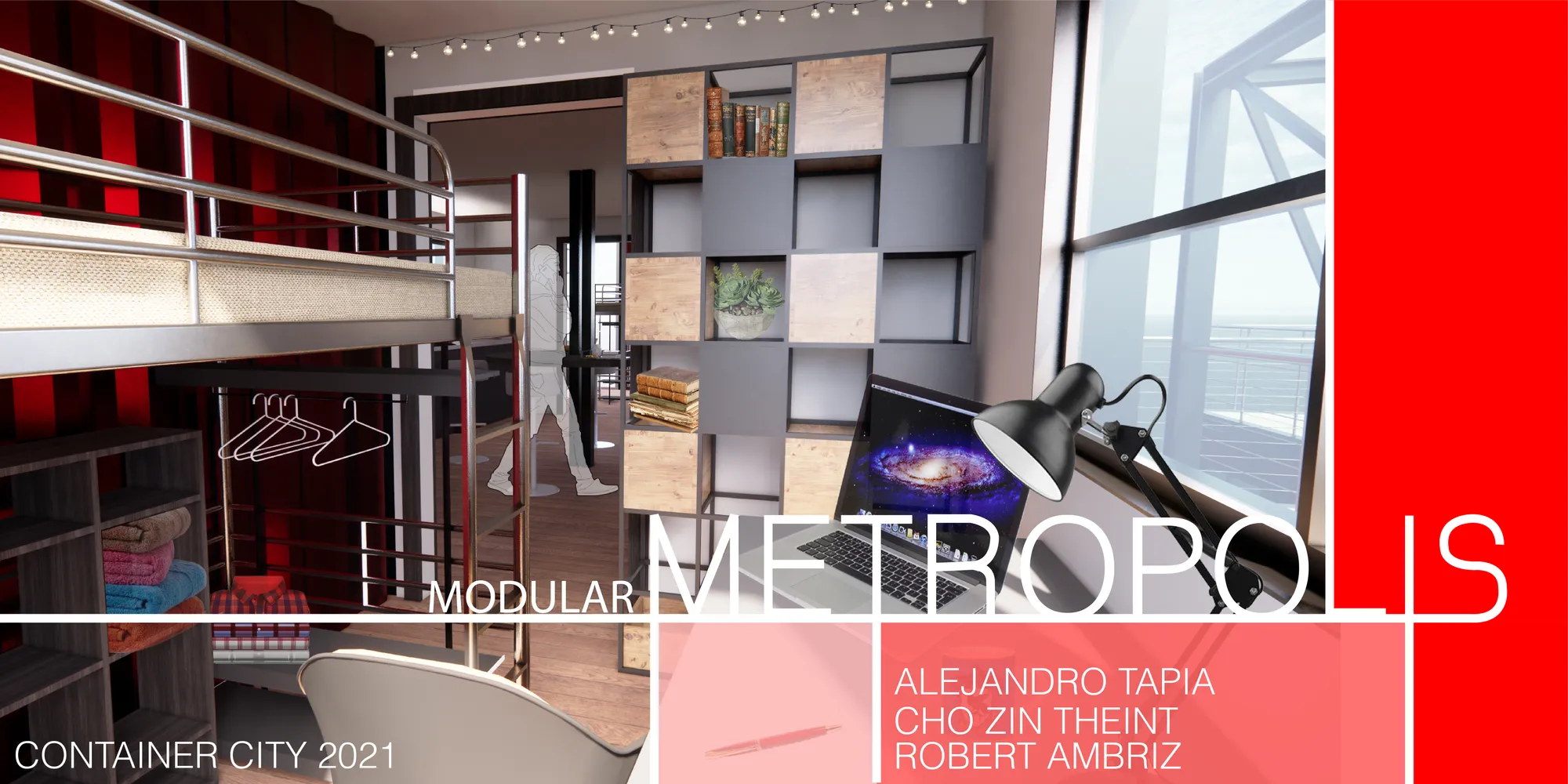
Modular Metropolis
Creating a Portable Urban Community.
We approached the project by determining that it would be best to combine two 40’ long containers to create a unit, which would provide 3 bedrooms for 3 students (with the only exceptions that rule being the units found on the ground level, so as to create ADA compliant units), rather than providing one container per student, densifying the “container city” furthermore. Due to the 2 containers being combined, part of the containers’ structure became altered, providing columns for the necessary supports, while using those columns to create a grid. From that grid, the plans were developed, as the grid facilitated the separation of spaces. Because the containers were combined in pairs, one was left over which was repurposed as an enclosed part of the roof deck.
The competition didn’t call for a specific site, so it was deemed that taking advantage of that lack of site would be one of the main driving factors of the structure’s design. Due to shipping containers not being native to any one location, the structure was designed to follow this nature and retain the ability to be deployed anywhere. The units were designed in mirrored pairs stacking into two towers. The circulation is placed between the towers, acting as the connection between the towers while also being a freestanding structure, following the main idea of modularity behind the project. . With one being a stack of three containers high, excluding the one used for the enclosed observation deck, the other tower became a stack of four, to achieve the usage of 15 containers that the brief asked for. However, due to the nature of the stacking method, the structure can be stacked higher if more containers were deemed to be added. Likewise, the stacks could be lower, if not many containers were being asked to be used. Just as the “city” is able to grow upwards, it too can grow outwards, creating a complex of structures. This modularity found in the design allows the container city to change based on whatever site it sits upon (if on a small site, maybe the combination of the two containers creating a single unit could be used, requiring no stack. Likewise, if there’s a large site, the “city” can expand as much as needed). This is demonstrated through both the plan and site plan, as the plan of the structure sits upon a water deck, similar to the Urban Rigger, whereas in the site plan, a whole complex is placed in the city of San Francisco. This modular nature also allows for the addition of parking structures and similar programs below, whether it be underground or under a structural grid.
The program was fit into the grid system provided by the structure of the containers, which as mentioned before, was the method of design investigation. After approximately four iterations of design, both in terms of plan layout and stacking, a final design was agreed upon. The layout consisted of 3 bedrooms (excluding the ADA compliant units which held 2), a bathroom, a kitchen, dining area, and living space. The bathroom and bedrooms were positioned in the corners of the units, to allow exposure to the natural light and provide the necessary code requirements such as operable windows. The beds in the bedrooms were raised to provide storage below. The rest of the spaces were combined into one large room, placed in the center of the units, from where all the bedrooms had access to. In essence, the public center was accessible to the private rooms around it. The program layout remains mostly uniform across the units, so as to keep systems such as plumbing stacked atop each other, further facilitating the stacking and expansion of the units.
The connecting factor between the two towers is the circulation tower found in between. This aspect of the structure remained open, so as to create a sense of openness in between. The circulation also doesn’t span the length of the containers, in order to create a courtyard in between the units, giving the structure a sense of community and unity. This was also done in order to comply with the directive of only allowing extensions to the containers without surpassing 15% of the 15 containers’ surface area; extending the circulation would’ve neglected that regulation.
Once the overall design and layout of the structure was finalized, determining the materials used for the structure came next. Stainless steel was used throughout various parts of the units, such as the kitchen, bathroom, and even the bedrooms. This was done in order to go with the industrial appearance of the containers, having the inside compliment the outside.
In conclusion, all facets of design were approached through the use of trying to implement space efficient modules, while still providing the quality of living necessary for students.


Popular Articles
Popular articles from the community


The Musturak Paradise: Senior Living Architecture for a Connected Future in Temara, Morocco
The Musturak Paradise reimagines senior living architecture in Temara via private homes, social spaces, culture, community, and shared care.

Co-Life: Senior Housing Design That Reconnects Older Adults With the City
Co-Life reimagines senior housing design through healing gardens, shared streets, workshops, and a sustainable community across generations.

Co-life: Sustainable Architecture for Age-Friendly Community Living
Co-life reimagines sustainable architecture for seniors through courtyards, rammed earth, shared gardens, and spaces designed for belonging.

Riyadh For All: Intergenerational Urban Design for Active Aging in Rabat
Riyadh For All reimagines urban design in Rabat with intergenerational co-living, adaptive courtyards, and Moroccan cultural exchange today.


Similar Reads
You might also enjoy these articles

The Rhythm of Seasons
A Farmers' Market Connecting Nature and the City

More Than a Building-Designing a Living System
More Than a Building-Designing a Living System
Base Beyond
DESERT COMPOUND ARID: TOURISM OF ABSENCE AND ABUNDANCE


Comments (0)
Please login or sign up to add comments
No comments yet. Be the first to comment!