

Alan Chu Lifts a Trapezoidal Monocle Above Brazil's Cerrado to Frame the Sunrise
Perched five meters above native vegetation in Alto Paraíso de Goiás, a 78 m² cabin operates like an optical device aimed at the horizon.


There is a specific moment in the design of any elevated structure when the architect has to decide what the building is really doing up there. Is it retreating from the ground, or reaching toward something? In the case of the Monocle House, Alan Chu answers: both. Raised five meters on twelve black steel pillars above the preserved Cerrado landscape of Alto Paraíso de Goiás, this 78 m² cabin was conceived as a literal optical instrument, a trapezoidal volume that narrows toward a massive 6.5 by 4.3 meter opening aimed squarely at the sunrise over the mountains of Chapada dos Veadeiros.
Commissioned as an Airbnb rental, the project could have been a conventional treehouse stunt. What makes it genuinely compelling is the seriousness with which Chu treats the analogy of the monocular, an old photographic device used to view chromed images against light. The building's trapezoidal plan, its compressed entry, its carefully choreographed reveal of the panoramic opening: every spatial decision serves the idea that architecture can operate the way a lens does, selecting, concentrating, and intensifying a slice of the world.
Floating Dark Object
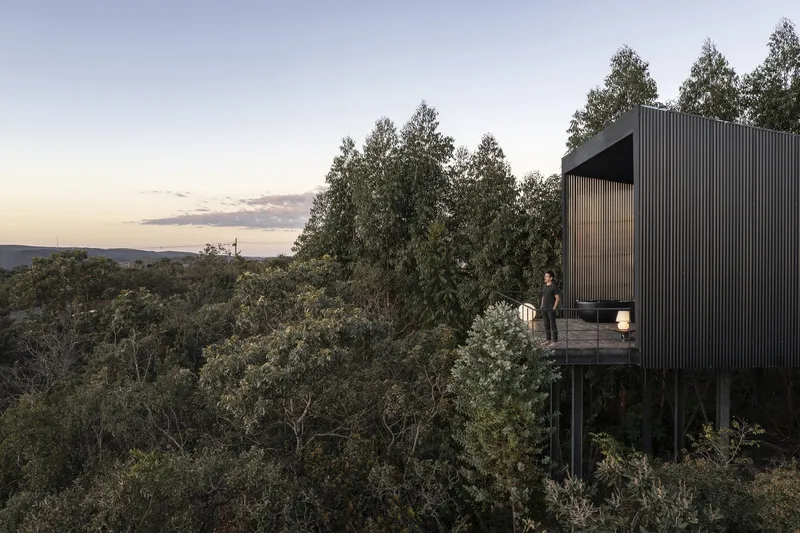
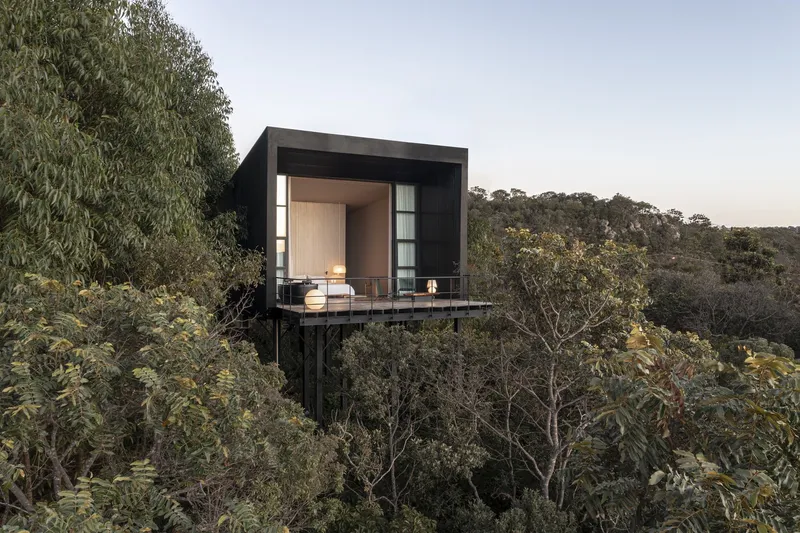
Seen from below at twilight, the Monocle House reads as a dark rectilinear mass detaching from the canopy, its corrugated metal skin absorbing the fading light while the illuminated deck glows underneath. The twelve steel columns are slender enough to almost disappear into the surrounding eucalyptus trunks and native bush, which is exactly the point. Chu's decision to elevate the structure this dramatically serves a double purpose: it preserves the pre-existing topography and vegetation completely, and it positions the living space at canopy level where the horizon opens up.
The proportions matter here. At only 40 m² of enclosed floor area plus 38 m² of deck, the cabin is small. But the five-meter elevation and the exaggerated scale of the glazed opening make the volume feel monumental from the outside. It is a building that punches well above its square meterage.
The Ascent as Prologue
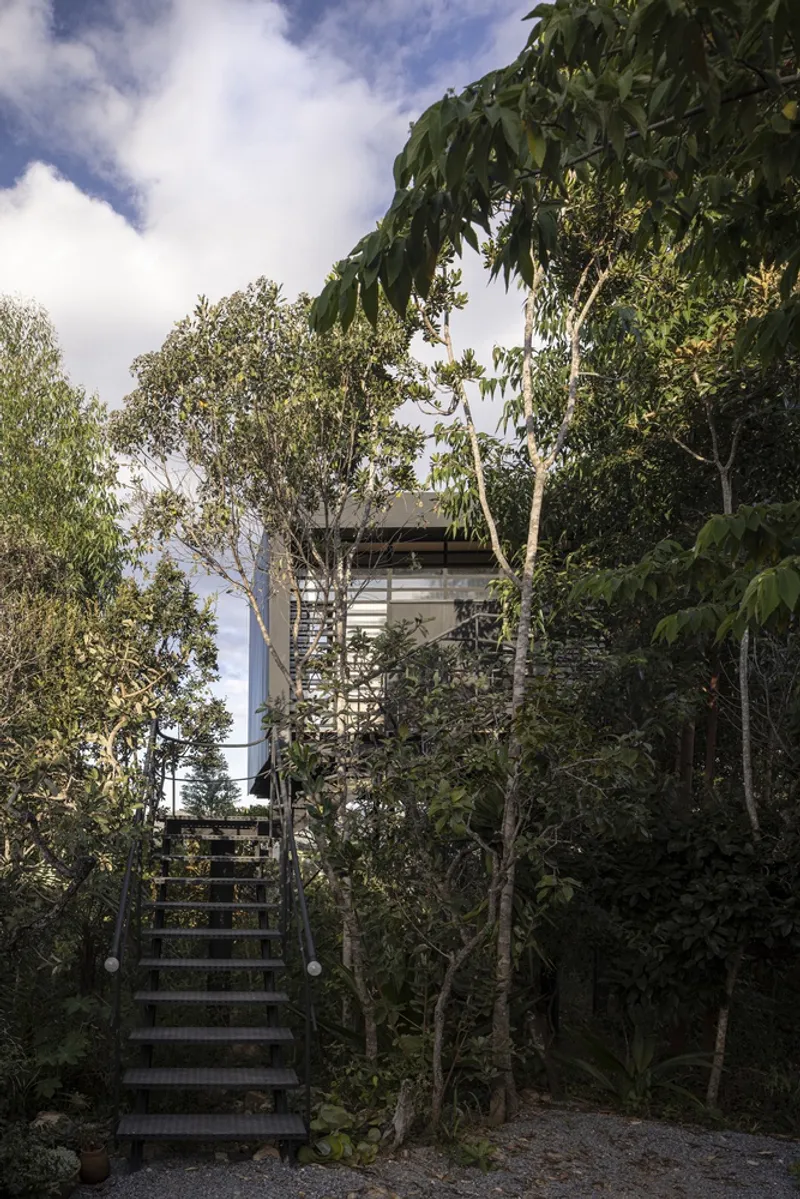
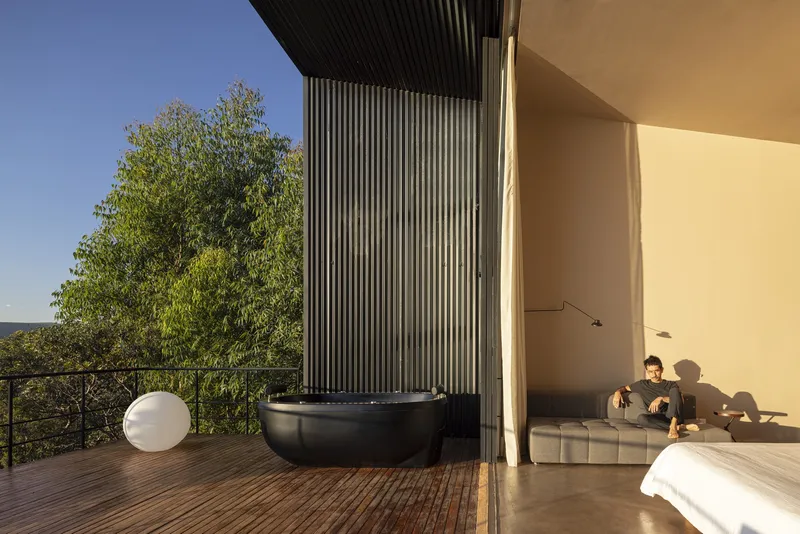
Access is through a winding steel staircase that threads upward through dense native bush and eucalyptus trunks. The approach is intentionally indirect and immersive. You are climbing through the landscape before you arrive at it. By the time you step onto the timber deck, your eye level has shifted from forest floor to canopy, and the psychological distance from the ground below is far greater than the literal five meters suggest.
The deck itself is generous, nearly the same area as the interior. On one side, a freestanding black bathtub sits against vertical metal cladding, oriented toward the golden hour sky. It is a deliberately theatrical gesture, and for an Airbnb property, it is the kind of image that earns its keep. But it also reinforces Chu's central argument: every element on this platform exists to frame an experience of looking outward.
Compression and Release
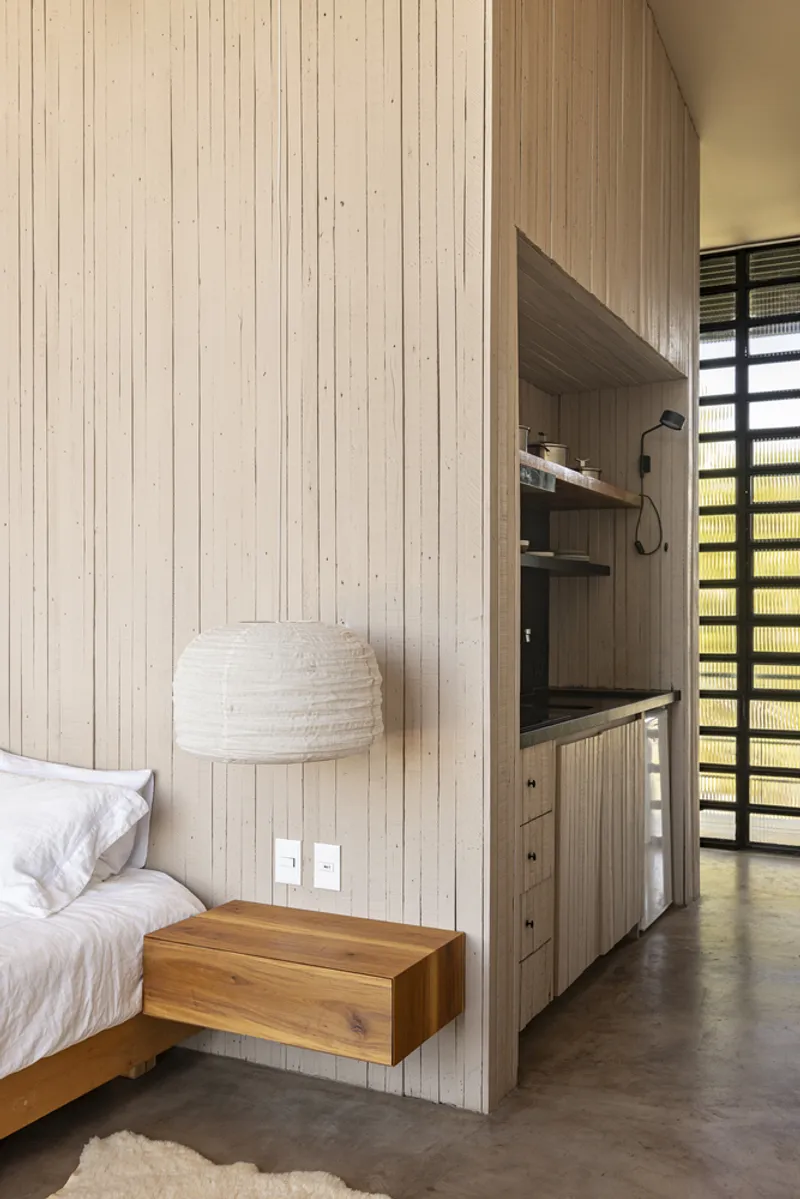
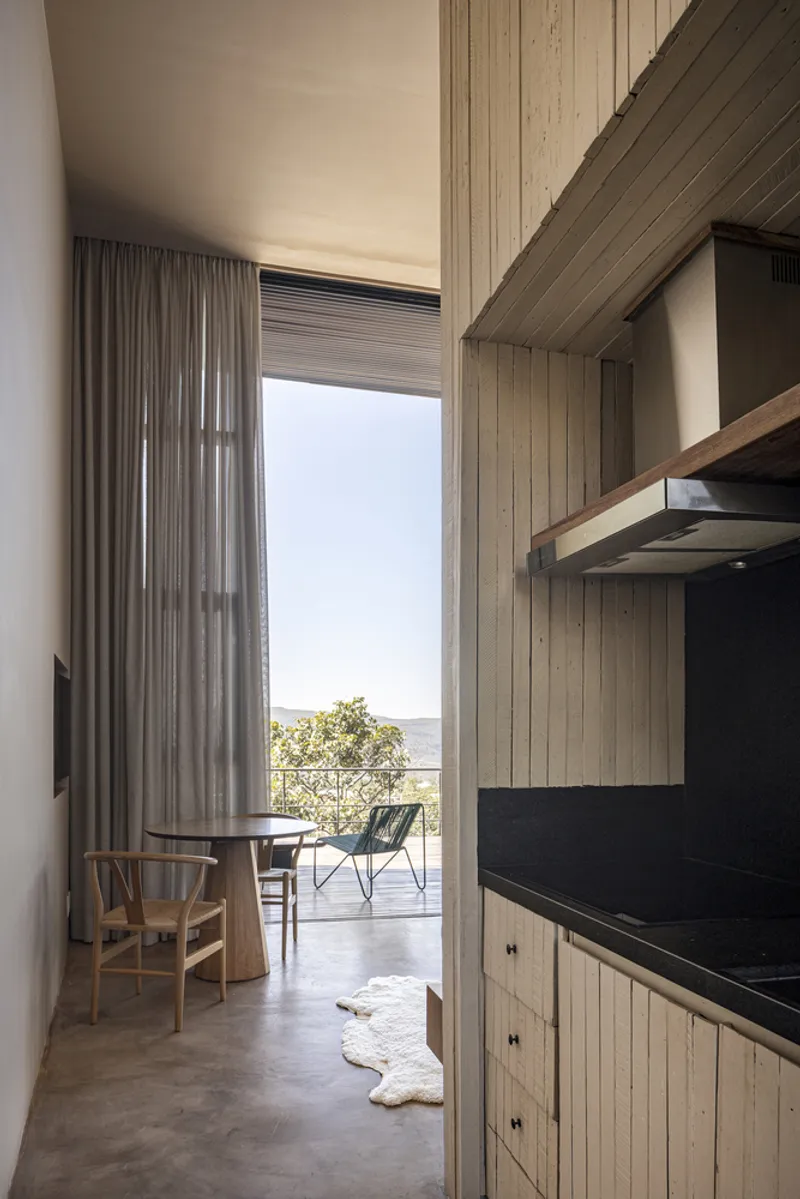
The interior spatial sequence is the project's most disciplined move. You enter through a low, compressed zone with a three-meter ceiling and encounter a central service volume that houses the bathroom and infrastructure. This opaque core forces you to navigate around it, creating a brief moment of visual suspense. Then the space opens to the full panoramic glazing, and the Cerrado landscape floods in.
The materials inside are kept deliberately restrained: pale timber paneling on the walls, a black countertop running along one side for the kitchenette, and translucent louvered windows for cross ventilation. None of it competes with the view. The bedroom, kitchen niche, and living area all share the single open volume, with the central core acting as the only solid partition. At 40 m², there is no room for spatial waste, and Chu wastes none.
What the interior photos reveal is how well the narrow end of the trapezoid works as a domestic space. The bedroom sits in the more enclosed portion, with softer, filtered light through the louvered panel. The living and kitchen end widens toward the massive opening, so the sensation of expansion builds as you move deeper into the house. That is the monocular logic made architectural: you look through the narrow end and the world grows.
The View as Program
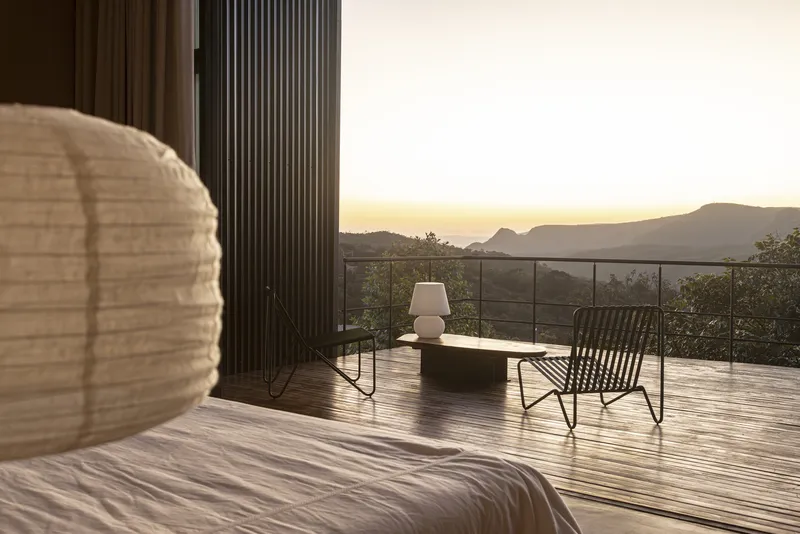
The timber deck terrace, with its glass railing and unobstructed sightline toward the mountains at sunset, is arguably the most important room in the house. Chu oriented the entire structure to face the rising sun behind the eastern mountain range, meaning that the primary architectural experience, the one the building is literally shaped around, happens at dawn. For a short-stay rental, this is a calculated decision: it gives guests a reason to wake up.
The glazed opening is not a window. At 6.5 by 4.3 meters, it is closer to a missing wall, and the forested hills visible through it become the dominant surface in the room. The black kitchen counter and dark framing elements act as a kind of vignette, darkening the edges of the field of vision so that the landscape beyond reads even brighter. It is a technique borrowed from photography and applied at the scale of a building.
Plans and Drawings
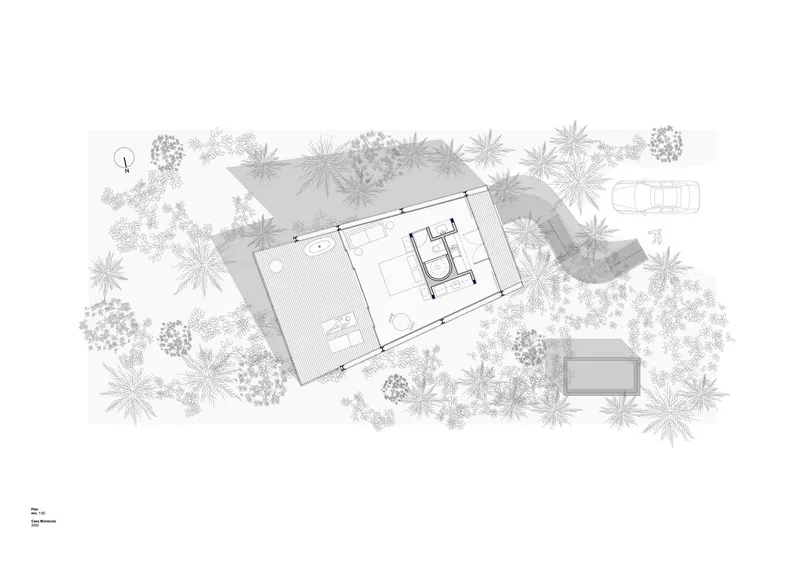
The site plan confirms how lightly the structure touches the ground. The rectangular footprint sits within a dense field of existing trees, with only a narrow access path and a small car parking area at grade. No trees were removed. The building's orientation, angled to capture the eastern sunrise, is clearly legible in the drawing, as is the proportional relationship between the compact interior and the expansive deck. Structural engineer Alberto Milhomem deserves credit for making twelve columns carry the whole thing with apparent effortlessness.
Why This Project Matters
The Monocle House belongs to a growing category of small, high-concept hospitality projects where the architecture itself is the attraction. What separates it from the pack is the rigor of its central idea. The monocular analogy is not decorative; it governs the plan, the section, the approach sequence, and the material palette. Every decision feeds back into the proposition that this building is a device for concentrating attention on a specific piece of landscape. That kind of conceptual discipline in a 78 m² Airbnb cabin is rare.
More broadly, the project demonstrates that ecological sensitivity and experiential ambition are not in tension. By lifting the structure entirely above the Cerrado, Chu avoids the usual trade-offs between building and landscape. The forest continues underneath, the topography stays intact, and the architecture gains its most powerful quality, the sensation of hovering inside the canopy, precisely because it refuses to disturb what was already there. It is a small building that thinks like a much larger one.
Monocle House by Alan Chu, located in Alto Paraíso de Goiás, Chapada dos Veadeiros, Brazil. 78 m². Completed 2023. Structural engineer: Alberto Milhomem. Photography by Joana França.
About the Studio
Share Your Own Work on uni.xyz
If projects like this are the kind of work you want to make, uni.xyz is a place to publish your own, find collaborators, and enter design competitions.


Popular Articles
Popular articles from the community


longwave studio Reorganizes a 112 m² Tainan Apartment Around the Daily Routines of a Family and Two Cats
In Tainan, Taiwan, birch plywood, rust-red furniture and a freestanding plaster wall link arrival, storage, work and family life in one apartment.

Jaramillo Van Sluys Arquitectura and Urbanismo Turn a Demolished Registry Lot in Quito into an Orchard Plaza
In Quito's Centro Histórico, a 2,800 m² plaza exposes the San Agustín convent wall and redraws its lost Augustinian orchard in volcanic stone.

GROUP A Strips a 1969 Rotterdam Harbor Headquarters to Its Frame and Wraps It in Timber Louvers
In Rotterdam's M4H harbor district, Ferro Offices reuses a 1969 frame, adds one timber storey and reaches BREEAM-NL Outstanding.

LT2A and OPEN Architectes Thread a Brick and Glass High School Through a Wooded Belgian Campus
In Braine-l'Alleud, a 3,000 m² wing for Collège Cardinal Mercier pairs pale brick with a glazed colonnade, deferring to a small chapel and a dense wood.

Similar Reads
You might also enjoy these articles


Hodi-Mandai Geram
Project Function: Preservation and revitalization of the Intangible heritage and socio-spatial identity of the Hodi by Housing, Cultural Memory Center, Sacred Grove, landscape, local tourism economy


Olio Towers: A Mid-Rise for Performers That Fuses Housing, Rehearsal, and Stage
Located blocks from Houston's Theater District, this modular tower stacks living units around a central performance atrium.

Oasis: Modular Green Housing Carved into Dhaka's Urban Fabric
A shortlisted Plugin Housing entry reclaims unauthorized settlements in Dhaka with stepped concrete volumes, green roofs, and ventilation-driven design.

Black Hole: A Floating Megastructure for the Post-Physical Era
Emiliano Mazzarotto envisions a spherical, self-scaling arena where e-sports, digital hotels, and holographic stadiums replace traditional public space.

Explore Architecture Competitions
Discover active competitions in this discipline

Challenge to reimagine the Iron Throne

Photograph architecture without architects

Illustrate the lost glory of Angkor Wat - Render Challenge

Design challenge to reuse E-waste
Comments (0)
Please login or sign up to add comments
No comments yet. Be the first to comment!