
Moon Hoon Stacks Eight Concrete Boxes into a Wave-Shaped House on Jeju Island
A neurosurgeon's family home in Seogwipo channels volcanic geology and Pacific Ocean swells through split-level concrete volumes.

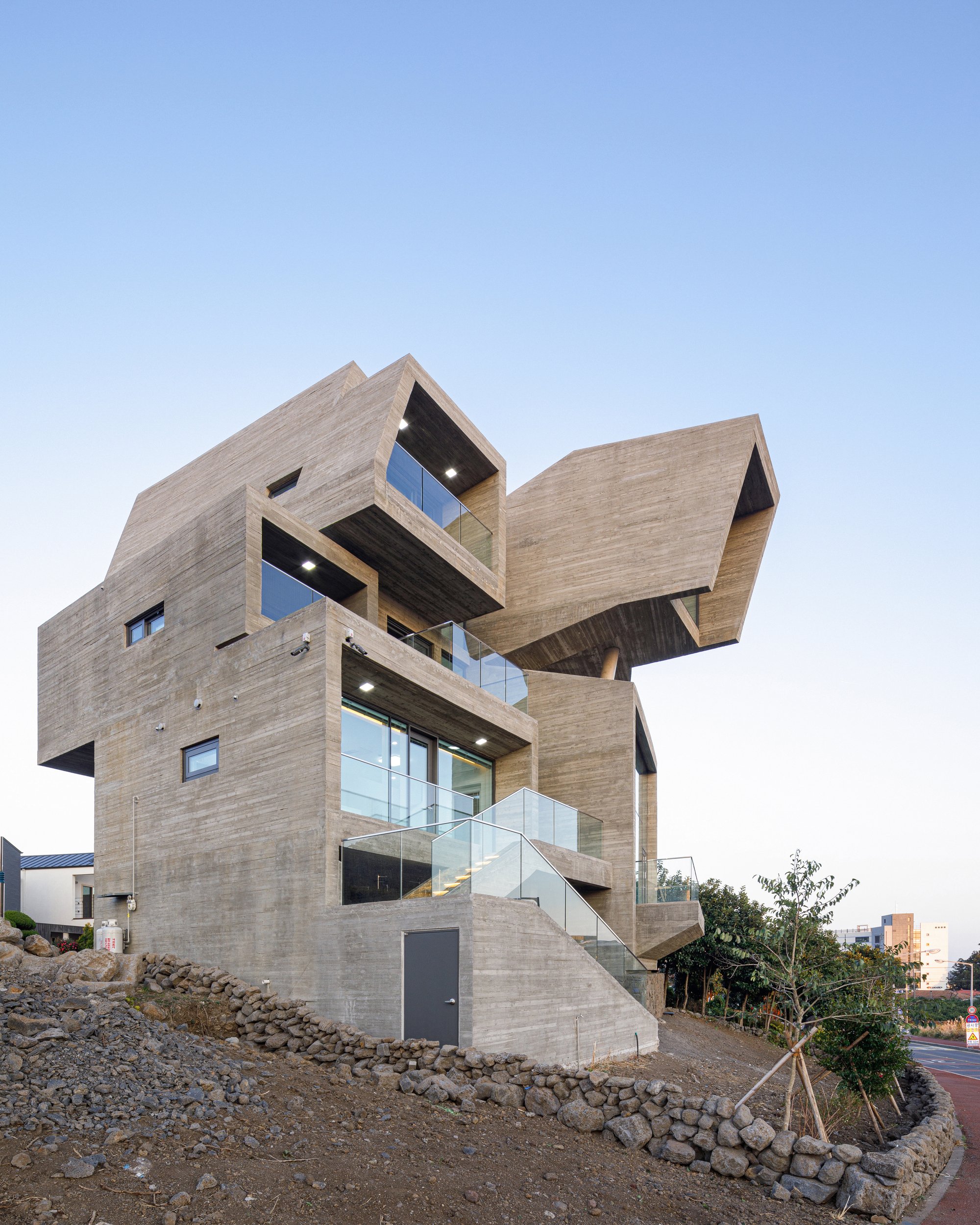
Jeju Island sits where volcanic rock meets the Pacific, and its architecture tends to hunker down against the wind. Moon Hoon's Pacific Residence in Seogwipo does the opposite. Eight angular concrete volumes are stacked, shifted, and cantilevered over a gentle hillside, producing a silhouette that reads less like a house and more like a geological event caught mid-formation. Built for a neurosurgeon and his family, the 155-square-meter home packs four bedrooms, a double-height living room, a kitchen and dining area, and a top-floor library into a vertical sequence of split levels connected by ramps and stairs.
What makes this project worth studying is how literally it takes its site. Moon Hoon describes the form as a counter-wave to the ocean, and the board-formed concrete deliberately echoes the basalt formations that define Jeju's coastline. Every room faces south for light and for the view, while a low basalt-stone wall at the entrance buffers the family against the island's notoriously strong winds. The material choice, wood-plank-textured exposed concrete, is not just aesthetic; it is a direct response to salt air and typhoon-grade gusts that would punish lighter cladding systems.
A Stack of Volumes on a Sloped Site
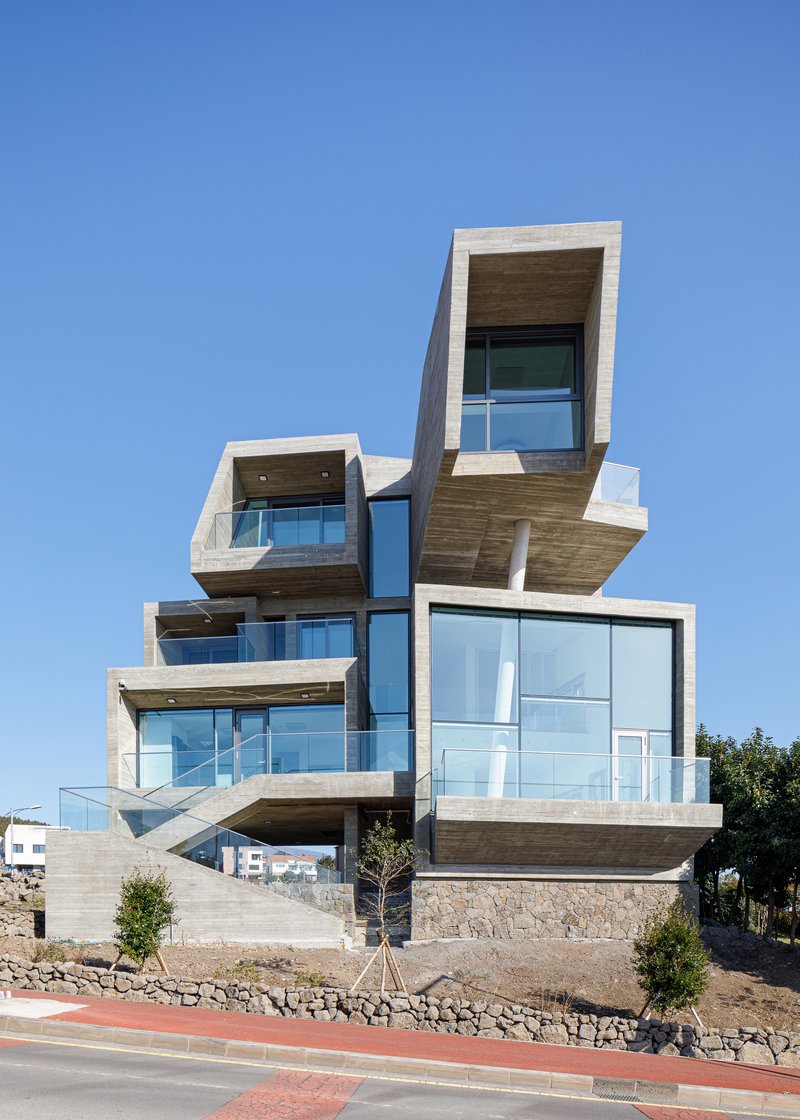
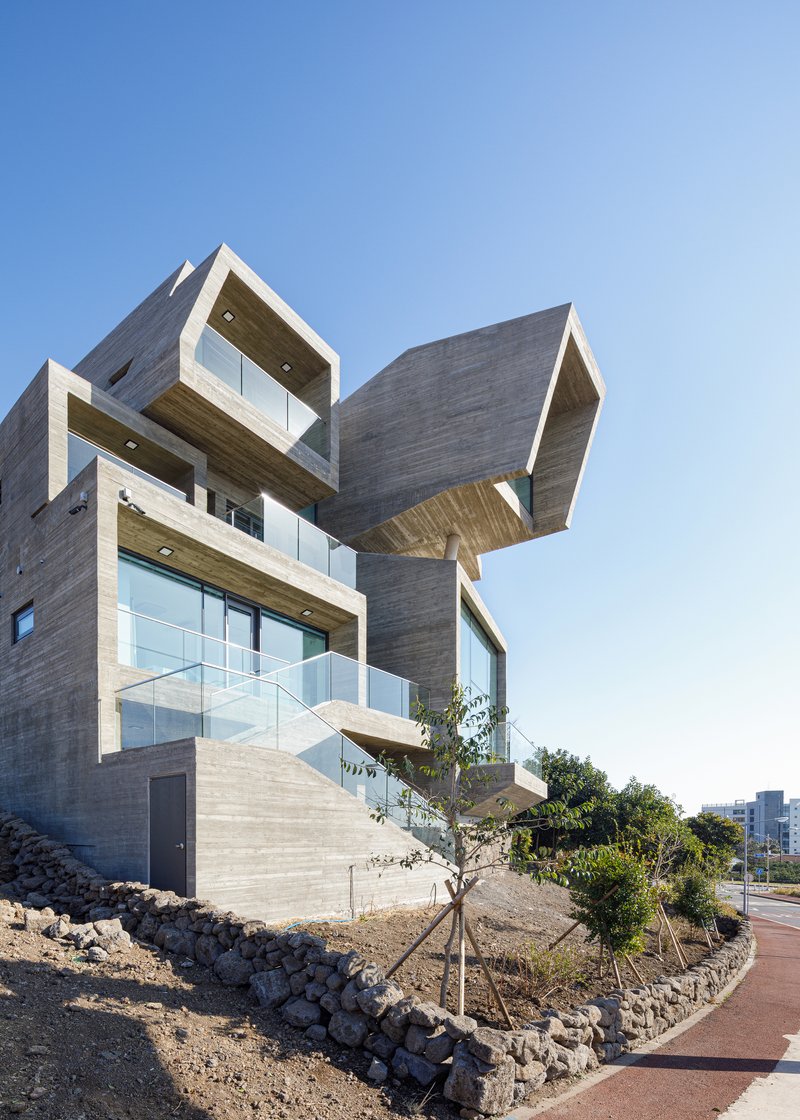
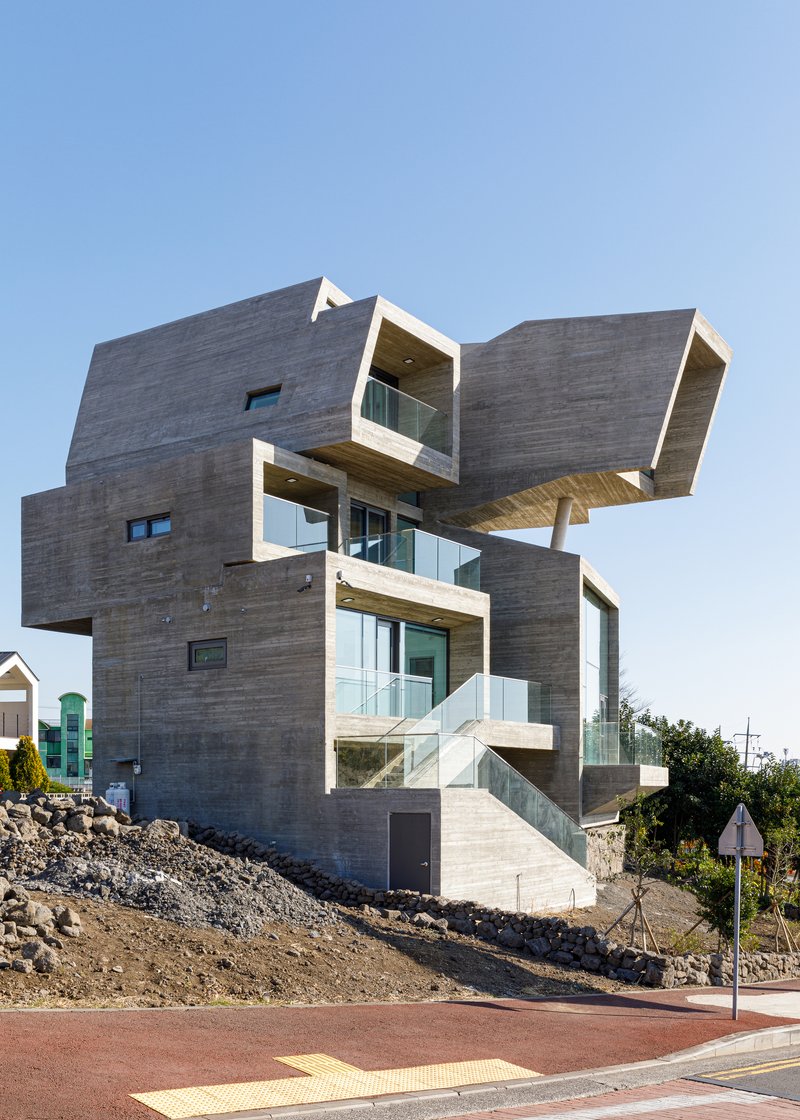
From the slope below, the house reveals its organizing logic most clearly. Each box is offset from the one beneath it, creating overhangs and recesses that shade glazed walls while generating balconies and terraces without any added structure. The site sits atop a small hill in a brand-new grid of house plots, and the vertical stacking gives the family views of both Hallasan (Jeju's dormant volcano) to the north and the Pacific to the south, a dual orientation that a conventional two-story plan could never achieve on a plot this compact.
Young trees and stone edging at the base ground the composition in the volcanic landscape. The basalt retaining walls at grade level are not decorative; they are Jeju's traditional answer to wind and erosion, repurposed here as a structural plinth for a decidedly untraditional house.
Board-Formed Concrete as Island Armor
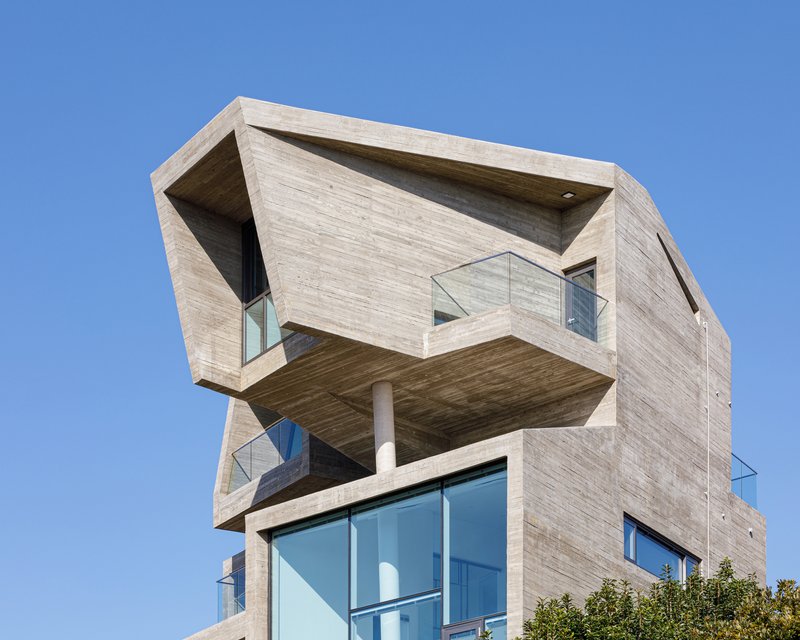
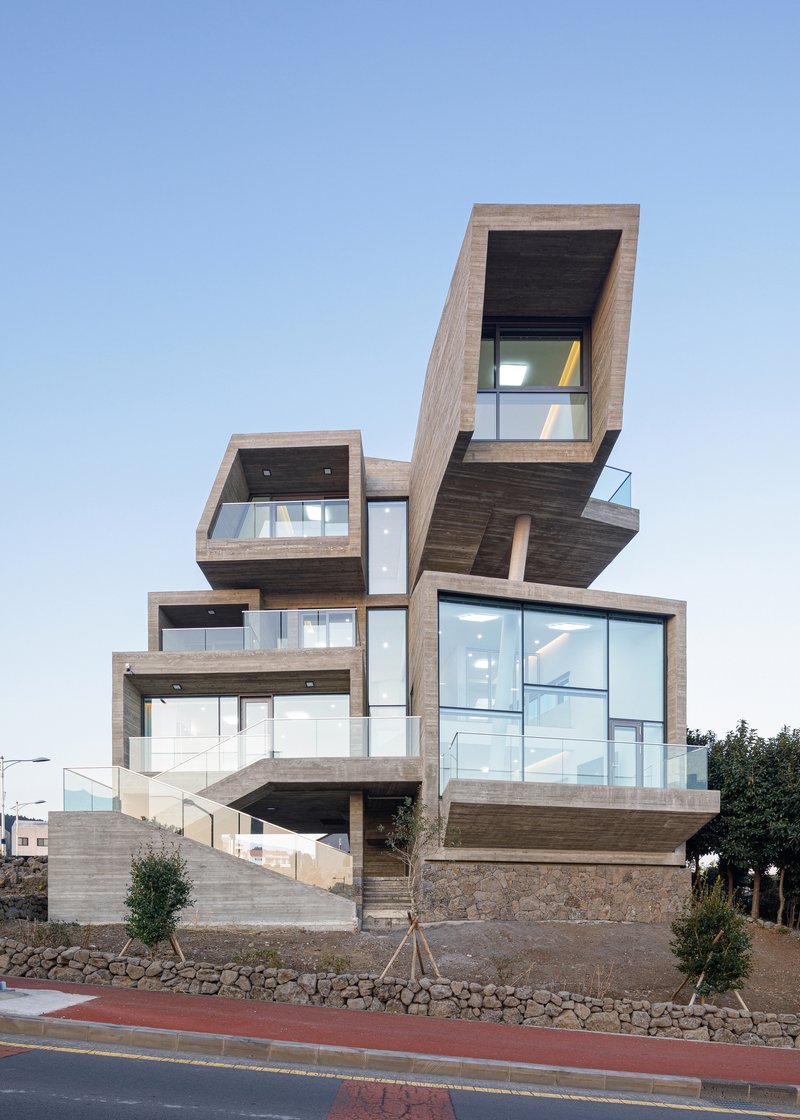
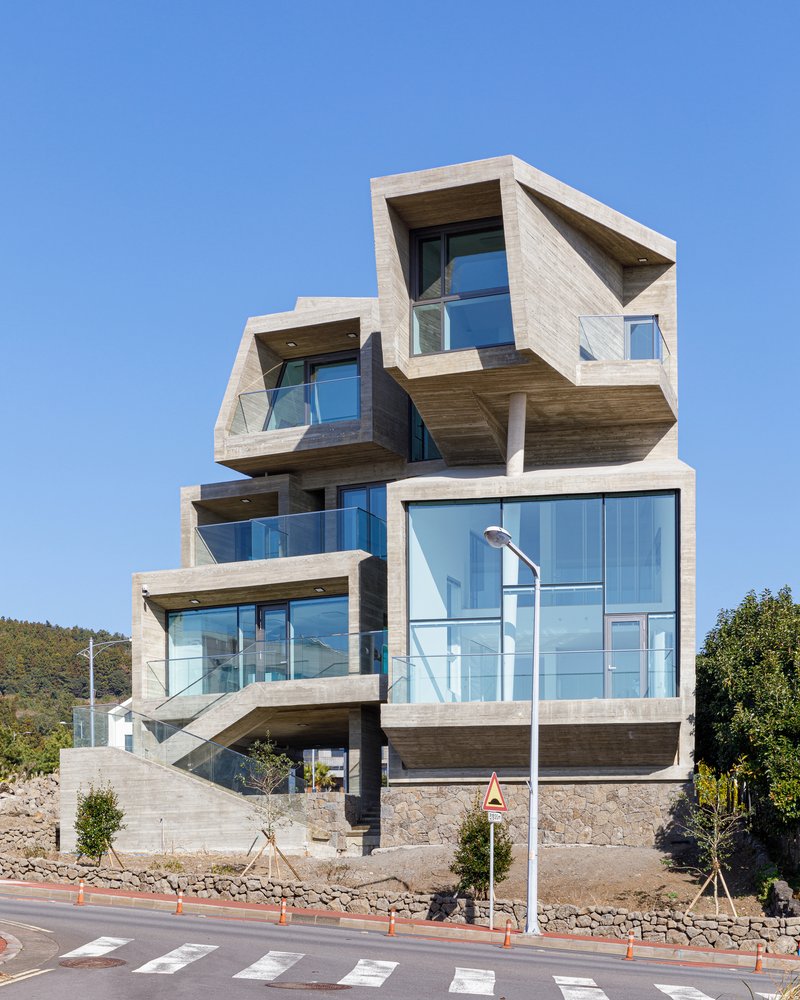
The wood-plank imprint on every concrete surface is Moon Hoon's signature move for his Jeju projects, and here it does triple duty. It gives the monolithic volumes a grain that catches light differently through the day, it helps the surfaces weather gracefully as salt and moisture work on them over the years, and it visually softens what would otherwise be a brutalist cliff of grey. The texture is most legible on the projecting balconies, where you can see the horizontal striations playing against the vertical proportions of the floor-to-ceiling glazing.
Glass railings on the cantilevered balconies are kept deliberately minimal so they disappear against the sky, letting the concrete do all the visual talking. The result is a house that looks heavy but feels open, anchored to the hillside yet projecting outward with real confidence.
The Dusk Facade and Street Presence
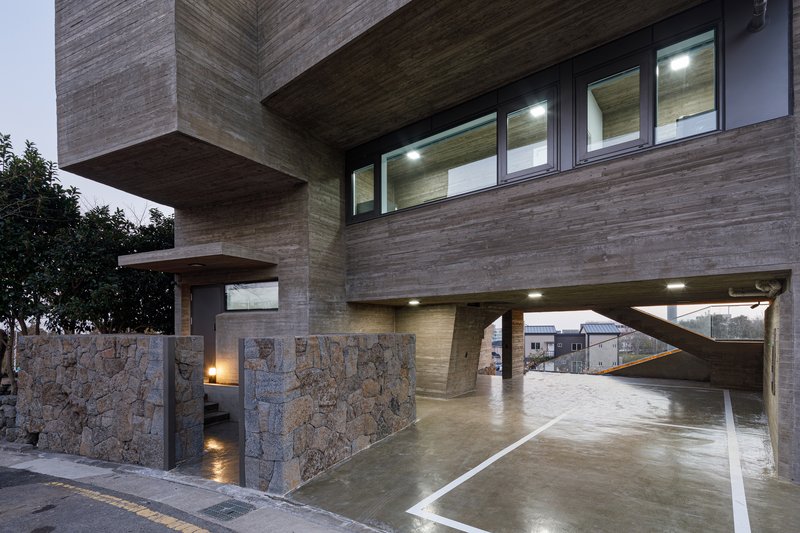
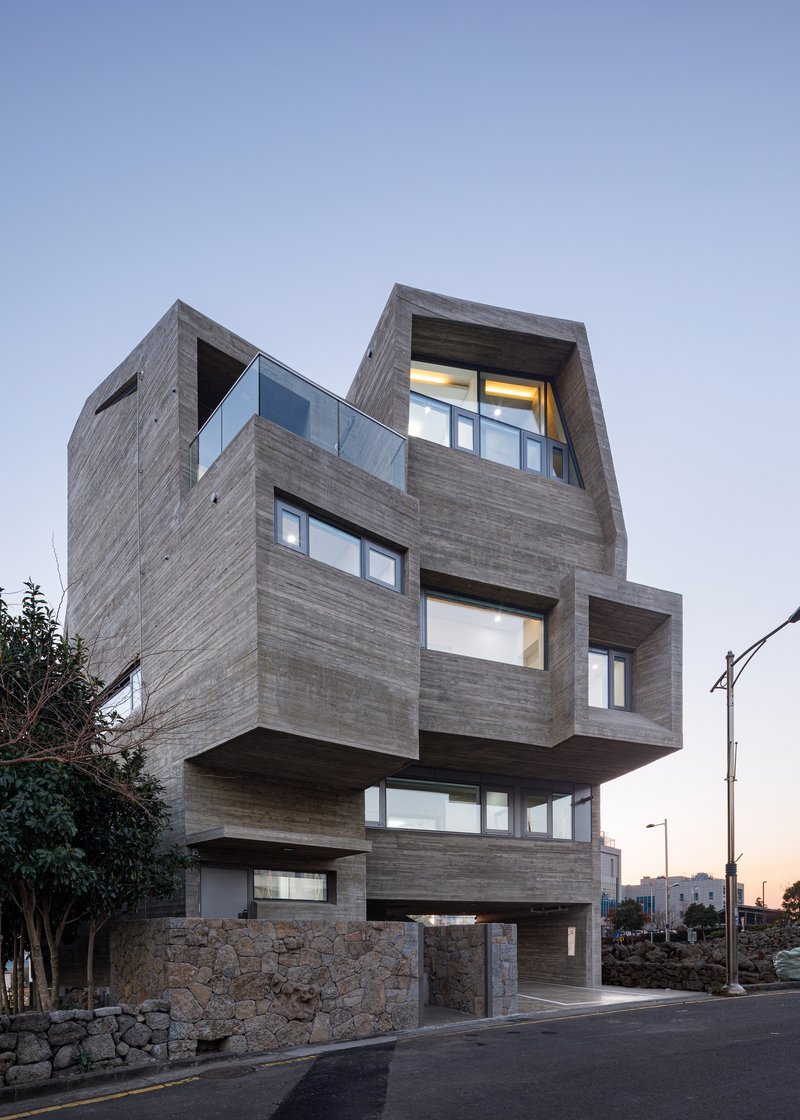
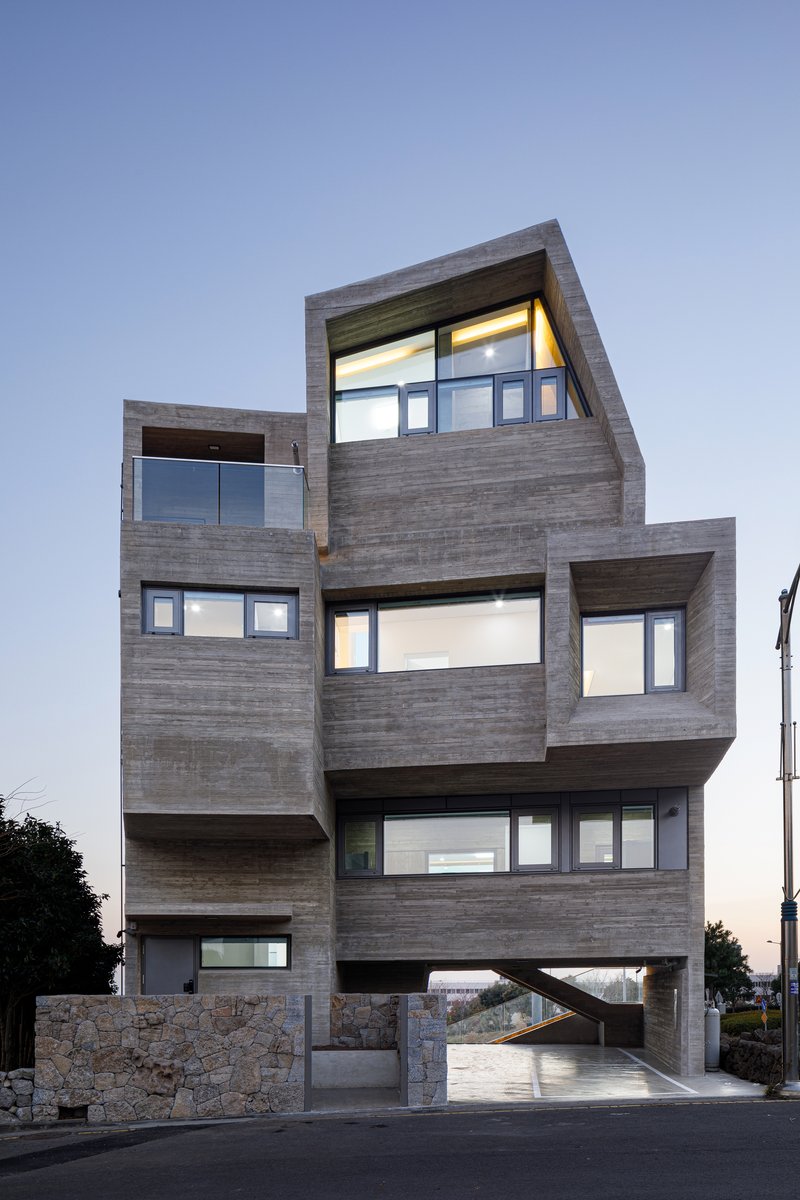
At twilight the house transforms. The timber-clad volumes on the street-facing side glow warm against the darkening sky, and the pilotis at the base create a hovering effect over the stone-clad retaining walls. Moon Hoon exploits the split between the concrete ocean-side expression and a softer, wood-toned street facade. It is a house with two faces: one bracing itself against the Pacific, the other greeting its neighbors in a residential Seogwipo street.
The ribbon windows on the street side are proportioned to admit light while maintaining privacy from the sidewalk, a practical distinction from the full-height glazing on the south-facing rooms. LED step lighting embedded in the exterior staircase activates at dusk, tracing the path between volumes like a luminous spine.
Illuminated Edges at Twilight
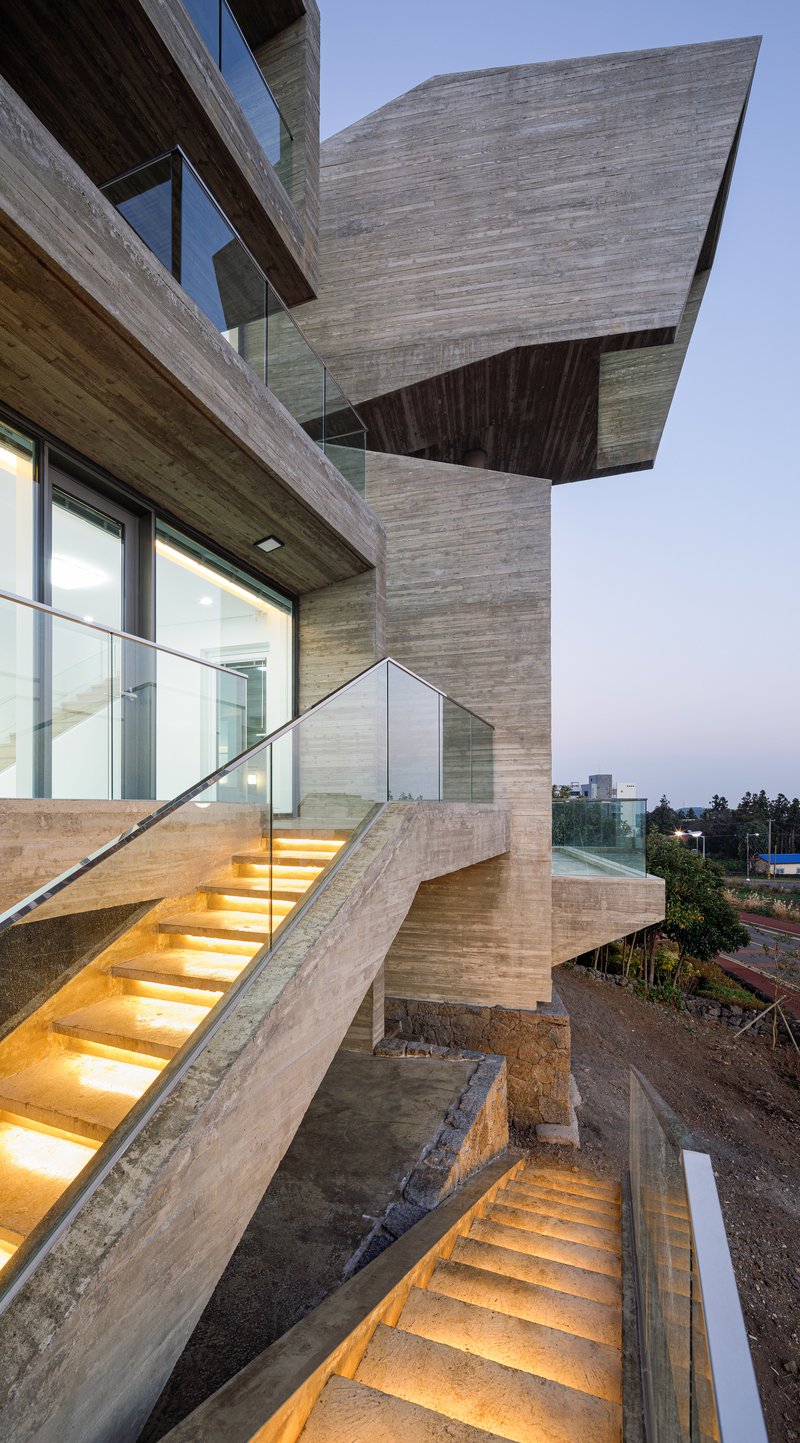
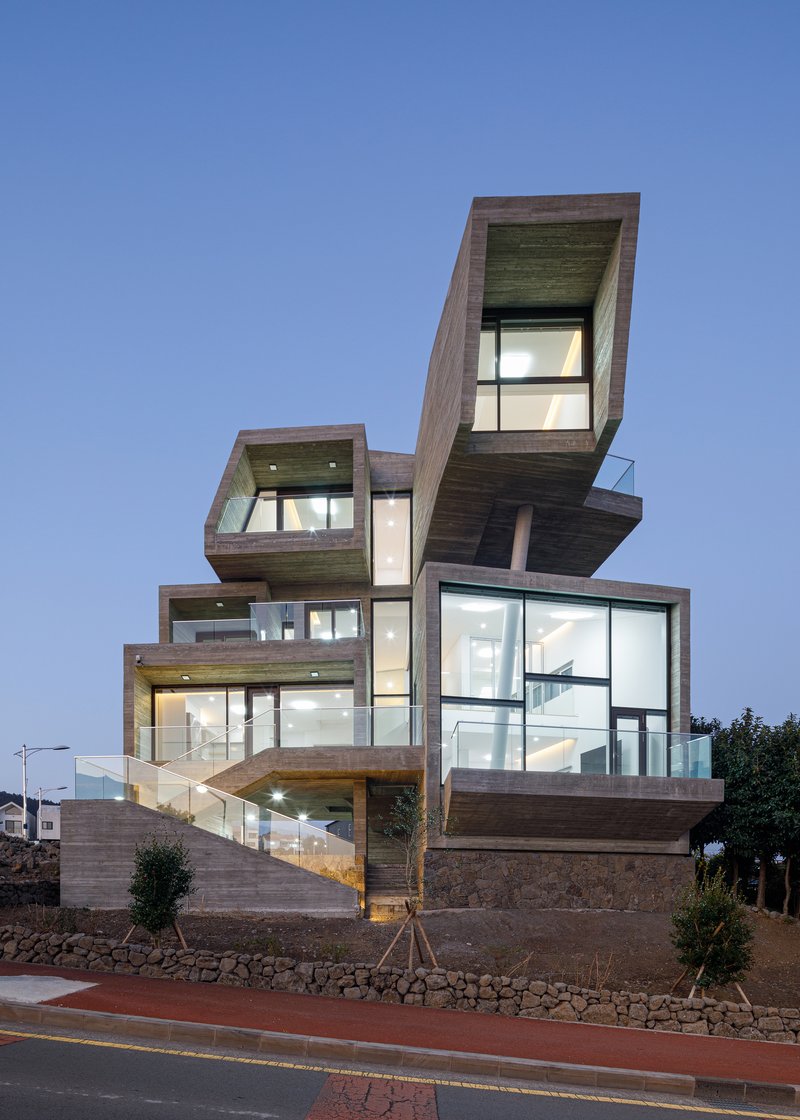
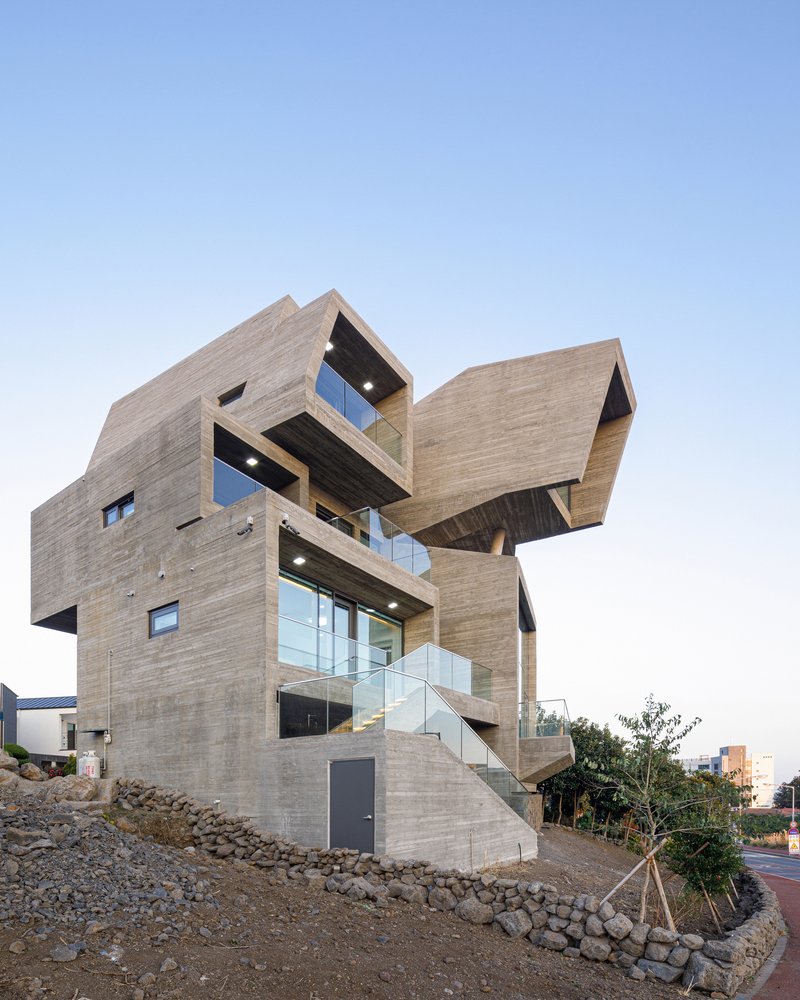
The exterior staircase between cantilevered volumes is one of the project's best moments. Ascending between concrete walls with integrated LED risers, it turns a simple circulation element into an architectural event, a vertical canyon lit from below. At twilight, when the concrete softens to a warm grey and the interior lights begin to leak through the glazing, the stacked volumes read as a lantern on the hillside.
Double-Height Living and Split-Level Flow
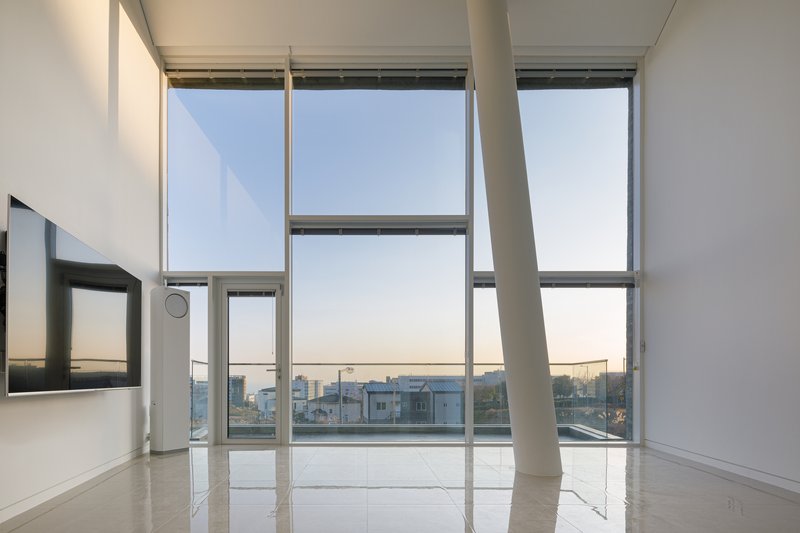
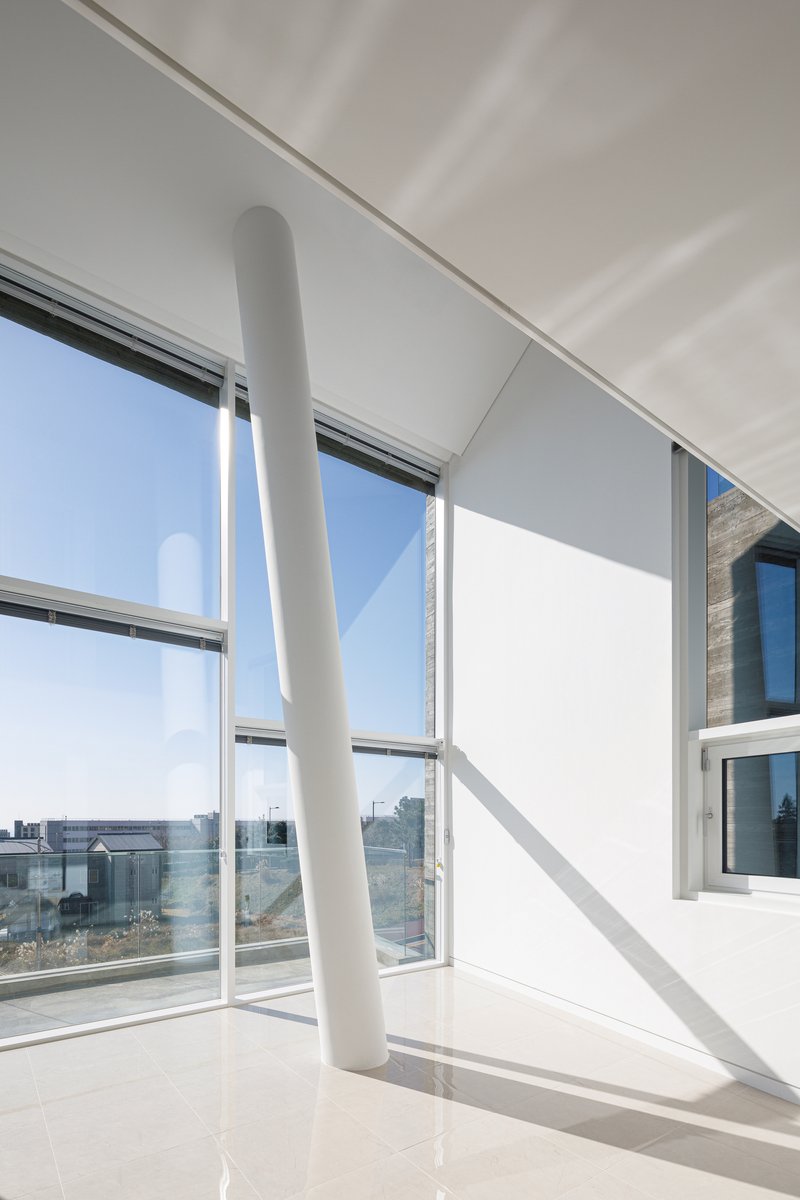
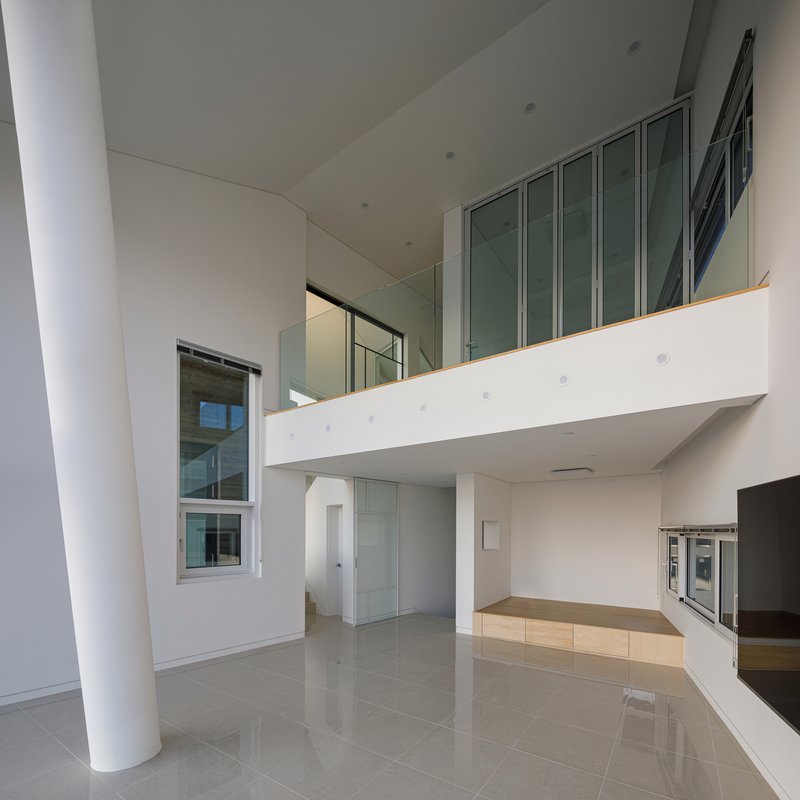
Inside, the spatial sequence is driven by continuous vertical movement. The double-height living space is the heart of the house, anchored by a white cylindrical column that carries loads from the library above while marking the transition between the ground-level social zone and the upper bedrooms. Floor-to-ceiling aluminum-framed windows frame a panorama of Seogwipo's rooftops at sunset, pulling the landscape into the room with no visual barrier.
A mezzanine gallery overlooks the living room, creating spatial generosity that belies the house's modest 155-square-meter footprint. The kitchen and dining area are accessed by ascending a short flight of steps from the living space, reinforcing the wave-like choreography Moon Hoon intended: you are always either climbing or descending, never standing still.
Ramps, Stairs, and Clerestory Light
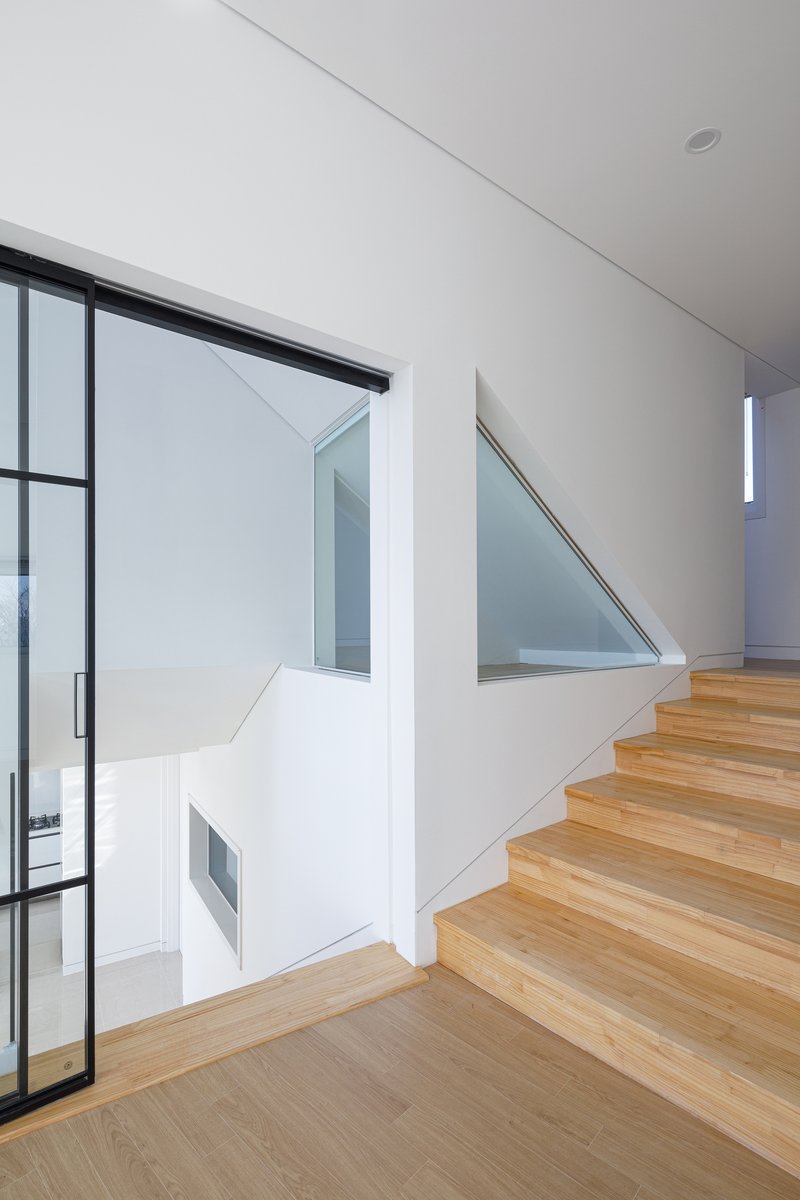
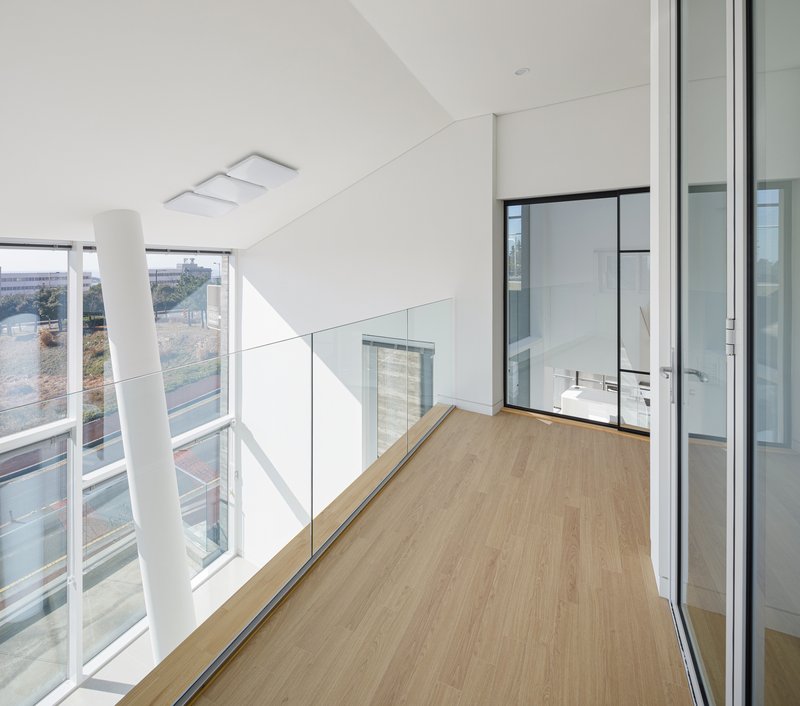
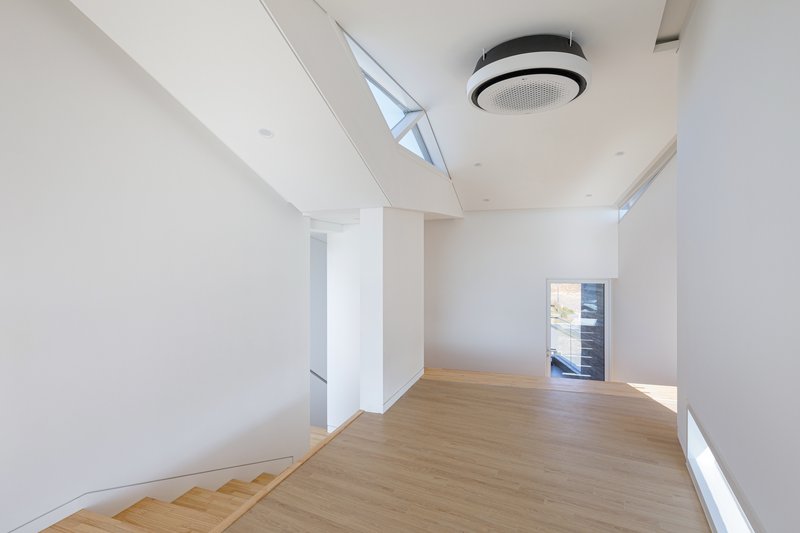
The timber staircase threading between white walls and steel-framed glass partitions is where Moon Hoon's playfulness is most visible. Triangular clerestory windows punch unexpected daylight into landings and corridors, creating bright moments where you would normally expect dim transition zones. The upper-level corridor, with its glass balustrade overlooking the double-height living space, turns everyday movement through the house into a kind of promenade architecturale.
Timber flooring on the upper levels contrasts with polished tile below, signaling the shift from communal to private zones. The cylindrical columns reappear at the top-floor landing beneath a sloped ceiling, hinting at the library that occupies the crown of the house. That room, with its stepped seats on the north side, opens to a balcony facing Hallasan, giving the family a retreat that is simultaneously the highest and most sheltered space in the building.
Interior Detail and the White Column
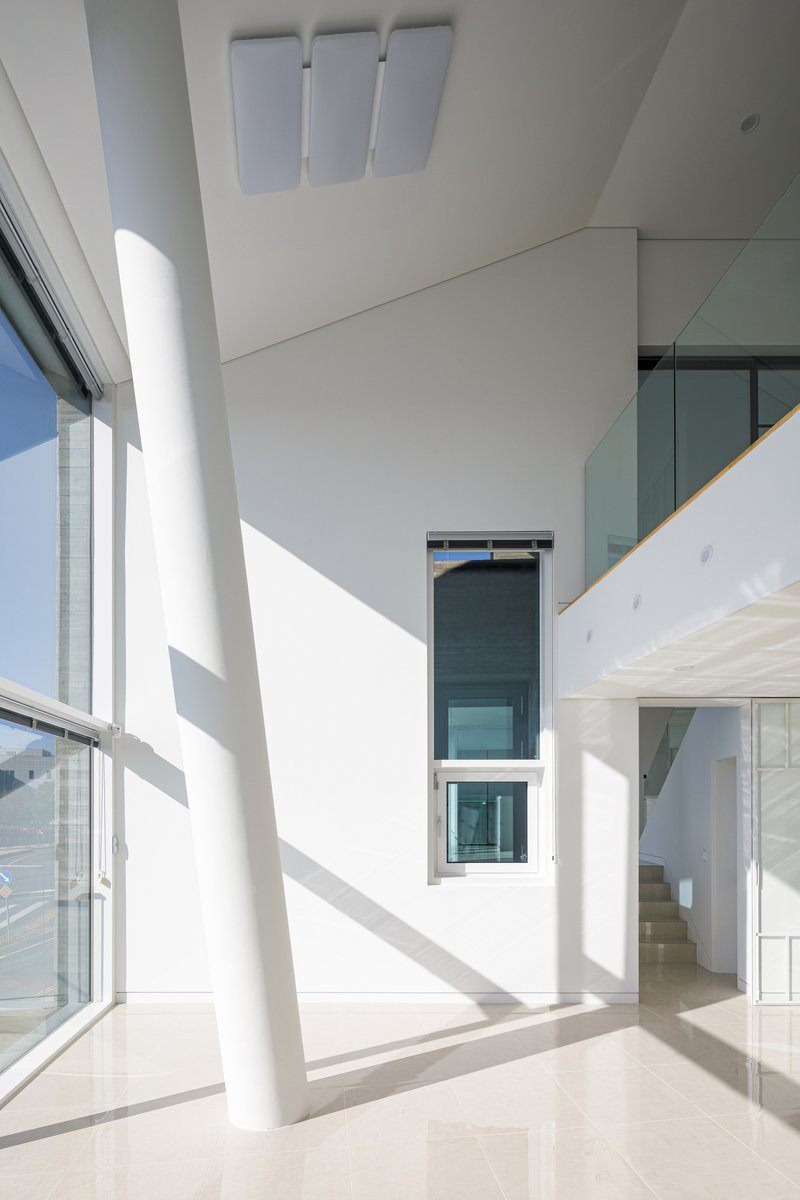
A recurring motif: the white cylindrical column appears at critical junctions throughout the house, marking the points where structural loads transfer between offset volumes. In most residential projects columns are hidden inside walls or apologized for. Here they are celebrated, left freestanding and painted bright white against the warm timber and concrete around them. They function almost like exclamation points, reminding you that this house's acrobatic form is real structure, not just sculptural gesture.
Why This Project Matters
The Pacific Residence is a reminder that small houses can be spatially ambitious without being gratuitously complex. At 155 square meters, the program is ordinary: bedrooms, a kitchen, a living room, a library. What elevates the project is Moon Hoon's insistence on treating vertical circulation as the primary design tool. Every room sits at a different level, every view is earned by movement, and every material choice, from the board-formed concrete to the basalt retaining walls, is calibrated to a specific island condition. There is no generic detailing here.
More broadly, the house demonstrates how to build assertively on a volcanic island without ignoring its forces. The form may look exuberant, but the concrete armors the family against salt and wind, the split levels maximize views on a tight plot, and the dual-facade strategy (concrete to the ocean, timber to the street) shows genuine sensitivity to context. Moon Hoon's reputation for playfulness sometimes overshadows his pragmatism. The Pacific Residence should correct that.
Pacific Residence by Moon Hoon (Architects of Record: KJY Architects). Seogwipo, Jeju Island, South Korea. 155 m². Completed 2022. Photography by Kim Chang Mook.
About the Studio
Share Your Own Work on uni.xyz
If projects like this are the kind of work you want to make, uni.xyz is a place to publish your own, find collaborators, and enter design competitions.




Popular Articles
Popular articles from the community

Reincarnation Weaves a Three-Story Retreat into the Green Landscape of Rural Bangladesh
Ara Manor in Narsingdi dissolves the line between domestic architecture and its lush surroundings through screens, courtyards, and planted rooftops.
Eco Chapel: A Green Architecture Pavilion Designed in Symbiosis with the Forest
Eco Chapel uses green architecture to weave prayer, learning and reuse into a forest pavilion shaped by modular hexagonal canopies for life.
Inside a Timeless Mumbai Residence by Aether Studio
Aether Studio's 2,250 sq ft apartment in Malad, Mumbai uses marble, brass, boucle, and disciplined restraint to build a quiet retreat from the city.
PLATAFORMArq Folds a Concrete Roof Over the Portuguese Mountains in House #474
A 220-square-meter residence in Teixoso, Portugal, wraps board-formed concrete into an angular canopy that frames the Serra da Estrela foothills.


Similar Reads
You might also enjoy these articles

Freebird Residence by Alexis Dornier: A Tropical Modernist Sanctuary in Bali
Floating living pavilion above pool anchors H-shaped tropical villa, blending Japanese minimalism, sustainable strategies, lush landscape, and sculptural interiors.
127af Flips a Tiny Bagnolet Rowhouse Upside Down with a Handcrafted Roof Extension
A 55-square-meter terraced house on the edge of Paris gains a luminous upper living floor through lightweight timber and steel.
1.61 Design Workshop Wraps a 600-Square-Meter Café in Vietnam in Sculptural Burgundy Drama
Reden Café & Bistro pairs a helical staircase, mosaic floors, and deep red interiors to rethink Vietnamese hospitality space.

The Unbound Brain: A School Shaped by Cognitive Architecture
Cylindrical learning pods radiate like neurons from a central cortex, turning the floor plan into a spatial model of human thought.


Explore Residential Building Competitions
Discover active competitions in this discipline




The International Standard for Design Portfolios


The Global Benchmark for Architecture Dissertation Awards


The Global Benchmark for Graduation Excellence


Challenge to design mud housing for contemporary communities
Comments (0)
Please login or sign up to add comments
No comments yet. Be the first to comment!