
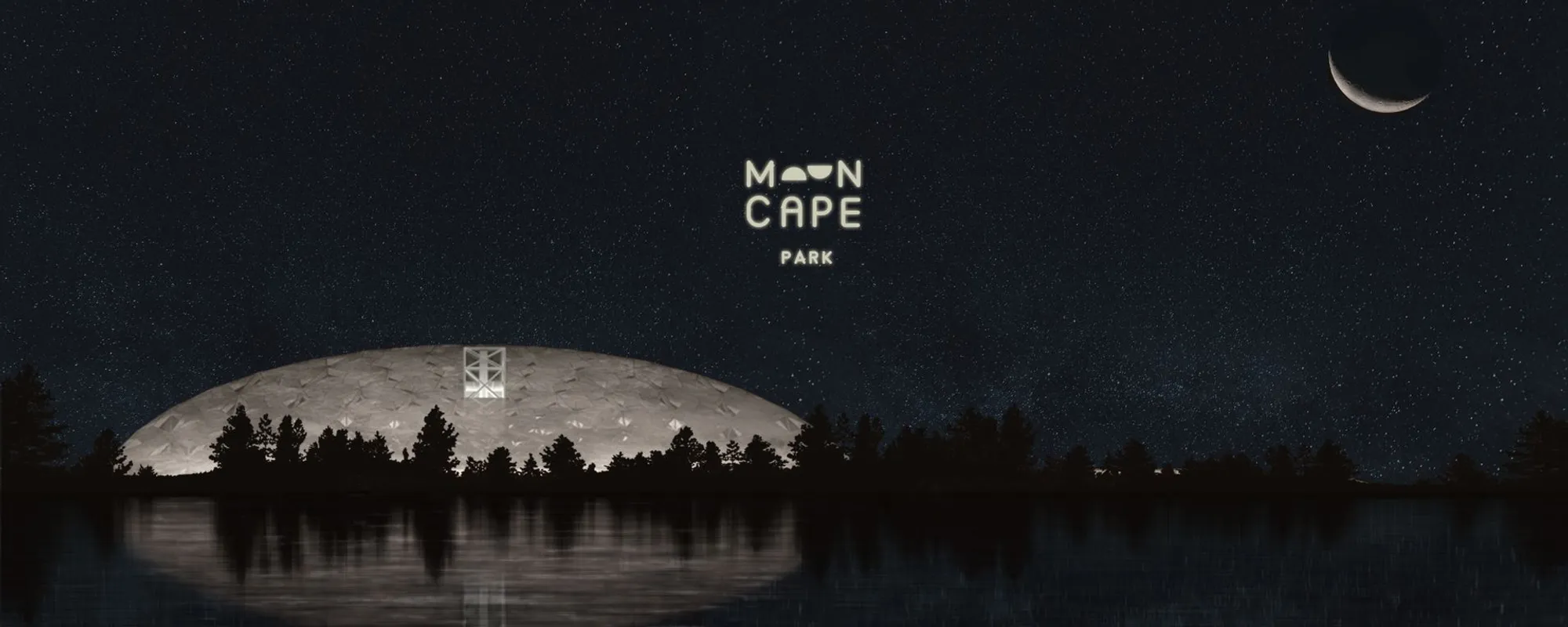
MoonCape Park: Where Lunar Landscapes Meet Sustainable Playgrounds for Children
An honorable mention in Moontrip 2019, this children's park fuses lunar-inspired play spaces with solar power, rainwater harvesting, and recycled materials


What if a children's park could teach kids about the moon while running entirely on sustainable systems? MoonCape Park takes that question seriously, proposing an interactive landscape where lunar-inspired playgrounds sit alongside solar-powered lighting, rainwater harvesting infrastructure, and structures built from recycled construction materials. The result is a piece of architecture that treats sustainability not as a checkbox but as part of the story it tells.
Designed by Giuseppe De Guglielmo, MoonCape Park received an Honorable Mention in the Moontrip 2019 competition. The project imagines a park built primarily for children, combining simulated moon-walking activities with educational installations about the history of lunar missions and the technology behind space travel. It positions itself as both a civic landmark and a pedagogical tool, grounded in eco-friendly materials and energy-efficient systems.
A Dome on the Horizon: Anchoring the Park in Its Landscape
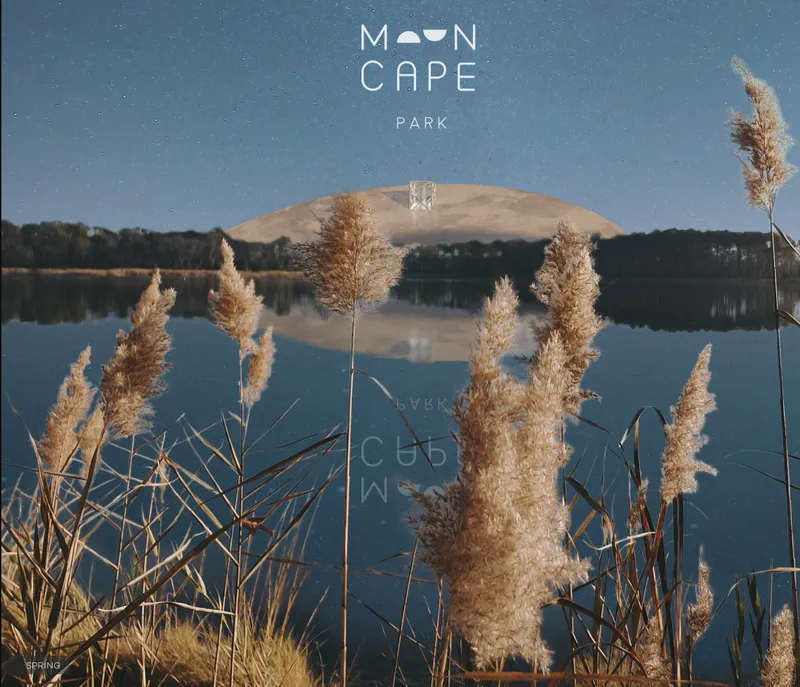
Seen from across a lake with ornamental grasses blurring the foreground, MoonCape Park's dome structure reads as a quiet anomaly on the far shore. The siting is deliberate: the dome's curved silhouette evokes a lunar surface rising from an otherwise familiar landscape. Rather than dominating the terrain, the structure invites discovery. You notice it in the distance and want to walk toward it. That pull, from curiosity to approach, mirrors the park's broader educational ambition.
Glass Walls and Angled Canopies: Framing the Sky
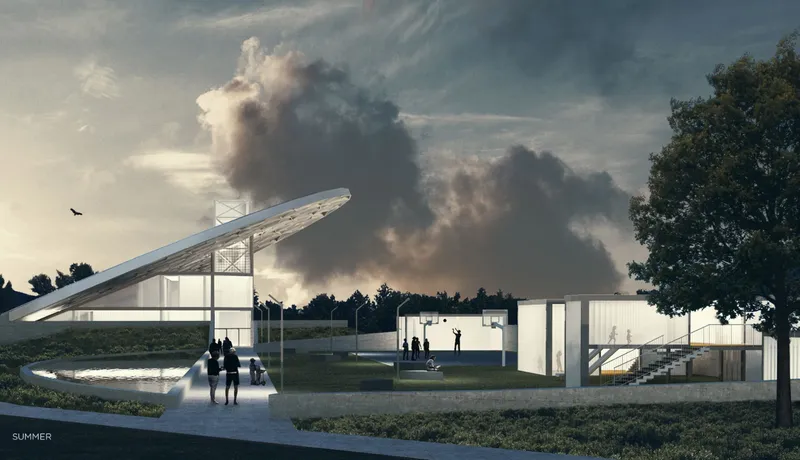
The pavilion's angled canopy roof and glass walls work in tandem. The canopy shelters visitors while directing their gaze upward toward dramatic sky conditions, reinforcing the park's thematic connection to space. Glass walls dissolve the boundary between interior exhibits and the surrounding landscape, allowing natural light to flood the educational installations inside. This transparency also makes the building legible to children: they can see activity happening before they enter, lowering the threshold between play and learning.
Corrugated Metal and Concrete: Materials That Invite Play
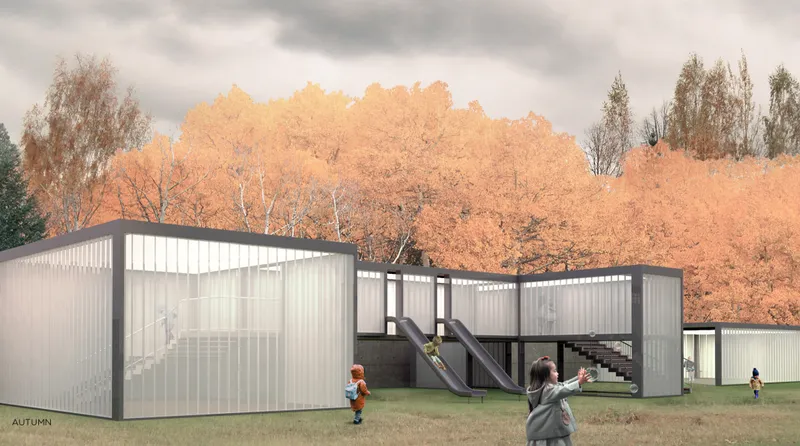
A cluster of corrugated metal volumes sits on a concrete base, connected by exterior stairs that children treat as part of the playground itself. The rendering captures an autumn scene with kids in motion, and the material palette reinforces the project's sustainable credentials. Corrugated metal and concrete are durable, recyclable, and low-maintenance, qualities that matter for a public facility designed for heavy use by young visitors. The volumes' angular geometry also echoes the fragmented topography of a lunar surface, keeping the narrative consistent without resorting to literal mimicry.
The Triangulated Dome: A Year-Round Presence
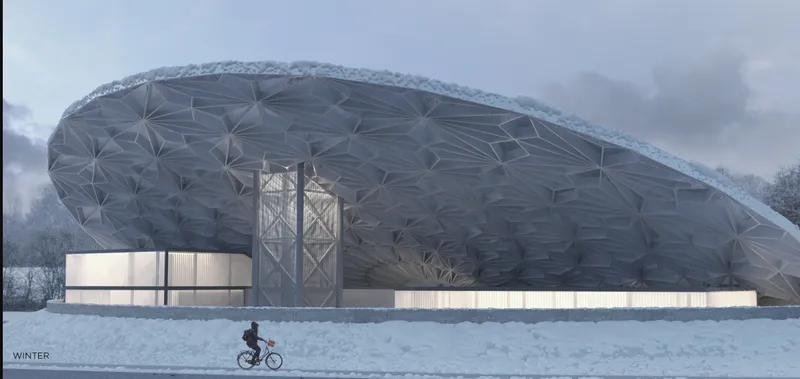
The side elevation reveals the full structural logic of the dome: a triangulated shell supported by a cylindrical service tower. Rendered in winter with snow on the ground and a cyclist passing, the image demonstrates that the park is conceived as a year-round civic space, not a seasonal attraction. The triangulated shell distributes loads efficiently while creating an unmistakable profile against the winter sky. The service tower likely houses the mechanical systems that support the park's energy-efficient operation, including its solar power infrastructure.
Why This Project Matters
MoonCape Park succeeds because it refuses to separate education from experience. Too many children's learning environments feel like classrooms with decorations. Here, the architecture itself teaches: the dome tells a story about lunar geometry, the materials demonstrate sustainable construction, and the landscape staging encourages the kind of curiosity that lunar exploration once demanded of an entire generation. The interactive exhibits on mission history and space technology are embedded within a structure that practices what it preaches about environmental responsibility.
De Guglielmo's Honorable Mention in Moontrip 2019 recognizes a project that balances ambition with practicality. The sustainable systems, from solar-powered lighting to rainwater harvesting to recycled construction materials, are not afterthoughts but integral design drivers. For a competition that asked entrants to reimagine our relationship with the moon, MoonCape Park offers a grounded answer: build something on Earth that makes children want to look up.
View the Full Project
About the Designers
Designer: Giuseppe De Guglielmo
Enter a Design Competition on uni.xyz
uni.xyz runs architecture and design competitions year-round that reward proposals with spatial conviction and real site intelligence.
Project credits: MoonCape Park by Giuseppe De Guglielmo Moontrip 2019 (uni.xyz).



Popular Articles
Popular articles from the community


Co-Life: Senior Housing Design That Reconnects Older Adults With the City
Co-Life reimagines senior housing design through healing gardens, shared streets, workshops, and a sustainable community across generations.

The Ocean Hive: Sustainable Architecture for a Self-Sufficient Civilization at Sea
The Ocean Hive imagines sustainable architecture at sea, where modular habitats, algae, wave power and ocean waste sustain a growing colony.

The Earth Pod: 3D Printed Homes for Resilient Refugee Communities
The Earth Pod reimagines refugee housing through 3D printed homes made from clay, combining resilience, self-sufficiency, and rapid shelter.

Hill & Cross Opera: Sculptural Opera House Architecture Shaped by Tallinn’s Landscape and Identity
Hill & Cross Opera reimagines opera house architecture in Tallinn through its sculptural hill, civic plaza, glass wave and a luminous cross.


Similar Reads
You might also enjoy these articles

Day and Night Park: A Time-Based Urban Newsstand in Beijing
A temporary urban newsstand in Beijing blending travel, light, and reading through poetic colors, compact form, and community-focused design.

Modernist Patio Renovation in El Masnou, Barcelona by Oliver Segura Arquitectura + Cebrià Arquitectura
Modernist patio renovation blending tradition and innovation with a movable pool, leveled floors, and Catalan materials in El Masnou.
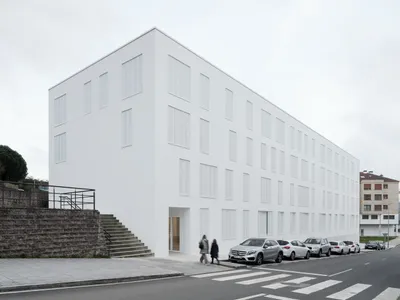
Alto Residencial Coop: Cooperative Housing Development in Santiago de Compostela by Carbajo Barrios Arquitectos
A linear cooperative housing complex blending white volumes and perforated metal façades, enhancing community living, natural light, privacy, and urban integration.
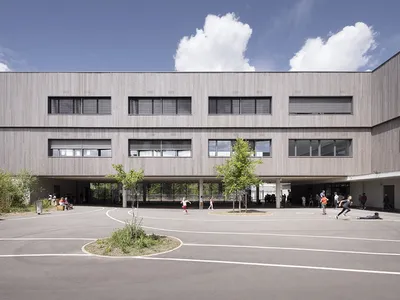
Vil Genis School by BPA ARCHITECTURE – Massy, France
Vil Genis School in Massy, France, features sustainable design, south-facing classrooms, community integration, accessible spaces, and modern educational architecture.

Comments (0)
Please login or sign up to add comments
No comments yet. Be the first to comment!