

Moontrip: Floating Bubbles and Subterranean Caves Bring Space Exploration to Children
The Air Bubble Space Center merges floating capsules, cave-like undergrounds, and 3D-printed structures into an immersive launchpad for young explorers.


What if a building could feel like leaving Earth? The Air Bubble Space Center takes that question seriously, proposing an architecture that splits in two directions at once: upward into floating, bubble-like capsules that simulate zero-gravity environments, and downward into cave-like subterranean spaces that evoke the mystery of alien terrain. The result is a children's space exploration center where architecture itself becomes the primary vehicle of discovery, not signage, not screens, but the spatial experience of moving between weightlessness and groundedness.
Designed by Meng Liu and Shaohang Zhang, this shortlisted entry for the Moontrip 2019 competition reimagines what a launchpad for interstellar curiosity could look like. Rather than mimicking rocket aesthetics or plastering walls with planetary imagery, the designers constructed an environment where organic forms, smart mobility systems, and 3D-printed construction techniques produce something genuinely unfamiliar. The center is conceived as both a functional educational facility and an architectural argument: that buildings designed for extreme environments can teach us something about how we build on Earth.
A Surface Landscape of Curved Paths and Red Planted Beds
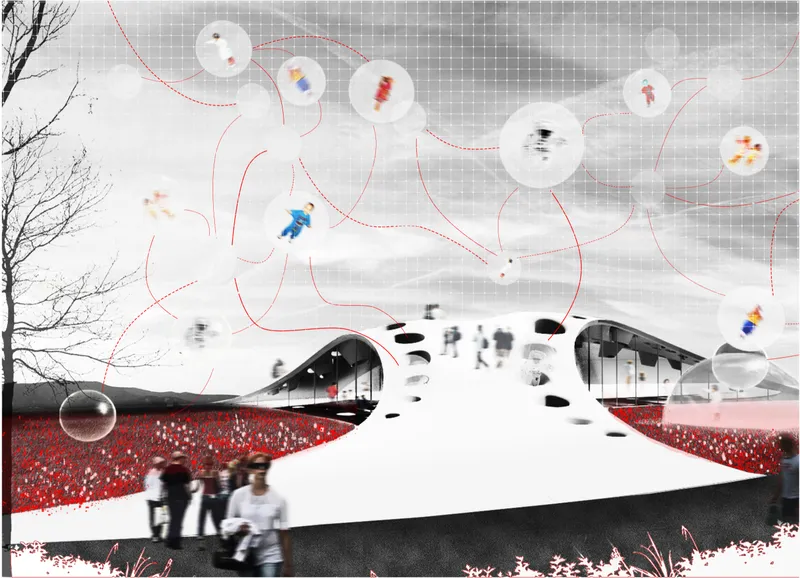
At ground level, the center reads as a landscape rather than a building. Curving white pathways thread between red planted beds, drawing visitors through a series of low pavilions that barely announce themselves above grade. The approach is deliberately anti-monumental. There is no grand facade, no singular entry point. Instead, the architecture distributes itself across the site like a topographic feature, encouraging exploration from the first step. The red planting beds punctuate the white surfaces with warmth and color, hinting at the biophilic thinking embedded in the project's DNA.
Spiraling Down into the Unknown
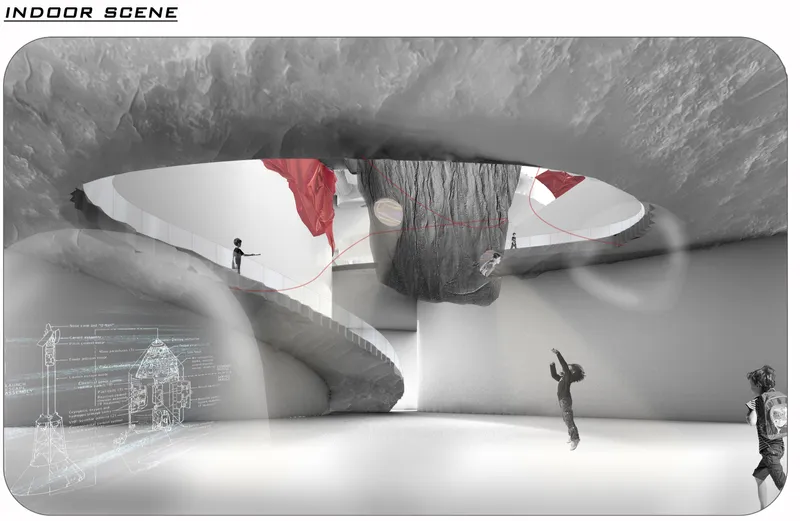
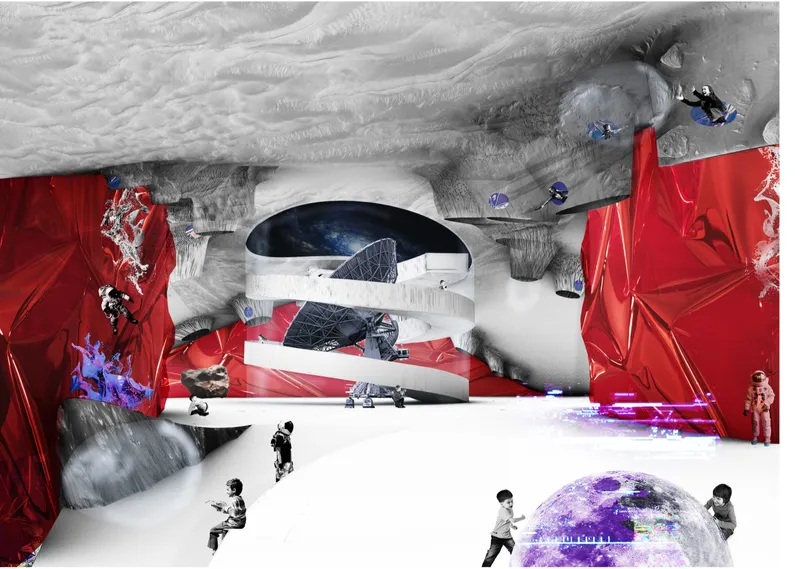
The building's real ambition reveals itself below ground. A spiral ramp winds around a central suspended element, drawing visitors down through textured ceilings and curving walls into the cave-like spaces that form the heart of the center. The descent is choreographed to heighten a sense of mystery and dislocation. Natural light recedes. Surfaces shift from smooth to rough. By the time children arrive in the cavernous lower levels, with their billowing red fabric panels and sculpted white enclosures, the architecture has effectively transported them to another world.
These underground spaces are where the "bubble pods" come into play: capsules designed to mimic the sensation of space travel through simulated zero-gravity experiences. The contrast between the grounded, geological quality of the caves and the buoyant, floating quality of the pods is the project's central spatial idea. It asks children to feel the tension between being rooted and being weightless, between Earth and space, and to find wonder in that threshold.
Section Logic: Bubbles Radiating from a Linear Spine
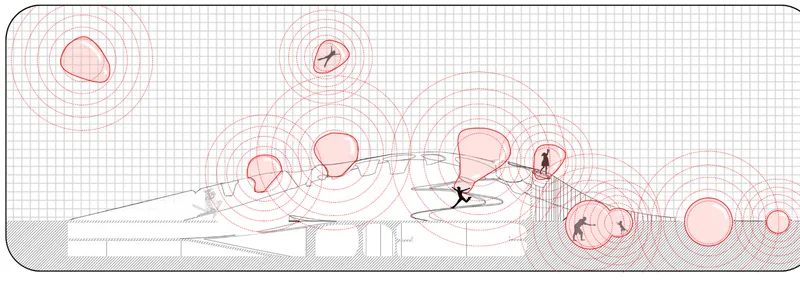
The section drawing clarifies how the design organizes its dual nature. A linear base structure acts as a spine from which bubble zones radiate outward, each containing different programmatic functions: simulation pods, educational areas, circulation cores. The section reveals that the floating and underground elements are not arbitrary gestures but part of a coherent spatial system. Circulation paths connect every level, ensuring that the experience of moving through the building is continuous rather than episodic. Smart mobility systems guide visitors between zones, maintaining the sense of architectural fluidity that the designers prioritize.
Three Lobes Across Three Levels
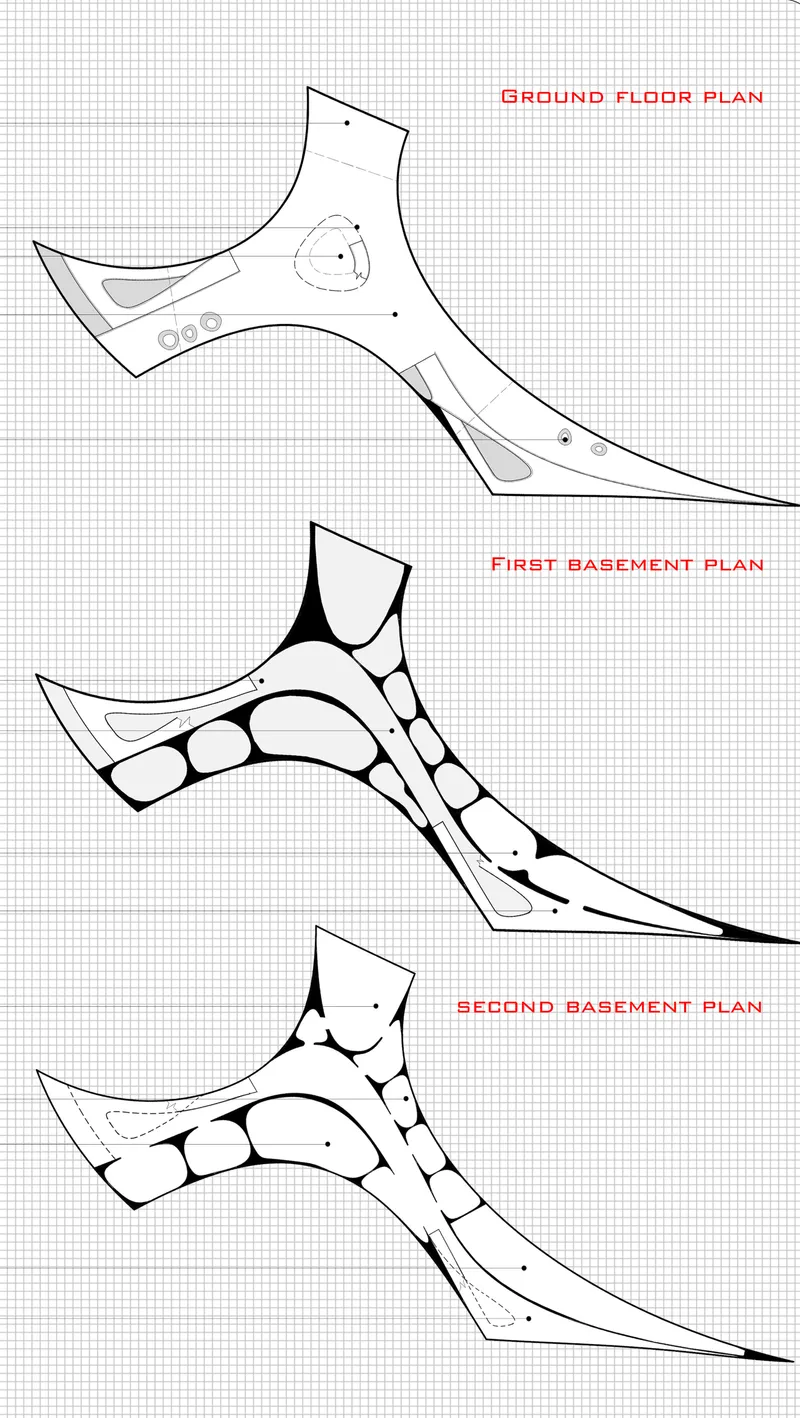
The floor plans reveal a three-lobed form that organizes the center across a ground floor and two basement levels. Each lobe appears to house distinct programmatic clusters, though they remain connected through shared circulation. The tripartite plan is clever: it allows the building to distribute visitor flow across multiple zones simultaneously, preventing bottlenecks while maintaining a sense of continuous exploration. The deeper basement level accommodates the most immersive experiences, while the ground floor remains porous and accessible, functioning as both arrival landscape and transition zone.
The reliance on 3D printing technology and lightweight, eco-friendly materials is not just a sustainability talking point here. It is what makes these complex, organic geometries feasible. Conventional construction would struggle with the curving double-height caverns and suspended interior elements visible in the sections. The manufacturing method and the architectural language are inseparable, each enabling the other.
Why This Project Matters
Most projects that invoke "space architecture" default to sleek pods and chrome finishes, borrowing the visual vocabulary of science fiction without interrogating what space environments actually feel like. Liu and Zhang take a different approach. Their Air Bubble Space Center is less interested in looking futuristic than in producing a genuinely unfamiliar spatial experience, one where the act of descending into a cave and then floating inside a bubble capsule rewires how children understand gravity, enclosure, and movement.
The project also makes a compelling case for architecture as pedagogy. Rather than teaching children about space through exhibits and displays, the building teaches through direct spatial encounter. You learn what weightlessness might feel like by entering a pod. You learn what alien terrain might look like by walking through a cave that doesn't resemble anything on the surface above. That commitment to experiential learning, embedded in the geometry of the building itself, is what elevates Moontrip beyond a competition rendering into a serious proposition for how we design environments that expand the imagination.
View the Full Project
About the Designers
Designers: Meng Liu, Shaohang Zhang
Enter a Design Competition on uni.xyz
uni.xyz runs architecture and design competitions year-round that reward proposals with spatial conviction and real site intelligence.
Project credits: Moontrip by Meng Liu, Shaohang Zhang Moontrip 2019 (uni.xyz).


Popular Articles
Popular articles from the community


Opera on the Sea: Driftwood Logic Shapes a Timber Opera House on Estonia's Coast
Trevor Orgill's opera house translates the entangled drift of floating timber into a civic building where wood, water, and music converge.

Singing Woman: An Opera House That Performs Before the Curtain Rises
Ovidiu Cristian Pavel's conceptual opera house translates Estonia's choral identity into a sculpted waterfront landmark facing the Baltic Sea.
Cloaked Colonization: A Mobile Underwater Habitat That Moves Like a Fish
Micah Abaya's shortlisted EHC Pacific entry reimagines ocean settlement as a dispersed network of self-sustaining architectural organisms.
Faces of the Soviet Avant-Garde: Turning Moscow's Street Names into an Open-Air Museum
A network of sculptural installations across a Moscow residential district transforms forgotten architect names into spatial encounters with cultural memor

Similar Reads
You might also enjoy these articles

Shakur's House: Exposed Brick as an Interior Organiser in a 168 m² Mashhad Residence
Brick moves indoors in this Mashhad residence, where masonry walls, glass partitions and teal planes sequence a compact home without closing it off.

Day and Night Park: A Time-Based Urban Newsstand in Beijing
A temporary urban newsstand in Beijing blending travel, light, and reading through poetic colors, compact form, and community-focused design.

Modernist Patio Renovation in El Masnou, Barcelona by Oliver Segura Arquitectura + Cebrià Arquitectura
Modernist patio renovation blending tradition and innovation with a movable pool, leveled floors, and Catalan materials in El Masnou.

Alto Residencial Coop: Cooperative Housing Development in Santiago de Compostela by Carbajo Barrios Arquitectos
A linear cooperative housing complex blending white volumes and perforated metal façades, enhancing community living, natural light, privacy, and urban integration.

Explore Space Architecture Competitions
Discover active competitions in this discipline

Challenge to reimagine the Iron Throne

Photograph architecture without architects

Illustrate the lost glory of Angkor Wat - Render Challenge

Design challenge to reuse E-waste
Comments (0)
Please login or sign up to add comments
No comments yet. Be the first to comment!