

Moray 2.0: A Circular Urban Farm That Functions as a Self-Sustaining Prototype Machine
Fernando Jáuregui's runner-up entry for Urban Meal Mine nests a seven-level agricultural innovation center inside a semi-submerged circular pavilion in Nin


What if a building could operate like a closed-loop organism, cycling food production, research, and public life through a single architectural body? Moray 2.0 answers that question with a cube nested inside a circle: a seven-level Agricultural Innovation Center sunk partially into the ground at Nine Elms, London, where vertical farming labs, aquaponics pools, and community markets stack into what its designer calls an endogenous machine. The geometry alone signals intent. The cube holds programmatic logic; the circular enclosure generates a self-referencing ecosystem that resists stylistic trends in favor of something more durable.
Designed by Fernando Jáuregui, the project earned runner-up recognition in the Urban Meal Mine competition. The brief asked entrants to imagine how architecture could embed sustainable farming into the fabric of a city. Jáuregui responded with a proposal that refuses to separate research from public engagement, treating food production not as an isolated utility but as a spatial experience open to residents, researchers, and visitors alike.
A Semi-Submerged Pavilion in the Park
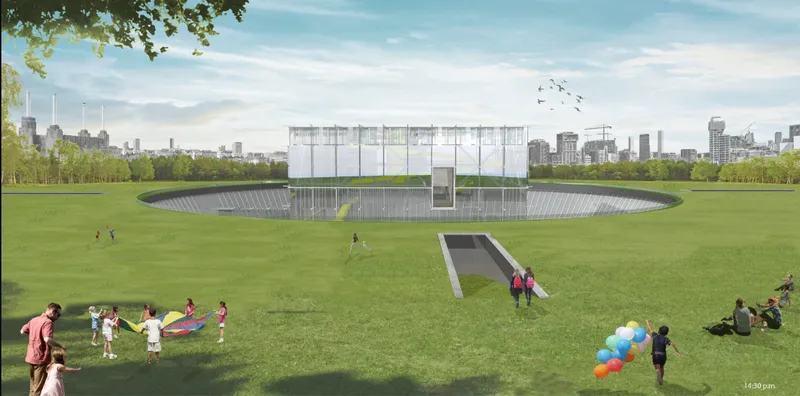

The rendering of Moray 2.0 from the park level reveals a striking formal decision: the circular pavilion sits partially below grade, its translucent facades rising gently above the surrounding landscape rather than dominating it. Families populate the foreground while London's skyline stretches behind, establishing the project's ambition to serve as infrastructure that belongs to its neighborhood. The semi-submerged posture keeps the building's mass in check, allowing it to read as a landform as much as a structure.
In section, the logic becomes clearer. A concrete service core anchors the interior while a structural steel bracing system holds the translucent glass facade in tension around it. The layering of opacity and transparency is deliberate: heavy program like labs and workshops retreats into the core, while public circulation and farming zones press outward toward daylight. The effect is a building that exposes its own processes to anyone walking past.
Market Halls, Yellow Ramps, and the Architecture of Circulation
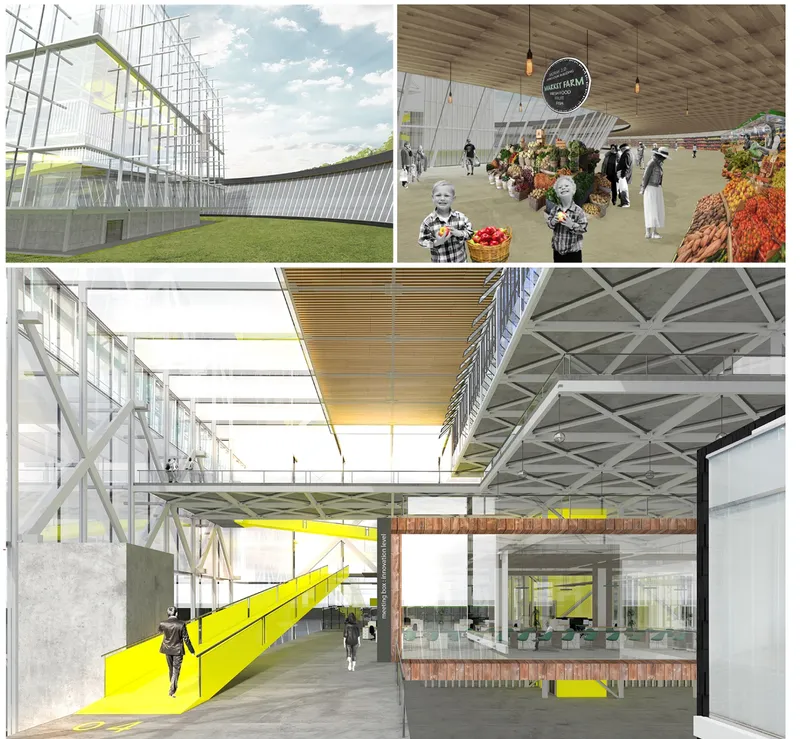
A composition of four interior and exterior views captures the experiential range of the project. At the corner, the translucent facade meets the ground with a crisp structural expression. Inside, a market hall opens up at the public level, connecting the auditorium, exhibition gallery, and hotel reception that occupy Level 01. The standout detail is the bright yellow circulation ramp threading between floors, a continuous pathway designed to foster interaction between the building's distinct zones. Rather than sealing each level off with conventional elevator lobbies, Jáuregui uses these interconnecting ramps to make movement itself a social act, pulling farmers' market visitors past vertical farming units and into the research floors above.
Purple Light and Water: Hydroponic and Aquaculture Systems at Work
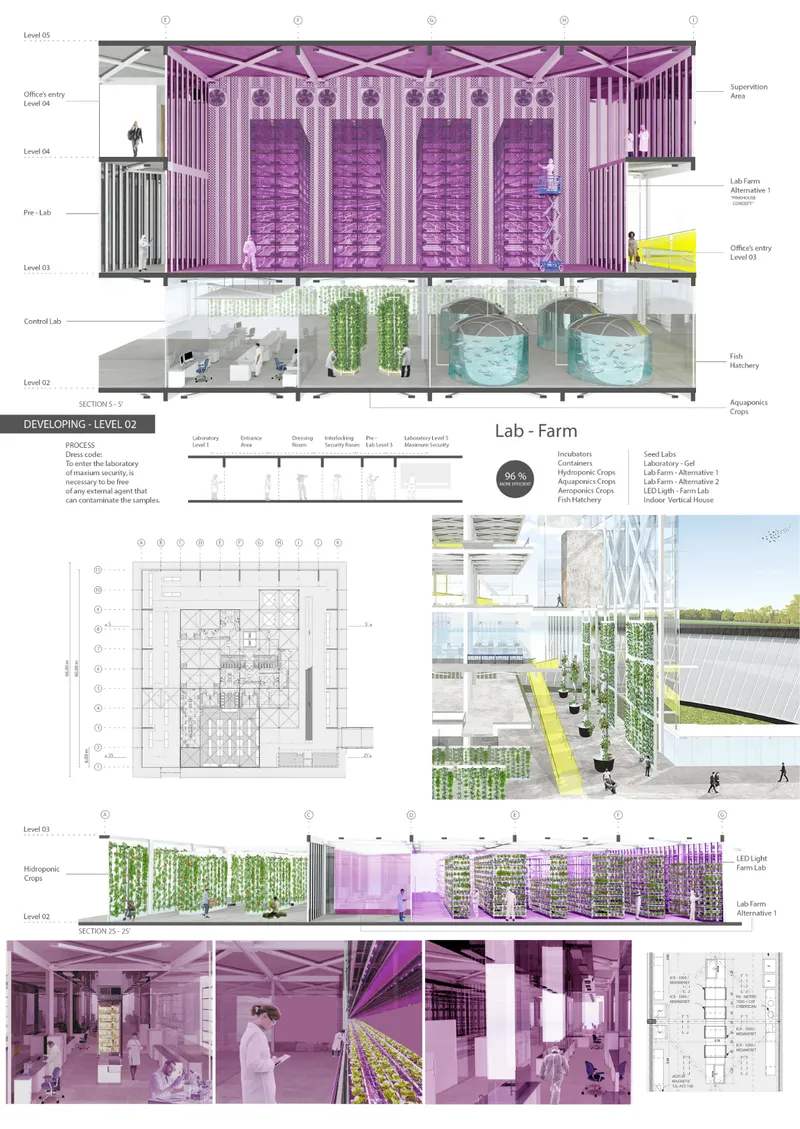
The presentation board unpacks the project's programmatic ambition in full. Sections and plans reveal hydroponic farming spaces bathed in purple grow-light, a vivid atmospheric choice that signals these are not ornamental gardens but calibrated production environments. Below them, aquaculture pools complete the aquaponics loop, where fish waste feeds plants and plants filter water for fish. This cycle sits at the heart of Moray 2.0's claim to self-sufficiency. Levels 02 and 03 house vertical farming units, agricultural laboratories, training classrooms, and container micro-lab farms for experimental testing, while Levels 05 through 06 dedicate space to research workshops and innovation offices. At the top, Level 07 opens into a restaurant and social zone, closing the loop from production to plate.
Structural Logic: Steel, Glass, and a Concrete Base
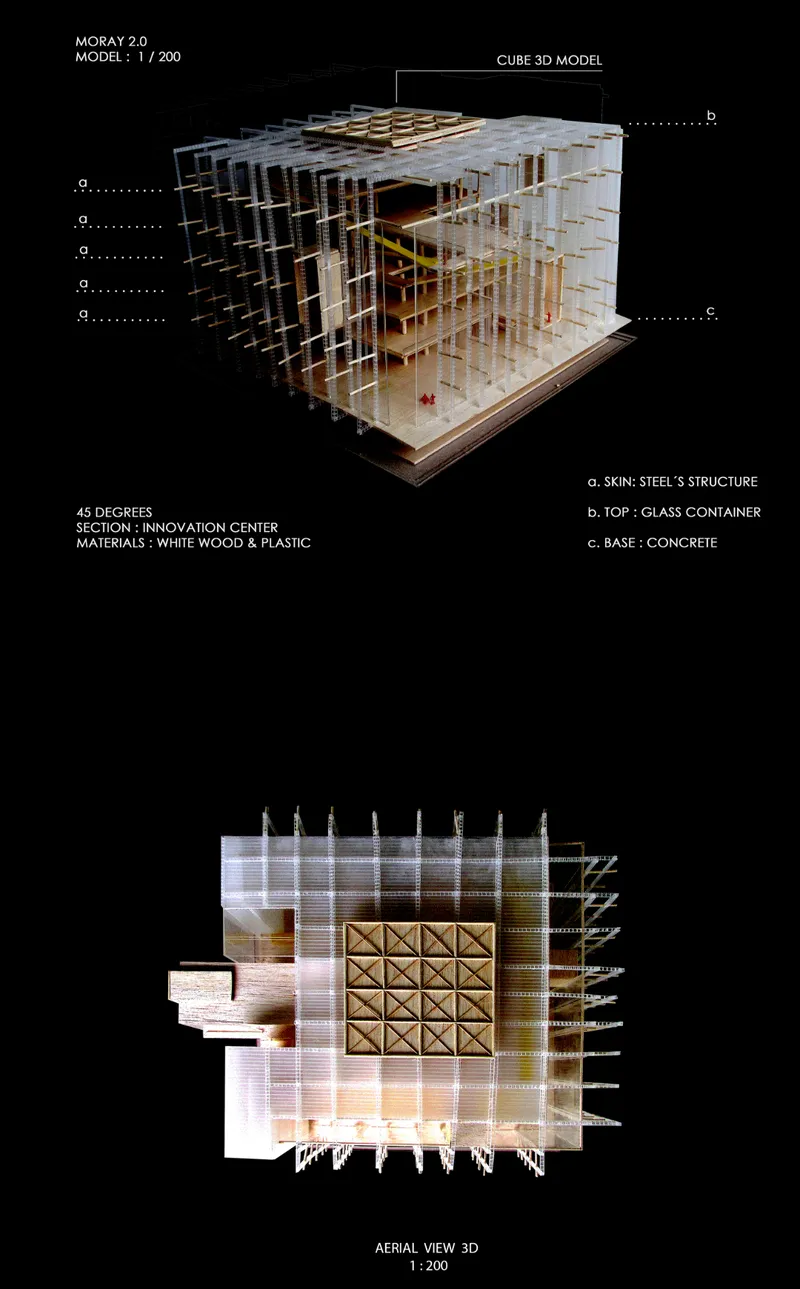
A physical model photograph and exploded axonometric plan strip the project down to its tectonic essentials. The layered steel structure reads as a cage, holding the glass container facade at a defined distance from the concrete base below. The exploded view clarifies how each system operates independently before locking together: the heavy base absorbs the semi-submerged condition and groundwater loads, the steel frame provides the flexibility needed for evolving lab configurations, and the glass envelope delivers the transparency that makes the building legible from outside. It is a pragmatic hierarchy disguised as a bold geometric gesture.
Radiating Landscape: The Building as Agricultural Field
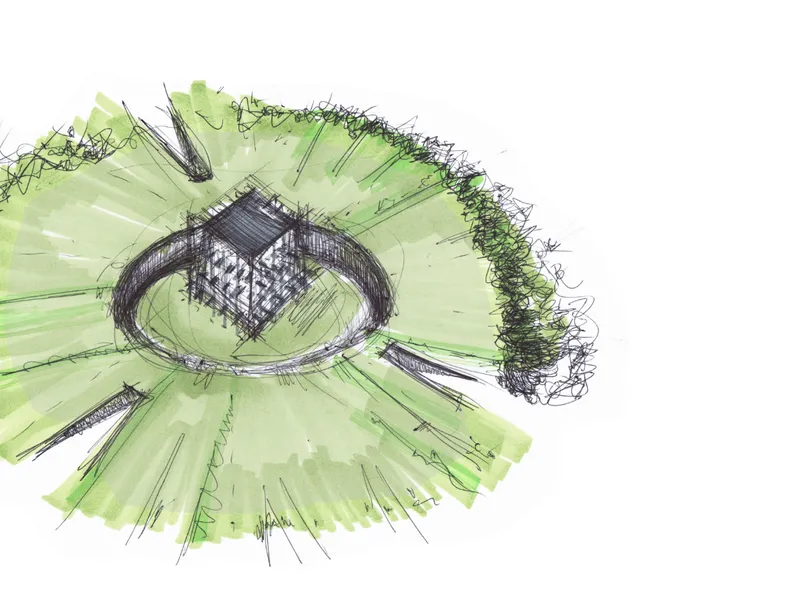
An aerial watercolor and ink sketch pulls the camera back to reveal the project's territorial ambition. The circular structure sits at the center of radiating green landscape fields, blurring the boundary between building and agricultural ground. This is more than site planning; it is a conceptual statement about the relationship between architecture and the land that feeds it. The sketch suggests that Moray 2.0 does not merely contain farming within its walls but extends its logic outward, treating the surrounding park as a continuation of its productive mission.
Why This Project Matters
Moray 2.0 earns its place in the conversation about urban food systems because it refuses to treat agriculture as an afterthought bolted onto a conventional building. The programmatic sequence from research to innovation to development to public engagement is embedded in the architecture itself, moving vertically through the section and horizontally through those continuous ramps. Water-efficient systems, aquaponics, and flexible lab spaces are not listed as sustainability checkboxes; they are the generators of the spatial design.
For a competition entry, the level of resolution is noteworthy. Jáuregui offers a physical model, sectional logic, atmospheric interiors, and a landscape strategy, building the case that an endogenous machine is not utopian rhetoric but a plausible architectural type. As cities confront the fragility of their food supply chains, proposals like Moray 2.0 make a compelling argument: the next generation of public buildings should grow something.
View the Full Project
About the Designers
Designer: Fernando Jáuregui
Enter a Design Competition on uni.xyz
uni.xyz runs architecture and design competitions year-round that reward proposals with spatial conviction and real site intelligence.
Project credits: Moray 2.0 by Fernando Jáuregui Urban Meal Mine (uni.xyz).



Popular Articles
Popular articles from the community


Co-life: Sustainable Architecture for Age-Friendly Community Living
Co-life reimagines sustainable architecture for seniors through courtyards, rammed earth, shared gardens, and spaces designed for belonging.

Play: Fragments of Their World
Familiar architecture becomes modular playground design, creating safe spaces where displaced children can learn, connect, imagine and play.

Conexión: Biophilic Design Reimagines High-Rise Living in Hong Kong
Conexión reimagines high-rise living in Hong Kong through biophilic design, green facades, shared spaces, daylight, water and nature within.

Hill & Cross Opera: Sculptural Opera House Architecture Shaped by Tallinn’s Landscape and Identity
Hill & Cross Opera reimagines opera house architecture in Tallinn through its sculptural hill, civic plaza, glass wave and a luminous cross.


Similar Reads
You might also enjoy these articles

Lunar Spiral: Space Architecture Shaped by the Mathematics of the Universe
Lunar Spiral reimagines space architecture through Fibonacci geometry, lunar regolith, levitating habitats, and self-sustaining Moon living.
The Main Dream: Modular Architecture for Play, Learning, and Community
A modular playground turns recycled plastic into adaptable spaces where refugee children can play, build, learn, and reconnect.
Play: Fragments of Their World
Familiar architecture becomes modular playground design, creating safe spaces where displaced children can learn, connect, imagine and play.

Wadi Rum Observatory: Desert Architecture Designed for the Night Sky
Wadi Rum Observatory turns desert architecture into a quiet instrument for astronomy, hiding research spaces under Jordan's starlit terrain.

Comments (0)
Please login or sign up to add comments
No comments yet. Be the first to comment!