
Multifunctional High Rise Complex: A 228-Meter Diagrid Tower Rising From Central Park's Great Hill
Elena Saharova sets a cultural landmark inside Central Park, touching just 1,600 square meters of ground while rerouting paths and transit below.


Putting a skyscraper inside Central Park is close to heresy in New York, and that is exactly why this proposal deserves a careful look. The Multifunctional High Rise Complex does not try to beat Lower Manhattan's towers. It argues for a different kind of tall building: a vertical marker for a cultural sub-center in Upper Manhattan, standing on a footprint small enough that the park around it keeps working as a park.
Designed by Elena Saharova, the project sits on the Great Hill, in the park land between West 97th and West 110th Streets, running from Central Park West into the interior of the park. The site's legal address is 1000 5 Avenue. It is zoned as park territory, maintained by NYC Parks, and already holds pedestrian paths, asphalt tracks, trees, benches, lanterns, public toilets and metro infrastructure underground. Across a plot of roughly 490,000 square meters, the tower's built-up area at ground level is only 1,600 square meters. That ratio is the core of the proposal.
A Cylinder Wrapped in Diagonal Lines Above the Tree Canopy
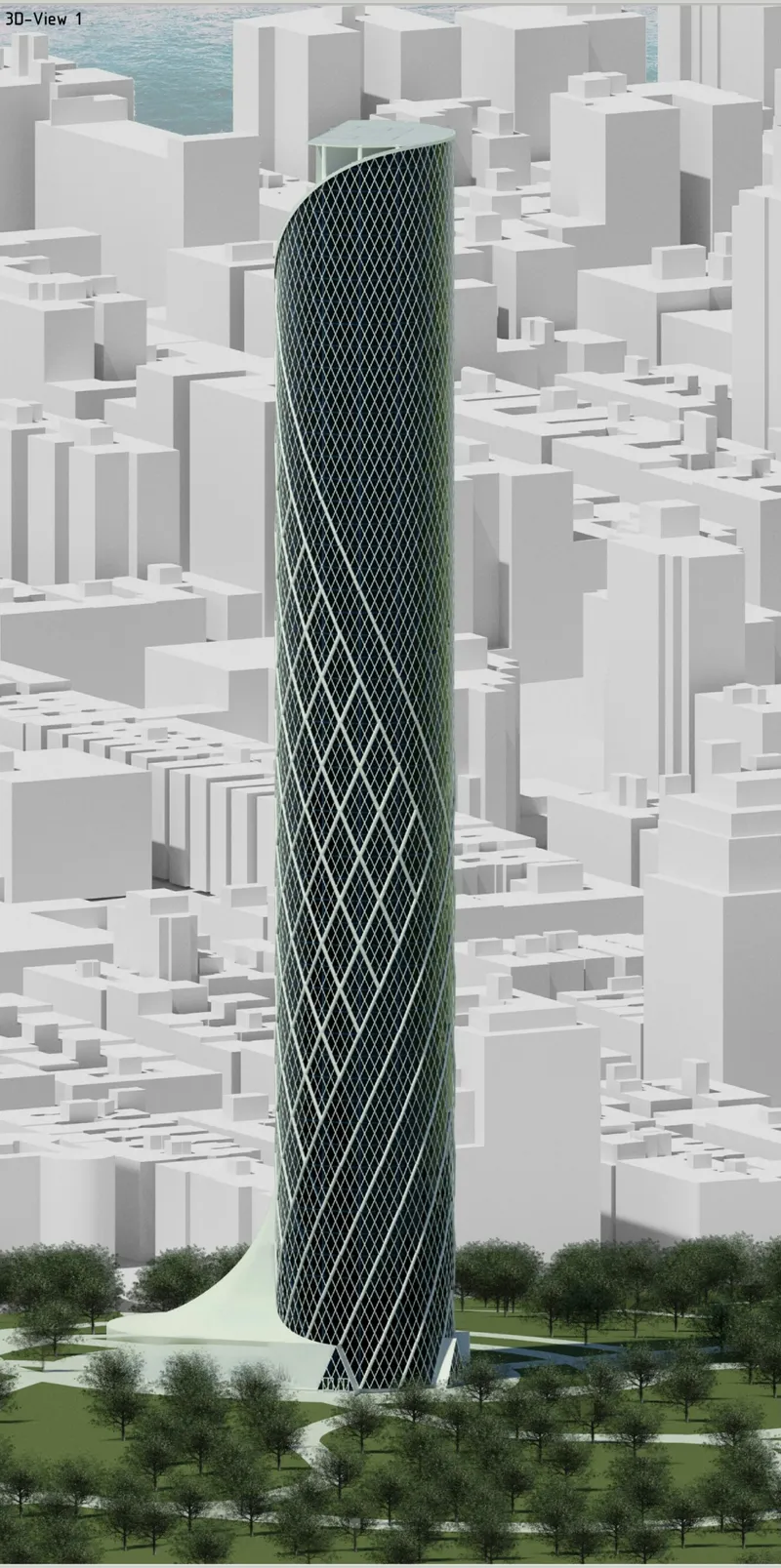
The opening render makes the case visually before any numbers do. A cylindrical glass shaft rises above low white massing and a thick band of trees, and a diagonal lattice wraps the whole volume, which gives it a twisting quality. The diagrid does two jobs. It carries load efficiently by sending forces down the shell instead of through a heavy interior frame, and it gives the tower a readable identity from the park paths below. Together with the aerodynamic geometry, it reduces the wind loading a slender tower attracts.
Saharova's argument for the height is the most interesting part of the brief. Buildings around Central Park average about 41 meters, and Lower Manhattan averages about 97 meters. With One World Trade Center at 541.3 meters as the upper reference, she arrives at 228 meters. That is tall enough to read as a landmark from a distance and well below the downtown peaks. You can disagree with any tower on park land, but this height comes from a contextual calculation, not from a wish to set a record.
Small Footprint, Wider Paths: Reworking the Ground Plane
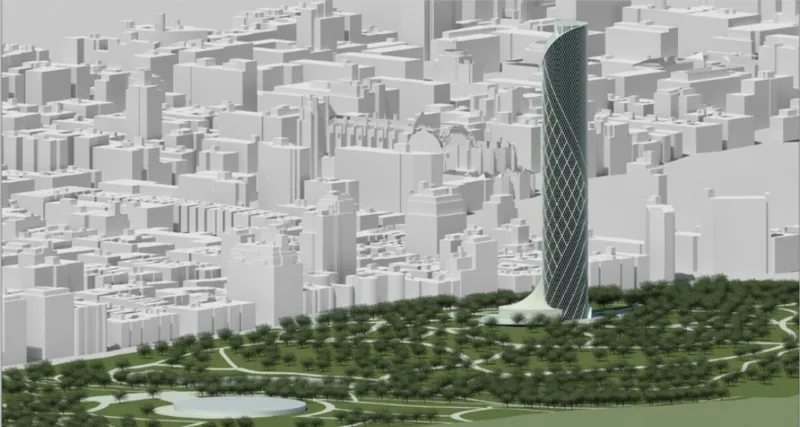
From above, the tower turns out to be a pin in the landscape rather than a block. Winding paths and a circular pond spread out around its base, and most of the project's ambition is at this level. Pedestrian routes widen to six and nine meters, new paths are added, tree clusters thicken the park's western edge, and the Pool is enlarged. The building gives back recreational space in exchange for the vertical space it takes.
The infrastructure moves are just as significant. An underground entrance from West 104th Street ties the complex into the existing transit network, and Transverse Road 97 goes into a tunnel, which takes traffic off the park surface. Most of the arrival happens below grade, so the tower can rise from landscaped ground instead of a plaza of drop-off lanes. This is the strongest answer the project gives to the obvious objection about building in a park.
Where the Lattice Meets: Nodes, Hoistways and Elevations
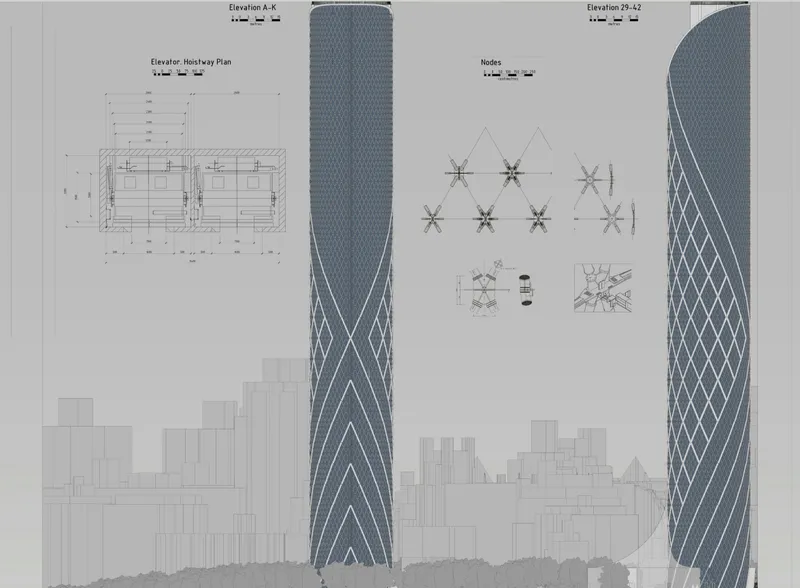
The technical sheet shows that the diagrid was developed as a structure and not only as a pattern. The elevations follow the diagonal grid across the full height, the elevator hoistway plan sets out how vertical circulation runs through the cylindrical core, and the node diagrams show how the lattice members meet and transfer load. These connection points decide whether a diagrid looks crisp or clumsy once it is built, and it is good to see a young designer resolving them at this stage.
Research as Foundation: Analogues, Tables and Town-Planning Maps
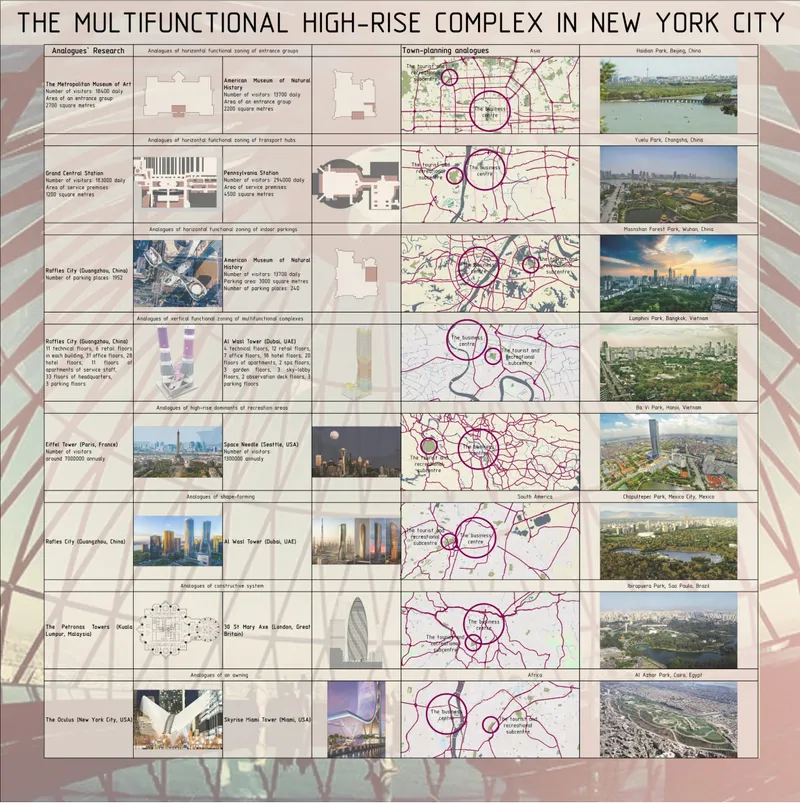
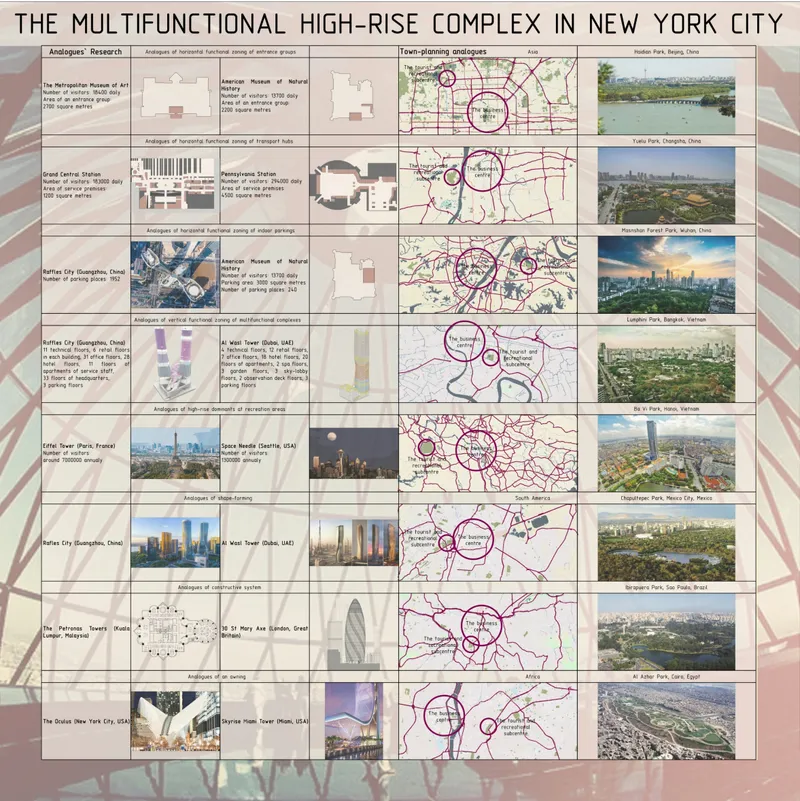
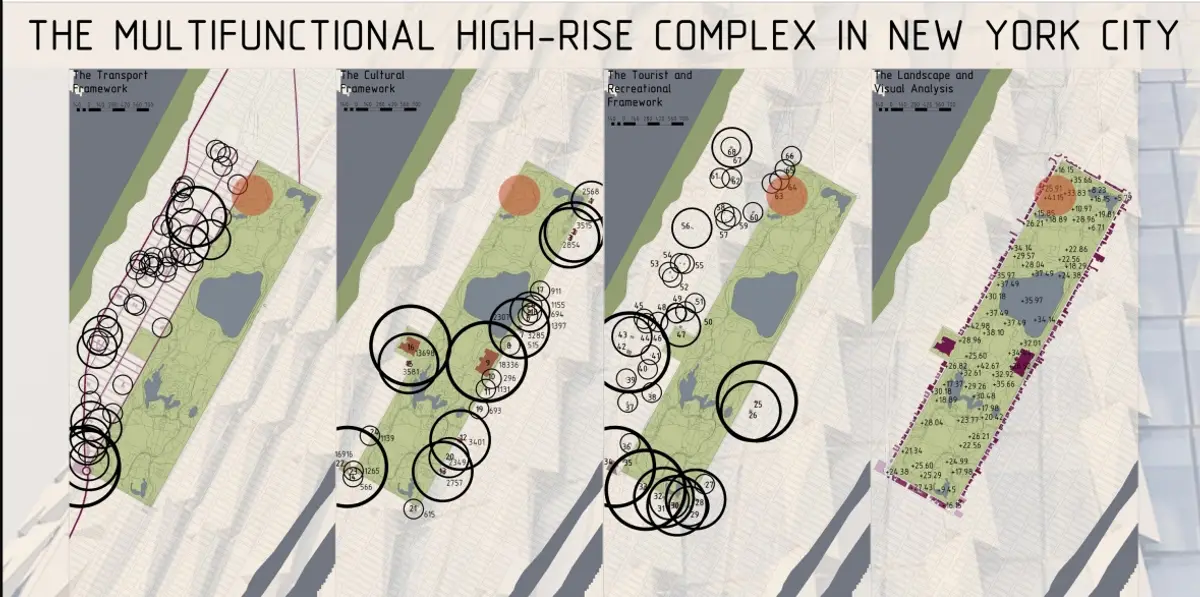
The two research boards show where the design came from. Saharova studied analogues of entrance groups, parking, towers and city structures, and set them against photographs of the park. A second board puts landmark buildings into comparison tables alongside Manhattan's planning maps. According to the project text, this work covered horizontal and vertical functional zoning, transport hubs, high-rise dominants in recreational zones and current structural systems.
The faded steel lattice behind both boards is a smart graphic decision, because it keeps the tower's structural language in view even on pages full of data. More importantly, the boards explain the logic behind the scheme. The 228-meter height, the underground arrival and the mixed-use stacking all trace back to this comparative groundwork, which makes the proposal easier to argue with on its merits.
Why This Project Matters
Saharova takes on a question most designers avoid: can a high-density, mixed-use building sit inside protected green space without taking it over? Her answer depends on a 1,600-square-meter footprint on a 490,000-square-meter site, traffic moved underground, wider paths and an enlarged Pool. The tower is presented as a way to strengthen the park's recreational and tourist role, not as a building that happens to have a park next to it.
Whether Manhattan should ever build on the Great Hill is still open to debate, and the project is better for inviting that debate. What stands out is the method. The height is calculated from context, the structure comes from a resolved diagrid, and the programme rests on documented research. For a student-scale proposal, that combination of contextual reasoning and structural detail is what turns a provocation into an argument worth taking seriously.
View the Full Project
About the Designers
Designer: Elena Saharova
Enter a Design Competition on uni.xyz
uni.xyz runs architecture and design competitions year-round that reward proposals with spatial conviction and real site intelligence.
Project credits: Multifunctional High-Rise Complex in New York City by Elena Saharova.


Popular Articles
Popular articles from the community


Cube Design Draws an Ecological Corridor Between Two Shenzhen Hills with the Nankai Building
Beside Shenzhen's container docks, the Nankai Building pairs stacked balconies with a climbing green screen to connect two hillsides across its height.

David Ortega Stacks a Two-Story Mexico City Penthouse Around a Steel Stair and a Pergola-Shaded Roof Terrace
In Colonia Roma, a 300 m² penthouse uses oak joinery, a planted steel stair and a slatted roof pergola to make a new-build apartment feel like a house.


Manzana Morphosis: Stretching Barcelona's Grid into a Living Landscape for 2050
A radical reworking of the Eixample manzana turns density into a tool for generous public space, vertical ecology, and environmental performance.

Singing Woman: An Opera House That Performs Before the Curtain Rises
Ovidiu Cristian Pavel's conceptual opera house translates Estonia's choral identity into a sculpted waterfront landmark facing the Baltic Sea.

Similar Reads
You might also enjoy these articles
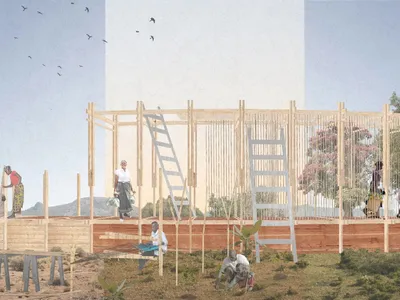
Healing Façade: A Modular Chapel System That Restores Ethiopia's Sacred Forests
Winner of the Eco-Chapel competition, this circular timber façade collects water from air to rebuild soil and reforest degraded Ethiopian landscapes.
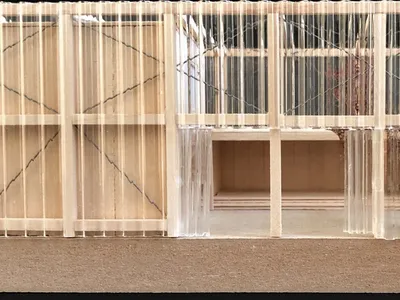
Kaffeebühnen: Where Coffee Shop Architecture Becomes a Civic Stage in Vienna
A linear sequence of timber boxes, transparent shells, and open yards turns the Viennese café tradition into a public performance space.
Eco Chapel: A Modular Forest Pavilion That Grows Like the Landscape It Protects
Hexagonal timber modules weave through existing trees, turning a chapel into a living system for prayer, education, and reforestation.


Urban Forest: A Vertical Ecosystem for 5,000 Workers in Singapore's Changi Business Park
Radially stacked pods and layered green decks turn a 7-acre plot into 47 acres of ecological workspace projected for 2040.

Comments (0)
Please login or sign up to add comments
No comments yet. Be the first to comment!