

Multifunctional Service Center of Liuba Mountain Scenic Area by Shulin Architectural Design: A Dialogue Between Nature, Structure, and Community
A multifunctional service center blending wood, concrete, and landscape, offering rest, views, and cultural amenities in Liuba Mountain.


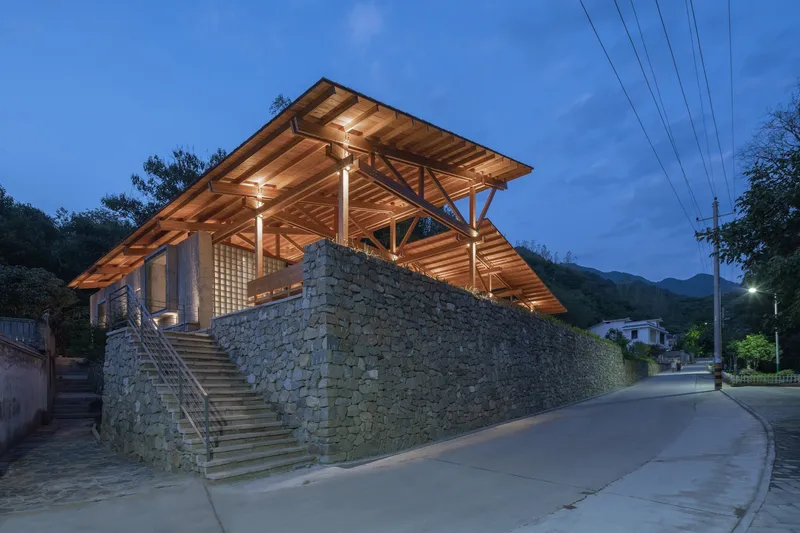
Located at the serene southern foot of the Qinling Mountains in Liuba County, Hanzhong, China, the Multifunctional Service Center of Liuba Mountain Scenic Area by Shulin Architectural Design is a compact yet architecturally rich intervention that redefines how tourism infrastructure integrates into a natural context. Completed in 2022, this 380-square-meter architectural project serves as the primary gateway to the scenic area, offering multiple public functions—reception, consultation, public restrooms, a cultural products store, and a community-oriented book bar.
Blending With the Mountain: Site Strategy and Architectural Memory
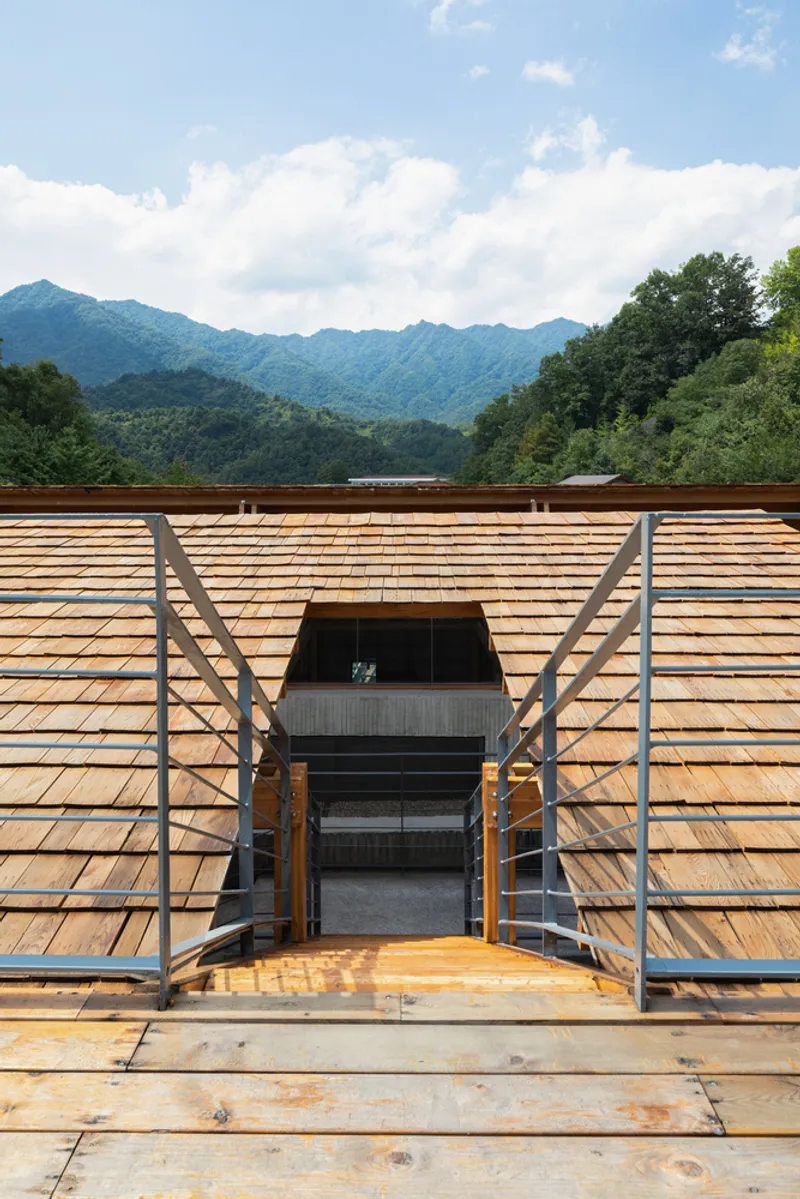
From the very beginning, the design respected the original topography and architectural memory of the site. Two old red-brick buildings inspired the axis and alignment of the new structure, which nestles organically between mountain ridges. The architects preserved the visual corridor toward the distant peaks, allowing the building to frame nature rather than compete with it.
One of the design’s most compelling features is how the mountainside toilet facilities, semi-open reception areas, and circulation pathways are arranged along dual axes. These axes respect both the topography and historical memory while offering multiple paths—some skirting the structure, others piercing through it—allowing for diverse experiential routes for visitors.
A Clear Structural Language: Three Roofs, One System
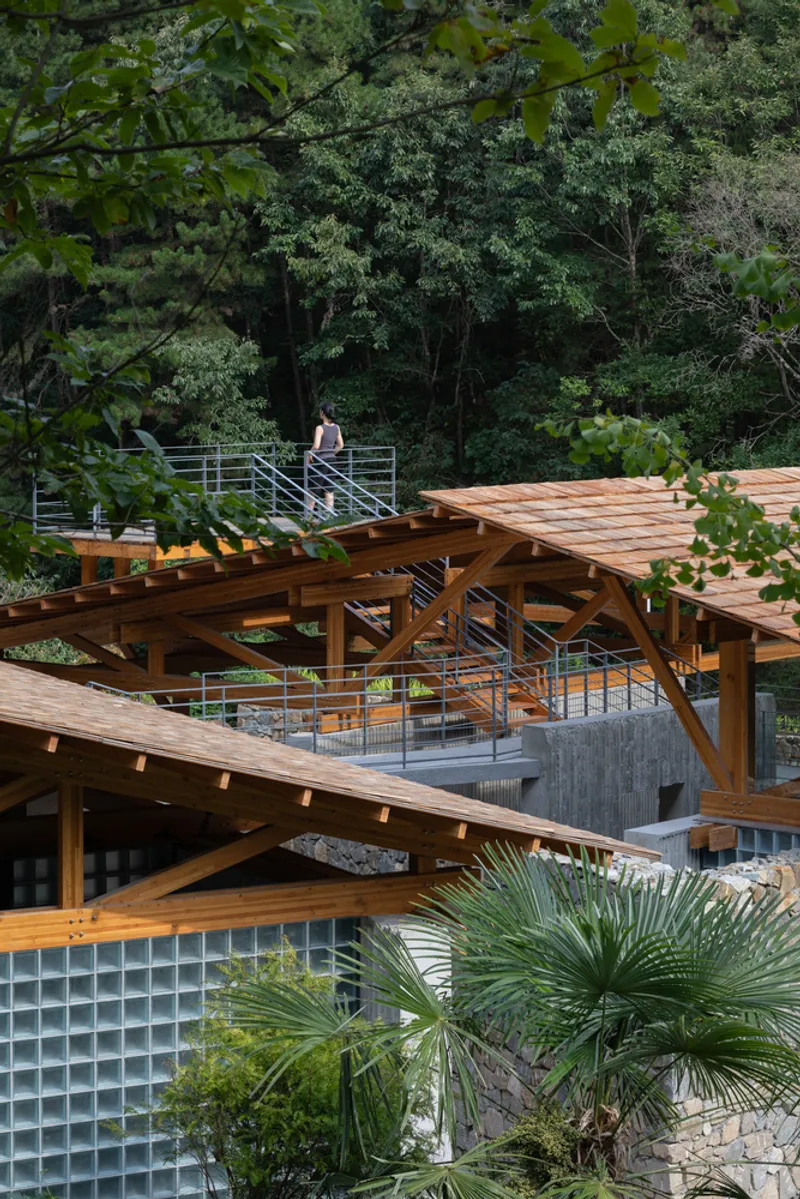
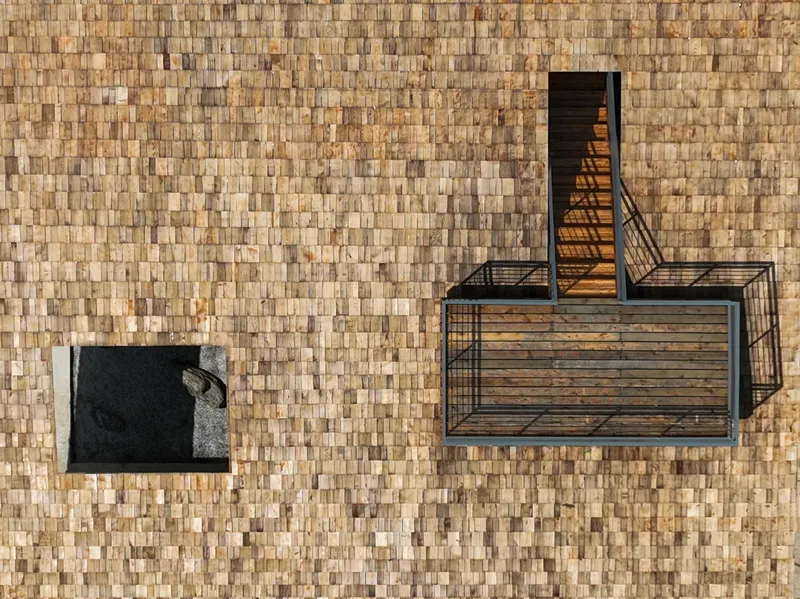
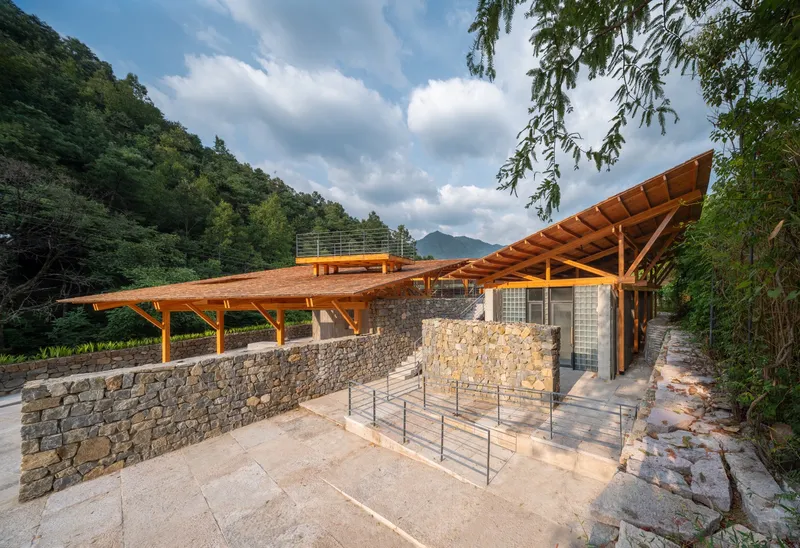
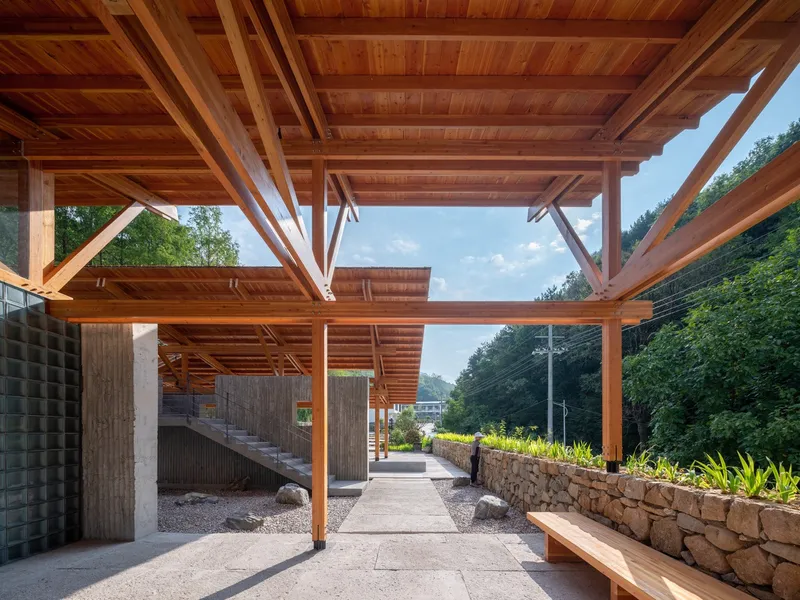
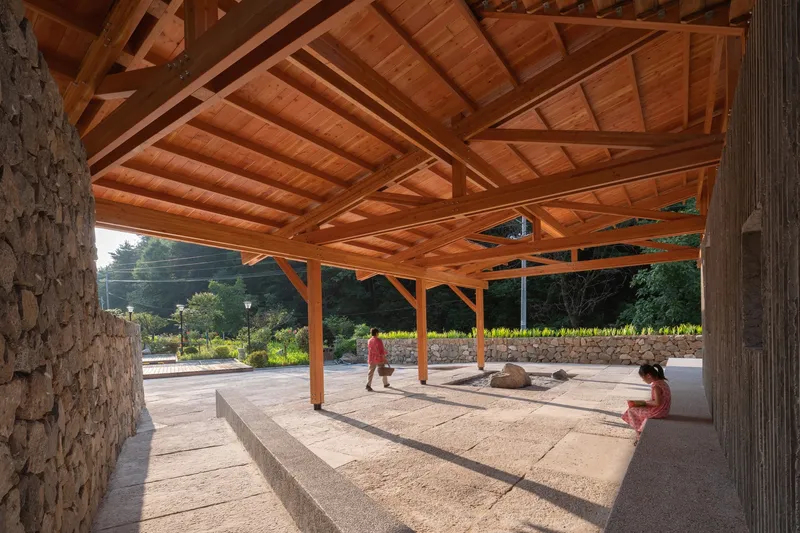
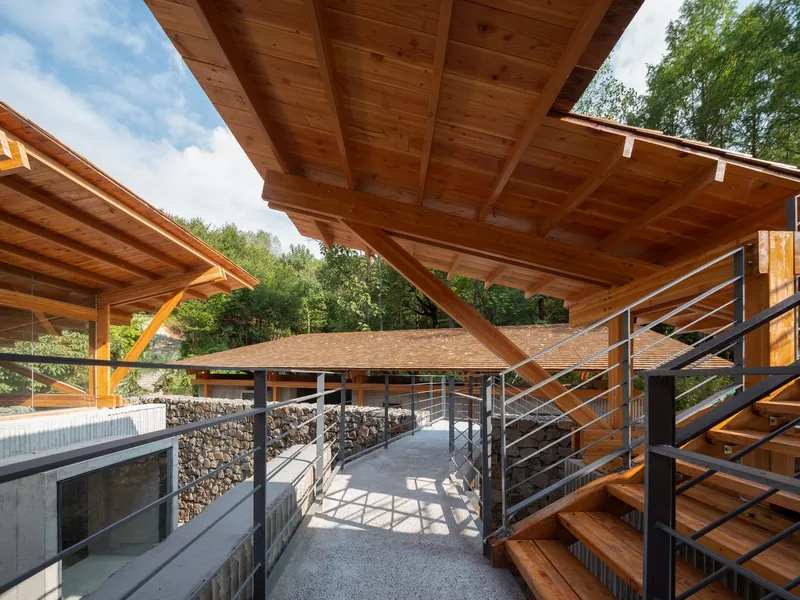
Architecturally, the project is defined by a system of three large wooden roofs, each sheltering a different function. These roofs are supported by repetitive prefabricated Douglas fir plywood trusses, reminiscent of traditional Chinese wooden architecture, where variation is achieved through rhythmic structural repetition. The clarity of the roof system allows each functional block—reception, public gathering space, and restroom—to remain visually distinct yet compositionally unified.
This roof system is not just aesthetic—it is functional, modular, and sustainable, allowing for efficient construction while maximizing spatial variation and visual interest.

Wall Typologies and Material Texture: Rough Meets Refined
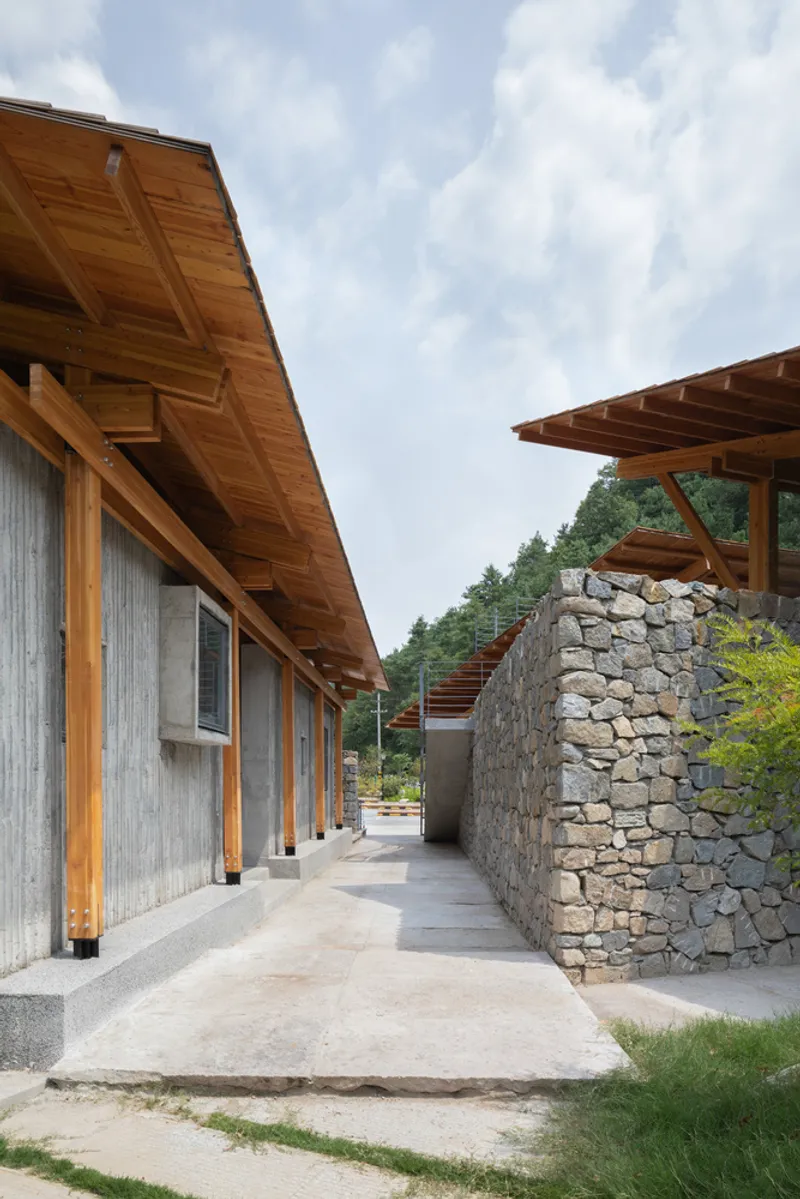
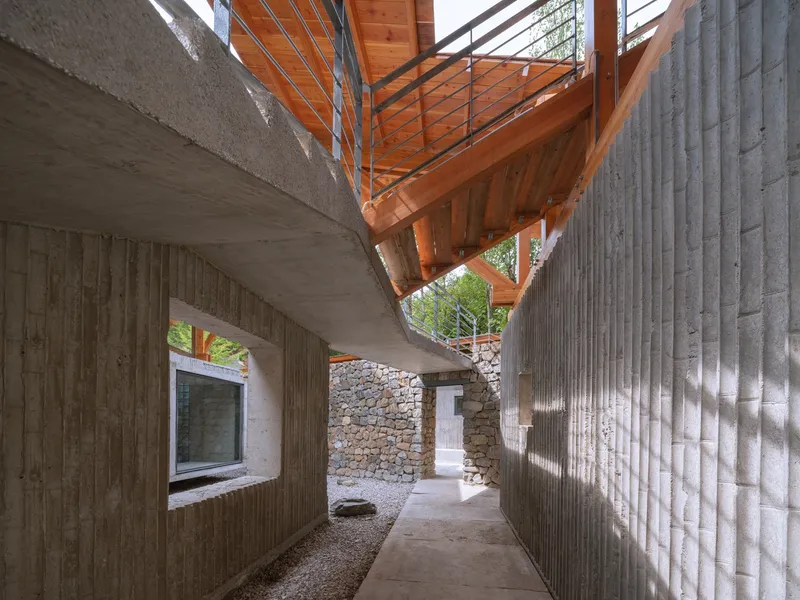
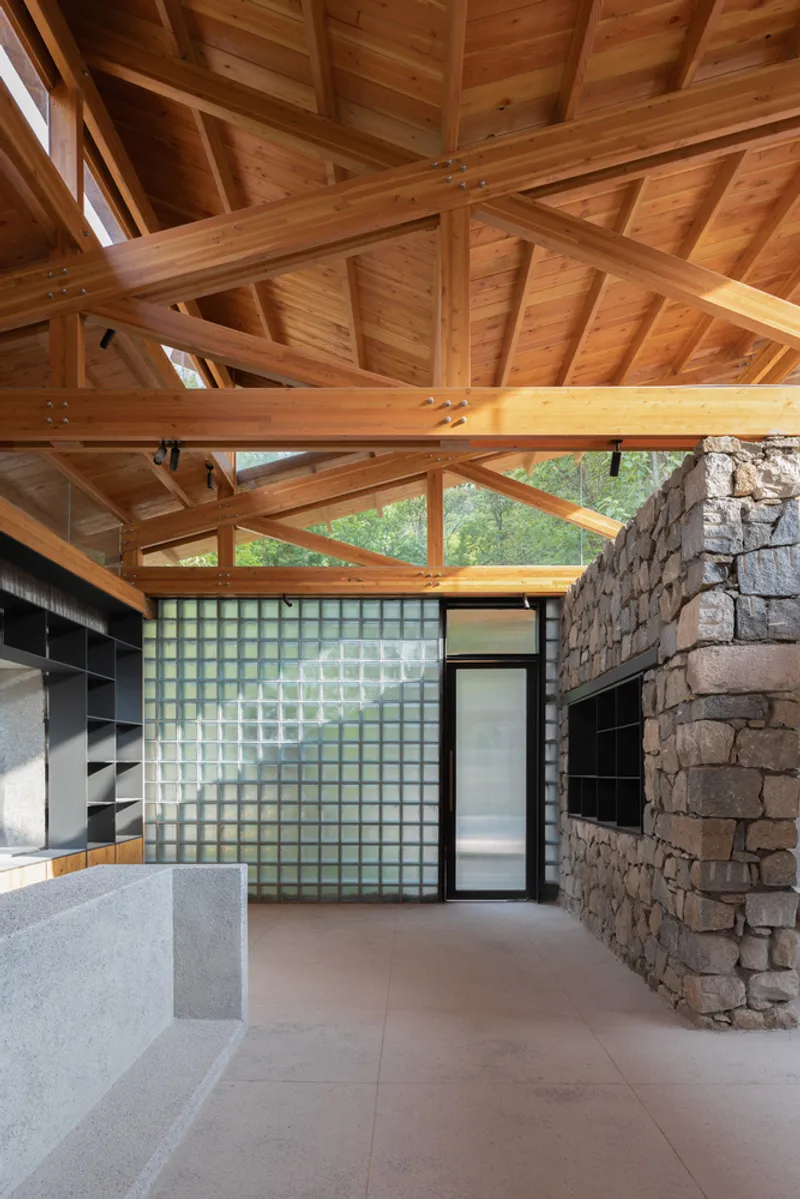
Material choice plays a critical role in expressing the building’s dual identity: warm and welcoming above, grounded and elemental below. The walls consist of cast-in-place bamboo formwork concrete, glass brick, and rubble masonry, each aligned to follow the rhythm of the roofs and the land. On the lower levels, grey-toned materials dominate—washed stone, terrazzo flooring, and weathered slate paving—while the upper regions are warmed by Douglas fir siding and red cedar shingles, creating a harmonious blend of tactile richness and visual softness.
The walls also serve as spatial dividers and functional elements, hosting windows that retreat and project at key viewpoints. These apertures not only enhance natural ventilation and daylighting but create visual dislocations and layering, turning everyday spatial transitions into moments of surprise and play.
Spatial Logic: Internal-External Structural Relationships
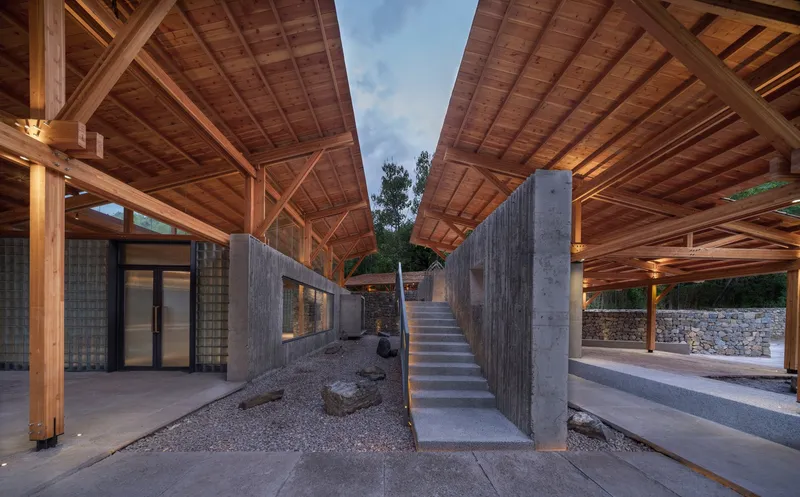
One of the most nuanced aspects of the design lies in the varying relationships between the timber structure and enclosing walls. In the reception space, timber columns are internal and detached from the wall’s axis. In contrast, at the public toilet, the structure is entirely external. Meanwhile, in the semi-open public zone, the wall and structure share a single axis. This shifting logic is a tribute to vernacular construction practices while also enriching spatial perception and architectural experience.
Pathways, Elevation, and the Experience of Time
Drawing inspiration from classical Chinese gardens, the design encourages aimless wandering. Visitors encounter split paths, sloped levels, and stairs, producing non-linear journeys that evoke a meditative sense of time. A sloped veranda meanders between the three roof volumes, leading to an overhead platform with panoramic mountain views. The interplay of direction, height, and texture gives users a deep sense of place and time, turning the building into an immersive spatial narrative.

Light, Shadow, and the Play of Experience
Natural light plays across the building’s textured surfaces, interacting with the grain of the wood, the roughness of the bamboo concrete, and the translucence of Changhong glass doors and glass bricks. During different times of day and seasons, the shadows shift—sometimes sharp and angular, other times soft and diffuse—heightening the material poetry of the space.


Harmony of the Wild and the Refined
The center embodies a "party of gray", a design concept that fuses wild natural textures with refined craft. The contrast of rough concrete walls with fine timber joints, and of robust masonry with delicate glass bricks, illustrates the balance between light and heavy, smooth and rough, human-made and natural. These contrasts are not superficial but integral to the architectural identity and emotional resonance of the space.
The outcome is a multifunctional structure that is simple yet layered, utilitarian yet poetic, and always in dialogue with the land. It enhances the ecotourism experience without overwhelming the landscape, offering both pragmatic services and contemplative spatial journeys.


All photographs are works of Yilong Zhao, Ang Wu


Popular Articles
Popular articles from the community


Conexión: Biophilic Design Reimagines High-Rise Living in Hong Kong
Conexión reimagines high-rise living in Hong Kong through biophilic design, green facades, shared spaces, daylight, water and nature within.

The Ocean Hive: Sustainable Architecture for a Self-Sufficient Civilization at Sea
The Ocean Hive imagines sustainable architecture at sea, where modular habitats, algae, wave power and ocean waste sustain a growing colony.

The Musturak Paradise: Senior Living Architecture for a Connected Future in Temara, Morocco
The Musturak Paradise reimagines senior living architecture in Temara via private homes, social spaces, culture, community, and shared care.
AL-JANNAH: Sustainable Architecture and Permaculture for Afghan Widows
AL-JANNAH uses sustainable architecture and permaculture to create resilient oasis of housing, learning, work and renewal for Afghan widows.
Similar Reads
You might also enjoy these articles


Hodi-Mandai Geram
Project Function: Preservation and revitalization of the Intangible heritage and socio-spatial identity of the Hodi by Housing, Cultural Memory Center, Sacred Grove, landscape, local tourism economy


Olio Towers: A Mid-Rise for Performers That Fuses Housing, Rehearsal, and Stage
Located blocks from Houston's Theater District, this modular tower stacks living units around a central performance atrium.

Oasis: Modular Green Housing Carved into Dhaka's Urban Fabric
A shortlisted Plugin Housing entry reclaims unauthorized settlements in Dhaka with stepped concrete volumes, green roofs, and ventilation-driven design.

Black Hole: A Floating Megastructure for the Post-Physical Era
Emiliano Mazzarotto envisions a spherical, self-scaling arena where e-sports, digital hotels, and holographic stadiums replace traditional public space.

Explore Landscape Design Competitions
Discover active competitions in this discipline



Challenge to reimagine the Iron Throne


Photograph architecture without architects


Illustrate the lost glory of Angkor Wat - Render Challenge


Design challenge to reuse E-waste
Comments (0)
Please login or sign up to add comments
No comments yet. Be the first to comment!