
MWArchitekten Builds a Farm Kindergarten That Thinks Like a Barn in Hohenems, Austria
A concrete-and-timber kindergarten on the edge of open farmland in Vorarlberg uses thermal mass and gable geometry to root children in rural life.


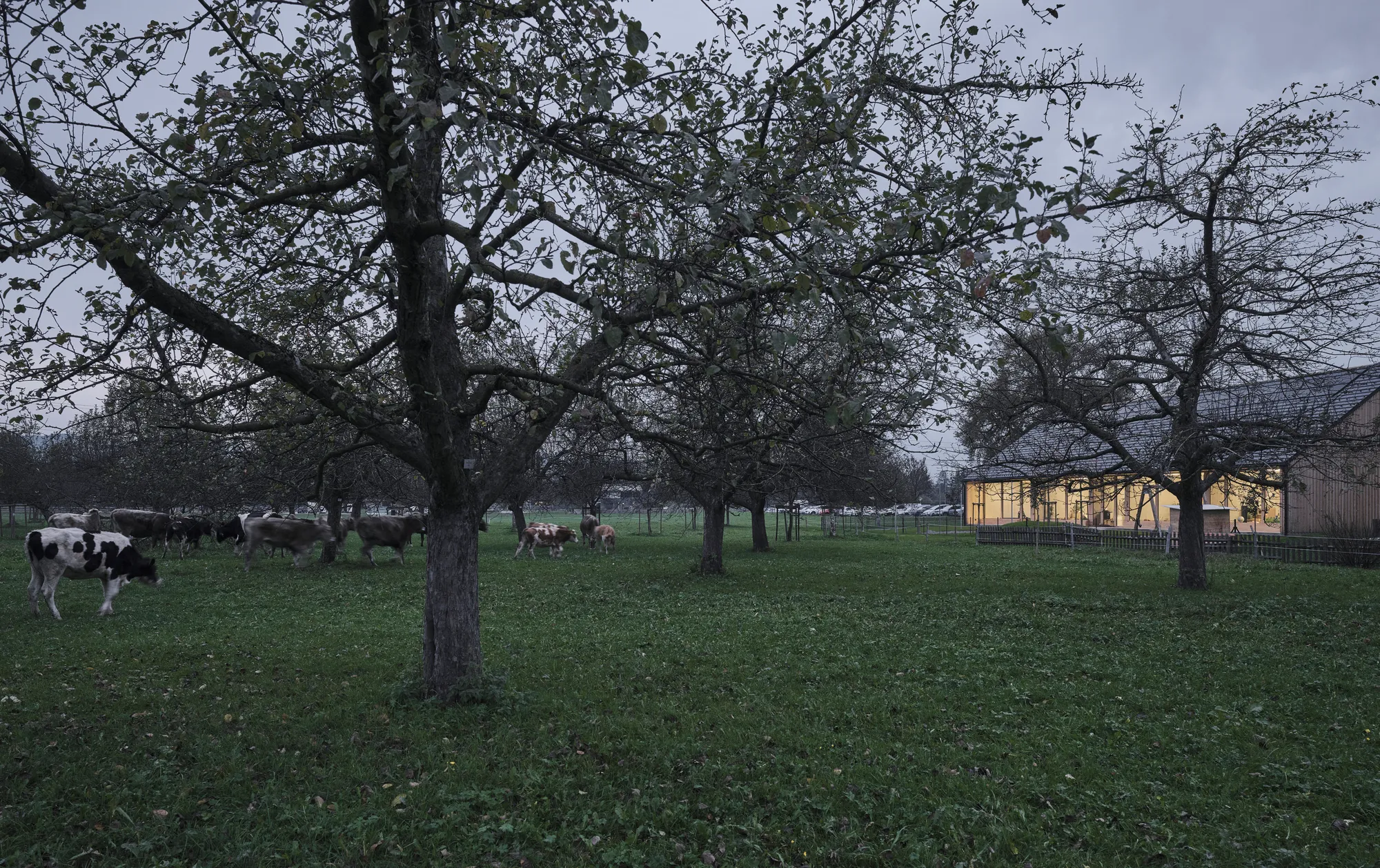
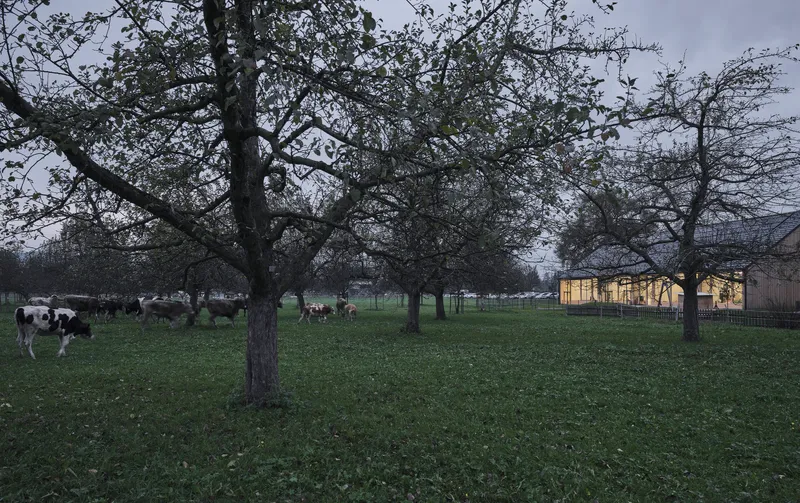
At the edge of an active farm in Hohenems, cows graze in front of a lit glass pavilion at dusk. The image reads like a storybook, but the building behind it is doing serious work. MWArchitekten's Farm Kindergarten Rheinhof is a 470 m² childcare facility that houses a kindergarten retreat area and two childcare groups, all organized under a simple gable roof that borrows its proportions and material logic from the Vorarlberg agricultural vernacular. Completed in 2022 in collaboration with the Bäuerlichen Schul- und Bildungszentrum (BSBZ) at Rheinhof farm, the building sits precisely where open farmland meets an urban school complex across the road, acting as a hinge between two worlds.
What makes this project worth studying is the discipline of its means. There is no formal showmanship here. Instead, the design concentrates on two strategies: a concrete thermal mass base that passively regulates interior temperatures, and a sequential spatial arrangement organized along two hallway axes that frame views of orchards, pastures, and the Alps beyond. The pedagogical concept treats the outdoors as the primary classroom, and the building obliges by dissolving its long facade into floor-to-ceiling glazing while keeping its gable ends opaque and grounded. The result is a kindergarten that feels less like an institution and more like a shed someone decided to fill with light and children.
A Barn Silhouette Against the Farmland
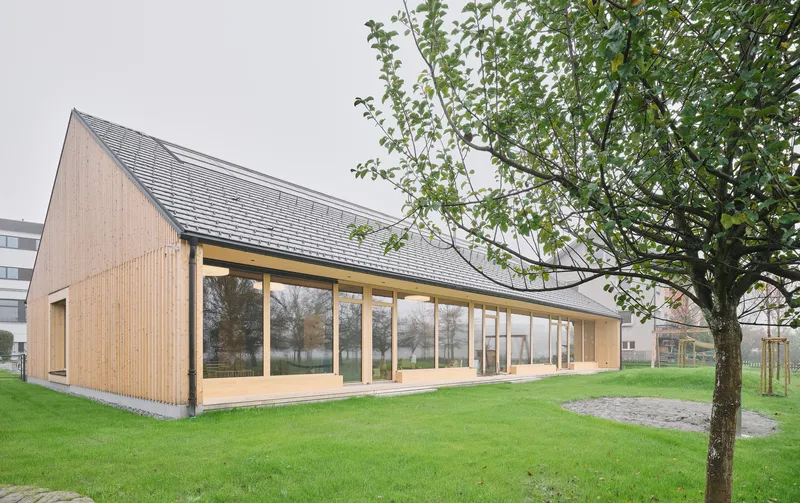
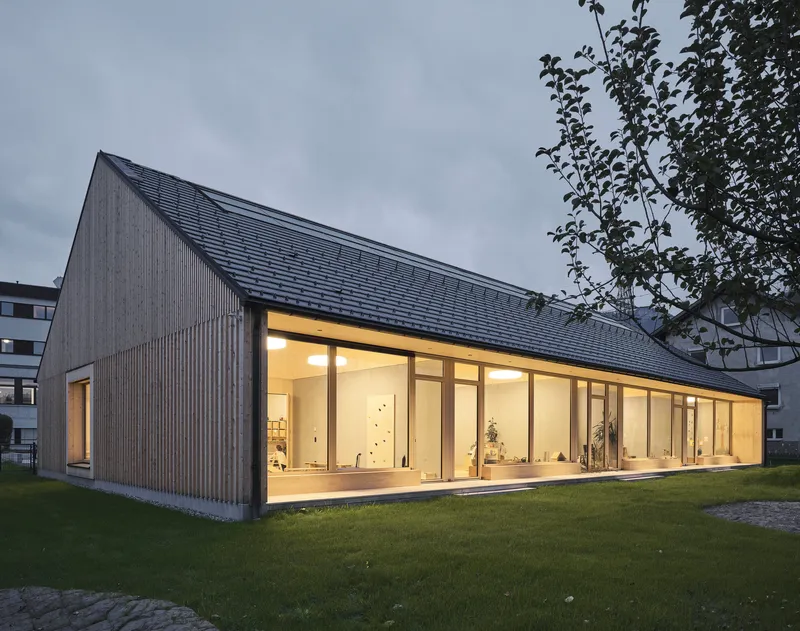
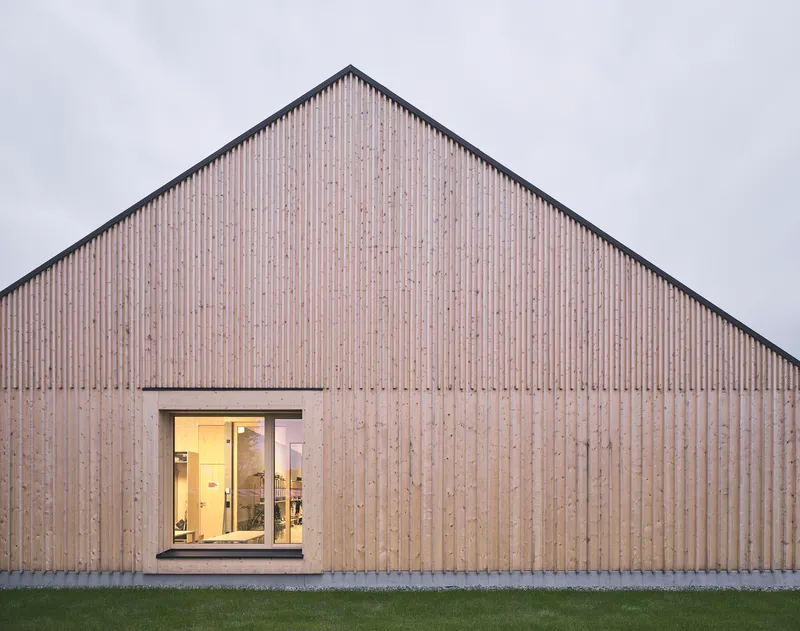
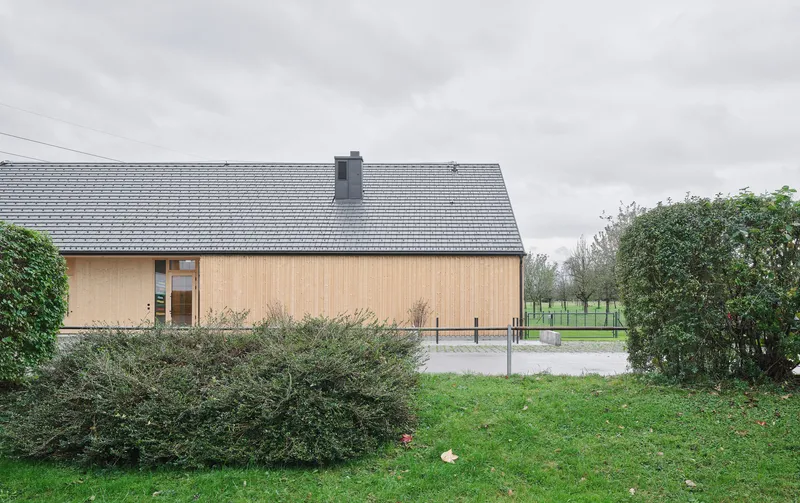
The gable form is the first and most legible move. MWArchitekten accentuates the triangular gable to consciously reference traditional Vorarlberg farm buildings, and the effect is immediate: from a distance, the kindergarten registers as part of the agricultural landscape rather than an urban intrusion. Vertical timber cladding wraps the gable ends in tight slats, creating an opaque, barn-like presence that contrasts sharply with the transparent long elevations.
The pitched roof also mediates scale. From the farm side, the building reads as a low, horizontal structure beneath a sloping eave. From the school campus across the road, the gable peak rises to meet the taller institutional volumes. It is a quiet piece of contextual negotiation, achieved without any of the angular gymnastics that kindergarten architecture often indulges in.
Glass Walls and the Working Landscape
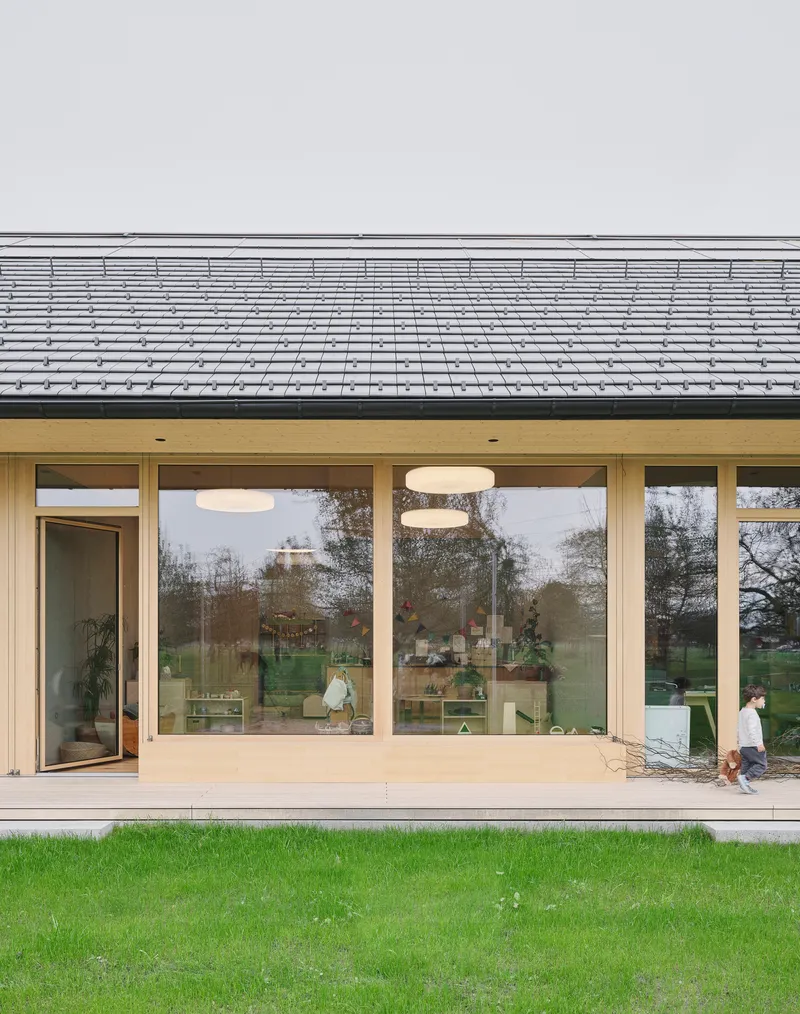
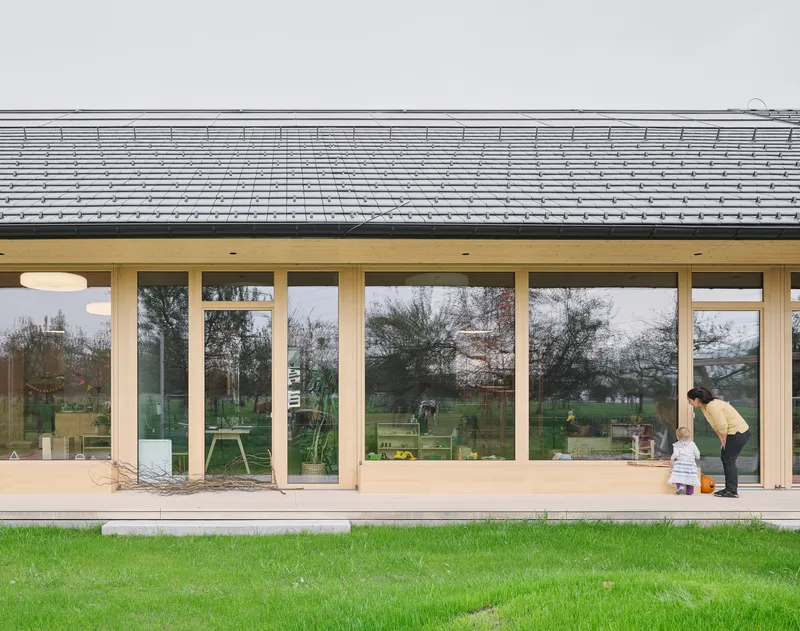
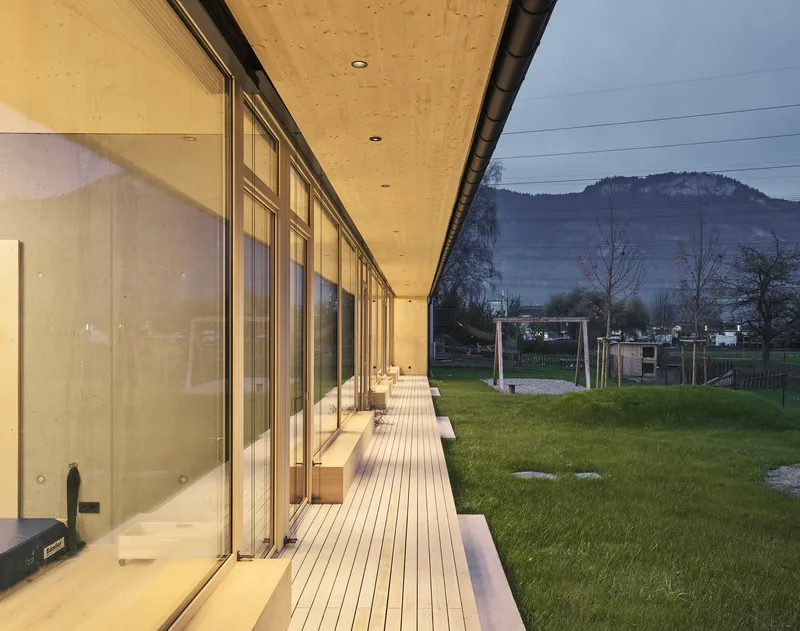
The long facade is almost entirely glazed, set back beneath a deep eave overhang that provides solar shading and weather protection. Timber mullions structure the glass wall into a rhythmic grid that recalls agricultural fenestration without being literal about it. The overhang creates a covered zone that blurs inside and outside, a threshold the children clearly use: one image captures a child walking along the glazed wall as if the building were simply a porch with a very good roof.
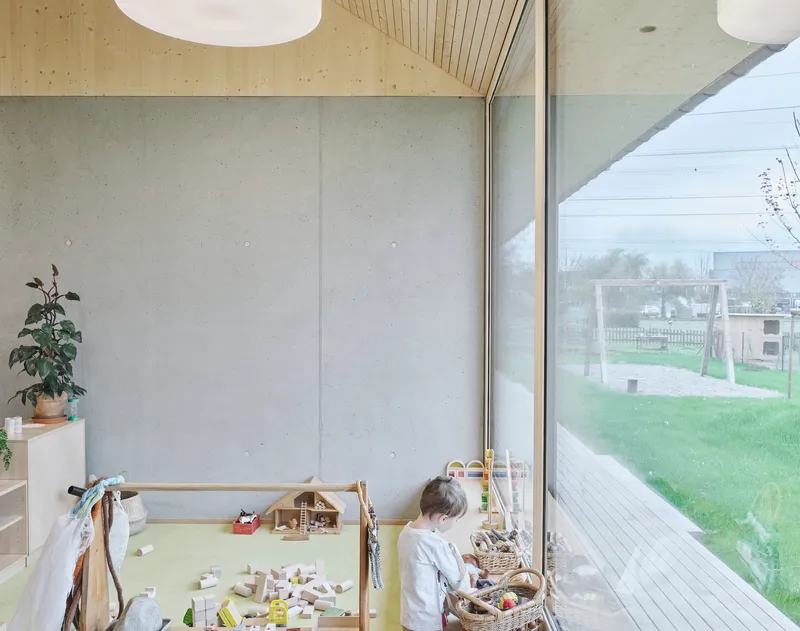
The transparency is not decorative. It serves the pedagogical model directly. Children in these rooms look out onto fenced pastures, young orchard trees, and grazing cattle. The architecture positions the farm as the primary visual field, making the landscape a constant presence rather than a destination reached only during outdoor play.
Concrete Base, Timber Crown
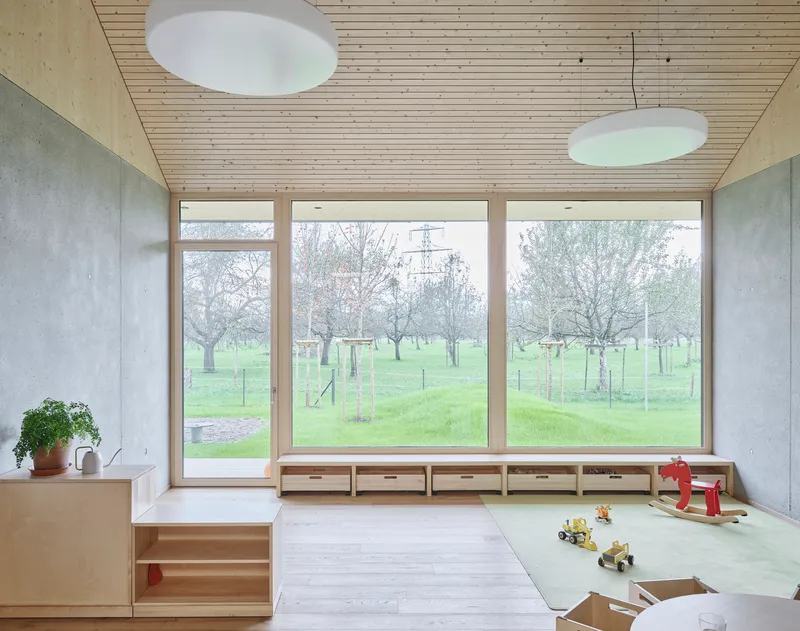
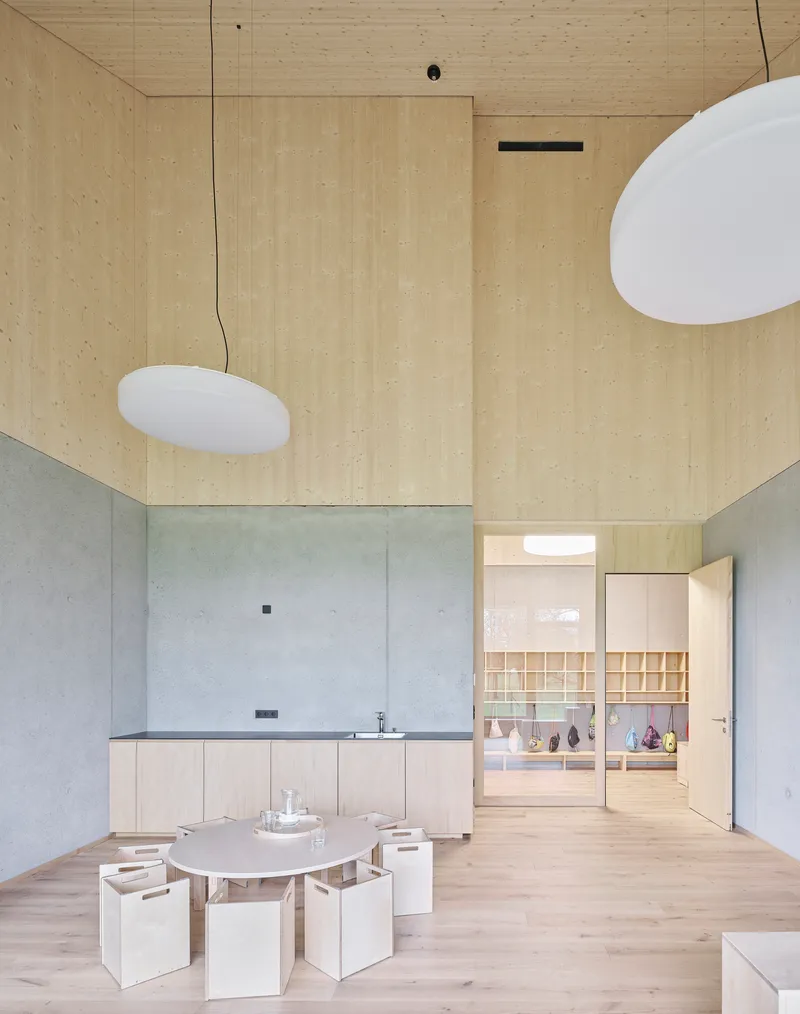
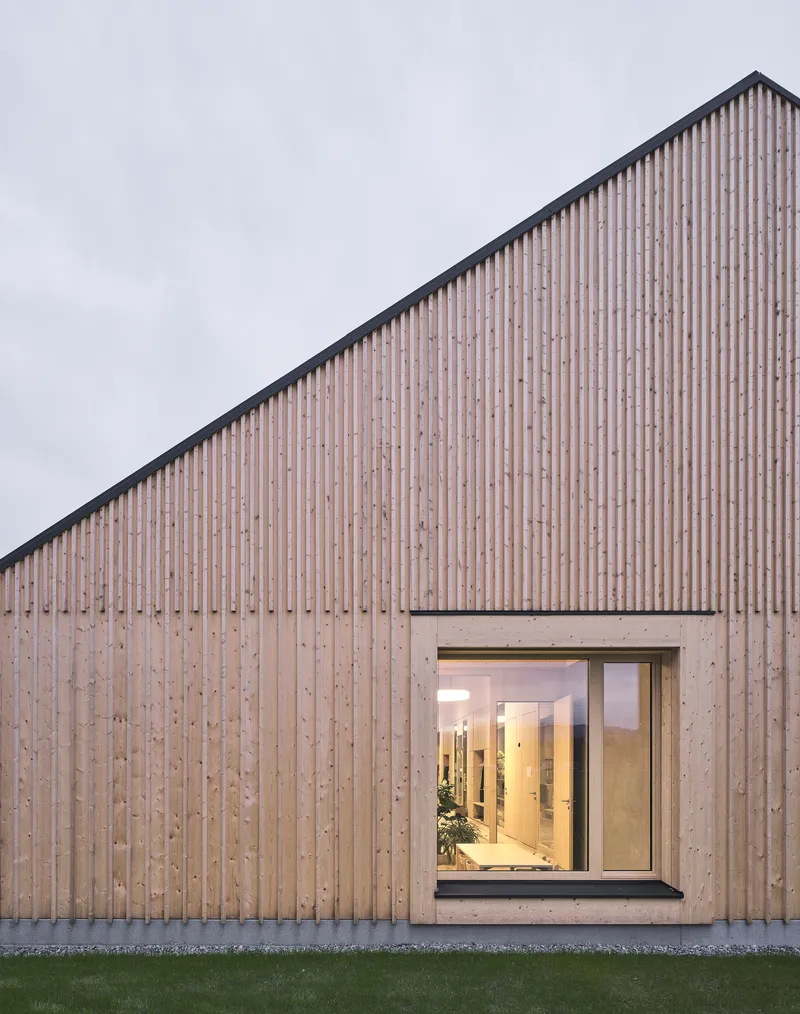
The material split is legible inside and out. Concrete walls rise to 3.15 meters, forming the building's thermal and structural base. Above that line, everything shifts to wood: plywood ceilings, raw spruce surfaces, slatted acoustic panels. The concrete is sandblasted to a pale, chalky finish that feels warm rather than industrial, and its mass does real environmental work. The walls absorb excess heat during the day and cool overnight, reducing overall energy demand through a passive cycle validated by building physics simulation.
The junction between the two materials is handled cleanly. Concrete stops, wood begins, and the transition reads as a datum line that orients you within the section. For children, that line sits roughly at the height of a tall adult, which means the concrete world is the world of the body and the timber world is the world of the roof above. It creates a legible hierarchy without any signage or color coding.
Rooms That Frame the Outdoors
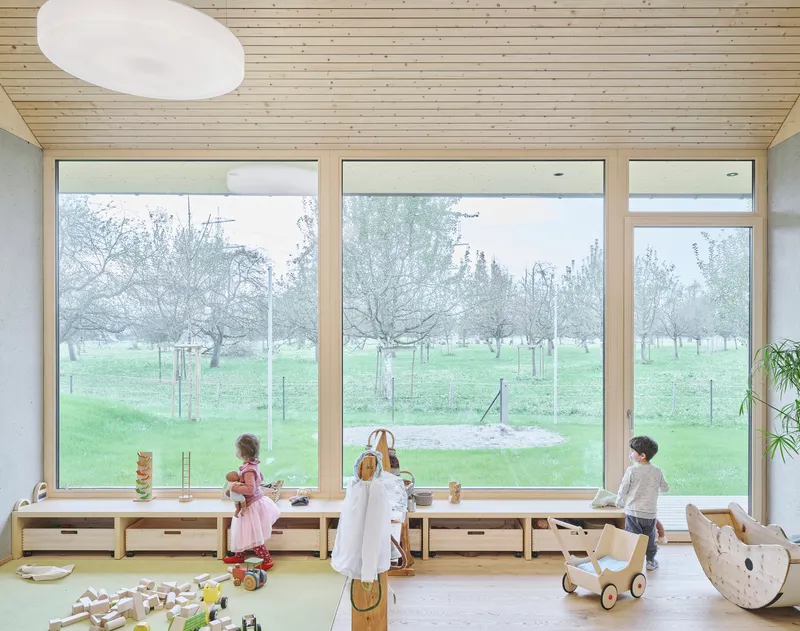
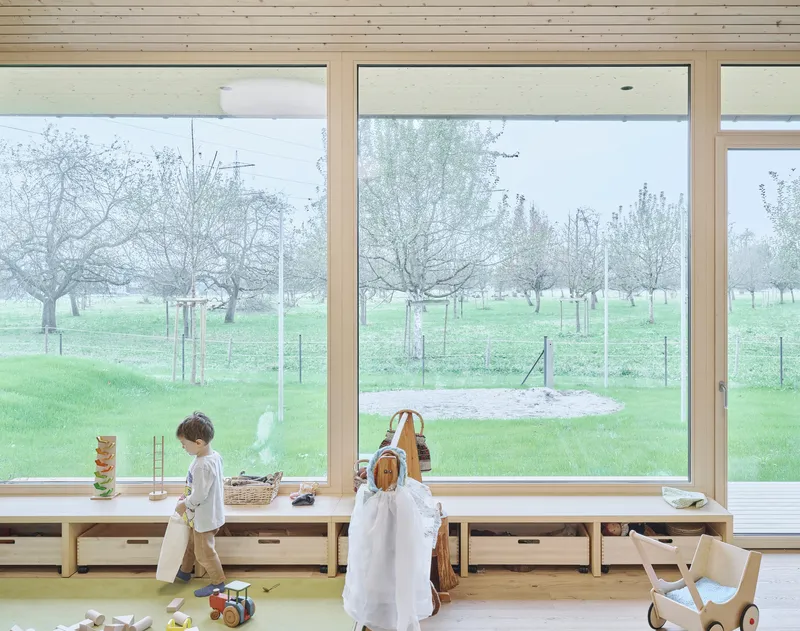
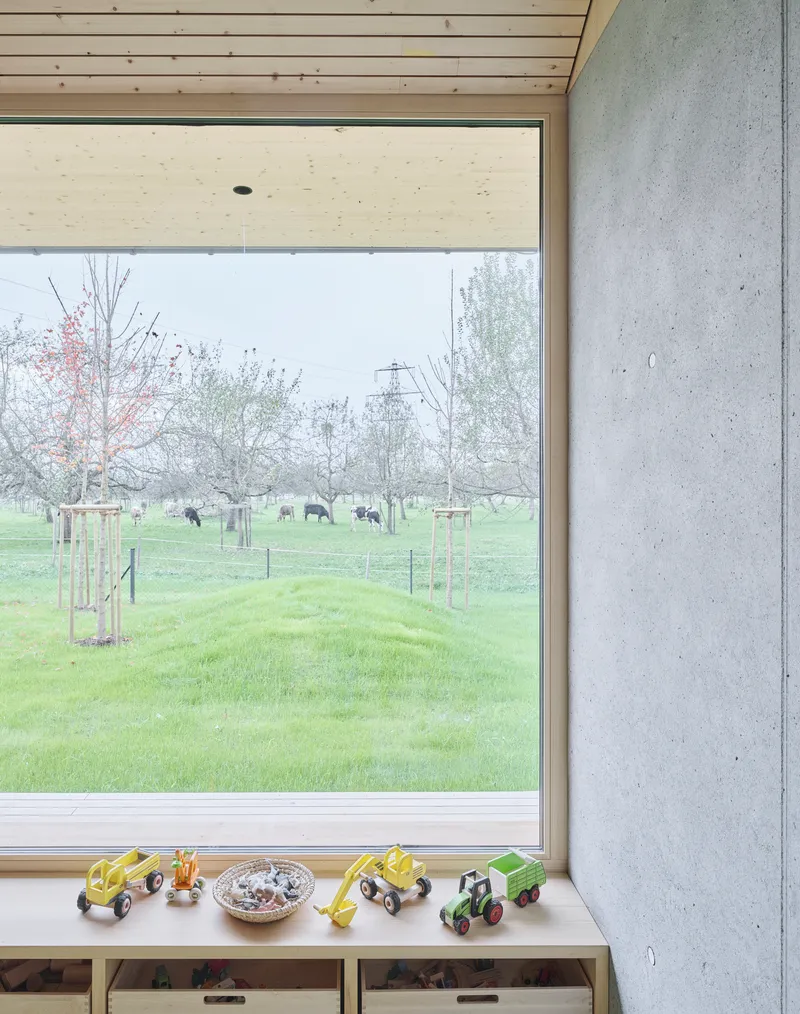
The interior photographs tell the pedagogical story more honestly than any diagram. Children sit at window benches with toy tractors on the sill while real cattle graze beyond the glass. Others play in misty morning light that floods through floor-to-ceiling windows overlooking the orchard. The rooms are designed as sequential experiences, each calibrated to sensitize children through light and haptic qualities: brushed parquet underfoot, raw spruce at hand height, cool concrete at the back wall.
Corner windows are placed at child height, turning the sill into a stage for observation. The architecture teaches by proximity, not instruction. A child watching cattle through the glass while holding a wooden tractor is performing the kind of associative learning that no curriculum diagram can prescribe. MWArchitekten built the frame; the farm provides the content.
Thresholds and Covered Ground
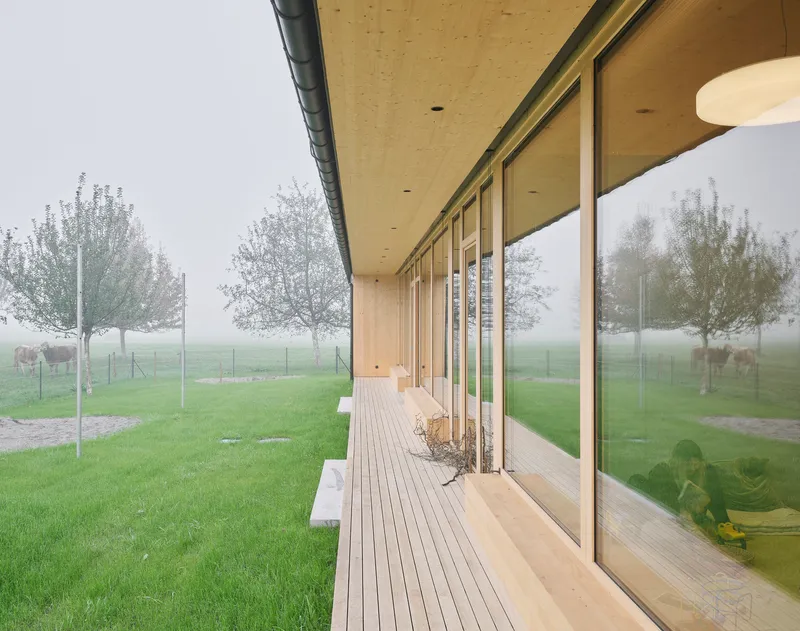
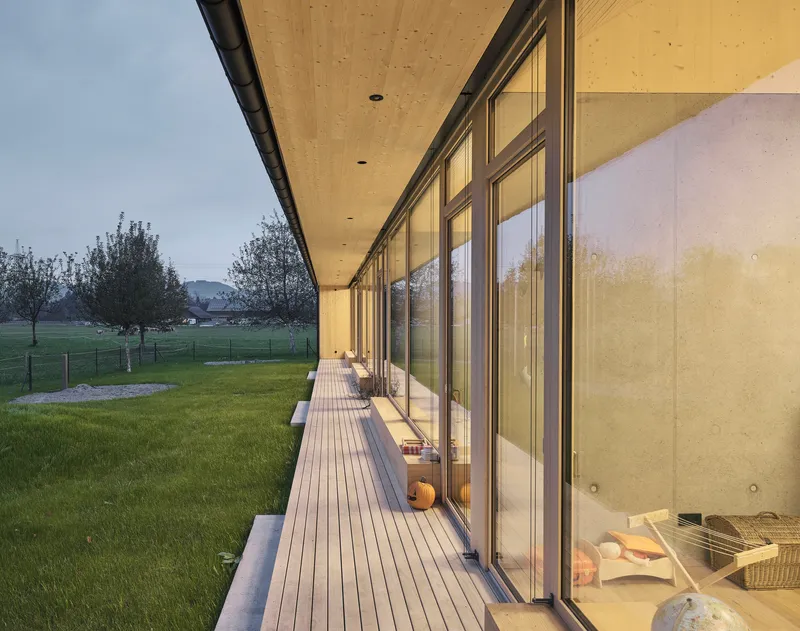
The covered timber deck is one of the project's most effective spatial elements. Running the length of the glazed facade, it operates as an outdoor room under the deep plywood soffit, protected enough for use on foggy mornings and warm enough at dusk to extend the day. Sliding glass doors open the interior directly onto the deck, eliminating the threshold entirely when weather permits.
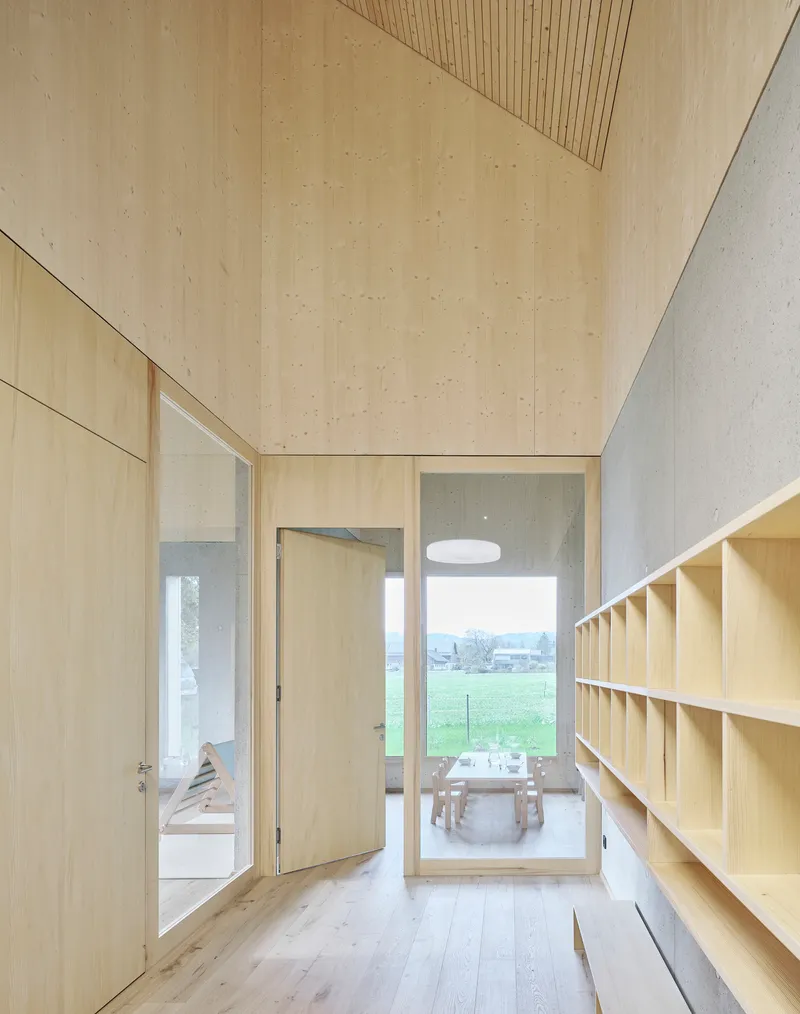
Inside, the corridor acts as a second threshold. Plywood walls and a slatted ceiling create a warm, compressed passage that opens through doorways to the larger rooms beyond. One view captures the sequence perfectly: corridor, open door, dining area, orchard. It is a telescopic arrangement that pulls the landscape deep into the plan, giving even the circulation spaces a sense of destination.
Working Spaces for Small Hands
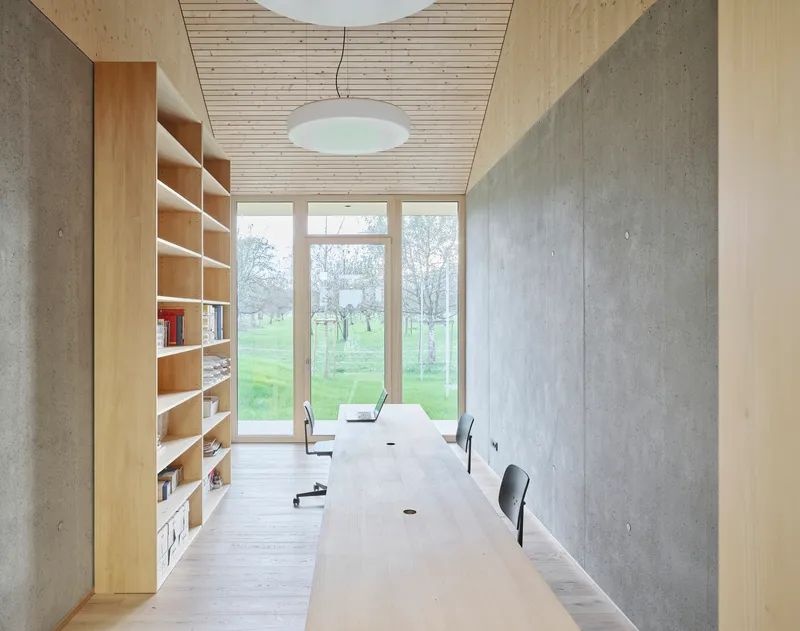
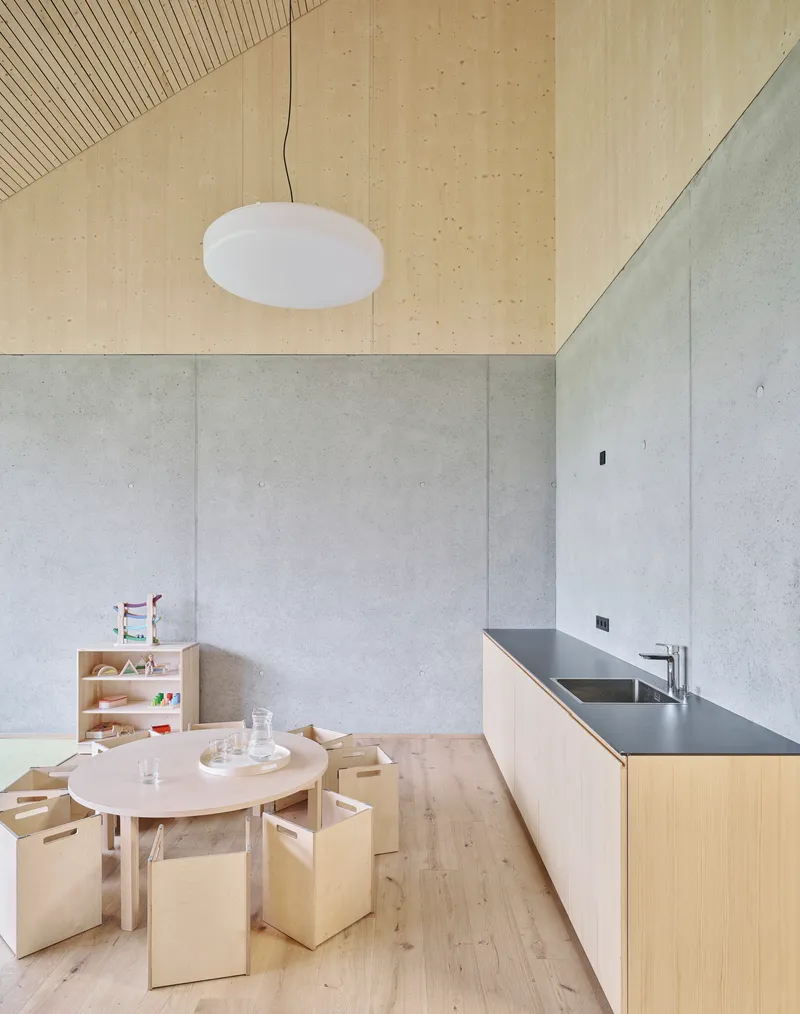
The interiors are furnished with restraint. Plywood shelving lines the workrooms, timber tables sit at child scale, and disc pendant lights provide even illumination without glare. The kitchenette in one childcare group features a dark countertop against pale concrete, a material contrast that signals a different kind of activity without resorting to color or graphics. Low built-in storage keeps the floor plane clear, giving children room to spread out.
These rooms feel calm but not precious. The materials are robust enough to absorb daily use, and the proportions are generous for a building of only 470 m². MWArchitekten's decision to limit the palette to concrete, spruce, and plywood pays off in spatial coherence: every room belongs to the same family, which helps young children orient themselves without visual cues.
Plans and Drawings
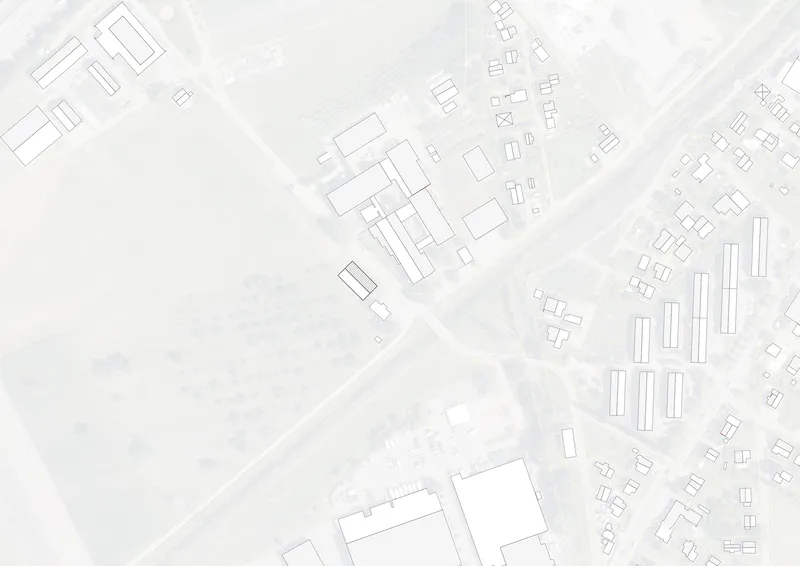
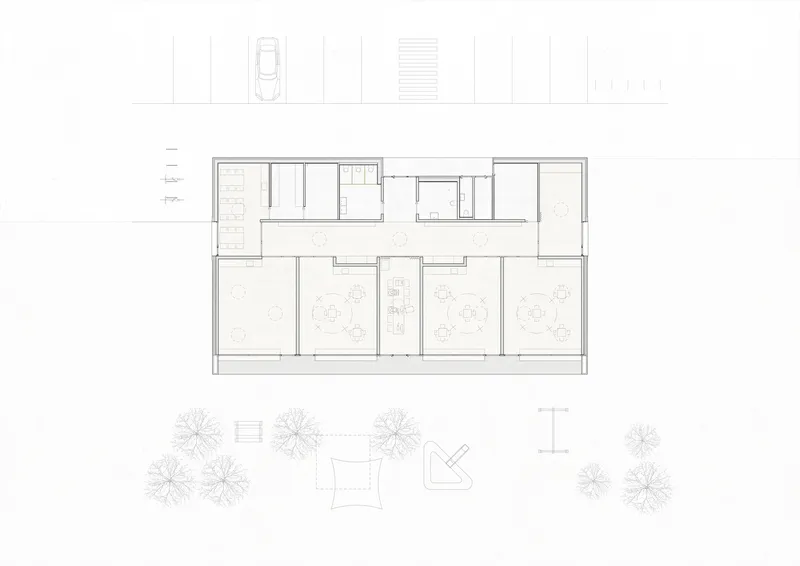
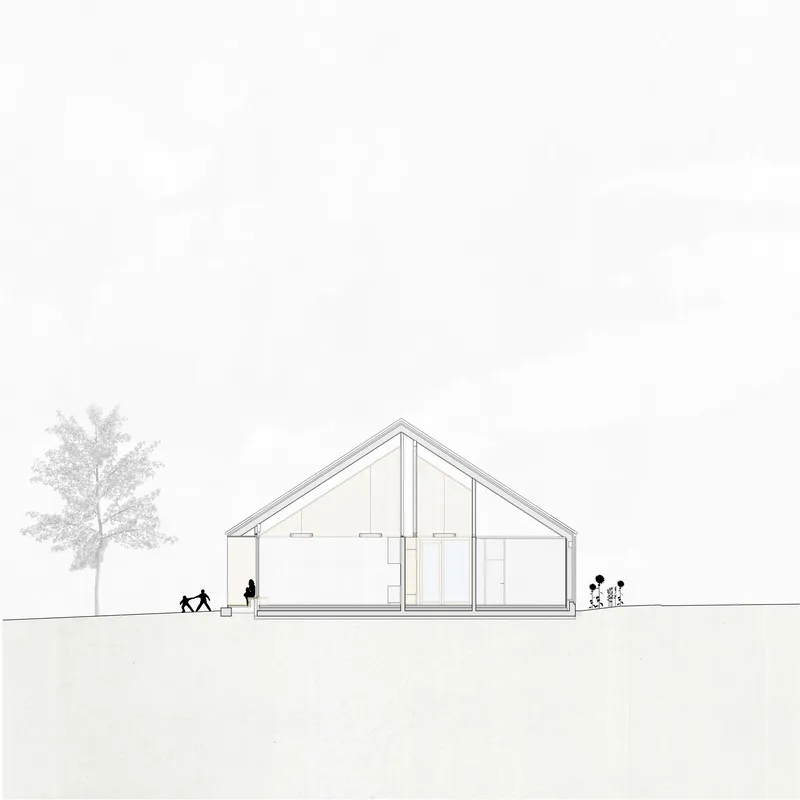
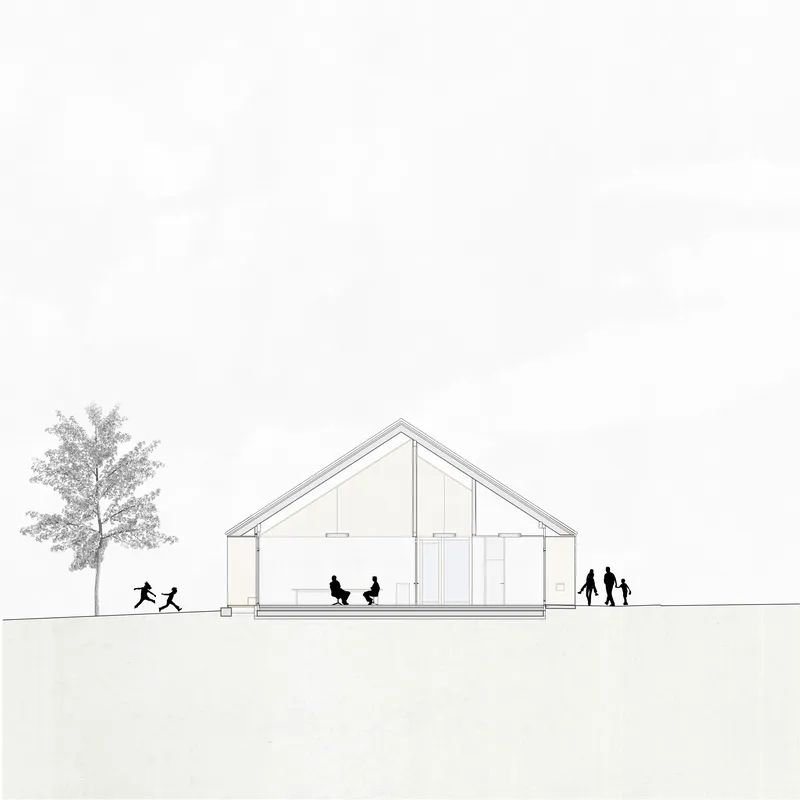
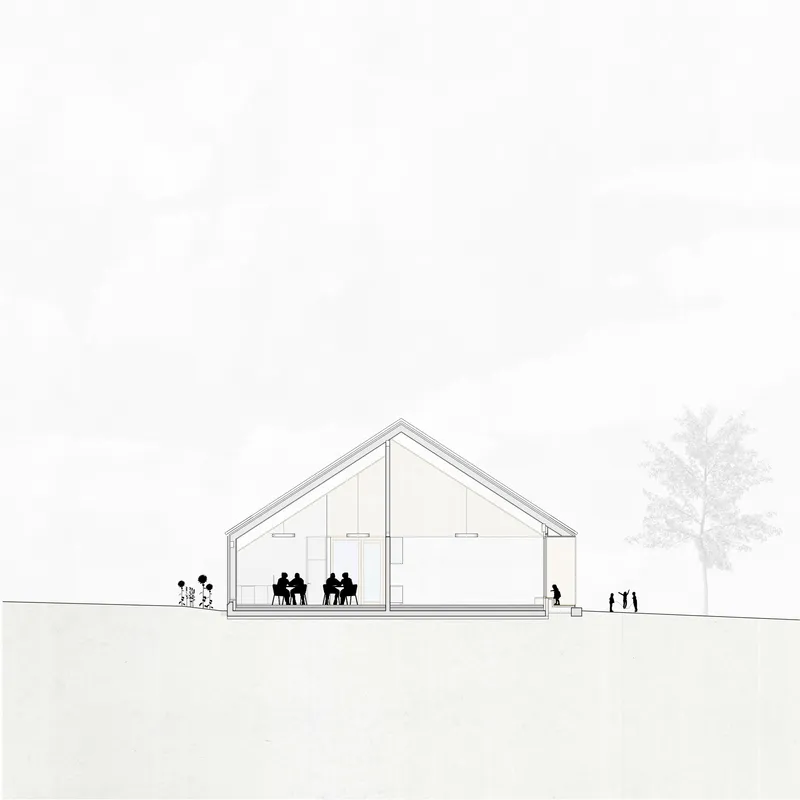
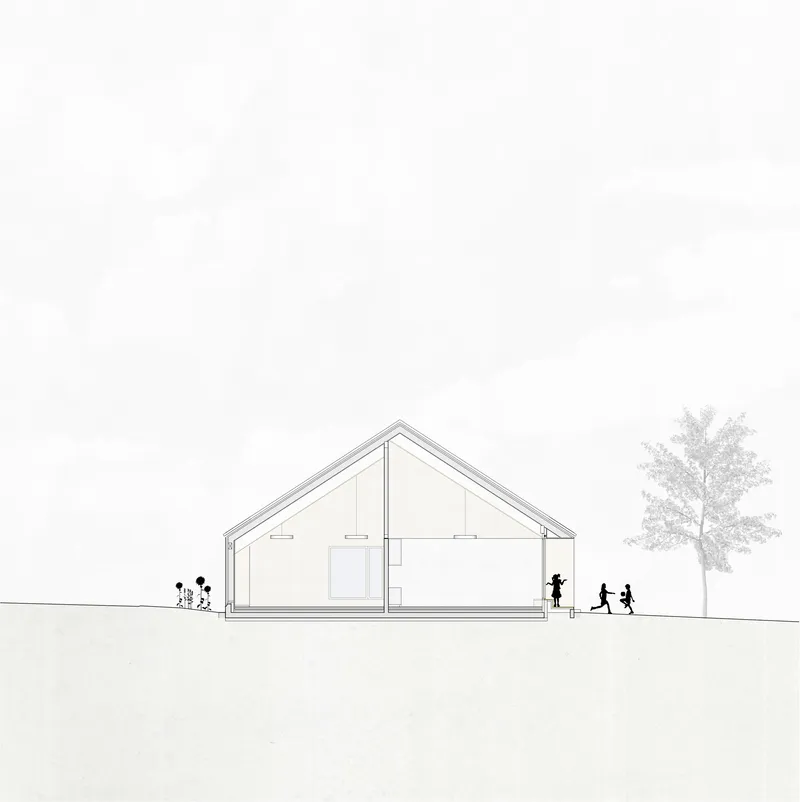
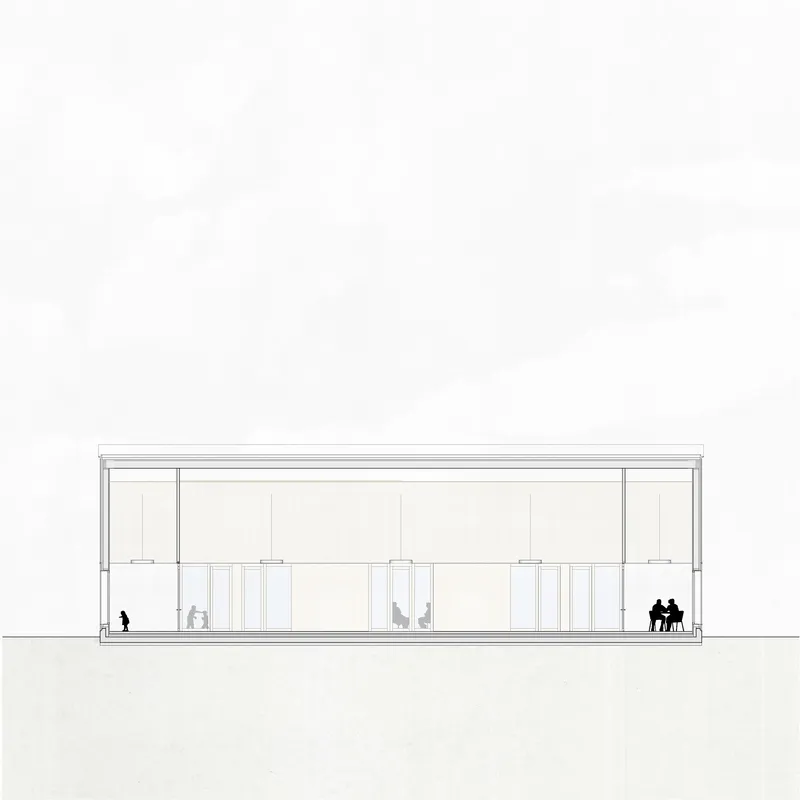
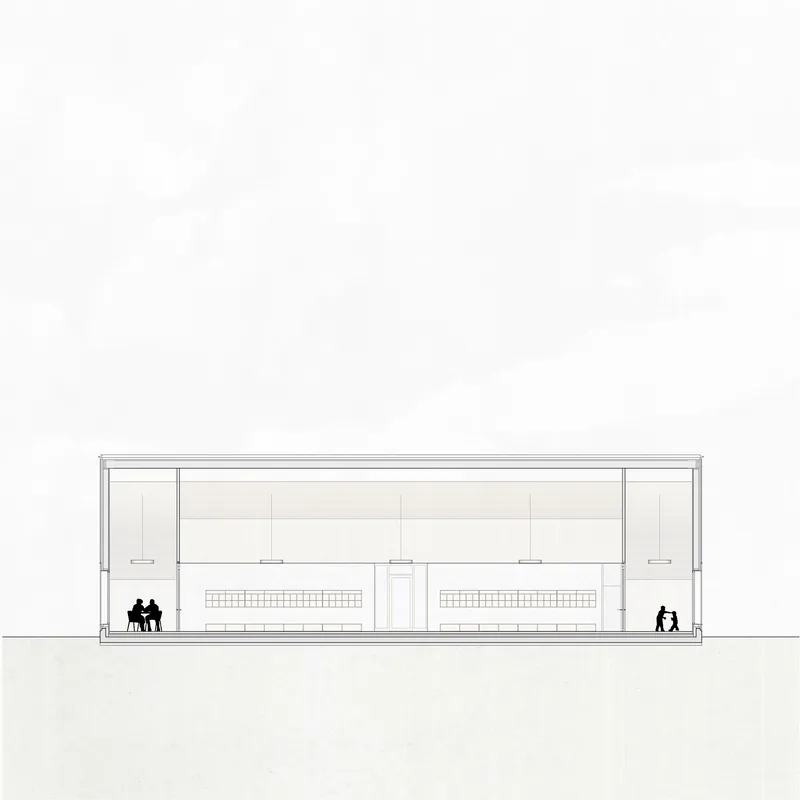
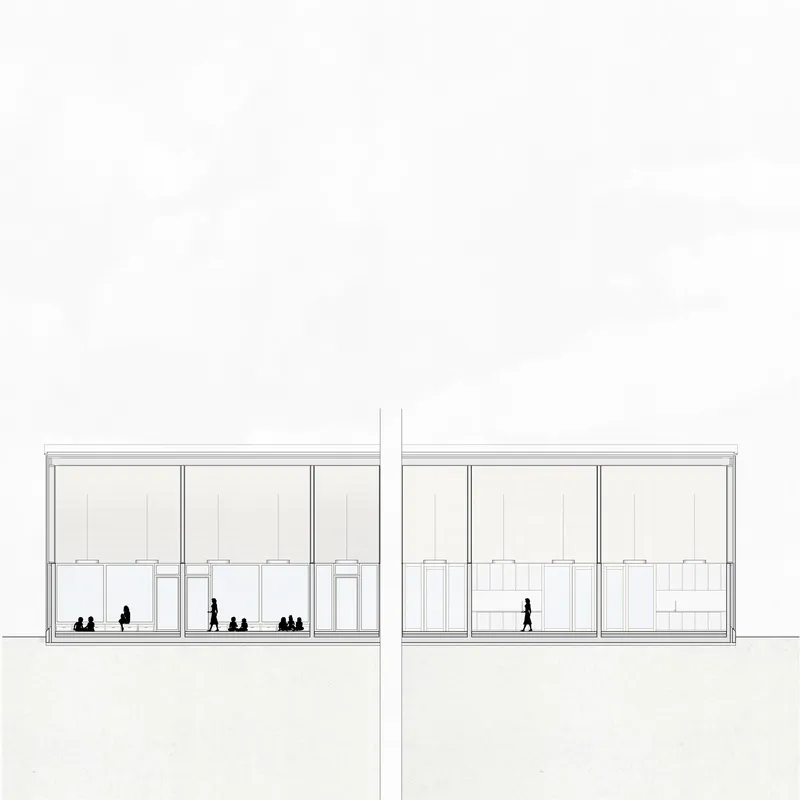
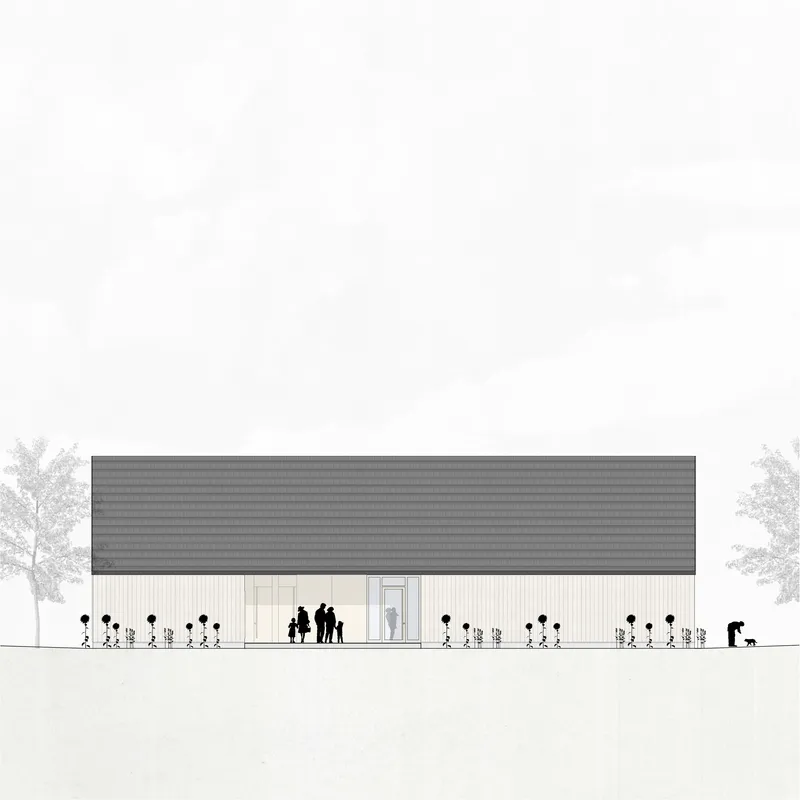
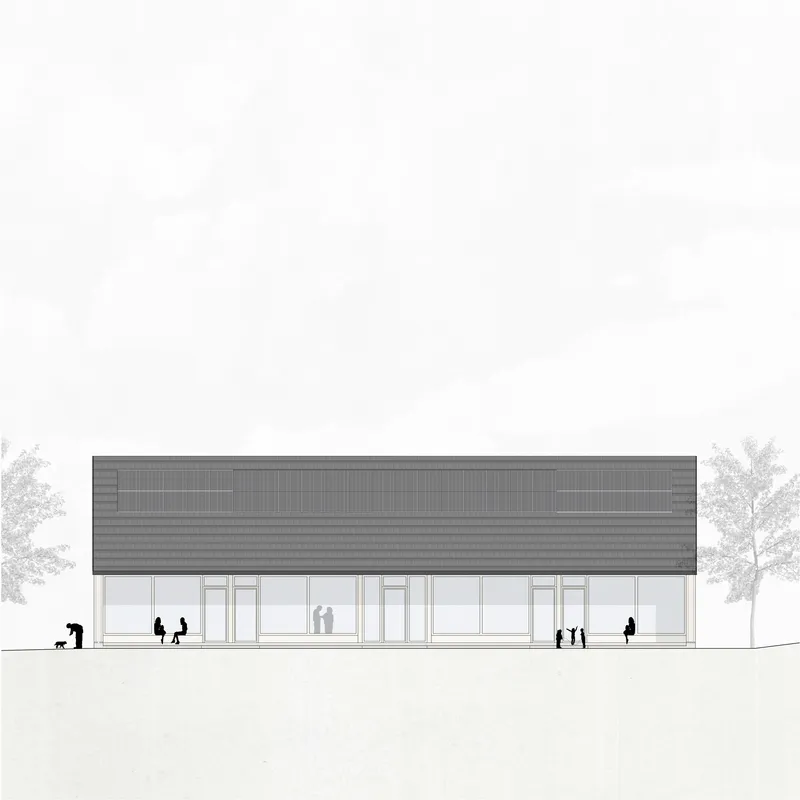
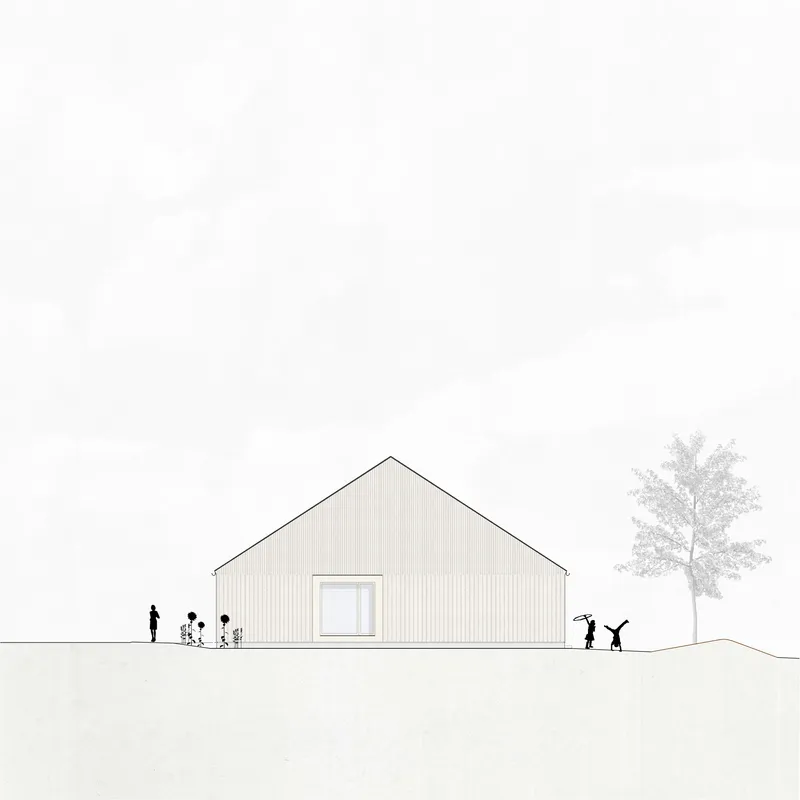
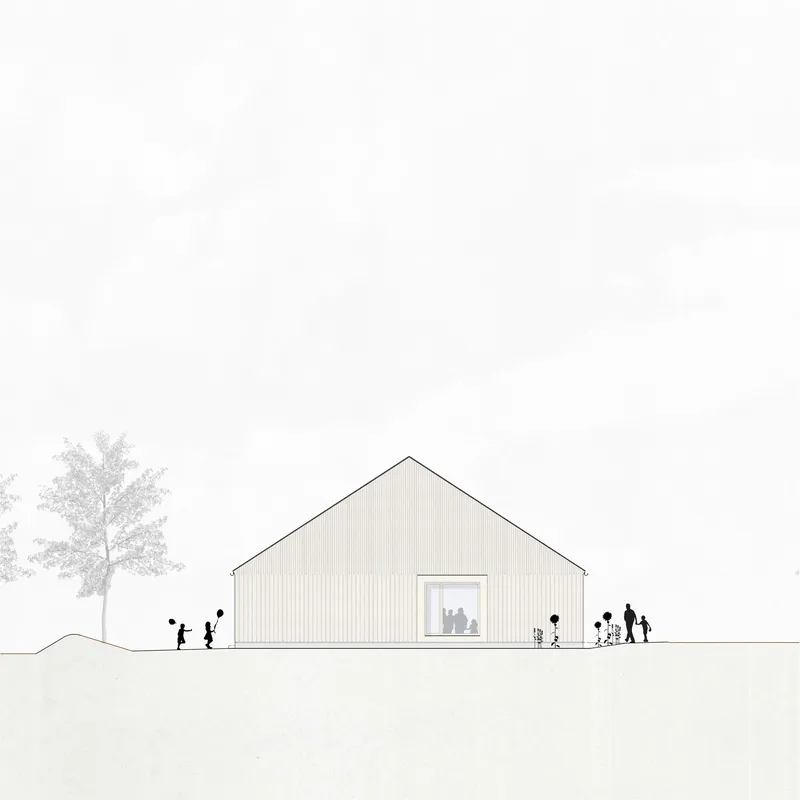
The floor plan reveals a tripartite arrangement: three large rooms flanking a central service core, with the two hallway axes providing visual and physical connections across the length of the building. The site plan shows the kindergarten positioned at the boundary between the Rheinhof farm's open land and the denser school campus to the north, confirming the building's role as a mediating element.
The section drawings are particularly instructive. They show the gable volume in profile, with the timber structure rising above the concrete datum line and figures scaled to suggest both children and adults. Several alternative sections explore flat-roofed configurations and tiered seating arrangements, suggesting that MWArchitekten tested multiple volumetric options before settling on the gable. The elevations reinforce the barn reading: vertical cladding, minimal openings on the gable ends, and a dark corrugated roof that sits quietly above the timber walls.
Why This Project Matters
The Farm Kindergarten Rheinhof matters because it resists the temptation to make kindergarten architecture performative. There are no rainbow facades, no blob geometries, no playful rooflines signaling "this is for children." Instead, MWArchitekten built a simple agricultural volume and invested the savings in material honesty, passive climate strategy, and a plan that positions the working landscape as the primary pedagogical tool. The building is legible to children not because it looks like a toy but because it looks like the farm buildings they already know.
The concrete thermal mass system deserves wider attention. In a moment when mechanical cooling is the default response to overheating, MWArchitekten demonstrated that 3.15 meters of concrete wall, combined with nighttime ventilation, can passively regulate interior temperatures in a small educational building. It is not a novel technique, but it is applied here with rigor and validated through simulation. For a 470 m² kindergarten in rural Austria, that kind of low-tech intelligence is exactly the right scale of ambition.
Farm Kindergarten Rheinhof by MWArchitekten. Hohenems, Austria. 470 m². Completed 2022. Photography by David Schreyer.
About the Studio
Share Your Own Work on uni.xyz
If projects like this are the kind of work you want to make, uni.xyz is a place to publish your own, find collaborators, and enter design competitions.



Popular Articles
Popular articles from the community


The Earth Pod: 3D Printed Homes for Resilient Refugee Communities
The Earth Pod reimagines refugee housing through 3D printed homes made from clay, combining resilience, self-sufficiency, and rapid shelter.

Riyadh For All: Intergenerational Urban Design for Active Aging in Rabat
Riyadh For All reimagines urban design in Rabat with intergenerational co-living, adaptive courtyards, and Moroccan cultural exchange today.

Conexión: Biophilic Design Reimagines High-Rise Living in Hong Kong
Conexión reimagines high-rise living in Hong Kong through biophilic design, green facades, shared spaces, daylight, water and nature within.

The Musturak Paradise: Senior Living Architecture for a Connected Future in Temara, Morocco
The Musturak Paradise reimagines senior living architecture in Temara via private homes, social spaces, culture, community, and shared care.


Similar Reads
You might also enjoy these articles

Bao Huynh Watercolor Atelier: A Serene Art Retreat in Hội An
Bao Huynh Watercolor Atelier in Hội An blends multifunctional art spaces, sustainable design, local materials, and family-friendly living in a serene environment.

Atelier Macri Concept Store Interior Design by CASE-REAL
Atelier Macri store features a "ko" counter, walnut wood details, cork displays, blending retail, gallery, and seamless customer experiences.

Manuel Vargas Izquierdo Stadium and High-Performance Sports Center: Architectural Excellence in Jalpa de Méndez
The Manuel Vargas Izquierdo Stadium blends sustainable design, inclusive sports facilities, and cultural-inspired architecture, revitalizing Jalpa de Méndez’s public spaces.

KAKR Buluh Awar Hall: Revitalizing Community and Ecology Through Bamboo Architecture
Community built bamboo hall revitalizes Buluh Awar village, empowering youth, restoring ecology, celebrating vernacular craftsmanship through sustainable architecture and culture.


Explore Educational Building Competitions
Discover active competitions in this discipline



Challenge to design public laboratory


Challenge to reimagine the Iron Throne


Photograph architecture without architects


Illustrate the lost glory of Angkor Wat - Render Challenge
Comments (0)
Please login or sign up to add comments
No comments yet. Be the first to comment!