

NASCA Embeds a Multilevel Diving Retreat into the Forested Hillside of Japan's Izu Peninsula
A concrete and timber pavilion in Ito, Japan, stacks pools, saunas, and living spaces across three levels within a preserved forest canopy.


There is something genuinely radical about designing a sports facility that refuses to behave like one. MIZU NO IE, or "House of Water," is a 293 m² diving retreat designed by NASCA under lead architect Nobuaki Furuya. Sited in the forested hills of Ito, on Japan's Izu Peninsula, the building stacks its aquatic program across three levels: a basement spa with onsen and sauna, a ground floor with kitchen and lounge, and an upper level housing a full lap pool, diving pool, and jacuzzi. Rather than clearing the site to make room for this program, the building threads itself through the existing tree canopy, its angled walls negotiating with root systems and trunks.
What makes the project genuinely interesting is its insistence on treating water as a spatial medium rather than a recreational amenity. The pools are not dropped into a standard box; they occupy the widest, most structurally ambitious floor of the building, placed at an elevation where swimmers look directly into the forest canopy. The retreat collapses distinctions between athletic infrastructure, domestic comfort, and bathing culture into a single architectural gesture. It is at once a training facility, a ryokan, and a wellness center, and the architecture does not privilege any one reading over the others.
A Timber Pavilion Floating on Concrete
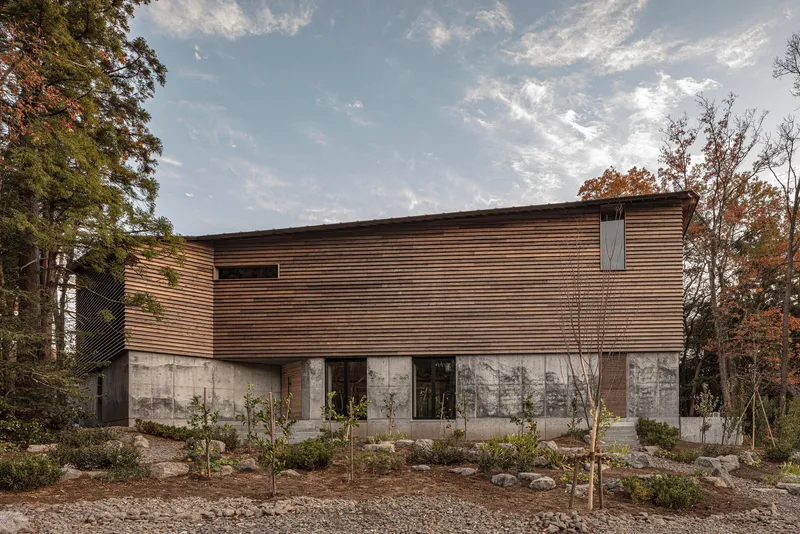

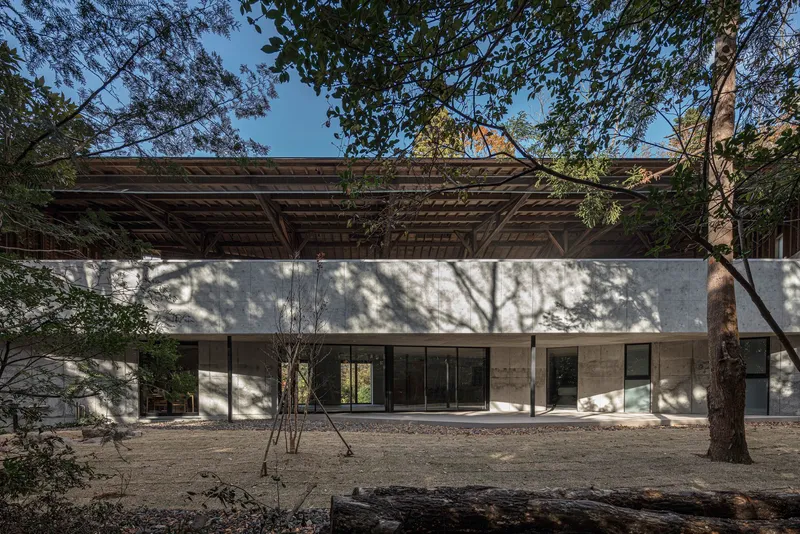
The building's primary architectural move is a split between its heavy concrete base and the lighter timber volume that sits on top. The lower levels are cast in board-formed concrete, giving the structure a rough, geological quality that anchors it visually to the hillside. Above, horizontal timber slats wrap the upper pool level in a breathable screen, filtering light and air while maintaining a visual continuity with the surrounding forest. The effect is that the building appears to have been excavated from the ground rather than placed on it.
NASCA's choice of materials is precise. The concrete absorbs the damp, mossy quality of the Izu climate, aging in sympathy with the forest floor. The timber slats, meanwhile, echo the vertical rhythm of the surrounding pine and deciduous trunks. Young trees planted in gravel beds at the building's perimeter further soften the boundary between structure and landscape, suggesting that the architecture is already in the process of being reclaimed.
The Roof Edge and the Canopy
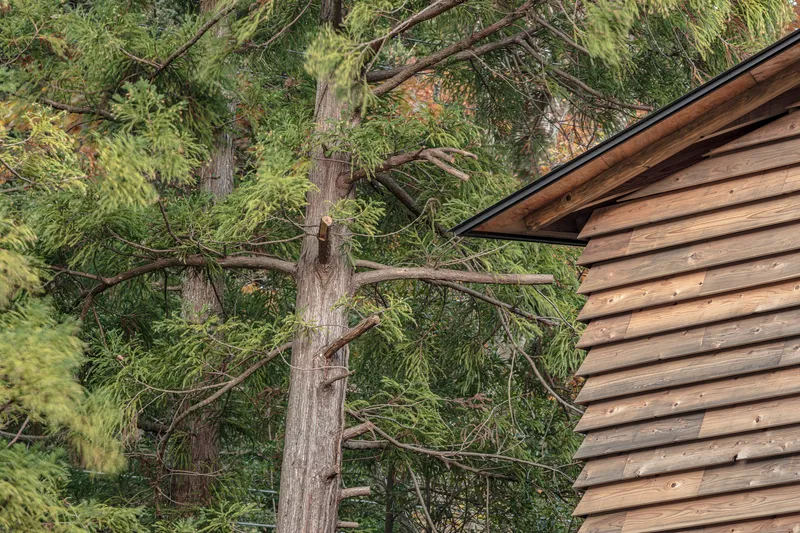
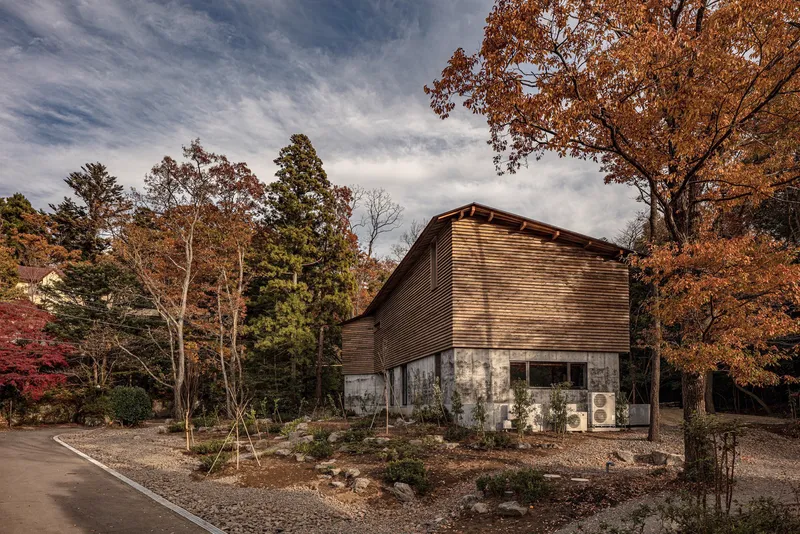
One detail tells you everything about NASCA's priorities on this project: the angled timber roof edge meeting the crown of a pine tree. The roof does not assert a clean geometric line against the sky. It angles, tilts, and negotiates with existing vegetation, accepting the irregularity of the canopy as a design constraint rather than an obstacle. The building's perimeter walls, visible in the plan drawings, are not orthogonal. They follow an angular, almost pentagonal geometry that seems calibrated to specific trees and topographic features.
Autumn foliage and fallen leaves accumulate around the base, and the architects have clearly anticipated this. The ground-level HVAC equipment is tucked beneath the timber overhang, visible but unobtrusive. The seasonal cycle is treated as a collaborator, not an inconvenience.
Swimming in the Treetops
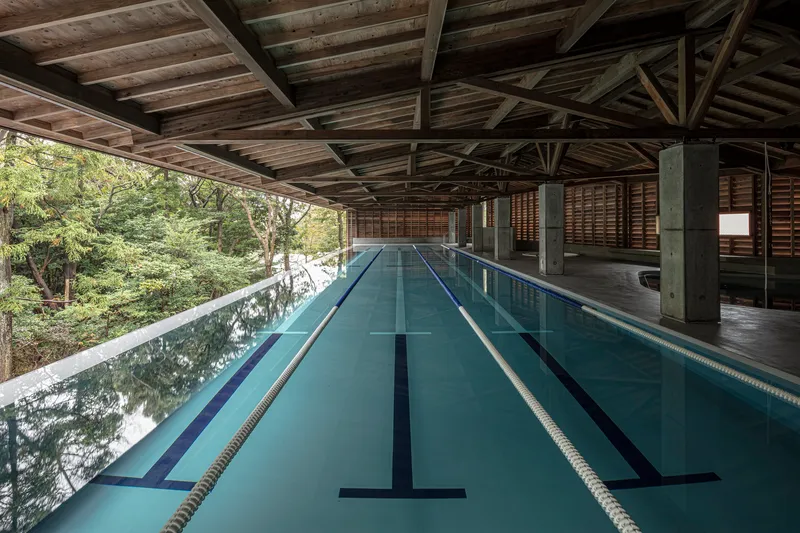
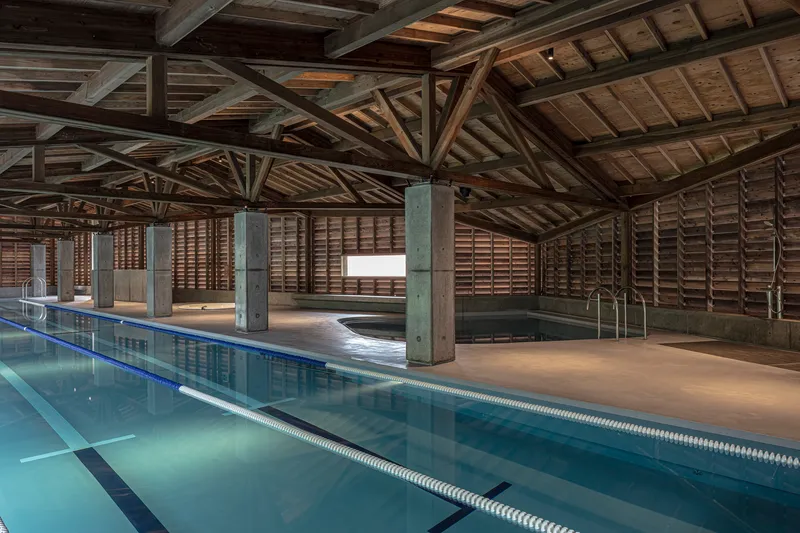
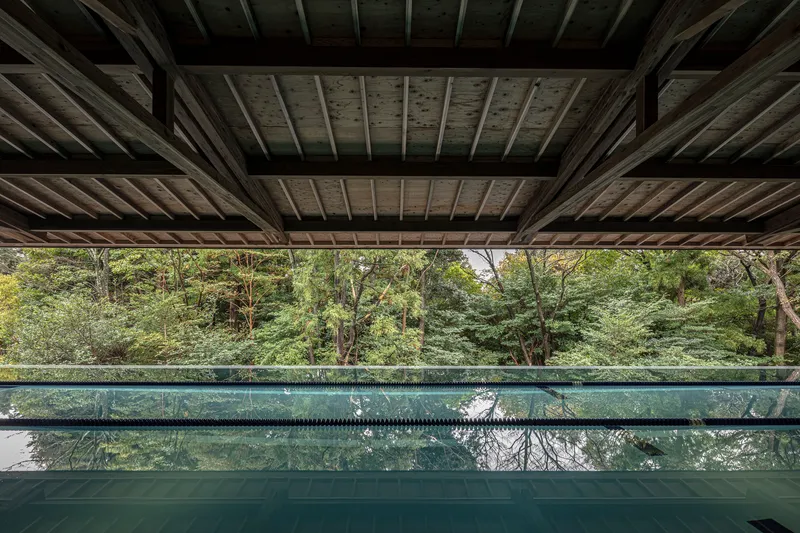
The lap pool occupies the upper level, a counterintuitive placement that yields extraordinary spatial results. Exposed timber roof trusses span above the water, supported by concrete columns that rise through the floor plate. The structural expression is honest and legible: you can read the load path from truss to column to foundation. Lane markers stripe the pool's surface, confirming this is a serious training facility, but the openness of the timber pavilion structure dissolves any sense of institutional enclosure.
From the pool, swimmers look directly into the forest through the open slatted walls. The horizontal timber screens act as a kind of architectural eyelid, controlling the degree of visual connection to the landscape without resorting to glass. The result is a pool that feels genuinely outdoor while being structurally sheltered, an ambiguity that is central to the project's character.
Poolside Details
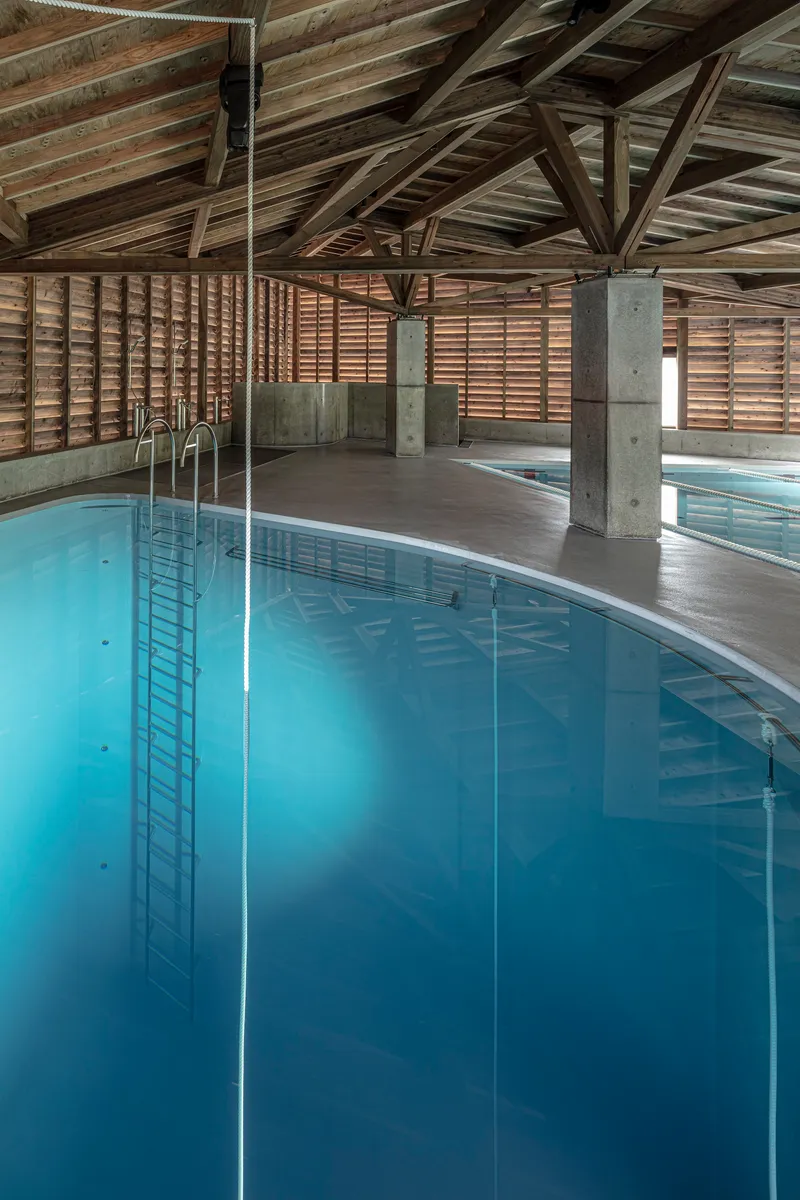
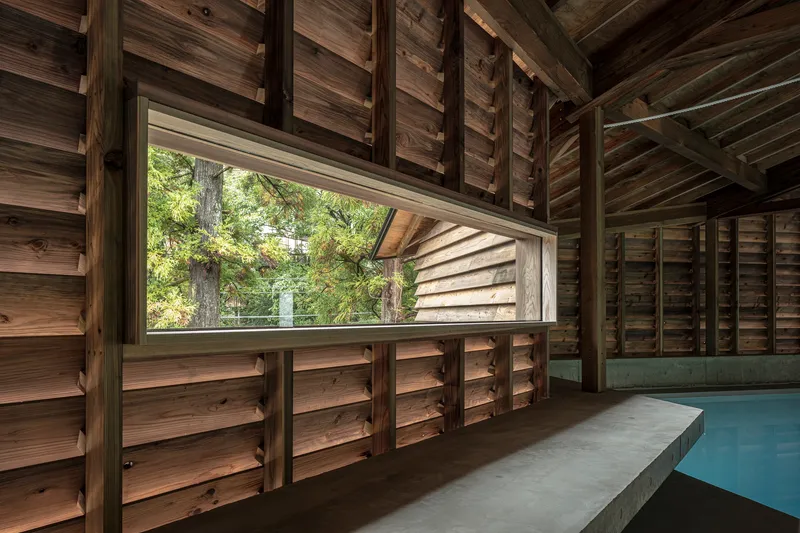
At the pool edge, the architecture shifts to a finer grain. Stainless steel ladder rails emerge from the water beside horizontal slatted timber walls. A horizontal window is carefully cut into the timber screen, framing a specific view of the forest as a composed landscape painting. These moments reveal NASCA's attention to the embodied experience of moving through water and then pausing at the edge: wet hands on metal rails, eyes adjusting from the blue-green of the pool to the deep green of the canopy beyond.
Living Spaces Cast in Concrete
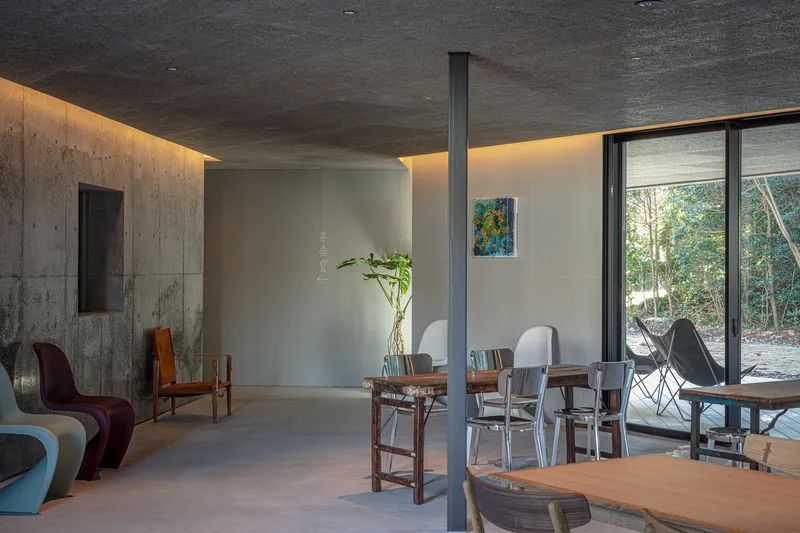


The retreat's living spaces occupy the ground floor, where polished concrete floors and board-formed walls establish a restrained material palette. Cove lighting washes the ceiling, producing a warm ambient glow that softens the concrete's austerity. Glazed walls open directly to the forest, and a gridded wood screen beside one window introduces a finer texture that mediates between the roughness of the concrete and the delicacy of the view.
A weathered concrete panel wall with a recessed stainless steel window opening shows the precision of the formwork. The board marks in the concrete are deliberate, creating a striated surface that catches raking light. These are not luxury finishes in any conventional sense; they are construction processes made visible and valued for their own textural qualities.
Bathing, Sauna, and Outdoor Rooms


The basement level houses the spa program: onsen, sauna, and bathing facilities that tie the building back to Japan's deep tradition of communal water culture. The sauna interior features tiered timber benches and a stone heater beside a glass slot window, a minimal composition that focuses attention on heat, steam, and the thin line of forest visible through the aperture. Bathrooms are similarly spare, with floating vanities, vessel sinks, and backlit slot windows that treat each fixture as a considered element rather than a standard fitting.
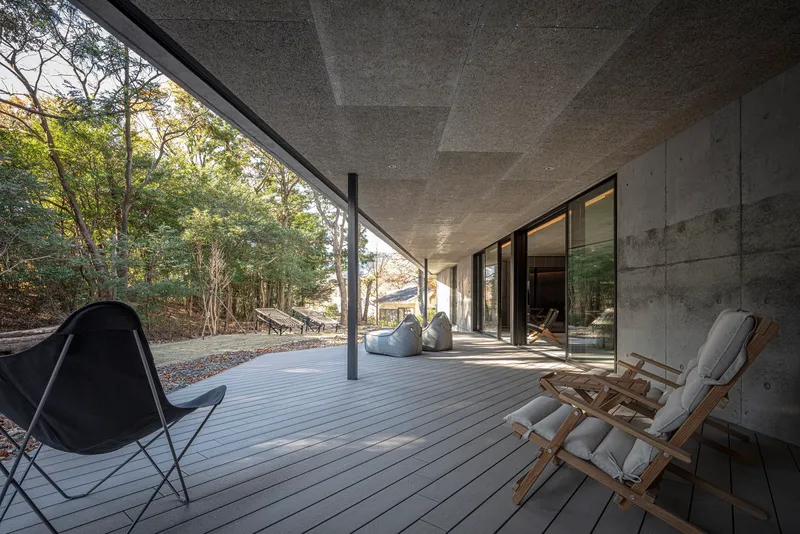
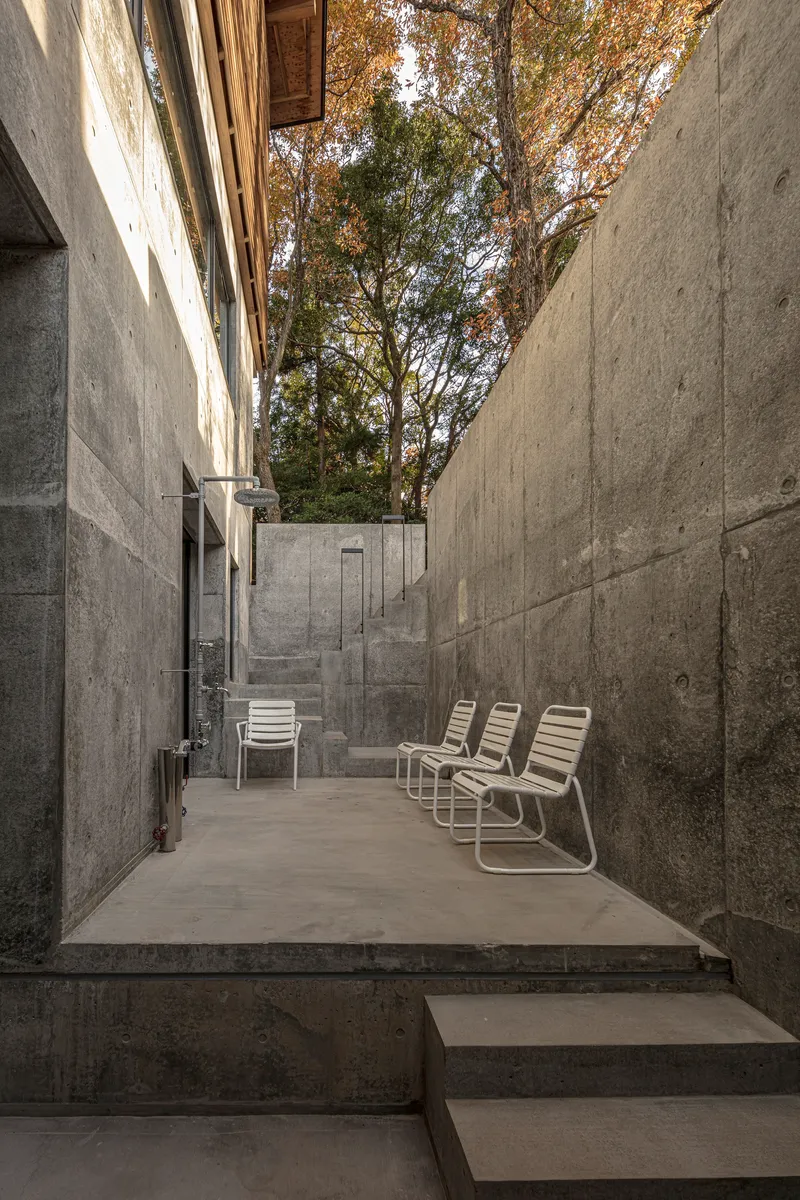
Outdoor rooms extend the bathing sequence into the landscape. A covered timber deck terrace with folding canvas chairs overlooks the wooded hillside, offering a decompression space between the intensity of the pool and the stillness of the forest. A concrete courtyard flanked by board-formed walls accommodates metal lounge chairs beneath autumn trees, creating a space that is simultaneously domestic and monumental. These outdoor rooms are not afterthoughts; they are integral parts of the building's circulatory logic, linking water, air, and rest.
Plans and Drawings
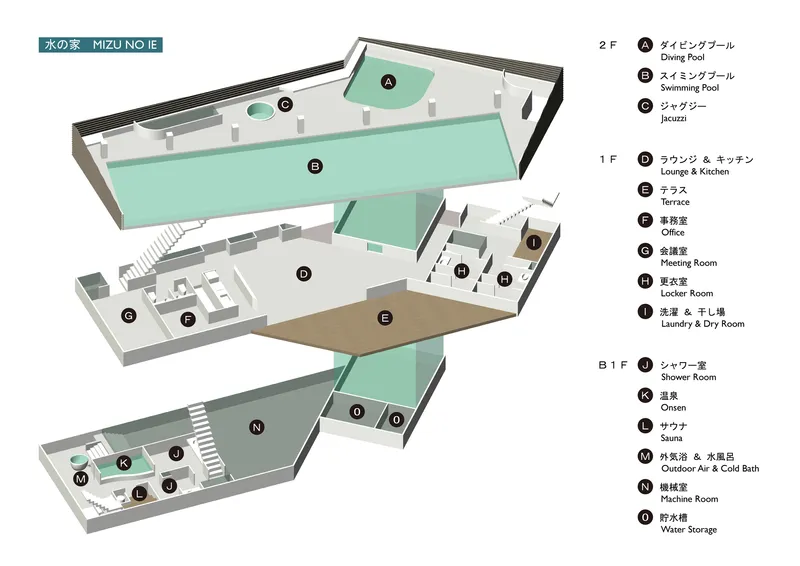
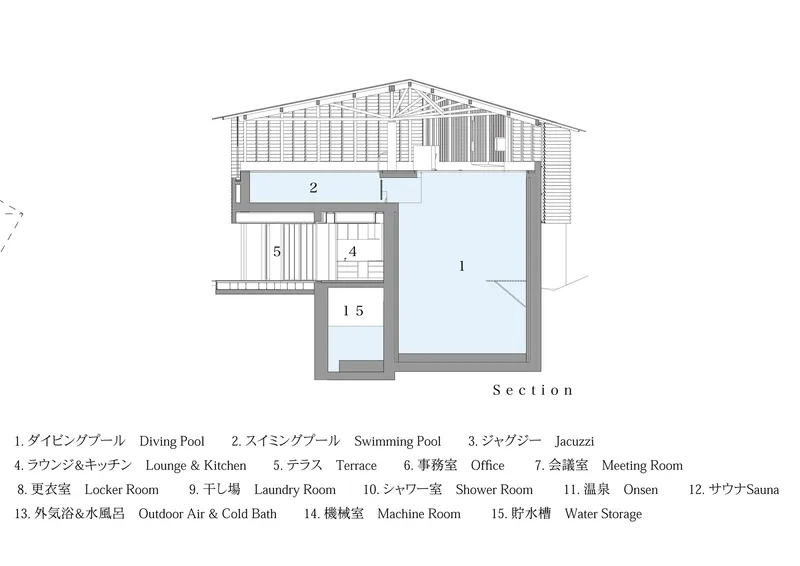

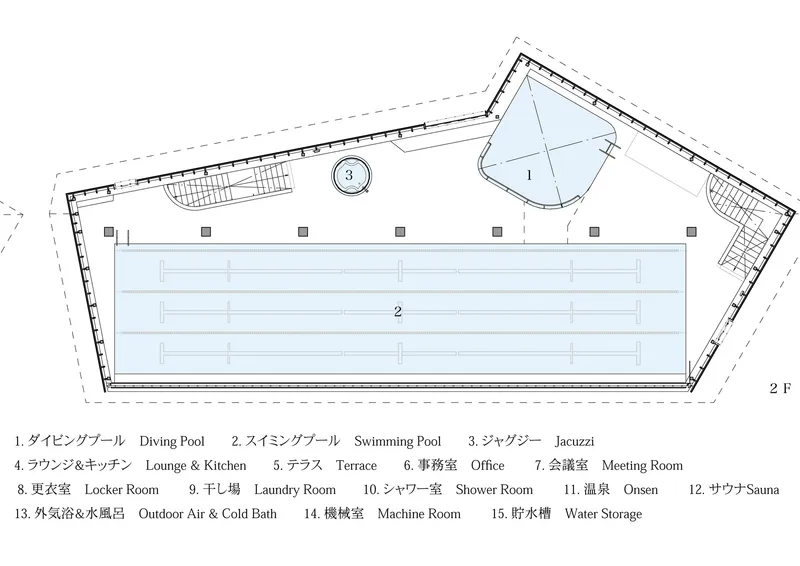
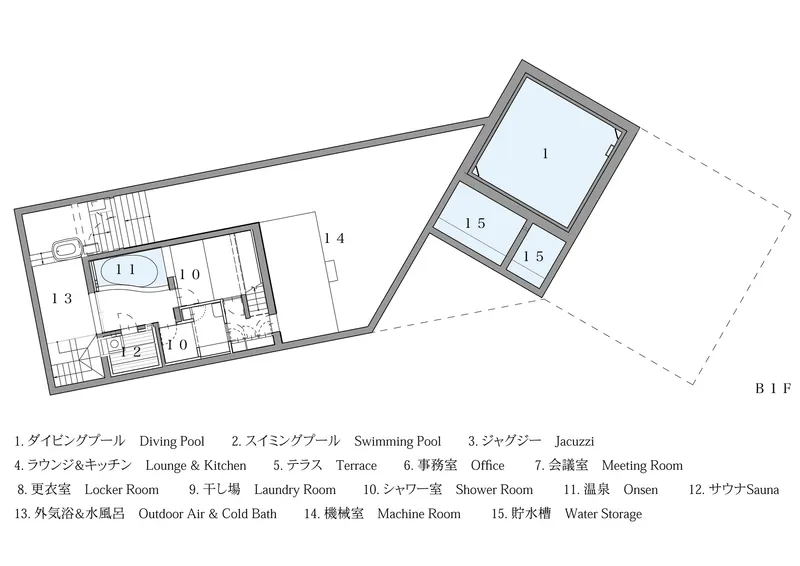
The axonometric drawing reveals the building's three-level stacking strategy with clarity. The pentagonal swimming pool at the ground level, the lap pool spanning the full width of the upper level, and the spa facilities buried in the basement are all visible in their spatial relationship. The section drawing confirms the multilevel interior, showing how the slatted timber roof structure shelters the upper pool while the concrete base embeds itself into the hillside. The angled perimeter walls visible in all three floor plans are the project's geometric signature, producing trapezoidal and pentagonal rooms that resist the predictability of orthogonal planning.
The basement plan is especially revealing. Spa facilities, onsen, and sauna are organized around an angled outdoor terrace that extends from the interior spaces, ensuring that even at the lowest level, the building maintains a direct relationship with the ground plane and the forest. The upper floor plan shows the diving pool and jacuzzi tucked into a corner beside the lap pool, concentrating the building's most demanding structural loads into a compact zone.
Why This Project Matters
MIZU NO IE matters because it refuses the false choice between athletic facility and retreat. Most sports architecture assumes that performance requires institutional aesthetics: tile, fluorescent light, acoustic ceiling panels. NASCA has built a training facility that draws its spatial logic from the onsen tradition, the forest pavilion, and the hillside house, collapsing those typologies into a single structure that serves divers, swimmers, and anyone seeking rest with equal conviction. The building does not look like a pool complex, and that is precisely the point.
The project also offers a quiet lesson in siting. By stacking program vertically and angling walls to preserve existing trees, NASCA demonstrates that a 293 m² building can occupy a forested hillside without dominating it. The timber and concrete palette will weather, the trees will grow, and over time the distinction between building and landscape will continue to blur. In an era when sustainability is often reduced to energy metrics, MIZU NO IE proposes something simpler and harder to quantify: an architecture that genuinely belongs where it stands.
MIZU NO IE, Izu Diving Retreat by NASCA (lead architect: Nobuaki Furuya). Ito, Japan. 293 m². Completed 2024. Photography by Satoshi Asakawa.
About the Studio
Share Your Own Work on uni.xyz
If projects like this are the kind of work you want to make, uni.xyz is a place to publish your own, find collaborators, and enter design competitions.




Popular Articles
Popular articles from the community


The Earth Pod: 3D Printed Homes for Resilient Refugee Communities
The Earth Pod reimagines refugee housing through 3D printed homes made from clay, combining resilience, self-sufficiency, and rapid shelter.
A Reinforced Cocoon: Vernacular Architecture for Security, Healing and Community in Qandahar
A Reinforced Cocoon reimagines Afghan vernacular architecture as secure community space for widowed women, families, healing and resilience.

Pangolin Can Help Mining: Biomimicry Architecture for an Asteroid Mining Habitat
Pangolin Can Help Mining explores biomimicry architecture through a modular 3D-printed habitat designed for asteroid mining and future life.

How Henri Picq's 1889 Paris Pavilion Traveled 11,000 Kilometers to Become Santiago's Artequín Museum
A prefabricated iron and glass pavilion built for the Paris Universal Exposition found a second life as a children's art museum in Chile.


Similar Reads
You might also enjoy these articles

Bao Huynh Watercolor Atelier: A Serene Art Retreat in Hội An
Bao Huynh Watercolor Atelier in Hội An blends multifunctional art spaces, sustainable design, local materials, and family-friendly living in a serene environment.

Atelier Macri Concept Store Interior Design by CASE-REAL
Atelier Macri store features a "ko" counter, walnut wood details, cork displays, blending retail, gallery, and seamless customer experiences.

Manuel Vargas Izquierdo Stadium and High-Performance Sports Center: Architectural Excellence in Jalpa de Méndez
The Manuel Vargas Izquierdo Stadium blends sustainable design, inclusive sports facilities, and cultural-inspired architecture, revitalizing Jalpa de Méndez’s public spaces.

KAKR Buluh Awar Hall: Revitalizing Community and Ecology Through Bamboo Architecture
Community built bamboo hall revitalizes Buluh Awar village, empowering youth, restoring ecology, celebrating vernacular craftsmanship through sustainable architecture and culture.


Explore Residential Building Competitions
Discover active competitions in this discipline



The International Standard for Design Portfolios


The Global Benchmark for Architecture Dissertation Awards


The Global Benchmark for Graduation Excellence


Challenge to design mud housing for contemporary communities
Comments (0)
Please login or sign up to add comments
No comments yet. Be the first to comment!