

1110 Office Strings a Dog-Friendly Rental Villa Around a Courtyard on Japan's Awaji Island
On a rapidly urbanizing stretch of coastline, Necklace Villa loops cedar-lined rooms into a sheltered ring for guests and their dogs.


Northern Awaji Island is caught between two identities. What was once a quiet fishing village pressed between mountains and sea is now absorbing cafés, theme parks, and commercial development at a pace that outstrips its narrow roads and tightly packed houses. Into this charged context, 1110 Office, led by Hiroto Kawaguchi, has threaded a 185-square-meter rental villa that neither romanticizes the old coastline nor capitulates to the new one. The practice calls its guiding philosophy one of "ambiguity and ambivalence," and the building makes that stance tangible: it is protective yet porous, vernacular in color yet contemporary in form, and explicitly designed for guests traveling with dogs.
The name tells you the organizational idea. Necklace Villa arranges its rooms like beads on a string, looping them around a central courtyard so that every space connects to the next without corridor walls. The ring doubles as an indoor-outdoor dog run, and the courtyard acts as a buffer against road noise and the gaze of neighboring houses. Below the living room, a small take-out restaurant opens to the street, stitching the villa into the life of the neighborhood rather than hiding from it. It is a compact project with an unusually high ratio of ideas per square meter.
A Rust-Red Shell on a Coastal Road
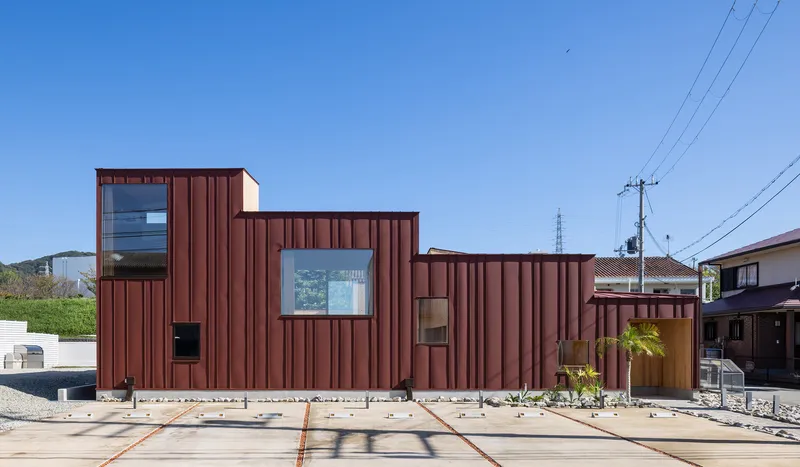
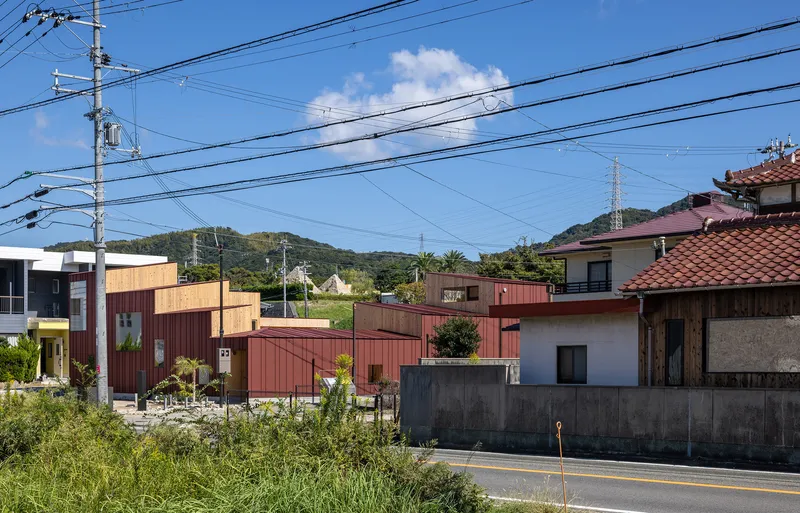
From the street, Necklace Villa reads as a cluster of stepping volumes wrapped in reddish-brown steel panels. The color is not arbitrary. It draws directly from the architectural inventory of the area: glazed roof tiles, painted cedar boards, warehouse facades, even the corrugated roofs of bicycle parking lots. By sampling this local palette and applying it to a new formal language, 1110 Office lets the building sit quietly among its neighbors without pretending to be one of them.
The steel cladding serves a practical purpose as well. Awaji Island's coast is exposed to salty winds that corrode softer materials. Metal panels shrug off that assault while aging into a patina that deepens the connection to context over time. Beneath the power lines and alongside compact residential plots, the villa's gravel forecourt and staggered massing break down its footprint so it reads as several small structures rather than one oversized house.
The Courtyard as Organizing Principle


Step past the exterior shell and the mood shifts completely. Cedar planks line the courtyard-facing walls, and the ground slopes gently with the terrain, allowing the building's internal floor levels to step up and down in sync with the topography. Stone pathways weave between grassy mounds and planted beds, turning the courtyard into a miniature landscape rather than a flat void.
The courtyard is the project's engine. It admits daylight and wind into every room while screening out traffic noise and neighboring sightlines. For the dogs, it is a sheltered loop they can circuit freely. For the humans, it is a frame: wherever you sit inside the villa, the courtyard anchors your view and orients you within the building's ring.
Rooms Without Walls

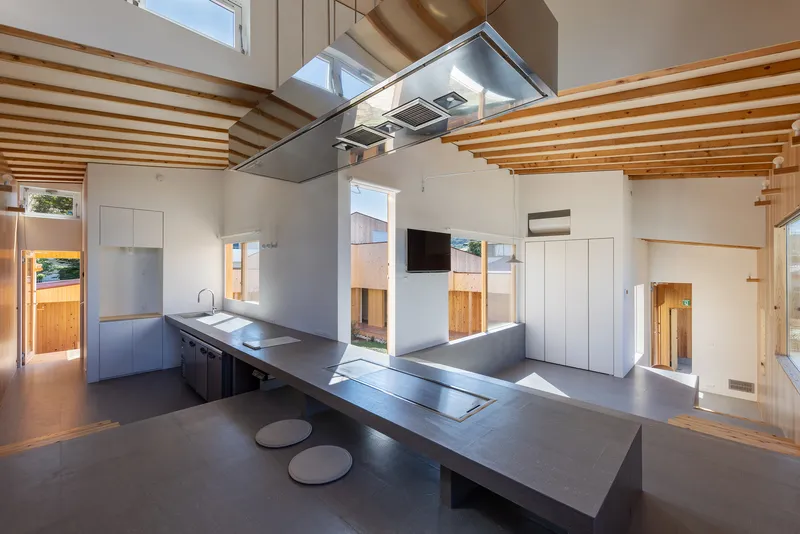
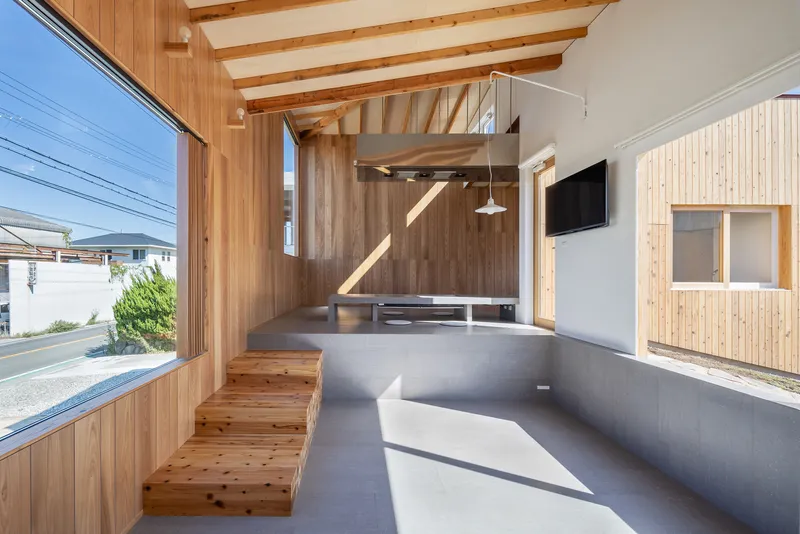
Inside, the looped plan means rooms are mostly linked rather than separated. A stair landing becomes a floor; a raised floor flows naturally into a tabletop. The kitchen, with its stainless steel island and exposed timber ceiling beams, opens directly into living zones without the interruption of doors. Concrete surfaces anchor the ground plane while pale cedar overhead keeps the spaces warm and resonant.
The split-level strategy is both spatial and behavioral. By raising the living room above the level of passing traffic, 1110 Office found an elegant solution to a specific problem: dogs bark less when they cannot see cars at eye level. That functional logic drives a series of half-level shifts that give each zone its own altitude and character while maintaining the continuous flow that makes the villa feel larger than its 185 square meters.
Framing the Sea and the Sky

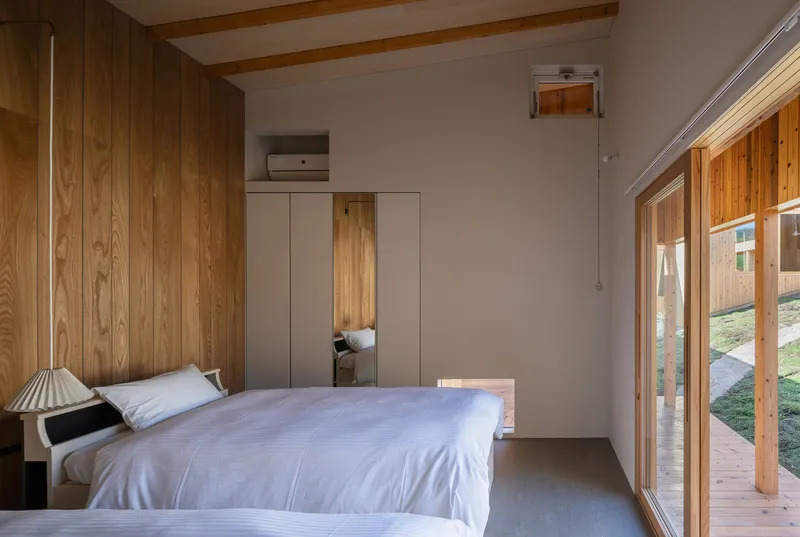
The bedrooms are where the villa's relationship with the ocean becomes most direct. A square window in one room isolates a distant view of the sea like a painting hung on a timber wall. In another, glazed sliding doors open fully onto the courtyard, collapsing the boundary between sleeping and open air. Exposed rafters run overhead in both rooms, their rhythm reinforcing the wooden structure that underpins the entire building.
These openings are carefully calibrated. Large enough to pull in light and cross-ventilation, they are positioned to maintain privacy from the road and from adjacent properties. The north-facing terrace offers a shaded, tranquil vantage point; the south-facing terrace is oriented toward evening skies. Light and wind are not incidental here. They are programmed.
Reading the Roof from Above

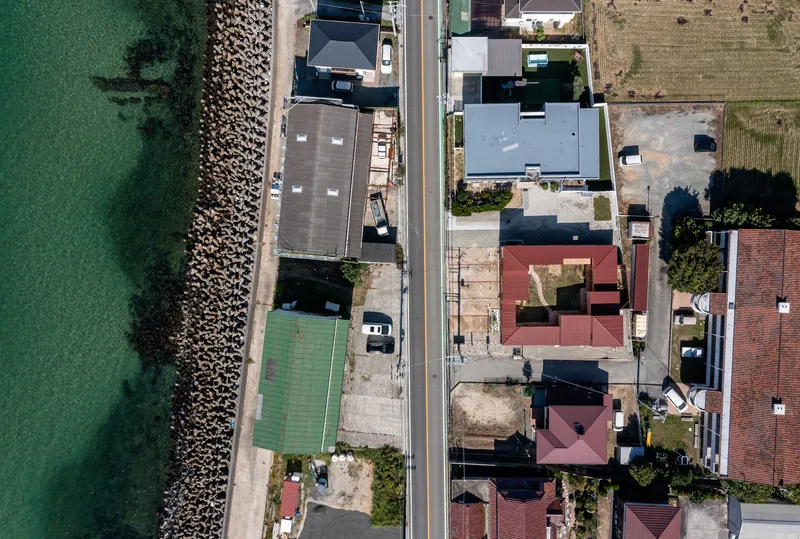
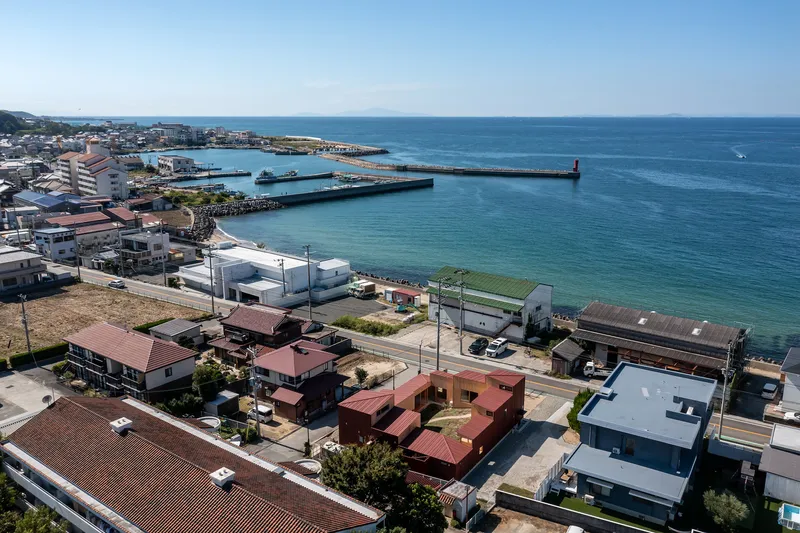
Drone photography reveals what the ground-level experience only implies: the villa is a compound. Maroon roofs cluster around the courtyard garden, their corrugated surfaces catching light at slightly different angles as each volume steps with the terrain. The aerial view also makes the coastal context legible. The breakwater, the harbor, the sea, and the tightly packed residential fabric all sit within a few hundred meters, underscoring how little flat land is available and how surgically the building had to be placed on its 608-square-meter plot.
From above, the necklace metaphor clarifies. Each volume is a bead; the courtyard is the thread that holds them together. The turf-covered slopes between volumes blur the line between roof and ground, giving the compound a geological quality, as if the building grew out of the hillside rather than being placed on top of it.
Plans and Drawings

The ground floor plan confirms the looped circulation strategy. Rooms wrap the courtyard in a continuous ring, with stone paths threading through planted zones at the center. No room is a dead end; every space feeds into the next. The plan also shows how the take-out restaurant is tucked beneath the living room at the street edge, giving the building a public face without compromising the privacy of the courtyard behind it.
Why This Project Matters
Necklace Villa matters because it refuses the false choice between resistance and surrender in the face of rapid change. Northern Awaji Island is transforming fast, and many new buildings there either ape tradition or ignore it entirely. 1110 Office found a third path: absorbing the material vocabulary of the existing context, rethinking it through a contemporary spatial logic, and producing a building that belongs to neither the old village nor the new tourist strip but to both simultaneously.
It also demonstrates that designing for a niche program, in this case a dog-friendly rental villa, can generate real architectural invention. The split-level strategy, the looped plan, the courtyard buffer: none of these moves would exist without the specific constraints of dogs, coastal winds, dense neighbors, and limited land. Constraint, as always, is the architect's best collaborator.
Necklace Villa by 1110 Office (lead architect Hiroto Kawaguchi, with Antonin Henrard and Kenta Shimamura). Northern Awaji Island, Japan. 185.49 m² on a 607.81 m² plot. Completed 2024. Structural consulting by NEN Architecture. Photography by Yohei Sasakura.
About the Studio
Share Your Own Work on uni.xyz
If projects like this are the kind of work you want to make, uni.xyz is a place to publish your own, find collaborators, and enter design competitions.




Popular Articles
Popular articles from the community

EW PARK: Sustainable Architecture Reimagines the Future of Urban Parking
EW PARK reimagines city parking as a modular wooden tower combining automation, solar energy, electric mobility, and adaptable urban design.

Riyadh For All: Intergenerational Urban Design for Active Aging in Rabat
Riyadh For All reimagines urban design in Rabat with intergenerational co-living, adaptive courtyards, and Moroccan cultural exchange today.

The Earth Pod: 3D Printed Homes for Resilient Refugee Communities
The Earth Pod reimagines refugee housing through 3D printed homes made from clay, combining resilience, self-sufficiency, and rapid shelter.

AL-JANNAH: Sustainable Architecture and Permaculture for Afghan Widows
AL-JANNAH uses sustainable architecture and permaculture to create resilient oasis of housing, learning, work and renewal for Afghan widows.


Similar Reads
You might also enjoy these articles


Hodi-Mandai Geram
Project Function: Preservation and revitalization of the Intangible heritage and socio-spatial identity of the Hodi by Housing, Cultural Memory Center, Sacred Grove, landscape, local tourism economy


Olio Towers: A Mid-Rise for Performers That Fuses Housing, Rehearsal, and Stage
Located blocks from Houston's Theater District, this modular tower stacks living units around a central performance atrium.

Oasis: Modular Green Housing Carved into Dhaka's Urban Fabric
A shortlisted Plugin Housing entry reclaims unauthorized settlements in Dhaka with stepped concrete volumes, green roofs, and ventilation-driven design.

Black Hole: A Floating Megastructure for the Post-Physical Era
Emiliano Mazzarotto envisions a spherical, self-scaling arena where e-sports, digital hotels, and holographic stadiums replace traditional public space.


Explore Japanese Architecture Competitions
Discover active competitions in this discipline



Challenge to reimagine the Iron Throne


Photograph architecture without architects


Illustrate the lost glory of Angkor Wat - Render Challenge


Design challenge to reuse E-waste
Comments (0)
Please login or sign up to add comments
No comments yet. Be the first to comment!