
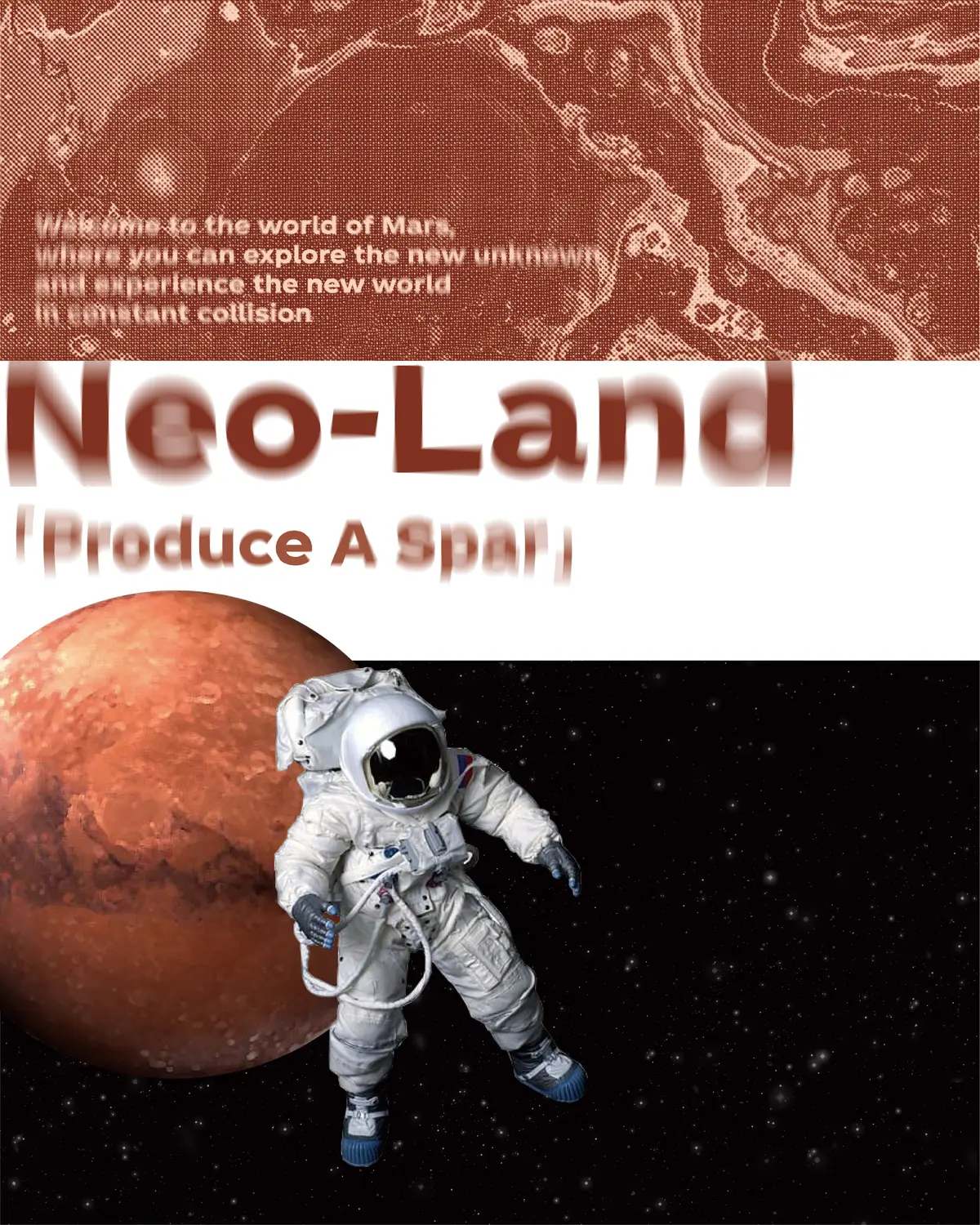
"Neo-Land" Mars Residence Design Notes
Mars / Satisfy / Basic needs

However, the world's population growth rate is decreasing, the population is saturate due to the limited amount of living resources. We will be working on the "Neo-Land" 40-person Mars colony project and will be designing a residential base on Mars within 4,000 m².The design aims to develop a new territory for human habitation on Mars, which not only satisfy the basic needs of human existence, such as oxygen, light, water, nutrients but also the security and sense of community. The concept references the Maslow's needs, the second level - security - and the third level - belonging and love – will be the main design opportunities in addition to the physical needs. The proposed time for the Mars migration will be the year 2100.
The "Neo-Land" housing site is located in one of the seven caves discovered by the Odyssey rover, where, due to the high level of methane, the heat and electricity and water needed for human survival can be supplied by collecting methane and making it react chemically. The chemical reactions can also be used to supply methane, while human excrement can be converted into heat and electricity through digesters. In this way, mankind can recycle heat, electricity and water on Mars, and the establishment of a recycling system is a fundamental prerequisite for survival.
We have discovered through our research that the soil on Mars itself is not suitable for vegetation. So, we intend to transform the soil environment through microorganisms that decompose human excrement, and use the water produced by methane to irrigate plants.
Having solved the problem of survival, we start to focus on the second level of demand – safety, according to Maslow's Needs. We adopt the tandem relationship of living unit groups in the group living relationship, the tandem in form is for the internal structure of the tandem, providing a relatively stable space for the living environment, and also giving people a safe psychological space. The spatial composition uses a decentralised grouping form, mostly using arches and cylinders, so that the spatial form itself is centripetal, stable and secure. On this basis, each living unit has an independent circulation system to avoid simultaneous failures (e.g. the reasoning that eggs cannot be packed into one basket), and they are also modular, allowing for easy transfer or replacement at any time, and quick disconnection to avoid threatening continuous spread, which can reduce damage in case of failure and danger. The whole space has a circulation system, with equipment in the outermost ring for real-time monitoring. The human living area is arranged mainly underground, taking into account the natural factors of radiation, temperature, wind speed etc. This provides greater security and also achieves a sense of continuity and tandem between the above-ground and underground complexes, providing greater spatial stability, avoiding unexpected situations above or below ground and facilitating the spatial transfer of humans.
The use of AI homes in the human indoor living space, with a minimalist form of intelligent homes, creates a good echoing relationship with our entire external complex, while also minimising and avoiding waste. While optimising the space, the AI system can monitor the direction of the circulation system of the living environment in real time, warn of external safety issues, detect the air composition of the space; the health of the human body, etc.In case of danger, the house generates red lights and alarms, while the glass units on each floor become transparent for quicker communication and evacuation of people.People can use the smart home to understand the current state of their lives and can then live peacefully or avoid risks effectively.
After solving the physical and safety problems, people are gradually adapting to life on Mars and are beginning to develop a third level of needs - the need for a sense of belonging and love. In order to meet people's social needs, we have public spaces in the space, as well as laboratories and workshops, where people will form a tribal group in this small base, and they will have different roles according to the skills they are good at, resulting in a clash of cultures. status continues to improve.

Popular Articles
Popular articles from the community


Temporary Home for Dogs: A Reversed Zoo Rethinks Animal Shelter Architecture
In Bucharest, a sinuous corridor and freed landscape flip the logic of containment, designing a shelter that works to make itself unnecessary.

Opera by the Sea Estonia: Three Shells Dissolving Architecture into Tallinn's Coastline
A winning opera house proposal replaces monumental form with interconnected shells that blur the boundary between building, park and Baltic Sea.

Tsunami Convergenics: Turning Catastrophic Ocean Forces into Underwater Housing Infrastructure
A speculative underwater settlement off the coast of Onagawa, Japan, treats tsunamis and typhoons as energy sources rather than threats.
Faces of the Soviet Avant-Garde: Turning Moscow's Street Names into an Open-Air Museum
A network of sculptural installations across a Moscow residential district transforms forgotten architect names into spatial encounters with cultural memor

Similar Reads
You might also enjoy these articles

Day and Night Park: A Time-Based Urban Newsstand in Beijing
A temporary urban newsstand in Beijing blending travel, light, and reading through poetic colors, compact form, and community-focused design.

Modernist Patio Renovation in El Masnou, Barcelona by Oliver Segura Arquitectura + Cebrià Arquitectura
Modernist patio renovation blending tradition and innovation with a movable pool, leveled floors, and Catalan materials in El Masnou.

Alto Residencial Coop: Cooperative Housing Development in Santiago de Compostela by Carbajo Barrios Arquitectos
A linear cooperative housing complex blending white volumes and perforated metal façades, enhancing community living, natural light, privacy, and urban integration.

Vil Genis School by BPA ARCHITECTURE – Massy, France
Vil Genis School in Massy, France, features sustainable design, south-facing classrooms, community integration, accessible spaces, and modern educational architecture.


Comments (0)
Please login or sign up to add comments
No comments yet. Be the first to comment!