
NeuronaLab and Ruben Casquero Build a Three-Room Sensory Pavilion Inside a Barcelona Modernist Hospital
An ephemeral fashion installation inside Domènech i Montaner's Sant Pau complex fuses virtual, digital, and physical reality into one sequence.


Inserting a lightweight contemporary pavilion inside a protected heritage building is always a provocation, but the best provocations are the ones that make you reconsider both things at once. For the 080 Barcelona Fashion Week in 2022, NeuronaLab and Ruben Casquero did exactly that, building a self-supporting three-room installation inside one of the pavilions of the Recinto Modernista de Sant Pau, the hospital complex designed by Lluís Domènech i Montaner starting in 1902. The brief was to replace the conventional catwalk show for fashion brand LR3 with an immersive journey through three states of reality: virtual, digital, and physical.
What makes the project genuinely interesting is not the novelty of mixing VR headsets with fashion (plenty of brands have tried that), but the architectural discipline behind the sequence. Led by Ana García and Ruben Casquero, the team designed a freestanding structure of white tarpaulins and orange curtains that never touches the ornamental historic shell. An interstitial gap between old and new serves as the infrastructure corridor. Every sensory layer, fog machines, binaural sound, natural scent, LED screens, is choreographed room by room so that the visitor moves from isolation to immersion to encounter. The architecture does the storytelling.
Heritage as Stage Set
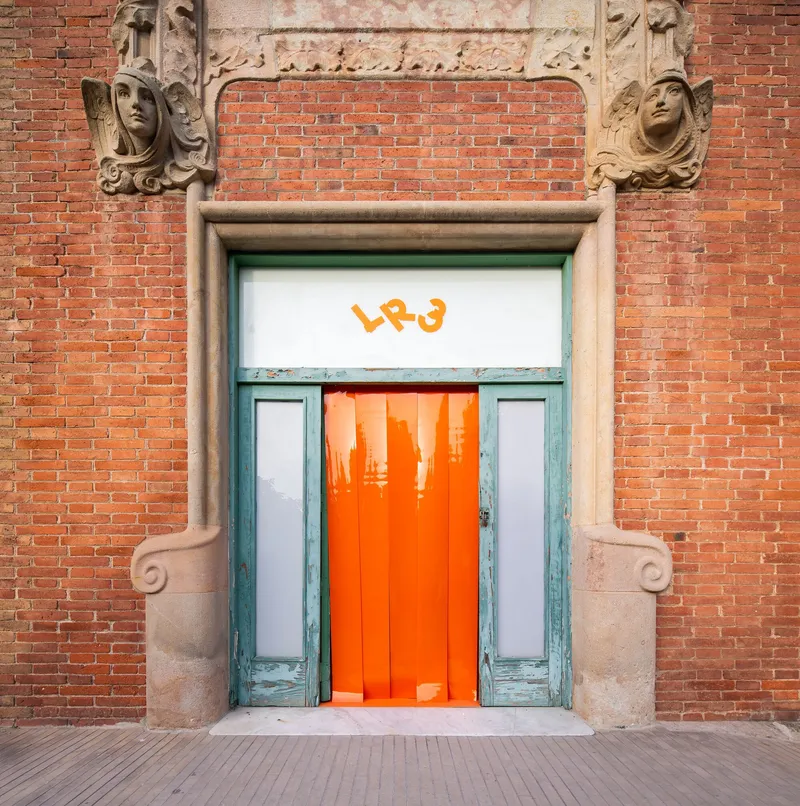
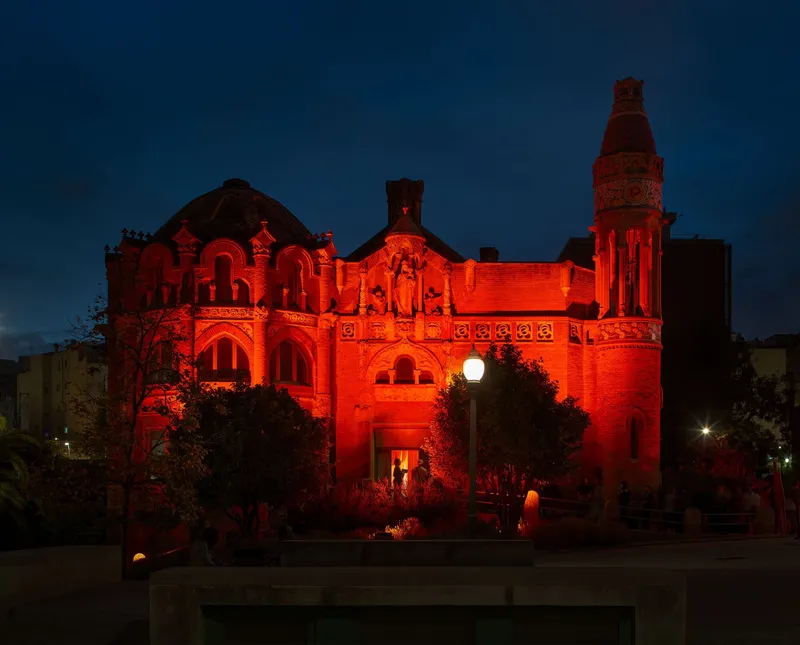
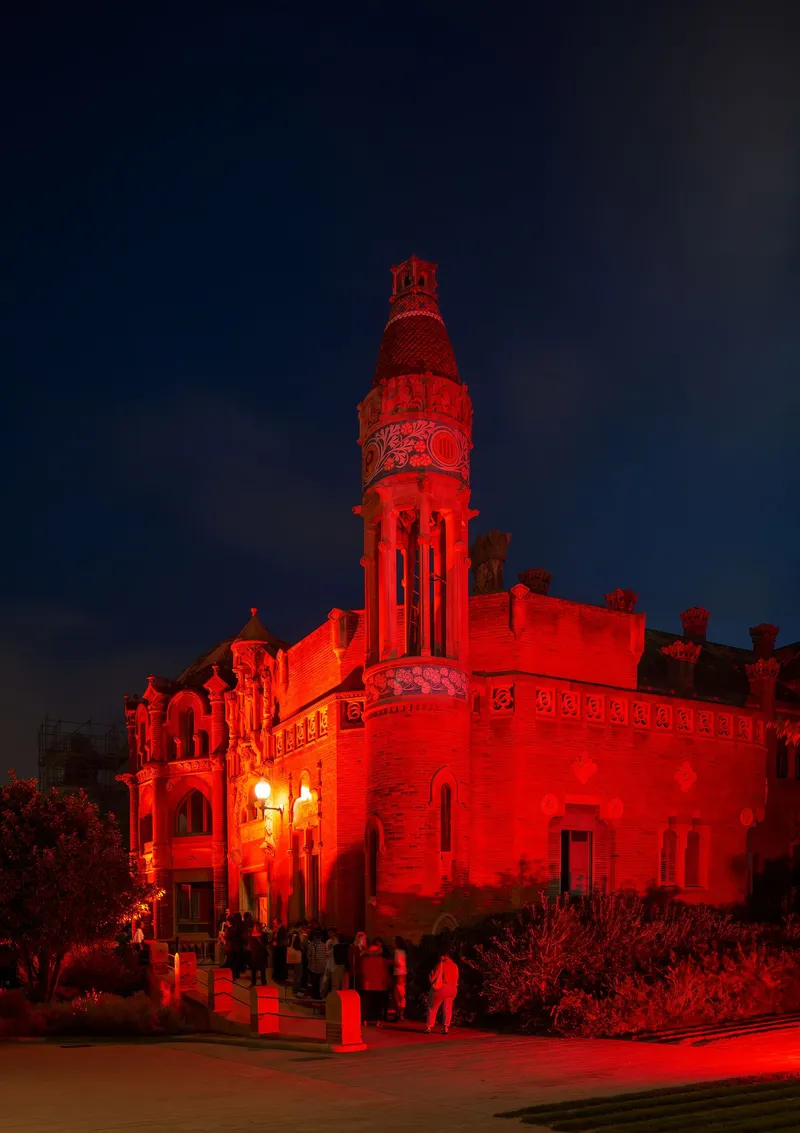
The pavilion of Nuestra Señora del Carme sits within the Sant Pau complex, a UNESCO World Heritage site whose hospital departments relocated to a new building in 2003, freeing the original structures for cultural use. Domènech i Montaner's facades are dense with carved stone, patterned brickwork, and ceramic detailing. The design team chose to treat this richness as a deliberate foil: at night, the building is bathed in red light, turning its ornamental surfaces into something closer to a theatrical backdrop than a hospital wing.
Visitors enter through a small door set within the original abraded wooden carpentry, an intentionally understated threshold that signals a change of register. The contrast between the weight of the Modernista envelope and the weightlessness of what lies inside is the first experiential move the project makes.
The Lure: Pixelated Figures in the Plaza
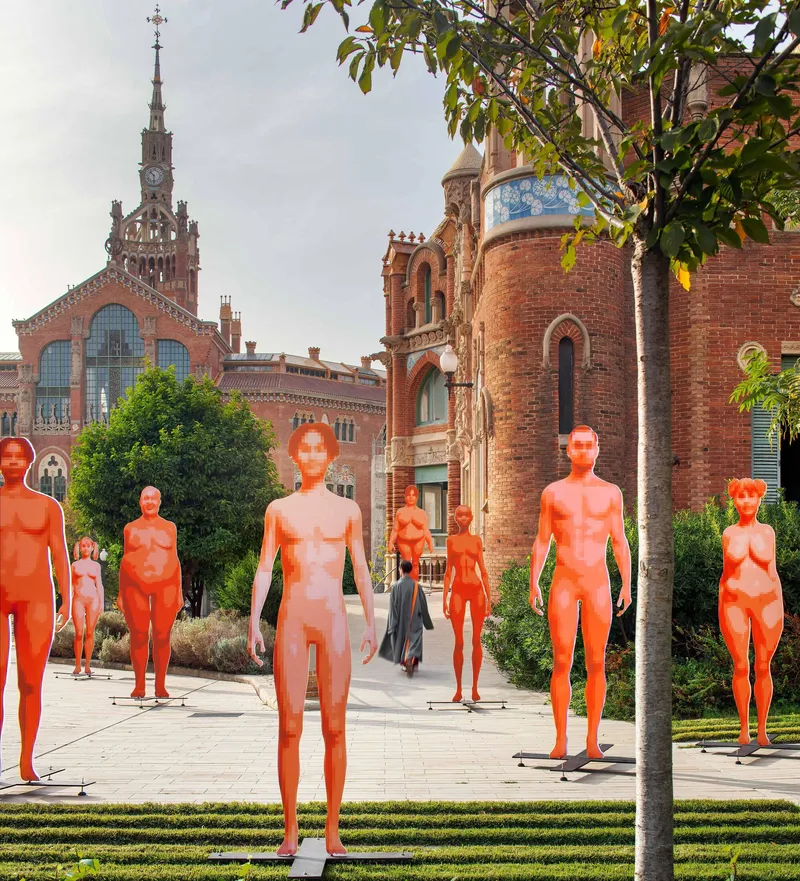
Before entering the pavilion, visitors encounter bright orange sculptural avatars placed among the trees of the surrounding plaza. These pixelated figures are deliberately crude against the botanical setting and the refined brickwork behind them, functioning as a lure that pulls people from the north side of the complex toward the entrance. It is a smart piece of wayfinding disguised as public art.
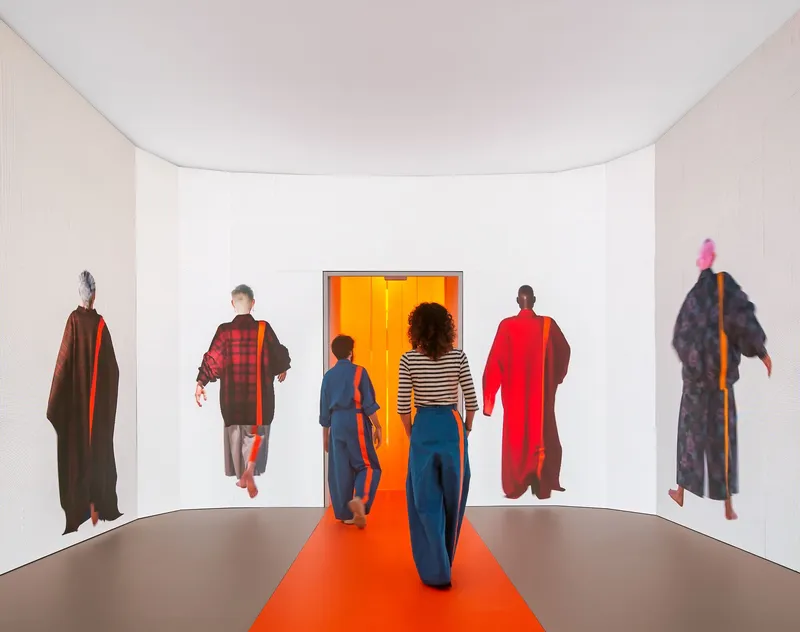
Inside, a white curved corridor with an orange floor stripe extends the transition. The path narrows perception, directing the eye toward a single glowing doorway. The tarpaulin walls are generic by design; they suppress context so that the rooms ahead can supply it on their own terms.
Room One: Virtual Reality
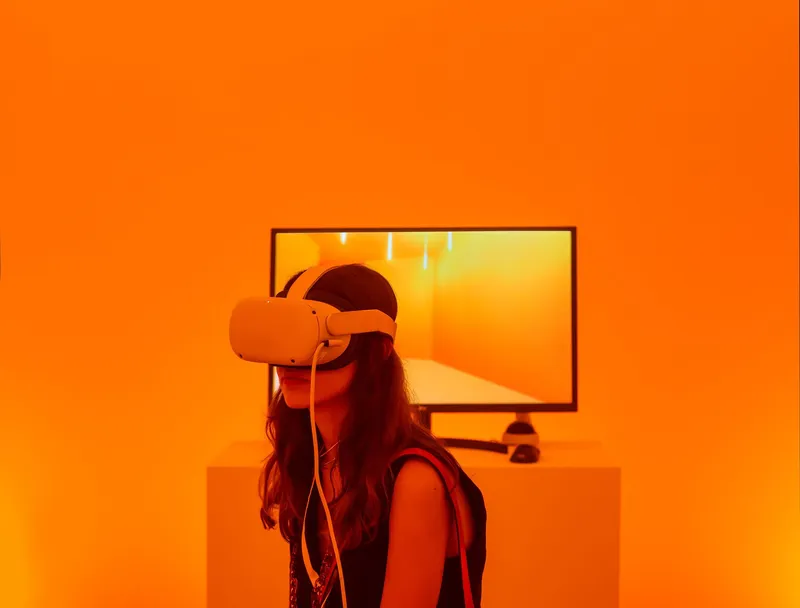
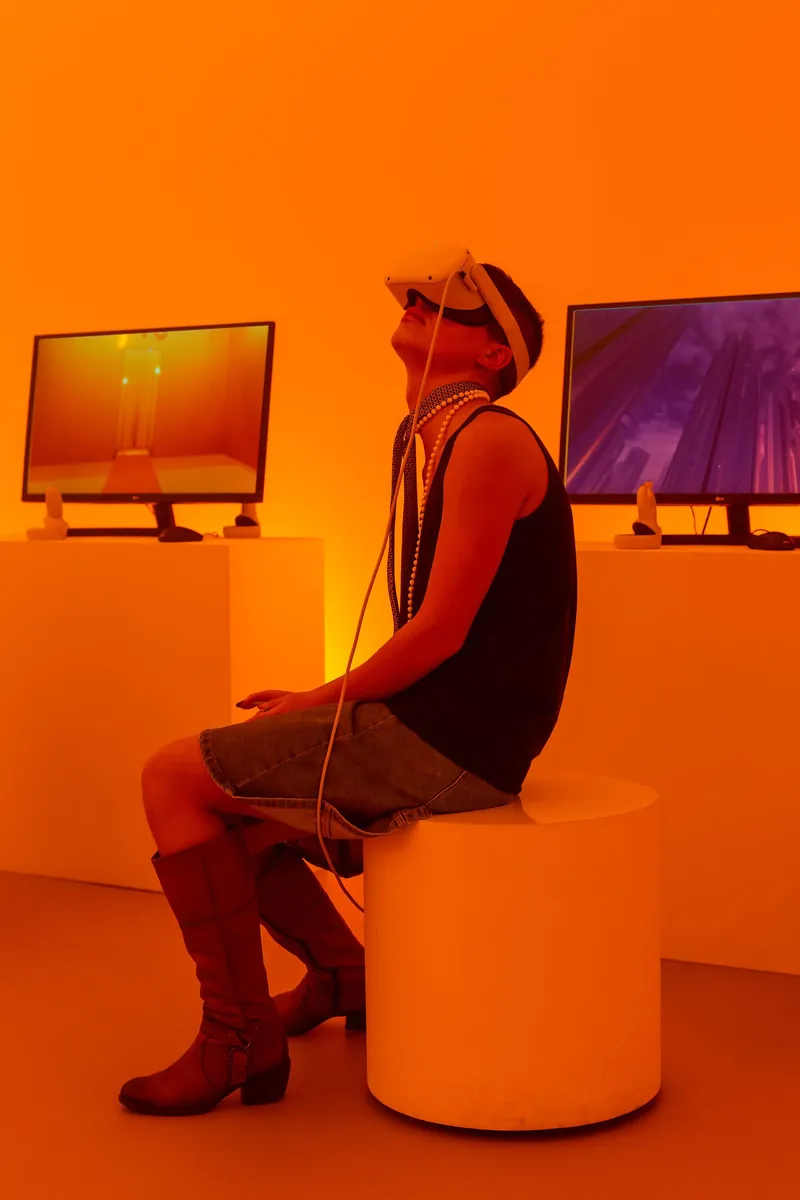
The first room is the most intimate and the most isolating. Visitors sit on cylindrical plinths, put on VR headsets and headphones, and receive a binaural soundscape that creates an enveloping acoustic cocoon. Orange ambient lighting saturates whatever peripheral vision the headset does not block. The architecture here is minimal on purpose: the room needs only to be small enough to feel private and controlled enough to let the technology do its work.
What matters architecturally is the ceiling height, which is deliberately lower than the other two rooms. That compression reinforces the sense that you are inside a device rather than inside a building. It is a simple dimensional decision with a strong experiential payoff.
Room Two: Digital Reality
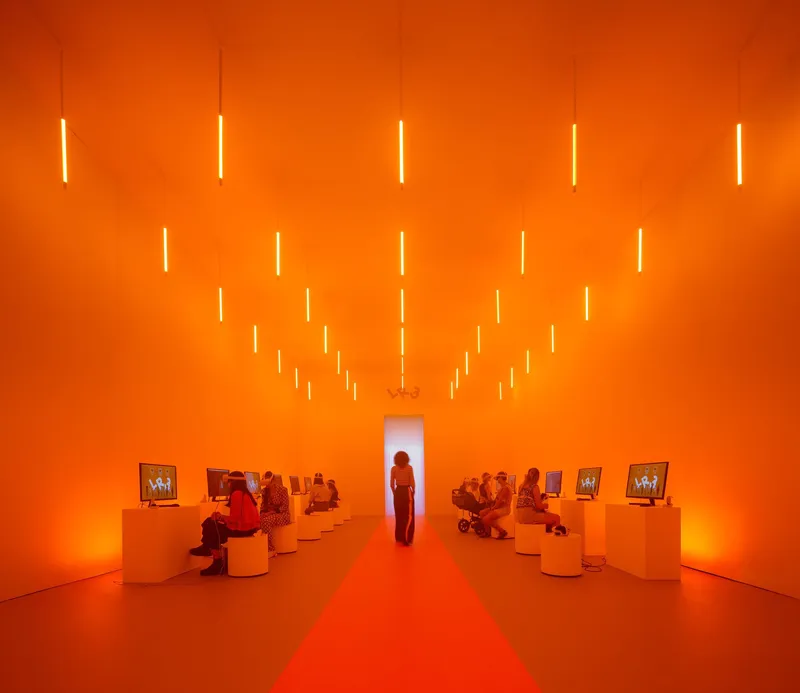
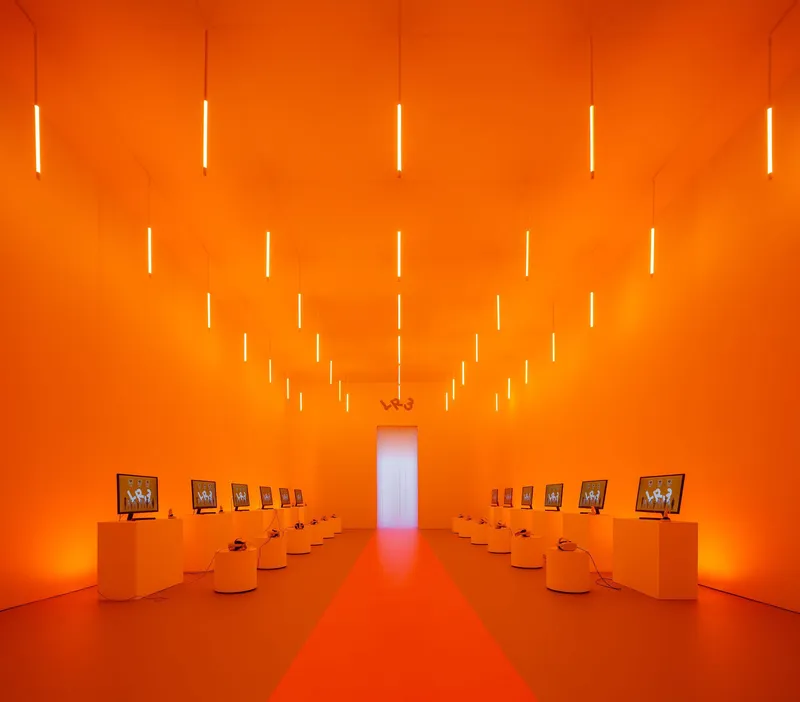
The second room expands the field. A perimeter of LED screens replaces the VR headset, surrounding visitors with moving imagery while a hazer machine fills the space with fog that thickens the light into something almost tangible. Natural scents evoke what the designers describe as an ecclesiastical atmosphere, a nod, perhaps, to the historic use of incense in the spiritual buildings that Sant Pau's architecture echoes. Vertical tube lighting suspended from the ceiling adds a sculptural rhythm overhead.
The key spatial quality here is the transition from individual immersion to collective immersion. Multiple visitors share the fog, the scent, the sound. The room works because it is wide enough to feel communal but enclosed enough that the LED screens dominate the visual field. Haptic atmosphere, viscosity and texture perceived through sight, is the stated goal, and the architecture enables it by eliminating competing visual information.
Room Three: Physical Reality and the Collection
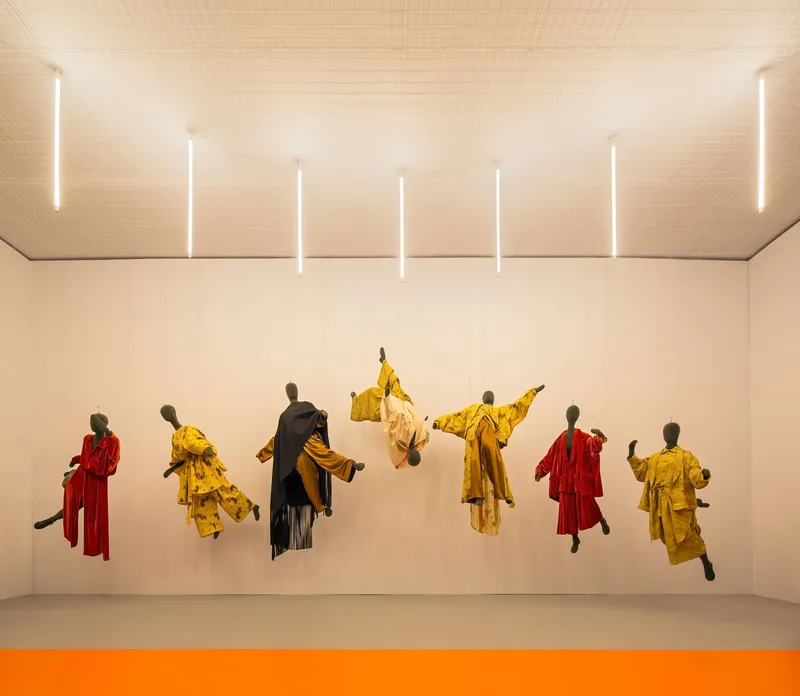
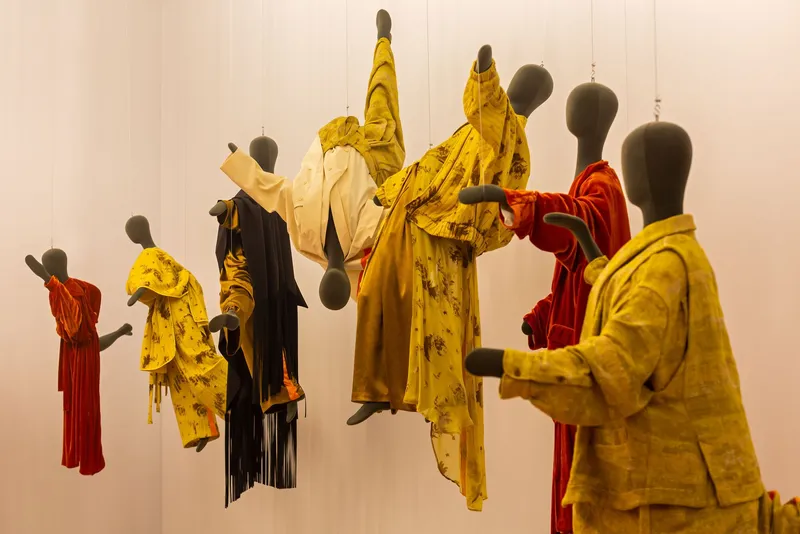
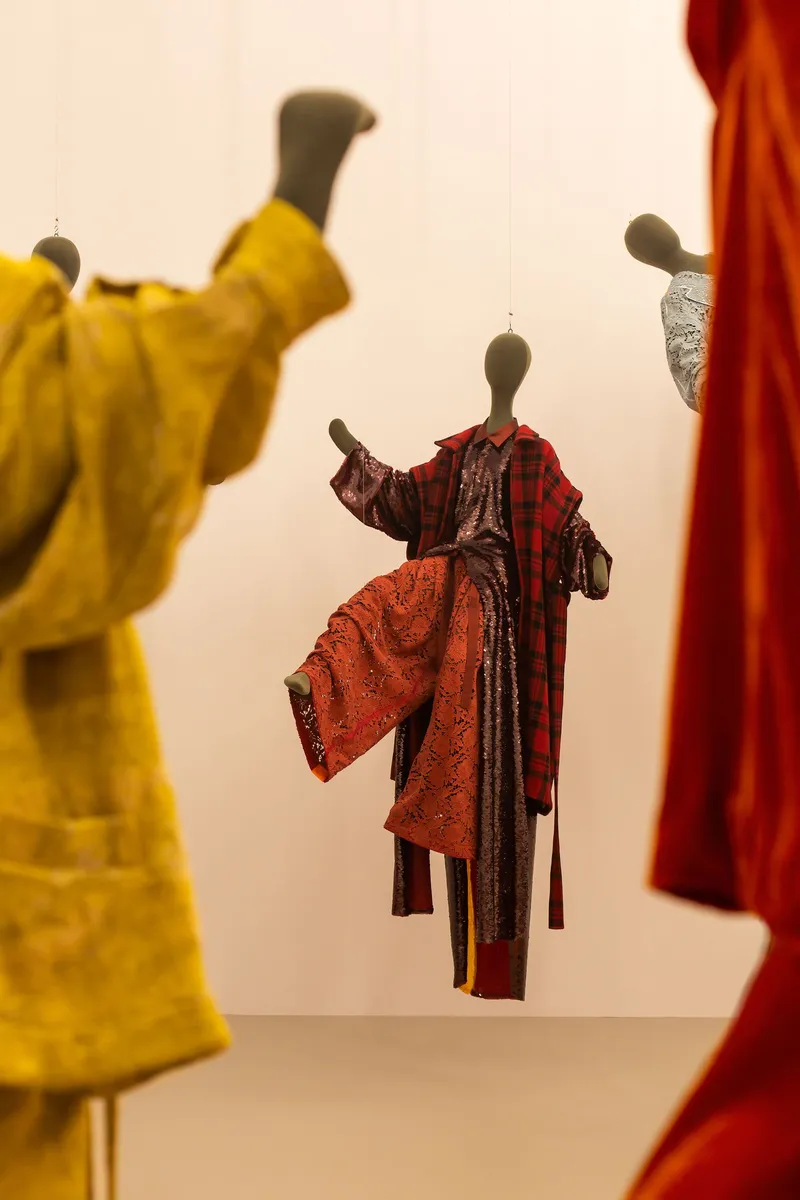
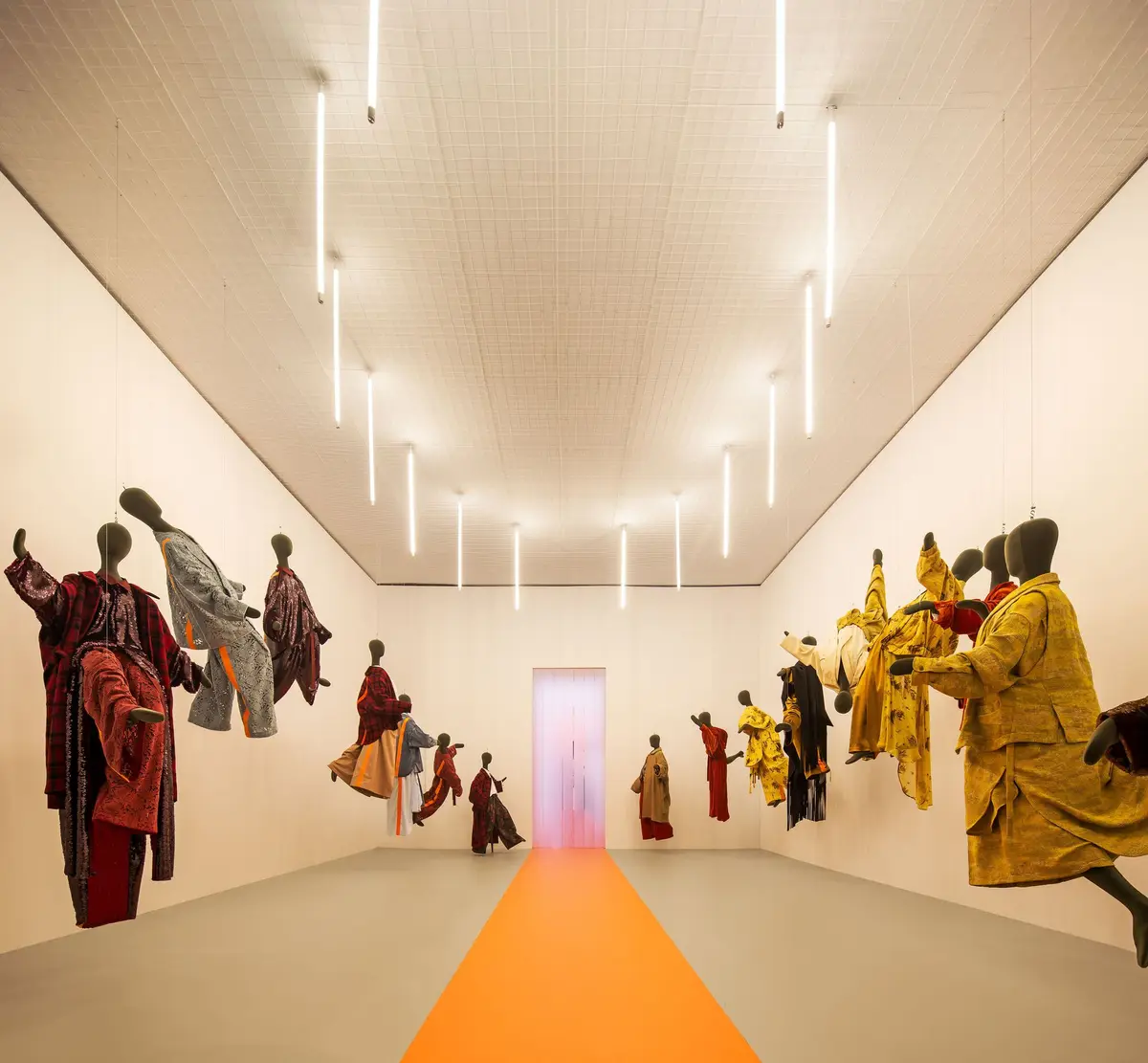
After two rooms of mediated experience, the third room delivers the actual garments. Mannequins draped in layered plaid and patterned textiles in yellow and red hang from ceiling wires, suspended at varying heights so that visitors circulate among them rather than past them. The room is the most spacious and the most discrete, its white walls serving as a neutral ground that lets fabric and color become the dominant information.
Suspending the mannequins is a curatorial choice, but it is also a structural one. By hanging everything from above, the floor remains clear, and the orange stripe that has guided movement throughout the pavilion continues uninterrupted. The garments float like artifacts in a museum case, freed from the body and from gravity, completing the progression from virtual avatar to physical textile.
The Exhibition Hall in Full
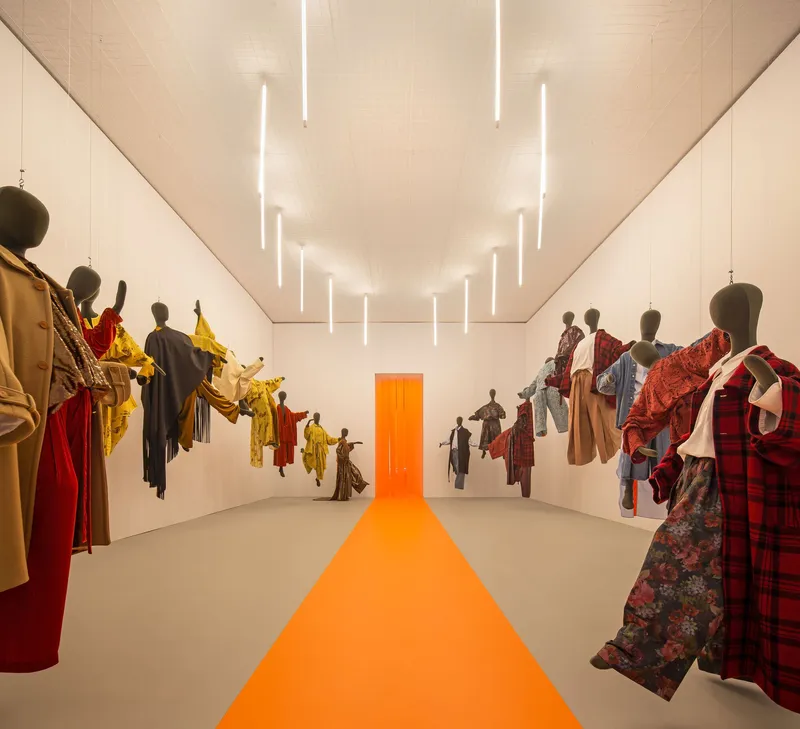
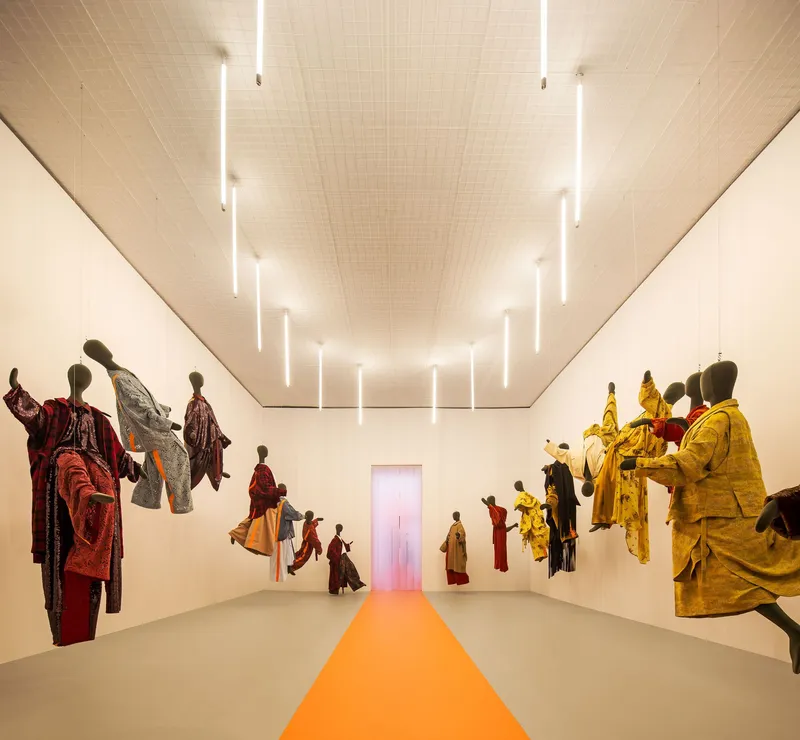
Seen in long perspective, the pavilion reads as a single linear sequence: corridor, compression, expansion, arrival. Wall-mounted textile displays line the sides while the vertical tube lighting establishes a consistent overhead rhythm that unifies all three rooms. The orange floor stripe functions as both circulation guide and branding device, a continuous thread of color that the eye follows even when the surrounding atmosphere shifts from fog to clarity.
The freestanding structure's independence from the historic shell is most legible from these longer views. You can sense the gap between tarpaulin and stone, the interstitial zone where cables, haze machines, and scent dispensers hide. That gap is the project's most genuinely architectural idea: a service cavity scaled to a heritage building.
Plans and Drawings
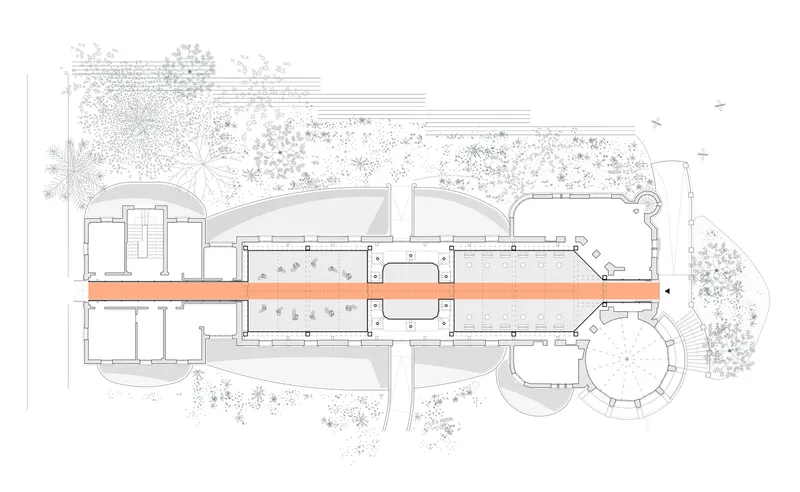
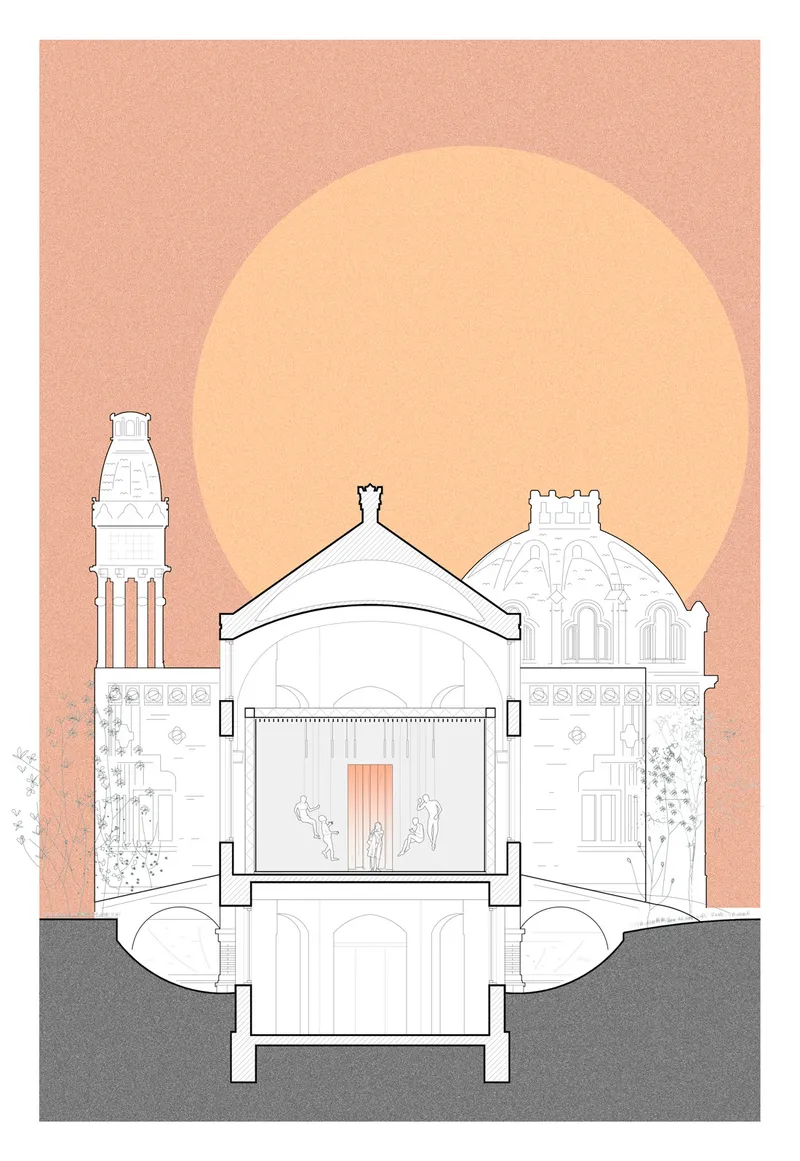
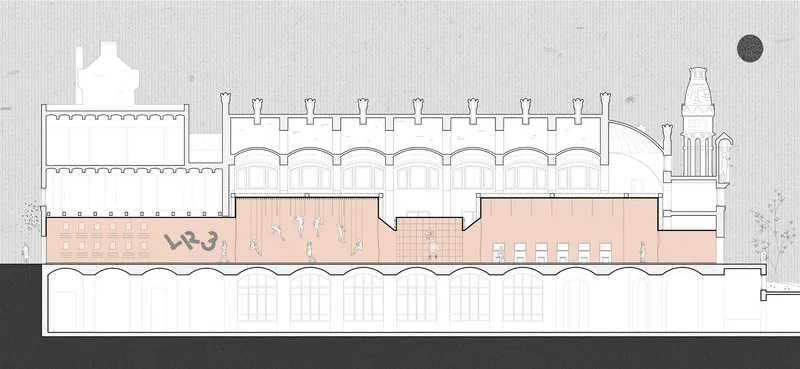
The floor plan reveals the linear logic at full scale, showing how the three rooms slot into the vaulted bays of the existing pavilion while maintaining the interstitial gap on all sides. The longitudinal section is especially telling: it exposes the arcaded galleries, the vaulted ceiling overhead, and the way the new insertion sits well below the apex of the historic structure, a respectful dimensional restraint that ensures the old building's volume is never challenged.
The cross-section through the domed central hall with its flanking towers reads almost like a sunset gradient, an evocative graphic choice that hints at the chromatic intensity inside. Together, these drawings confirm that the pavilion was conceived as an architectural project first and a fashion event second: the spatial sequence, the dimensional shifts between rooms, and the structural independence from the shell were all designed, not improvised.
Why This Project Matters
Ephemeral architecture often gets dismissed as event design with pretensions. The LR3 Experience earns its place in architectural discourse because it takes the hardest problem in temporary installation, how to intervene in a protected building without touching it, and makes that constraint generative. The interstitial gap is not just a preservation strategy; it is the spatial mechanism that allows fog, scent, sound, and light to be precisely controlled. Heritage conservation and sensory immersion end up reinforcing each other.
The three-room sequence also offers a useful model for how architecture can structure a narrative without relying on signage or guides. Each room is defined by its dimensions, its ceiling height, its material palette, and its relationship to technology. The visitor's body does the reading. In a moment when fashion increasingly reaches for the metaverse, NeuronaLab and Ruben Casquero remind us that the most convincing way to bridge virtual and physical reality is still a well-proportioned room with a clear door at the end of it.
Ephemeral Pavilion LR3 Experience by NeuronaLab and Ruben Casquero, with lead architects Ana García and Ruben Casquero. Barcelona, Spain, 2022. Photography by Pol Viladoms.
About the Studio
Share Your Own Work on uni.xyz
If projects like this are the kind of work you want to make, uni.xyz is a place to publish your own, find collaborators, and enter design competitions.


Popular Articles
Popular articles from the community


Aquadapt: An Underwater Habitat That Rewrites Its Rooms by the Hour
Curved modules ring the seabed while one shell shifts from breakfast room to cinema, farm and football pitch as residents' needs change.


David Ortega Stacks a Two-Story Mexico City Penthouse Around a Steel Stair and a Pergola-Shaded Roof Terrace
In Colonia Roma, a 300 m² penthouse uses oak joinery, a planted steel stair and a slatted roof pergola to make a new-build apartment feel like a house.

ETEH Reworks the Shared Spaces of São Domingos School in Brazil Around Timber, Color and Hanging Plants
At São Domingos School in Brazil, 436 m² of hall, refectory and library are recast with timber joinery, a yellow and blue code and trailing greenery.

Opera on the Sea: Driftwood Logic Shapes a Timber Opera House on Estonia's Coast
Trevor Orgill's opera house translates the entangled drift of floating timber into a civic building where wood, water, and music converge.

Similar Reads
You might also enjoy these articles

LAVA Architecten Gives Vocational Education a Sawtooth-Roofed Face on a Mechelen School Campus
In Mechelen, Belgium, a 2,053 m² STEM school on a 6×6 m grid turns workshops and classrooms into rooms that can be rearranged as teaching changes.

KEMA Studio Turns a Derelict Marvila Attic into a 60 m² Lighthouse Apartment Above Lisbon
In Lisbon's Marvila district, a rebuilt roof, four skylights and two plywood volumes turn an unlivable attic into a bright home facing the Tagus.

Pixel Gardens: One Repeated Module Stacked Into a Terraced Social Housing Tower for Famagusta
Salem Bader's shortlisted housing tower builds a vertical neighbourhood from one repeated module, offsetting units to carve terraces, light and air.

Bao Huynh Watercolor Atelier: A Serene Art Retreat in Hội An
Bao Huynh Watercolor Atelier in Hội An blends multifunctional art spaces, sustainable design, local materials, and family-friendly living in a serene environment.

Explore Remembrance Pavilion Competitions
Discover active competitions in this discipline

Challenge to design a portable theatre

Challenge to design a portable music platform

Challenge to design an open learning module for the elderly

Bring back Drive In's
Comments (0)
Please login or sign up to add comments
No comments yet. Be the first to comment!