
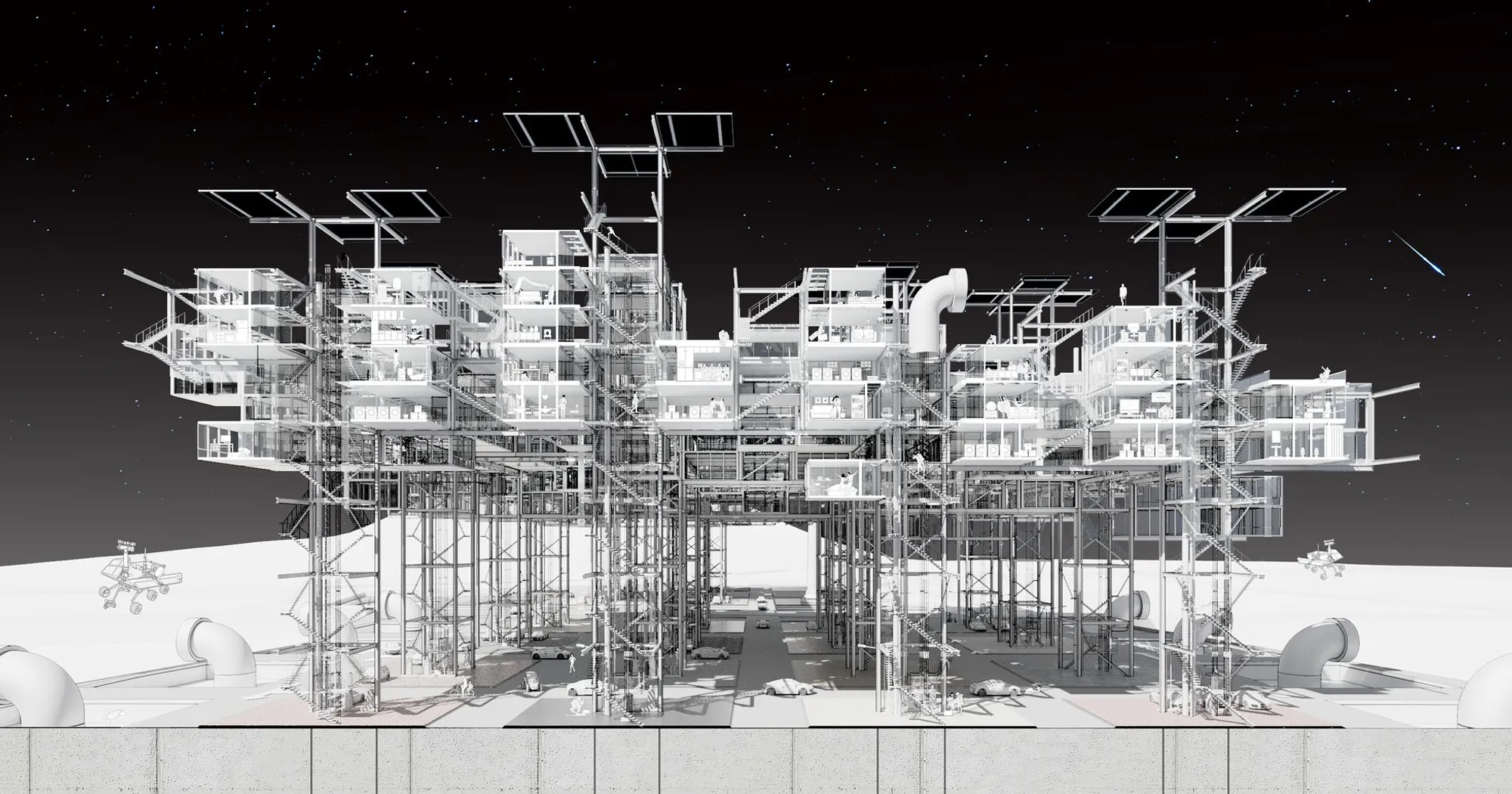
New Babylon II: A Plug-In Utopia of Machine Tectonics and Modular Living
Elevated housing networks, self-sustaining infrastructure, and customizable units confront overcrowding through a visionary circuitry city.


What if a city could function like a circuit board, with housing units plugged in and swapped out at will? New Babylon II proposes exactly that: a highly circuitous plugin housing network forming a miniature, autonomous city driven by machine tectonics. The project confronts housing shortages and social inequality head-on by elevating modular living units above ground level, creating an adaptable urban landscape where residents customize their environments without sacrificing affordability or collective infrastructure.
Designed by Jiajie Wang, this Honorable Mention entry in the Plugin Housing Challenge 2020 draws on the architectural ideologies of Le Corbusier and the Situationist International. The original New Babylon, proposed by Constant Nieuwenhuys in the 1950s and 60s, imagined a post-work society of nomadic inhabitants drifting through interconnected megastructures. Wang's sequel updates that ambition with sustainability frameworks, self-supporting systems, and a tangible material logic that grounds the utopian premise in buildable principles.
A White Lattice of Stacked Volumes
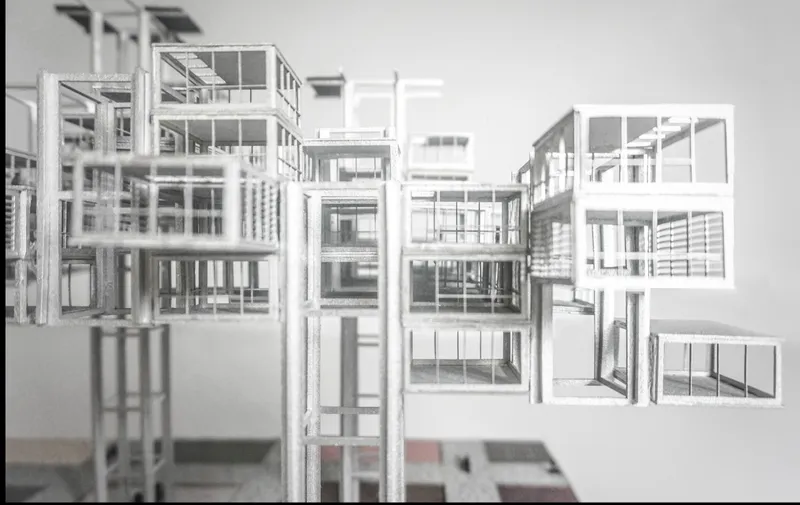
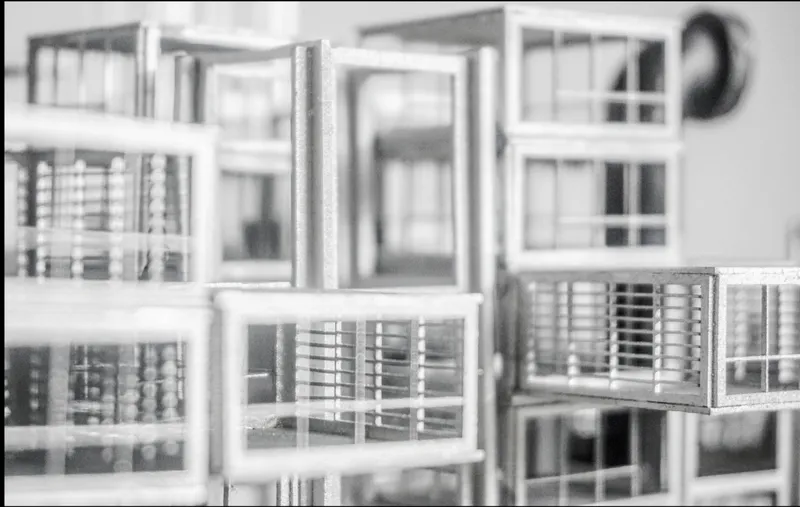
The physical model communicates the project's spatial logic with striking clarity. White framed volumes cluster and stack within open structural frameworks, each unit legible as an individual dwelling yet inseparable from the collective assembly. Up close, layered window frames and horizontal louvered elements reveal a secondary rhythm of environmental control, hinting at how ventilation, light, and privacy are negotiated at the unit scale. The model avoids the trap of looking like a generic tower; instead, it reads as an inhabited scaffold, a system designed for perpetual reconfiguration.
Infrastructure as Architecture: The Cylindrical Core
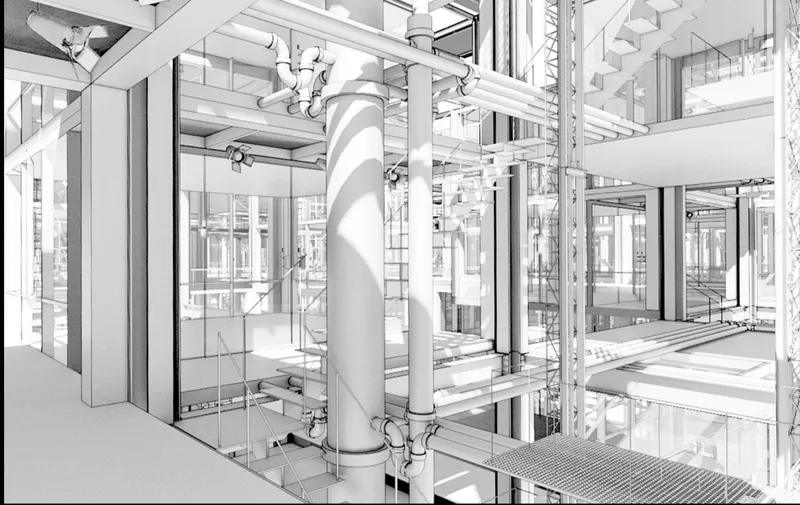
A rendered section cuts through one of the complex's cylindrical columns, exposing the mechanical guts that keep the network alive. Lift shafts wrapped in glass walls sit alongside exposed mechanical systems, making the building's circulatory infrastructure both visible and celebrated. This is machine tectonics in action: structure, movement, and servicing fused into a single vertical element that the housing units latch onto.
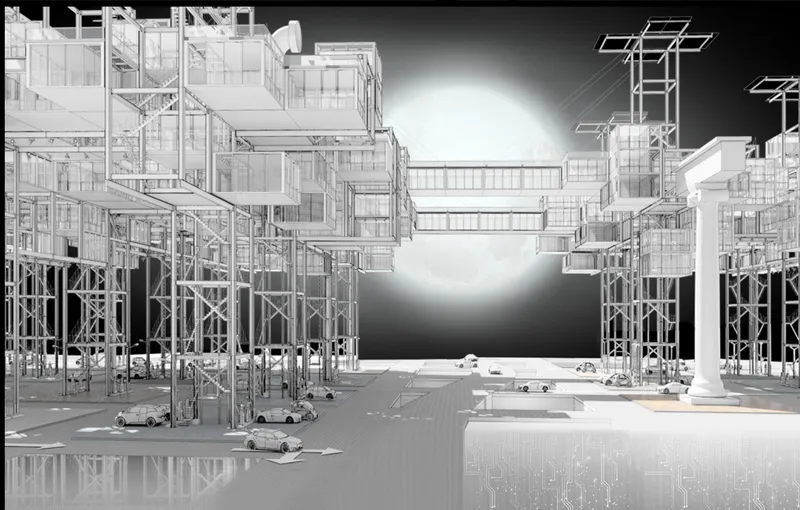
Pulling back to an aerial view, the full scope of the network becomes apparent. Elevated bridges link clusters of modular units, while rooftop solar panels signal the project's commitment to self-sustaining energy. Streets, pedestrian bridges, and vehicular pathways are layered to ensure seamless movement through the cityscape. The result is a panoramic urban experience that lifts residents above the congestion and poor housing quality of conventional ground-level development.
Life on the Elevated Walkway
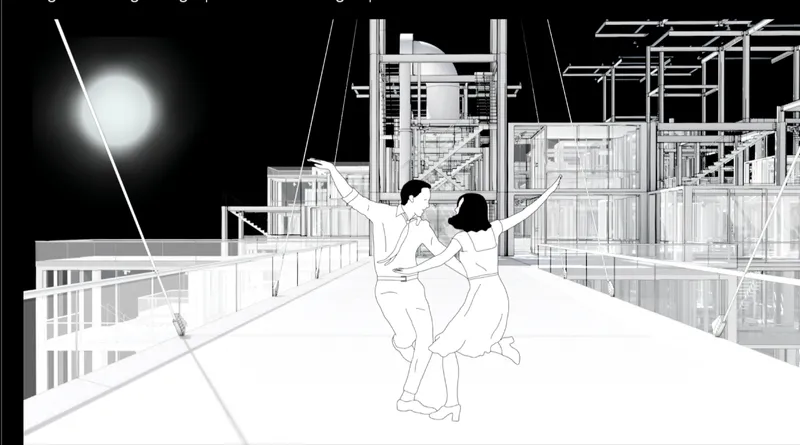
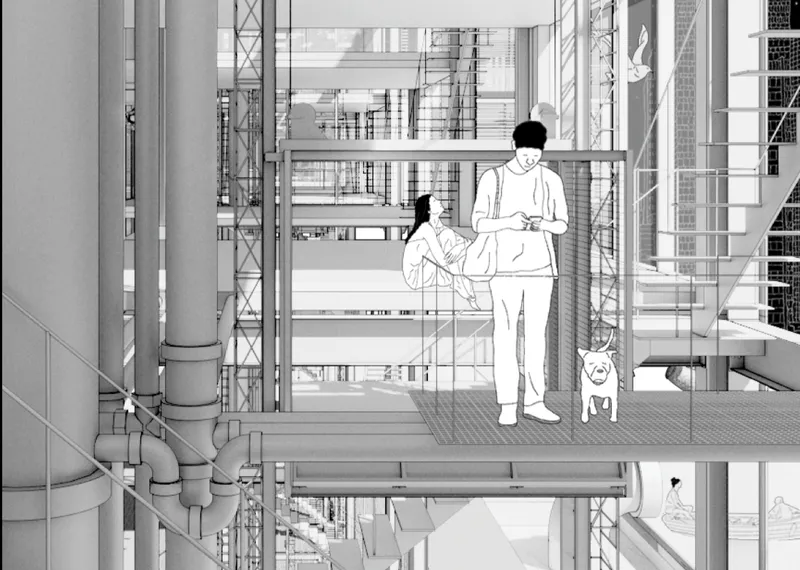
Two line drawings shift the register from systems thinking to lived experience. In one, two figures embrace on an elevated walkway beneath suspended cable lighting, a moment of intimacy staged against industrial infrastructure. In the other, a couple and their dog occupy an outdoor platform flanked by exposed ductwork. These are not polished lifestyle renderings; they are deliberate sketches that argue for the human warmth possible within a machine-tectonic framework. The drawings make a quiet but persuasive case that exposed services and steel framing do not preclude domesticity.
Structural Clarity from Section to Axonometric
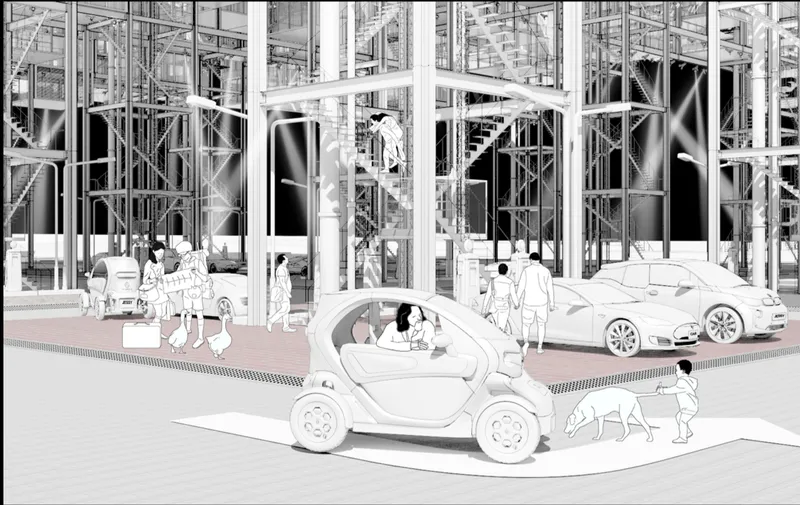
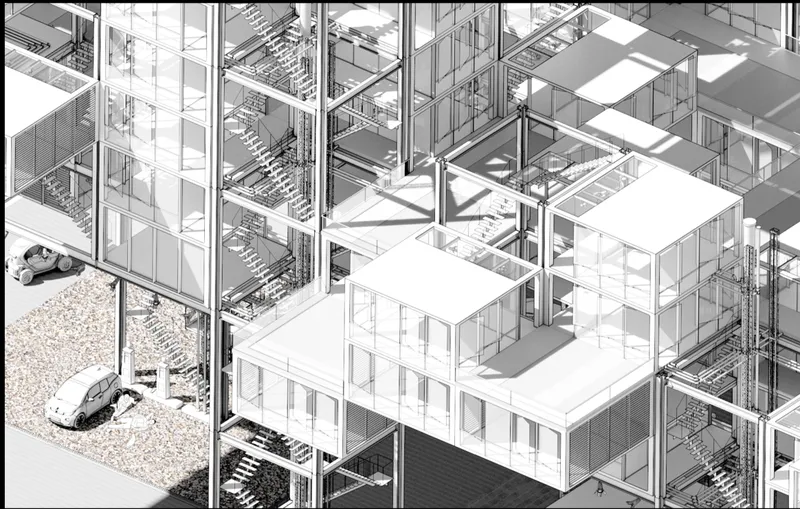
A sectional perspective drawing reveals the ground plane in full: pedestrians, cars, and even a dog navigate among the exposed steel structural frame, coexisting with the heavy infrastructure above. The ground level functions as a conventional street while the elevated network operates independently overhead. An axonometric drawing then peels back the skin to show stacked residential units nested within the steel framework, accessed by external staircases. The self-selection principle becomes spatially legible here: units slot into the grid at various positions, and the framework accommodates rather than dictates their arrangement.
Together, these drawings demonstrate how the project's political values of equality and freedom translate into spatial terms. Every unit has equivalent access to light, air, and circulation. No dwelling is landlocked or hierarchically diminished. The plug-in logic ensures that growth, contraction, and customization are built into the system's DNA rather than treated as afterthoughts.
Why This Project Matters
New Babylon II takes a historically charged reference point and refuses to treat it as nostalgia. Where the original New Babylon remained a poetic provocation, Wang's iteration introduces material specificity: solar panels, mechanical cores, louvered facades, and a clear structural hierarchy that could, in principle, be engineered. The project operates in the fertile space between manifesto and feasibility study, and it is stronger for occupying that tension rather than resolving it prematurely.
For a competition centered on plugin housing, this entry pushes the brief to its conceptual limit. It asks not just how to plug in a dwelling, but how to plug in an entire mode of urban life. The network of bridges, cores, and customizable units proposes a city where architecture is never finished, only continuously inhabited and rearranged. That ambition, grounded in sustainability and social equity, makes it a compelling addition to the ongoing conversation about housing's future.
View the Full Project
About the Designers
Designer: JIAJIE WANG
Enter a Design Competition on uni.xyz
uni.xyz runs architecture and design competitions year-round that reward proposals with spatial conviction and real site intelligence.
Project credits: New Babylon II by JIAJIE WANG Plugin Housing Challenge 2020 (uni.xyz).



Popular Articles
Popular articles from the community


The Musturak Paradise: Senior Living Architecture for a Connected Future in Temara, Morocco
The Musturak Paradise reimagines senior living architecture in Temara via private homes, social spaces, culture, community, and shared care.

Play: Fragments of Their World
Familiar architecture becomes modular playground design, creating safe spaces where displaced children can learn, connect, imagine and play.

The Earth Pod: 3D Printed Homes for Resilient Refugee Communities
The Earth Pod reimagines refugee housing through 3D printed homes made from clay, combining resilience, self-sufficiency, and rapid shelter.

Riyadh For All: Intergenerational Urban Design for Active Aging in Rabat
Riyadh For All reimagines urban design in Rabat with intergenerational co-living, adaptive courtyards, and Moroccan cultural exchange today.

Similar Reads
You might also enjoy these articles

Day and Night Park: A Time-Based Urban Newsstand in Beijing
A temporary urban newsstand in Beijing blending travel, light, and reading through poetic colors, compact form, and community-focused design.

Modernist Patio Renovation in El Masnou, Barcelona by Oliver Segura Arquitectura + Cebrià Arquitectura
Modernist patio renovation blending tradition and innovation with a movable pool, leveled floors, and Catalan materials in El Masnou.

Alto Residencial Coop: Cooperative Housing Development in Santiago de Compostela by Carbajo Barrios Arquitectos
A linear cooperative housing complex blending white volumes and perforated metal façades, enhancing community living, natural light, privacy, and urban integration.
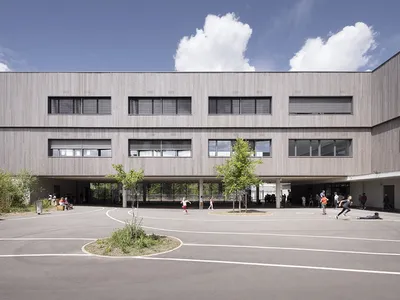
Vil Genis School by BPA ARCHITECTURE – Massy, France
Vil Genis School in Massy, France, features sustainable design, south-facing classrooms, community integration, accessible spaces, and modern educational architecture.



Comments (0)
Please login or sign up to add comments
No comments yet. Be the first to comment!