New Operaism: The Fiction Of Autonomy
From Victims Of Transboundary Waste To A Cyborg Post Material Community

This story is told through the lens of Keo, a Cambodian migrant who has lost a leg, while working in the dangerous electronic waste industry in Thailand.
---
The Alien
In the beginning, he crossed the border, full of hope that he could live a comfortable life. Now he exists nowhere, slave to the job he had hoped would set him free. Countless others share the same fate and wish nothing more than the freedom to be something.
An elbow wrapped in an upcycled shirt and a shovel in his other hand, Keo braved the flooded plains and made his way to work. Noticing that the screws on his prosthetic leg were slightly rusty, he lamented as he reminded himself not to expect anything of decent quality from the second-hand prosthetics made from recycled copper.
The years of working at a recycling facility have exposed him to toxic fumes from heavy metals found in the discarded electronics, so much that he had lost a limb during a time when he allowed his concentration to slip and the molten iron from the furnace to spill onto his leg.
At a low daily wage of 8 dollars, the cost of replacement for his leg was unaffordable. It was only by the company’s ‘goodwill’ that the leg was manufactured for him. Now, he is forever obliged to serve them. Who else would hire him, a crippled, illegal alien?
Submerged Suburbias
Wading through the submerged paddy fields, he wondered to himself if the rice from these fields were still edible. The four-decade pollution of the Pakong river has ceased ever since the water inundated the factories, forcing them to move away.
Most recycling companies have taken refuge in the landfills. What was once seen as deplorable has now become a precious resource for the corporations to continue their extraction of precious metals and the new plasma rock: a valuable construction material. While civilisation has mostly retreated inwards to higher grounds, these companies stayed on, working on land and water no one else dared for the risk is shared within the circles of their employees.
Approaching the fence, Keo made out the distinctive form of the extractor. It stood like a fortress on stilts, towering over the massive heap of discarded junk ready to consume any material that was about to be fed into its extraction chutes by the cyborg workers.
Sweeping across, his vision was splattered with these dark shiny landforms. The exterior of the facility was fortified with a gargantuan wall, an attempt by the megacorporation to prevent any erosion of their precious resources from the seeping waters.
“Toxic levels are above human thresholds, switching to closed-circuit ventilation”, beeped the monitor on his prosthetic arm. Flicking his arm to acknowledge the warning, Keo proceeded into the facility, unfazed by the prospects of contamination.
Under(mining) For An Identity
Keo connected his tablet to the newest batch of memory disks his co-workers have salvaged from the landfill, scouring its contents for potentially useful data. After the years of physical abuse, they were ready to move on.
In the darkness of the night, behind the fortified walls of the landfills, he felt a fleeting moment of safety, safe enough from the prying eyes of the officials at least.
Having planned this for years, they managed to gather enough compromising material against both the government and the companies, enough to transform the country into chaos should they find out the degree of corruption rampant in the political system. The seemingly unattainable identity and recognition that they dreamt of for years finally felt within reach…
Agrarian Alliance
In response to their demands, the government allowed the workers to operate the landfills as an independent entity. With their newfound partial-citizenship status, the workers could acquire new tools to establish their new building materials.
With their livelihoods dependent on the now diminished arable land, multitudes from the agrarian community have joined forces with the workers and taken refuge behind the walls of the landfill. Together, they were able to establish new infrastructures for aquaculture and habitation, co-existing together as a new community.
Eyes Of The Storm
Over time, the citadels grew and became increasingly recognised as the e-waste capital of the world.
From the exterior, one could make out the faint outline of the wall. The furnaces of the citadels stood like crowns, encircling the new capital cities and framing the waste in its full glory. Born from the ashes of the landfill, the sea scrapers floated above the water, resilient to climatic adversities of the future.


Popular Articles
Popular articles from the community


AL-JANNAH: Sustainable Architecture and Permaculture for Afghan Widows
AL-JANNAH uses sustainable architecture and permaculture to create resilient oasis of housing, learning, work and renewal for Afghan widows.

The Musturak Paradise: Senior Living Architecture for a Connected Future in Temara, Morocco
The Musturak Paradise reimagines senior living architecture in Temara via private homes, social spaces, culture, community, and shared care.
EW PARK: Sustainable Architecture Reimagines the Future of Urban Parking
EW PARK reimagines city parking as a modular wooden tower combining automation, solar energy, electric mobility, and adaptable urban design.

Co-life: Sustainable Architecture for Age-Friendly Community Living
Co-life reimagines sustainable architecture for seniors through courtyards, rammed earth, shared gardens, and spaces designed for belonging.


Similar Reads
You might also enjoy these articles

Day and Night Park: A Time-Based Urban Newsstand in Beijing
A temporary urban newsstand in Beijing blending travel, light, and reading through poetic colors, compact form, and community-focused design.

Modernist Patio Renovation in El Masnou, Barcelona by Oliver Segura Arquitectura + Cebrià Arquitectura
Modernist patio renovation blending tradition and innovation with a movable pool, leveled floors, and Catalan materials in El Masnou.

Alto Residencial Coop: Cooperative Housing Development in Santiago de Compostela by Carbajo Barrios Arquitectos
A linear cooperative housing complex blending white volumes and perforated metal façades, enhancing community living, natural light, privacy, and urban integration.
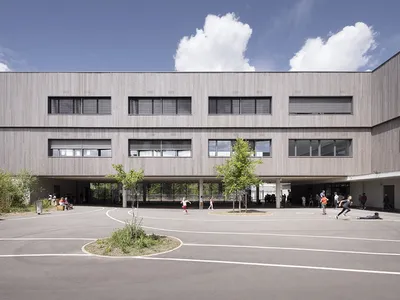
Vil Genis School by BPA ARCHITECTURE – Massy, France
Vil Genis School in Massy, France, features sustainable design, south-facing classrooms, community integration, accessible spaces, and modern educational architecture.




Comments (0)
Please login or sign up to add comments
No comments yet. Be the first to comment!