
H-H Studio Weaves Courtyards and Concrete into a Layered Family Home in Vietnam
Nhà Hương House in Vietnam negotiates between raw concrete, warm timber, and a series of planted voids that dissolve the boundary between indoors and out.


A house that breathes. That is the simplest way to describe Nhà Hương House by H-H Studio, a multi-level residence in Vietnam built around a sequence of planted courtyards, reflecting pools, and open-sky voids. The project belongs to a growing body of Vietnamese residential architecture that treats landscape not as ornament but as infrastructure: thermal buffer, light source, spatial organizer, and emotional anchor.
What makes Nhà Hương worth studying is how precisely it calibrates two opposing material registers. Board-formed concrete provides mass, permanence, and shadow, while warm timber and thatch give the interior a domestic softness that keeps the house from feeling like a bunker. The courtyards are not leftover space; they are the plan's organizing principle, pulling light deep into the section and allowing cross-ventilation to do most of the work that mechanical systems would otherwise handle.
Street Presence and Entry Sequence
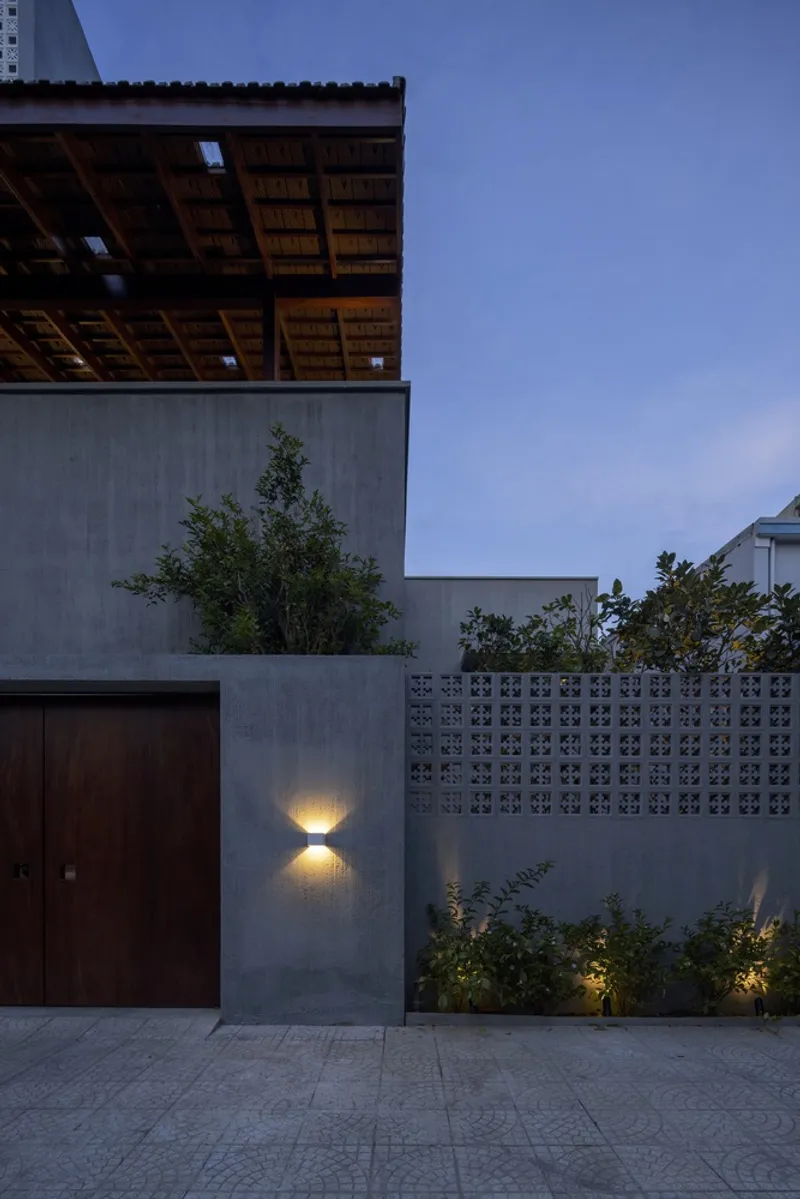
From the street, the house announces itself quietly. A perforated breeze-block wall and a single wall-mounted sconce set the tone at dusk: restrained, material-driven, intentionally opaque. This is a house that withholds its pleasures from passersby, revealing them only once you cross the threshold.
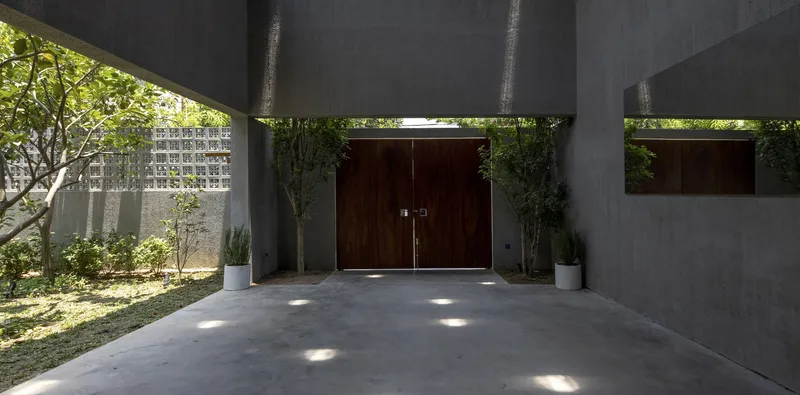
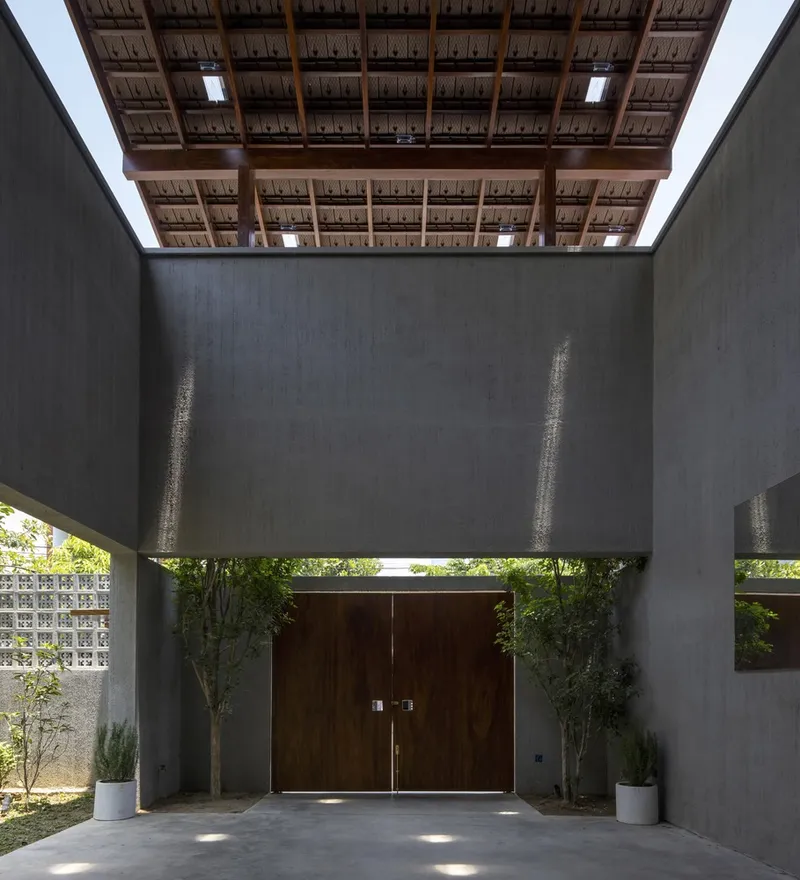
The entry sequence moves from a sun-dappled forecourt, sheltered by a deep concrete overhang, to a set of timber doors framed by planters and topped with an exposed thatch ceiling. The transition from public to private happens in layers rather than in a single step. You move through light, then shadow, then light again, and by the time you reach the interior, the street feels impossibly distant.
Concrete as Climate Machine
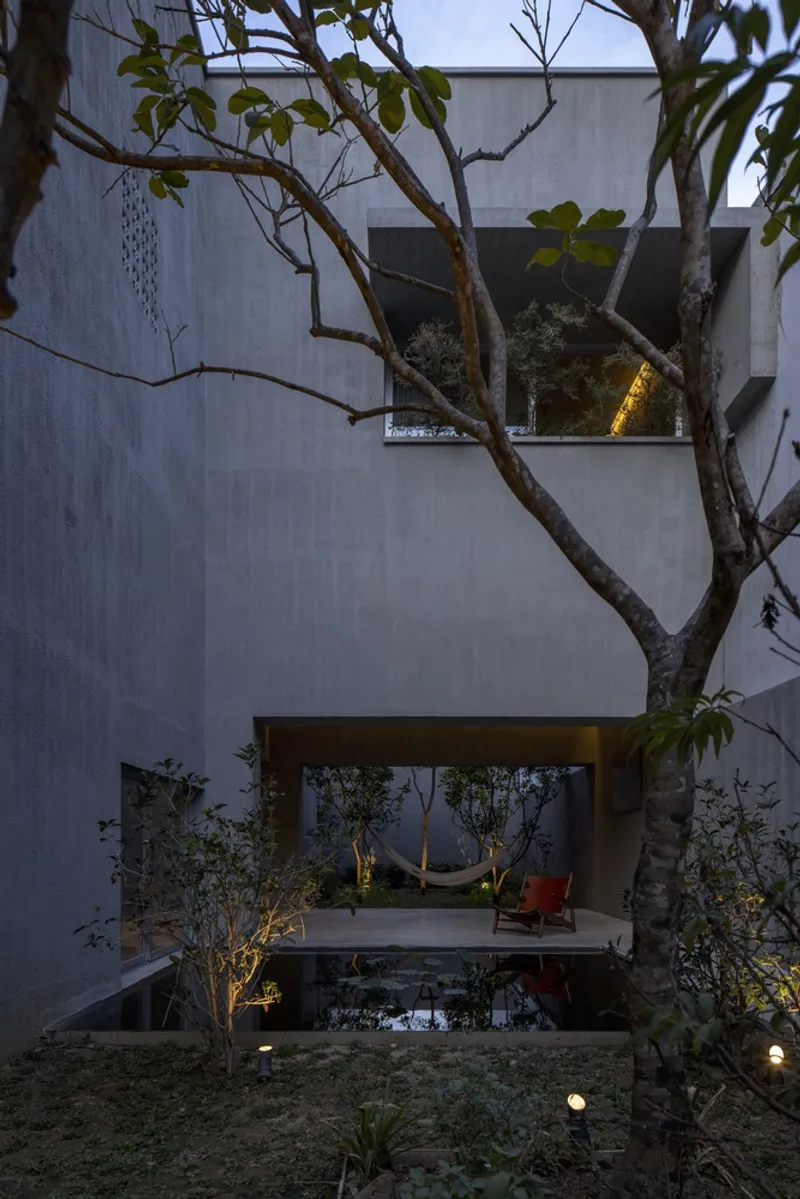
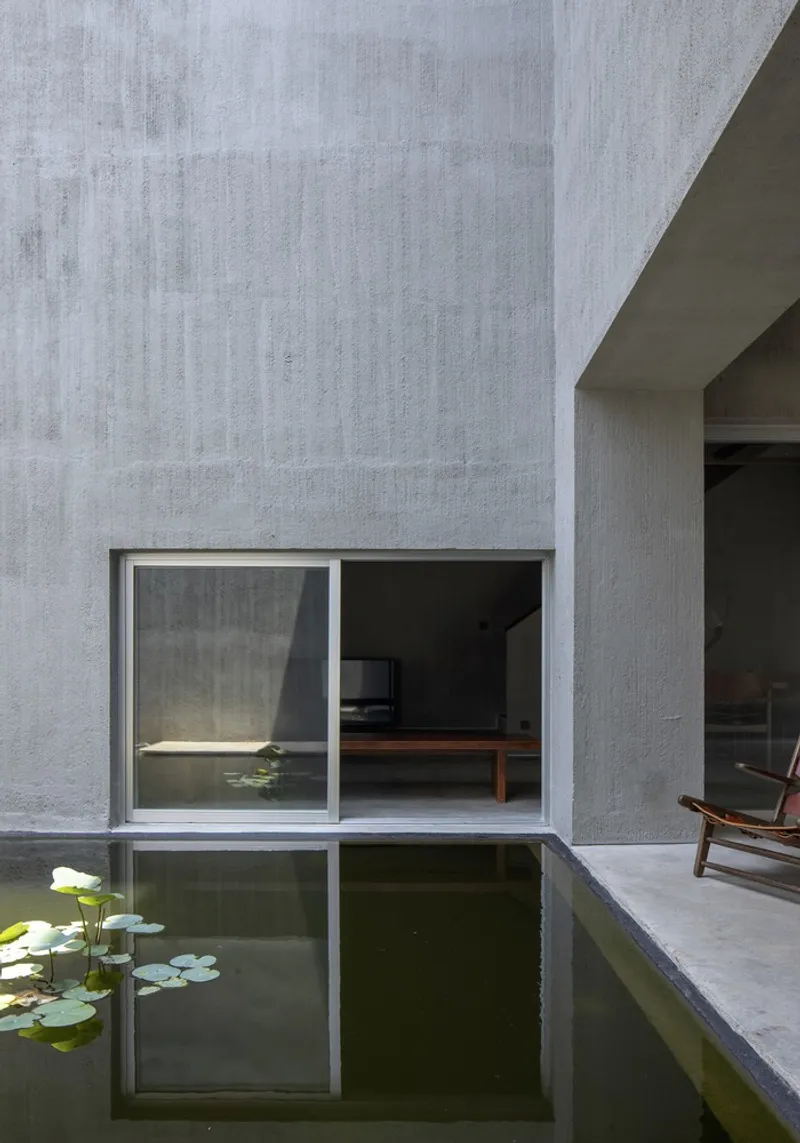
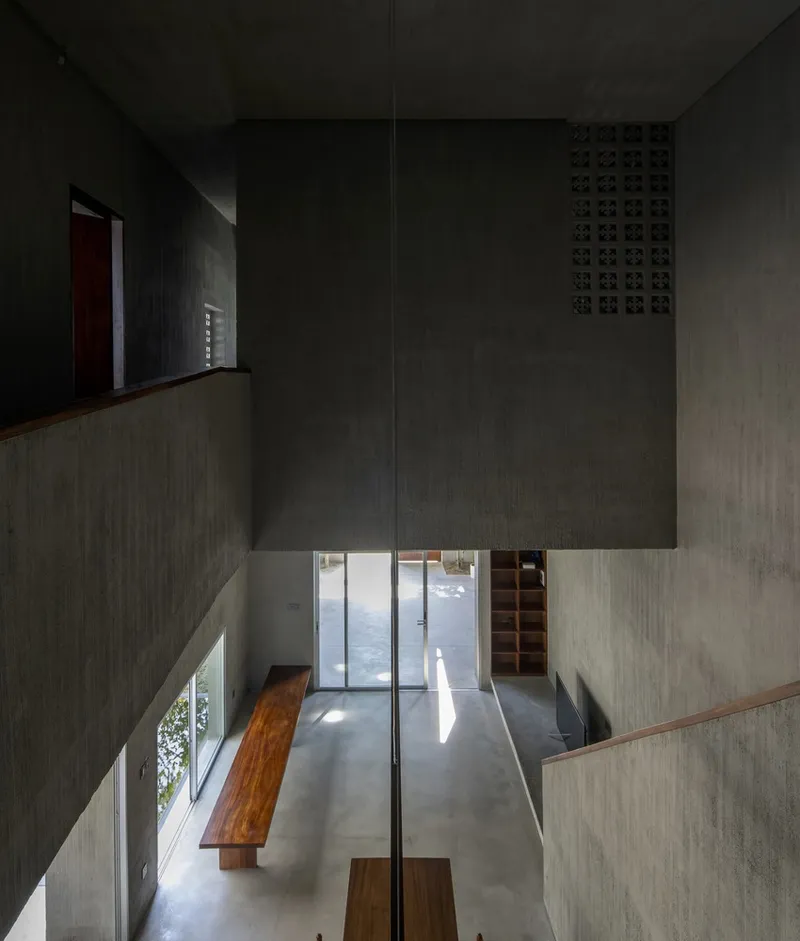
Concrete here is not just structure; it is the primary climate-moderating device. The thick walls absorb heat during the day and release it slowly at night, a strategy as old as masonry itself but executed here with a board-formed finish that gives every surface a subtle grain. Cantilevered terraces shade the glazing below, while slot windows and strategic openings keep air moving through the section without requiring the walls to dissolve entirely.
The double-height void in the main living zone is the most dramatic expression of this strategy. Board-formed walls rise from a polished concrete floor, and daylight enters from above, bouncing off the rough surfaces and producing a luminous, almost chapel-like quality. Timber benches keep the space from feeling austere, but the protagonist is clearly the interplay of mass and light.
Courtyards That Organize Everything
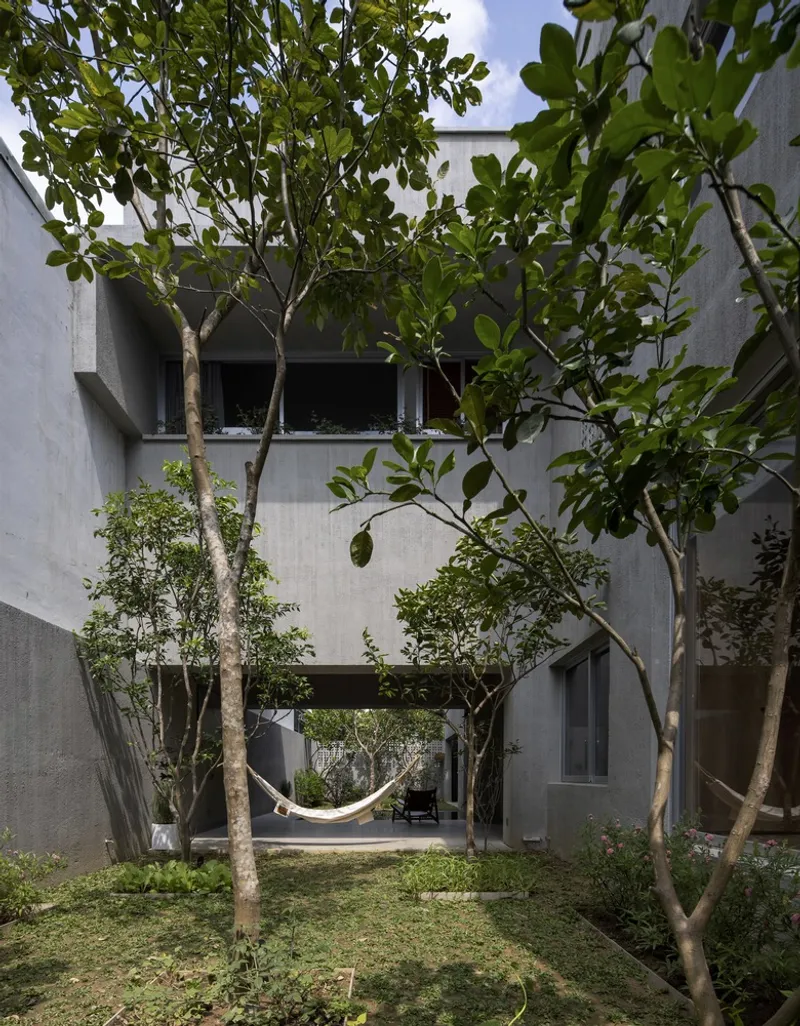
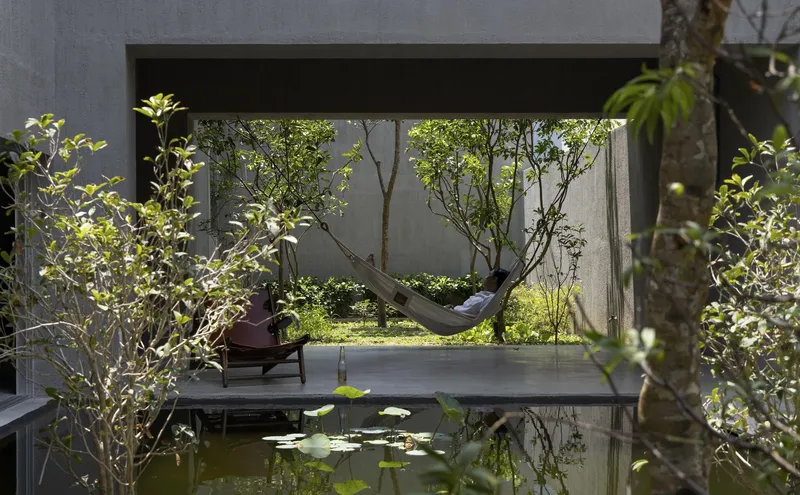
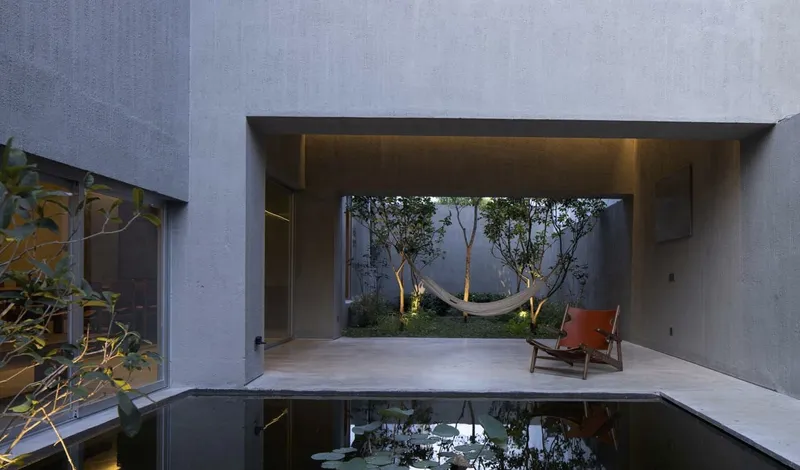
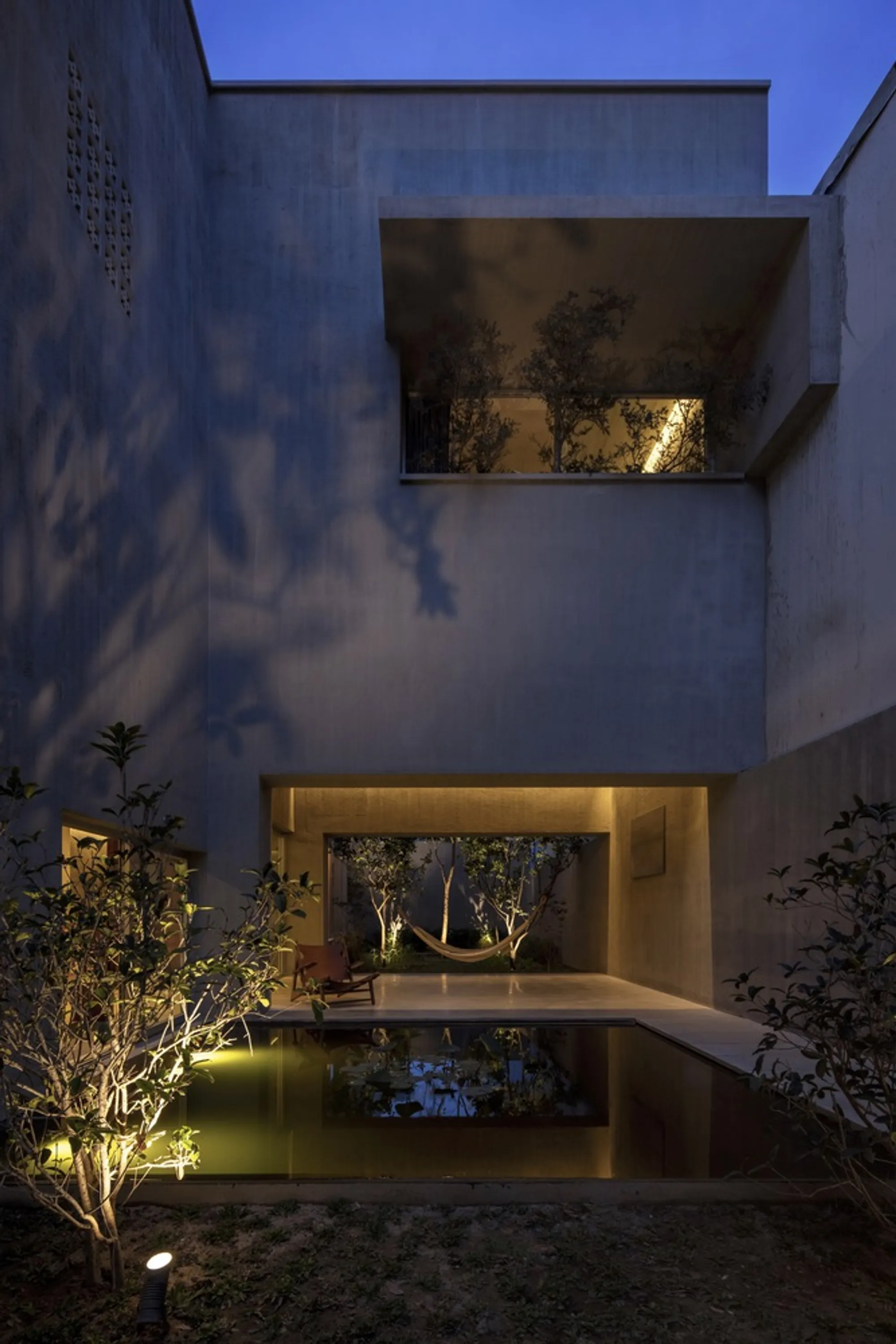
The project's courtyards are not a single garden in the middle of a plan. They are distributed across the site, each one tuned to a different condition. A garden courtyard with mature trees and a planted lawn separates concrete volumes and introduces open sky into what would otherwise be a dense footprint. A reflecting pond bordered by lily pads creates a microclimate that cools the air before it enters the living spaces.
The hammock strung between trees over the reflecting pool is the kind of detail that separates a lived-in house from an architectural exercise. It signals that this landscape is not just for looking at. It is occupiable, daily, casually. The covered terrace overlooking the same pool frames a scene that could be a resort, except it is someone's Tuesday afternoon.
Living Spaces and the Timber Register
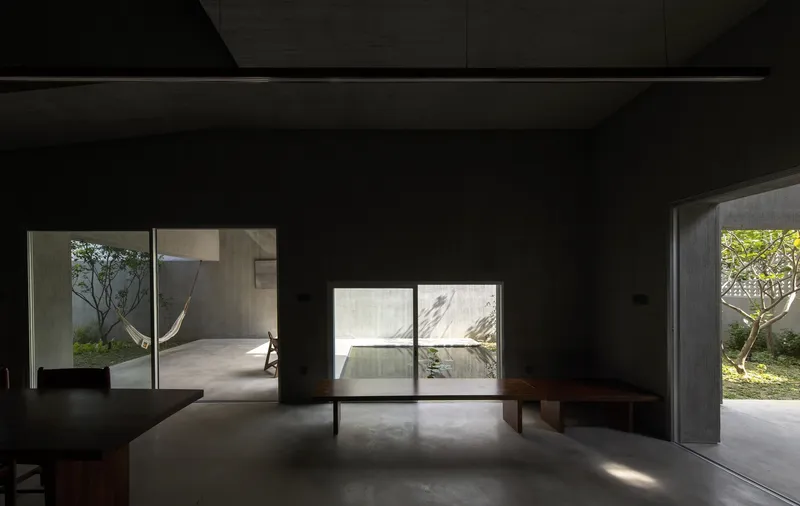
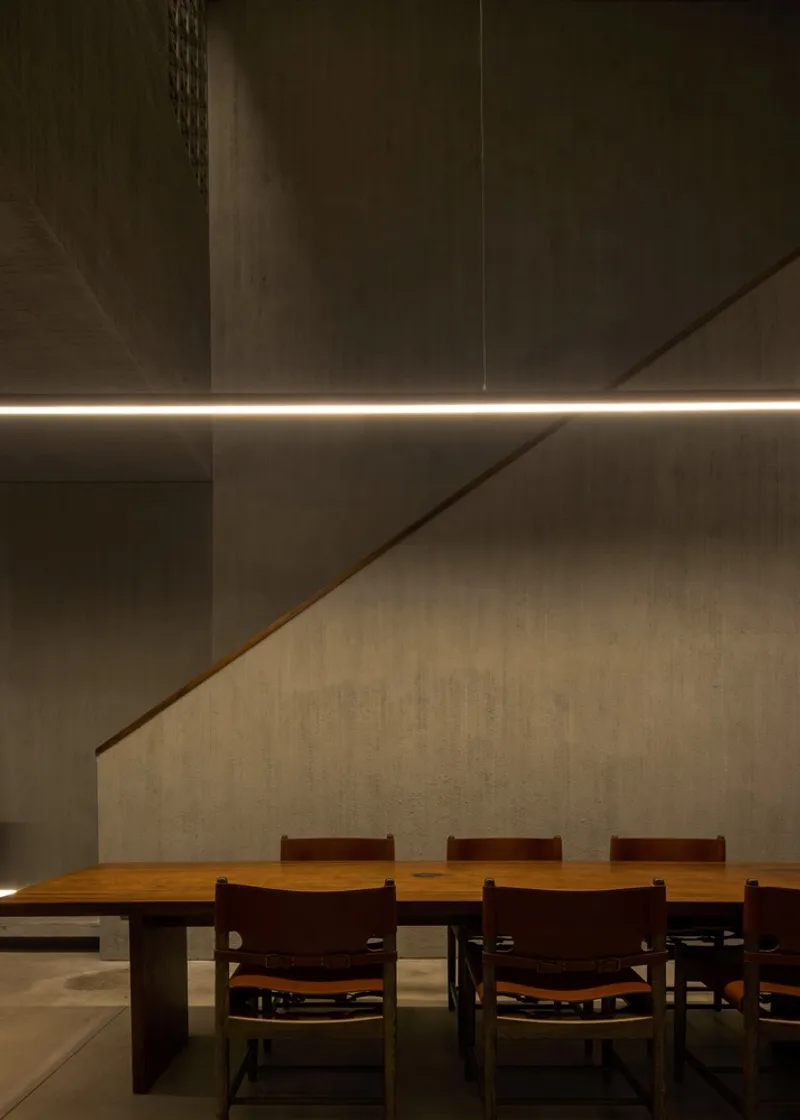
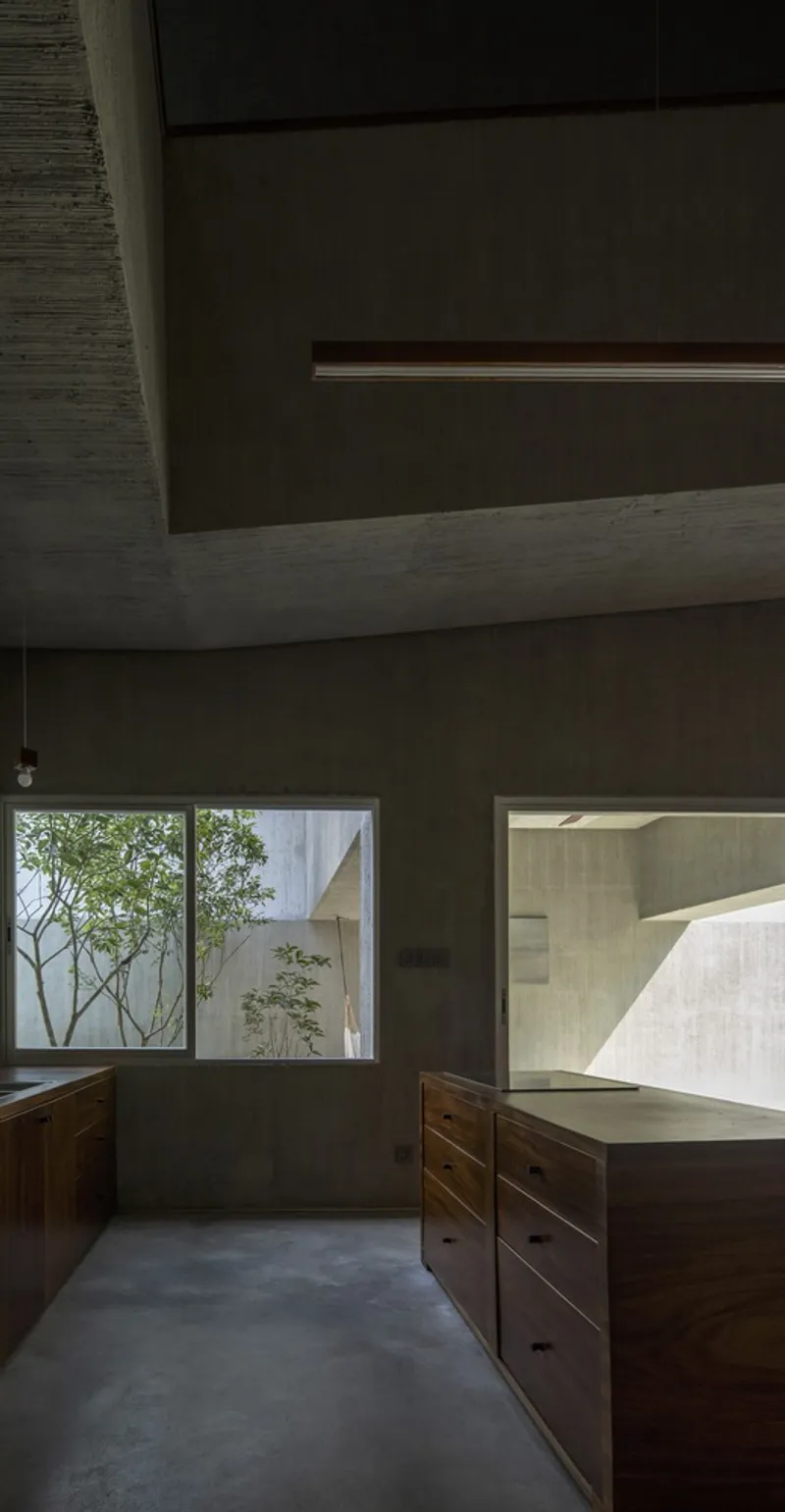
Inside, the concrete yields to timber. The living area deploys low furniture and generous glazing to establish sightlines through multiple courtyards simultaneously. You are never looking at a wall; you are looking through the house and out to green. The dining zone sits beneath recessed linear lighting, with a wooden staircase adding verticality and warmth to the otherwise horizontal composition.
A workspace tucked into a timber-clad niche offers a view directly into an internal courtyard with trees. It is a small room with an enormous sense of space, achieved entirely through the framing of a single window. This is the kind of intelligent economy that earns the project its distinction: every opening is precise, every view composed.
Private Rooms as Garden Pavilions
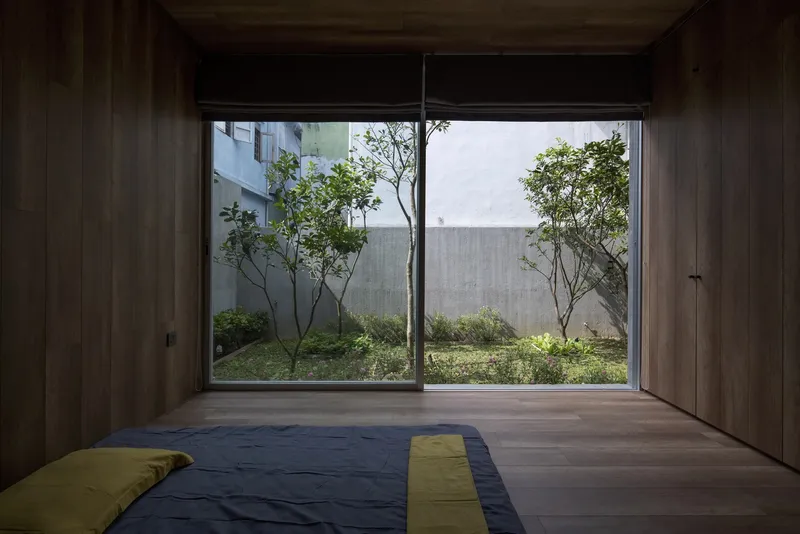
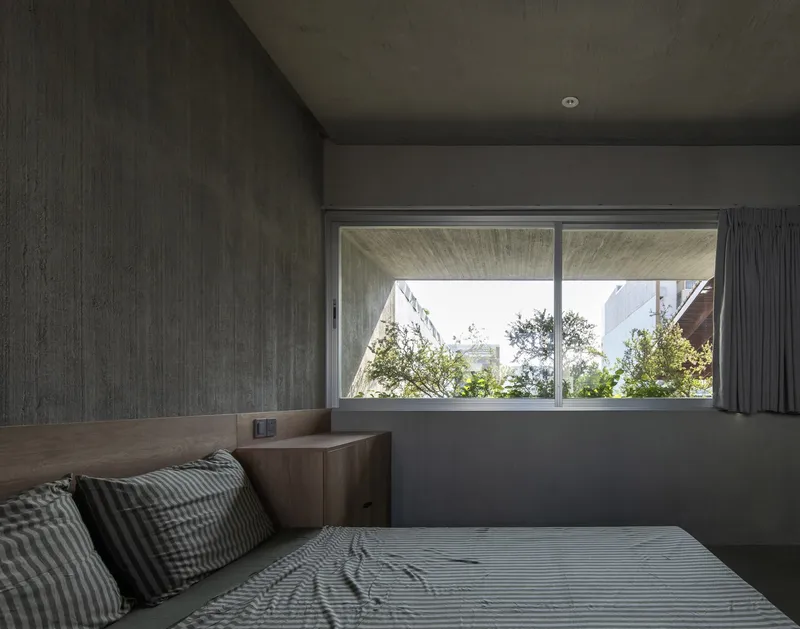
The bedrooms continue the logic of landscape immersion. A timber-lined room with a floor mattress opens entirely to a planted courtyard through sliding glass doors, collapsing the distinction between sleeping and being outside. Another bedroom uses a horizontal slot window to frame a band of garden vegetation, controlling the view while maximizing daylight.
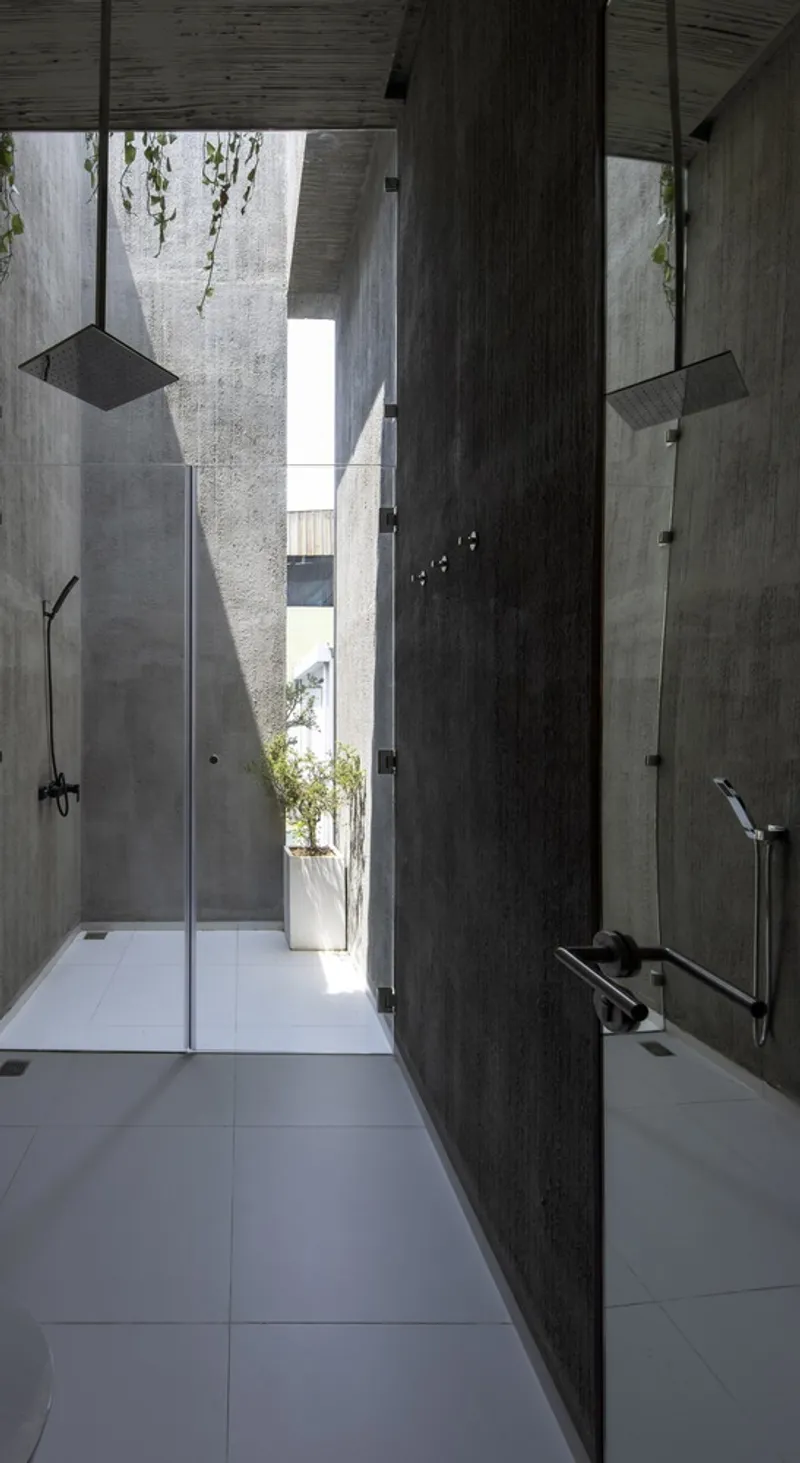
Even the bathroom participates. A narrow corridor with a dark timber divider leads to a glazed shower that opens directly onto a planted courtyard. Bathing becomes a semi-outdoor activity, screened from neighbors by the building's own mass but fully connected to sky and greenery. It is luxurious without any of the usual signifiers of luxury: no marble, no gold fixtures, just space, light, and a well-placed tree.
Twilight and the Stacked Section
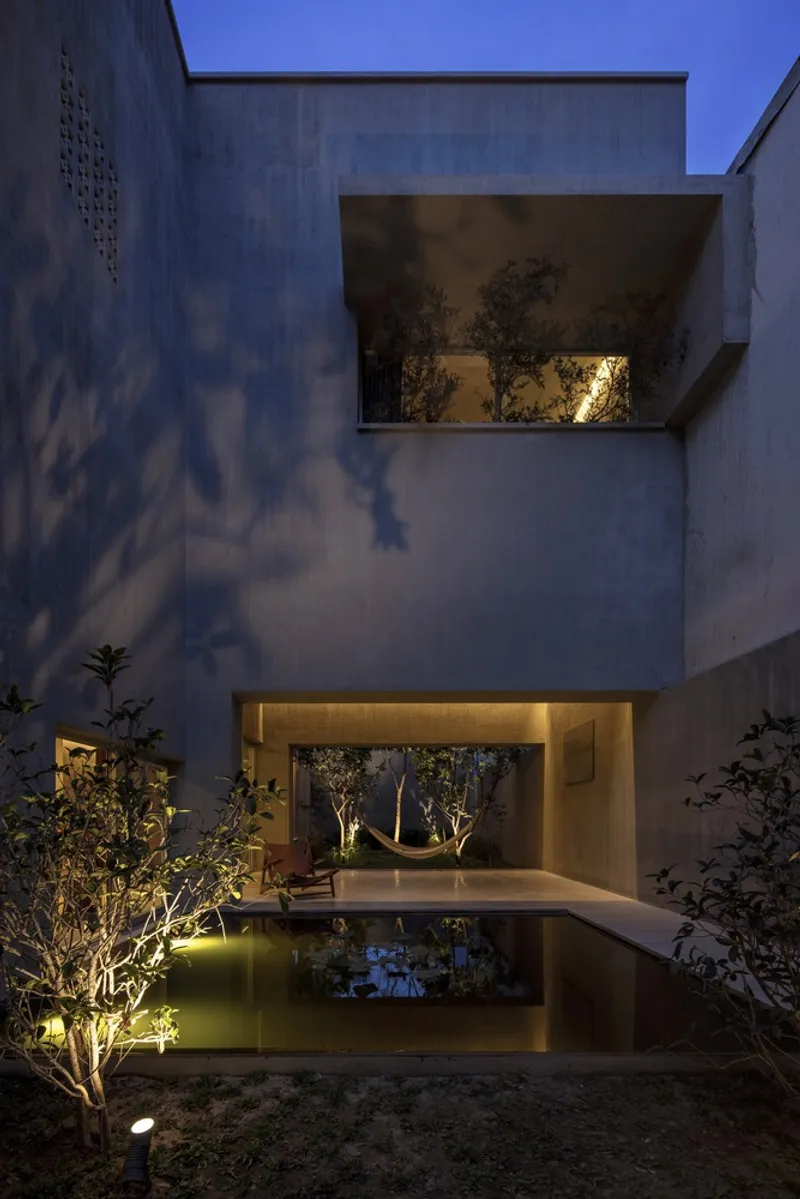
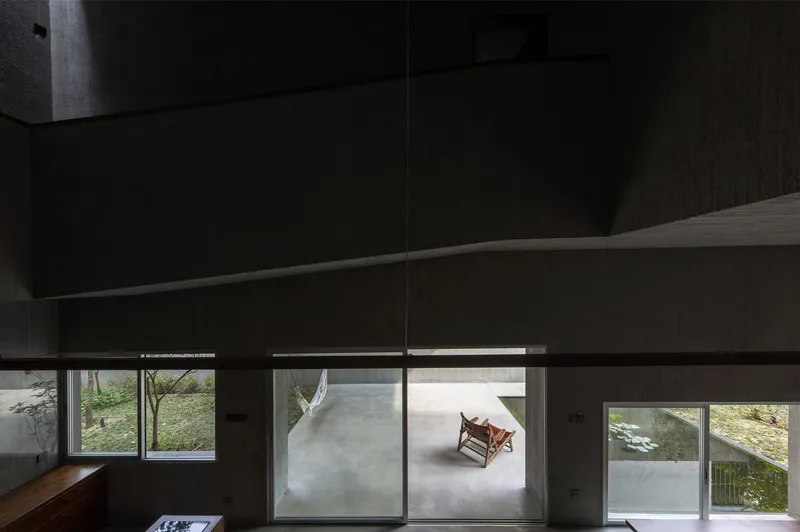
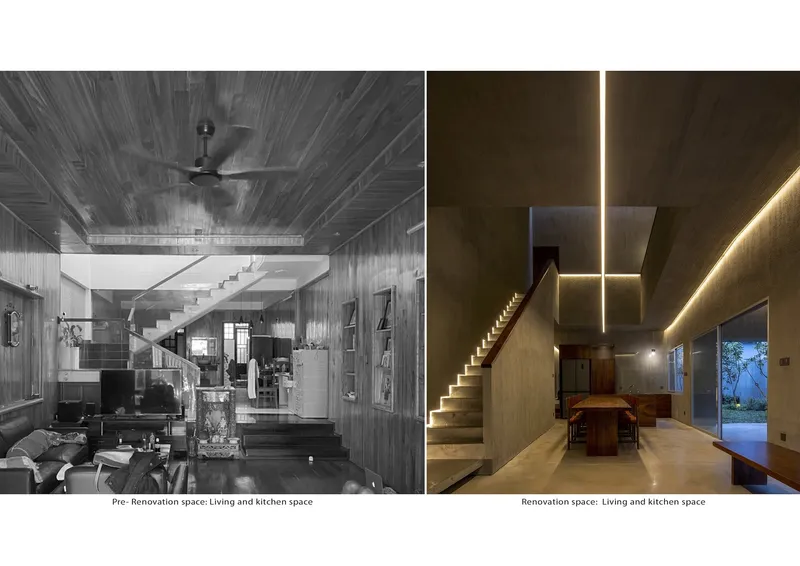
At twilight, the house reveals its sectional logic most clearly. Stacked concrete volumes glow from within, their illuminated terraces stepping back from the reflecting pool in a composition that reads like a geological outcropping. Horizontal slot windows frame unexpected vignettes: a rocking chair on a concrete terrace, a before-and-after view of the living space showing how timber ceilings and linear lighting slots transform the raw shell into something warm and specific.
The split-level organization means that every floor sits at a slightly different elevation, creating visual connections between rooms that a conventional plan would seal off. You are always aware of the house's depth, even from its periphery.
Plans and Drawings
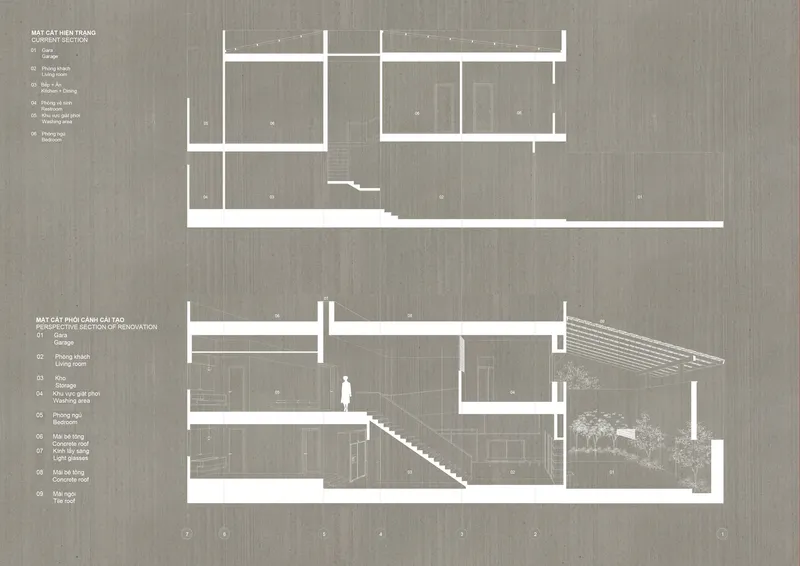
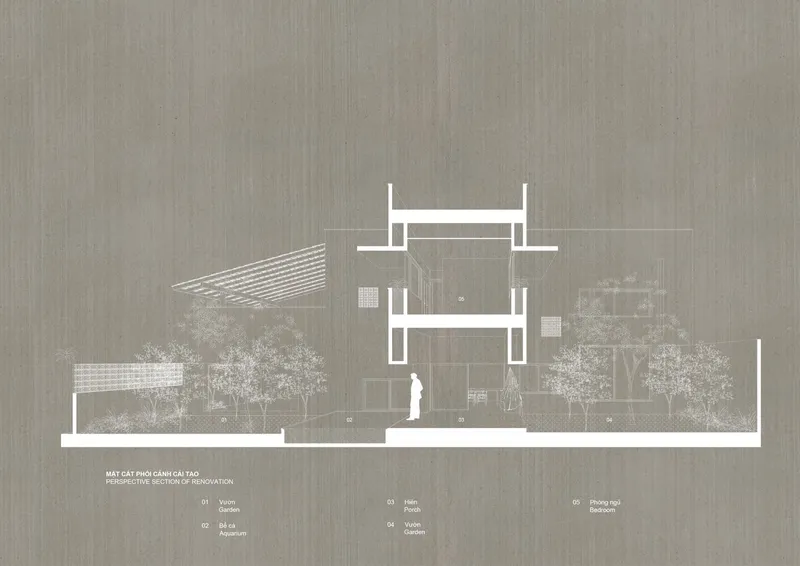
The section drawing makes the project's strategy explicit. Split levels connected by short flights of stairs create a continuous spatial flow that moves upward through the section while maintaining visual links to the courtyards at every turn. Planted trees appear at multiple levels, reinforcing the idea that landscape is not confined to the ground plane but threaded vertically through the building.
The perspective section is equally revealing. Layered spaces peel back to show how each room negotiates its relationship to the adjacent void, the surrounding vegetation, and the sky above. A standing figure provides scale and reminds us that these are intimate spaces, not monumental ones, despite the weight of all that concrete.
Why This Project Matters
Nhà Hương House matters because it refuses the false choice between robustness and comfort. The concrete is unapologetic: thick, raw, load-bearing in every sense. But the courtyards, the timber linings, and the carefully framed views prevent that robustness from becoming oppressive. The result is a house that feels both permanent and permeable, anchored to its site yet open to the weather and the seasons.
For anyone designing in tropical and subtropical climates, the project offers a working template for how to use mass, void, and vegetation together as a passive climate system that also happens to be spatially rich. H-H Studio has demonstrated that you do not need to choose between environmental performance and architectural ambition. At Nhà Hương, they are the same thing.
Nhà Hương House by H-H Studio, Vietnam. Photography by Hoang Le.
About the Studio
Share Your Own Work on uni.xyz
If projects like this are the kind of work you want to make, uni.xyz is a place to publish your own, find collaborators, and enter design competitions.




Popular Articles
Popular articles from the community


Lunar Spiral: Space Architecture Shaped by the Mathematics of the Universe
Lunar Spiral reimagines space architecture through Fibonacci geometry, lunar regolith, levitating habitats, and self-sustaining Moon living.

Co-life: Sustainable Architecture for Age-Friendly Community Living
Co-life reimagines sustainable architecture for seniors through courtyards, rammed earth, shared gardens, and spaces designed for belonging.

Play: Fragments of Their World
Familiar architecture becomes modular playground design, creating safe spaces where displaced children can learn, connect, imagine and play.

Conexión: Biophilic Design Reimagines High-Rise Living in Hong Kong
Conexión reimagines high-rise living in Hong Kong through biophilic design, green facades, shared spaces, daylight, water and nature within.


Similar Reads
You might also enjoy these articles


Hodi-Mandai Geram
Project Function: Preservation and revitalization of the Intangible heritage and socio-spatial identity of the Hodi by Housing, Cultural Memory Center, Sacred Grove, landscape, local tourism economy


Olio Towers: A Mid-Rise for Performers That Fuses Housing, Rehearsal, and Stage
Located blocks from Houston's Theater District, this modular tower stacks living units around a central performance atrium.

Oasis: Modular Green Housing Carved into Dhaka's Urban Fabric
A shortlisted Plugin Housing entry reclaims unauthorized settlements in Dhaka with stepped concrete volumes, green roofs, and ventilation-driven design.

Black Hole: A Floating Megastructure for the Post-Physical Era
Emiliano Mazzarotto envisions a spherical, self-scaling arena where e-sports, digital hotels, and holographic stadiums replace traditional public space.


Explore Architecture Competitions
Discover active competitions in this discipline



Challenge to reimagine the Iron Throne


Photograph architecture without architects


Illustrate the lost glory of Angkor Wat - Render Challenge


Design challenge to reuse E-waste
Comments (0)
Please login or sign up to add comments
No comments yet. Be the first to comment!