

Nibandha: A Cultural Center That Grows Like a Tree in Kozhikode
On a site once home to Kerala's first soap factory, concentric geometry and porous copper screens root a civic cultural space in memory and land.


A soap factory opened in 1914. It closed, was demolished, and left behind an urban void that collected waste and neglect. Nibandha reclaims that void in Kozhikode, Kerala, proposing a community cultural center whose plan radiates outward from a circular core like the rings of a tree trunk. The metaphor is deliberate: culture, like a tree, survives through what lies beneath the surface. Roots, traditions, collective memory. The building's concentric geometry makes that idea spatial, organizing galleries, workshops, amphitheaters, and courtyards into orbits around a central open-to-sky court.
Designed by Huda Umer Arakkal, Nibandha is a shortlisted entry in the Bharat Bhavan 2020 competition. The brief called for a contemporary interpretation of Bharat Bhavan: a civic anchor for artistic exchange that serves people across age groups, religions, and social backgrounds. Kozhikode, historically known as Calicut, is a natural host for such a program. The City of Spices has been a global cultural crossroads for centuries, shaped by maritime trade routes connecting the Middle East, Europe, and Asia, and deeply associated with theyyam, thirumural, oppana, wood carving, and literature. The project positions itself within that layered identity, not as a monument to one tradition but as a platform for many.
Curved Timber and Copper Screens Frame the Threshold
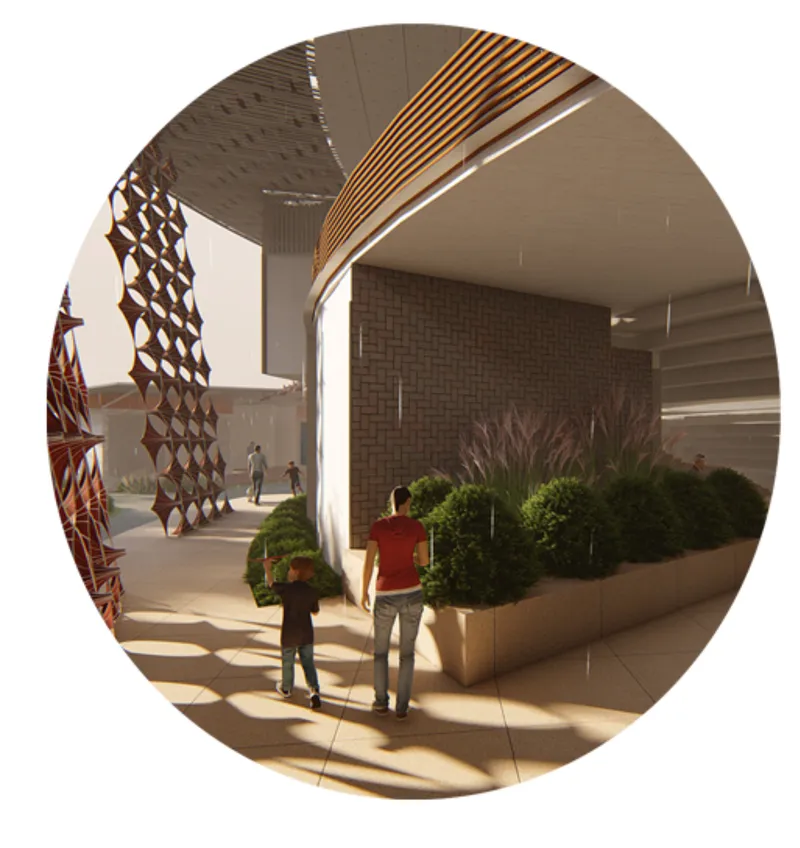
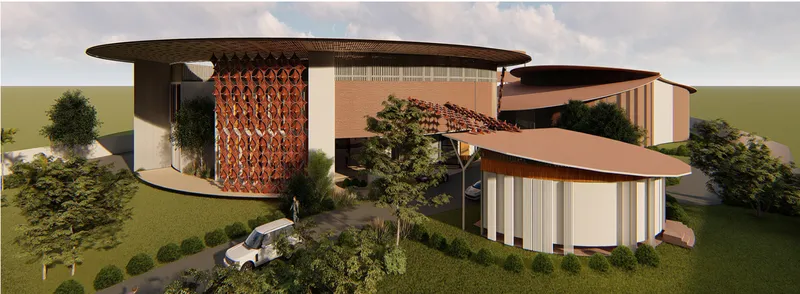
The entry sequence sets the project's material and spatial tone immediately. A covered plaza greets visitors beneath curved timber ceiling slats that arc overhead, directing movement toward the interior while filtering light into warm, rhythmic stripes. Patterned copper screens define the edge of this threshold, their geometric perforations drawing from traditional craft vocabularies without replicating them literally. The result is an envelope that breathes, softening the boundary between exterior landscape and interior program.
From above, the aerial view reveals how the curved roof forms nest into the landscaped perimeter. The copper screen tower rises as a vertical marker, a civic signal visible from the surrounding neighborhood. The building's refusal of straight lines is consistent at every scale: nothing in nature is rigidly straight, and the design philosophy follows that conviction through plan, section, and facade articulation. Secondary blocks radiate concentrically from the primary circular form, creating spatial continuity between galleries, the auditorium, workshop studios, and the sculpture park.
A Cylindrical Tower Wrapped in Geometric Craft
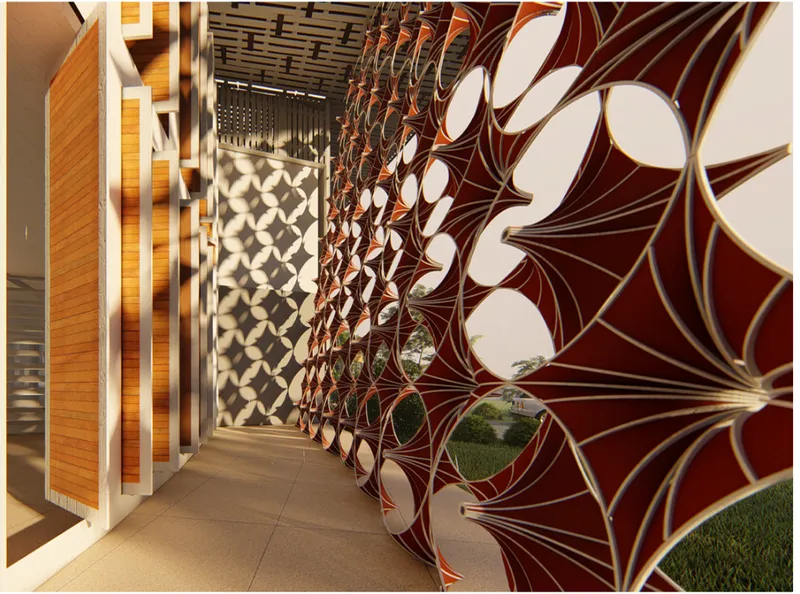
The cylindrical tower is the project's most photogenic element, but its role goes beyond landmark. Wrapped in a decorative copper screen whose geometric patterns reference traditional Malabar metalwork, the tower functions as a vertical connector and ventilation chimney, pulling air upward through the building's porous envelope. At its base, a planted courtyard softens the ground plane, reinforcing the tree metaphor by literally placing vegetation at the center of the built form.
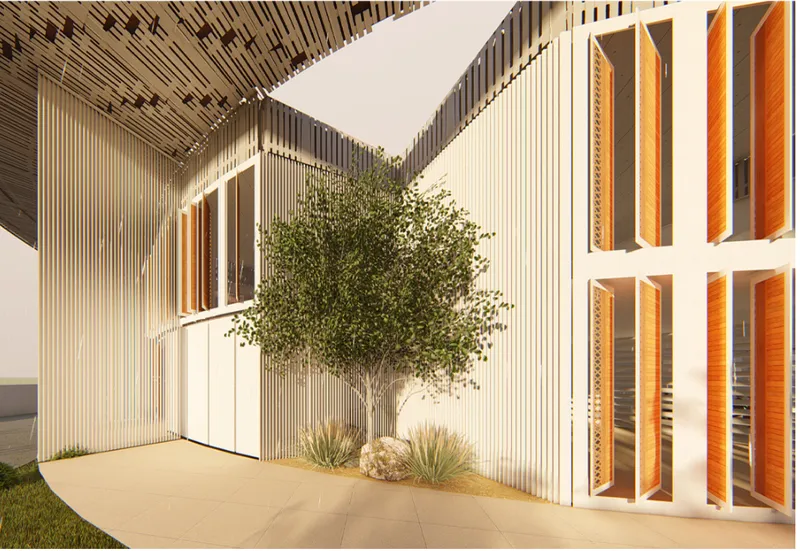
Adjacent to this, the interior courtyard reveals a quieter register. Vertical white louvers modulate daylight along the perimeter, while a woven timber ceiling stretches overhead, creating a canopy effect that recalls the dappled shade beneath a forest crown. A single tree stands at the center of this space, not decorative but programmatic: it anchors the contemplative atmosphere that supports gallery viewing and creative work in the surrounding studios. The master plan dedicates specific workshop areas to wood, bamboo, and coconut shell craft, grounding the cultural program in the material traditions of Kerala.
Arrival by Vehicle, Transition on Foot
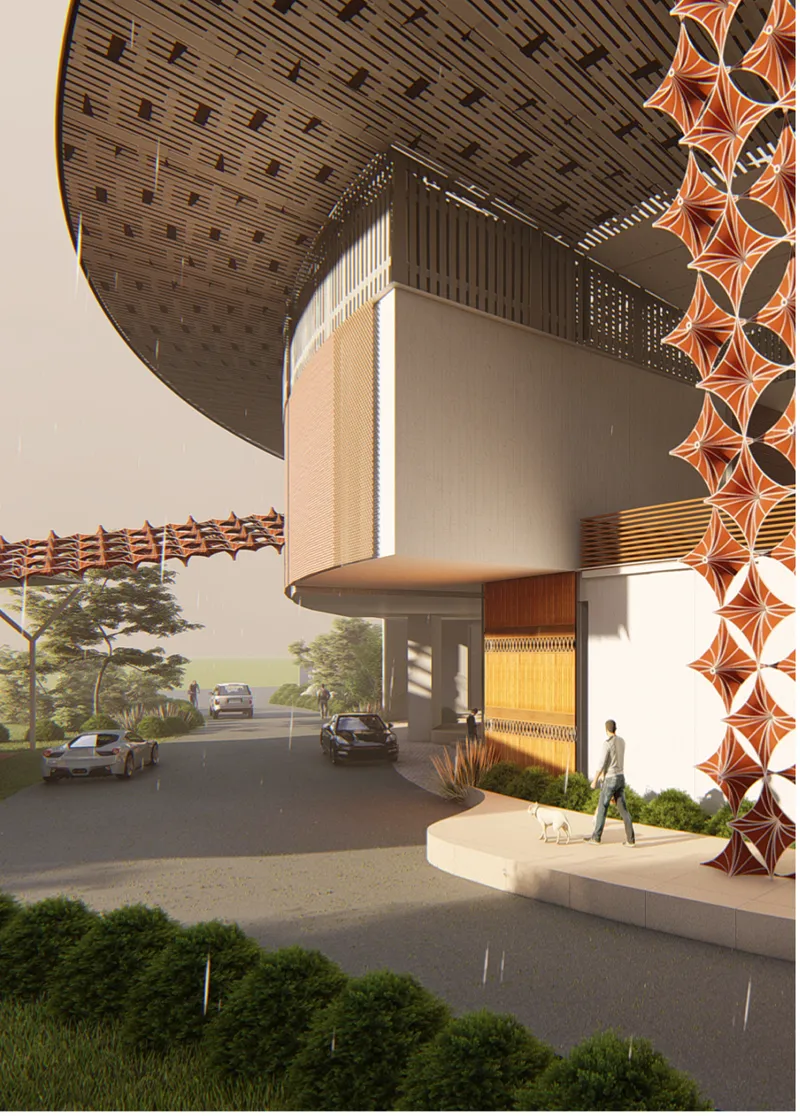
The vehicle drop-off canopy demonstrates how carefully the project manages the shift from automotive to pedestrian scale. A curved timber soffit shelters arriving visitors while copper screen columns frame the walkway beyond, drawing the eye toward the building's interior courts. The zoning strategy separates vehicular, public, semi-public, and service areas without creating hard boundaries. Instead, transitional landscapes and sculpture parks introduce visitors to the cultural narrative before they reach the main Bharat Bhavan block containing galleries, museum spaces, amphitheaters, and courtyards.
Light, Water, and Brick at the Heart of the Plan
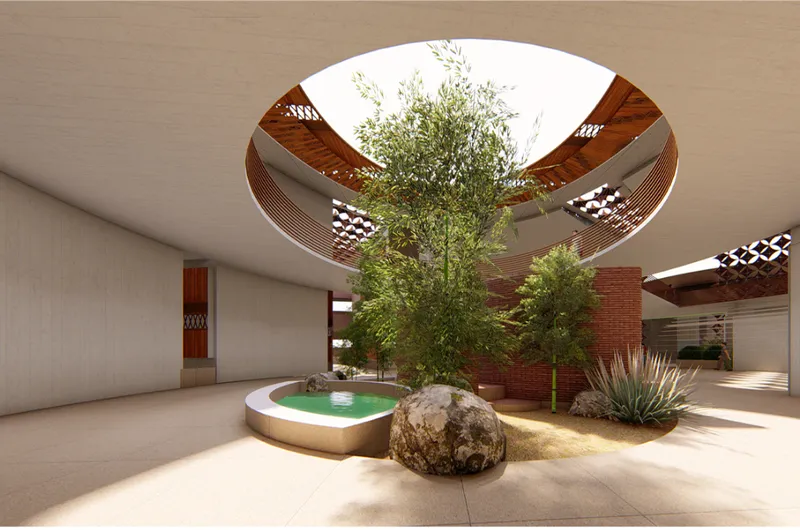
The central courtyard is the building's lung. A circular skylight opens the roof to the sky, flooding the space with natural light that shifts across brick walls throughout the day. Planted trees rise through this opening, their canopies breaking the geometry with organic irregularity. A reflecting pool at the base catches light and greenery, amplifying the sense of calm. The courtyard allows light, air, and vegetation to penetrate deep into the built mass, reducing dependence on mechanical systems while creating the contemplative environment the program demands.
The material palette reinforces this strategy. Brick, timber, and copper are all regional materials with strong thermal and tactile properties, appropriate for Kozhikode's tropical climate. The porous envelopes and open courtyards promote cross-ventilation, aligning the building's environmental performance with its cultural ambitions. Architecture that claims to celebrate tradition but ignores climate would be contradictory; Nibandha avoids that trap.
Why This Project Matters
Nibandha takes a site defined by industrial abandonment and waste disposal and proposes a cultural landscape that is genuinely public. The program spans galleries, performance spaces, craft workshops, a sculpture park, and administrative support, yet the design never fragments into isolated pavilions. The concentric plan holds everything in orbit around a shared center, making the act of moving through the building an experience of cultural interconnection rather than isolated consumption.
What gives the project conviction is its consistency between concept and execution. The tree metaphor could easily remain a diagram on a competition board, but here it translates into real spatial decisions: the circular core, the radiating secondary blocks, the courtyard vegetation, the porous envelope that lets the building breathe. For a city as culturally layered as Kozhikode, Nibandha offers an architecture that does not flatten that complexity into spectacle but instead provides the ground, literally and figuratively, for it to grow.
View the Full Project
About the Designers
Designer: Huda Umer Arakkal
Enter a Design Competition on uni.xyz
uni.xyz runs architecture and design competitions year-round that reward proposals with spatial conviction and real site intelligence.
Project credits: Nibandha – Bharat Bhavan by Huda Umer Arakkal Bharat Bhavan 2020 (uni.xyz).


Popular Articles
Popular articles from the community


Opera on the Sea: Driftwood Logic Shapes a Timber Opera House on Estonia's Coast
Trevor Orgill's opera house translates the entangled drift of floating timber into a civic building where wood, water, and music converge.


Cube Design Draws an Ecological Corridor Between Two Shenzhen Hills with the Nankai Building
Beside Shenzhen's container docks, the Nankai Building pairs stacked balconies with a climbing green screen to connect two hillsides across its height.

David Ortega Stacks a Two-Story Mexico City Penthouse Around a Steel Stair and a Pergola-Shaded Roof Terrace
In Colonia Roma, a 300 m² penthouse uses oak joinery, a planted steel stair and a slatted roof pergola to make a new-build apartment feel like a house.

Manzana Morphosis: Stretching Barcelona's Grid into a Living Landscape for 2050
A radical reworking of the Eixample manzana turns density into a tool for generous public space, vertical ecology, and environmental performance.

Similar Reads
You might also enjoy these articles

Aquadapt: An Underwater Habitat That Rewrites Its Rooms by the Hour
Curved modules ring the seabed while one shell shifts from breakfast room to cinema, farm and football pitch as residents' needs change.

Play: Fragments of Their World: Remembered Architecture Rebuilt as a Modular Playground for Refugee Camps
Tom Gardner abstracts domes, arches and towers from the homelands of displaced families into a kit of child-scaled play parts for camp settlements.
REBIRTH: A Circular Settlement Where Afghan Widows and Their Children Rebuild Life Together
A shortlisted Resile entry turns the circle into a protective ring of timber and brick, gathering homes, classrooms and gardens around a shared landscape.
The Main Dream: A Recycled Plastic Kit That Lets Refugee Children Build Their Own Playground
Thirty-centimetre interlocking cubes that connect on three axes turn play into construction, letting children author the spaces they occupy.

Explore Bharat Bhavan Competitions
Discover active competitions in this discipline

Challenge to reimagine the Iron Throne

Photograph architecture without architects

Illustrate the lost glory of Angkor Wat - Render Challenge

Design challenge to reuse E-waste
Comments (0)
Please login or sign up to add comments
No comments yet. Be the first to comment!