
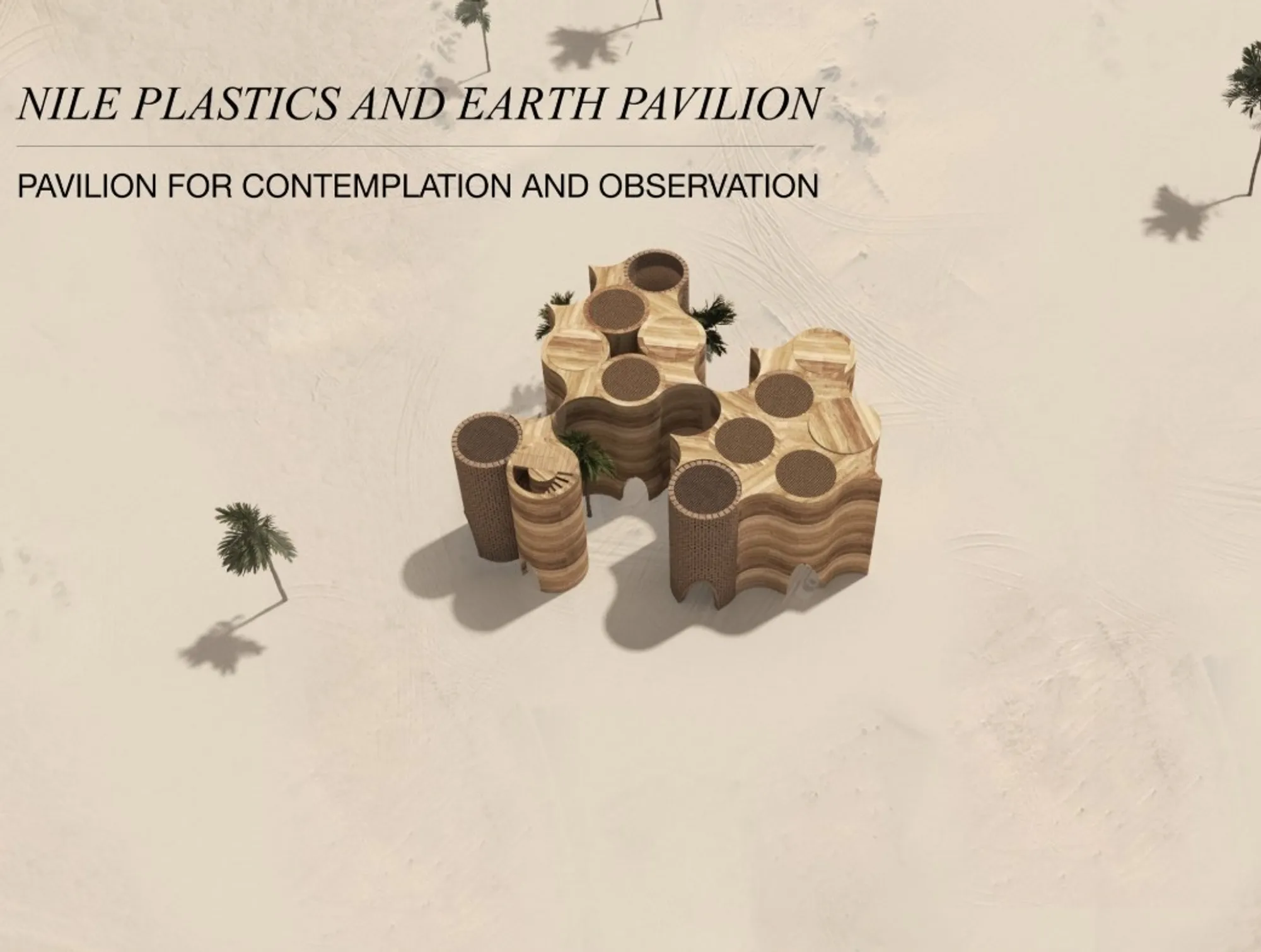
Nile Plastics and Earth Pavilion
A sustainable architecture pavilion merging earth and recycled plastic, transforming Nile waste into a timeless climate memorial of reflection


In the evolving discourse of sustainable architecture, projects that merge ecological responsibility with spatial storytelling are redefining how we engage with the built environment. Nile Plastics and Earth Pavilion, an Honorable Mention entry in the Hourglass competition by Havar Cemal, stands as a compelling exploration of circular design, material innovation, and cultural continuity.
Set within a landscape shaped by both history and environmental urgency, the pavilion operates as more than a physical structure. It is conceived as a reflective monument that bridges past and present while projecting a future rooted in ecological consciousness.

Concept: Architecture as Reflection of Time, Place, and Identity
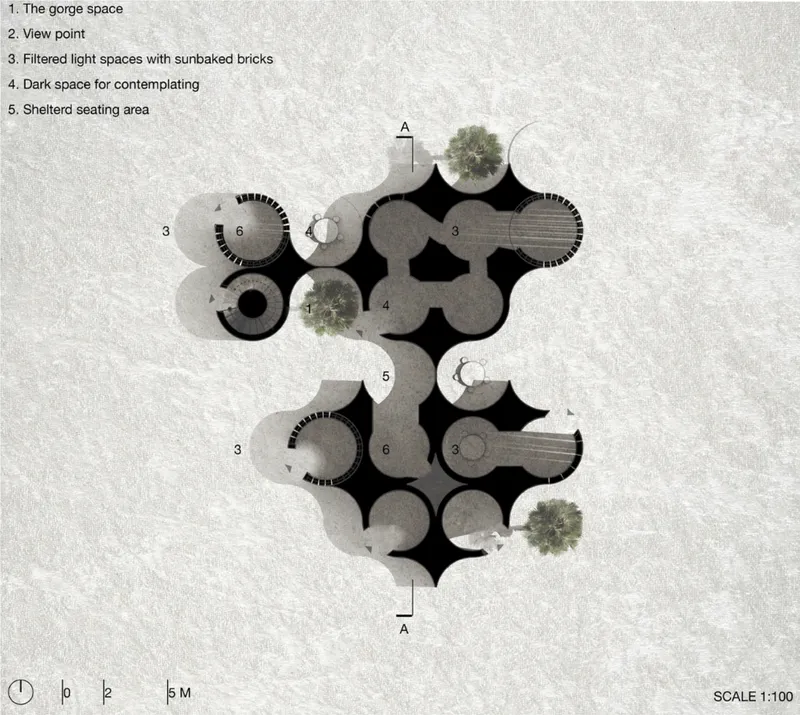
The pavilion draws from the language of ruins, embracing simplicity as a powerful narrative tool. Its cylindrical configuration eliminates hierarchy, removing the notion of front or back and allowing visitors to approach from all directions. This democratic spatial logic reinforces inclusivity while echoing traditional architectural forms found in the region.
The design intentionally juxtaposes primitive geometry with layered experiential complexity. As visitors move through the structure, they transition from narrow, introspective spaces into light-filled volumes. This spatial sequencing creates a psychological journey that mirrors the transition from awareness to realization.
The project positions architecture as a medium of reflection, encouraging users to contemplate climate change, material consumption, and the long-term impact of human intervention on the planet.
Material Strategy: Rammed Earth Meets Recycled Plastic
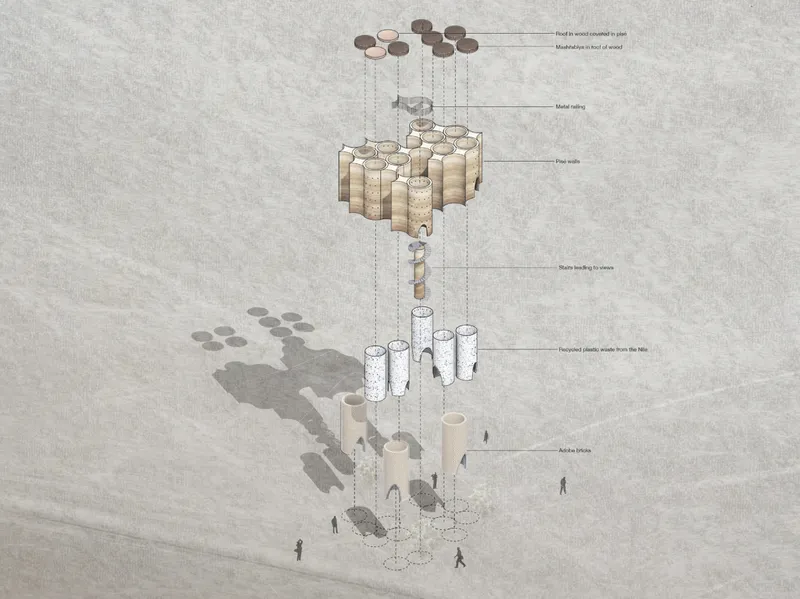
At the core of this sustainable architecture proposal lies a hybrid material system that combines rammed earth construction with recycled plastic waste sourced from the Nile River.
Rammed earth walls, constructed from locally available aggregates, sand, silt, and clay, establish a strong connection to regional building traditions. This technique significantly reduces embodied energy by minimizing transportation and industrial processing. Adobe bricks further reinforce this localized construction logic, ensuring that the project remains contextually grounded.
In contrast, the interior surfaces introduce recycled plastic as a contemporary layer. Plastic waste, intercepted from river systems where a significant portion of ocean pollution originates, is repurposed as an architectural material. This integration creates a powerful dialogue between organic and inorganic elements, symbolizing the coexistence of tradition and modernity.
The result is a tactile and visual contrast that transforms waste into meaning, embedding environmental narratives directly into the architectural experience.
Circular Design and Environmental Impact
The pavilion operates within a circular design framework, challenging the conventional linear lifecycle of materials. Instead of viewing plastic as waste, the project repositions it as a resource with architectural potential.
Globally, billions of tons of plastic have been produced since the mid-20th century, with a significant percentage entering river systems and eventually the oceans. By targeting river-based waste collection, the project addresses pollution at its source, where intervention is most effective.
The proposal aligns with emerging global efforts to clean waterways through technological and systemic solutions. By incorporating collected plastic into construction, it not only reduces environmental burden but also demonstrates a scalable model for material reuse.
This approach situates the pavilion at the intersection of sustainable architecture and environmental activism, transforming it into both a building and a system of awareness.
Spatial Experience: Journey Through Light and Material
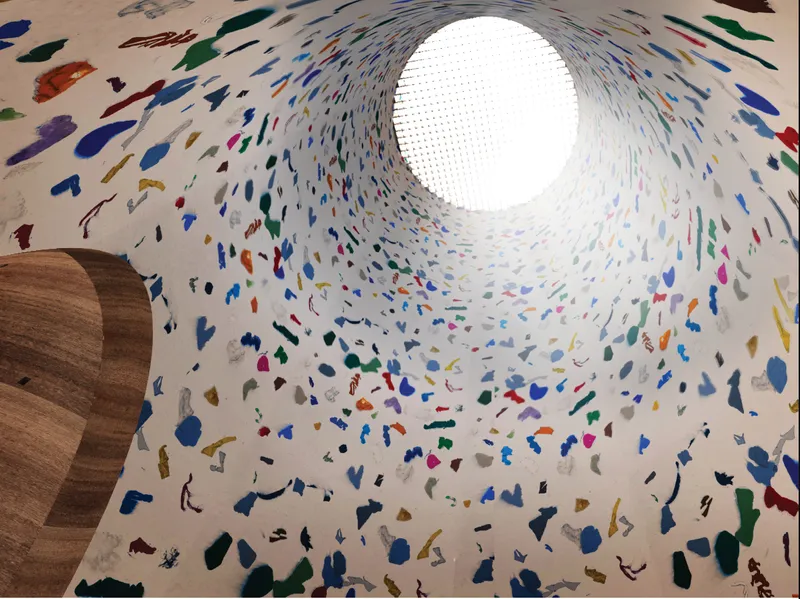
The interior experience is defined by a sequence of cylindrical chambers that vary in scale, light, and atmosphere. Narrow passages create moments of compression, leading into expansive voids illuminated by overhead openings.
The plastic-lined interiors introduce a dynamic visual field, where fragments of color embedded within surfaces produce an almost celestial effect. Light filtering through these materials amplifies their presence, turning waste into an immersive aesthetic experience.
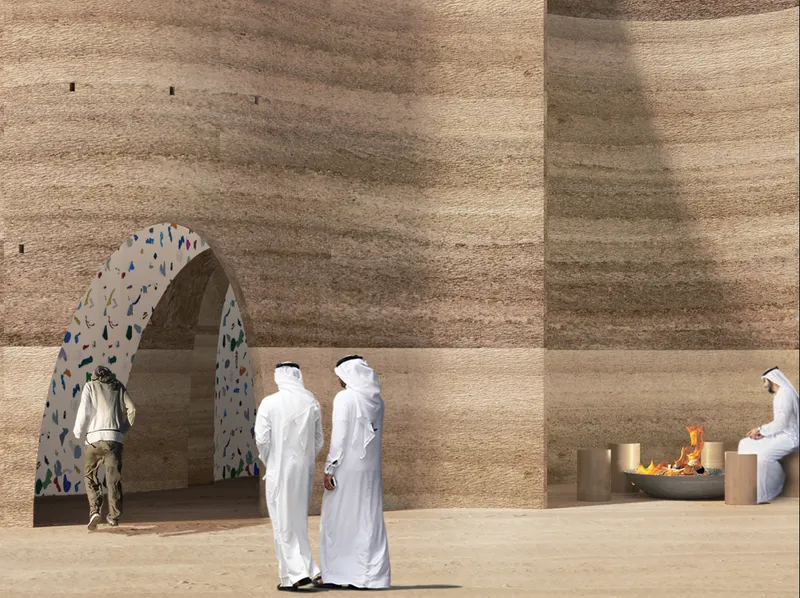
Externally, the earthen massing appears monolithic and grounded, anchoring the structure within the desert landscape. Internally, however, the space becomes porous, luminous, and contemplative.
This duality between exterior solidity and interior transformation reinforces the project’s conceptual narrative.
Construction Logic and Modularity
The pavilion is designed as a modular system of cylindrical units that can expand over time. This scalability is critical to its conceptual framework, allowing the architecture to grow in response to the increasing volume of recovered plastic.
Each unit functions as both an independent spatial element and a component of a larger collective system. Over time, the aggregation of these units has the potential to occupy the entire site, creating a continuously evolving architectural landscape.
This strategy introduces time as an active design parameter, positioning the pavilion not as a static object but as a living system that adapts and expands.
Climate Narrative and Cultural Context
The project situates itself within a broader narrative of climate change and human responsibility. Historically, architecture has been used to control and modify environmental conditions. However, this pavilion reverses that paradigm, advocating for a more symbiotic relationship with nature.
By combining traditional construction methods with contemporary material challenges, the design creates a bridge between cultural heritage and environmental urgency. Elements such as arches, mashrabiya-inspired openings, and earthen textures root the project in its local context while engaging with global concerns.
The pavilion becomes a place of gathering, contemplation, and education, where architecture facilitates dialogue around sustainability and collective responsibility.
Aging, Decay, and Timelessness
A critical dimension of the project is its acceptance of decay as part of the architectural lifecycle. Over time, the earthen walls will erode, and the plastic elements will degrade, physically manifesting the passage of time.
This intentional aging process transforms the pavilion into a temporal artifact, where material transformation becomes a narrative device. The structure evolves into a contemporary ruin, embodying both resilience and vulnerability.
Through this lens, the pavilion challenges conventional notions of permanence, suggesting that architecture can be meaningful precisely because it changes.
Jury Perspective
Jonas Prismontas, juror, observed:
“I understand -or at least hope- that this monument is intended to grow with time because the amount of plastic that can be recovered is truly enormous. So it would be good to see a diagram how these cylindrical units multiply over the course of time and occupy the whole site.”
This insight reinforces the importance of scalability within the project, highlighting its potential as an evolving system rather than a fixed installation.
Nile Plastics and Earth Pavilion positions itself as a forward-thinking model within sustainable architecture and circular design. By merging local materials with recycled waste, it proposes a new architectural language that is both contextually grounded and globally relevant.
The project demonstrates how architecture can move beyond static form-making to become an ակտիվ participant in environmental processes. It reframes waste as a resource, time as a design tool, and space as a medium for awareness.
In doing so, it offers a compelling vision for the future of architecture, one where ecological responsibility and spatial experience are inseparable.




Popular Articles
Popular articles from the community


Riyadh For All: Intergenerational Urban Design for Active Aging in Rabat
Riyadh For All reimagines urban design in Rabat with intergenerational co-living, adaptive courtyards, and Moroccan cultural exchange today.

Lunar Spiral: Space Architecture Shaped by the Mathematics of the Universe
Lunar Spiral reimagines space architecture through Fibonacci geometry, lunar regolith, levitating habitats, and self-sustaining Moon living.

Co-Life: Senior Housing Design That Reconnects Older Adults With the City
Co-Life reimagines senior housing design through healing gardens, shared streets, workshops, and a sustainable community across generations.

The Ocean Hive: Sustainable Architecture for a Self-Sufficient Civilization at Sea
The Ocean Hive imagines sustainable architecture at sea, where modular habitats, algae, wave power and ocean waste sustain a growing colony.


Similar Reads
You might also enjoy these articles

Eco Chapel: A Green Architecture Pavilion Designed in Symbiosis with the Forest
Eco Chapel uses green architecture to weave prayer, learning and reuse into a forest pavilion shaped by modular hexagonal canopies for life.
Kaffeebühnen: Coffee Shop Architecture Designed as a Civic Stage Between Vienna’s City and Park
Kaffeebühnen turns coffee shop architecture into a civic stage, linking Vienna’s park edge, urban life, warm timber yards, and coffee craft.
Healing Façade: Sustainable Architecture for Reforestation, Community, and Sacred Ecology in Ethiopia
Healing Façade reimagines sustainable architecture as a living wall that restores soil, catches water and renews Ethiopia's forest churches.


Urban Forest: A Vertical Ecosystem for 5,000 Workers in Singapore's Changi Business Park
Radially stacked pods and layered green decks turn a 7-acre plot into 47 acres of ecological workspace projected for 2040.


Explore Architecture Competitions
Discover active competitions in this discipline



Challenge to design a portable theatre


Challenge to design a portable music platform


Challenge to design an open learning module for the elderly


Challenge to reimagine the Iron Throne
Comments (0)
Please login or sign up to add comments
No comments yet. Be the first to comment!