
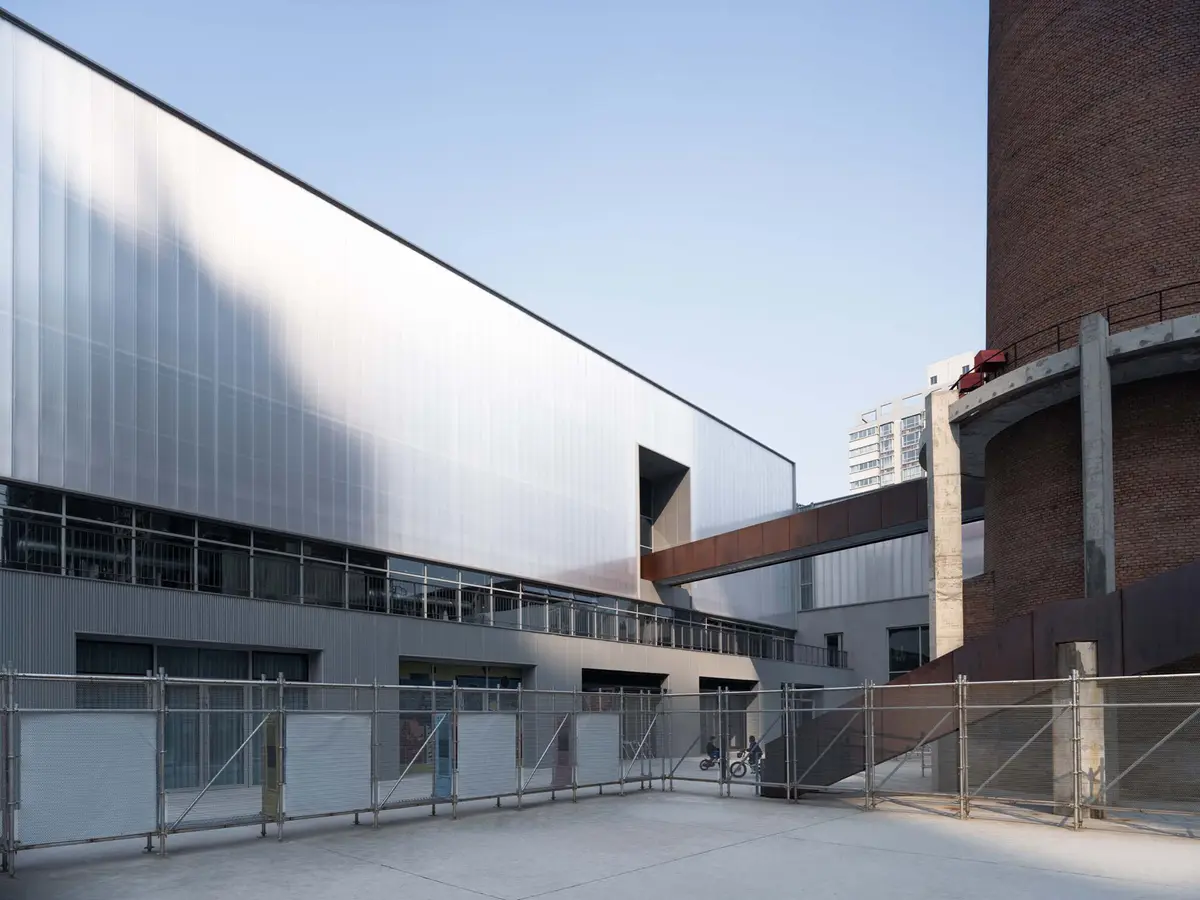
Nomos Architects Wraps a Defunct Xi'an Boiler Station in Polycarbonate to Create an Art Community
A coal-burning heating plant from the 1990s becomes a translucent gallery and retail hub in Xi'an's dense residential core.


Coal-burning boiler stations were once a fixture of northern Chinese cities, squat industrial volumes responsible for heating entire residential districts through long winters. The one on Xi'an Shiyou University's residential campus was planned in 1994, completed in 1997, and shut down in 2014 when centralized municipal heating made it redundant. That 17-year lifespan is short enough to feel wasteful, and the building sat empty in a thicket of residential towers with no obvious second act. Nomos Architects proposed one: gut the program, keep the bones, and turn the whole thing into TanArt Community, a 3,988-square-meter exhibition and retail complex that treats the old infrastructure not as a liability but as an asset.
What makes the project genuinely interesting is the refusal to prettify the ruin or to erase it behind a slick new shell. Nomos kept the concrete frame, the tall chimneys, and the enormous coal scuttles, then wrapped the exterior in translucent Rodeca polycarbonate panels that glow at dusk. The effect is a building caught between two identities: heavy industrial skeleton and luminous lantern. A weathering steel runway bridges the outdoor plaza to the third-floor main exhibition hall, creating a processional entrance that bypasses the ground floor entirely. It is a renovation that argues for keeping difficulty in, rather than smoothing it out.
A Glowing Wrapper for a Concrete Skeleton

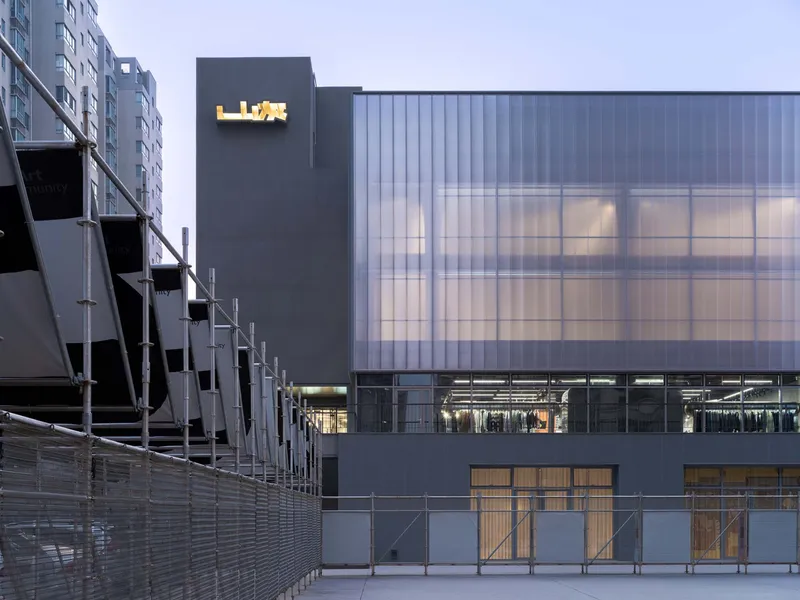
The polycarbonate facade is the project's most visible move, and its success depends on context. Surrounded by nondescript residential towers, TanArt Community needed a material presence that could signal cultural use without resorting to spectacle. The vertically ribbed polycarbonate panels achieve this by diffusing interior light outward at twilight, turning the building into a soft beacon. During the day, the panels work in reverse: they bring filtered, even light into the exhibition spaces, eliminating the harsh directional glare that plagues many gallery conversions.
The choice is also pragmatic. Polycarbonate dramatically improves the thermal performance of a structure that was originally designed to contain furnaces, not people browsing art. By replacing the original cladding with these lightweight panels, Nomos achieved insulation gains without adding mass to an aging concrete frame.
The Chimney Stays


The tall brick chimney is the building's most recognizable element, visible from blocks away above the residential fabric. Nomos left it standing, and it functions now as a vertical landmark that orients visitors toward the complex. In aerial views, the chimney reads as a hinge between the old and the new: raw masonry next to translucent skin, vertical thrust against horizontal volume. There is no attempt to clad it or integrate it visually. It simply persists, a blunt reminder of the building's first life.
Retaining the chimney also prevented a common pitfall of Chinese industrial conversions, where heritage elements are demolished to maximize leasable floor area and the building gets carved into low-cost co-working units. By preserving the chimney and the coal scuttles, Nomos made the original program legible, which in turn gives the cultural program its narrative gravity.
Steel Bridge as Threshold

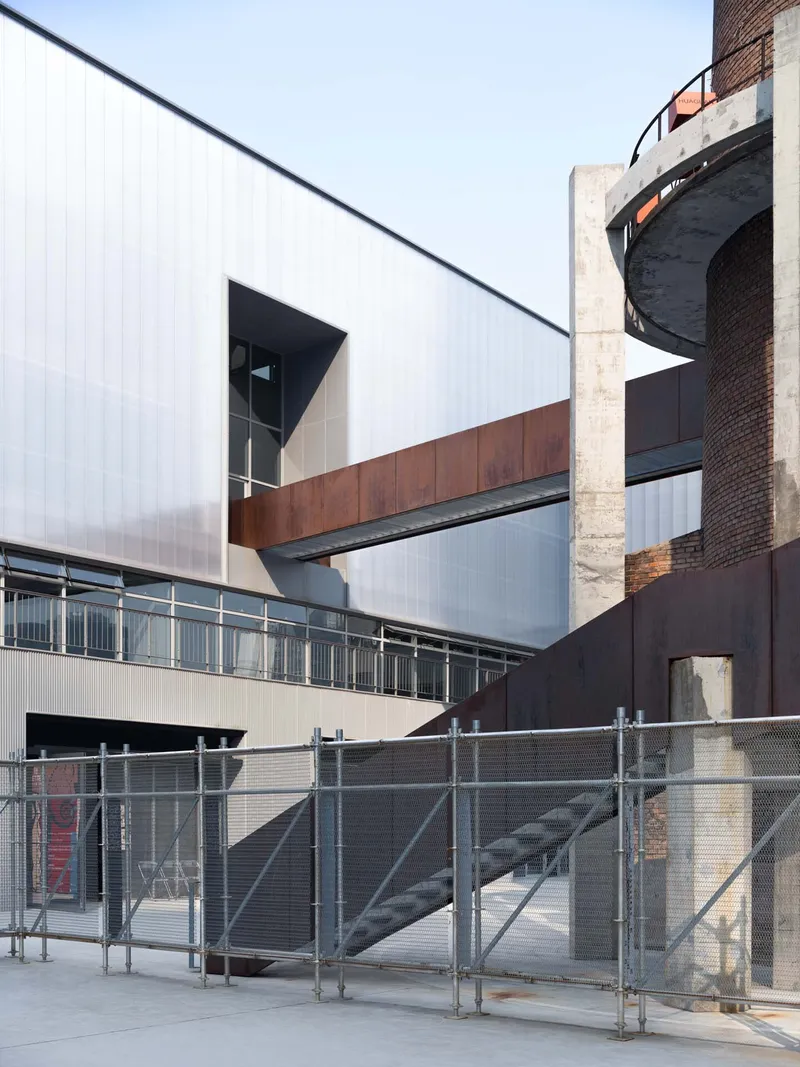
The weathering steel runway is the most theatrical gesture in the project. It launches from the outdoor plaza and arrives at the third-floor main exhibition hall, bypassing the commercial ground level and forcing visitors into an elevated, cinematic approach. The Corten surface picks up the rust tones of the brick chimney, creating a material dialogue between new insertion and existing structure. Where the bridge meets the polycarbonate wall, an angular cutout frames the connection, making the joint between old and new architecturally explicit rather than seamless.
Structurally, the bridge works because the original column grid was robust enough to accept new lateral loads. Nomos exploited the triangular spaces between the coal scuttles and existing columns, threading air ducts and structural connections through gaps that the original engineers never anticipated anyone would use.
Interiors: Concrete Left Raw


Inside, the tall boiler operation room has been converted into the primary exhibition space. The concrete columns and beams are left exposed, their surfaces aged and stained from decades of industrial use. Tall gridded windows, likely derived from the polycarbonate system, diffuse daylight across the interior in a way that flattens shadows and creates even illumination. Twenty-four spherical air nozzles dot the main hall, a detail borrowed from industrial HVAC that Nomos repurposed for climate control.
The decision to leave the concrete rough rather than skim-coating or painting it is the interior equivalent of keeping the chimney. It gives the gallery a texture that no new-build can replicate. Scaffolding-based display systems add another layer of industrial reference while allowing the exhibition layout to be reconfigured without drilling into the preserved structure.
Urban Presence in a Residential Sea

From above, TanArt Community is a compact anomaly among identical residential slabs. The flat roof, the circular chimney base, and the translucent volume read as fundamentally different from the housing blocks that surround it on every side. That difference is the point. In a dense urban district with few cultural amenities, the converted boiler station introduces a public program that did not exist before. The ground-floor retail and upper-level galleries create a reason for residents to cross the street, which is a modest but real contribution to neighborhood life.
Why This Project Matters
Chinese cities are full of decommissioned boiler stations. Most get demolished. A few get preserved as heritage objects. Very few get turned into functioning cultural venues that respect the original structure while serving a radically different program. TanArt Community belongs to that third, rarest category. Nomos Architects made a series of clear, defensible choices: keep the frame, keep the chimneys, keep the scuttles, replace the skin, add a bridge. Each decision reinforced the others, producing a coherent project rather than a collage of renovation tactics.
The broader lesson is about the value of difficulty. A boiler station is not an easy building to convert. Its volumes are wrong for retail, its structure is over-engineered for galleries, and its location inside a residential campus limits visitor traffic. Nomos did not pretend those constraints away. The polycarbonate wrapper, the elevated runway, the exposed concrete interior: all of these are direct responses to specific problems posed by the existing building. That discipline is what separates a good renovation from a cosmetic rebrand.
TanArt Community by Nomos Architects. Xi'an, China. 3,988 m². Completed 2022. Photography by Xiao Tan (Studio Ten) and TanArt Community.
About the Studio
Share Your Own Work on uni.xyz
If projects like this are the kind of work you want to make, uni.xyz is a place to publish your own, find collaborators, and enter design competitions.


Popular Articles
Popular articles from the community


Tsunami Convergenics: Turning Catastrophic Ocean Forces into Underwater Housing Infrastructure
A speculative underwater settlement off the coast of Onagawa, Japan, treats tsunamis and typhoons as energy sources rather than threats.

Opera on the Sea: Driftwood Logic Shapes a Timber Opera House on Estonia's Coast
Trevor Orgill's opera house translates the entangled drift of floating timber into a civic building where wood, water, and music converge.

The Amber Palace Opera: A Geological Fiction Surfaces on Tallinn's Baltic Waterfront
Pierre Brillard reimagines a Baltic legend as a public landscape, opera house, and waterfront promenade rooted in Tallinn's coastal identity.

Faces of the Soviet Avant-Garde: Turning Moscow's Street Names into an Open-Air Museum
A network of sculptural installations across a Moscow residential district transforms forgotten architect names into spatial encounters with cultural memor

Similar Reads
You might also enjoy these articles

Pixel Gardens: One Repeated Module Stacked Into a Terraced Social Housing Tower for Famagusta
Salem Bader's shortlisted housing tower builds a vertical neighbourhood from one repeated module, offsetting units to carve terraces, light and air.

Bao Huynh Watercolor Atelier: A Serene Art Retreat in Hội An
Bao Huynh Watercolor Atelier in Hội An blends multifunctional art spaces, sustainable design, local materials, and family-friendly living in a serene environment.

Atelier Macri Concept Store Interior Design by CASE-REAL
Atelier Macri store features a "ko" counter, walnut wood details, cork displays, blending retail, gallery, and seamless customer experiences.

Manuel Vargas Izquierdo Stadium and High-Performance Sports Center: Architectural Excellence in Jalpa de Méndez
The Manuel Vargas Izquierdo Stadium blends sustainable design, inclusive sports facilities, and cultural-inspired architecture, revitalizing Jalpa de Méndez’s public spaces.

Explore Interactive Art Competitions
Discover active competitions in this discipline

Challenge to reimagine the Iron Throne

Photograph architecture without architects

Illustrate the lost glory of Angkor Wat - Render Challenge

Design challenge to reuse E-waste
Comments (0)
Please login or sign up to add comments
No comments yet. Be the first to comment!