
NORM Architects Distill a Danish Lakeside Home to Its Barn Essentials
Lakeshore Barn House strips the rural archetype to its bones, finding warmth in restraint on the edge of a Danish harbour.


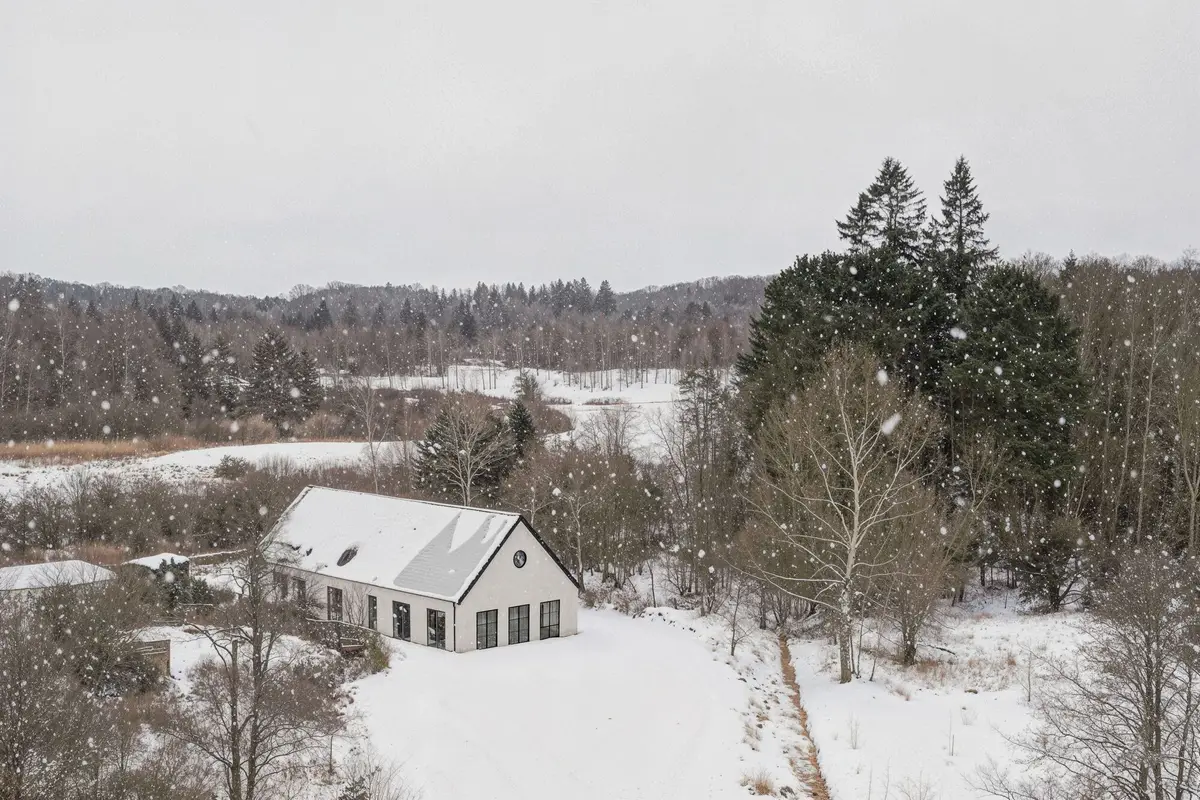
There is a particular Danish confidence in knowing what to leave out. Lakeshore Barn House, designed by Copenhagen's NORM Architects, takes the gabled silhouette of an agricultural barn and treats it not as a nostalgic reference but as a disciplined starting point. Sited near a small harbour in Denmark, the house sits among bare trees like a piece of furniture that has always been there, white and precise against the muted Scandinavian palette.
What makes the project worth studying is not the archetype itself, which is common enough in Nordic residential work, but the relentless consistency of its interior logic. Every niche, corridor, and threshold is treated with the same vocabulary of flush planes, recessed volumes, and tactile material contrasts. The result is a home where restraint does not feel cold. It feels edited.
A Barn in the Snow
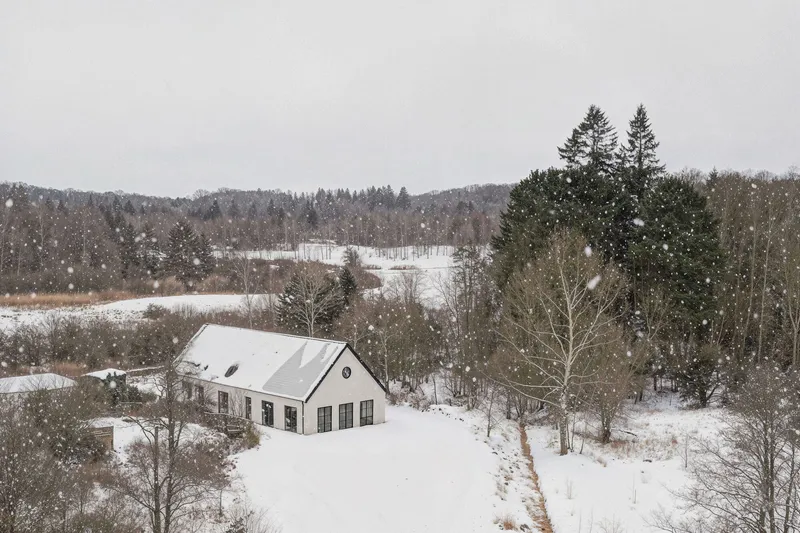

From the air, the house reads as a single white gable dropped into a copse of leafless trees. The snow erases the ground plane, and what remains is pure form: pitched roof, clean walls, no ornamental ambiguity. NORM Architects have spoken often about the idea of "soft minimalism," and the aerial view captures that ethos in one frame. The building does not compete with the landscape. It absorbs it.
Step inside and the double-height entry hall reveals how the barn archetype translates vertically. A vaulted ceiling stretches the proportions upward, while a circular window at the peak punches a controlled aperture of light into the space. Fluted glass doors at ground level filter the afternoon sun into soft bands, giving the hall a diffused luminosity that feels almost ecclesiastical. It is a generous threshold, one that tells you to slow down before moving deeper into the house.
Corridors as Composition


The narrow corridor lined with flush white cabinetry is one of the project's quietest and most revealing moments. There are no visible handles, no shadow gaps beyond those that are absolutely necessary. The passage terminates at a steel-framed glass door, and the compression of the hallway amplifies the release when you reach it. NORM treats circulation not as leftover space but as choreography.
A recessed desk niche along the way demonstrates the same principle at a smaller scale. Wrapped in warm oak veneer and framed by white panels, it is functionally a workspace and spatially a portrait. The proportions are tight, the materials limited to two, and the effect is complete. There is no monitor arm, no cable tray, no ergonomic apparatus in sight. Whether that is aspirational or practical depends on the owner, but as a design statement it is unambiguous: every object here has to earn its place.
Material Restraint in Wet Spaces

Bathrooms often betray a project's true level of discipline, and Lakeshore Barn House holds its line. The recessed shower niche, carved into a wall of dark grey stone tile, is a single vertical slot with one dispenser bottle. No shelf, no ledge, no second thought. The tonal shift from the white corridors to this darker enclosure is the house's strongest material contrast, and it works precisely because it is so contained.
Across the house, the palette stays narrow: white plaster, oak veneer, grey stone, steel frames, fluted glass. NORM's contribution here is not invention but curation. Each material appears in a specific role, and none of them try to do two jobs at once. In a residential market saturated with maximalist kitchens and feature walls, that clarity is its own kind of luxury.
Why This Project Matters
Lakeshore Barn House belongs to a lineage of Nordic homes that treat the barn gable as a container for contemporary life. What distinguishes NORM's version is the rigor of its interior architecture. The plan reads as a sequence of calibrated volumes, each one framed, recessed, or compressed to produce a specific spatial experience. The building is not about a single dramatic gesture. It is about dozens of small ones aligned in the same direction.
For architects working on rural residential projects, the lesson here is proportional: how much you can remove before warmth disappears, and how little material variation you need to sustain it. NORM's answer is less than most would attempt. That the house still feels inviting, even generous, is the real achievement.
Lakeshore Barn House by NORM Architects, Denmark. Photographs by Jonas Bjerre-Poulsen.
About the Studio
Share Your Own Work on uni.xyz
If projects like this are the kind of work you want to make, uni.xyz is a place to publish your own, find collaborators, and enter design competitions.


Popular Articles
Popular articles from the community


Conexión: Biophilic Design Reimagines High-Rise Living in Hong Kong
Conexión reimagines high-rise living in Hong Kong through biophilic design, green facades, shared spaces, daylight, water and nature within.

Play: Fragments of Their World
Familiar architecture becomes modular playground design, creating safe spaces where displaced children can learn, connect, imagine and play.

Hill & Cross Opera: Sculptural Opera House Architecture Shaped by Tallinn’s Landscape and Identity
Hill & Cross Opera reimagines opera house architecture in Tallinn through its sculptural hill, civic plaza, glass wave and a luminous cross.

Co-Life: Senior Housing Design That Reconnects Older Adults With the City
Co-Life reimagines senior housing design through healing gardens, shared streets, workshops, and a sustainable community across generations.

Similar Reads
You might also enjoy these articles

Bao Huynh Watercolor Atelier: A Serene Art Retreat in Hội An
Bao Huynh Watercolor Atelier in Hội An blends multifunctional art spaces, sustainable design, local materials, and family-friendly living in a serene environment.

Atelier Macri Concept Store Interior Design by CASE-REAL
Atelier Macri store features a "ko" counter, walnut wood details, cork displays, blending retail, gallery, and seamless customer experiences.

Manuel Vargas Izquierdo Stadium and High-Performance Sports Center: Architectural Excellence in Jalpa de Méndez
The Manuel Vargas Izquierdo Stadium blends sustainable design, inclusive sports facilities, and cultural-inspired architecture, revitalizing Jalpa de Méndez’s public spaces.
KAKR Buluh Awar Hall: Revitalizing Community and Ecology Through Bamboo Architecture
Community built bamboo hall revitalizes Buluh Awar village, empowering youth, restoring ecology, celebrating vernacular craftsmanship through sustainable architecture and culture.


Comments (0)
Please login or sign up to add comments
No comments yet. Be the first to comment!