
NYAC
New York Affordable Housing

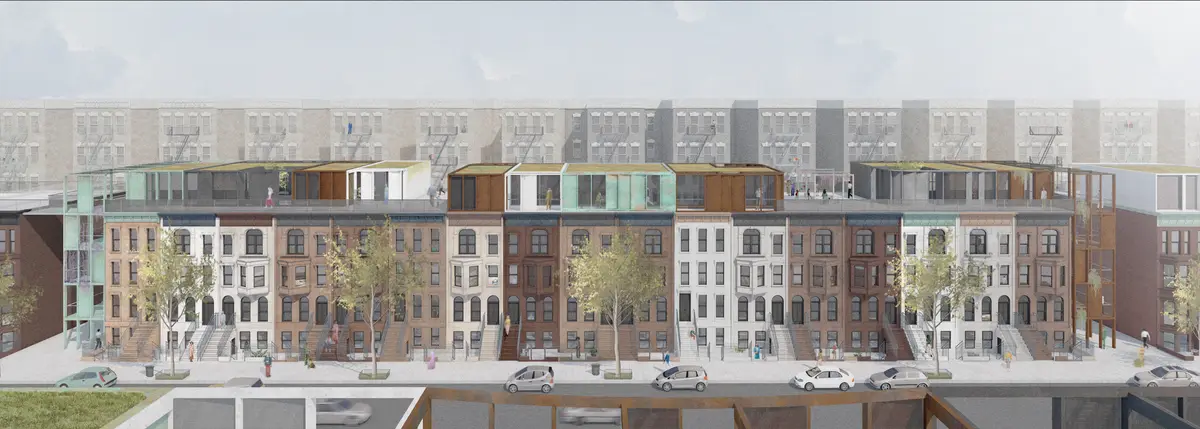
Starting from the city’s goal to reach 300,000 affordable units by 2026, this thesis aims to investigate the process that makes the city un-affordable, through a design experience based on a multi-layered reading of the urban and social fabric of the city. Tales, Multimensionality and Affordability are the three guiding concepts of this work:
1. The narrative of the city through popular culture has been the tool used to recognize two extremes of New York: ‘Capital City’ and ‘Segregation City’, along with their corresponding architectural translations. It is thus possible to identify a city caught between the two extremes and investigate how they are affecting the daily lives of its residents.
2. A critical reading of current urban policies highlights how these strategies, aimed at increasing the number of affordable housing units, in some cases incentivize and instrumentalize the phenomenon of gentrification, and in most cases are not enough to solve the city’s housing crisis. Therefore, a strategy of micro-densification is proposed, supported by a possible new urban policy, which aims to reverse the lack of space within the city a through a new buildable layer.Thanks to the mapping of different degrees, both physical and demographic, we seek a possible area to implement a pilot intervention, demonstrative of a new way to build and inhabit the city. The classification of the urban morphologies of the chosen area leads to a scientific reading of its basic urban blocks, the Brownstones.
3. The designed units offer flexible domestic spaces, creating a new urban landscape integrated with the context. Structured as elements that allow to create new points of contact between communities, their thresholds provide a smooth transition between public and domestic space. Everything works synchronously to create a new shared and inclusive habitat, while maintaining the principles of affordability and sustainability, both social and environmental.The project is thus used as a tool for critical reading, to address central issues of today’s metropolis,. It proposes a prototype, as a result of a transcalar, social and architectural research of the city. Given the new urban policy, the project could be hosted, with different morphological characters, in multiple areas of New York. Could then, the radically expanded micro-densification process throughout Manhattan be sufficient to solve the affordable housing crisis and simultaneously counteract the gentrification phenomenon?

Popular Articles
Popular articles from the community


LT2A and OPEN Architectes Thread a Brick and Glass High School Through a Wooded Belgian Campus
In Braine-l'Alleud, a 3,000 m² wing for Collège Cardinal Mercier pairs pale brick with a glazed colonnade, deferring to a small chapel and a dense wood.

David Ortega Stacks a Two-Story Mexico City Penthouse Around a Steel Stair and a Pergola-Shaded Roof Terrace
In Colonia Roma, a 300 m² penthouse uses oak joinery, a planted steel stair and a slatted roof pergola to make a new-build apartment feel like a house.

GROUP A Strips a 1969 Rotterdam Harbor Headquarters to Its Frame and Wraps It in Timber Louvers
In Rotterdam's M4H harbor district, Ferro Offices reuses a 1969 frame, adds one timber storey and reaches BREEAM-NL Outstanding.

David Macias Steps a Doorless Stone and Plaster House Down a Tropical Colombian Hillside
In the humid hills of Colombia, Threshold House replaces the front door with an open void and terraces its 850 m² down the slope instead of fighting it.

Similar Reads
You might also enjoy these articles

The Rhythm of Seasons
A Farmers' Market Connecting Nature and the City


More Than a Building-Designing a Living System
More Than a Building-Designing a Living System
Base Beyond
DESERT COMPOUND ARID: TOURISM OF ABSENCE AND ABUNDANCE

Comments (0)
Please login or sign up to add comments
No comments yet. Be the first to comment!