
0E1 Arquitetos Turns Light Itself into Architecture at a Jiu-Jitsu Academy in Porto Alegre
Translucent polycarbonate walls and a carefully choreographed spatial sequence transform a martial arts gym into a luminous ritual space.


A jiu-jitsu academy is, at its core, a room with a mat. Most gyms treat the rest of the program as an afterthought: locker rooms get tucked into leftover corners, circulation is a hallway, and lighting is whatever the drop ceiling allows. 0E1 Arquitetos rejected all of that when they designed the Oden Jiu-Jitsu Academy in Porto Alegre. Instead of treating the 250 square meter space as a box to fill, the firm organized the entire project around the experience of moving through it, using light as both material and narrative device.
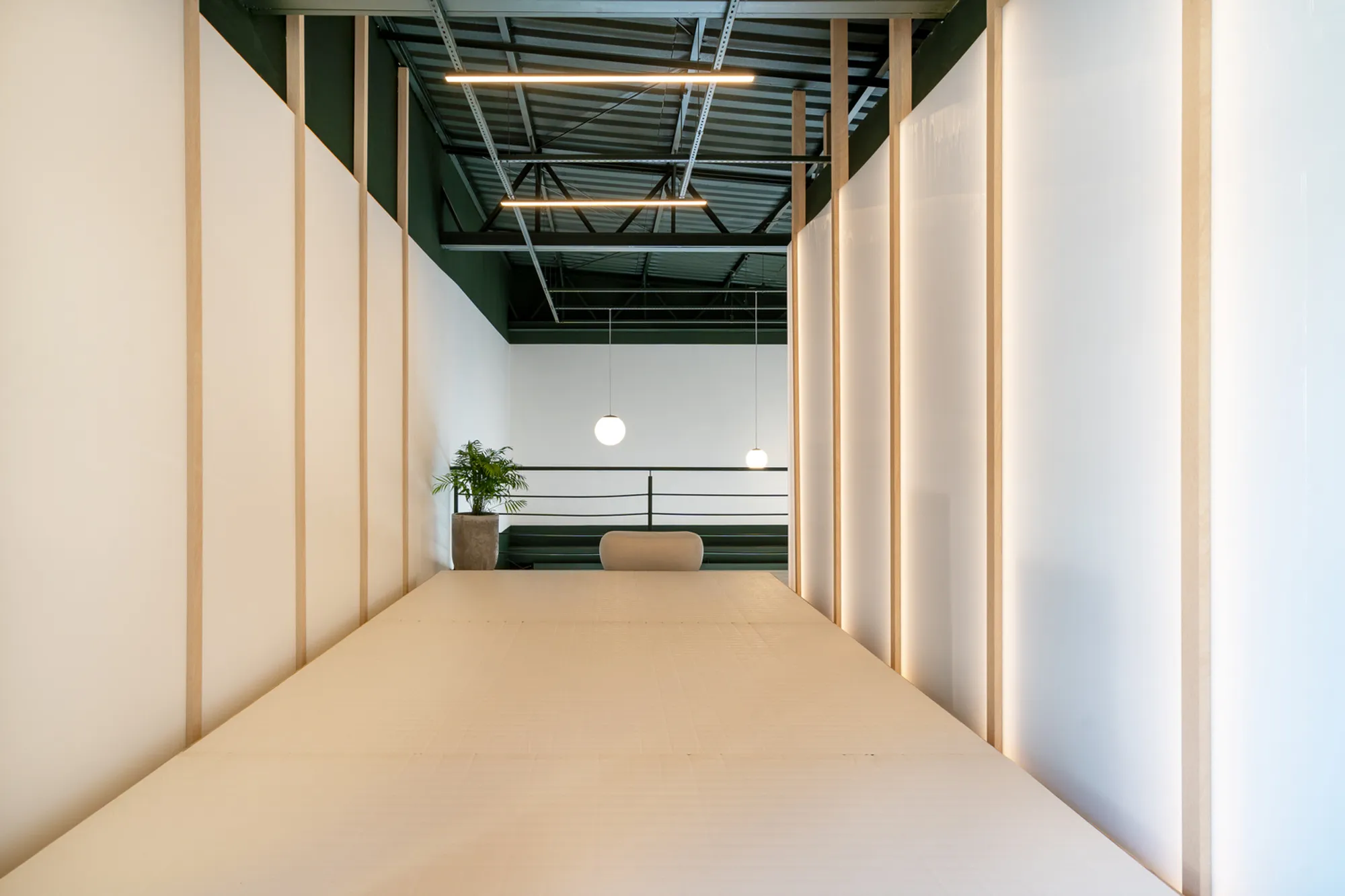
The result is a gym that feels closer to a temple than a sports facility. Translucent polycarbonate panels embedded with LEDs form glowing walls that shift the atmosphere from zone to zone, guiding practitioners through a deliberate sequence: bright transparency at the entrance, diffused natural light on the ground floor, deepening shadow on the stairs, a backlit chrysalis in the changing rooms, and finally re-entry to the tatami through a luminous sliding door. The architecture doesn't just house jiu-jitsu; it performs the ritual of preparation that every martial artist knows but few buildings acknowledge.
The Tatami as Centerpiece
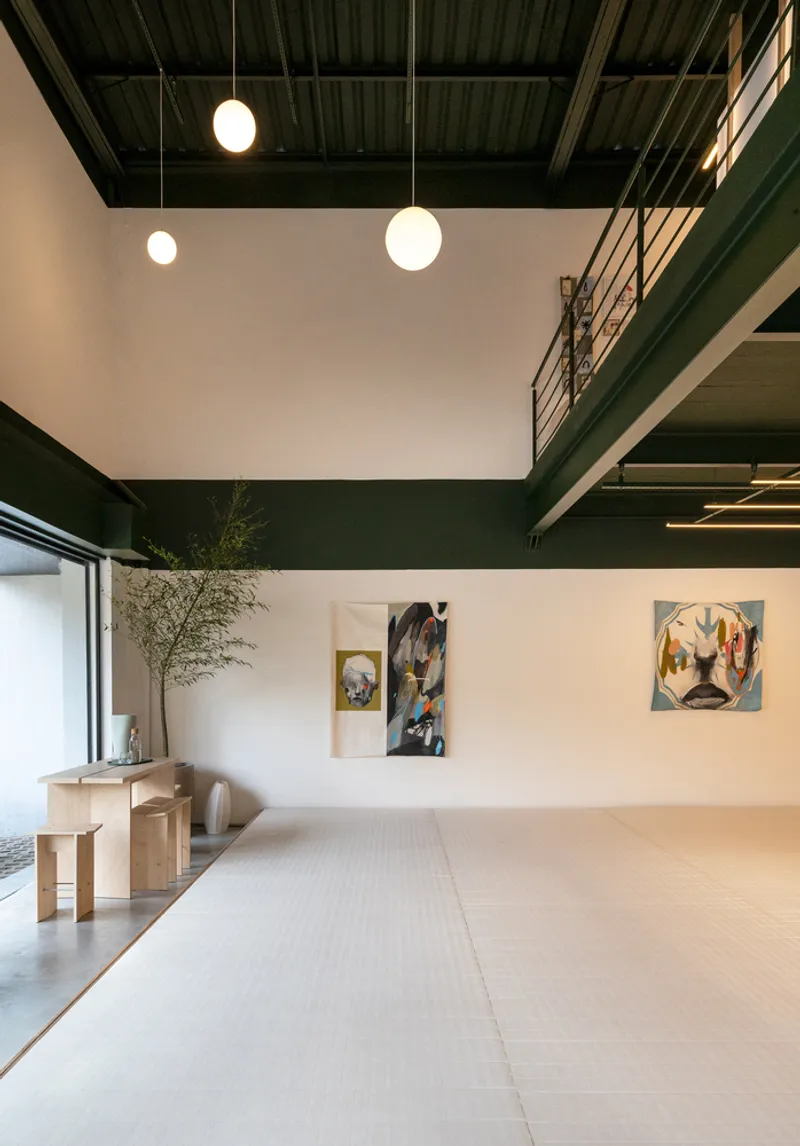
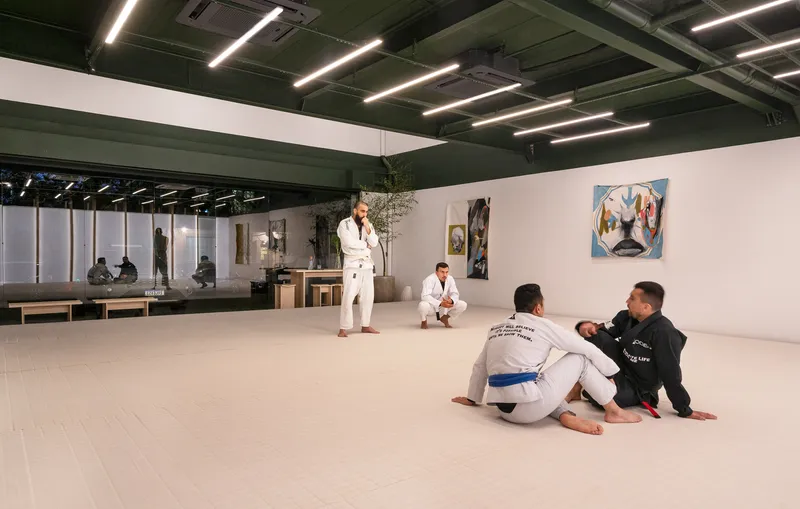
The ground floor is dominated by a generous white tatami surface stretched beneath a double-height volume with exposed green steel ceiling beams. It is the gravitational center of the whole plan. Large group classes happen here, with practitioners visible from both the mezzanine above and the gallery wall that lines one side of the mat. That gallery wall is not an afterthought: it rotates work by local artists, turning the training space into a cultural venue that reinforces the academy's stated mission of inclusivity and community engagement.
Linear fluorescent fixtures run parallel to the ceiling beams, providing even, functional light during training. The structure above is left deliberately raw. Green-painted steel and exposed services give the room an industrial backbone that contrasts with the softness of the mat and the glow of the surrounding polycarbonate walls. It is an honest space: you can see exactly how it is built, which is appropriate for a discipline that prizes transparency and discipline.
Light Walls and the Polycarbonate Envelope
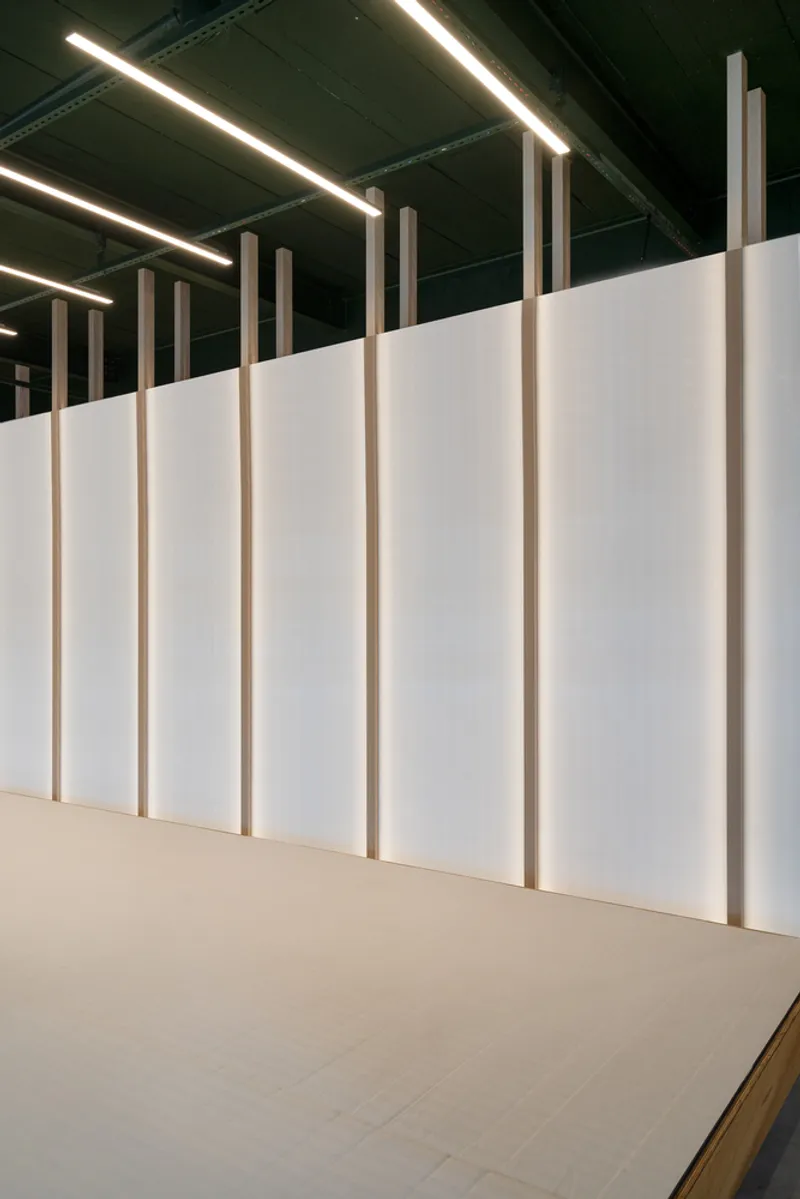
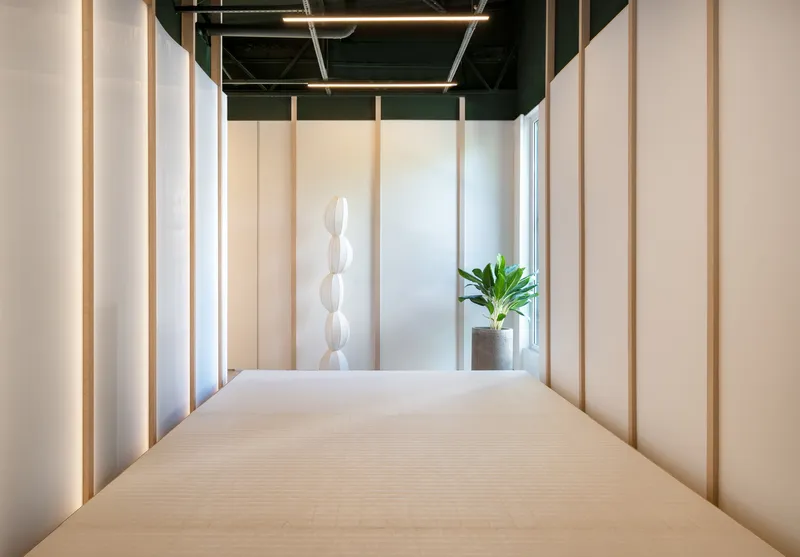
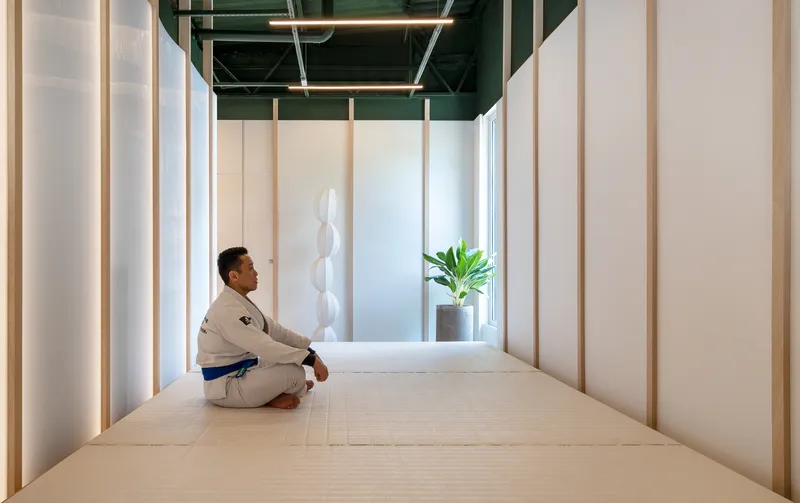
The defining architectural element is the "light wall," a construction of translucent polycarbonate panels stretched over vertical wooden studs spaced at 90 centimeters. The cavity between studs conceals LED strips, turning the entire wall surface into a uniform, diffuse light source. When the sliding polycarbonate door to the tatami area is closed, it merges flush with the wall, making the boundary between partition and portal vanish into a single luminous plane.
The timber battens are left exposed on the corridor side, creating a rhythmic texture that simultaneously reads as structure and ornament. Walking along these corridors, the vertical cadence of wood against soft backlighting gives the sensation of moving through a lantern. It is a simple detail, repeated with discipline, and it does more atmospheric work than any elaborate finish could.
A Choreographed Sequence from Street to Mat
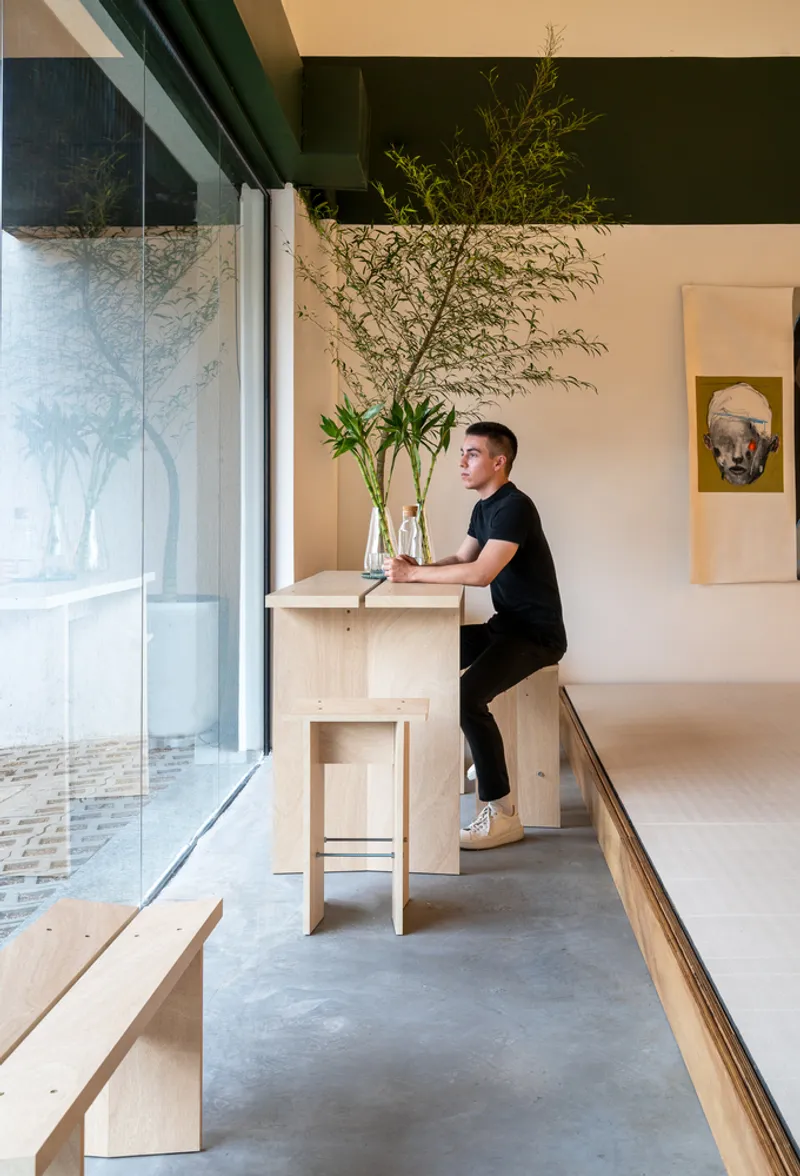
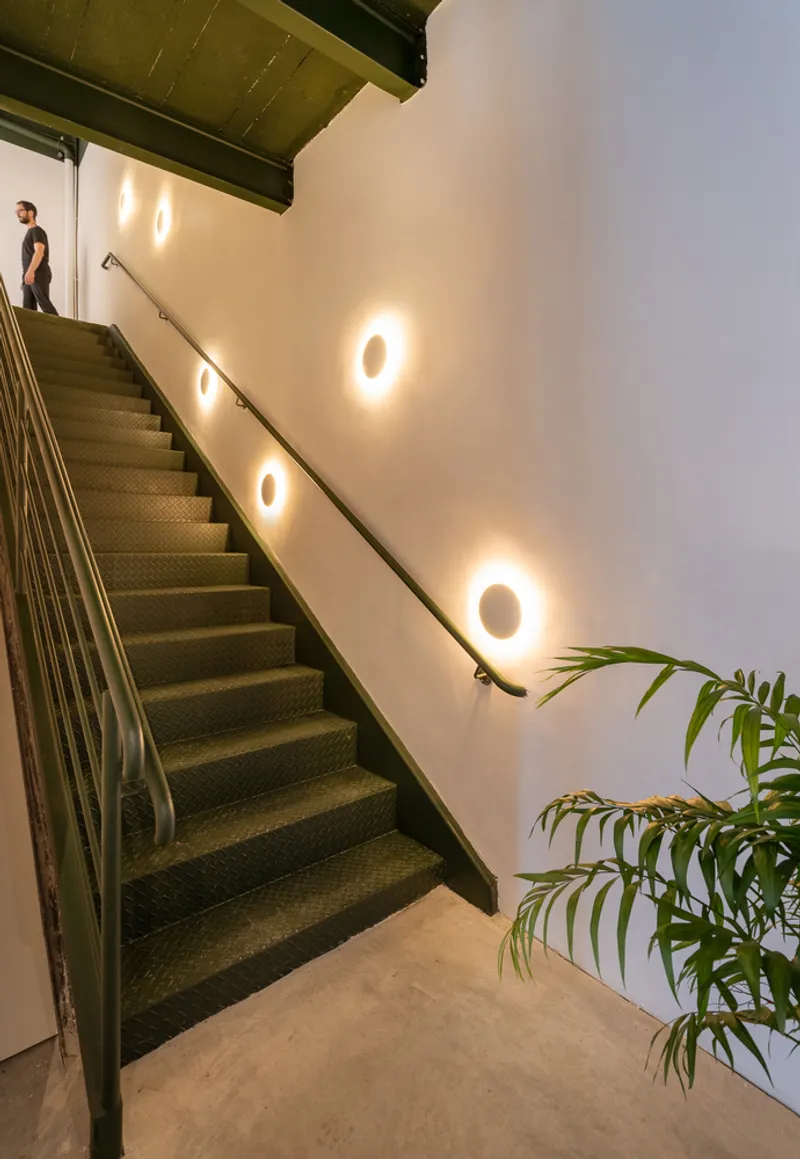
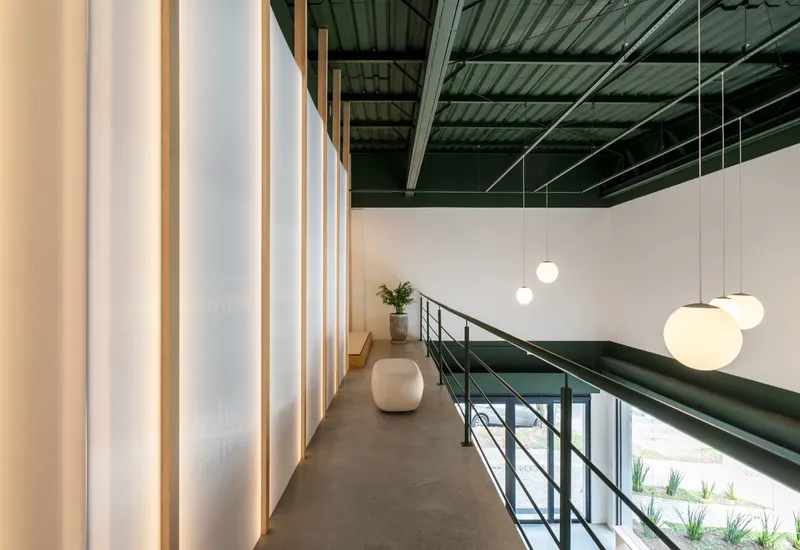
Entry happens through a glass facade that preserves a visual connection to the city. A plywood bar-height table beside the glazing, a vase of bamboo, and natural daylight establish a domestic, welcoming tone before anything athletic begins. From here, the path moves alongside the tatami, up a steel staircase lit by round wall sconces, and onto the mezzanine, where the ambient light noticeably drops.
On the upper level, the polished concrete floor and backlit translucent panels of the changing rooms create a compressed, contemplative atmosphere. The lighting design by Frazzon Iluminação is critical here. Each transition, from bright to dim to glowing, mirrors the psychological preparation of a martial artist who leaves their street identity behind and steps onto the mat as a practitioner. The descent back to the ground floor and the passage through the lit sliding door completes the loop. It is spatial storytelling executed with conviction.
The Mezzanine as Social Infrastructure
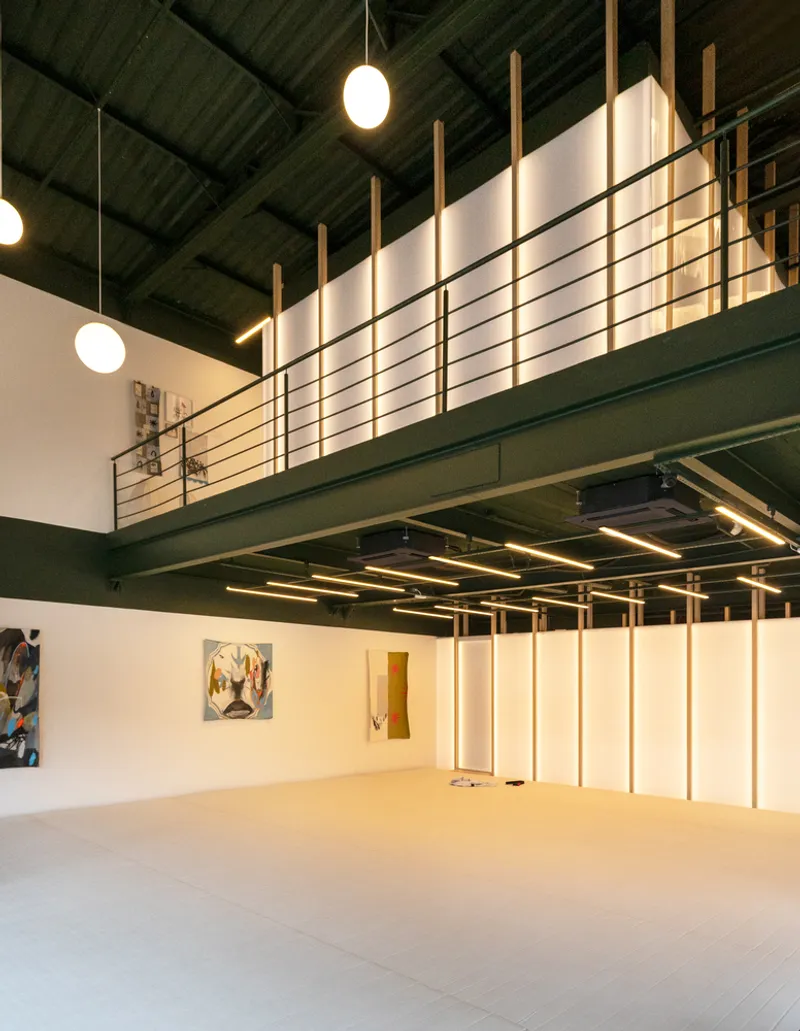
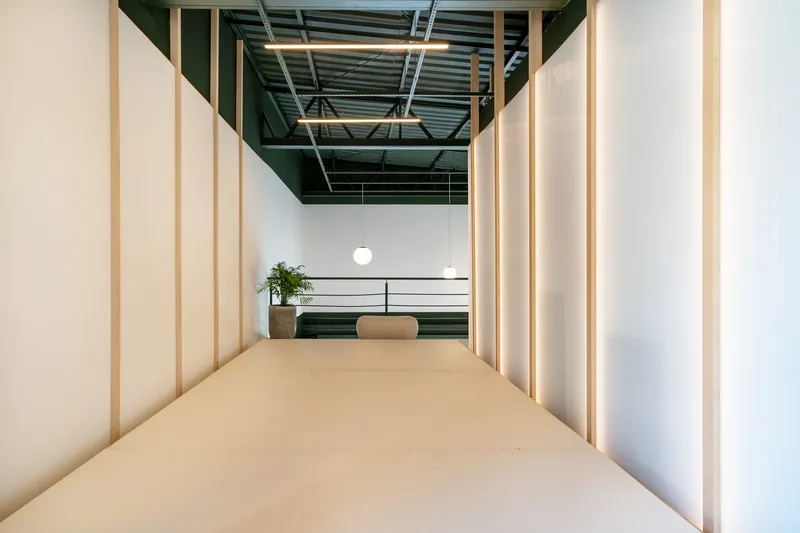
The mezzanine serves double duty. Its open edge overlooks the tatami below, functioning as a viewing gallery during large classes. But its own floor area is programmed for individual training sessions and, crucially, for socializing. Globe pendant lights, a metal balustrade, and the warm timber framing of the polycarbonate corridor give this level a distinctly different character from the industrial volume below. It is quieter, more intimate, and explicitly designed for the community-building side of martial arts culture.
The suspended mezzanine structure reads clearly from the ground floor as a horizontal plane hovering in the double-height void. Its underside is visible alongside the green ceiling beams, and the metal railing adds a thin, graphic line to the composition. The two-level configuration is a pragmatic solution to a modest footprint, but 0E1 Arquitetos treats the vertical relationship between floors as an opportunity for visual connection rather than mere stacking.
Plans and Drawings
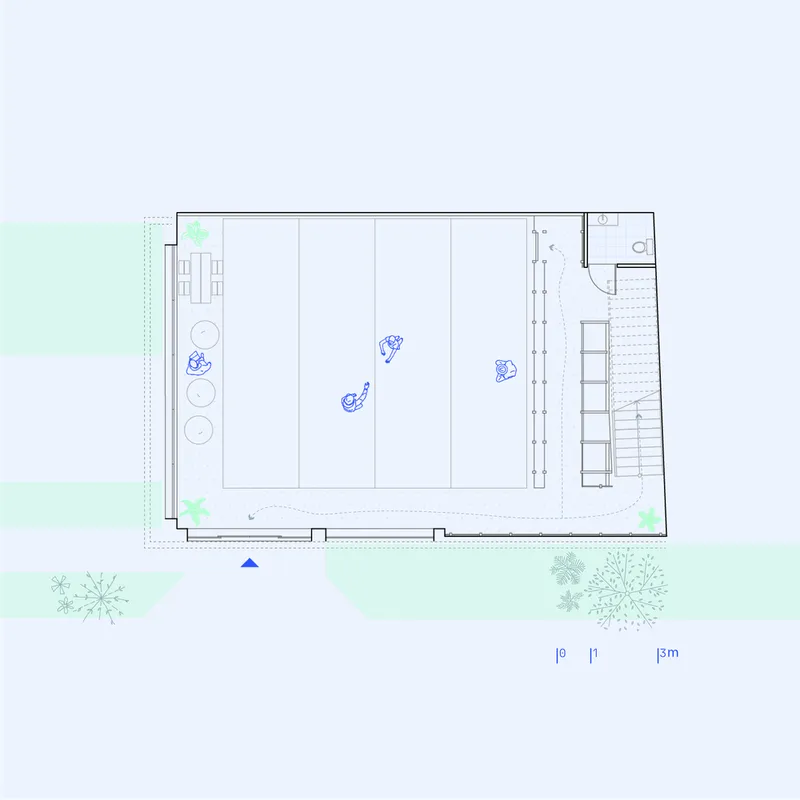
The floor plan reveals the economy of the layout. A rectangular footprint is divided into a dominant tatami grid, a narrow circulation spine along one edge, a compact stair core, restrooms, and an outdoor terrace at the rear. Every square meter is accounted for. The sliding door between the circulation spine and the tatami is the plan's hinge point: when open, the two zones merge; when closed, the light wall is seamless. The terrace, modest in area, provides a pressure release and daylight source at the back of the site.
Why This Project Matters
Sports architecture, particularly at the scale of a neighborhood academy, rarely receives this level of design attention. The Oden Jiu-Jitsu Academy proves that a 250 square meter gym can carry real architectural ideas without inflating its budget or its ego. The polycarbonate light wall is not expensive or technically exotic. It is plywood studs, plastic panels, and LED tape. What elevates it is the rigor with which 0E1 Arquitetos deploys it: as a spatial divider, a light source, a surface for a door to disappear into, and a narrative instrument that frames the practitioner's journey from street to mat.
More broadly, the project is a case study in how architecture can encode the values of a client. The academy was commissioned with inclusivity and diversity as explicit goals. The design responds not with signage or color coding but with spatial generosity, clear circulation, and an atmosphere that invites rather than intimidates. That is architecture doing its job quietly and well.
Oden Jiu-Jitsu Academy by 0E1 Arquitetos. Porto Alegre, RS, Brazil. 250 m². Completed 2022. Photography by Roberta Gewehr.
About the Studio
Share Your Own Work on uni.xyz
If projects like this are the kind of work you want to make, uni.xyz is a place to publish your own, find collaborators, and enter design competitions.



Popular Articles
Popular articles from the community


Riyadh For All: Intergenerational Urban Design for Active Aging in Rabat
Riyadh For All reimagines urban design in Rabat with intergenerational co-living, adaptive courtyards, and Moroccan cultural exchange today.

The Musturak Paradise: Senior Living Architecture for a Connected Future in Temara, Morocco
The Musturak Paradise reimagines senior living architecture in Temara via private homes, social spaces, culture, community, and shared care.

Play: Fragments of Their World
Familiar architecture becomes modular playground design, creating safe spaces where displaced children can learn, connect, imagine and play.

Lunar Spiral: Space Architecture Shaped by the Mathematics of the Universe
Lunar Spiral reimagines space architecture through Fibonacci geometry, lunar regolith, levitating habitats, and self-sustaining Moon living.


Similar Reads
You might also enjoy these articles


Hodi-Mandai Geram
Project Function: Preservation and revitalization of the Intangible heritage and socio-spatial identity of the Hodi by Housing, Cultural Memory Center, Sacred Grove, landscape, local tourism economy


Olio Towers: A Mid-Rise for Performers That Fuses Housing, Rehearsal, and Stage
Located blocks from Houston's Theater District, this modular tower stacks living units around a central performance atrium.

Oasis: Modular Green Housing Carved into Dhaka's Urban Fabric
A shortlisted Plugin Housing entry reclaims unauthorized settlements in Dhaka with stepped concrete volumes, green roofs, and ventilation-driven design.

Black Hole: A Floating Megastructure for the Post-Physical Era
Emiliano Mazzarotto envisions a spherical, self-scaling arena where e-sports, digital hotels, and holographic stadiums replace traditional public space.


Explore Sports Architecture Competitions
Discover active competitions in this discipline



Challenge to design a barrier free sports center


Challenge to design an outdoor ice-rink and park


Challenge to reimagine the Iron Throne


Photograph architecture without architects
Comments (0)
Please login or sign up to add comments
No comments yet. Be the first to comment!