
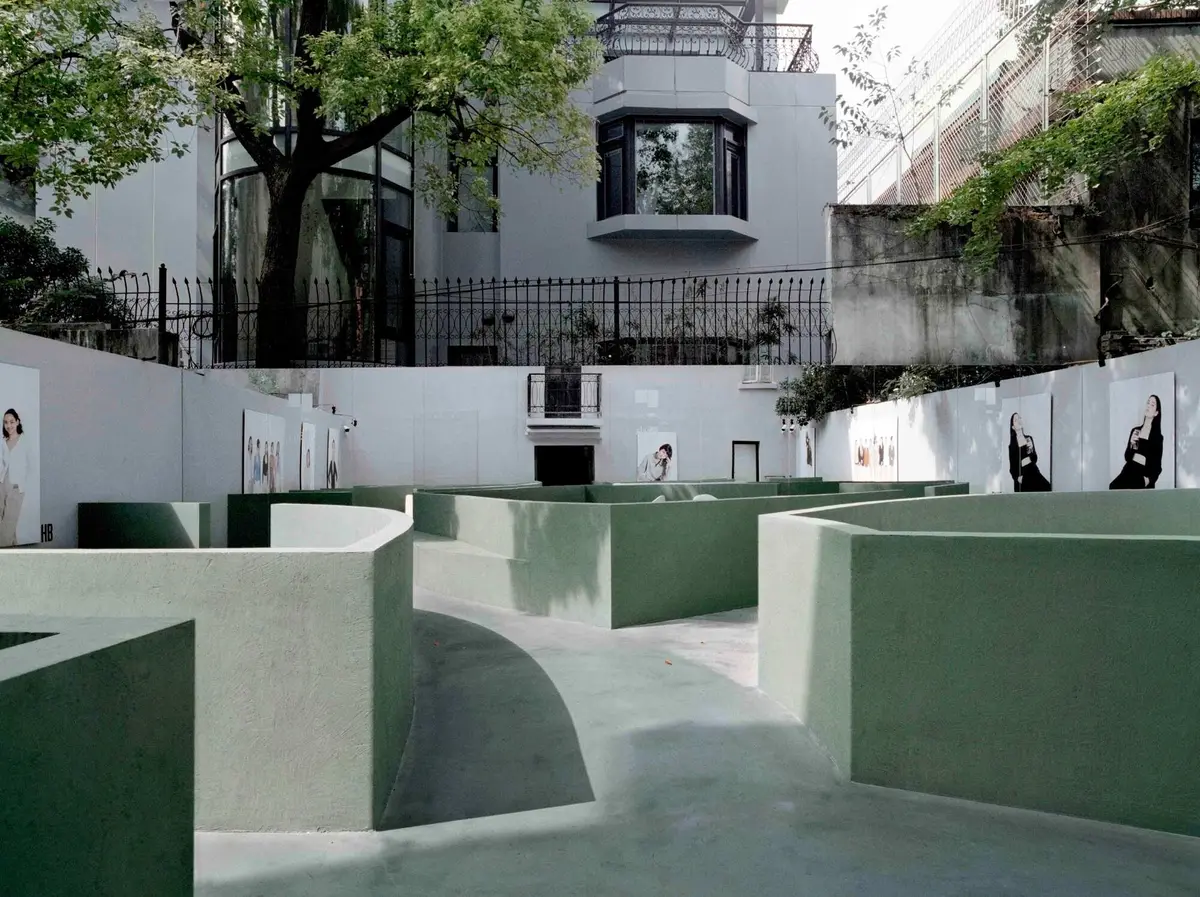
Offhand Practice Threads a Green Path Through a 1930s Shanghai Garden House for Fashion Brand XiaoZhuo
A curving concrete ribbon inspired by Wukang Road's winding streetscape turns a heritage house into a five-storey retail journey.


Wukang Road is one of Shanghai's most storied stretches: a canopy of plane trees, a curve borrowed from Paris, and a row of 1930s garden houses that have survived every wave of demolition the city has thrown at them. At No. 368, Offhand Practice has converted one of those houses into the flagship store for emerging fashion label XiaoZhuo, threading a continuous green concrete path from the street gate up through five floors and back down into the front yard. The intervention is modest in footprint but radical in attitude: it treats the boundary between city and shop as something to dissolve rather than defend.
What makes the project genuinely interesting is not the heritage shell itself but the circulatory device that occupies it. A curving ribbon of textured green concrete, inspired by the winding road outside, rises from the courtyard and guides visitors floor by floor until it terminates at a rooftop water bar, then loops them back down to a packaging area at the entrance. The path is deliberately raised, almost demanding that you step onto it. It collapses the distance between landscape and retail display, turning shopping into something closer to a garden walk.
Arrival on Wukang Road
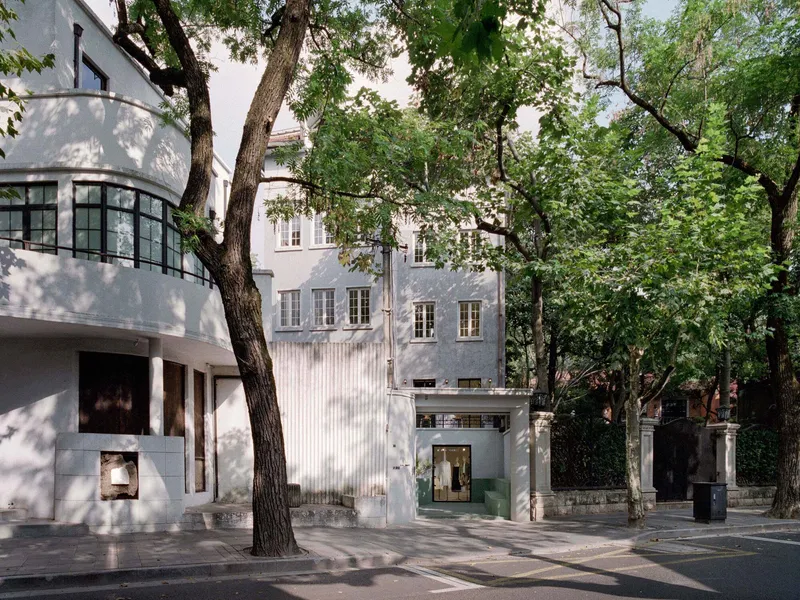
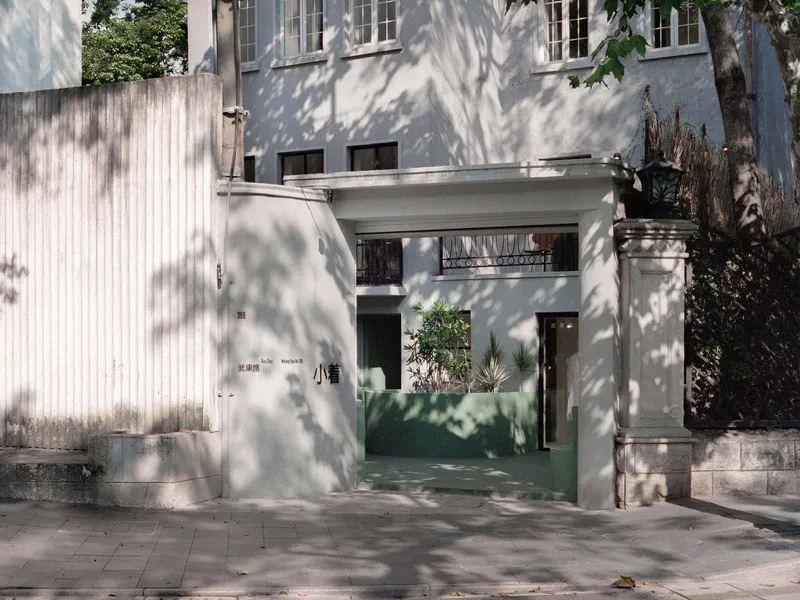

From the street, the store barely announces itself. A white facade slots between its historic neighbors, its surface dappled by the shadows of mature deciduous trees that line the road. A green metal gate marks the threshold, and the site plan reveals how tightly the building is embedded in the urban grain of the Xuhui District. The restraint is deliberate: on a road where every building competes for attention, the most effective signal is calm.
The Green Path Begins
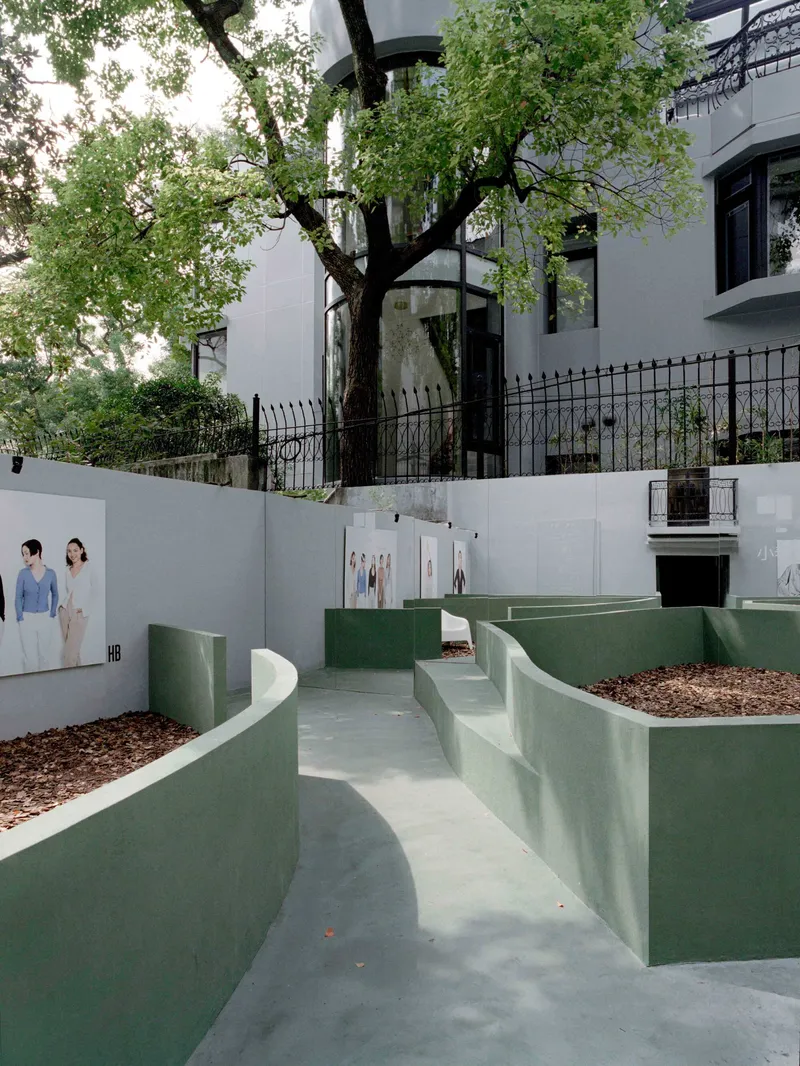
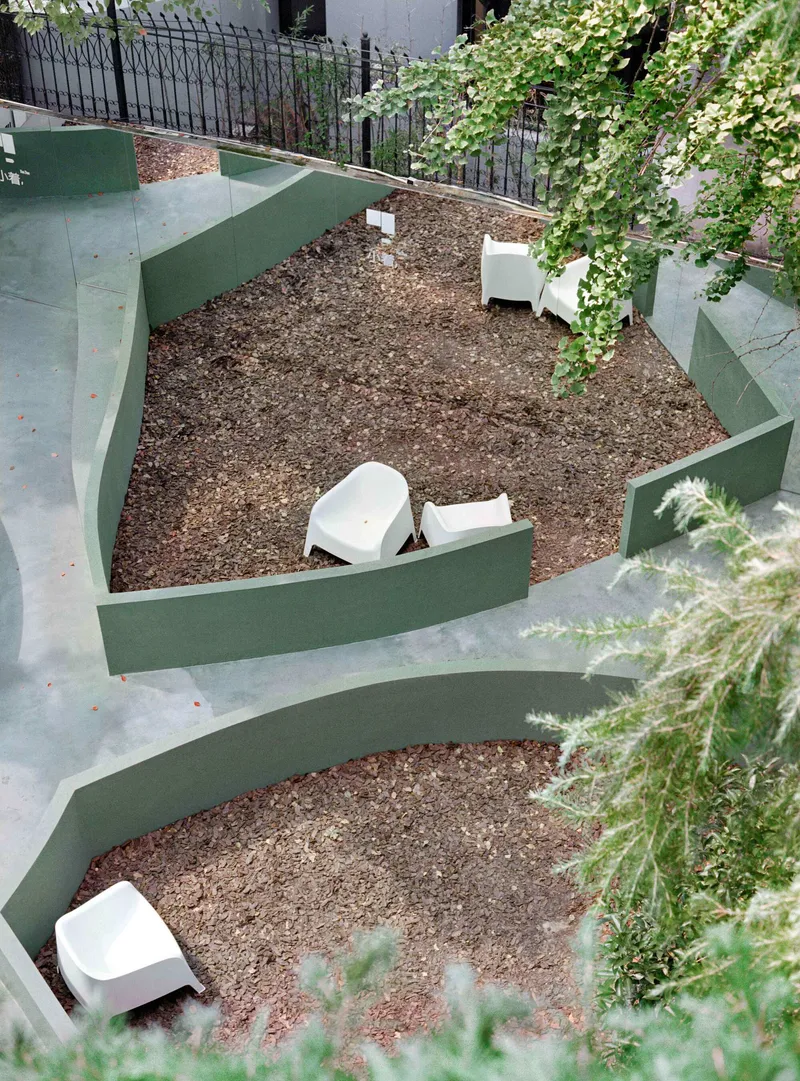

Two outdoor yards flank the main building, and the green path starts in these transitional spaces before ever reaching an interior wall. Curved sage green planters with mulch beds and concrete walkways wind beneath a preserved tree, while terraced courtyard steps, painted in the same green, cascade through gravel beds and climbing vines. It is landscape architecture doing the work of a shop window.
The view through a green plaster doorway toward ascending courtyard steps captures the moment where outside becomes inside, or rather, where the distinction stops mattering. Offhand Practice has made the path itself slightly elevated, creating a subtle threshold that asks you to commit: step up, and you are on the route.
Retail Floors Wrapped in Texture

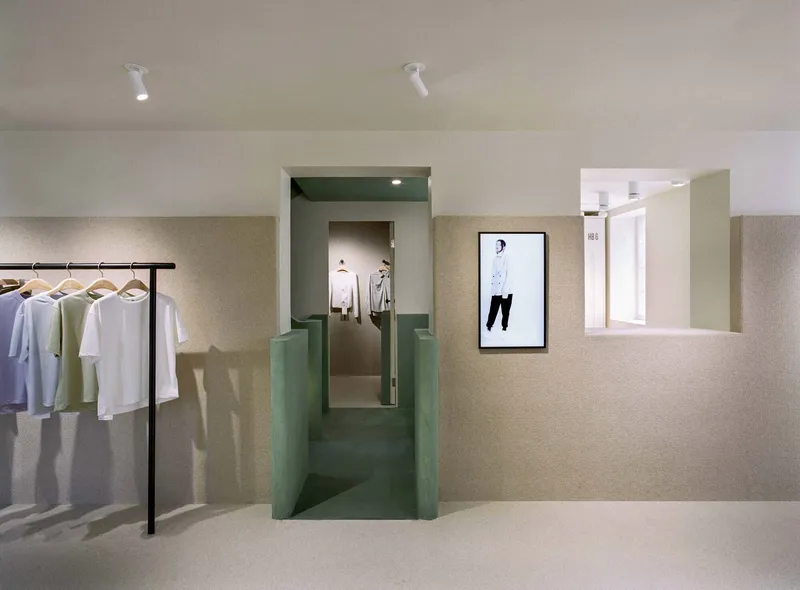

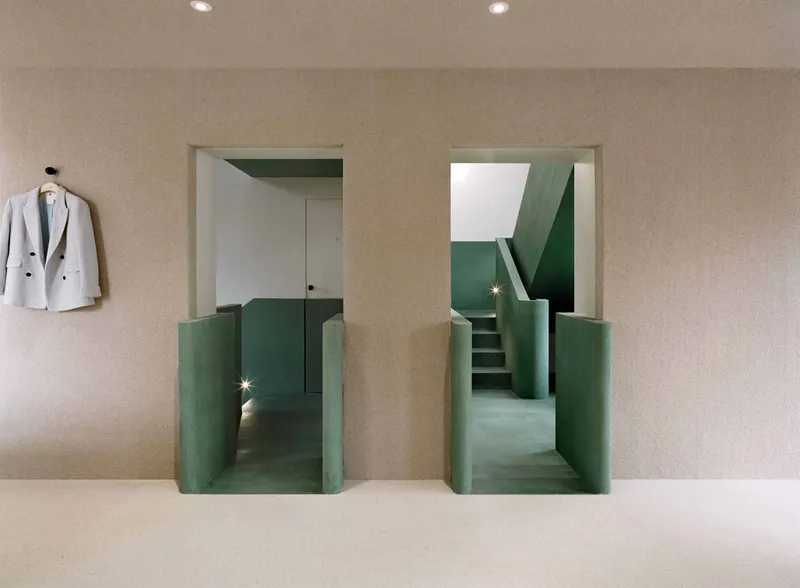
The second and third floors house the clothing merchandise, and the material palette shifts from hard concrete to linen wool carpets that wrap angular walls. Green plaster portals frame corridors where garments hang against textured beige surfaces. Cork-textured shelving sits beside black-framed windows that open directly onto the courtyard, keeping daylight and greenery in constant view. The effect is not so much a retail interior as a series of domestic rooms that happen to hold clothing.
White mannequins stand against the curving green partitions, and the contrast is precise: the brand's soft neutral tones gain clarity when set against the saturated green. Track lighting supplements the natural light rather than replacing it, and the ceilings remain low enough to feel intimate without becoming oppressive.
Vertical Circulation as Spatial Event
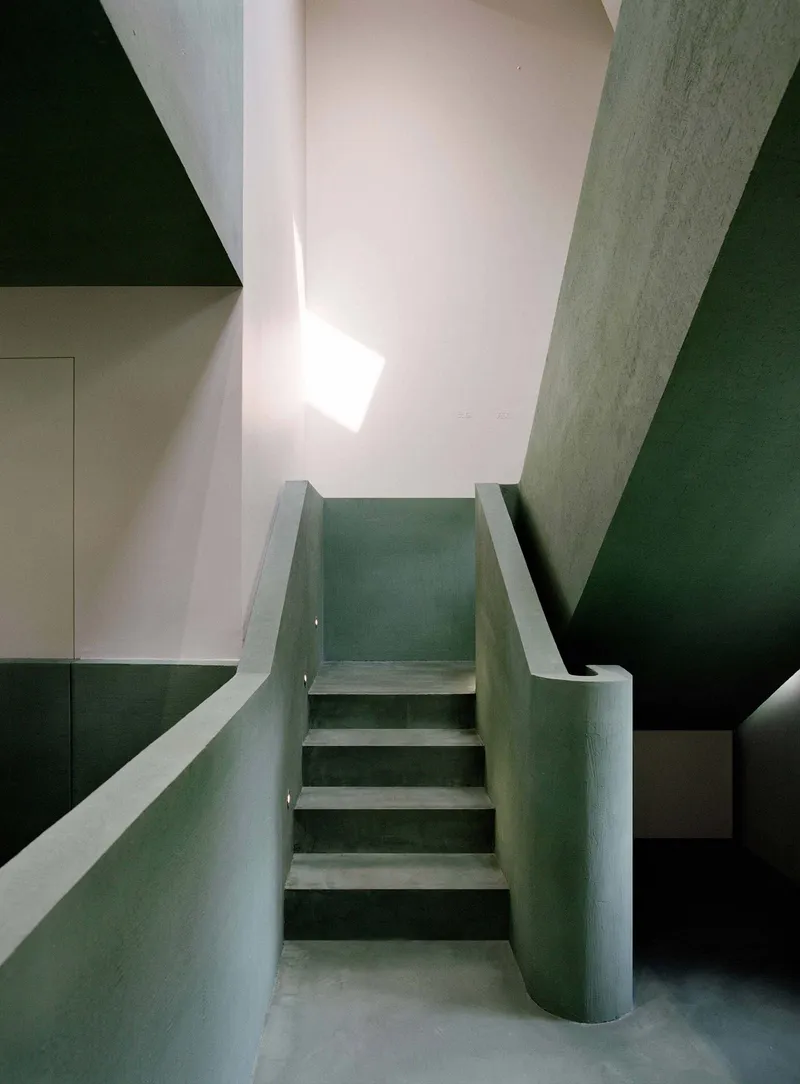

In a five-storey building of only 760 square meters, the stairs are not a service element. They are the project. Green plaster walls wrap the stairwell, and a cylindrical column rises toward a skylight that pours morning light down through the void. The stair openings are recessed into beige ceilings with calculated precision, and the green pigment intensifies as you move higher, marking your progress along the path.
Offhand Practice uses these voids to allow natural light from upper storeys to penetrate to lower tiers. The stairwell becomes a light well, a ventilation shaft, and a navigational landmark all at once. It is the kind of section-driven thinking that separates a considered conversion from a cosmetic renovation.
Corridors and Thresholds
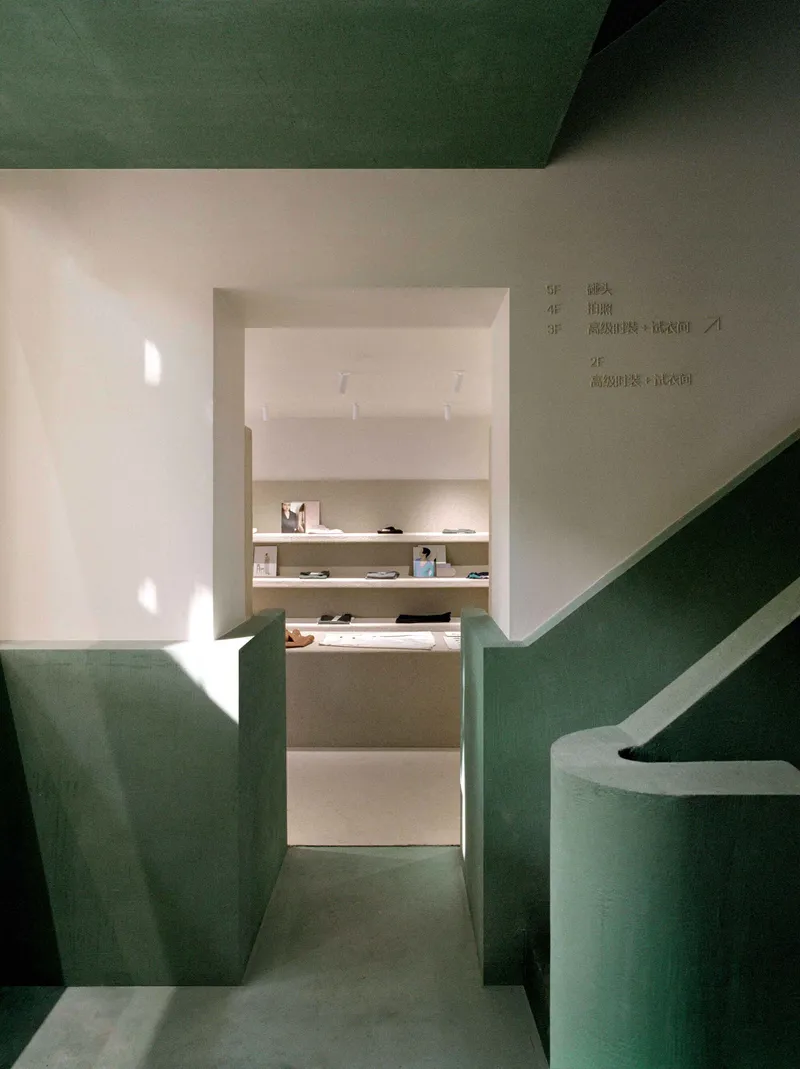


The narrow corridors between green plastered walls are some of the most charged spaces in the building. Compression and release govern every transition: a tight passage leads to a white display room with shelving, another terminates at a counter, and a curved green wall forms a passage with nothing but recessed lighting overhead. These moments are borrowed from gallery design, where the approach to an object matters as much as the object itself.
Upper Floors: Story and Gathering
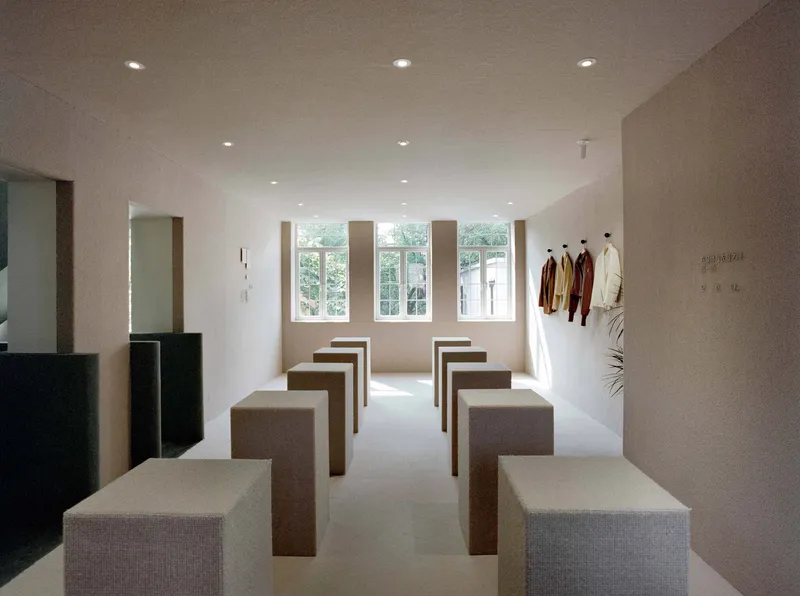
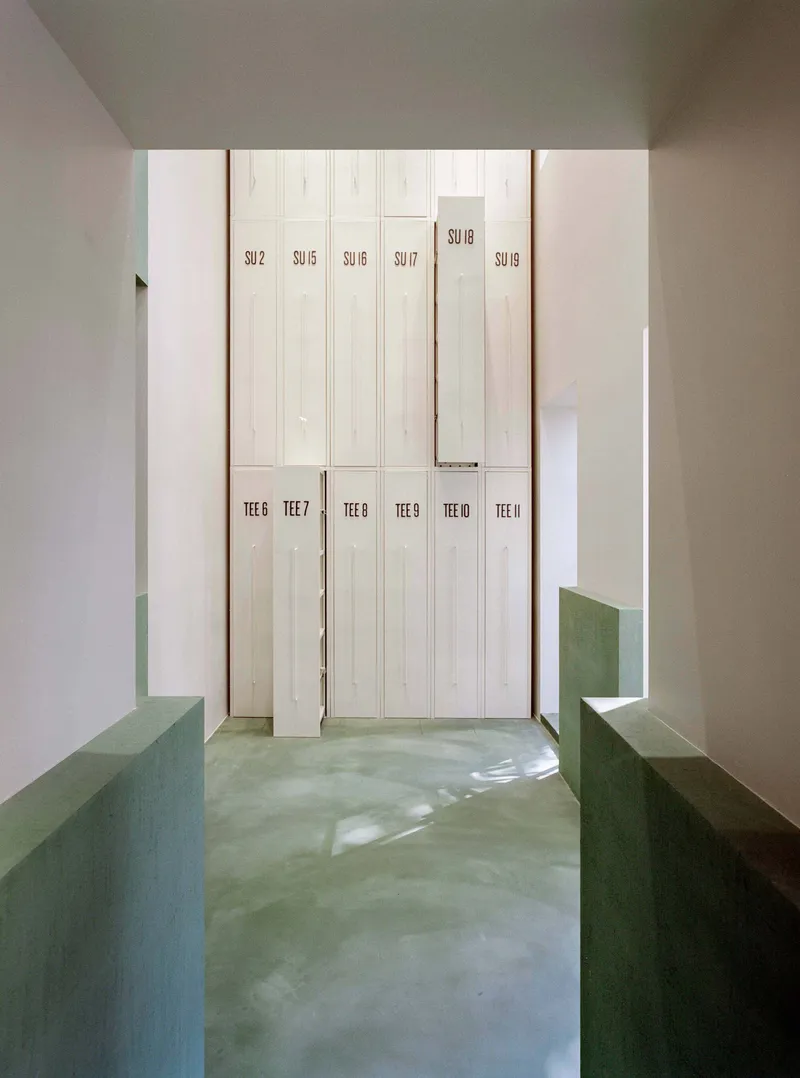

The fourth floor functions as a storytelling space where movable carpet blocks can be rearranged for events, workshops, or quieter brand presentations. Rows of upholstered benches sit beneath tall windows that admit generous daylight, and the room has the character of a reading room rather than a showroom. Numbered white storage lockers line one wall, visible through green concrete benches, suggesting both archive and cloakroom.
Below, the retail interior transitions with cream lockers, a green staircase, and track lighting that keeps the palette unified. The fifth-floor water bar, where the green path terminates, gives visitors a reason to reach the top that has nothing to do with purchasing. It is a smart programmatic move: the most generous space in the building is the one that sells nothing.
Garments in Daylight
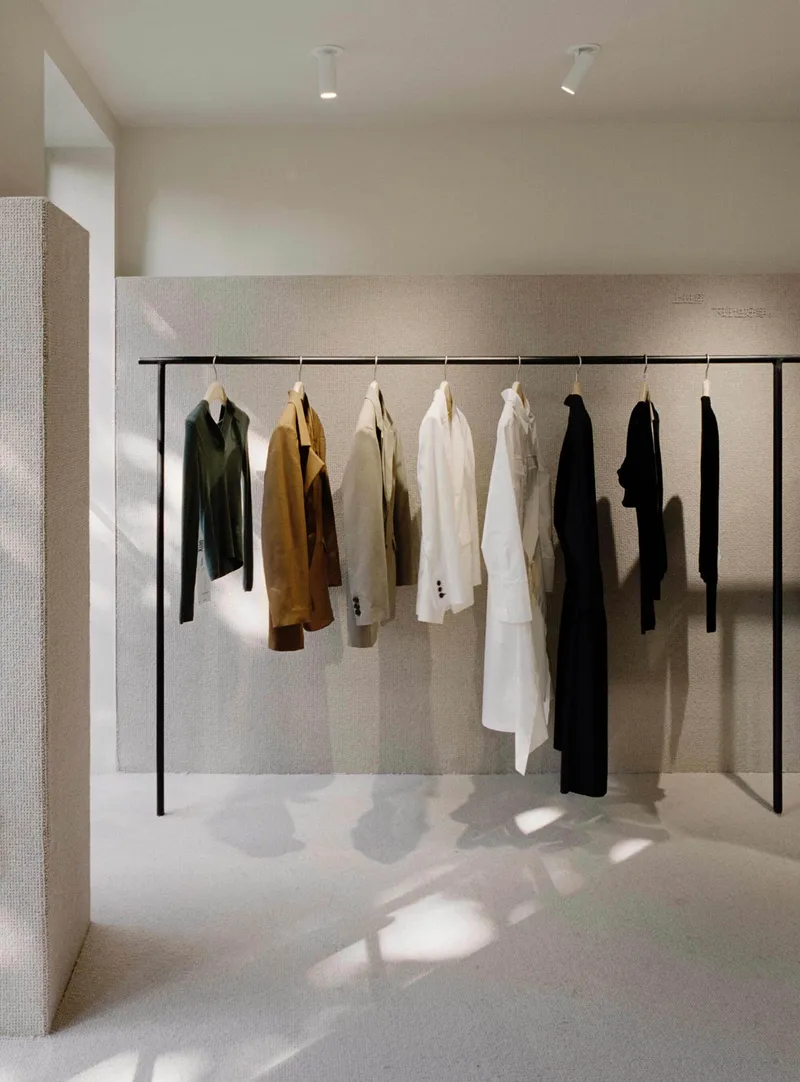
A black clothing rail with hanging garments in natural light against a textured plaster wall captures the store at its most elemental. No neon, no branded signage, no aggressive merchandising. Just fabric, light, and surface. For a young fashion label, this is a statement of confidence: the clothes are enough. Offhand Practice supports that confidence by refusing to compete with the product.
Plans and Drawings
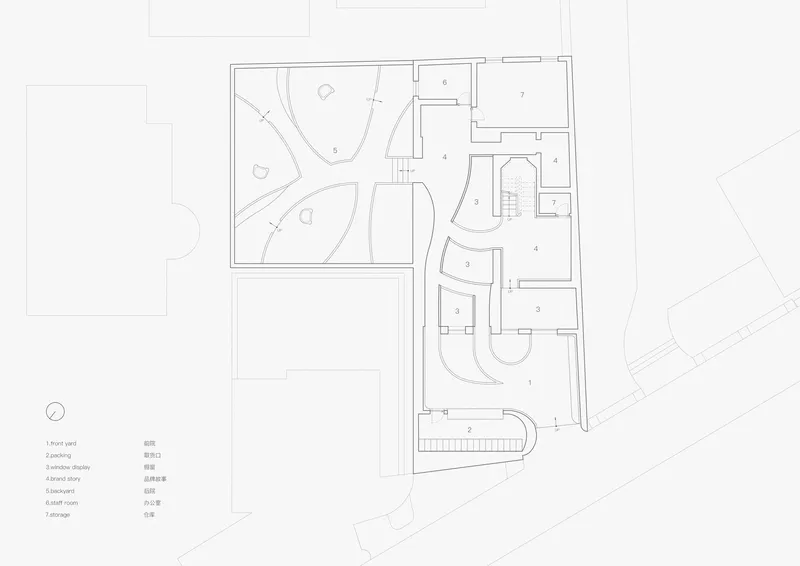
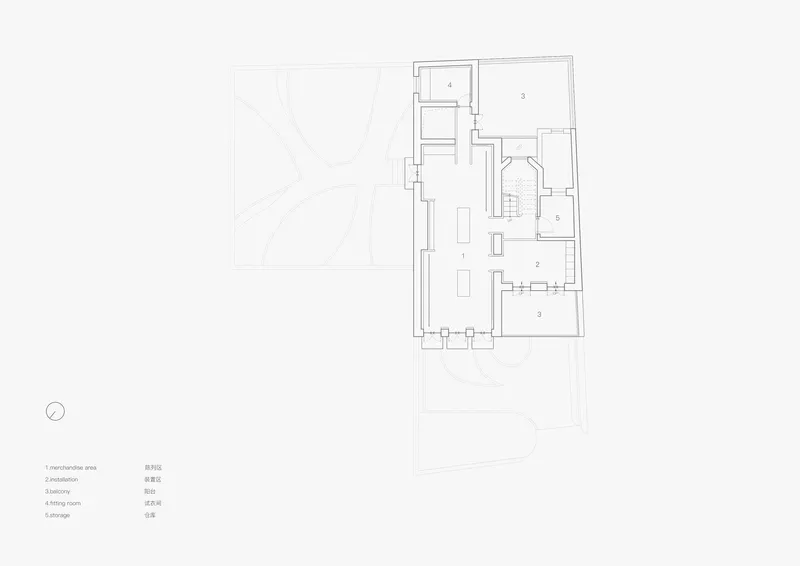
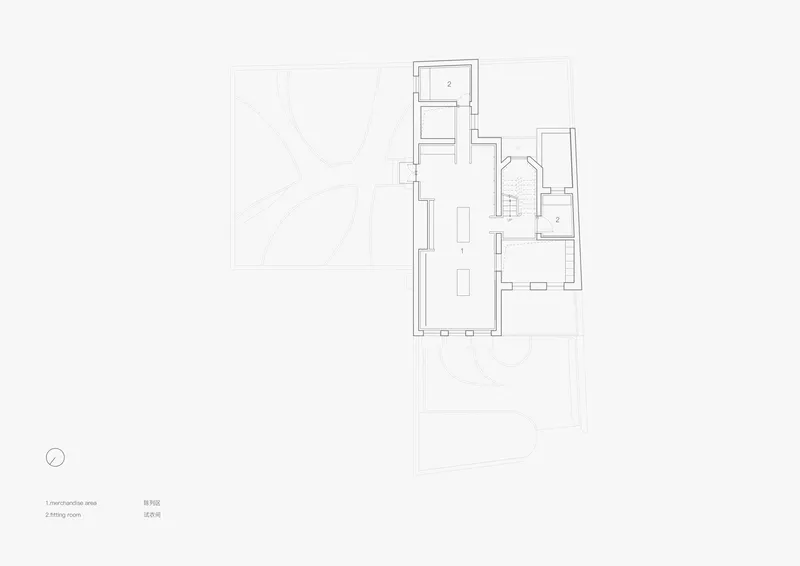
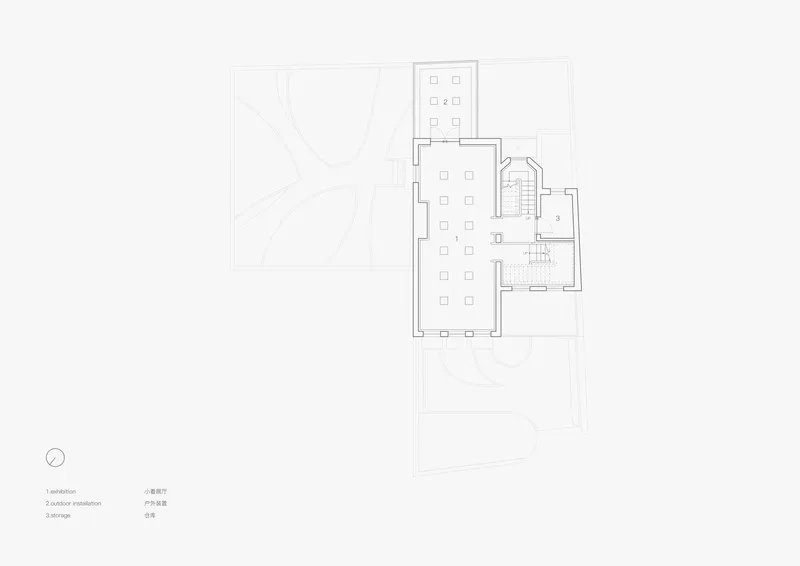


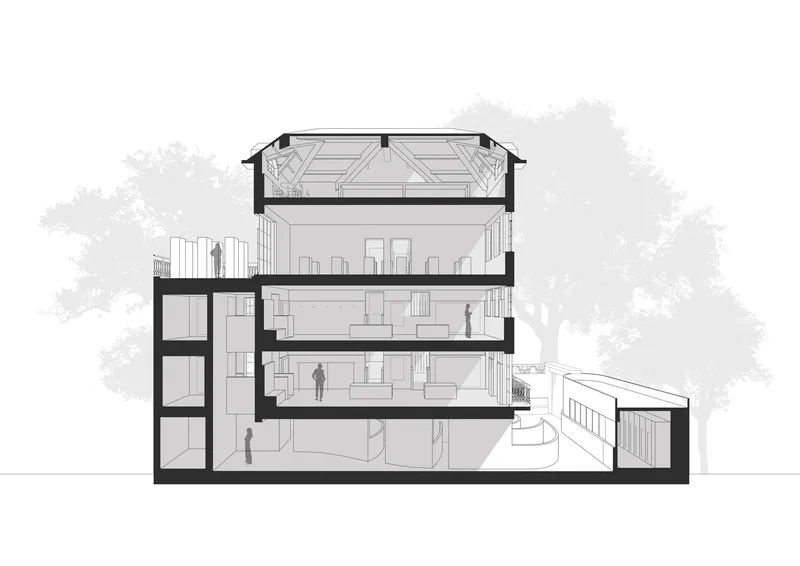

The floor plans reveal the curvilinear courtyard layout on the ground level, the central staircase that anchors every floor, and the progressive simplification of the plan as the building rises toward the rooftop water bar. The axonometric diagram is the clearest explanation of the project's thesis: green landscape surfaces wrap around and through stacked floor plates, collapsing the distinction between outdoor and indoor, between garden and shop.
The two section drawings expose the timber truss roof structure of the original 1930s house and show how the new insertion threads through it without disrupting the primary structure. Five levels are linked by the central staircase beneath a pitched roof volume, and the stepping of the floors creates the voids that bring light deep into the plan. It is a tight, disciplined section for a building that operates more like a vertical garden path than a conventional retail stack.
Why This Project Matters
Retail design in heritage buildings tends to fall into two traps: either the old structure is gutted and treated as a branding vessel, or it is preserved so reverently that the commercial program feels apologetic. Offhand Practice avoids both by introducing a single, strong device: the green path. It gives the project a legible idea that connects every floor, every courtyard, and every threshold without overwriting the original architecture. The 1930s garden house remains readable, but it now has a new circulatory system.
For XiaoZhuo, the payoff is a flagship that functions less like a store and more like a destination. The water bar at the top, the storytelling room on the fourth floor, the courtyards at ground level: these are spaces that reward time, not transactions. In a city where retail square footage is ruthlessly optimized, that generosity is the most radical gesture in the building.
XiaoZhuo Flagship Store by Offhand Practice. Located at No. 368 Wukang Road, Xuhui District, Shanghai, China. 760 m². Completed 2021. Photography by Yanyun Hu.
About the Studio
Share Your Own Work on uni.xyz
If projects like this are the kind of work you want to make, uni.xyz is a place to publish your own, find collaborators, and enter design competitions.


Popular Articles
Popular articles from the community


Little Red Riding Hood: Architectural Design as a Journey Through Fear, Light, and Storytelling
Little Red Riding Hood reimagines the fairy tale through architectural design shaped by fear, light, scale, memory, uncertainty, and choice.

ALGAL REALM: A Bio-Integrated Lunar Habitat Design for Life Beyond Earth
ALGAL REALM reimagines lunar habitat design with algae-powered life support, 3D-printed regolith, and vertical living for a lunar future.

Co-life: Sustainable Architecture for Age-Friendly Community Living
Co-life reimagines sustainable architecture for seniors through courtyards, rammed earth, shared gardens, and spaces designed for belonging.

Hill & Cross Opera: Sculptural Opera House Architecture Shaped by Tallinn’s Landscape and Identity
Hill & Cross Opera reimagines opera house architecture in Tallinn through its sculptural hill, civic plaza, glass wave and a luminous cross.

Similar Reads
You might also enjoy these articles

Bao Huynh Watercolor Atelier: A Serene Art Retreat in Hội An
Bao Huynh Watercolor Atelier in Hội An blends multifunctional art spaces, sustainable design, local materials, and family-friendly living in a serene environment.

Atelier Macri Concept Store Interior Design by CASE-REAL
Atelier Macri store features a "ko" counter, walnut wood details, cork displays, blending retail, gallery, and seamless customer experiences.

Manuel Vargas Izquierdo Stadium and High-Performance Sports Center: Architectural Excellence in Jalpa de Méndez
The Manuel Vargas Izquierdo Stadium blends sustainable design, inclusive sports facilities, and cultural-inspired architecture, revitalizing Jalpa de Méndez’s public spaces.

KAKR Buluh Awar Hall: Revitalizing Community and Ecology Through Bamboo Architecture
Community built bamboo hall revitalizes Buluh Awar village, empowering youth, restoring ecology, celebrating vernacular craftsmanship through sustainable architecture and culture.

Comments (0)
Please login or sign up to add comments
No comments yet. Be the first to comment!