

Where Work Dissolves into Dutch Heathland
Studio Massimo's Tafelberg office in Blaricum uses charred timber, curved volumes, and low-slung massing to let the landscape lead.


There is a familiar trick in contemporary architecture where a building claims to "merge with the landscape" while doing nothing of the sort. Studio Massimo's Tafelberg office in Blaricum is not that building. Sited at the edge of the Gooi heathland, one of the few remaining stretches of open moorland in the densely populated Randstad region, the 1,000 square meter office takes a posture of genuine deference. It stays low. It follows the slope. It wraps itself in charred timber that, over time, will grey out to match the bark of the surrounding birch and pine.
What makes the project genuinely interesting is not just its material humility but how it redefines the office typology itself. Rather than stacking floors to maximize footprint, lead architect Max Verhoeven stretched the program into a single linear volume with curved terminations, essentially a path through the heath that happens to contain desks, meeting rooms, and a staircase. Every workspace faces the trees. Every corridor bends. The result is a building you walk through the way you might walk through a forest: with attention, and without the impulse to rush.
A Building That Stays Below the Canopy


Seen from across the open heath, the Tafelberg office barely registers as architecture. Its roofline stays well below the surrounding tree canopy, and its charred timber cladding absorbs light rather than reflecting it. The shou sugi ban treatment is more than aesthetic: the carbonized surface resists moisture, insects, and weathering, making it a practical choice for a structure designed to age alongside its environment.
The facade is punctuated by generously scaled window openings that are deep-set into the timber skin. In image_1 you can see how dappled afternoon light through the tree canopy plays across the blackened surface, creating a constantly shifting texture. The building does not compete with its surroundings; it accepts them as collaborators in its own appearance.
Charred Skin, Living Bark

Up close, the materiality becomes even more layered. One of the most arresting details is the use of what appears to be rough-textured bark cladding on select exterior surfaces. Where the charred timber panels read as a deliberate architectural finish, the bark sections feel almost accidental, as if the building grew out of the site rather than being placed upon it. These two surface treatments create a dialogue between craft and nature that runs through the entire project.
It is a subtle but effective strategy. By varying the exterior expression from panel to panel, Verhoeven avoids the monotony that can plague single-material buildings while maintaining a completely unified palette. Everything here comes from wood, but no two surfaces behave the same way under light.
The Staircase as Spatial Spine


The entrance hall is anchored by a curved timber staircase that wraps around a cylindrical volume, rising through the full height of the building under a skylight. It is unquestionably the set piece of the interior. But unlike so many statement staircases in office design, this one earns its prominence by doing real spatial work. It connects the stepped levels of the building as it follows the sloping terrain, and its curving form introduces a geometry that carries through every corridor and room.
The staircase's integrated balustrade and the warm tone of the timber give it a surprisingly domestic quality for a commercial building. You can imagine reaching for the smooth rail and feeling like you are ascending through the interior of a finely made instrument. The slatted ceiling overhead reinforces the sense of enclosure without claustrophobia, filtering daylight from above into rhythmic bands.
Corridors That Curve, Ceilings That Breathe
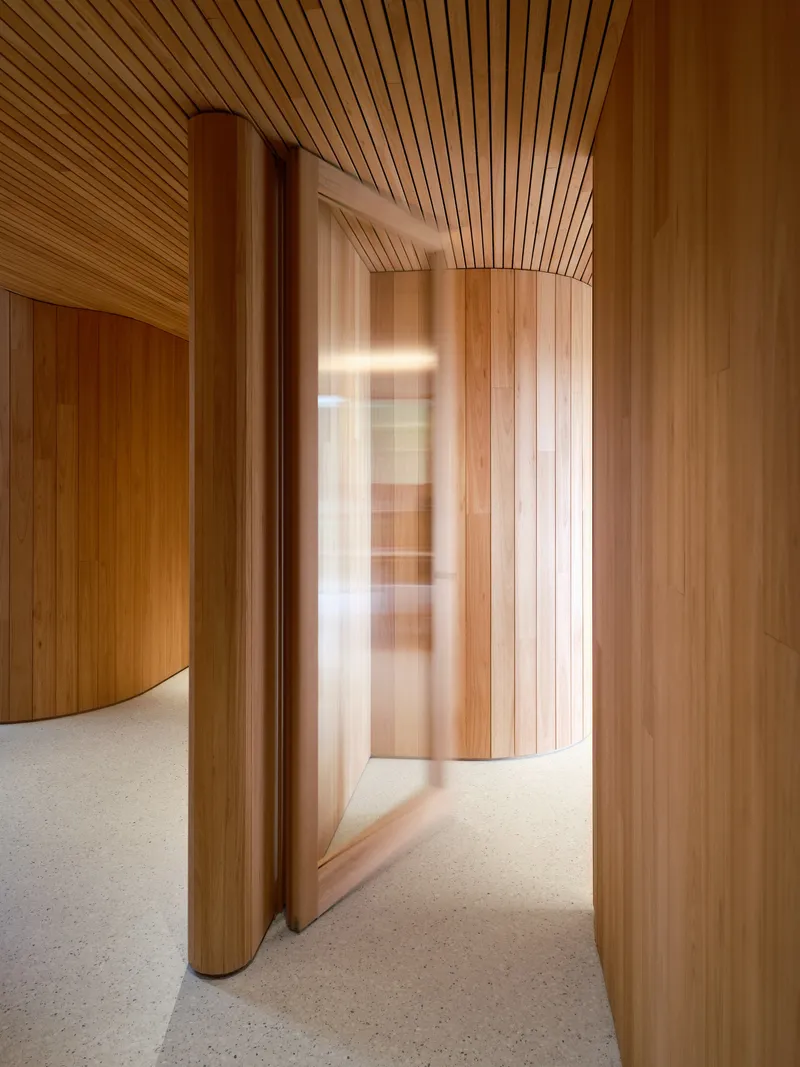
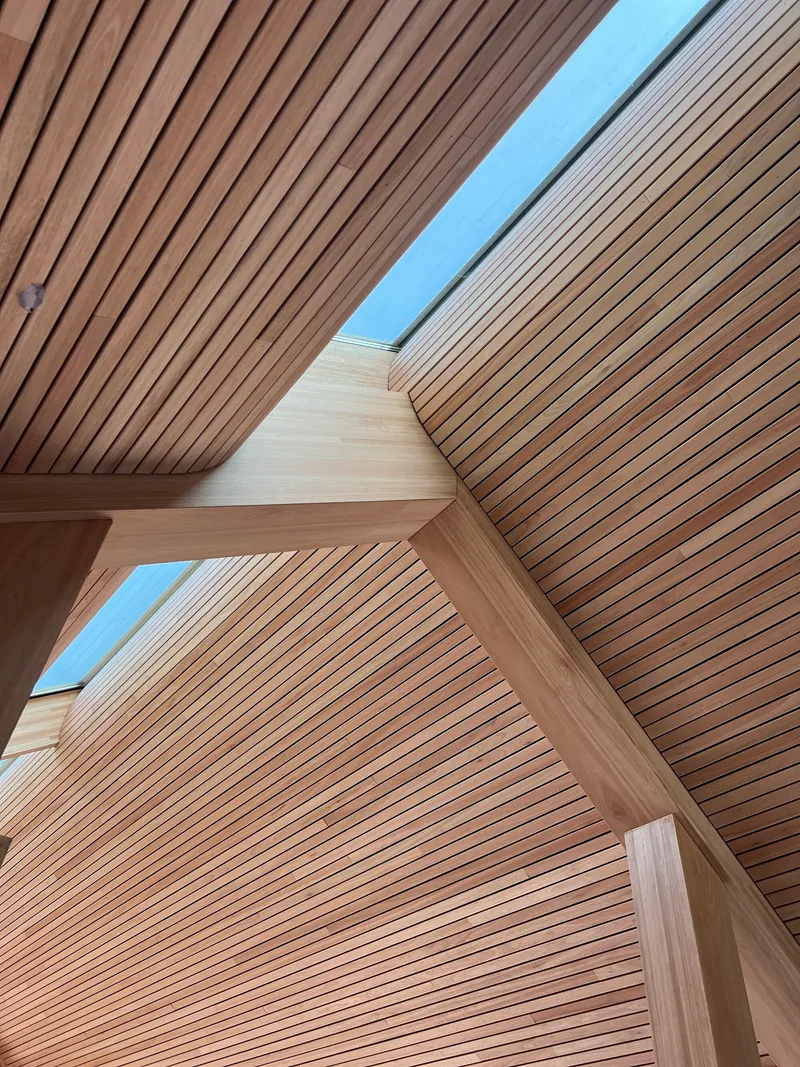

Studio Massimo treats circulation not as residual space but as primary experience. The corridors bend gently around the cylindrical columns, and the slatted timber ceilings shift in angle and direction throughout the building. Narrow skylights run along the junctions where ceiling planes meet, introducing slivers of natural light that change character with the time of day and the weather.
The vaulted ceiling captured in image_8 is particularly effective: clerestory windows along the ridge allow warm afternoon light to wash down the timber surface, making the entire room glow. These are not dramatic gestures. They are calibrated atmospheric choices that acknowledge something important about office design: people spend eight hours a day in these spaces, and the quality of light directly determines whether that time feels like confinement or habitation.
Work Rooms Framed by Trees

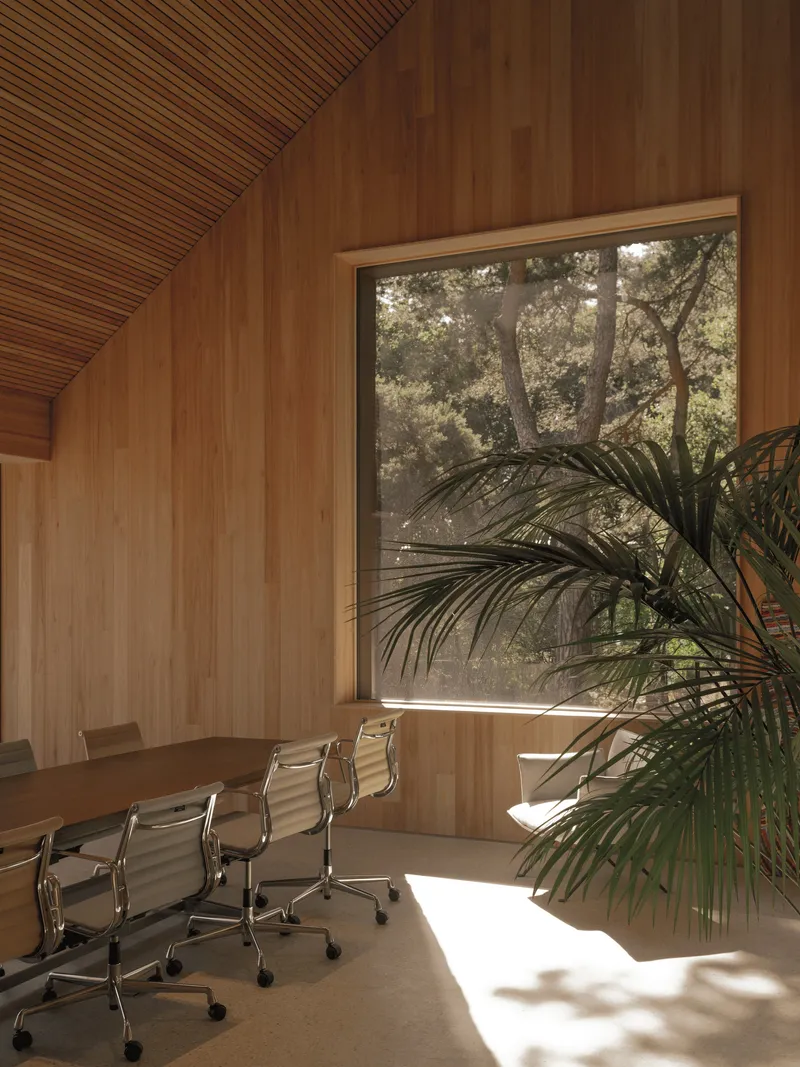

The workspaces and meeting rooms share a consistent strategy: timber-lined interiors with wide windows that frame specific views of the surrounding trees. In the conference room, an angled slatted ceiling directs attention toward the glazing, turning the landscape into a kind of living mural that shifts with the seasons. A suspended timber table in one of the workspaces feels like it belongs in a woodworker's studio, not a corporate office.
Glazed courtyard doors in the interior views suggest the building encloses at least one open-air space, creating a microclimate within the footprint. This is a smart move for a linear plan: it breaks the potential monotony of a long volume and gives different rooms distinct orientations, some facing the wild heath, others looking into a more sheltered garden condition. Workers get variety without needing to leave the building.
Plans and Drawings

The floor plan confirms what the photographs imply: the building is a single elongated volume with softly curved ends, threaded through a stand of existing trees. The tree canopies are drawn as part of the plan, not as context but as integral elements of the architectural composition. Rooms are organized along one side of a central spine, ensuring that every occupied space has direct access to natural light and a view.
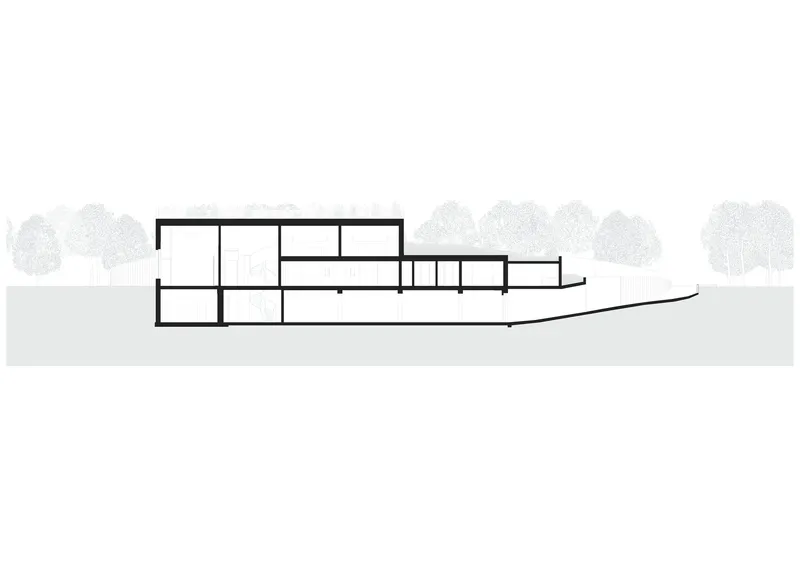
The section drawing reveals how the building steps down with the site's natural slope, maintaining a consistently low profile. Roof heights vary to accommodate the vaulted and angled ceiling conditions visible in the interior photographs. The stepping also means that each segment of the building sits at a slightly different elevation, lending spatial variety to what could otherwise be a repetitive plan. It is a quiet lesson in how topography, when respected, can generate architecture.
Why This Project Matters
The contemporary office is in crisis. Remote work has made it clear that people will not commute to a glass box with fluorescent lighting unless they absolutely have to. The buildings that will survive this shift are the ones that offer something a home office cannot: a meaningful spatial experience tied to a specific place. Studio Massimo's Tafelberg office makes a compelling case that the answer is not more amenities or louder design, but a deeper relationship between the built environment and the natural one.
At 1,000 square meters, this is not a large building, and that is part of its strength. It does not try to be everything. It tries to be a good place to think, surrounded by heathland that has looked roughly the same for centuries. The charred timber will weather. The trees will grow. And the people inside will look up from their screens and see something worth looking at. That, in 2026, qualifies as radical.
Office by Nature (Tafelberg) by Studio Massimo, lead architect Max Verhoeven. Blaricum, The Netherlands. 1,000 m². Completed 2026. Photography by Riccardo de Vecchi.
About the Studio
Share Your Own Work on uni.xyz
If projects like this are the kind of work you want to make, uni.xyz is a place to publish your own, find collaborators, and enter design competitions.


Popular Articles
Popular articles from the community


Extended Shell: Retrofitting Kolkata's Balconies as Living Urban Thresholds
A modular retrofit system recovers the social and environmental intelligence of Kolkata's historic verandas for contemporary Park Street residents.

Cloaked Colonization: A Mobile Underwater Habitat That Moves Like a Fish
Micah Abaya's shortlisted EHC Pacific entry reimagines ocean settlement as a dispersed network of self-sustaining architectural organisms.

Opera by the Sea Estonia: Three Shells Dissolving Architecture into Tallinn's Coastline
A winning opera house proposal replaces monumental form with interconnected shells that blur the boundary between building, park and Baltic Sea.

Opera on the Sea: Driftwood Logic Shapes a Timber Opera House on Estonia's Coast
Trevor Orgill's opera house translates the entangled drift of floating timber into a civic building where wood, water, and music converge.

Similar Reads
You might also enjoy these articles

Bao Huynh Watercolor Atelier: A Serene Art Retreat in Hội An
Bao Huynh Watercolor Atelier in Hội An blends multifunctional art spaces, sustainable design, local materials, and family-friendly living in a serene environment.

Atelier Macri Concept Store Interior Design by CASE-REAL
Atelier Macri store features a "ko" counter, walnut wood details, cork displays, blending retail, gallery, and seamless customer experiences.

Manuel Vargas Izquierdo Stadium and High-Performance Sports Center: Architectural Excellence in Jalpa de Méndez
The Manuel Vargas Izquierdo Stadium blends sustainable design, inclusive sports facilities, and cultural-inspired architecture, revitalizing Jalpa de Méndez’s public spaces.

KAKR Buluh Awar Hall: Revitalizing Community and Ecology Through Bamboo Architecture
Community built bamboo hall revitalizes Buluh Awar village, empowering youth, restoring ecology, celebrating vernacular craftsmanship through sustainable architecture and culture.

Comments (0)
Please login or sign up to add comments
No comments yet. Be the first to comment!