
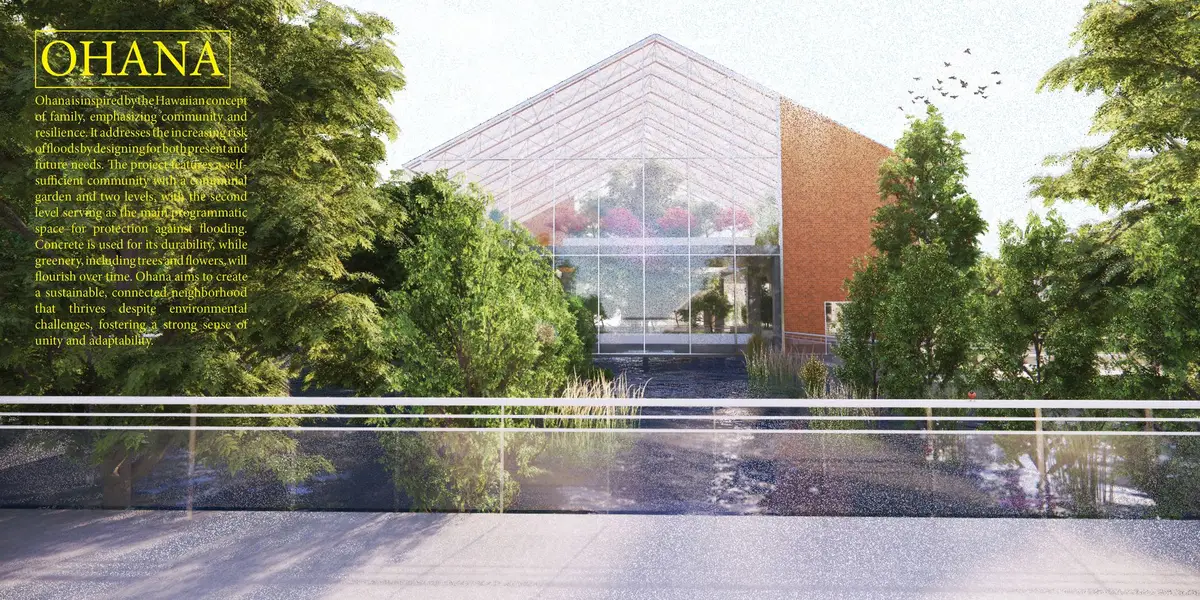
OHANA: A Vision for Resilient Architecture
Designing flood-resilient communities that foster family, sustainability, and togetherness—building the future of living.


In Hawaiian, ohana means family, and family means that no one gets left behind. OHANA, designed by Evan Fernandes, takes that idea literally and builds a neighbourhood where the flood, when it comes, does not leave anyone behind either. The project won the Ohana competition on uni.xyz by proposing a settlement where raised walkways, communal buildings, and family homes all continue to function when the water rises.
Most flood-resilient projects stop at the building. They raise a house on stilts, and the neighbourhood around it fails. OHANA raises the neighbourhood. The houses sit around a perimeter. The communal buildings sit at the centre. Elevated bridges connect everything. And when the floodwater arrives, the ground plane disappears, but the community still walks, meets, and shops on the level above.
The Neighbourhood: One Family, One Grid
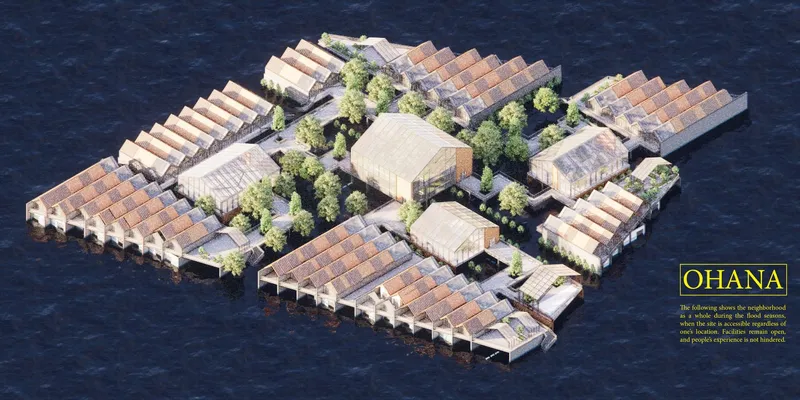
The axonometric is the project's clearest drawing. The full OHANA settlement sits on water. Perimeter rows of small gable-roofed housing blocks wrap three sides of the plan. Raised bridges link them to a cluster of larger communal buildings at the centre, each with a pitched glazed roof. The composition reads as a village, not a housing estate. The scale is low. The programme is mixed. Everything is connected.
The housing, the shops, the gardens, the libraries, and the medical facilities share the same system. That is the point. OHANA argues that resilience is not a feature added to a building. It is a property of the neighbourhood's geometry. Get the neighbourhood right and the flood stops being an emergency.
Before and After: What the Flood Looks Like
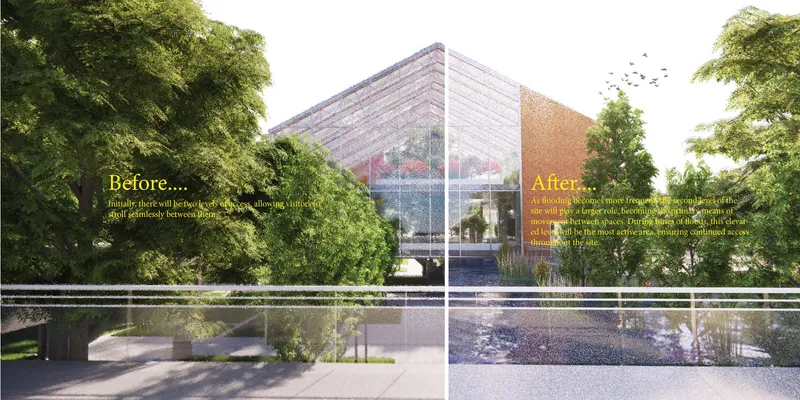
The before and after diptych is the project's most honest image. On the left, a dry courtyard on a normal day: residents walking, plants in bloom, the pavilion visible through the trees. On the right, the same courtyard flooded. The water is brown and still. But the raised walkway above it is still in use. The trees are still visible. The pavilion is still open. Life continues on the level above.
The value of the diptych is that it refuses to romanticise either state. The dry day is not a utopia and the flood day is not a disaster. Both are normal conditions in a place that floods, and the design has to work for both. This is the project's single most important argument: a flood-resilient neighbourhood cannot be designed only for the dry day.
The Raised Walkway: Family on a Bridge
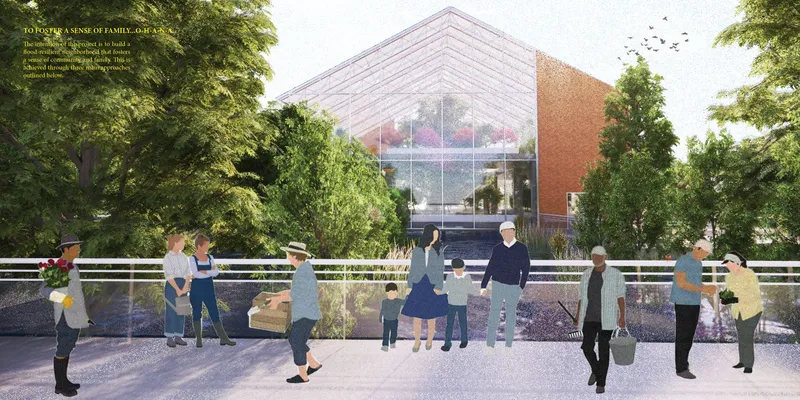
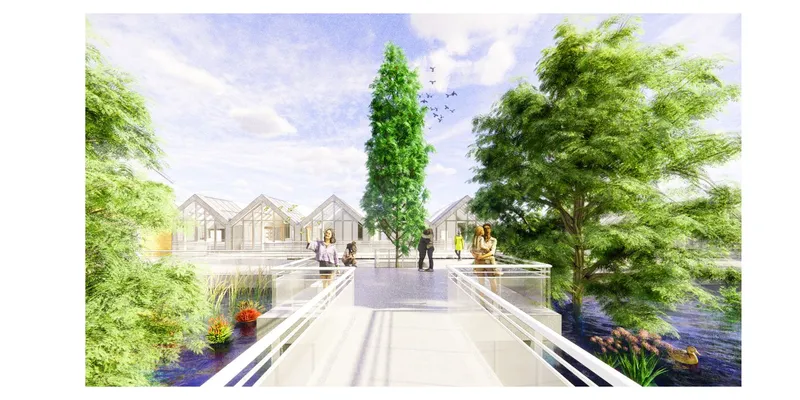
The two bridge-level renders show what daily life on the elevated walkway feels like. In the first, residents and children gather on a raised deck in front of a gabled glass communal pavilion. In the second, the walkway threads between rows of family homes over standing water, with figures crossing and planters lining the edges. The tone is ordinary: people talking, kids playing, flowers in boxes. The extraordinary thing is that the ground is below, not underfoot.
This is where the project earns its name. The raised walkway is not a flood defence. It is the family dinner table, stretched across the whole neighbourhood. Every journey between homes, shops, and communal spaces happens on this elevated deck, which means every journey passes your neighbours. The circulation network is the social network. Ohana is not a sentiment. It is a floor plan.
The Ground Plane: Life When the Water Is Gone
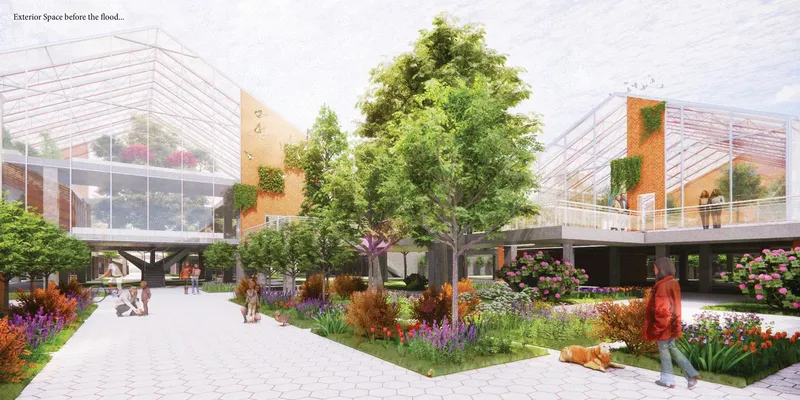
The dry-day street render shows OHANA's ground level at its best. Trees, flowering borders, and glass-roofed communal pavilions frame a lively plaza where residents walk dogs and gather outside shops. Without the flood, the ground floor is a conventional mixed-use village: pleasant, green, walkable. The raised walkways above read as pergolas rather than lifelines.
This duality matters. A flood-resilient neighbourhood that only makes sense during the flood is a bad neighbourhood. OHANA's ground plane is generous when the water is absent and programmed when it returns. The storage, the permeable pavements, and the flood-channel landscaping are all doing quiet work on the dry day as drainage, planting, and play space. The building is always the same. Only the water level changes.
Why This Project Won
The Ohana competition asked for flood-resilient family housing. Most entries designed a house. Evan Fernandes designed a neighbourhood, and that scale choice is what won the competition. The project understands that flooding does not happen to buildings. It happens to places. The only way to design for a place that floods is to design the relationships between buildings, not just the buildings themselves.
For anyone studying flood-resilient urbanism, amphibious housing, or the geometry of climate-adapted neighbourhoods, OHANA is a useful reference. It draws the raised walkway, the perimeter block, the communal centre, and the permeable ground plane as a single integrated system. The family, in the end, is not a metaphor. It is a diagram of who walks past whose door every day, and the project makes that diagram legible at every level of the plan.
View the Full Project
About the Designer
Designer: Evan Fernandes
Enter a Design Competition on uni.xyz
If flood-resilient architecture, climate-adapted neighbourhood planning, or amphibious housing is the kind of work you want to explore, uni.xyz runs competitions year-round that reward proposals grounded in real climate logic and real social geometry.
Project credits: OHANA by Evan Fernandes. Winner, Ohana competition (uni.xyz).


Popular Articles
Popular articles from the community


Conexión: Biophilic Design Reimagines High-Rise Living in Hong Kong
Conexión reimagines high-rise living in Hong Kong through biophilic design, green facades, shared spaces, daylight, water and nature within.

The Ocean Hive: Sustainable Architecture for a Self-Sufficient Civilization at Sea
The Ocean Hive imagines sustainable architecture at sea, where modular habitats, algae, wave power and ocean waste sustain a growing colony.

Co-life: Sustainable Architecture for Age-Friendly Community Living
Co-life reimagines sustainable architecture for seniors through courtyards, rammed earth, shared gardens, and spaces designed for belonging.

Co-Life: Senior Housing Design That Reconnects Older Adults With the City
Co-Life reimagines senior housing design through healing gardens, shared streets, workshops, and a sustainable community across generations.

Similar Reads
You might also enjoy these articles

Day and Night Park: A Time-Based Urban Newsstand in Beijing
A temporary urban newsstand in Beijing blending travel, light, and reading through poetic colors, compact form, and community-focused design.

Modernist Patio Renovation in El Masnou, Barcelona by Oliver Segura Arquitectura + Cebrià Arquitectura
Modernist patio renovation blending tradition and innovation with a movable pool, leveled floors, and Catalan materials in El Masnou.

Alto Residencial Coop: Cooperative Housing Development in Santiago de Compostela by Carbajo Barrios Arquitectos
A linear cooperative housing complex blending white volumes and perforated metal façades, enhancing community living, natural light, privacy, and urban integration.
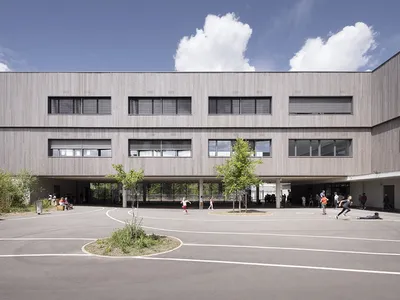
Vil Genis School by BPA ARCHITECTURE – Massy, France
Vil Genis School in Massy, France, features sustainable design, south-facing classrooms, community integration, accessible spaces, and modern educational architecture.

Explore Housing Competitions
Discover active competitions in this discipline

Challenge to visualize a collision of the future and past

Challenge to visualize future spaces of waste

Challenge to visualize slums of 2080

Challenge to illustrate the change you wish in architecture
Comments (0)
Please login or sign up to add comments
No comments yet. Be the first to comment!