
Oil Rings: Adaptive Reuse Architecture Reimagines Offshore Oil Rigs as Floating Innovation Islands
Transforming abandoned offshore oil rigs into floating innovation hubs where adaptive reuse architecture merges science, tourism, housing, and entertainment.


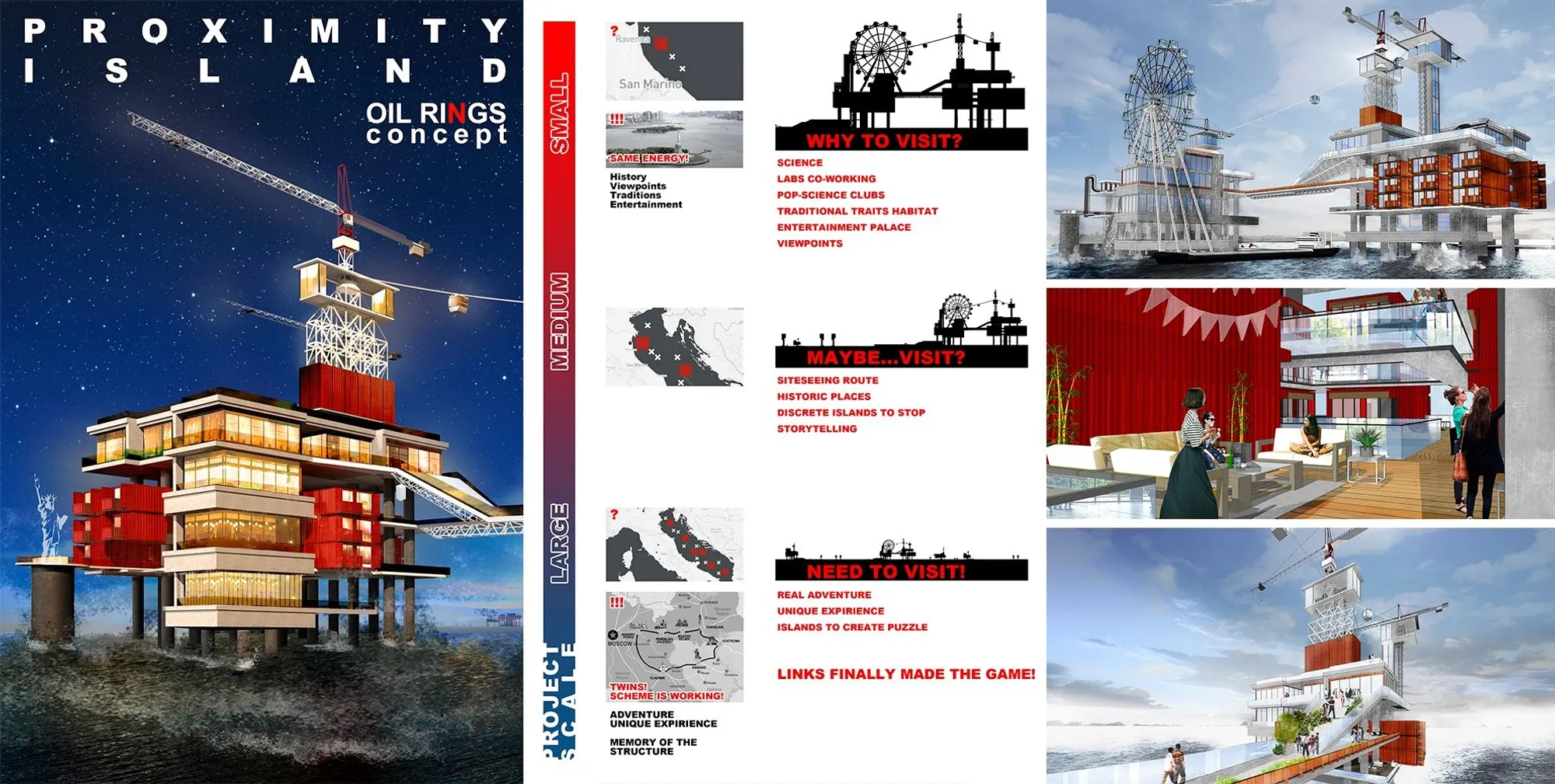
As the global energy landscape evolves, thousands of offshore oil rigs face an uncertain future. Traditionally viewed as industrial relics occupying remote maritime territories, these colossal structures are now becoming catalysts for a new architectural narrative. Oil Rings, a visionary proposal by Evelina Khachaturova and Lisa Shcherbakova, reimagines obsolete oil platforms as interconnected floating islands dedicated to science, tourism, entertainment, and communal living.
Centered around the principles of adaptive reuse architecture, the project transforms industrial infrastructure into a progressive offshore ecosystem that blends sustainability, urban experimentation, and cultural interaction. Rather than demolishing these monumental structures, the proposal advocates for preserving their identity while introducing new public programs that reconnect people with the ocean environment.
The project positions oil rigs not as isolated engineering machines, but as architectural landmarks capable of generating new social and economic possibilities within coastal waters.
Reimagining Offshore Infrastructure Through Adaptive Reuse Architecture
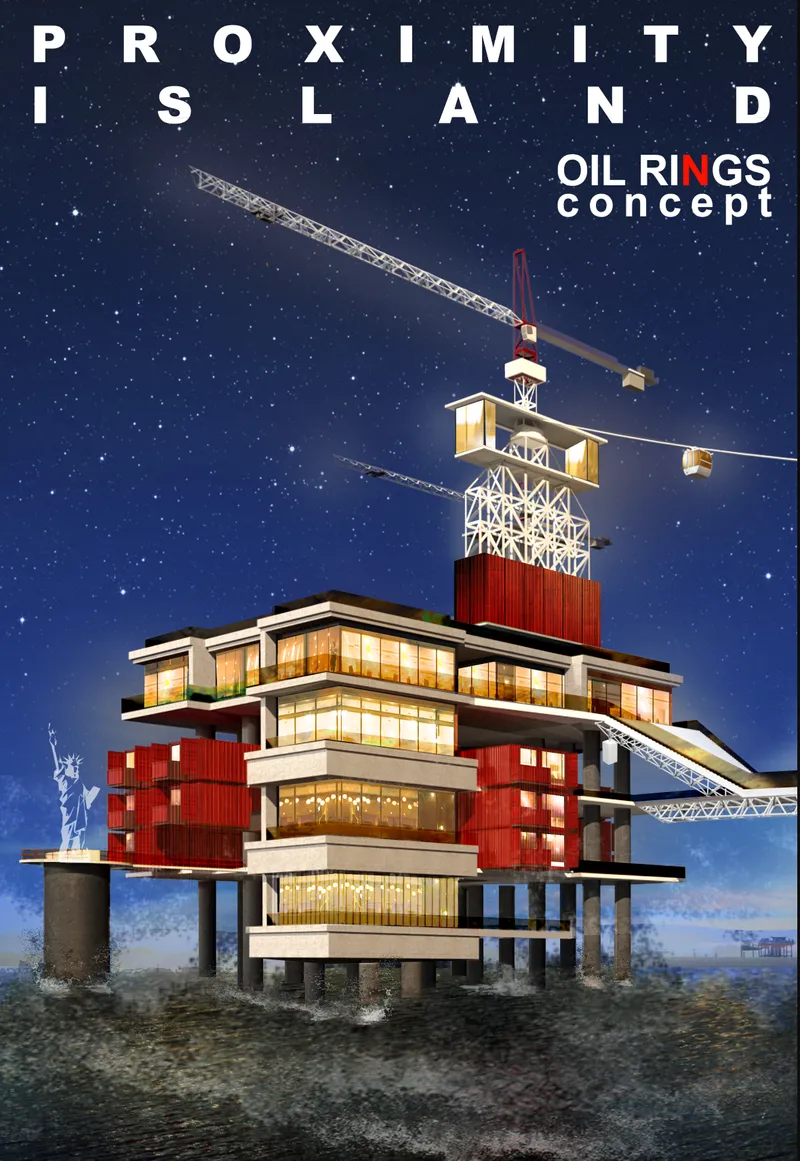
The core vision behind Oil Rings is rooted in the architectural philosophy of transformation rather than replacement. Existing offshore oil platforms are treated as artificial islands capable of supporting entirely new urban functions. Through adaptive reuse architecture, the project preserves the industrial aesthetic of oil rigs while inserting spaces for living, recreation, education, and exploration.
The proposal introduces a modular system where multiple rigs can evolve into a connected chain of floating destinations. These “oil rings” become scientific and entertainment clusters distributed across the sea, creating a new typology of offshore urbanism.
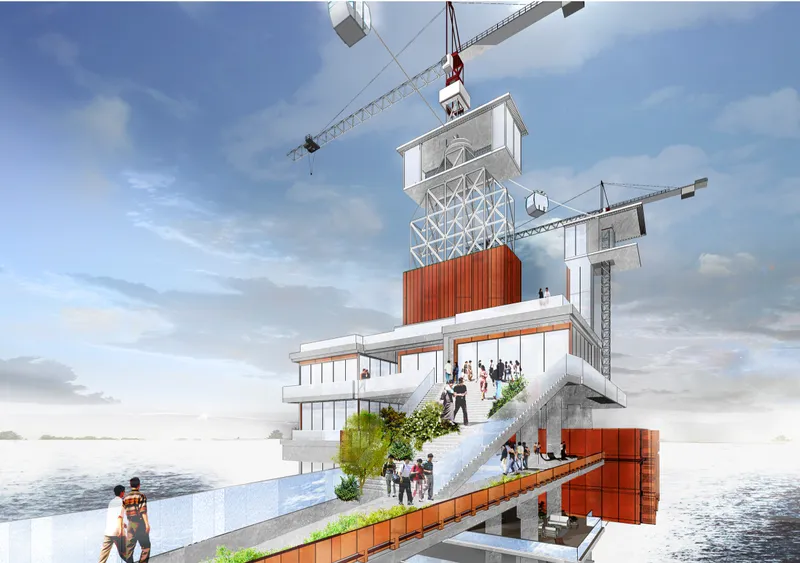
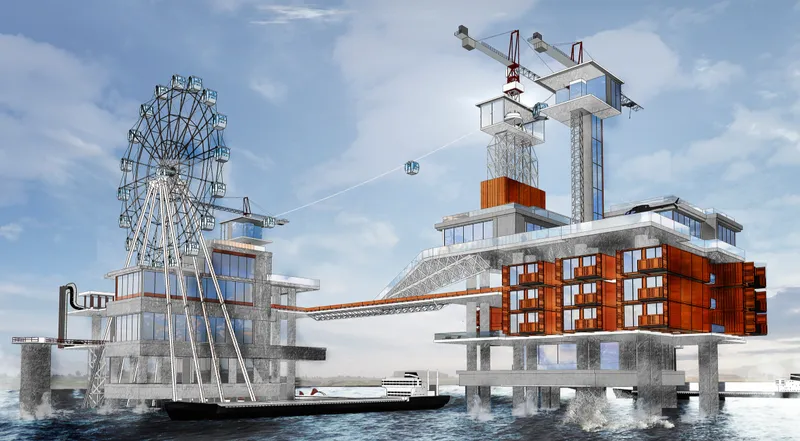
Instead of hiding the industrial character of the platforms, the project embraces cranes, steel structures, elevated decks, and mechanical systems as part of the visual identity. This strategy preserves the memory of the infrastructure while allowing people to experience it from a completely different perspective.
Offshore Urbanism and the Creation of Artificial Island Networks
One of the most compelling aspects of the proposal is its ambition to redefine offshore territories as inhabitable public environments. The project imagines oil rigs as nodes within a larger floating network that can eventually form new tourism routes and marine urban systems.
The architectural solution operates on two scales:
- At the territorial scale, the oil rigs become recognizable landmarks along coastal waters.
- At the human scale, each platform functions as a self-contained mini-city with public amenities, cultural attractions, and temporary residential facilities.
This duality allows the project to bridge industrial infrastructure with hospitality architecture and experiential tourism design.
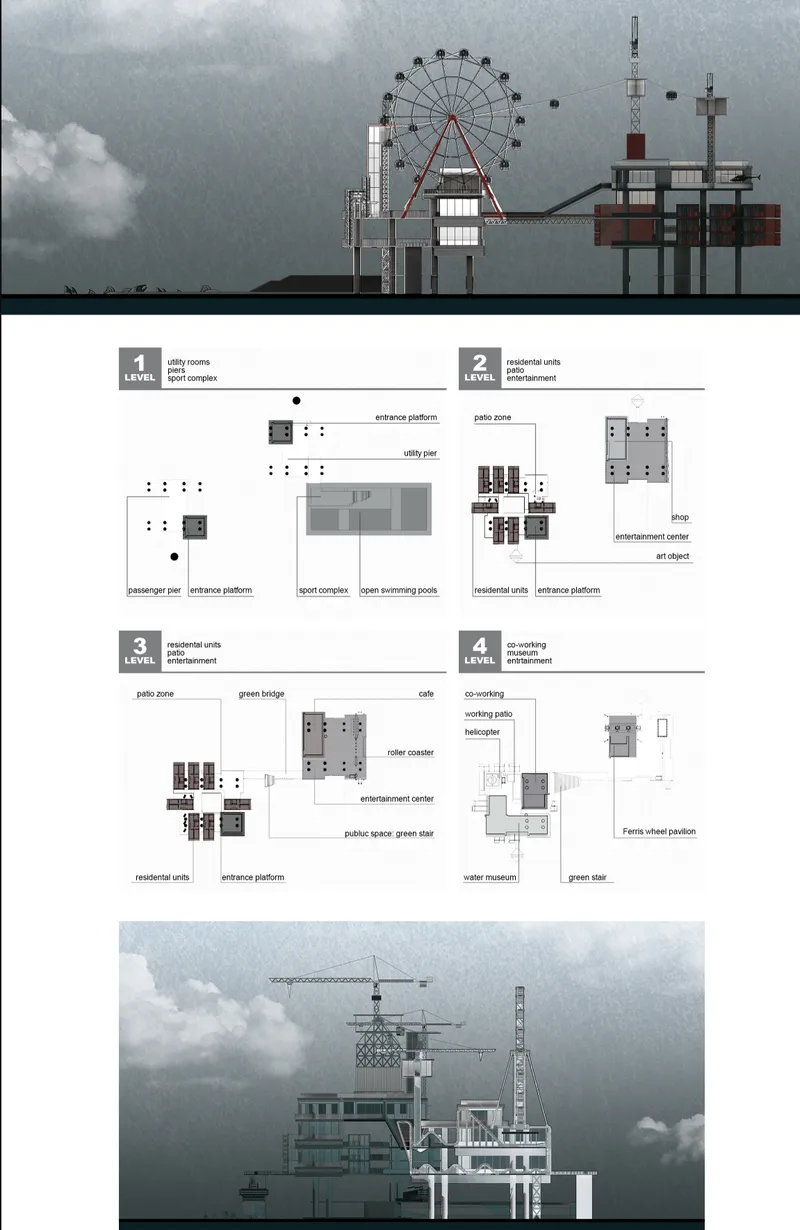
The floating platforms include:
- Scientific research centers
- Exhibition spaces
- Co-working environments
- Residential units
- Entertainment facilities
- Open-air public plazas
- Water sports infrastructure
- Observation decks
- Cultural and educational spaces
By combining these programs, Oil Rings transforms abandoned extraction sites into active civic environments.
Entertainment and Science as Catalysts for Public Engagement
Unlike conventional adaptive reuse projects that focus solely on preservation, Oil Rings introduces an immersive public experience centered around discovery and participation.
The entertainment block incorporates large-scale attractions including:
- Ferris wheels
- Roller coasters
- Cable cars suspended between cranes
- Swimming pools
- Amphitheaters
- Rooftop viewing platforms
These elements create a vibrant experiential landscape positioned directly above the sea.
Parallel to the entertainment infrastructure, the project integrates scientific institutions and collaborative workspaces. Laboratories, co-working environments, museums, and exhibition halls allow researchers, visitors, and creatives to interact within the same architectural ecosystem.
This hybridization of science and leisure generates a unique public identity where education becomes experiential rather than institutional.
Adaptive Reuse of Industrial Aesthetics
A major strength of the proposal lies in how it preserves the emotional and visual power of industrial architecture. The cranes, steel frameworks, and infrastructural systems are retained as architectural icons rather than erased.
The design intentionally references the raw geometry and engineering logic of offshore rigs. Elevated walkways, exposed structural grids, and suspended circulation systems reinforce the industrial atmosphere while introducing human-centered spatial experiences.
The cable car system, for example, transforms construction cranes into transportation infrastructure and public attractions. What was once machinery for extraction becomes part of a new recreational landscape.
This approach aligns strongly with contemporary adaptive reuse architecture strategies where preservation extends beyond material conservation into the retention of cultural memory and identity.
Floating Residential Communities Inspired by Co-Living Models
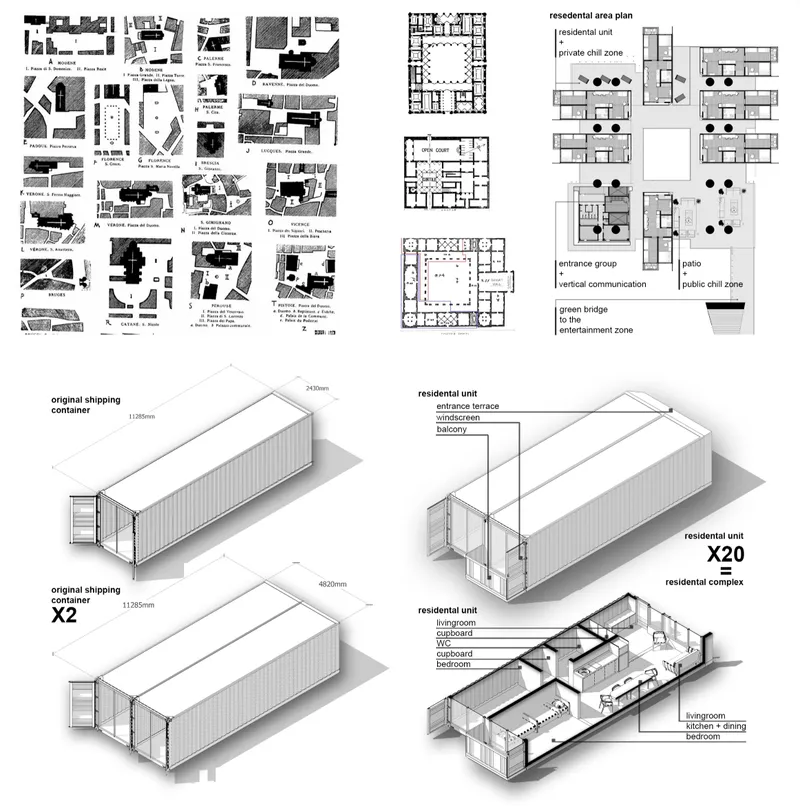
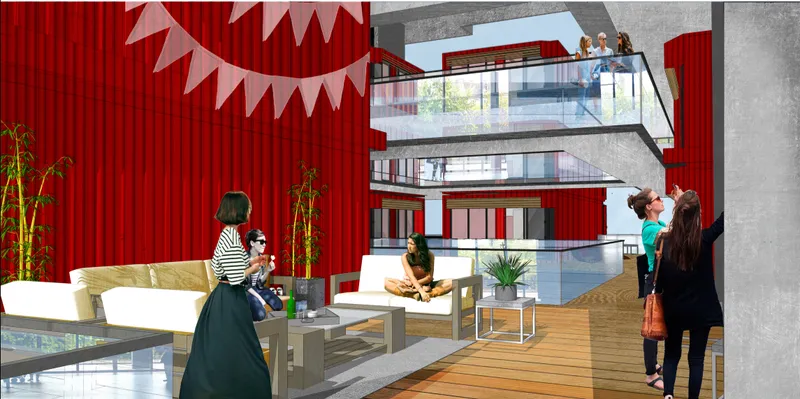
The residential component of the project introduces modular housing units derived from shipping containers. This decision references the historical relationship between maritime logistics and offshore industries while enabling flexible construction systems.
The housing blocks are arranged around shared patios inspired by traditional Italian courtyards. These communal open spaces encourage social interaction and reinterpret historic urban typologies within a floating offshore context.
Each residential cluster contains:
- Private living units
- Shared patios
- Public chill zones
- Green bridges
- Vertical circulation systems
- Open terraces facing the sea
The modular strategy allows the system to expand incrementally while maintaining spatial coherence.
By introducing temporary living environments into former industrial zones, the proposal explores new possibilities for offshore habitation and experimental communities.
Architecture Between Memory and Futurism
Visually, Oil Rings balances futuristic imagery with strong references to industrial heritage. The elevated decks, interconnected bridges, and exposed cranes create a sci-fi architectural language while remaining grounded in existing infrastructure.
The project’s atmosphere evokes a hybrid condition somewhere between maritime infrastructure, amusement park, research station, and floating city.
This ambiguity becomes one of the project’s strongest architectural qualities. Rather than assigning a singular identity to the oil rigs, the proposal allows them to evolve into multifunctional environments shaped by public participation.
The design demonstrates how adaptive reuse architecture can move beyond restoration and become a framework for speculative urban futures.
Tourism, Public Space, and the New Coastal Experience
The proposal also introduces a new understanding of tourism infrastructure. Instead of isolated resorts or conventional waterfront developments, Oil Rings creates distributed offshore destinations connected through maritime routes.
Visitors move through a sequence of floating islands where architecture becomes part of the journey itself.
The project proposes experiences such as:
- Extreme observation platforms
- Rope-jumping attractions
- Scientific exhibitions
- Floating public gardens
- Open-air cultural events
- Marine sports facilities
- Scenic transportation systems
This creates a layered tourism experience that combines education, recreation, and industrial heritage.
By activating inaccessible offshore territories, the project expands the cultural and spatial possibilities of coastal architecture.
The Future of Adaptive Reuse Architecture in Offshore Environments
As industries transition away from fossil fuel extraction, adaptive reuse architecture will play an increasingly important role in redefining obsolete infrastructure. Oil Rings presents an optimistic architectural response to this challenge by transforming offshore rigs into public assets rather than abandoned monuments.
The proposal demonstrates how architecture can extend the lifecycle of industrial systems while creating new forms of collective experience.
Through science, entertainment, tourism, and co-living, the project imagines a future where offshore structures become interconnected floating communities capable of supporting culture, education, and exploration.
Rather than disappearing into the ocean horizon as symbols of extraction, oil rigs are reborn as progressive islands of human interaction.
Project Credits
Project: Oil Rings Designers: Evelina Khachaturova, Lisa Shcherbakova



Popular Articles
Popular articles from the community


The Earth Pod: 3D Printed Homes for Resilient Refugee Communities
The Earth Pod reimagines refugee housing through 3D printed homes made from clay, combining resilience, self-sufficiency, and rapid shelter.

Play: Fragments of Their World
Familiar architecture becomes modular playground design, creating safe spaces where displaced children can learn, connect, imagine and play.

Riyadh For All: Intergenerational Urban Design for Active Aging in Rabat
Riyadh For All reimagines urban design in Rabat with intergenerational co-living, adaptive courtyards, and Moroccan cultural exchange today.

The Musturak Paradise: Senior Living Architecture for a Connected Future in Temara, Morocco
The Musturak Paradise reimagines senior living architecture in Temara via private homes, social spaces, culture, community, and shared care.

Similar Reads
You might also enjoy these articles

Eco Chapel: A Green Architecture Pavilion Designed in Symbiosis with the Forest
Eco Chapel uses green architecture to weave prayer, learning and reuse into a forest pavilion shaped by modular hexagonal canopies for life.
Kaffeebühnen: Coffee Shop Architecture Designed as a Civic Stage Between Vienna’s City and Park
Kaffeebühnen turns coffee shop architecture into a civic stage, linking Vienna’s park edge, urban life, warm timber yards, and coffee craft.
Healing Façade: Sustainable Architecture for Reforestation, Community, and Sacred Ecology in Ethiopia
Healing Façade reimagines sustainable architecture as a living wall that restores soil, catches water and renews Ethiopia's forest churches.


Urban Forest: A Vertical Ecosystem for 5,000 Workers in Singapore's Changi Business Park
Radially stacked pods and layered green decks turn a 7-acre plot into 47 acres of ecological workspace projected for 2040.


Comments (0)
Please login or sign up to add comments
No comments yet. Be the first to comment!