
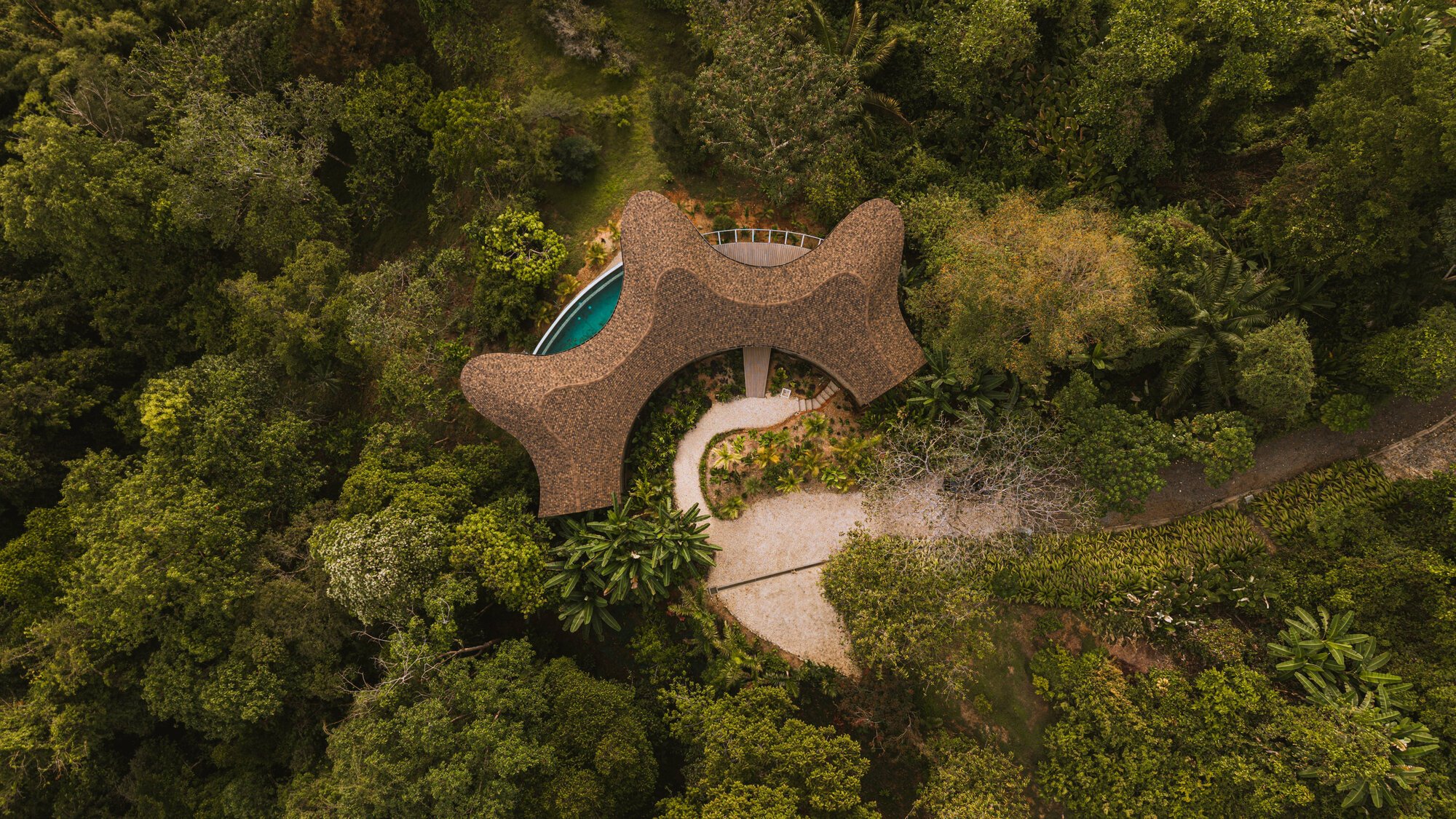
Ojo de Nila: A Sculpted Jungle House in Costa Rica
Studio Saxe designed a 300 m² residence in Bahía Ballena, Costa Rica with a sculpted shingle roof that floats over an open pavilion in the rainforest.

Costa Rica has become one of the most interesting places in the world to build a house. The climate allows for radical openness, the landscape is dramatic, and the local building culture knows how to work with timber, thatch and small-batch craft. Ojo de Nila, a 300 square metre residence in Bahía Ballena designed by Studio Saxe and completed in 2024, is a confident addition to a lineage of architects who treat the Costa Rican jungle as a collaborator rather than a site to be cleared.
The studio, led by Benjamin Saxe, was commissioned by a Swiss couple who wanted a home that would connect them to the rhythms of the landscape. That brief could have gone in a dozen predictable directions. Instead the architects produced a house that looks like nothing else on the hillside: a sculpted, undulating shingle roof floating above a glass pavilion, suspended in the rainforest like a leaf caught mid-fall.
A Roof That Moves
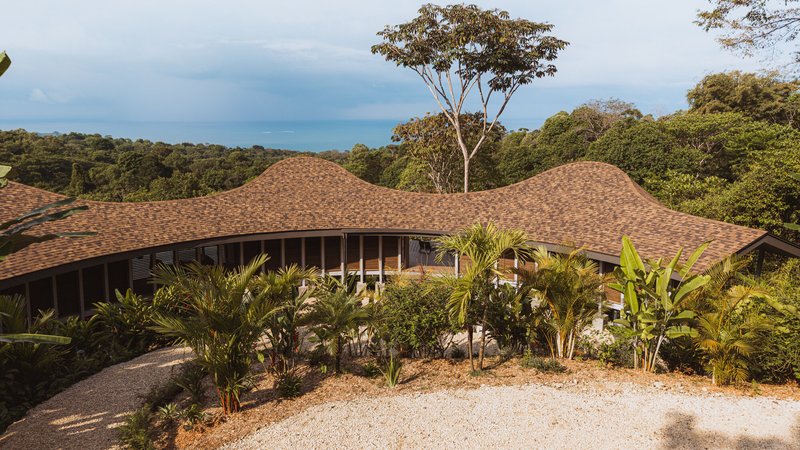
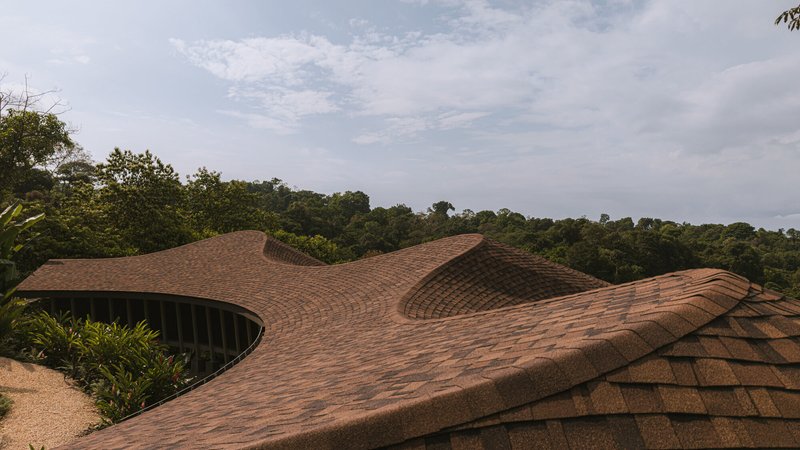
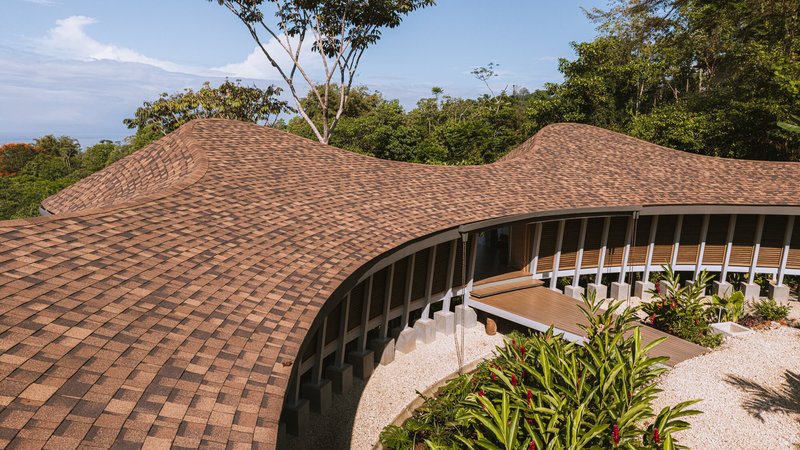
The defining element of the project is the roof. It is a continuous curved surface, rising and falling across the plan like a wave, and clad entirely in small timber shingles that soften the geometry and give it the scale of something organic. From the air, the roof does not look like architecture at all. It looks like a large leaf or a piece of terrain.
Roofs this sculptural are notoriously difficult to build. The shingles have to wrap a doubly-curved surface without buckling. The structure beneath has to hold the geometry precisely without appearing heavy. Studio Saxe has pulled both off. The result is a roof that reads as a single gesture from every angle and still resolves cleanly where it meets the supporting columns.
The Jungle as Site
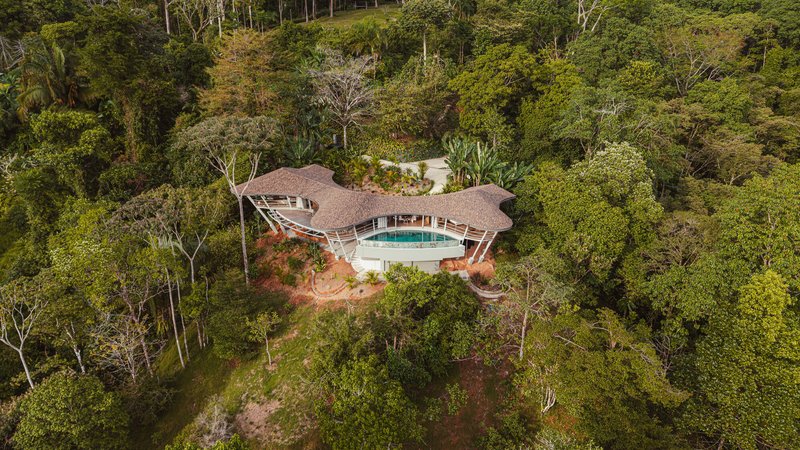
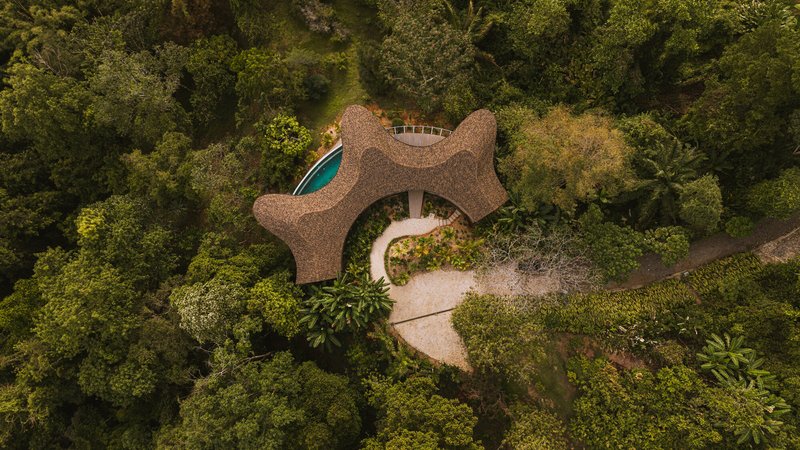
Seen from above, the house is barely visible. It sits in a small clearing in the rainforest with the surrounding trees closing in on every side. The roof is the only element you can identify from a distance, and even it reads as a slightly different shade of brown against the green canopy. The architects have built a 300 square metre house that refuses to announce itself to the landscape.
This is the correct response to a site like this. Bahía Ballena is not a place where you build for the view of the neighbours. It is a place where you build for the view out of the house, and where the best architecture disappears as much as possible into the trees. The construction footprint is kept small, the paths are gravel, and the garden around the house is an extension of the native planting rather than a formal landscape.
The Open Pavilion Underneath
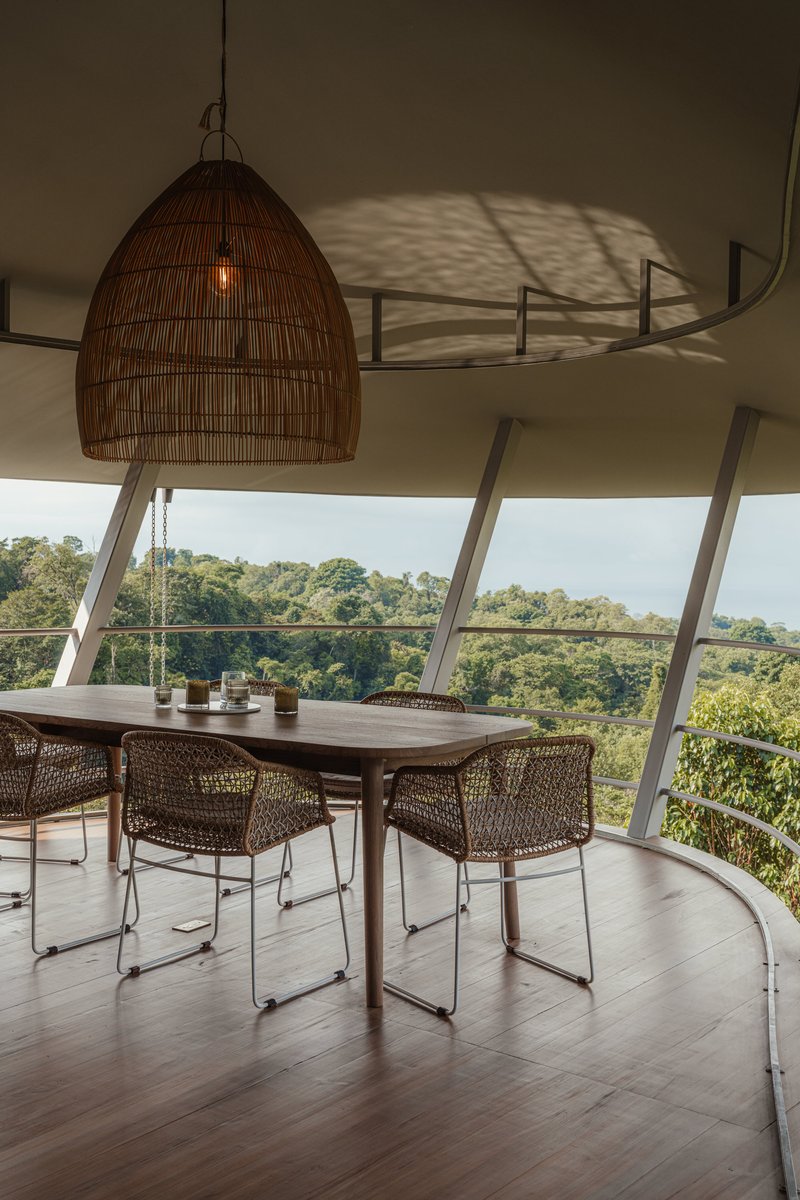
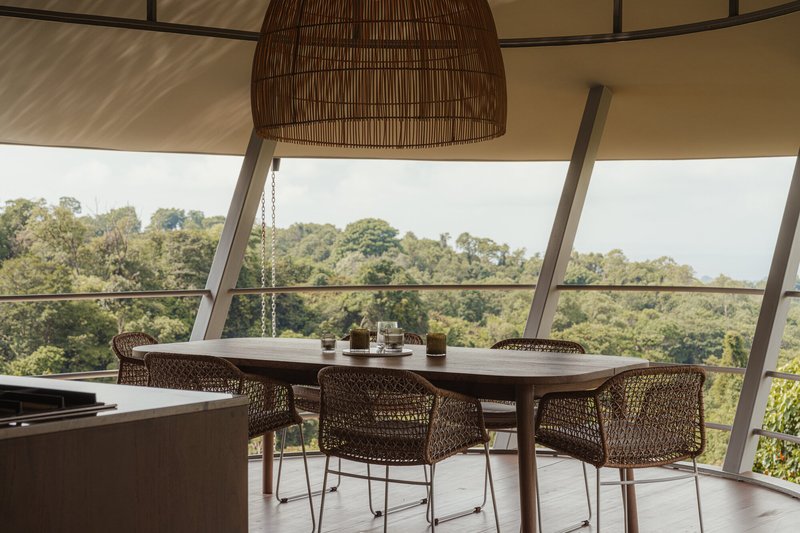
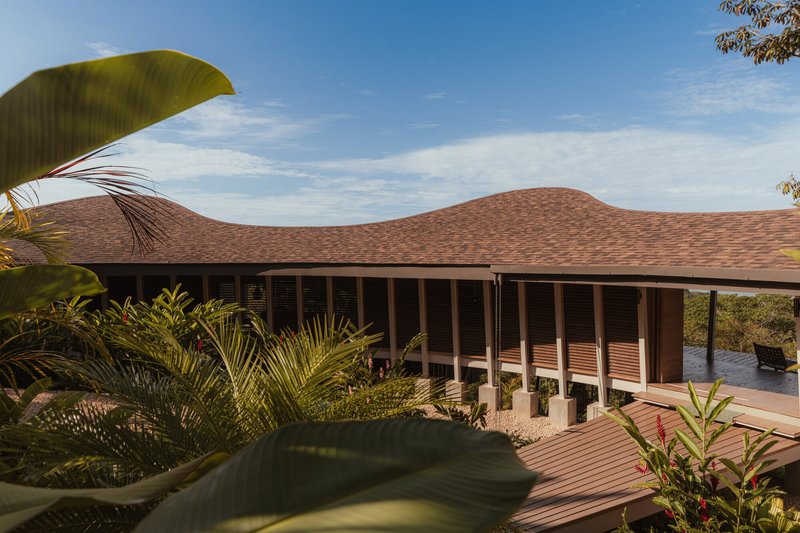
Beneath the sculpted roof, the main floor of the house is a single open pavilion. Kitchen, dining and living spaces share one continuous volume. There are no internal walls and almost no enclosure: the perimeter is glass on one side and open terraces on the others, with slender timber columns carrying the roof above. On a warm day the room becomes part of the forest.
The decision to leave the main floor as one open space is the right one for this climate. Costa Rica's coast is warm all year, and the cross ventilation through an open pavilion is more effective than any mechanical system would be. The only enclosed rooms are the bedrooms and the bathrooms, tucked behind the main volume where privacy matters.
Curved Terraces and the Pool
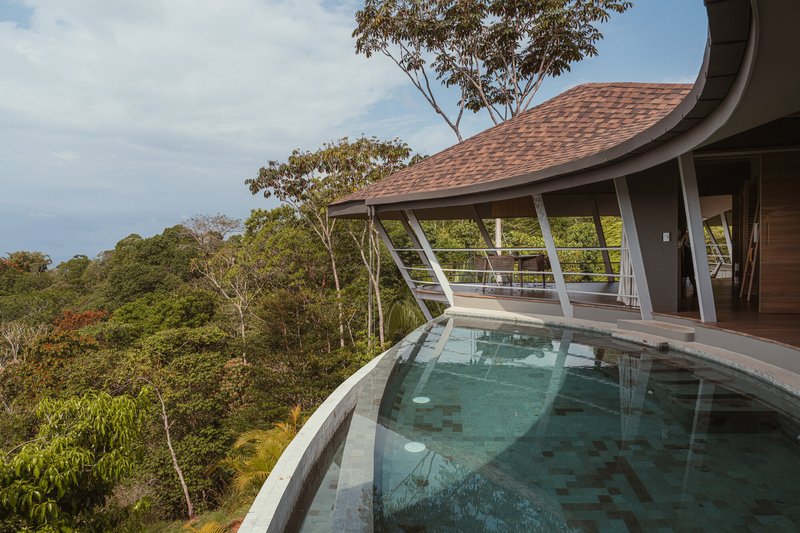
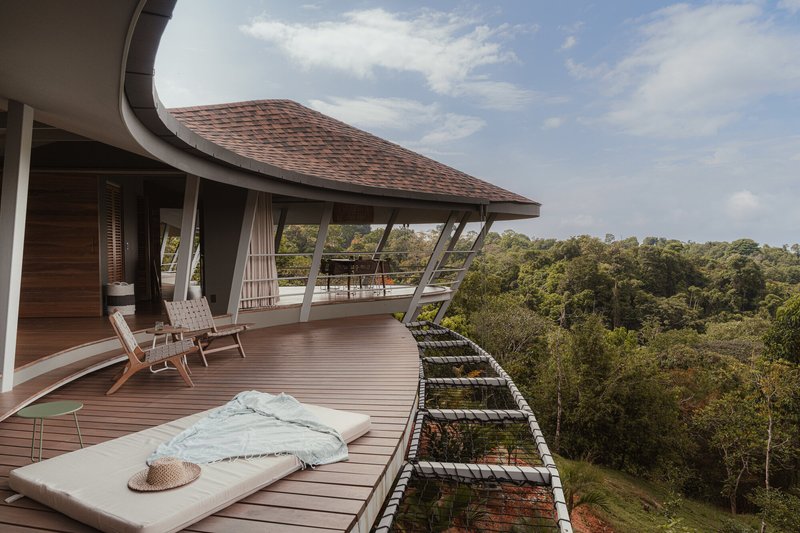
The terrace wraps around the curved edge of the main volume and ends in a small plunge pool cantilevered over the slope. The geometry is the same that runs through the roof and the floor plan: a single continuous curve that never quite resolves into a straight edge. Walking along the terrace you follow the line of the house out toward the canopy, and the pool becomes the final stop.
A small plunge pool on a curved cantilever is one of those details that cost more than a larger pool on flat ground would have. It is here because the geometry demanded it. The curve of the roof above is picked up by the curve of the pool below, and the house reads as a single object from any angle.
The Quiet Rooms
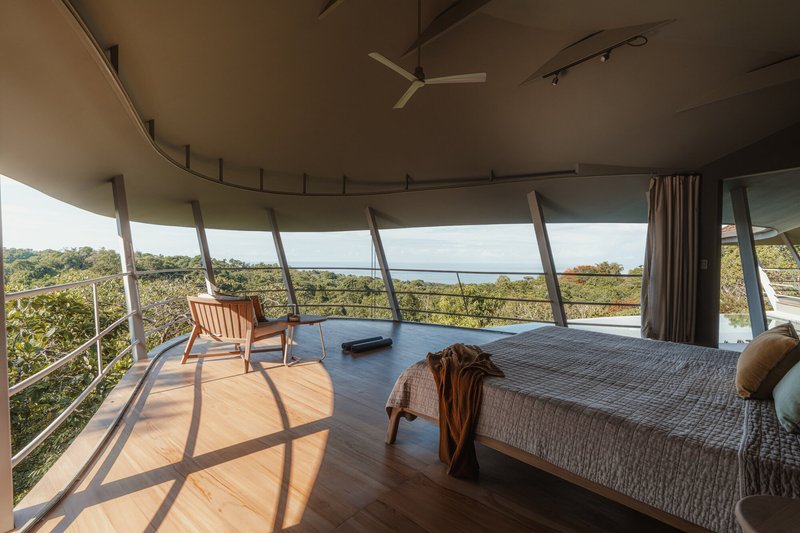
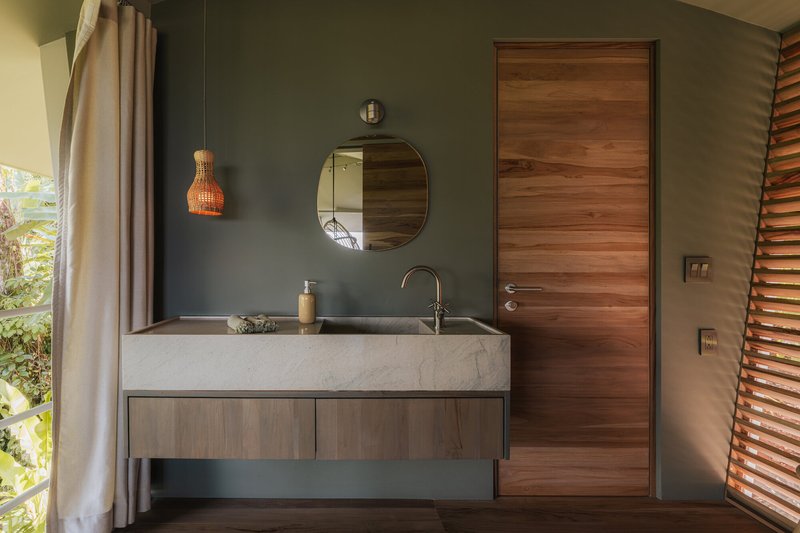
The bedrooms sit at the ends of the curved volume, each one wrapped in its own section of glass facing the trees. The bed faces outward so the first and last thing you see is the forest. The bathrooms, designed with Atelier Sandra Richard, are unexpectedly dark. A deep green wall, a stone basin, a single warm pendant and a timber door set against louvered shutters. This is the kind of small room that can afford to go saturated because the rest of the house is all light and openness.
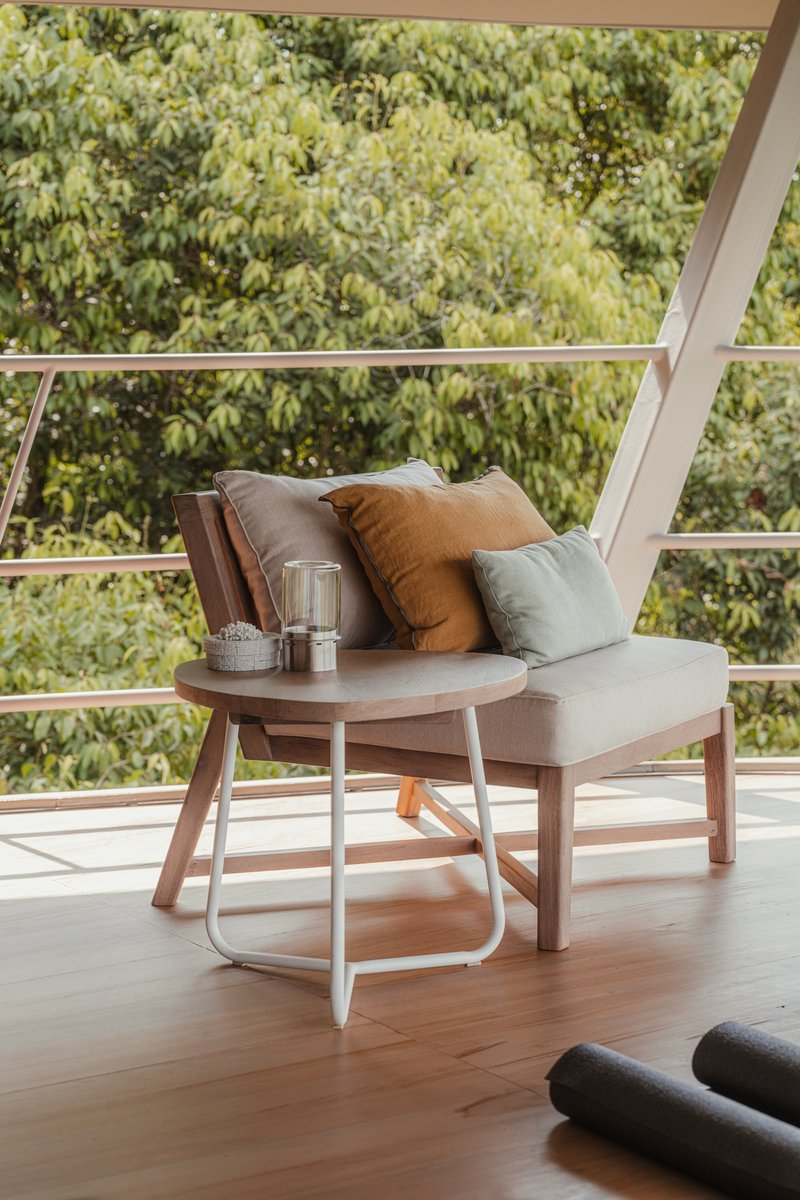
A small reading nook on the terrace, with woven cushions and a simple side table, suggests how the house is actually used. Most of the day is spent somewhere between inside and outside, moving along the curved edge of the volume, stopping where the light and the breeze are best at that hour.
Access and the Walk to the House
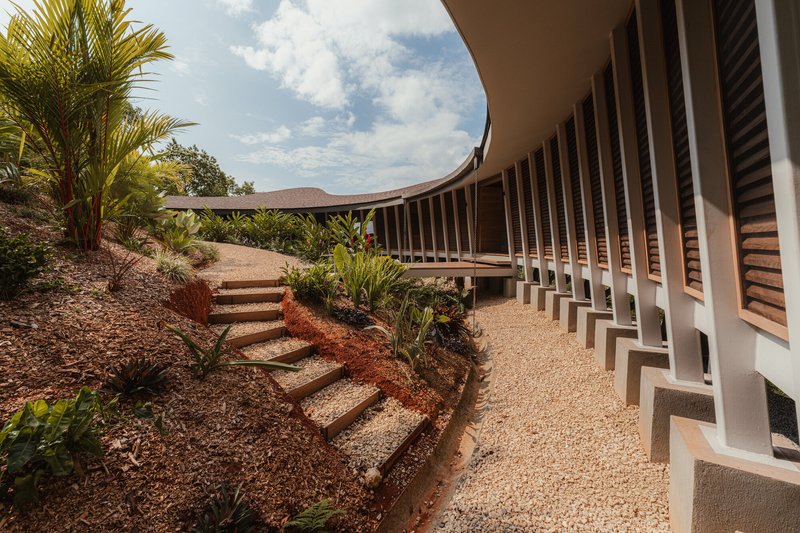
The approach to the house is along a gravel path cut into the slope, passing beneath the overhanging shingle roof and past a set of shuttered timber screens. The walk is part of the architecture. You do not arrive at a door. You move through a series of landscape moments until you are already inside. That sequence is harder to design than it looks, and it is one of the things Studio Saxe has always done well.
Drawings
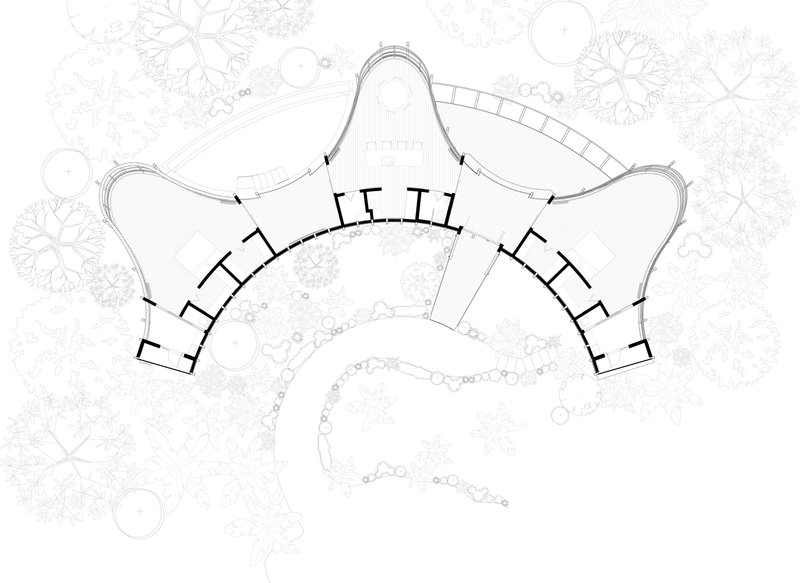
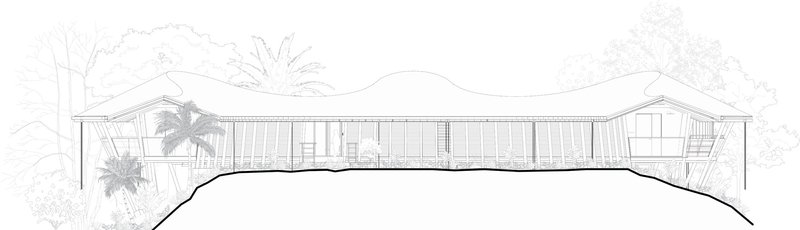
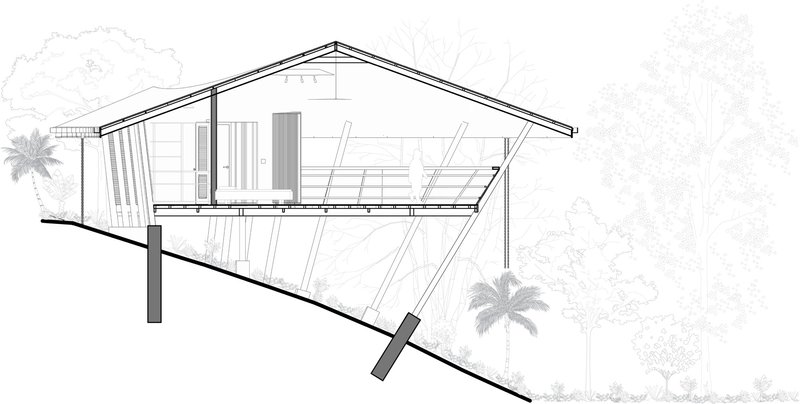
The drawings confirm what the photographs suggest. The plan is organised around a single curved volume with the open main floor at the centre and the bedrooms tucked behind. The elevation and section reveal how carefully the roof geometry was set out to ride over the interior spaces and resolve at the terrace edge.
Why This Project Matters
Tropical residential architecture is an unusually rich field because the climate rewards openness and the local material culture has deep roots. Ojo de Nila is worth studying because it refuses the two easiest traps in the genre: the resort house that looks like a hotel and the vernacular imitation that pretends to have been built by local hands. Instead, it produces a contemporary form (the sculpted shingle roof) using local materials and local craft, and places it in the jungle with real care.
The lessons are direct. Make the roof do the architectural work. Leave the main floor as open as possible. Treat the terrace as part of the plan. Tuck the enclosed rooms where privacy matters and let the rest of the building be open. And always consider the path to the house as part of the design, not an afterthought. Studio Saxe has delivered all of this with the quiet confidence of a studio that has spent years learning how to build in this particular landscape, and the photographs by Alvaro Fonseca / Depth Lens show the result in full.
About the Studio
Share Your Own Work on uni.xyz
If you are working on tropical residential architecture, landscape-integrated houses, or timber craft projects, uni.xyz is a place to publish your work, find collaborators, and enter design competitions.
Project credits: Ojo de Nila by Studio Saxe. Bahía Ballena, Costa Rica. 300 m². Completed 2024. Design director: Benjamin Saxe. Interior design and colour: Atelier Sandra Richard. Builder: New Age Construction. Structural: Robin Alpízar Leiva. Electromechanical: Dynamo. Photographs: Alvaro Fonseca / Depth Lens.




Popular Articles
Popular articles from the community

IKC de Geluksvogel: Sustainable School Architecture Designed for Free Movement and Digital Learning
IKC de Geluksvogel turns sustainable school architecture into a flexible Maastricht campus for digital learning, nature, and free movement.
Kawasaki Olympic Sports Center: Sports Complex Architecture Rooted in Community, Tradition, and Movement
Kawasaki Olympic Sports Center reimagines sports complex architecture as a civic park where tradition, training, and community meet locally.
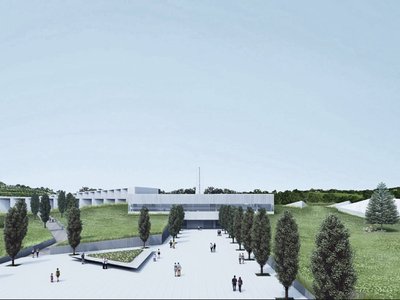
CRACK: Winery Architecture Carved Into the Landscape
CRACK reimagines winery architecture as a buried path through vineyard terrain, linking production, tasting, lodging, landscape and culture.
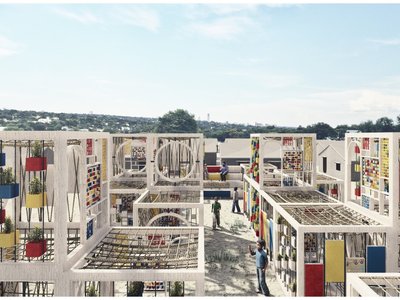
The Faith: Modular Architecture for Play, Learning, and Hope in Kutupalong Refugee Camp
A modular playground architecture project in Bangladesh where play, learning, safety, and hope rebuild childhood inside a refugee camp anew.


Similar Reads
You might also enjoy these articles
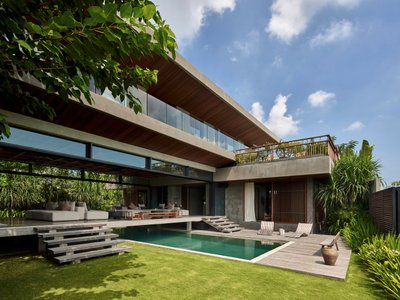
Freebird Residence by Alexis Dornier: A Tropical Modernist Sanctuary in Bali
Floating living pavilion above pool anchors H-shaped tropical villa, blending Japanese minimalism, sustainable strategies, lush landscape, and sculptural interiors.
127af Flips a Tiny Bagnolet Rowhouse Upside Down with a Handcrafted Roof Extension
A 55-square-meter terraced house on the edge of Paris gains a luminous upper living floor through lightweight timber and steel.
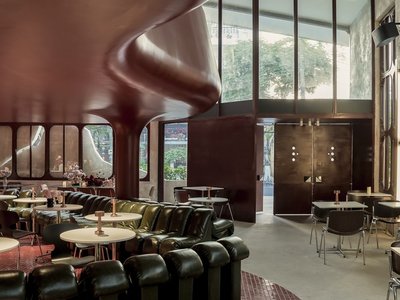
1.61 Design Workshop Wraps a 600-Square-Meter Café in Vietnam in Sculptural Burgundy Drama
Reden Café & Bistro pairs a helical staircase, mosaic floors, and deep red interiors to rethink Vietnamese hospitality space.

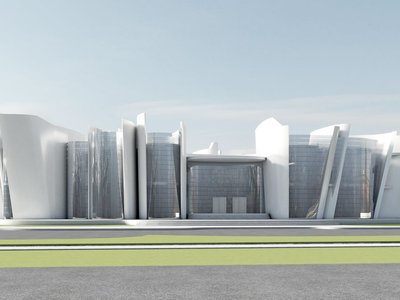
The Unbound Brain: A School Shaped by Cognitive Architecture
Cylindrical learning pods radiate like neurons from a central cortex, turning the floor plan into a spatial model of human thought.


Explore Installations Competitions
Discover active competitions in this discipline




The Global Benchmark for Architecture Dissertation Awards


Challenge to design a portable theatre


Challenge to design a portable music platform

Challenge to design an open learning module for the elderly
Comments (0)
Please login or sign up to add comments
No comments yet. Be the first to comment!