

Old Golden House by Mutabile Arquitetura , Casa Ouro Velho — A Vertical Dialogue with Forest, Light & Slope
A hillside house woven into Atlantic Forest, balancing memory, terrain, light, and economy to frame expansive living with minimal impact.


Nova Lima, Minas Gerais, Brazil — Mutabile Arquitetura, 2024
In the mountainous geography of Nova Lima, where Atlantic Forest vegetation climbs over uneven rock and daylight filters between layers of tree canopies, a house has been built with the same tension, cadence, and flexibility found in the landscape around it. Casa Ouro Velho — the Old Golden House — is less a conventional dwelling than an embedded architectural organism, folded into a steep slope, defined by gradients, and guided by the natural topography as a structural and conceptual constraint rather than an obstacle.

Designed by Mutabile Arquitetura, under the leadership of Gabriel Souza and Isabel Brant, the residence represents a balance of restriction and invention: a house that could not move the land, could not remove more than a third of the vegetation on its 1,000 m² site, and could not rely on abundant financial resources. The challenge produced an architecture that does not dominate, but rather negotiates. The result is a home that grows from the earth like a root system — in levels, in fragments, in controlled volumes — always leaving space for existing trunks, canopies, and wind.
Architecture as Topographic Continuity
The steep site is not disguised — it is embraced. Each floor of the house follows the natural descent, creating platforms suspended between forest and sky. Rather than excavating large masses of earth, the design adopts a strategy of minimal interference, reducing environmental impact and preserving hydrological and biological continuity across the lot.

Movement through the house simulates walking through terrain: descending half-levels, climbing gentle internal slopes, stepping out toward the mountains. From entrance to deck, one moves along a horizontal axis that gradually reveals vertical expanses — a rhythm that mirrors the experience of exploring hillside vegetation.
The living room becomes the pivotal hinge — an internal plateau from which programmatic layers unfold. Below, the social area expands into double-height space, open and panoramic. Above, the intimate wing rises discreetly, protected but never visually disconnected from the dramatic landscape. Circulation is not merely a functional gesture — it is experiential choreography.
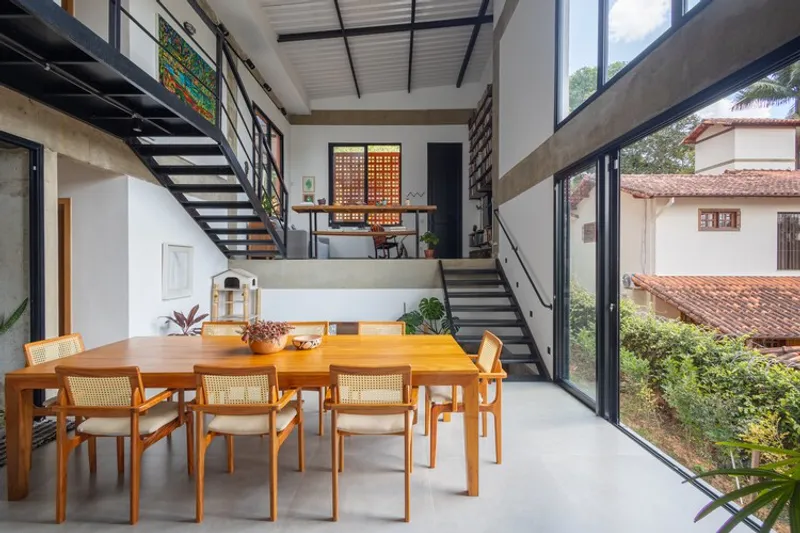
Where many hillside homes impose retaining walls and rectilinear decking, Casa Ouro Velho bends, shifts, adapts. The form is a conversation rather than a command.
Volume Defined by View, Sun, and Budget
The clients’ request was simple in language yet complex in material translation: a refuge open to the mountains, with the widest possible view. This, paired with strict preservation laws, transformed openings into the most important architectural element. Every window is sized not for symmetry, but for the ratio of investment to visual reward.
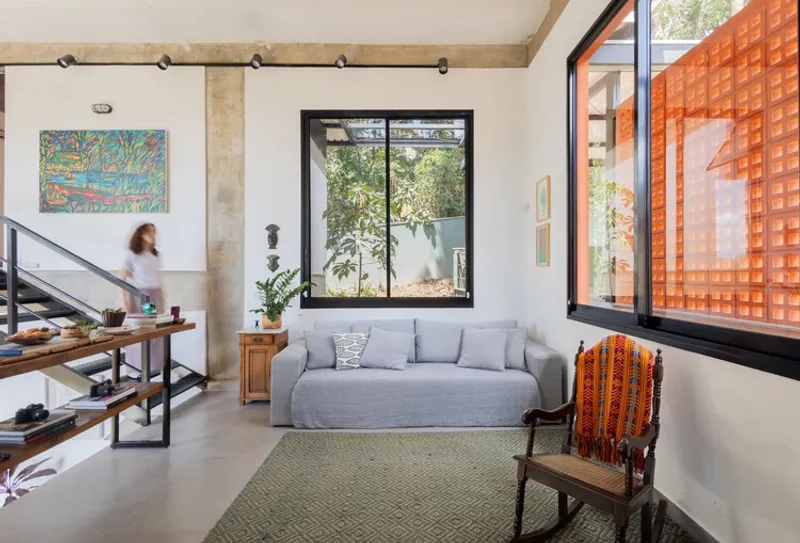
Rather than applying costly external materials, the architects opted to express form through color rather than cladding, giving the house its chromatic identity while controlling cost. Painted massing highlights each volumetric fragment, establishing a language of geometric clarity that stands against the organic density of the forest.
The house opens predominantly north — toward landscape, sun, and distant ridges.
The bedrooms retreat to the cooler south, protected from intense daylight.The master suite and living spaces rotate east and north, maximizing morning illumination and afternoon warmth.The west façade, facing the street, employs concrete cobogó panels to filter intense sunset heat while regulating privacy and framing air circulation.
Climate shapes architecture; architecture responds gently, not aggressively.
Butterfly Roof — A Simple Gesture with Complex Results
A single roofline crowns the unfolding structure — a black metal butterfly roof, its slim wings stretching beyond the walls like protective branches. The eaves extend widely, shielding glass from rain and excessive solar radiation.
The butterfly geometry is both aesthetic and functional:
• Rainwater is channeled gently along controlled slopes.• The roof exaggerates the building’s openness to the valley.• A light structure minimizes load and material consumption.
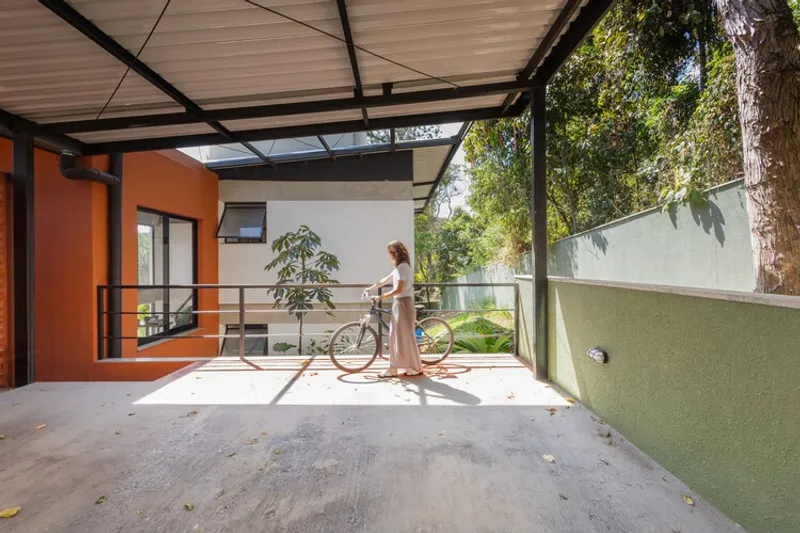
When viewed from below, the roof appears to hover — a floating plane over the forest’s density. At night, reflections of interior lighting against the dark metal create the illusion of suspension, enhancing the verticality of the stacked living spaces.
Program as Spatial Landscape
The house is not organized as a hierarchy of floors, but as a sequence of terrains:
The entrance begins sheltered under portions of the preserved ruin — an intentional gesture of memory. One must step outward to enter, passing through a covered open space that preserves the experience of the old structure, allowing history to frame arrival.
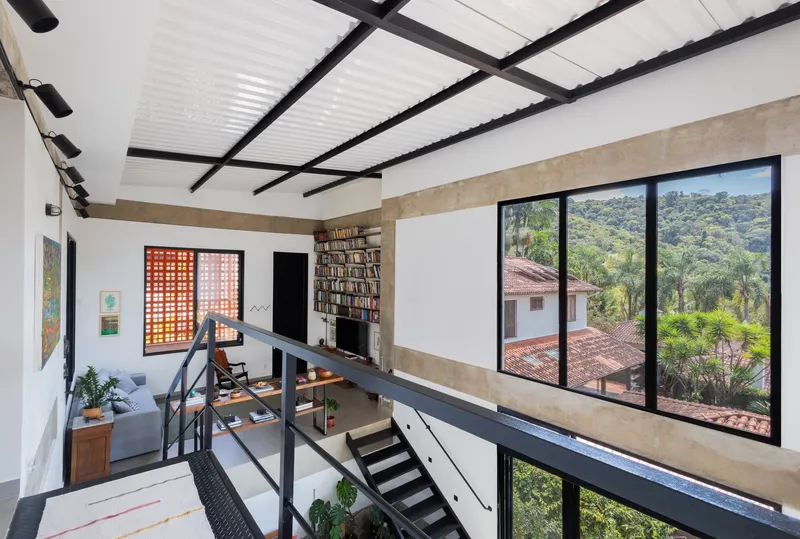
From here, circulation descends into social volume: living, dining, kitchen — an integrated open plan that extends toward a timber deck projecting into treetops. The deck becomes not simply an outdoor room but a suspended landscape edge. Mist, birdsong, humidity, and late-day gold sculpt daily atmosphere.
Half a level above, the private wing unfolds in silence. Bedrooms open onto the distant horizon through framed side windows and overhead clerestories. The mezzanine corridor, bridging opposite rooms, becomes a balcony for contemplation — a linear viewpoint above the living void and toward green infinity.
Circulation is experiential rather than mechanical — every step shifts visual horizon and relationship to the land.
Material Atmosphere — Wood, Stone, Light
Interior finishes rely on warmth rather than ornamentation. Timber surfaces wrap handrails, stair treads, furniture, and structural lines. The choice of wood resonates with the forest setting — the interior feels like an extension of the environment rather than an enclosed retreat from it.
Concrete — exposed, raw, minimally treated — anchors volume and temperature. The contrast of wood and concrete creates textural dialogue: warm against cool, soft against dense, human against geological.
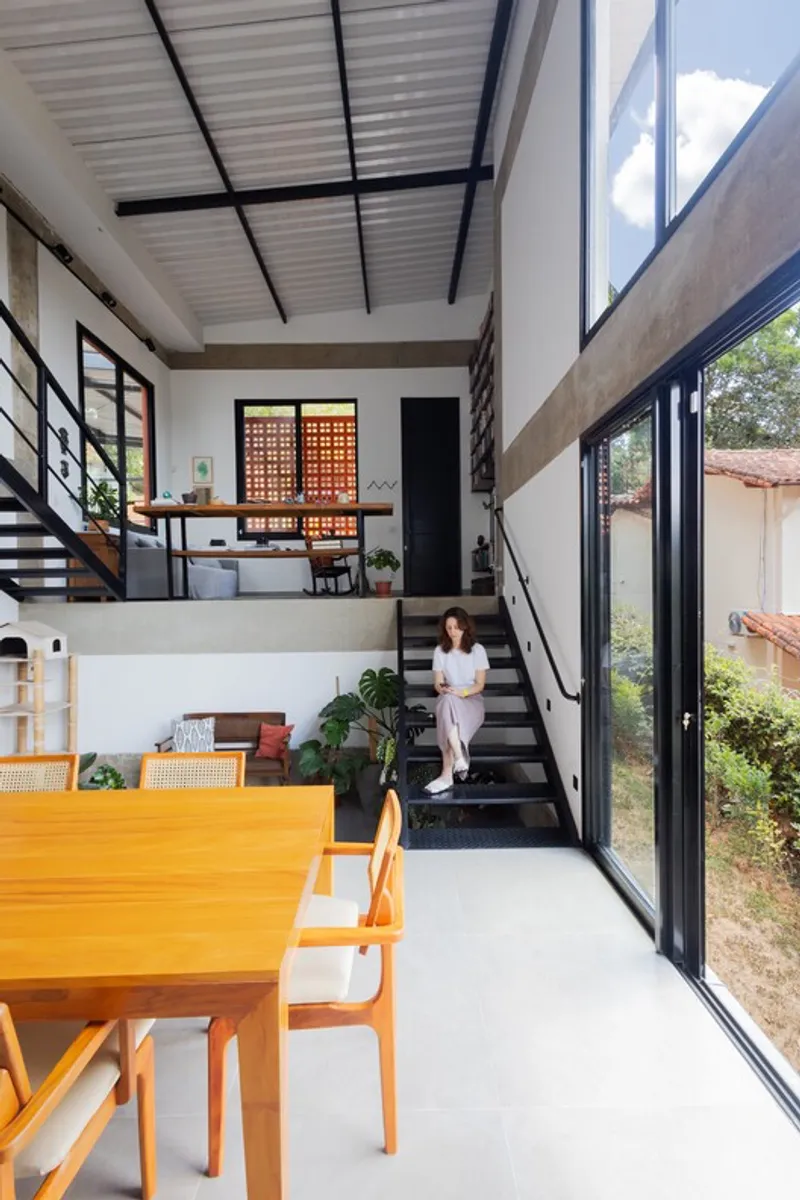
Daylight enters vertically through tall glazing and horizontally through deck-facing apertures, creating shifting luminance through morning and dusk. Textures of timber grain and concrete pores become spatial drawings — shadows articulate what architecture chooses not to verbalize.
The house never competes with its landscape — it frames and amplifies it.
Between Memory and Inhabitation
Casa Ouro Velho is built on the place of a ruin — a memory preserved and reactivated. The decision to reuse the footprint was emotional, familial, ancestral. It is not a house designed for residents alone but for history, for lineage, for generational return.
Where the original home once stood, now stands a kitchen — a placement that honors the cultural importance of cooking as center of life in Minas Gerais. A studio floats above, compact yet present, like an upper-floor guardian of memory.
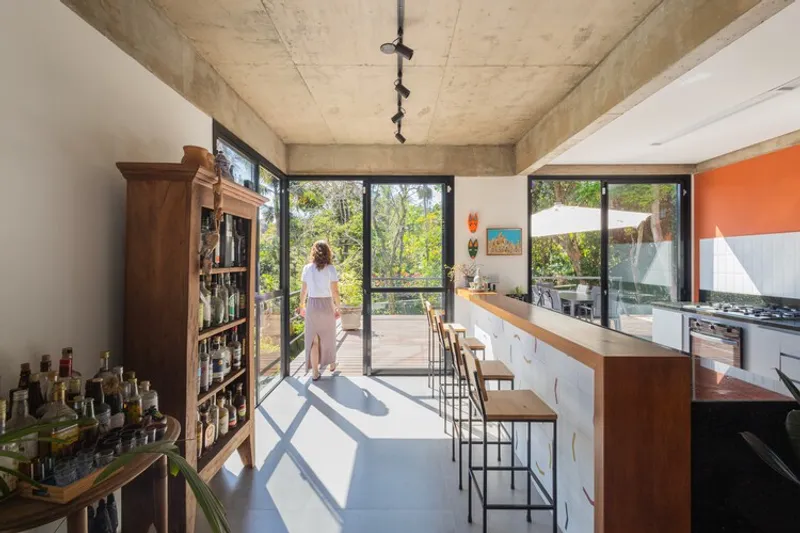
Through these decisions, the past is not erased — it is renovated into the present.
A House of Restraint and Expansion
Casa Ouro Velho demonstrates that budget limits can stimulate creativity rather than restrict it; that a steep forest lot can be a guide instead of a burden; that architecture can preserve vegetation, amplify view, and construct new domestic rituals without environmental sacrifice.
It proves that a home can be generous without being large, monumental without being massive, dramatic without being loud.
It is a house that descends like a thought into the landscape.A house that opens slowly, like a page of memory being turned.A house named for gold — not for wealth, but for the warm light that shapes it every morning.
All the Photographs are works of Sofia Vasconcelos



Popular Articles
Popular articles from the community


The Musturak Paradise: Senior Living Architecture for a Connected Future in Temara, Morocco
The Musturak Paradise reimagines senior living architecture in Temara via private homes, social spaces, culture, community, and shared care.

Co-life: Sustainable Architecture for Age-Friendly Community Living
Co-life reimagines sustainable architecture for seniors through courtyards, rammed earth, shared gardens, and spaces designed for belonging.

Co-Life: Senior Housing Design That Reconnects Older Adults With the City
Co-Life reimagines senior housing design through healing gardens, shared streets, workshops, and a sustainable community across generations.

The Earth Pod: 3D Printed Homes for Resilient Refugee Communities
The Earth Pod reimagines refugee housing through 3D printed homes made from clay, combining resilience, self-sufficiency, and rapid shelter.


Similar Reads
You might also enjoy these articles


Hodi-Mandai Geram
Project Function: Preservation and revitalization of the Intangible heritage and socio-spatial identity of the Hodi by Housing, Cultural Memory Center, Sacred Grove, landscape, local tourism economy


Olio Towers: A Mid-Rise for Performers That Fuses Housing, Rehearsal, and Stage
Located blocks from Houston's Theater District, this modular tower stacks living units around a central performance atrium.

Oasis: Modular Green Housing Carved into Dhaka's Urban Fabric
A shortlisted Plugin Housing entry reclaims unauthorized settlements in Dhaka with stepped concrete volumes, green roofs, and ventilation-driven design.

Black Hole: A Floating Megastructure for the Post-Physical Era
Emiliano Mazzarotto envisions a spherical, self-scaling arena where e-sports, digital hotels, and holographic stadiums replace traditional public space.

Explore Architecture Competitions
Discover active competitions in this discipline



Challenge to reimagine the Iron Throne


Photograph architecture without architects


Illustrate the lost glory of Angkor Wat - Render Challenge


Design challenge to reuse E-waste
Comments (0)
Please login or sign up to add comments
No comments yet. Be the first to comment!