

HAMS and, Studio Turns a Tokyo Grid-Plan Apartment into a Plaza You Can Live In
A suburban Tokyo renovation dissolves corridors and rigid rooms to create 50 years of adaptable, nuanced domestic life.


Most apartments built during Japan's postwar economic boom were optimized for production speed, not for life. The grid-plan units stamped out between the 1950s and 1970s followed a simple logic: corridor along one side, rooms stacked like cells along the other, each assigned a single function. Decades later, a couple in their 30s asked HAMS and, Studio to rethink one of these 80-square-meter units in suburban Tokyo, not as a cosmetic refresh but as a structural renegotiation of how rooms relate to one another. The brief was ambitious: make this apartment work for the next 50 years.
What emerged is the One Nuance Apartment, a project whose name signals its central preoccupation. "Nuance" here refers to the space between binary states: open and closed, public and private, active and still. By stripping out every corridor and connecting a ring of smaller rooms directly to a central living area, the architects turned a compartmentalized flat into something closer to a tiny urban plaza, complete with its own inner facades, streetscape rhythm, and shifting thresholds. It is a compelling argument that renovation, when done with conviction, can outperform new construction in spatial intelligence.
The Plaza Principle
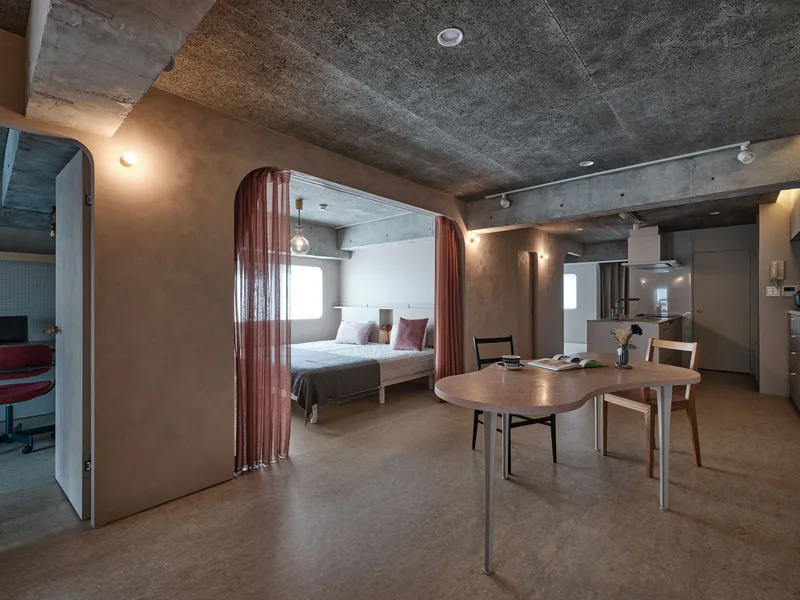
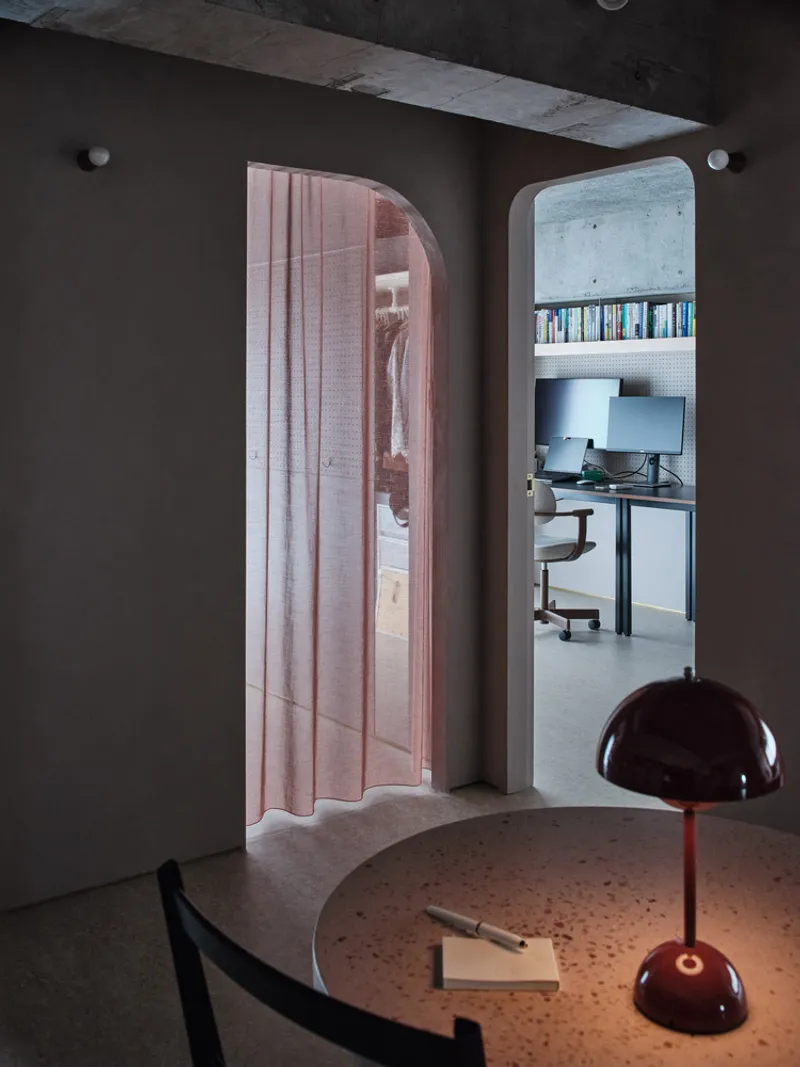
The most radical move here is conceptual rather than material. HAMS and, Studio reconceived the living room not as a destination room but as connective tissue, a shared ground from which every other space is accessed directly. The corridor, that hallmark of the grid-plan apartment, is gone entirely. In its place, the living area absorbs all circulation, functioning like a small public square surrounded by alcoves, workrooms, and sleeping quarters. You move through this home the way you might move through a neighborhood: choosing a path based on mood, not mandate.
The effect is immediately legible in the dusk-lit view of the open plan, where a curtained sleeping alcove, a round dining table, and the exposed concrete ceiling coexist without hierarchy. No single function dominates. The room is genuinely multi-valent, and it achieves that quality not through blankness but through the careful choreography of thresholds around its perimeter.
Thresholds as Instruments
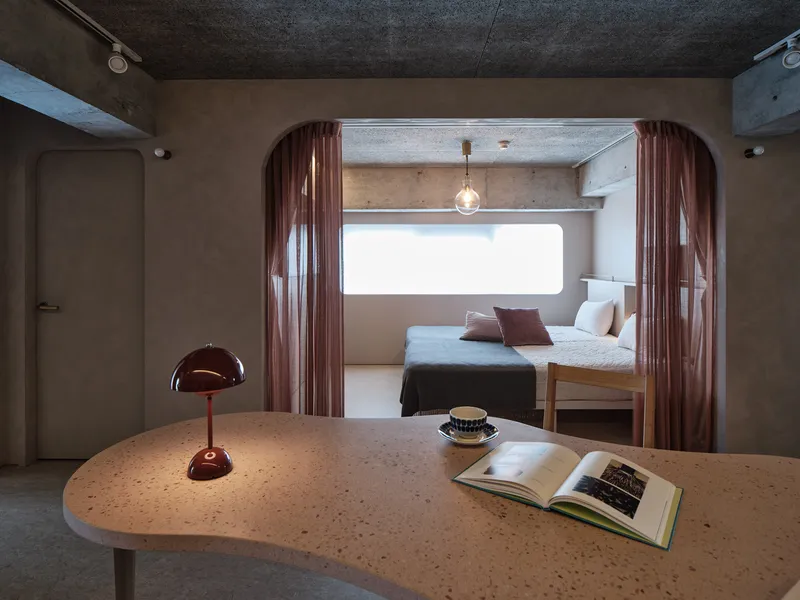
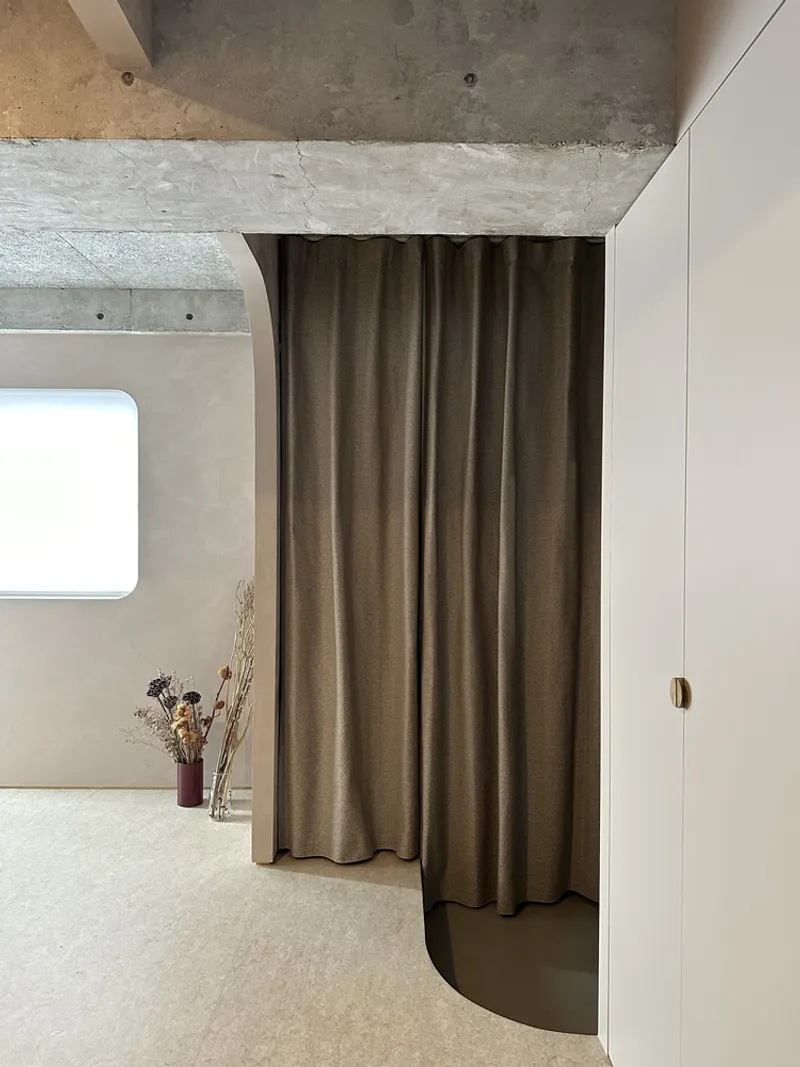
If the living room is the plaza, then the arched openings and curtains are its storefronts. HAMS and, Studio deploys a deliberate inventory of partition types: swing doors, sliding panels, transoms, and fabric curtains, each calibrated to a different degree of permeability. The rose-colored curtains, visible in several views, are perhaps the most evocative element. Suspended from the raw concrete ceiling, they soften the boundary between bedroom and living space without erasing it. Pull the curtain aside and you have a single continuous room. Let it fall and you have a private enclosure, filtered by color and diffused light.
The curved brown fabric curtain near dried flowers in glass vases demonstrates how textiles become spatial actors here, not decoration. The weight and drape of the material, the radius of its hanging track, the way it catches ambient light: these are all design decisions as deliberate as a wall's placement. The result is a home where openness is not a fixed condition but a dial you can turn.
Arched Openings and the Inner Facade
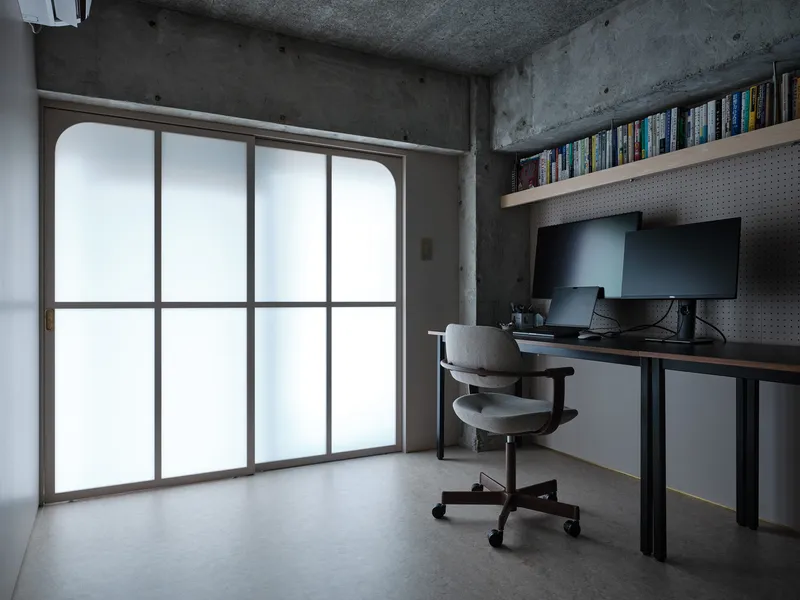
The double-opening concept is the project's most architecturally rigorous idea. Outer openings along the three exterior walls bring daylight and ventilation into the perimeter rooms. Inner openings, the arched thresholds cut into the walls facing the living room, then relay that light deeper into the plan. The walls of the smaller rooms are finished with a glossy coating that bounces light toward these inner openings, turning each peripheral space into a kind of lantern for the central zone.
The paired arched openings framing the bedroom and the workspace read almost like a streetscape elevation, two distinct addresses on the same lane. One reveals a translucent arched window and pegboard-backed desk. The other frames a sleeping nook with rose curtains. The formal consistency of the arches unifies the composition, while the materials and colors behind each one differentiate the program. It is a small but potent lesson in how repetition and variation can coexist in a confined footprint.
Material Honesty Under a Concrete Ceiling
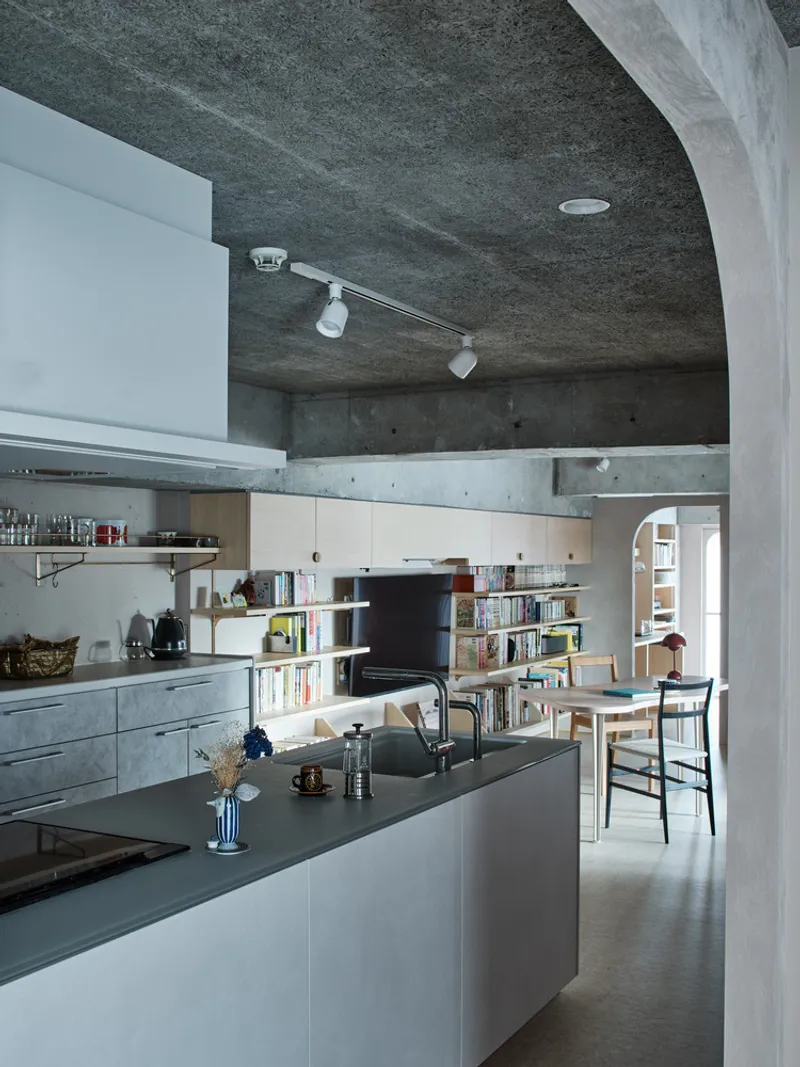
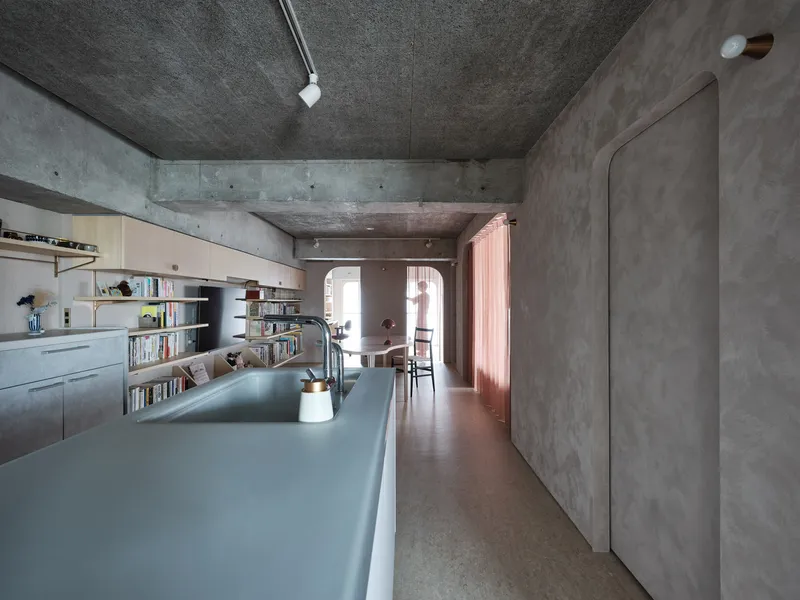
The exposed concrete ceiling is the project's constant. Its vaulted beams run the length of the apartment, and HAMS and, Studio wisely left them bare, using them as an ordering device and a reminder of the building's structural reality. Against this rugged datum, the architects layer a restrained palette: robust plaster on internal walls, glossy solid finishes on passage walls, and muted cabinetry in the kitchen. The galley kitchen, stretched beneath a dominant ceiling beam with rose curtains glowing at its far end, is one of the apartment's strongest compositions. It reads as both utilitarian and theatrical.
Track lighting mounted to the concrete follows the beam lines, reinforcing the apartment's longitudinal axis without competing with the structure. The island countertop and open shelving are straightforward, almost industrial, yet the proportions feel generous. That generosity comes from the absence of corridors: the square meters that would have been lost to dead circulation are redistributed into rooms that are both larger and more useful than the original plan allowed.
Entry and the Art of Arrival
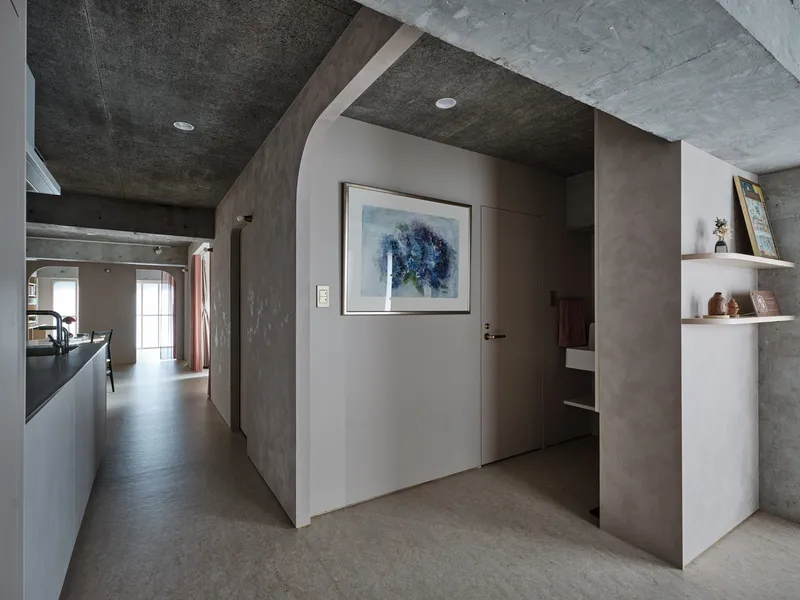
The entry corridor, with its white niche and painted ceiling vaults, signals the shift from public hallway to private interior with quiet authority. A small piece of artwork beside the doorway grounds the transition. The painted vaults overhead are a deliberate contrast to the raw concrete elsewhere, marking the threshold as a liminal zone: you are neither fully inside nor still in the building's common areas. It is a small gesture, but it sets up the spatial sequence that follows.
From here, the view opens through arched frames toward the deeper rooms. The terrazzo table in the foreground of one vantage point acts as a visual anchor, pulling the eye through successive layers of curtain, light, and material. The architects understand that depth in a small apartment is not about actual distance but about the number of legible layers between you and the furthest visible point.
Why This Project Matters
The One Nuance Apartment is a renovation of just 80 square meters, but its implications extend well beyond its footprint. Millions of grid-plan apartments from Japan's economic boom era remain occupied today, and most renovations treat them as blank canvases for new finishes. HAMS and, Studio instead treated the existing structure as a constraint worth interrogating. By removing corridors, introducing a taxonomy of thresholds, and reframing the living room as connective infrastructure, they produced a spatial model that could be adapted across an enormous housing stock.
More fundamentally, the project challenges the assumption that flexibility requires openness. The One Nuance Apartment is flexible precisely because it is not one big room. It is a collection of small, characterful spaces linked by adjustable boundaries. Privacy, light, sound, and movement can all be tuned without moving a single wall. For a couple planning to inhabit this home for half a century, that kind of resilience is not a luxury. It is the whole point.
One Nuance Apartment by HAMS and, Studio. Located in Tokyo, Japan. 80 m². Completed in 2023. Photography by Akira Nakamura.
About the Studio
Share Your Own Work on uni.xyz
If projects like this are the kind of work you want to make, uni.xyz is a place to publish your own, find collaborators, and enter design competitions.


Popular Articles
Popular articles from the community


Extended Shell: Retrofitting Kolkata's Balconies as Living Urban Thresholds
A modular retrofit system recovers the social and environmental intelligence of Kolkata's historic verandas for contemporary Park Street residents.

Tsunami Convergenics: Turning Catastrophic Ocean Forces into Underwater Housing Infrastructure
A speculative underwater settlement off the coast of Onagawa, Japan, treats tsunamis and typhoons as energy sources rather than threats.

Manzana Morphosis: Stretching Barcelona's Grid into a Living Landscape for 2050
A radical reworking of the Eixample manzana turns density into a tool for generous public space, vertical ecology, and environmental performance.

Cloaked Colonization: A Mobile Underwater Habitat That Moves Like a Fish
Micah Abaya's shortlisted EHC Pacific entry reimagines ocean settlement as a dispersed network of self-sustaining architectural organisms.

Similar Reads
You might also enjoy these articles


Hodi-Mandai Geram
Project Function: Preservation and revitalization of the Intangible heritage and socio-spatial identity of the Hodi by Housing, Cultural Memory Center, Sacred Grove, landscape, local tourism economy


Olio Towers: A Mid-Rise for Performers That Fuses Housing, Rehearsal, and Stage
Located blocks from Houston's Theater District, this modular tower stacks living units around a central performance atrium.

Oasis: Modular Green Housing Carved into Dhaka's Urban Fabric
A shortlisted Plugin Housing entry reclaims unauthorized settlements in Dhaka with stepped concrete volumes, green roofs, and ventilation-driven design.

Black Hole: A Floating Megastructure for the Post-Physical Era
Emiliano Mazzarotto envisions a spherical, self-scaling arena where e-sports, digital hotels, and holographic stadiums replace traditional public space.

Explore Residential Building Competitions
Discover active competitions in this discipline

Challenge to design mud housing for contemporary communities

Challenge to reimagine the Iron Throne

Photograph architecture without architects

Illustrate the lost glory of Angkor Wat - Render Challenge
Comments (0)
Please login or sign up to add comments
No comments yet. Be the first to comment!