
Organic Shelves
Farming for the community

Being one of the largest producers in the agricultural field, the Netherlands exports a massive average of 65 billion Euros worth of vegetables, fruit, flowers, meat, and dairy products each year. The country achieves this using its innovative farming practices procured over years of refining. With copious amounts of food to go around, consumers buying patterns come into question. Building an environment where consumption meets production, creates the ideal setting to encourage sustainable buying.
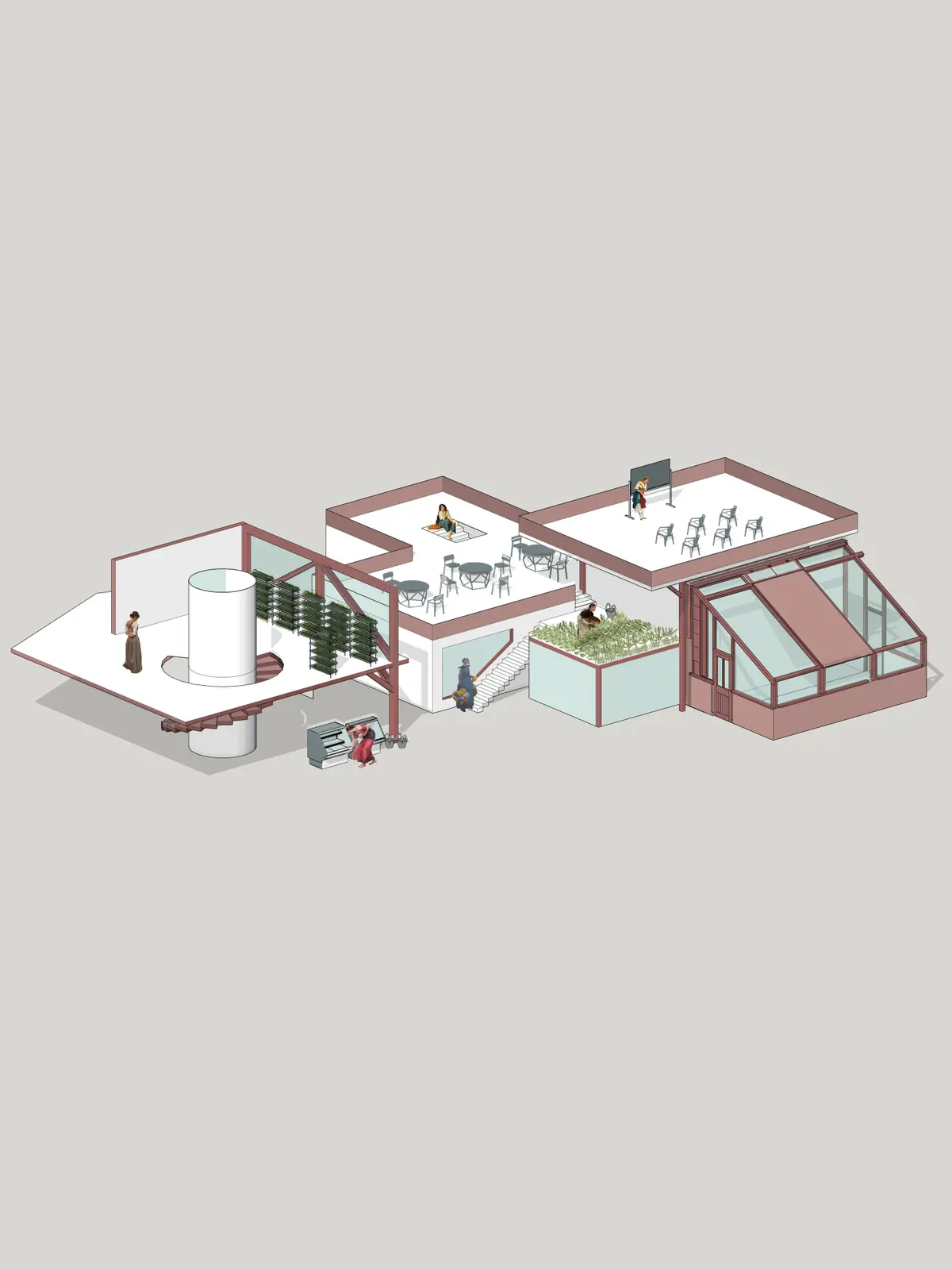
With that in mind, the design solution proposed is to make use of sustainable technology whilst keeping it within the reach of the shoppers. The circulation has been thought through so as to break out of the traditional supermarket layout. The spaces have been arranged such that the user group interacts with the process as well as the final product.
The market space being the rendezvous of various user groups, the design has been made to accommodate all their needs. The proposal is an amalgamation of traditional farming methods and contemporary techniques. By creating the same channel for production and public consumption on the same site, we are moving towards a more sustainable lifestyle.
The journey:
The entry into the site is provided through the SE direction after considering the smaller road running by the site making it away from traffic and easier to access for pedestrians.
Upon entry into the site, the user first interacts with the seasonal market. Moon gate arches with vines growing on top for shade create an enchanting space for the hustle-bustle to place. The seasonal market has been given keeping the local produce in mind. Local vendors can put up stalls and transactions happen between the respective vendor and shopper.
Greenhouses on both sides of the seasonal market sell gardening equipment and fertilizers to promote gardening in the locality.
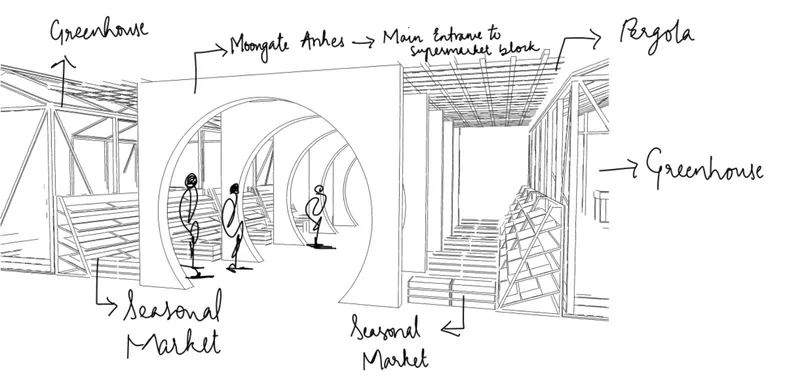
The user then enters the built structure which then opens into the pathway leading into the garden spaces. On the right, the building leads into the supermarket. This has been made to maintain an element of enjoyment while also giving an option of going directly to their desired products instead of having to go through the entire supermarket.
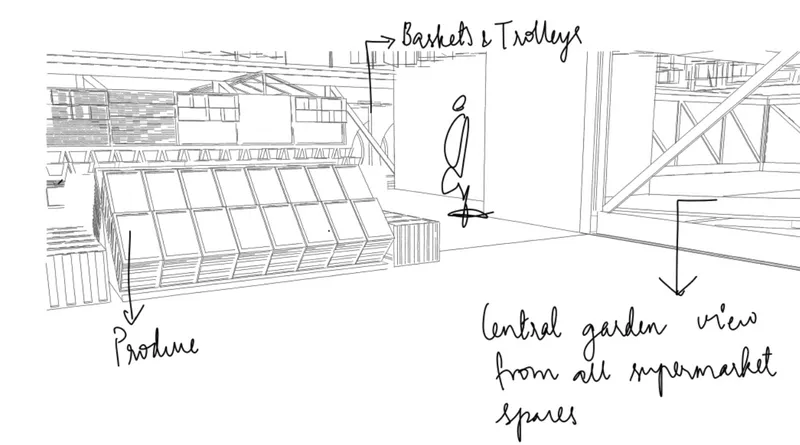
The Garden spaces have been inspired by the concept of forest gardening. Panels with information regarding the products are placed on the pathway at intervals for educating the community. The pathway leads onto a tulip garden enclosed by round seating for customers to relax between shopping. The tulips are also sold inside the supermarket. The pathway circulates throughout the site thus connecting and circulating the open spaces.
Customers who enter the supermarket have an option to go up to the terrace cafe or continue shopping in the supermarket. This is done to streamline the circulation through the building. The stairs lead into the greenhouse on the first floor. As they enter they are met with the immaculate view of the hydroponics. The user can then exit the greenhouse to enter the terrace cafe or continue on to the first-floor pathway which runs above the gardens below.
The cafe on top provides a beautiful view of the forest garden and greenhouses. Customers can get a light snack and enjoy the view.
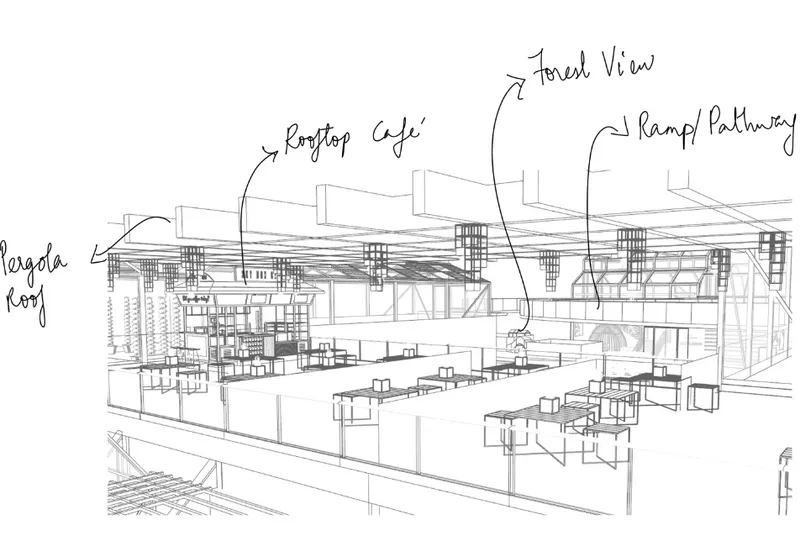
The pathway leads to the next greenhouse on the opposite side. The journey through these greenhouses has been kept separate from the supermarket circulation so as to not make it a hassle for regular customers. The production of the products sold in the supermarket below is done in these greenhouses. Hydroponics is used in these greenhouses to get maximum produce with minimum wastage. Customers can see and interact with the process here. While the main buying activities happen downstairs, customers can buy from these greenhouses to get a first-hand experience of the process.
A grid structure runs through the supermarket and greenhouses to provide a break from the monotonous buying and connects the interior spaces to the gardens outside.
A chicken coop is provided at the edge of the site to create a dynamic space for interaction with the animals. The coop has been designed in such a way that 2 plots of land for the animals' habitation are connected by a bridge creating a chicken coop run. An opening has been left under the bridge for children to run through and play.
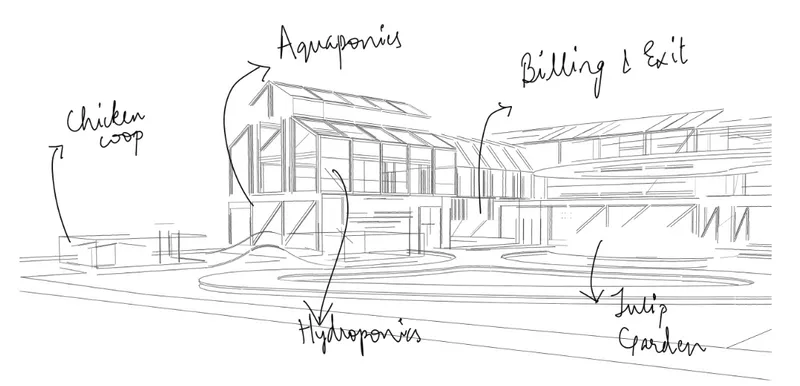
Near the chicken coop, the supermarket area has been allotted for aquaponics and a fish market. This has been done to group the animal-based products in one place to make it easy for the customers. The customers can also view the aquaponics behind the fish market counter.
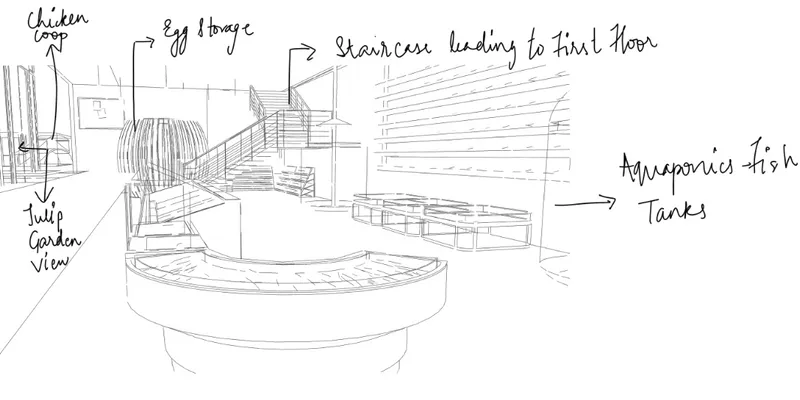
The billing counters are provided at the corner of the building, aptly situated at the end to avoid crowds formed during long queuing.
The customers can then exit the site out of NE into the main road so as to easily access their parked vehicles with their groceries.
A service entry has been provided through the SW from the smaller road so as to not cause traffic on the main road.
With this design, we hope for the community to have increased awareness about sustainable buying and consumption while having a positive and memorable experience in that process.

Popular Articles
Popular articles from the community


Cloaked Colonization: A Mobile Underwater Habitat That Moves Like a Fish
Micah Abaya's shortlisted EHC Pacific entry reimagines ocean settlement as a dispersed network of self-sustaining architectural organisms.

Faces of the Soviet Avant-Garde: Turning Moscow's Street Names into an Open-Air Museum
A network of sculptural installations across a Moscow residential district transforms forgotten architect names into spatial encounters with cultural memor
Extended Shell: Retrofitting Kolkata's Balconies as Living Urban Thresholds
A modular retrofit system recovers the social and environmental intelligence of Kolkata's historic verandas for contemporary Park Street residents.

Manzana Morphosis: Stretching Barcelona's Grid into a Living Landscape for 2050
A radical reworking of the Eixample manzana turns density into a tool for generous public space, vertical ecology, and environmental performance.

Similar Reads
You might also enjoy these articles

The Rhythm of Seasons
A Farmers' Market Connecting Nature and the City

More Than a Building-Designing a Living System
More Than a Building-Designing a Living System
Base Beyond
DESERT COMPOUND ARID: TOURISM OF ABSENCE AND ABUNDANCE

Comments (0)
Please login or sign up to add comments
No comments yet. Be the first to comment!