
Orion's Pavilion
Connecting the stars

Concept and Intent
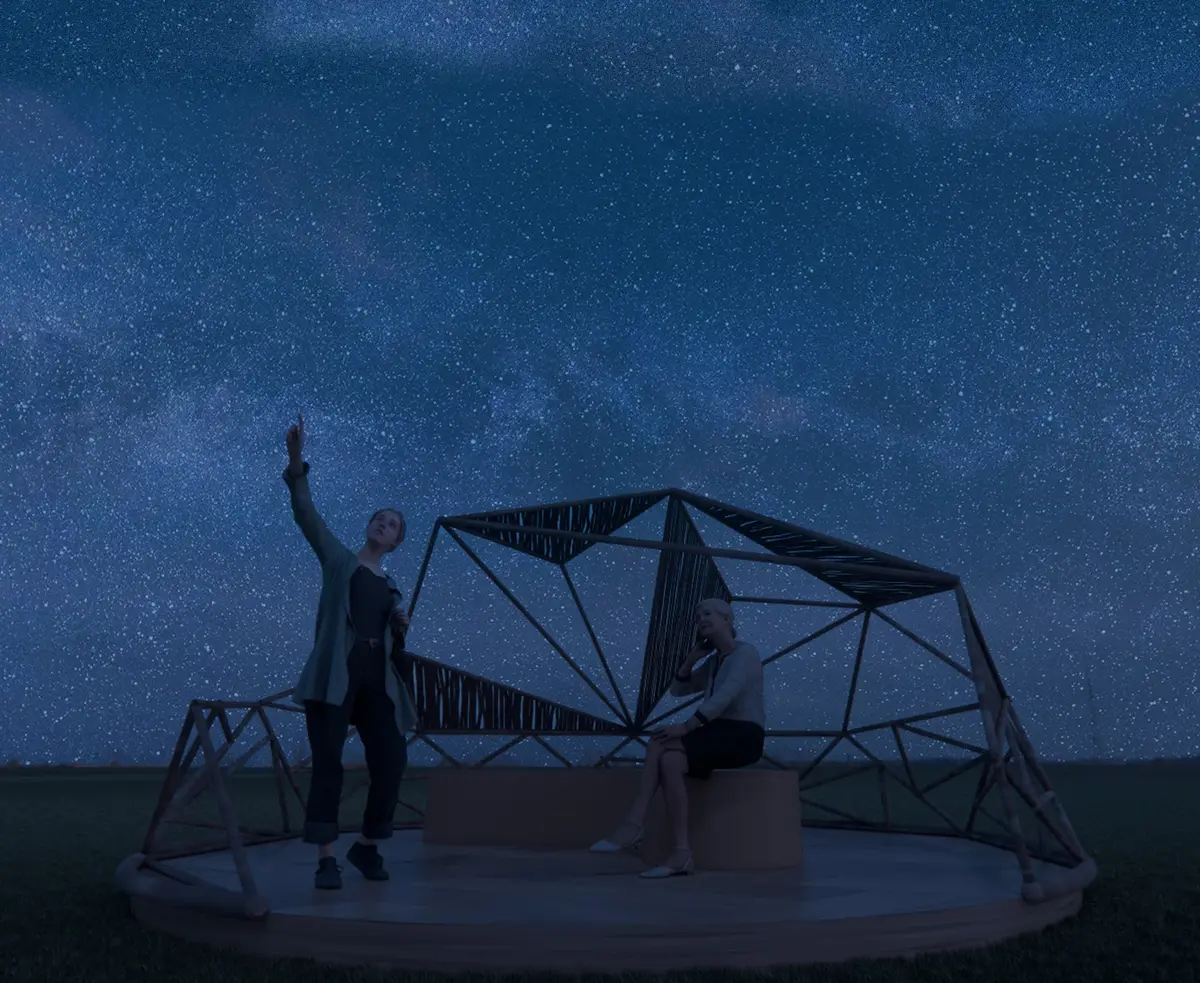
Orion’s Pavilion was created to encapsulate the culture of stargazing as well as the stories that are told from the stars with framing that resembles the imagery of constellations, as well as provide open views of the site and its surrounding nature. The connection between pavilion and site allows for a comforting and relaxing experience for people to enjoy while stargazing. Orion’s Pavilion is named after the constellation Orion; one of the most recognizable constellations, which tells the story of the legendary hunter from Greek Mythology. The stories that constellations tell play crucial roles in the larger context of stargazing, and Orion’s Pavilion displays this connection. Pavilions are found within the site as clusters reminiscent of constellations such as Orion and promote community between stargazers.
Iterations and Design Investigation
We went through several different iterations of the project based on different themes and precedents we analyzed. One of the primary precedents we looked at was the Stonehaugh Stargazing Pavilion designed by students of Newcastle University in conjunction with Kielder Art and Architecture in the UK. Their connection to the sky through its upwards curved opening was a form that spoke a lot about humans' connection to the stars. The elegant design as well as its relatively small form were intriguing to us and were something we wanted to replicate. Another precedent of importance was the AIRLAB pavilion in Singapore designed by the Bay Architects. The tubing used to compose the pavilion was the inspiration for our frame, with the steel materiality swapped out for bamboo.
We also explored different moving mechanism ideas in order to allow a stargazer to adjust their view to whatever they wanted; however, we decided that moving parts would be too heavy and would therefore be harder to disassemble, and ended up scrapping the concept as a whole. The idea of being able to see all of the skies within the pavilion was important to us, so we tested many different shapes that would allow that possibility such as spirals, however, the solution we discovered was a space frame. Because of the openness of the pavilion’s frame design, and the constellation compositions within the site, the pavilion is easily replicable throughout the entirety of the park, able to provide a full view of the sky anywhere.
We decided to use tubed framings so that we could imitate constellations using the tubing within the pavilion. Constellations and the stars that compose them are the primary focus of stargazing, and we wanted to respect the importance of them within our design. The usage of tubing as a frame is designed to provide a full view of the sky from within the pavilion. To capture this experience, it is composed as a frame in order to provide openings for stargazers to look through. Additional panels within the frame provide variation within our design as well provide shelter and shade to the occupants of the pavilion.
Material
Orion’s Pavilion is made primarily of wooden tubing and bamboo panelling as it is lightweight, as well as sustainable and won’t cause any harm to the surrounding environment. We chose bamboo for the panelling because it is highly sustainable and stronger while still being relatively lightweight. Although bamboo is uncommonly found in Hungary, there are a few Hungarians farms that grow it. The specific wood used for the panelling is local oak wood that is found around the site and is commonly used in Hungary. The tubing can be easily taken apart in order for quick assembly and disassembly of the pavilion.
Temporality
Due to its partial wooden materiality, the pavilion could suffer from deterioration such as mould over time from weather and other factors. To counteract this, waterproofing would need to be applied to the components of the pavilion. The modularity of the pavilion could help store the pavilion away during harsh weather conditions in order to keep it maintained. Since the park is closed during most of the winter season, the pavilions would be packed up and stored away.
Program
Orion’s Pavilion specifically takes into consideration the different types of stargazers and accommodates for that; allowing novice stargazers a view to the skies using their naked eyes, while also providing space for more experienced stargazers to set up and use telescopes to their fullest extent. Seating is provided in the middle of the pavilion for those stargazers who want to rest while still enjoying the stargazing experience. The pavilion can also be accessed during the day and used as a pitstop to rest for any park-goers passing by.
Conclusion
Orion’s Pavilion encapsulates the spirit of stargazing through its constellation-like design and the promotion of community and connection. Its sustainable and modular design allows it to be easily assembled and disassembled, as well as easily replicable across the site, and across the world as well. Orion’s Pavilion provides a simple yet elegant design that takes full advantage of stargazing and will have stargazers wanting to return every time.

Popular Articles
Popular articles from the community


The Amber Palace Opera: A Geological Fiction Surfaces on Tallinn's Baltic Waterfront
Pierre Brillard reimagines a Baltic legend as a public landscape, opera house, and waterfront promenade rooted in Tallinn's coastal identity.

Aquadapt: An Underwater Habitat That Rewrites Its Rooms by the Hour
Curved modules ring the seabed while one shell shifts from breakfast room to cinema, farm and football pitch as residents' needs change.


ETEH Reworks the Shared Spaces of São Domingos School in Brazil Around Timber, Color and Hanging Plants
At São Domingos School in Brazil, 436 m² of hall, refectory and library are recast with timber joinery, a yellow and blue code and trailing greenery.

LT2A and OPEN Architectes Thread a Brick and Glass High School Through a Wooded Belgian Campus
In Braine-l'Alleud, a 3,000 m² wing for Collège Cardinal Mercier pairs pale brick with a glazed colonnade, deferring to a small chapel and a dense wood.

Similar Reads
You might also enjoy these articles

Vereda Arquitetos Renovates a 40-Square-Meter Apartment Inside Niemeyer's Copan Building
A compact unit in São Paulo's most iconic residential tower gets a material overhaul that pairs exposed concrete with bold blue Formica.

Shakur's House: Exposed Brick as an Interior Organiser in a 168 m² Mashhad Residence
Brick moves indoors in this Mashhad residence, where masonry walls, glass partitions and teal planes sequence a compact home without closing it off.

Day and Night Park: A Time-Based Urban Newsstand in Beijing
A temporary urban newsstand in Beijing blending travel, light, and reading through poetic colors, compact form, and community-focused design.

Modernist Patio Renovation in El Masnou, Barcelona by Oliver Segura Arquitectura + Cebrià Arquitectura
Modernist patio renovation blending tradition and innovation with a movable pool, leveled floors, and Catalan materials in El Masnou.

Explore Cosmic Architecture Competitions
Discover active competitions in this discipline


Challenge to reimagine the Iron Throne

Photograph architecture without architects

Illustrate the lost glory of Angkor Wat - Render Challenge

Design challenge to reuse E-waste
Comments (0)
Please login or sign up to add comments
No comments yet. Be the first to comment!