
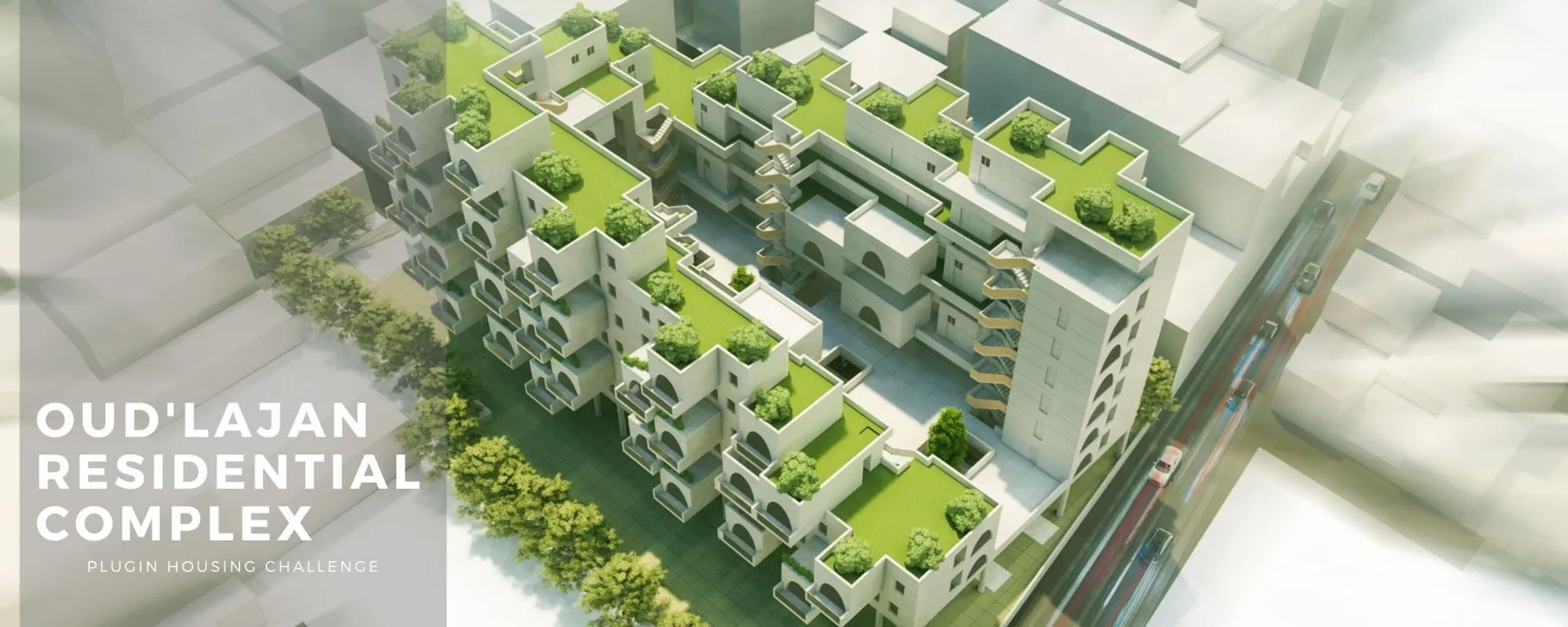
Oud'lajan Residential Complex: Modular Housing Rooted in Persian Vernacular
A prefabricated housing complex in Tehran's historic fabric fuses wind towers, Persian arches, and modular construction for urban regeneration.


What happens when you drop a modular, prefabricated housing system into one of Tehran's most historically layered neighborhoods? The Oud'lajan Residential Complex answers that question by refusing to choose between heritage and efficiency. Stacked concrete volumes punctuated by deep arched openings recall the courtyard houses and wind towers of Persian tradition, while the underlying logic is thoroughly contemporary: prefabricated, compact, and designed for reconfiguration as household needs evolve.
Designed by Sara Maleki, Mohammad Ali Izadi, Kurosh M, and Ali Zahaki, the project was a People's Choice Award entry in the Plugin Housing Challenge 2020. Set within the worn-out urban texture of historic Tehran, the complex takes on a dual ambition: delivering affordable, barrier-free housing at scale while actively regenerating a neglected district through public green areas, shared plazas, and cultural gathering points.
Arched Facades That Breathe and Remember
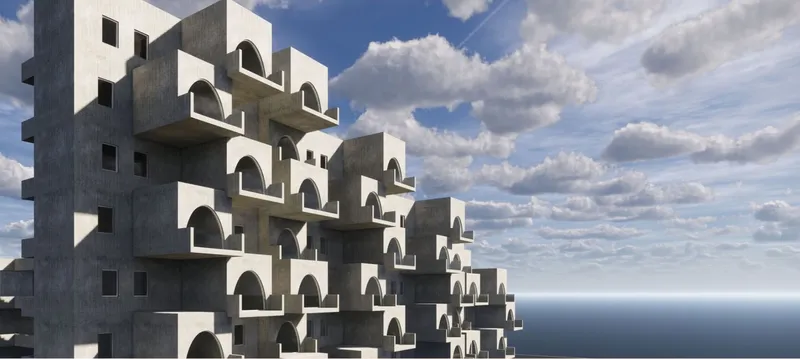
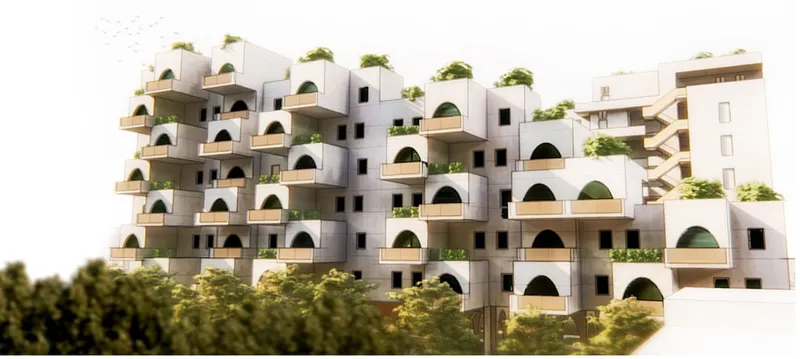
The most immediately striking move is the repetition of deep arched openings across every face of the complex. These are not decorative appliqué. Drawing explicitly from Persian architectural vocabulary and the precedent of Ricardo Bofill's Kafka Castle, the arches serve a climate-responsive function: they channel prevailing winds through the stacked units much like a traditional wind tower, maximizing natural ventilation while reducing dependence on mechanical cooling. The depth of each arch also controls solar gain, letting diffused light enter living spaces without direct glare.
The physical model reveals how the arched voids create a vertical rhythm that breaks the visual mass of what is, structurally, a repetitive modular grid. Planted terraces and rooftop vegetation further soften the silhouette, turning each tier into a band of green that enhances urban biodiversity and provides residents with shared recreational space right outside their doors.
Modular Volumes Stacked for Urban Density
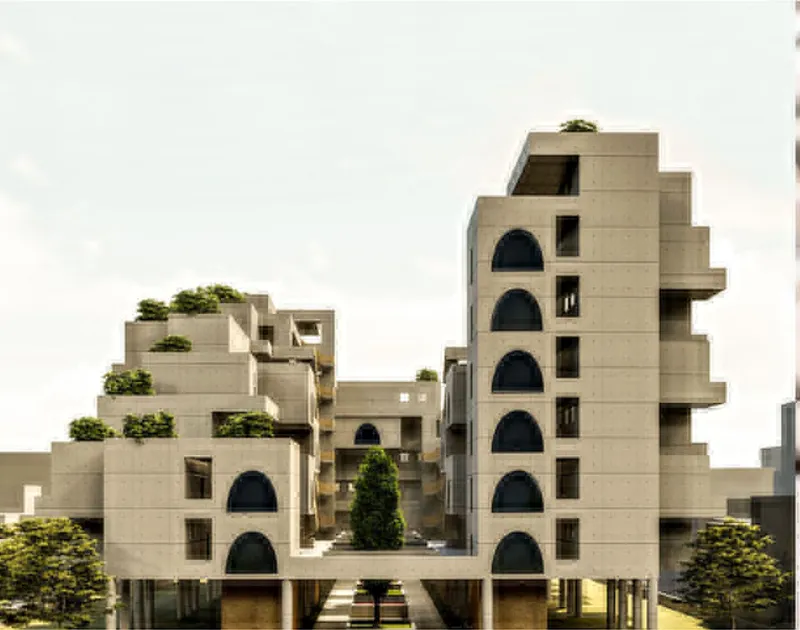
A sectional view through the physical model exposes the tunneling construction method at the heart of the structural system. Prefabricated columns support modular units that can be added, removed, or reconfigured as housing demand shifts. Vertical circulation cores run through the assembly, ensuring seamless movement across multiple levels without obstructing the open voids that give each unit its light and air. The approach drastically reduces construction waste, a critical consideration for any project claiming sustainability credentials.
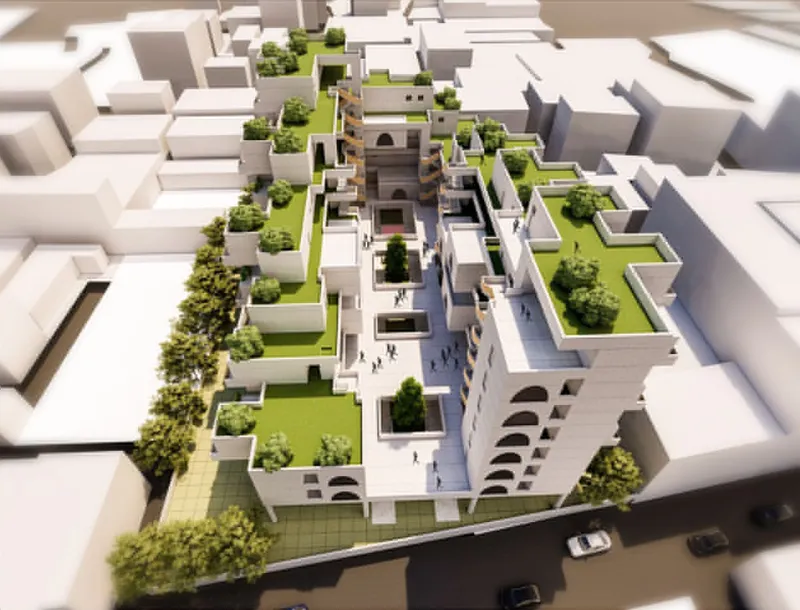
Seen from above within its white-block urban context, the complex reads as an intervention that respects the grain of Tehran's historic fabric rather than bulldozing it. The massing steps back at upper levels, allowing rooftop gardens to cascade downward and preventing the kind of sheer wall that would alienate pedestrians at street level. Public green areas and plazas are woven into the ground plane, reinforcing the designers' goal of strengthening community interaction rather than merely stacking units.
Concrete, Arches, and the Corner Condition
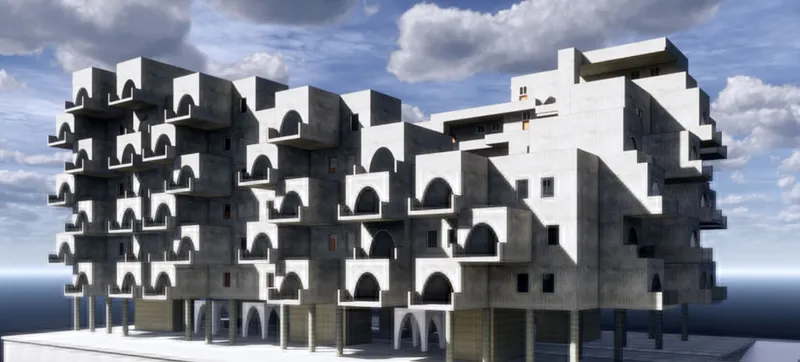
The corner perspective is where the project's tectonic logic becomes most legible. Each modular volume reads as a discrete box, its exposed concrete surfaces expressing the prefabricated assembly honestly. The arched openings punch through these boxes at varying scales, creating balconies, loggias, and double-height voids that prevent the facade from collapsing into monotony. Under an overcast sky, the raw concrete absorbs light in a way that makes the planted terraces pop, reinforcing the contrast between engineered structure and living green infrastructure.
Interiors Built Around Adaptability
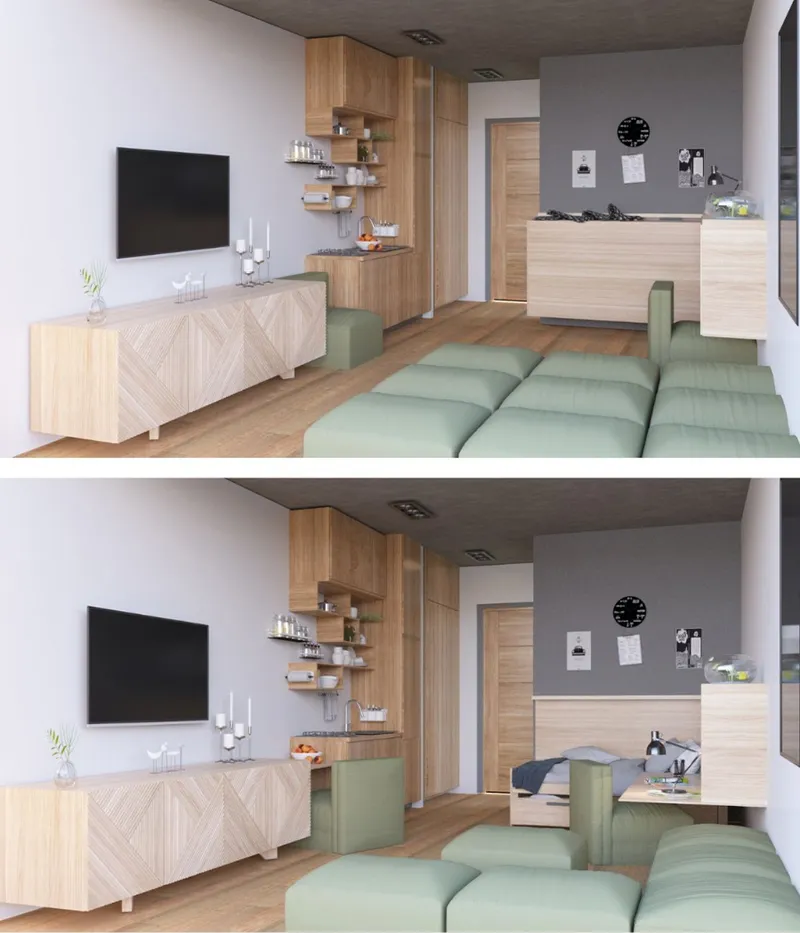
Step inside and the palette shifts from raw concrete to warm, light wood cabinetry and sage green seating set beneath an exposed concrete ceiling. The interior strategy relies on modular furniture and adaptable layouts that can accommodate different occupancy types, from single residents to families. Smart spatial planning keeps circulation tight, freeing up usable floor area in what are intentionally compact units. The open plan visible here demonstrates how natural light penetrates deep into the living space through the arched openings, validating the facade strategy as more than a formal gesture.
Accessibility runs through the design as a non-negotiable principle. The designers describe a barrier-free approach that eliminates physical obstacles for people with disabilities, a commitment that extends from unit layouts to the vertical circulation cores and shared public spaces. Off-the-grid features, including renewable energy systems and water recycling, push the complex toward self-sufficiency without requiring residents to compromise on spatial quality.
Why This Project Matters
Affordable modular housing projects too often treat cultural context as an afterthought, delivering efficient boxes that could land anywhere. The Oud'lajan Residential Complex resists that tendency by grounding its modular system in a specific architectural heritage: Persian arches, wind towers, and courtyard typologies are not stylistic choices but functional strategies that reduce energy consumption and improve comfort in Tehran's climate. The result is a complex that regenerates its neighborhood rather than merely occupying it.
The team of Maleki, Izadi, Kurosh M, and Zahaki demonstrates that prefabrication and cultural specificity are not opposing forces. By integrating community-oriented public spaces, accessible design, and off-the-grid infrastructure into a repeatable structural system, the project offers a replicable template for dense, sustainable, and socially engaged housing in historic urban cores well beyond Tehran.
View the Full Project
About the Designers
Designers: Sara Maleki, Mohammad Ali Izadi, Kurosh M, Ali Zahaki
Enter a Design Competition on uni.xyz
uni.xyz runs architecture and design competitions year-round that reward proposals with spatial conviction and real site intelligence.
Project credits: OUD'LAJAN RESIDENTIAL COMPLEX by Sara Maleki, Mohammad Ali Izadi, Kurosh M, Ali Zahaki Plugin Housing Challenge 2020 (uni.xyz).


Popular Articles
Popular articles from the community


Hill & Cross Opera: Sculptural Opera House Architecture Shaped by Tallinn’s Landscape and Identity
Hill & Cross Opera reimagines opera house architecture in Tallinn through its sculptural hill, civic plaza, glass wave and a luminous cross.

Riyadh For All: Intergenerational Urban Design for Active Aging in Rabat
Riyadh For All reimagines urban design in Rabat with intergenerational co-living, adaptive courtyards, and Moroccan cultural exchange today.

The Earth Pod: 3D Printed Homes for Resilient Refugee Communities
The Earth Pod reimagines refugee housing through 3D printed homes made from clay, combining resilience, self-sufficiency, and rapid shelter.

Play: Fragments of Their World
Familiar architecture becomes modular playground design, creating safe spaces where displaced children can learn, connect, imagine and play.
Similar Reads
You might also enjoy these articles

Day and Night Park: A Time-Based Urban Newsstand in Beijing
A temporary urban newsstand in Beijing blending travel, light, and reading through poetic colors, compact form, and community-focused design.

Modernist Patio Renovation in El Masnou, Barcelona by Oliver Segura Arquitectura + Cebrià Arquitectura
Modernist patio renovation blending tradition and innovation with a movable pool, leveled floors, and Catalan materials in El Masnou.

Alto Residencial Coop: Cooperative Housing Development in Santiago de Compostela by Carbajo Barrios Arquitectos
A linear cooperative housing complex blending white volumes and perforated metal façades, enhancing community living, natural light, privacy, and urban integration.
Vil Genis School by BPA ARCHITECTURE – Massy, France
Vil Genis School in Massy, France, features sustainable design, south-facing classrooms, community integration, accessible spaces, and modern educational architecture.

Comments (0)
Please login or sign up to add comments
No comments yet. Be the first to comment!