
Pablo Millán Restores a Forgotten Chapel in Porcuna as a Pantheon of Light and Stone
A three-pronged intervention recovers sixty centuries of material history inside a ruined Andalusian hermitage through archaeology, restoration, and restra


Porcuna sits on sandstone. Over sixty centuries of human presence have shaped the town from the same geological deposits, layering settlement upon settlement in a continuous act of building and rebuilding. The hermitage of Santa Ana was part of that continuum until abandonment and aggressive later interventions left it diminished, its remains entombed beneath decades of neglect. Pablo Millán's restoration does not attempt to reconstruct what was lost. Instead, it treats the ruin as an archaeological subject, a spatial vessel, and a vehicle for a single, elemental idea: that architecture is defined by the relationship between light and matter.
What makes this project worth studying is the discipline of its three-pronged strategy. The first front is archaeological excavation, carried out in collaboration with archaeologist Rafael Antonio Saco Montilla, which uncovered burial sites and stone foundations that now remain permanently visible. The second is heritage restoration of the surviving arched structures and vaulted chambers. The third, and most quietly radical, is the insertion of minimal contemporary elements, notably a glass floor plane and a vertical oculus, that reframe the existing fabric without competing with it. The result feels less like a renovation and more like a controlled revelation.
An Unassuming Threshold
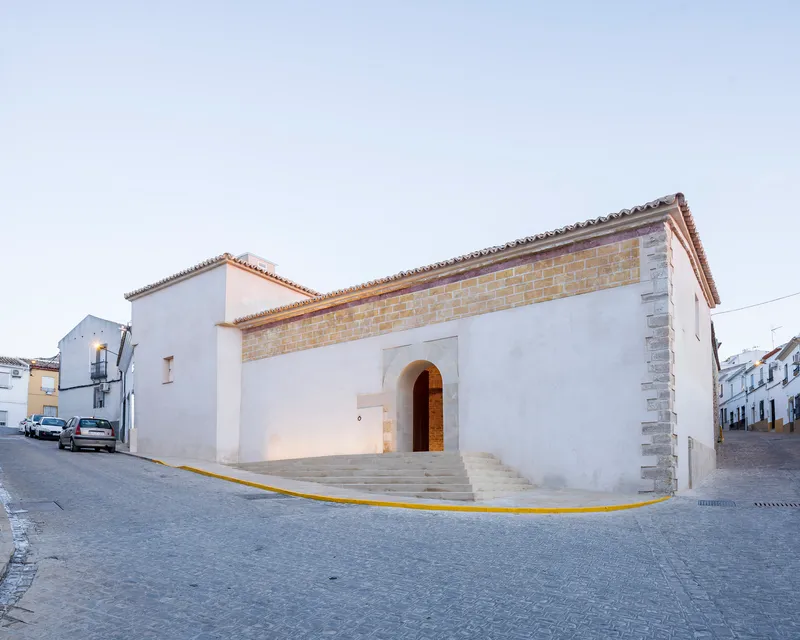
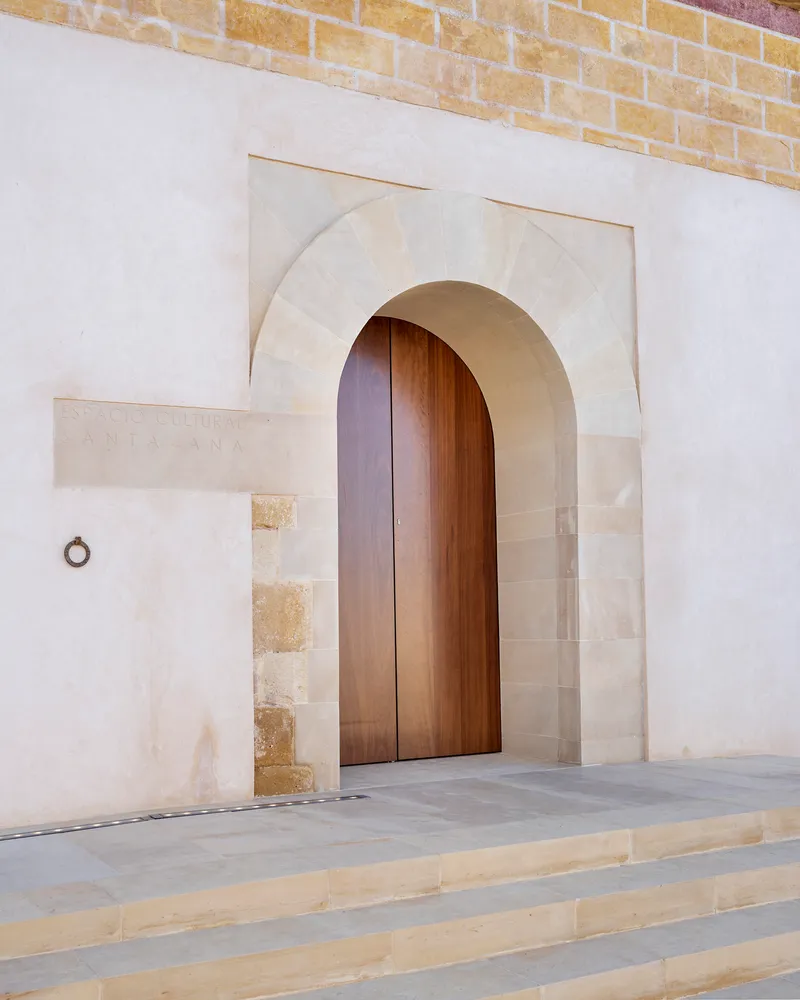
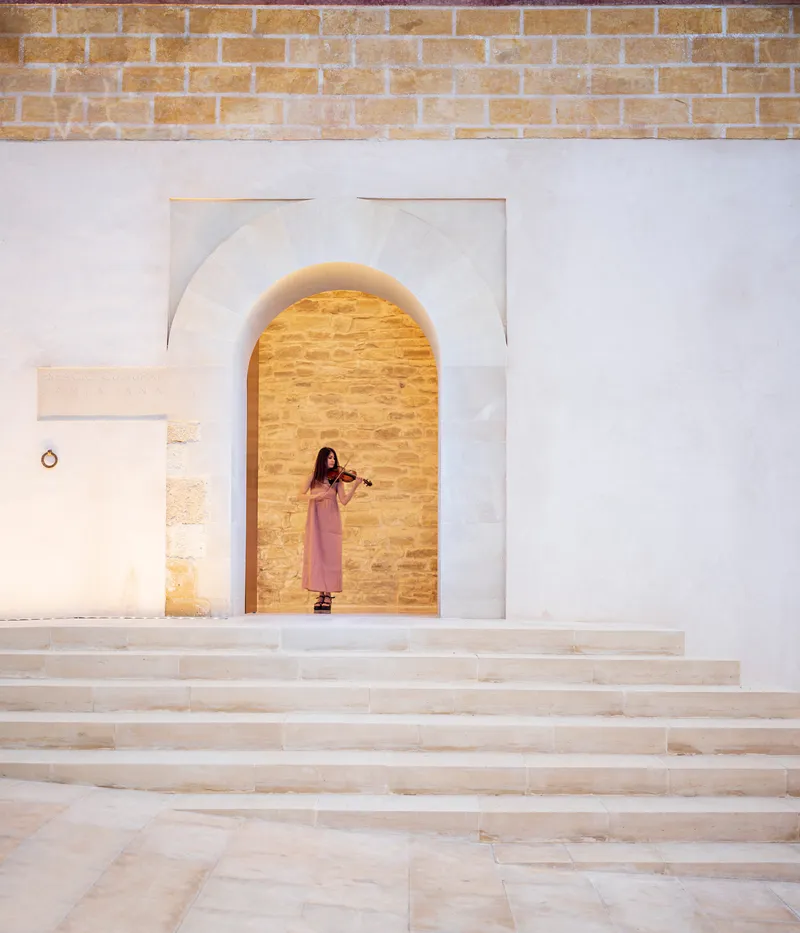
From the street, the chapel announces itself modestly. A white stucco facade, a terra cotta tile roof, and a single arched entry framed by limestone voussoirs are all that signal the presence of something exceptional within. The wide stone steps that rise to the portal establish a deliberate pace of approach, slowing the visitor before the interior takes over. At dusk, the whitewashed walls catch the last ambient light of the town, and the arch reads as a dark aperture, an invitation rather than a statement.
Millán understands that in a restoration of this kind, the exterior's job is to recede. The facade belongs to Porcuna's streetscape, not to the architect's ego. Its restraint is what makes the interior encounter so powerful by contrast.
Archaeology Underfoot
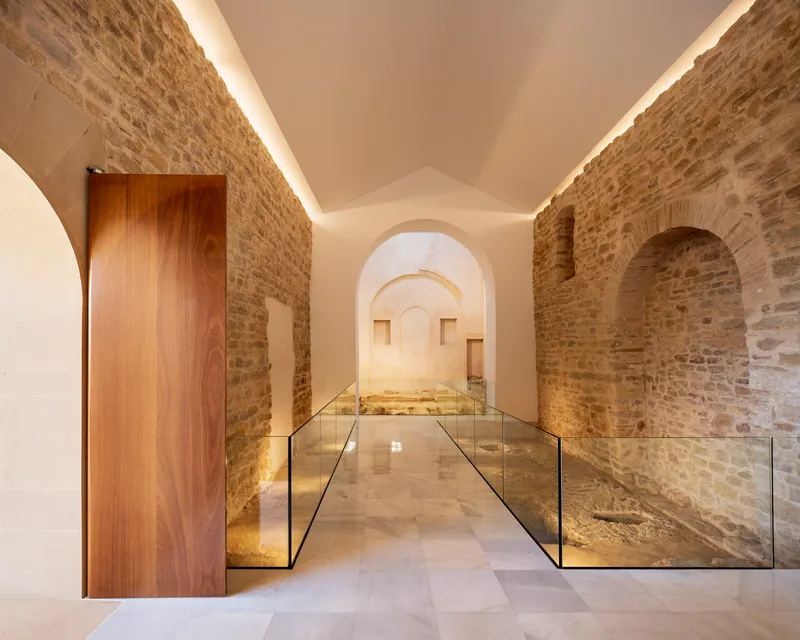
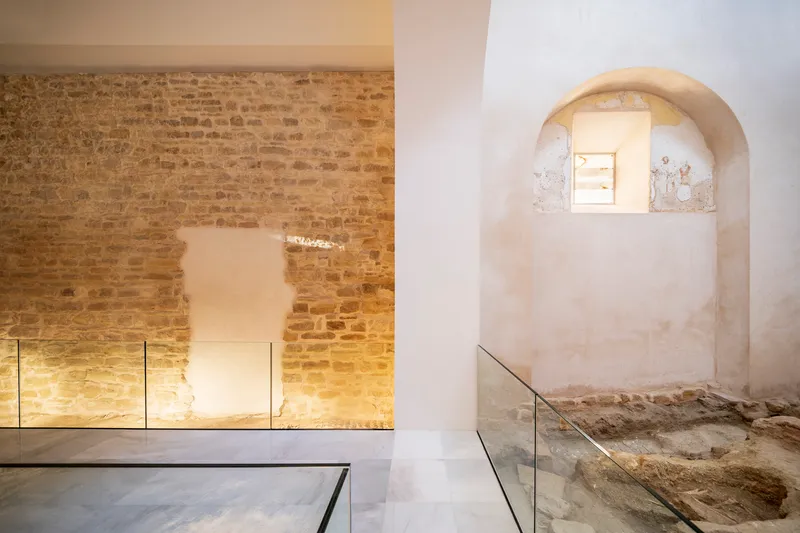
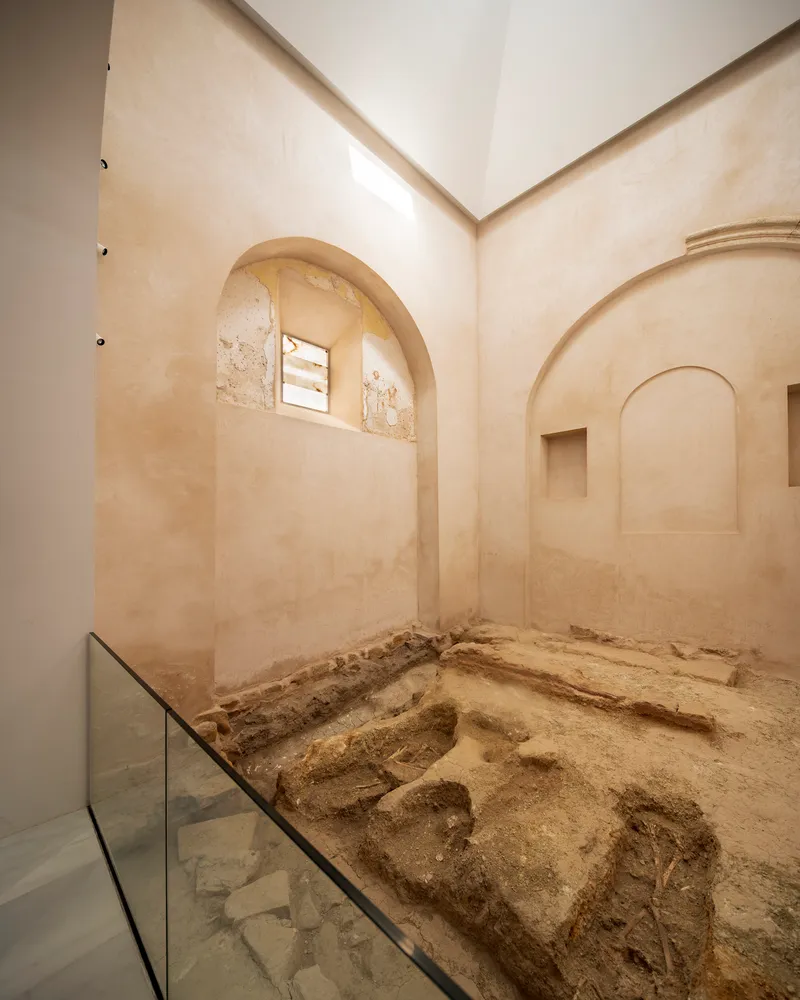
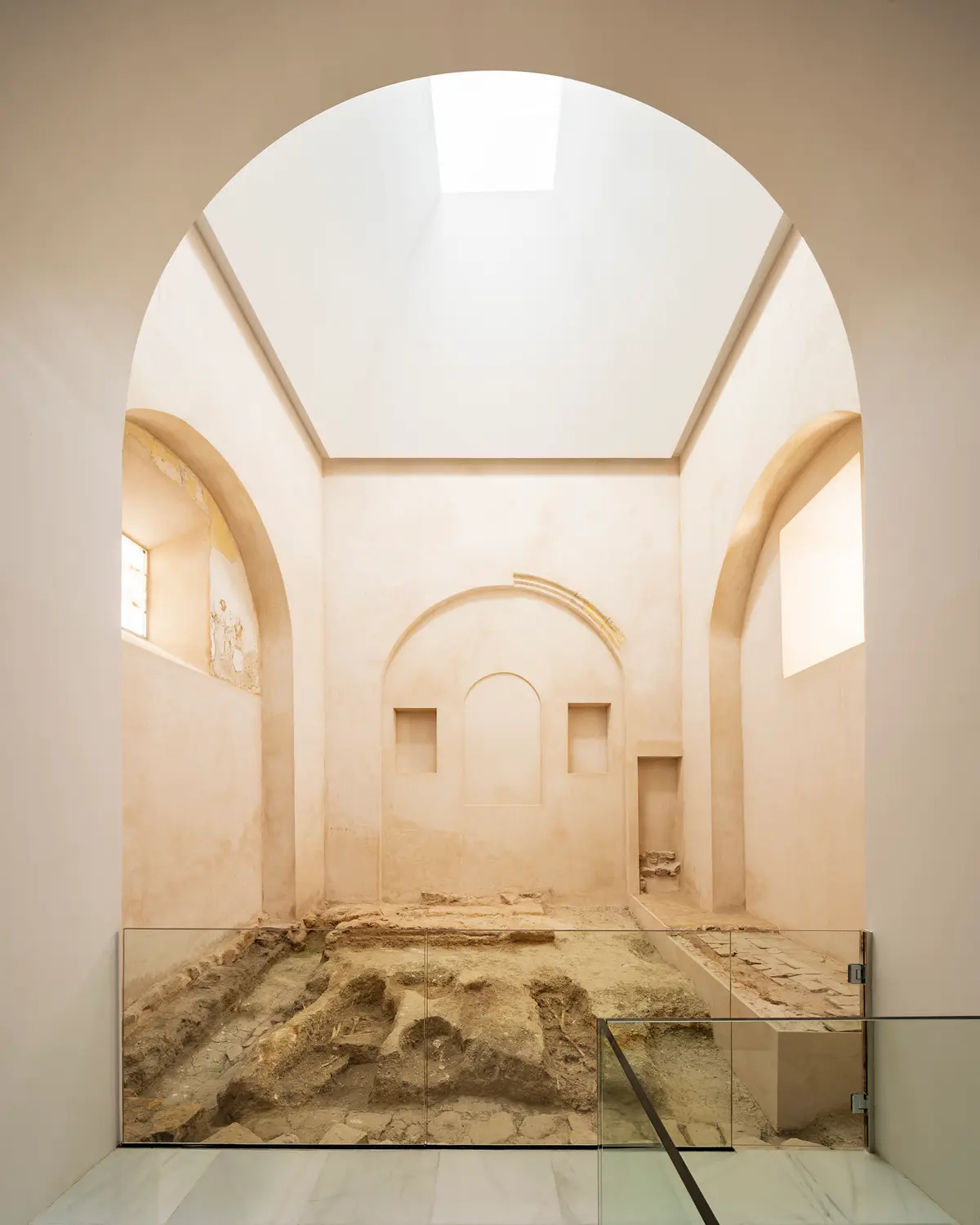
The most striking design decision is also the most structurally honest. Rather than covering the excavated remains of burials and earlier foundations with a new floor, Millán suspends a glass plane above them. Visitors walk over centuries of layered occupation, looking down through a transparent barrier at exposed stone, compacted earth, and the outlines of tombs. The walnut door and exposed stone walls in the entry corridor establish an immediate material warmth, but the glass floor introduces a jolt of temporal vertigo.
The arched niches flanking the main space frame views back into these archaeological strata, turning the interior into a series of calibrated sightlines. Every alcove reveals another fragment, another era. The glass barrier is minimal in profile, refusing to draw attention to its own engineering, which is precisely the point. The technology disappears so the history can surface.
The Oculus and the Vault
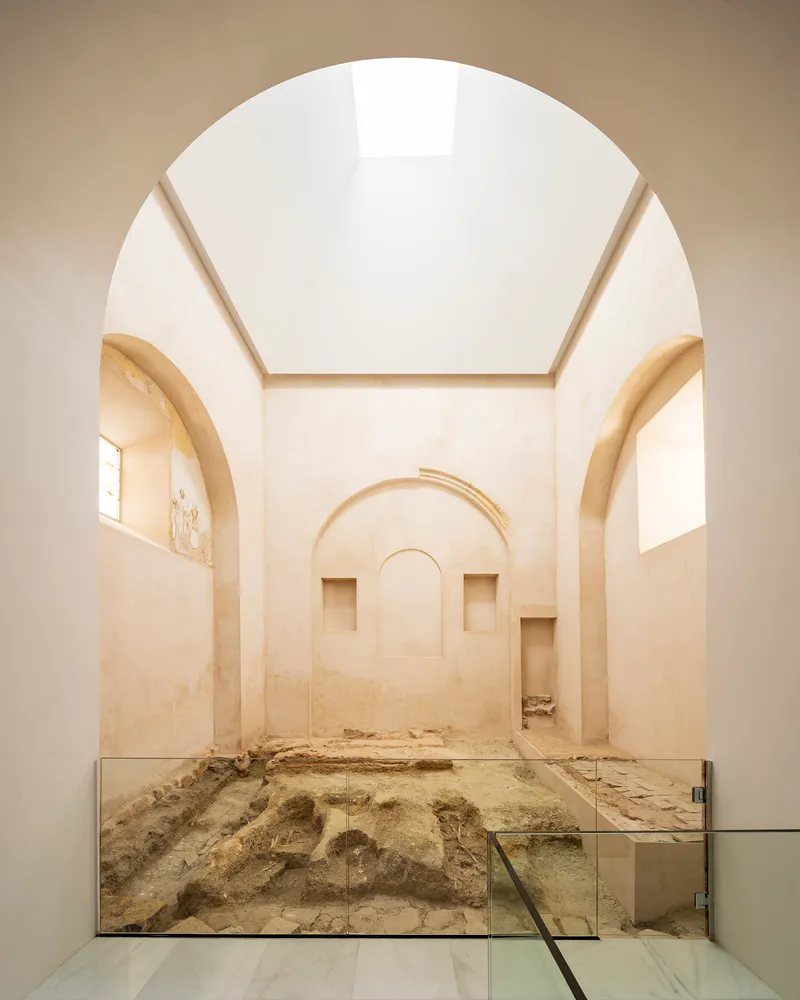
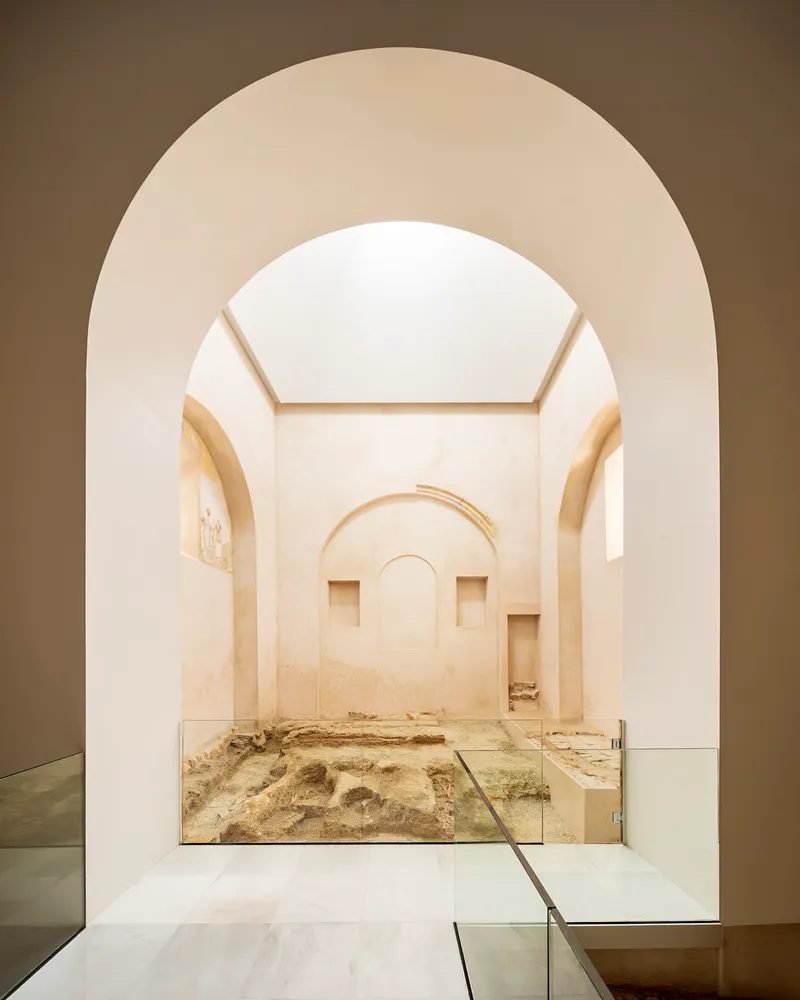
Millán describes the chapel as being designed "as if it were a pantheon," and the vertical oculus makes that ambition legible. A single opening in the vaulted ceiling channels daylight straight down into the excavation zone, creating a column of illumination that shifts with the hours and the seasons. The light is orderly, sober, serene. It does not dramatize; it reveals. In the central chamber, the restored arches frame this luminous event from every angle, giving the small space a gravitational pull that far exceeds its physical dimensions.
Lighting by Iguzzini supplements the natural light with discretion, ensuring the space remains usable without undermining the primacy of the oculus. The structural engineering, handled by Inmaculada Luque Pecci, keeps the restored vaults intact while accommodating the new skylight opening, a problem that is more delicate than it sounds in a building whose surviving structure was already compromised by prior neglect.
Matter Over Ornament
The material palette is deliberately narrow: local sandstone, white plaster, glass, walnut timber. There is no color applied for effect, no surface treatment that asks to be admired independently. The whitewash on the walls serves the same function it has served in Andalusia for centuries, reflecting and distributing light, while the exposed stone retains the texture of its geological origins. When you walk through the layered arches into the main chamber, the progression from rough to smooth, from dark corridor to bright vault, is legible without a single explanatory panel.
This is restoration as material argument. Millán's position is clear: the building already contains everything it needs. The architect's role is to remove what obscures and to introduce only what clarifies.
Plans and Drawings
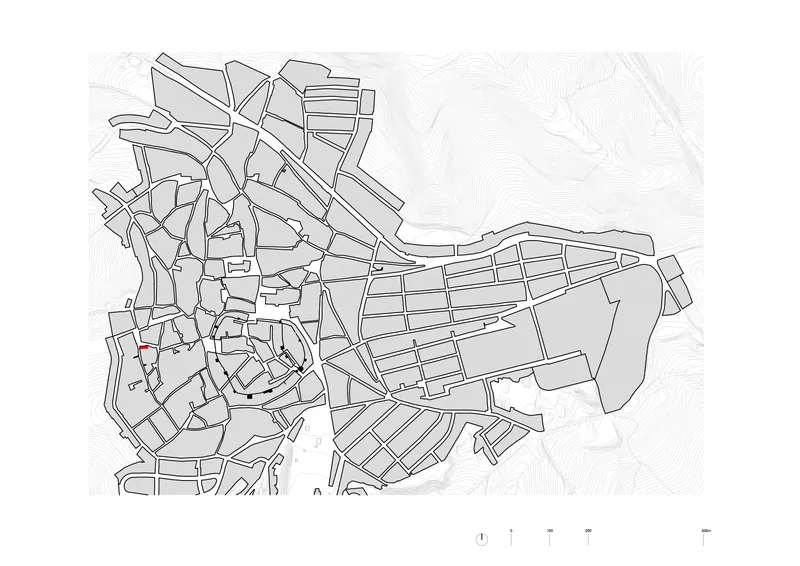
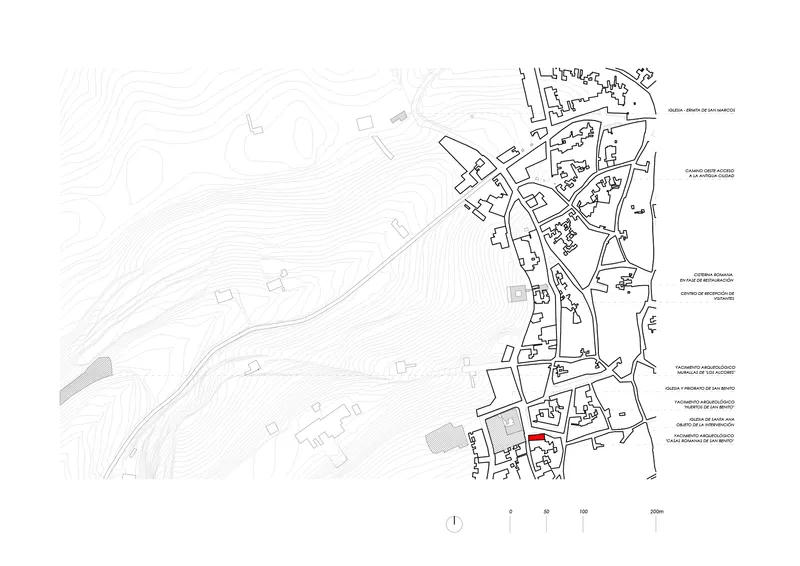
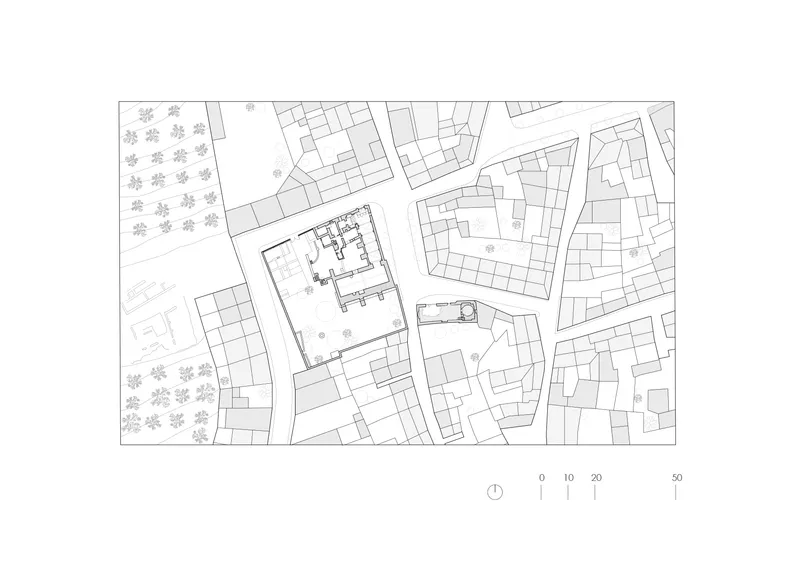
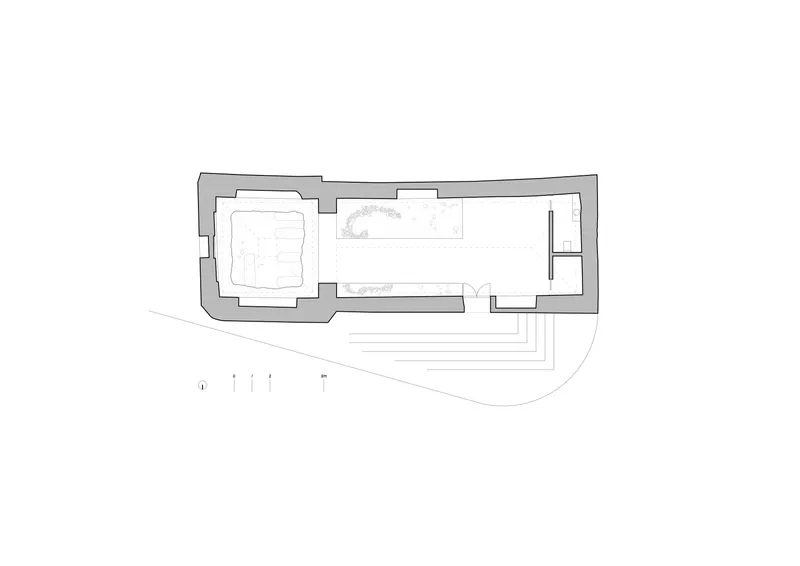
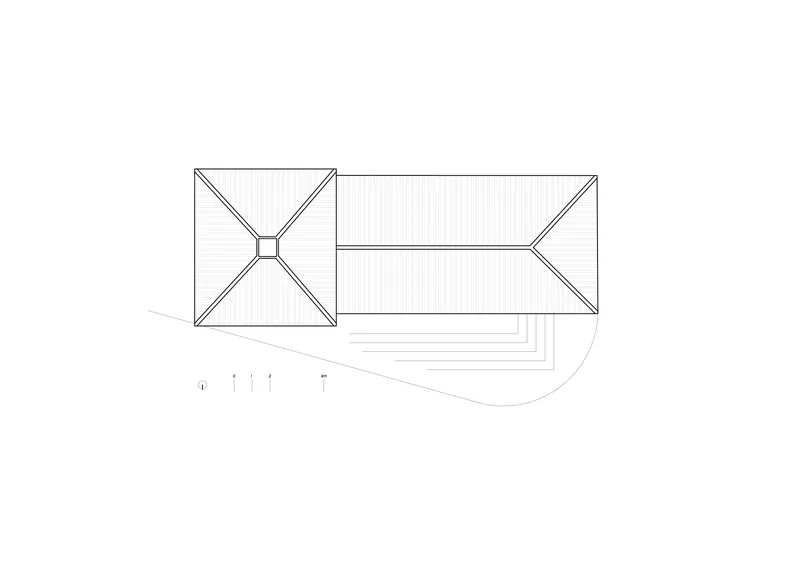
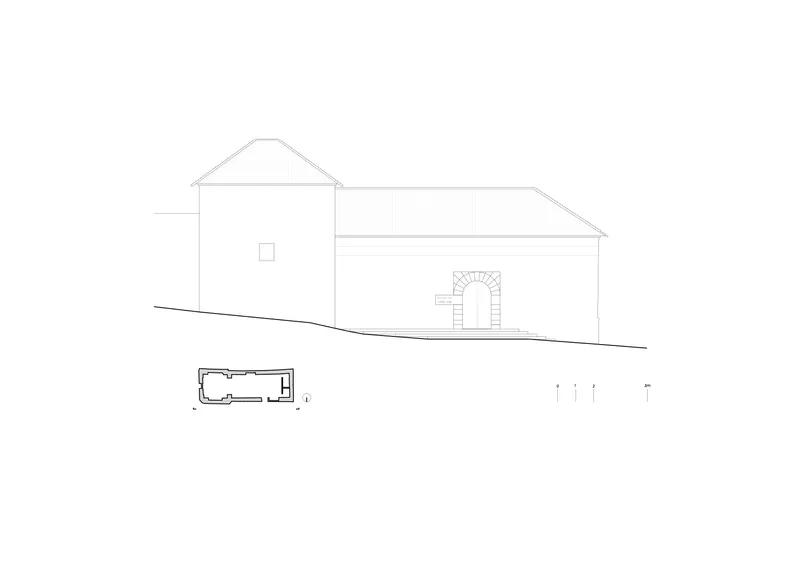
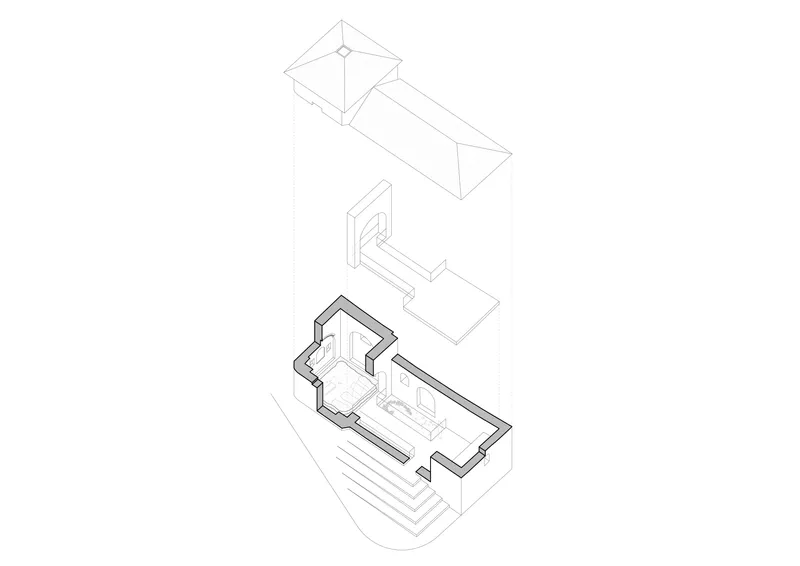
The urban and site plans reveal how tightly the chapel is embedded in Porcuna's fabric. It is not a freestanding monument but a building pressed against its neighbors, its stepped exterior approach negotiating a sloped site that drops toward the street. The floor plan shows the essential simplicity of the organization: a rectangular envelope containing a single central chamber, with the exterior steps providing a processional entry. The roof plan clarifies the two-volume composition, a pyramidal form over the main chamber and a gabled roof over the entry corridor, connected by stepped terracing.
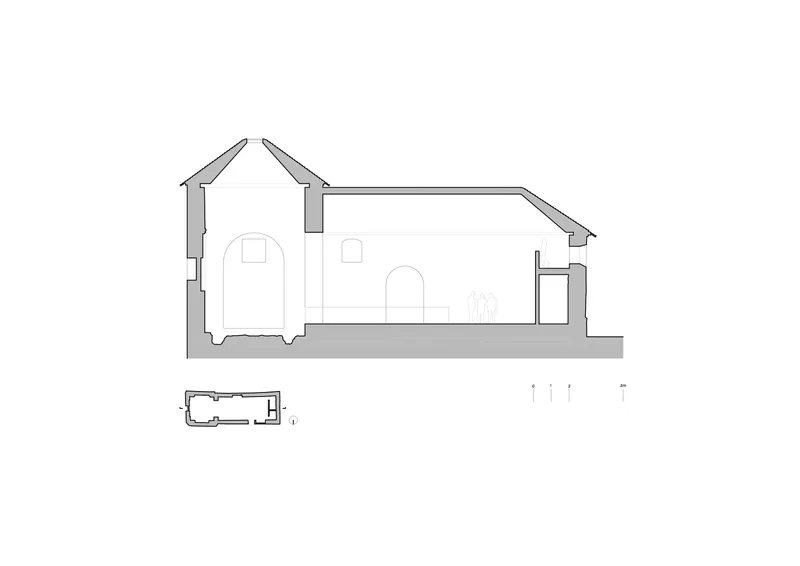
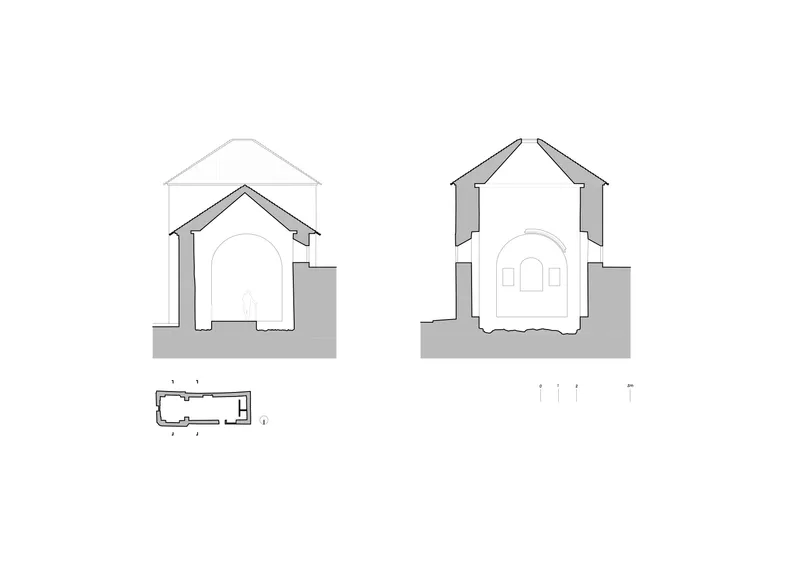
The sections are where the project's spatial intelligence becomes most legible. The pitched roof volumes and the vaulted interiors they contain operate at different scales, creating a gap between the outer shell and the inner chamber that accommodates the oculus. The cross sections display the arched openings as structural rhythms, and the axonometric drawing layers the roof forms above the plan to show how the exterior massing and the interior experience are deliberately misaligned, allowing light to enter where mass would otherwise dominate.
Why This Project Matters
Heritage restoration in Spain operates within a rigorous institutional framework, but the most valuable projects are those that go beyond compliance to articulate a spatial philosophy. Millán's chapel does exactly this. By treating the ruin as a site of ongoing revelation rather than a problem to be solved, the project reframes restoration as a creative act that gains power through subtraction. The three intervention fronts, archaeological, preservationist, and architectural, are not sequential phases but simultaneous conditions, each one visible and legible in the finished space.
In a discipline increasingly drawn to spectacle and novelty, a project that stakes its claim on the controlled intersection of light and stone feels almost countercultural. The Santa Ana chapel does not need to be large or loud to make its point. It needs a glass floor, a skylight, and sixty centuries of accumulated matter. That is enough.
Santa Ana de Porcuna Chapel Restoration by Pablo Millán, Porcuna, Spain, completed 2022. Photography by Javier Callejas Sevilla.
About the Studio
Share Your Own Work on uni.xyz
If projects like this are the kind of work you want to make, uni.xyz is a place to publish your own, find collaborators, and enter design competitions.


Popular Articles
Popular articles from the community


Singing Woman: An Opera House That Performs Before the Curtain Rises
Ovidiu Cristian Pavel's conceptual opera house translates Estonia's choral identity into a sculpted waterfront landmark facing the Baltic Sea.

Manzana Morphosis: Stretching Barcelona's Grid into a Living Landscape for 2050
A radical reworking of the Eixample manzana turns density into a tool for generous public space, vertical ecology, and environmental performance.


graciastudio Turns a Viewless Tijuana Lot Inward Around a Courtyard of Concrete, Timber and Trees
In Tijuana, Jorge Gracia's GA2 House stacks a timber-clad private floor over exposed concrete and replaces a missing view with a planted interior patio.

Cube Design Draws an Ecological Corridor Between Two Shenzhen Hills with the Nankai Building
Beside Shenzhen's container docks, the Nankai Building pairs stacked balconies with a climbing green screen to connect two hillsides across its height.

Similar Reads
You might also enjoy these articles

LAVA Architecten Gives Vocational Education a Sawtooth-Roofed Face on a Mechelen School Campus
In Mechelen, Belgium, a 2,053 m² STEM school on a 6×6 m grid turns workshops and classrooms into rooms that can be rearranged as teaching changes.

KEMA Studio Turns a Derelict Marvila Attic into a 60 m² Lighthouse Apartment Above Lisbon
In Lisbon's Marvila district, a rebuilt roof, four skylights and two plywood volumes turn an unlivable attic into a bright home facing the Tagus.

Pixel Gardens: One Repeated Module Stacked Into a Terraced Social Housing Tower for Famagusta
Salem Bader's shortlisted housing tower builds a vertical neighbourhood from one repeated module, offsetting units to carve terraces, light and air.

Bao Huynh Watercolor Atelier: A Serene Art Retreat in Hội An
Bao Huynh Watercolor Atelier in Hội An blends multifunctional art spaces, sustainable design, local materials, and family-friendly living in a serene environment.

Explore Chapel Competitions
Discover active competitions in this discipline

Design Challenge - Contemporary interpretation of a religious complex

Challenge to reimagine the Iron Throne

Photograph architecture without architects

Illustrate the lost glory of Angkor Wat - Render Challenge
Comments (0)
Please login or sign up to add comments
No comments yet. Be the first to comment!