

Pablo Patriota Builds a Courtyard House in Northeast Brazil Guided by Armando de Holanda's Principles
Casa Chamego in Caruaru, Pernambuco deploys brick screens, timber pavilions, and passive ventilation rooted in regional building wisdom.


Armando de Holanda's Guide to Building in the Northeast is one of those texts that circulates through Brazilian architecture schools more as gospel than as curriculum. Written in the 1970s, it codifies what generations of builders in the semiarid interior of Pernambuco already knew: shade the wall before you insulate it, catch the breeze before you cool it, and let the roof do more work than the air conditioner. Casa Chamego, a 447-square-meter residence in Caruaru designed by Pablo Patriota and Cléber Cabral of Pablo Patriota Arquitetos Associados, treats that guide not as historical artifact but as an active design manual.
What makes the project worth studying is how literally it applies those principles without slipping into nostalgia. The house is organized as a series of pitched-roof pavilions arranged around a central courtyard with a swimming pool, each volume oriented and screened to maximize cross-ventilation and minimize direct solar gain. Perforated brick screens, deep timber overhangs, clerestory windows, and generous colonnades are deployed not as ornament but as climate infrastructure. The result is a house that looks effortlessly of its place because it is engineered for its place.
A Roof Strategy, Not Just a Roofline
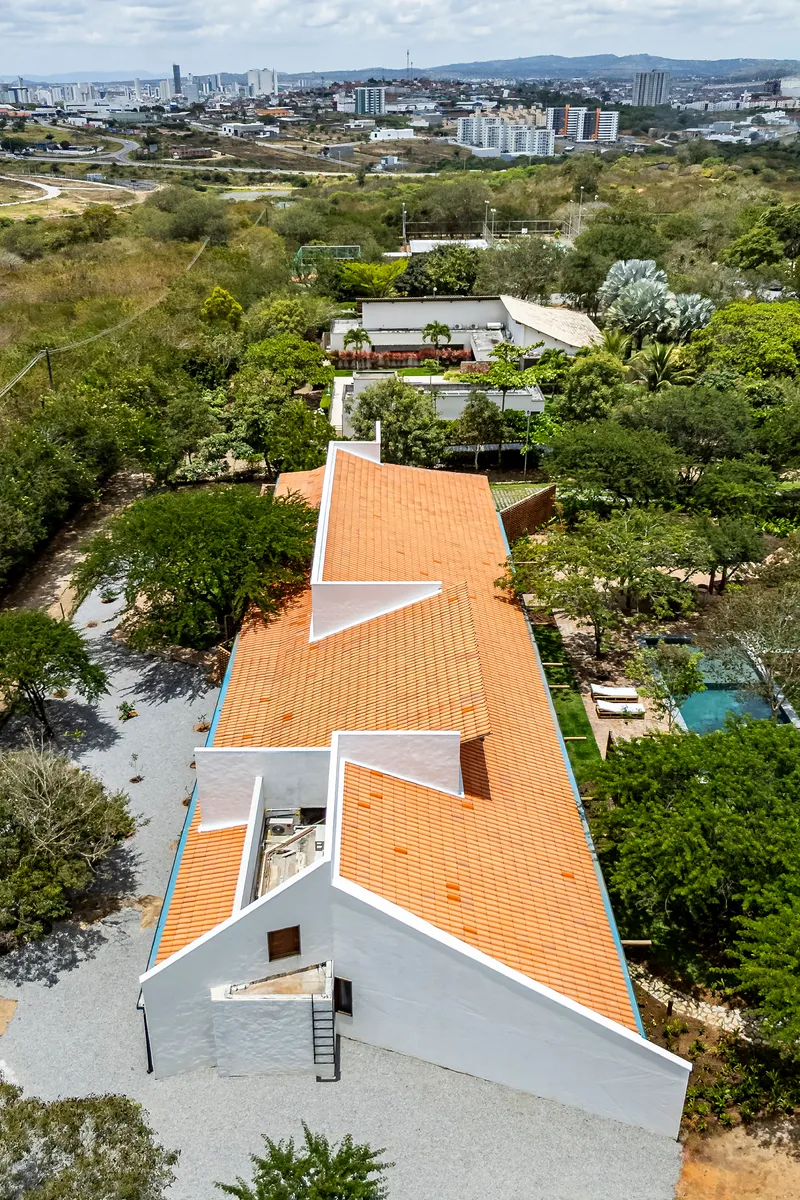
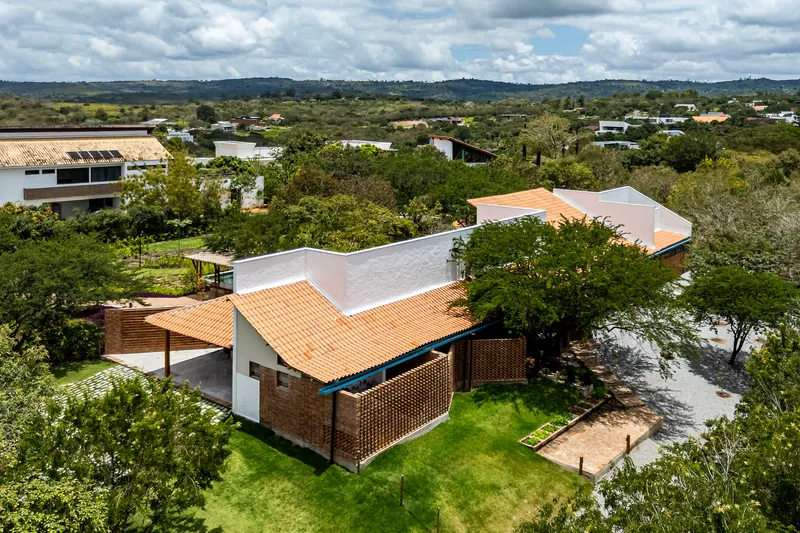
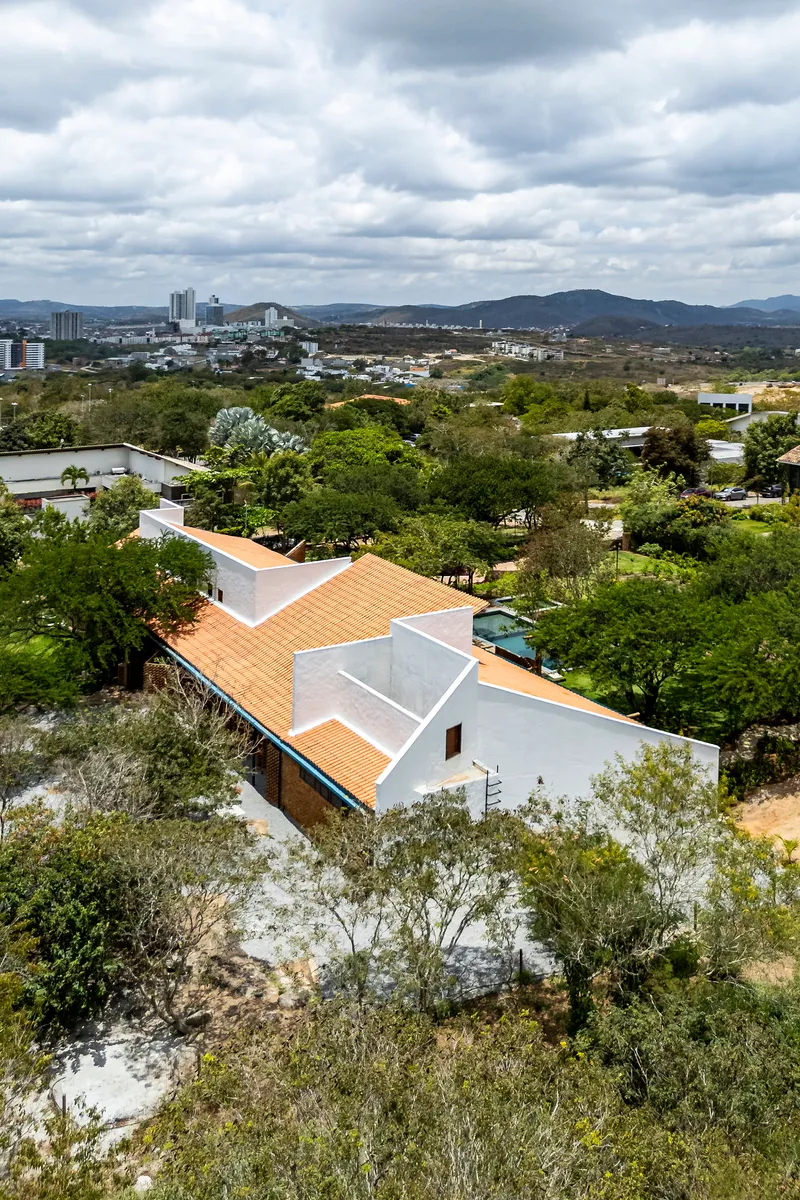
From above, Casa Chamego reads as a segmented orange carpet of clay tiles stretched linearly through dense vegetation. The roof is the dominant element, and intentionally so. Each pavilion carries its own pitched volume, and the sawtooth profile created where they meet allows clerestory openings to pull hot air up and out while drawing cooler air from the shaded courtyard below. The overhanging eaves extend well beyond the wall plane, shading the facades during the hottest hours.
Orange clay tile is the material doing double duty here: it absorbs less heat than dark alternatives, reads as unmistakably regional, and ages well in Pernambuco's climate. The aerial views reveal how the roof planes interlock around a central void, creating a pinwheel of shade and breeze that organizes every room's relationship to the outdoors.
The Courtyard as Climate Machine
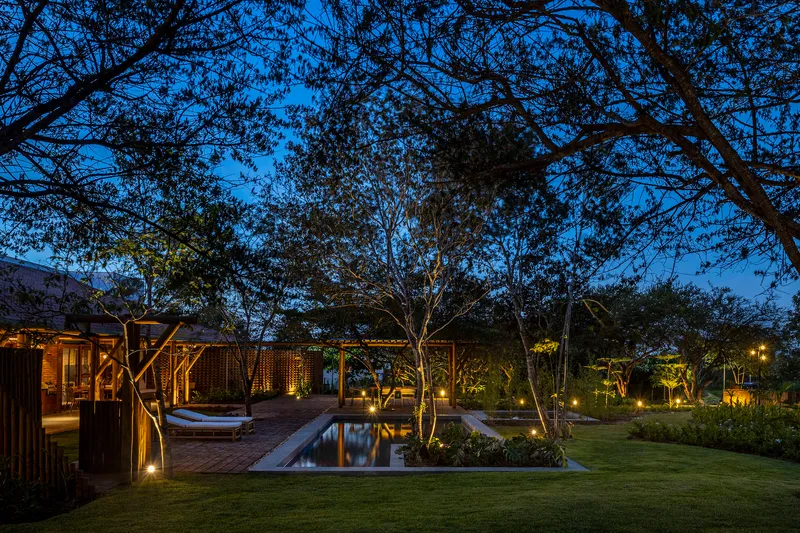
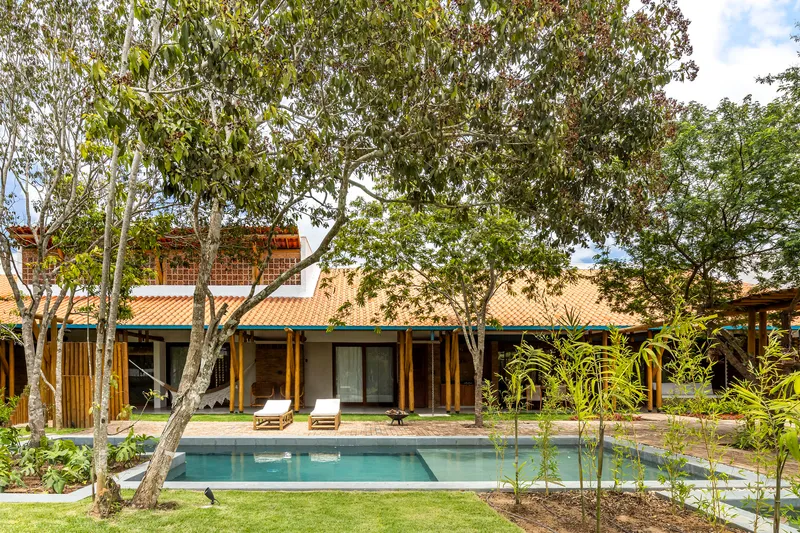
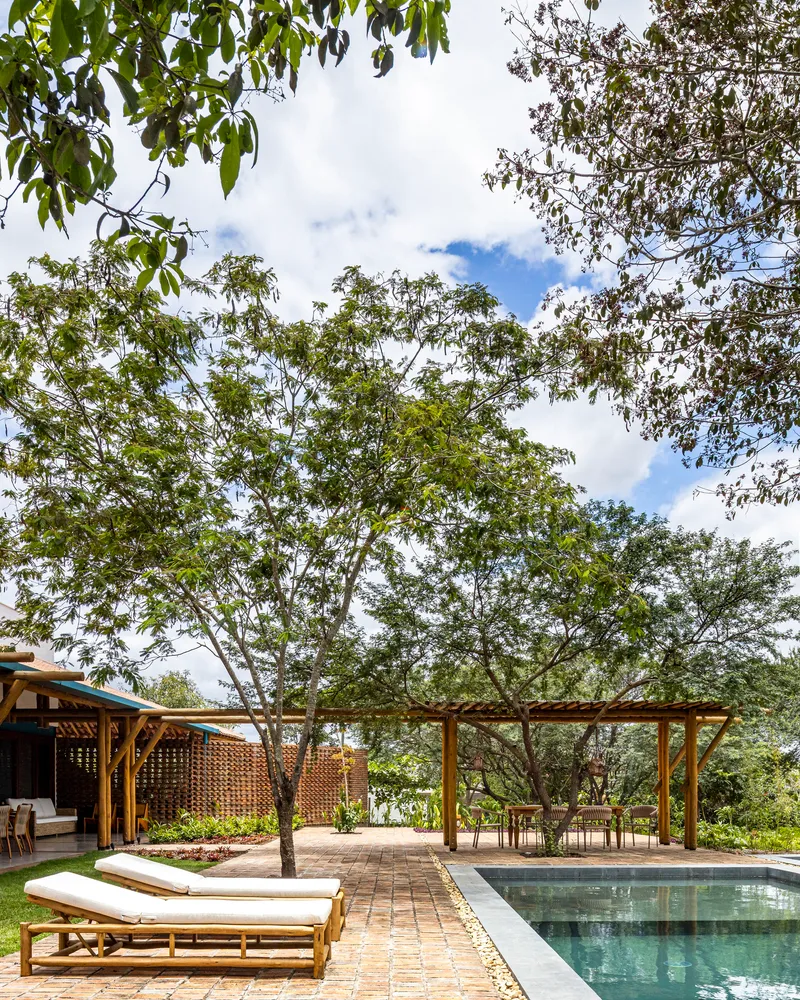
The courtyard at Casa Chamego does what the best courtyards in hot climates have always done: it creates a microclimate. The pool, the lawn, and the mature trees all contribute evaporative cooling, while the enclosing pavilions funnel prevailing winds through the center of the house. At twilight the reflecting pool and uplighted trees transform the space into something theatrical, but the real performance is thermal.
Brick pavers around the pool terrace and timber deck loungers create a ground plane that absorbs and releases heat slowly, keeping the courtyard comfortable well after sundown. The wooden lattice screens and vertical timber elements that line the courtyard edge filter views without blocking airflow, a recurring motif that gives every space a sense of permeability.
Brick Screens as Civic Texture
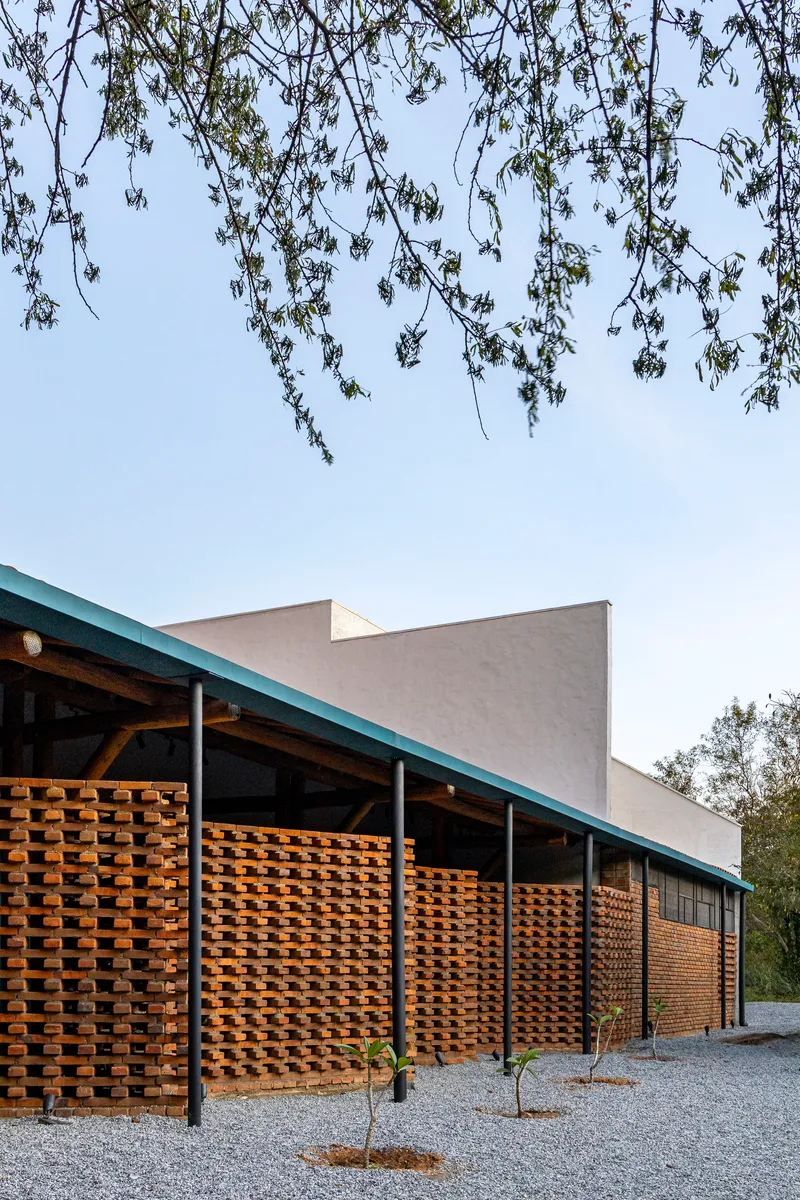
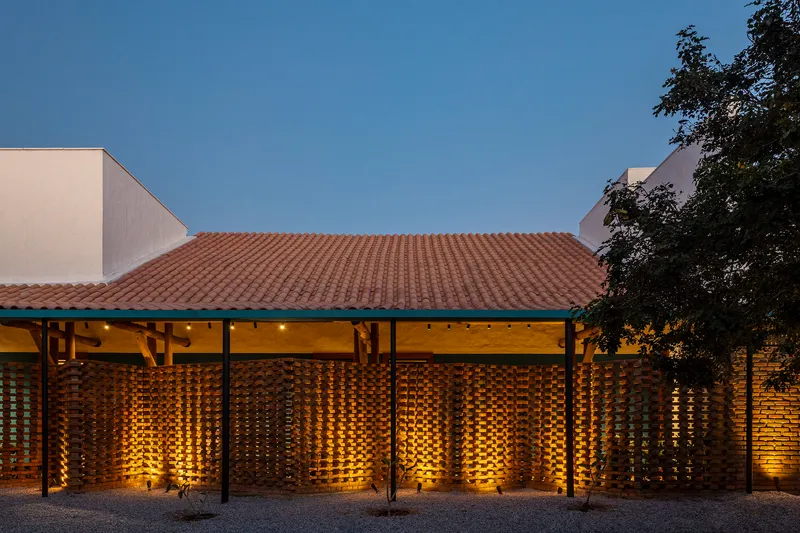
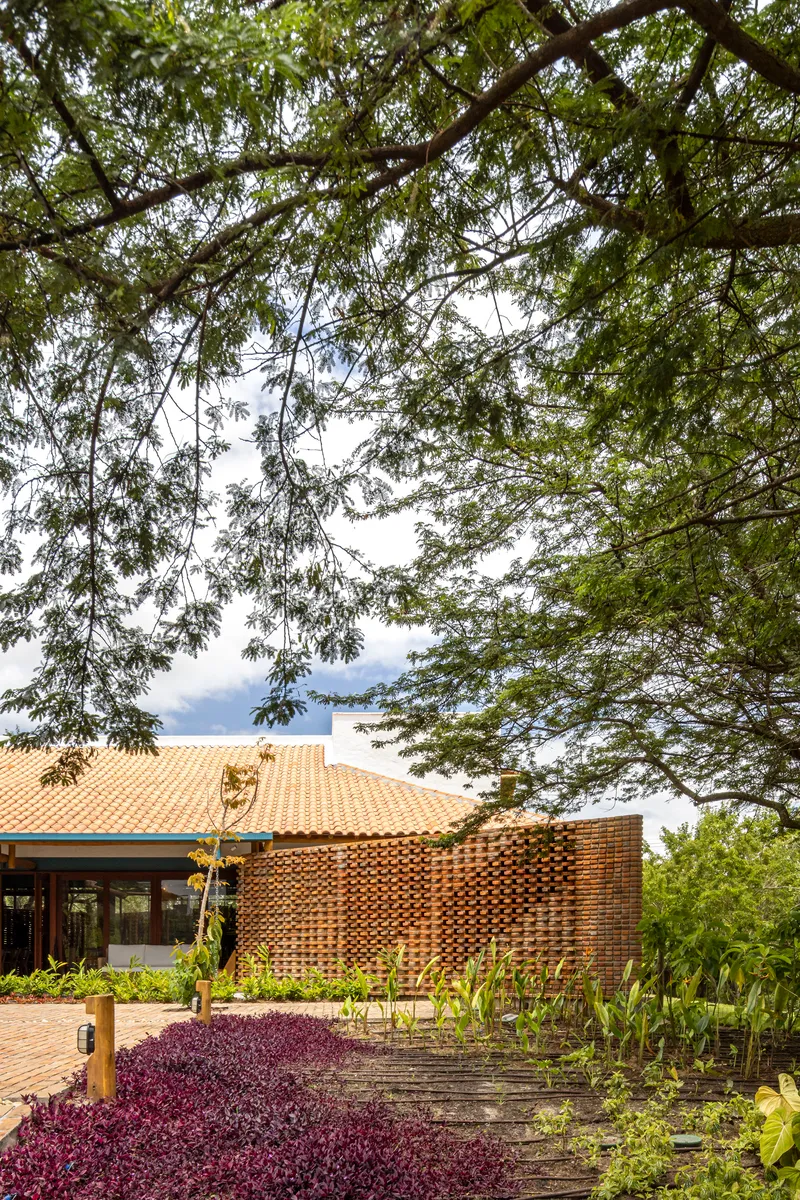
The perforated brick screen is perhaps the most recognizable element of northeastern Brazilian architecture, and Patriota and Cabral use it generously. At dusk, when interior light filters through the lattice, the screens glow like lanterns set into the landscape. During the day they do the harder work of breaking direct sunlight into dappled patterns while allowing air to move freely through the wall assembly.
What elevates the screens here is their variety. Some panels use a tight rotational pattern, others a more open stacked bond. Behind them, planted beds with purple groundcover soften the transition between architecture and garden. The screens are never purely decorative: they always sit at a point where the plan needs both privacy and ventilation, whether facing a street, a neighbor, or an interior corridor.
Timber Structure and the Extended Porch
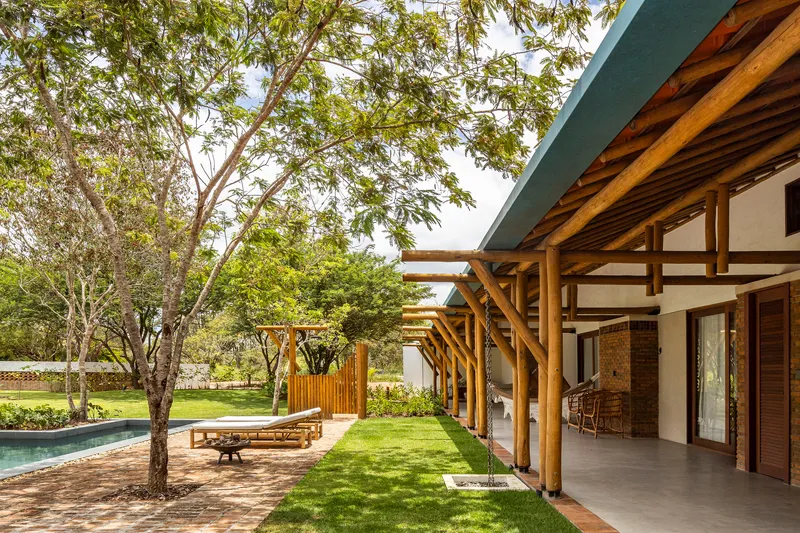
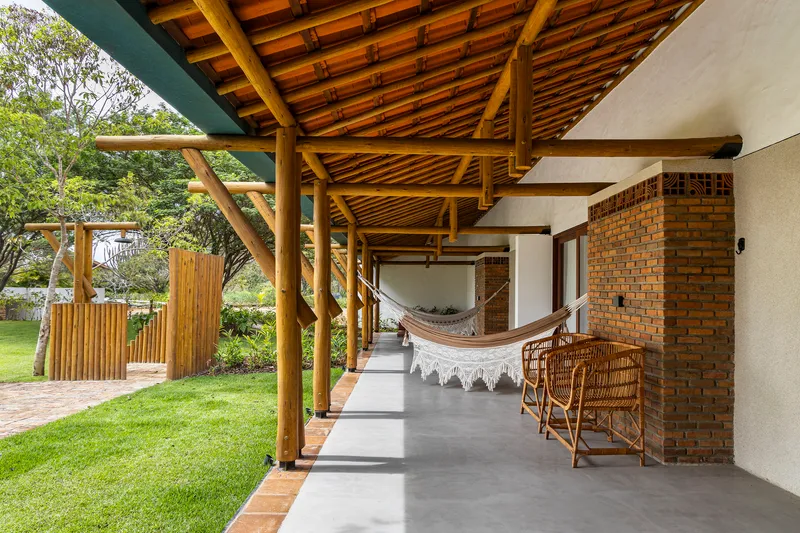
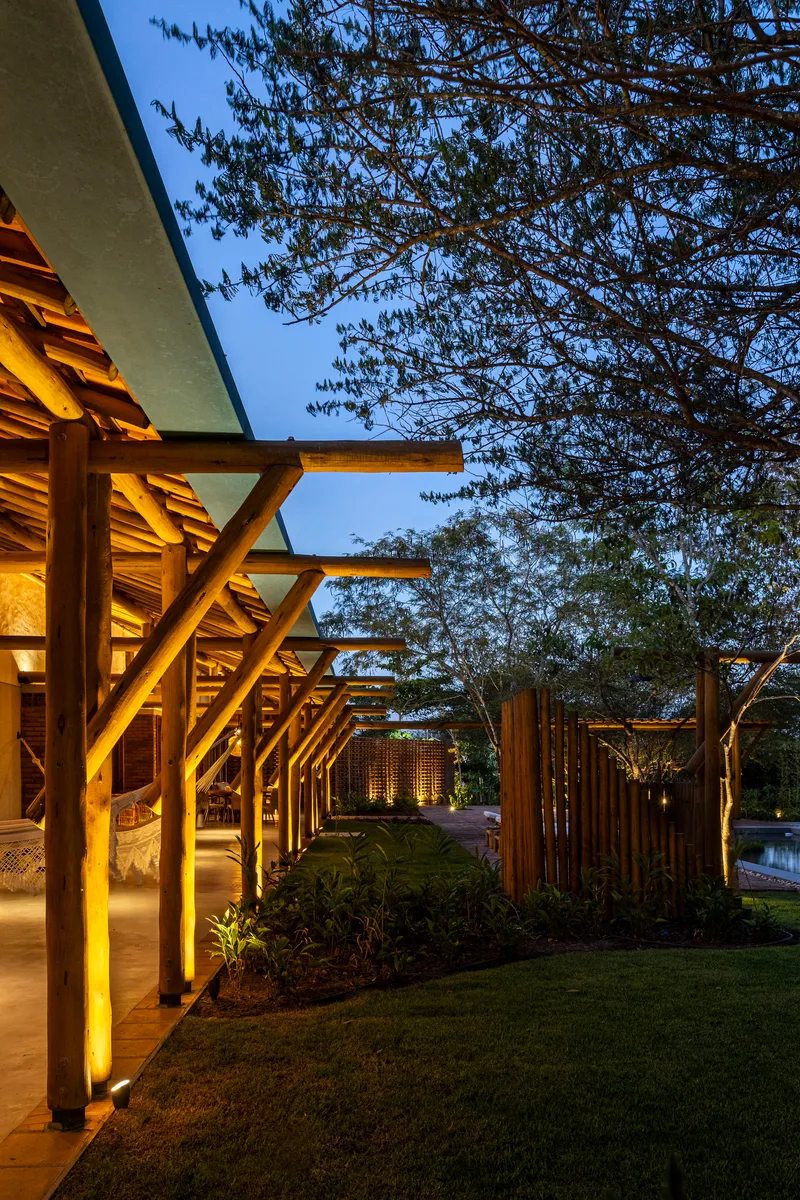
Holanda's guide emphasizes the importance of the "sombreado," the shaded zone between inside and outside that makes life in the tropics possible. Casa Chamego takes this seriously: deep covered porches with exposed timber rafters and beams extend the living area into the landscape without exposing it to sun or rain. A hammock hangs in one such terrace, looking out over lawn. It is the most Brazilian image imaginable, and it works because the proportions are right. The overhang is deep enough to be useful, the ceiling high enough to let hot air rise, and the columns slender enough to feel open.
At night, the timber colonnade beside the lawn becomes a luminous loggia, its exposed beams casting long shadows across the flat soffit. The structural honesty of these spaces, where every beam and rafter is visible and legible, gives them a directness that more polished interiors often lack.
Pergolas and Preserved Trees
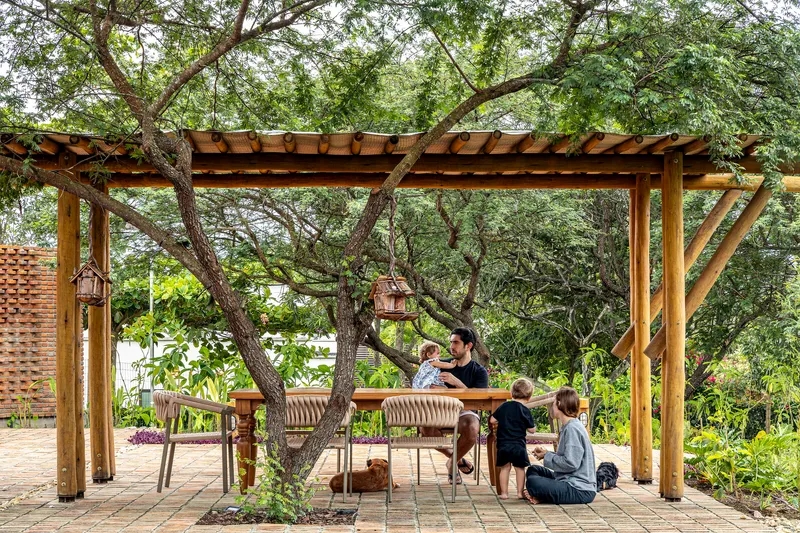
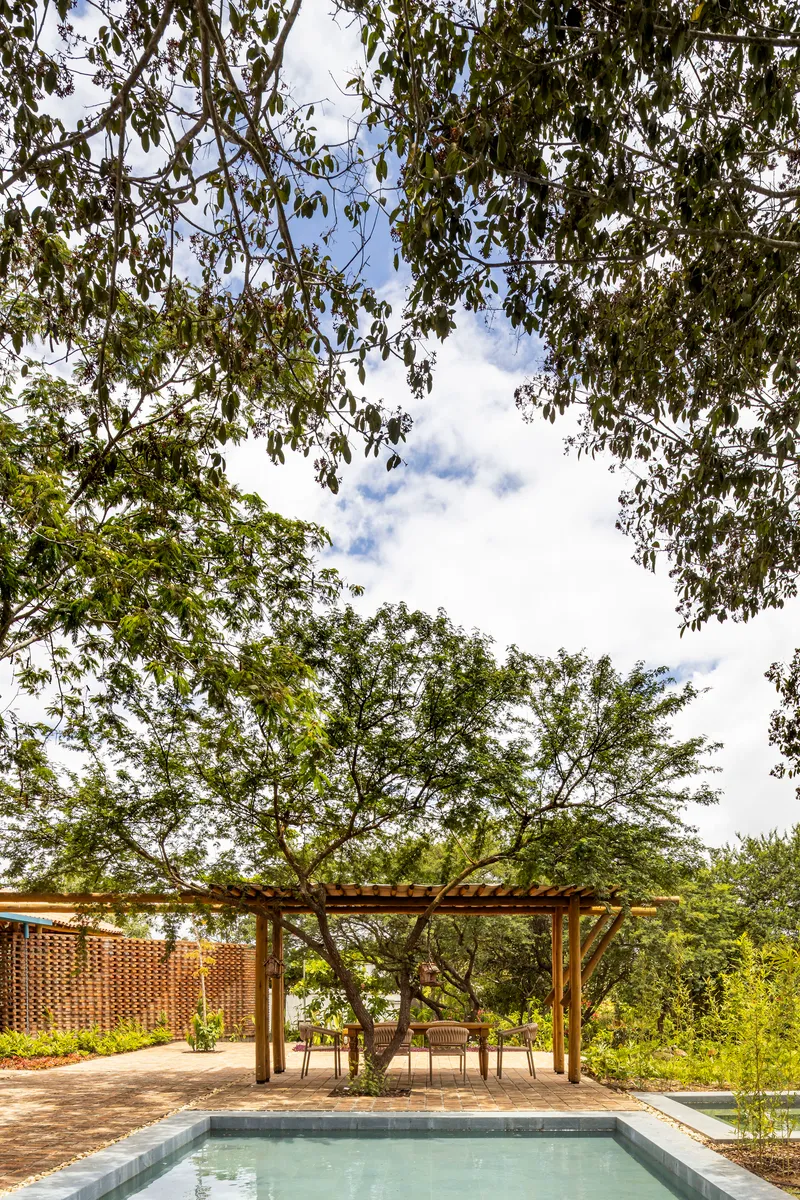
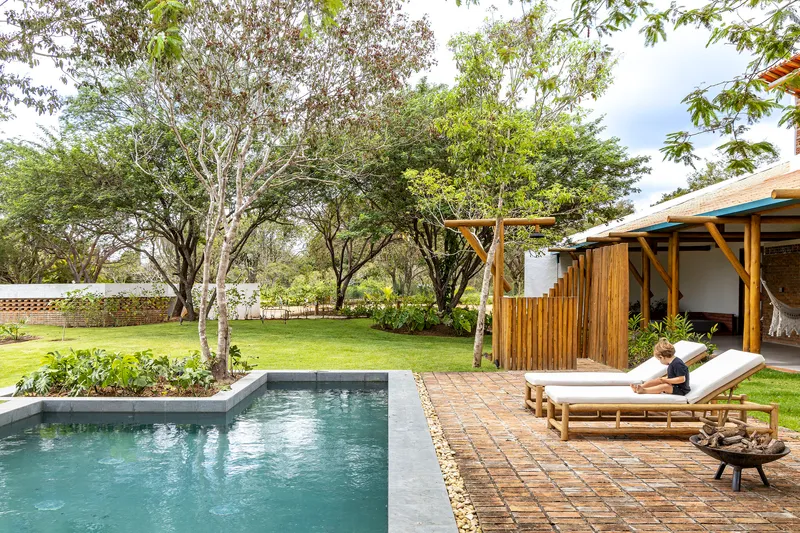
Several mature trees on the site have been preserved and integrated into the architecture rather than worked around as obstacles. The timber pergola that shelters an outdoor dining area is built to frame a large existing tree, its rafters fanning outward to accommodate the trunk. At the pool, another preserved tree rises through a gap in the brick paver terrace, its canopy providing shade that no architectural element could replicate at this scale.
This approach to landscape is less sentimental than strategic. Mature trees in the Agreste region of Pernambuco take decades to reach useful size. Removing them and replanting would sacrifice years of passive cooling capacity. By keeping them, the architects gain an immediate thermal benefit and a visual maturity that new construction rarely achieves.
Interiors That Breathe
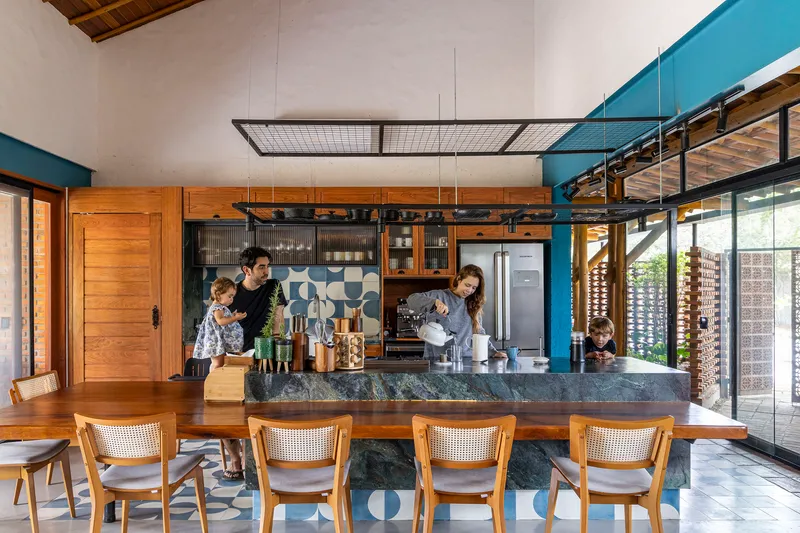
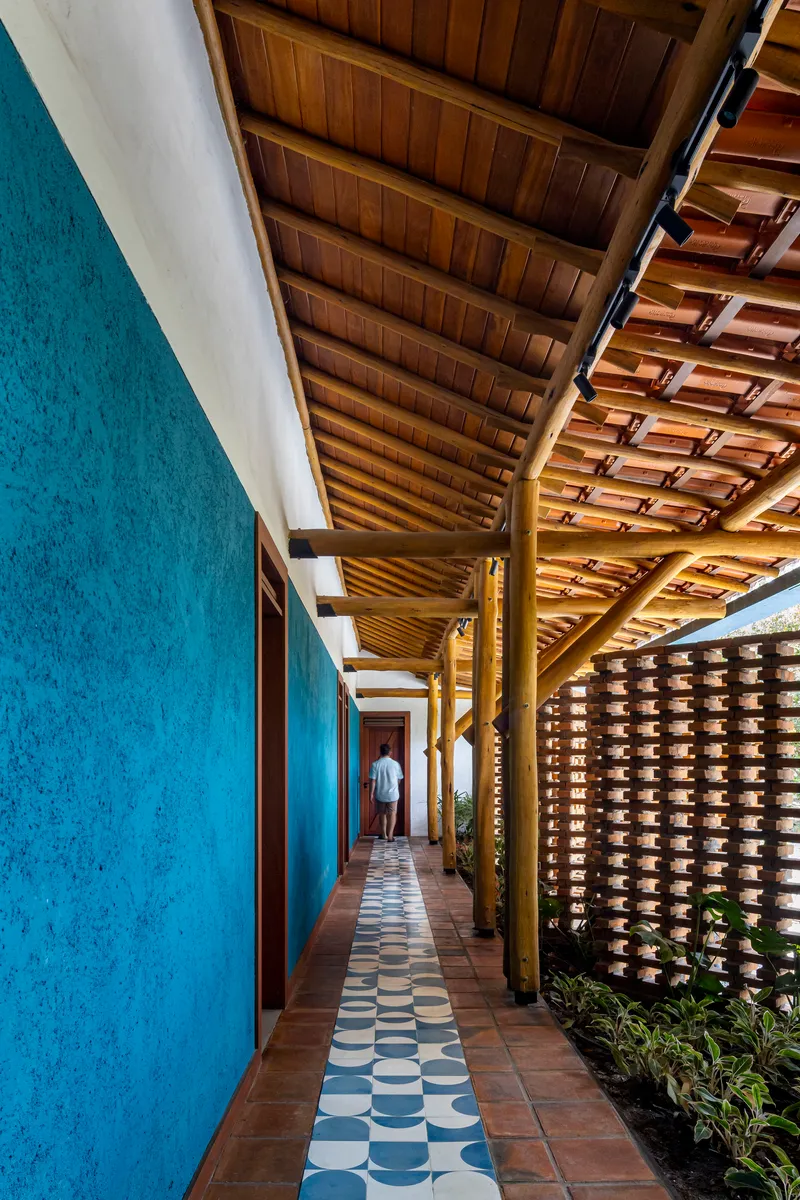
Inside, the palette stays restrained: dark stone countertops, caned dining chairs, exposed timber ceilings, and patterned tile floors that reference regional craft traditions. The kitchen island faces outward through an open wall, connecting cooking to the social life of the courtyard. A covered walkway with a vivid blue plaster wall and patterned tile floor leads past perforated brick screens lined with plantings, turning circulation into one of the house's most photogenic moments.
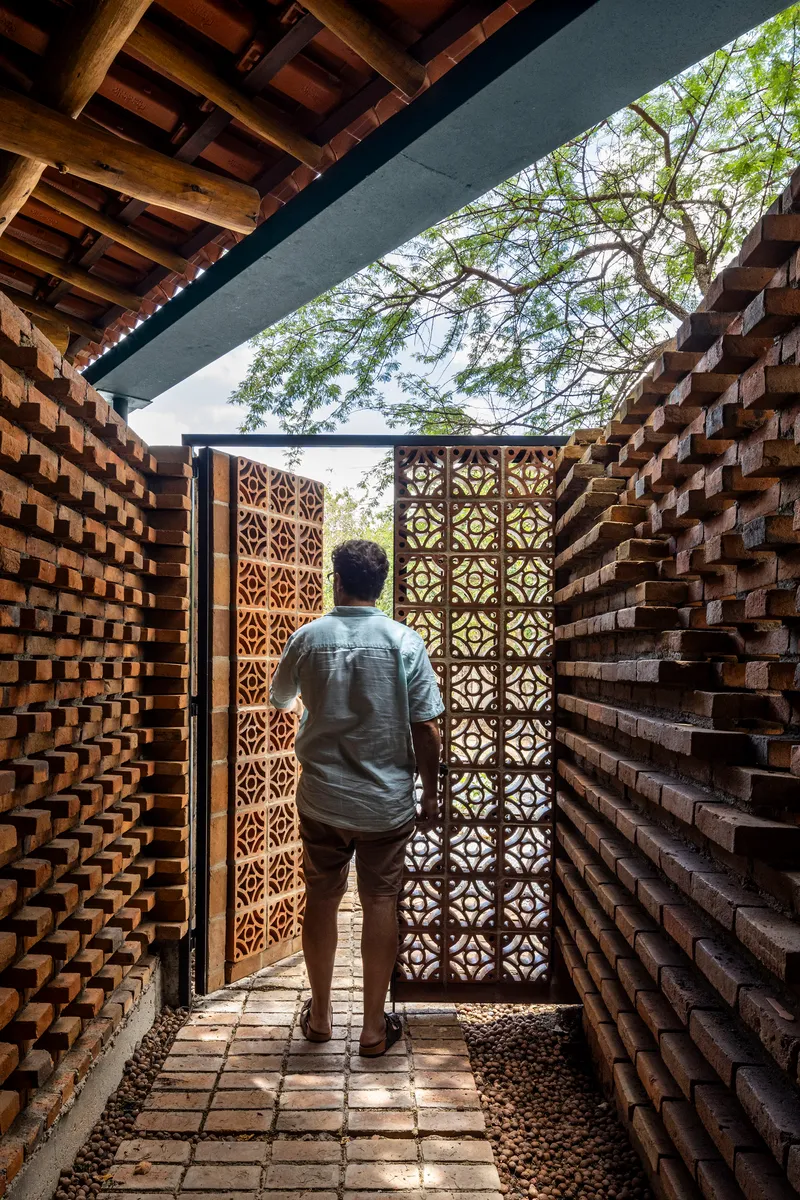
Corridors are treated as outdoor rooms. One passage toward a patterned metal gate is lined entirely in brick, its ceiling defined by a timber overhang that compresses the view before releasing it into the garden beyond. The compression-and-release sequence is a classic spatial move, but here it also serves a ventilation purpose, accelerating airflow through the narrow section.
Bathrooms as Curated Rooms
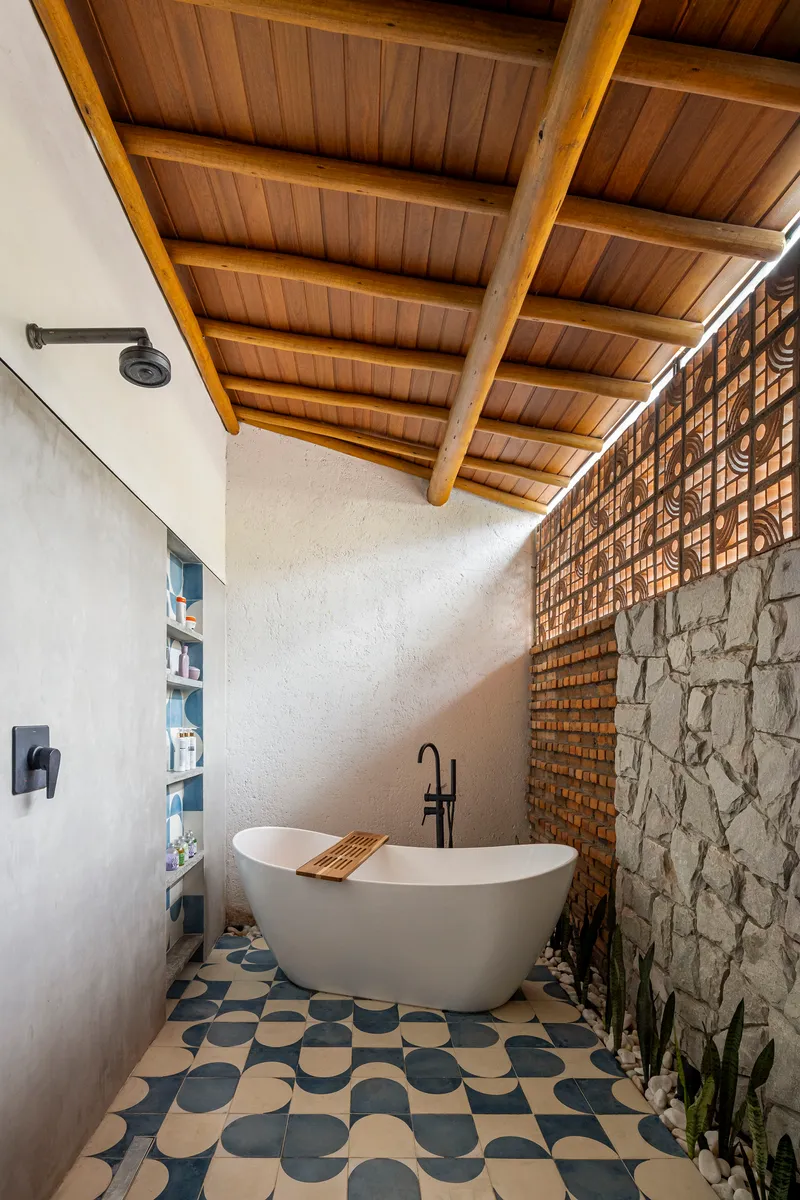
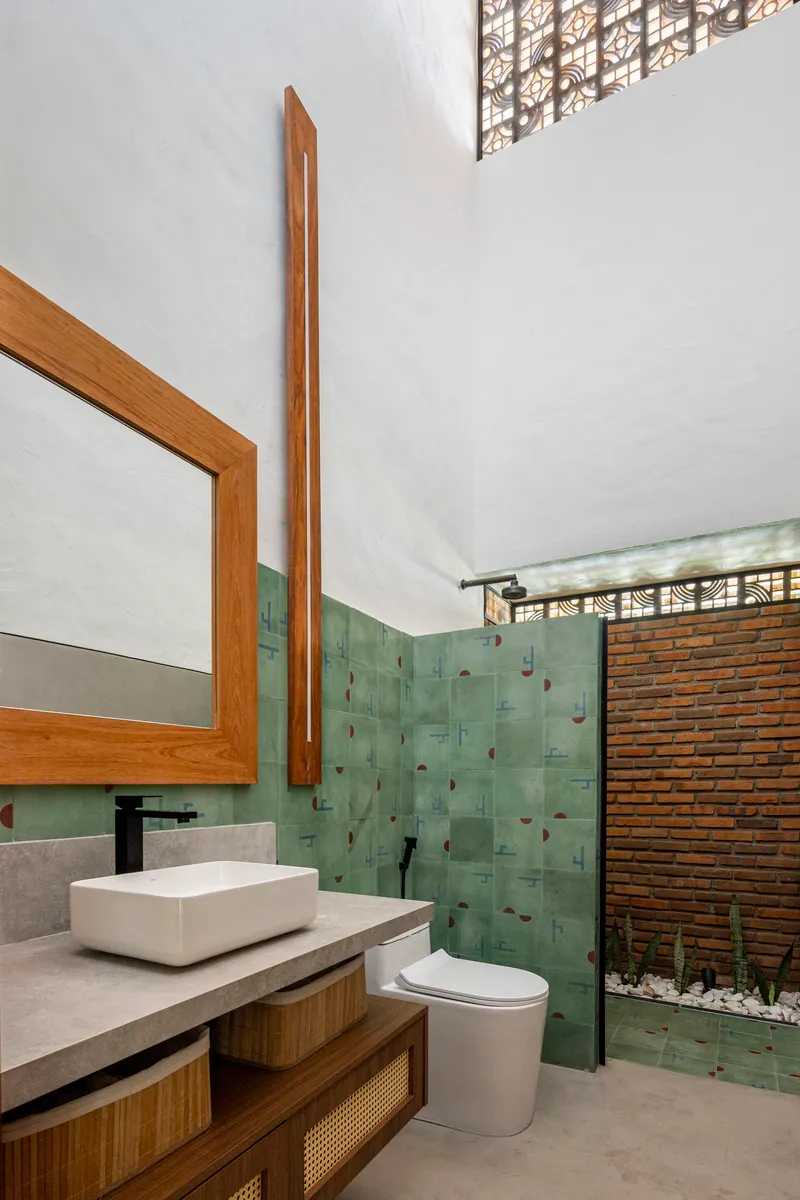
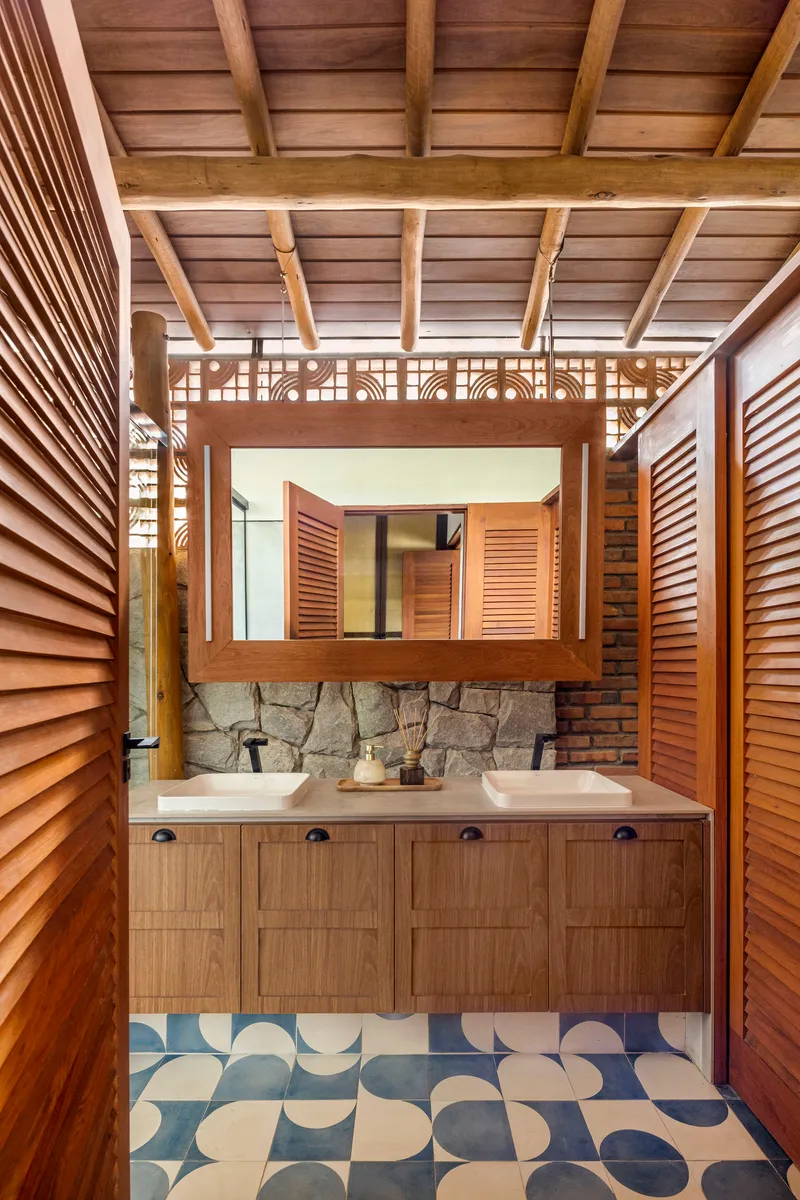
The bathrooms at Casa Chamego receive an unusual level of attention. A freestanding bathtub sits on a geometric patterned tile floor beneath exposed timber beams, with a lattice wall filtering light from an adjacent garden. Another bathroom opens through a glass shower screen directly to a courtyard, collapsing the boundary between bathing and landscape in a way that is comfortable only because the brick courtyard wall and clerestory above maintain privacy.
A vanity with twin sinks features a decorative brick screen above a stone base, its patterned tile floor a different geometry from the adjacent rooms. Each bathroom reads as its own material world, connected to the house's vocabulary but distinct enough to feel like a discovery. The vertical timber slat doors and high clerestory windows in the corridor spaces suggest that even the most utilitarian passages have been composed with care.
The House at Dusk
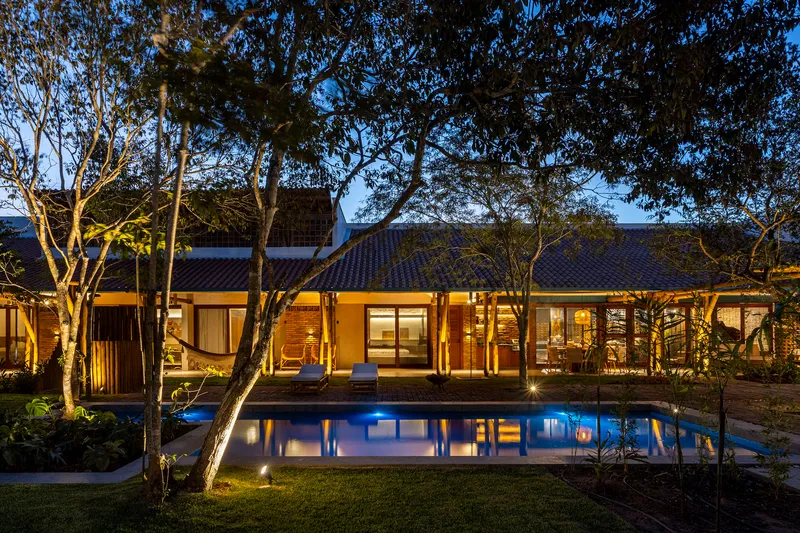
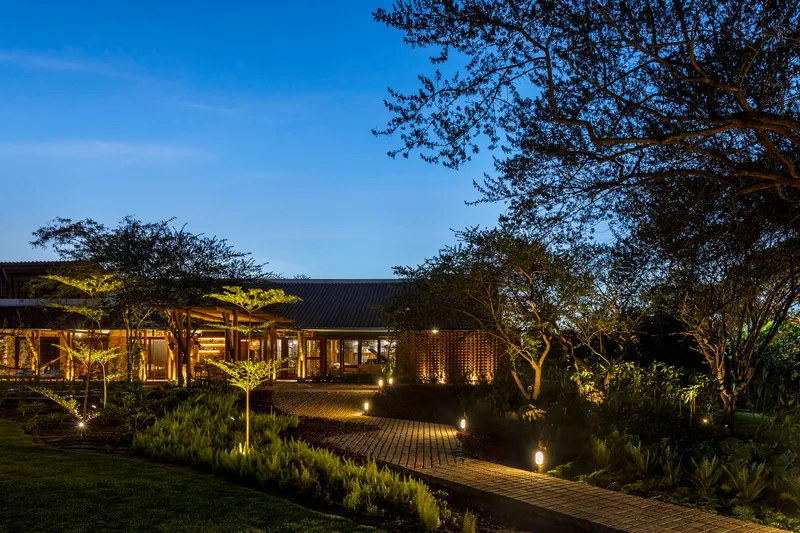
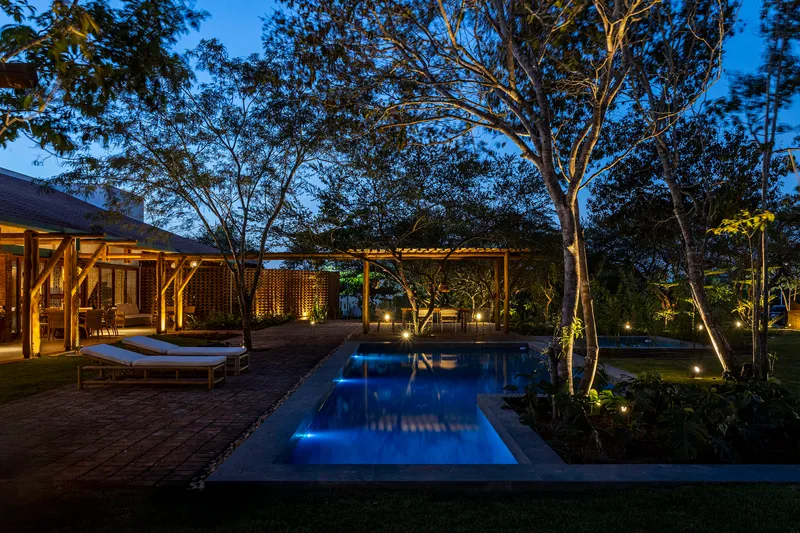
As daylight fades, Casa Chamego shifts register. The clay tile pavilions recede into silhouette while the perforated brick screens and open colonnades begin to emit a warm interior glow. The pool terrace at blue hour, framed by mature trees and soft uplighting, reveals how carefully the landscape lighting has been integrated. Nothing is spotlit for drama; instead, low fixtures wash the tree trunks and ground plane evenly, extending the usable hours of outdoor space well into the evening.
A low-slung pavilion with a corrugated roof and timber screen walls lines a brick-paved garden path, its warm light suggesting a separate service or guest volume. The compound-like organization of the house, multiple pavilions connected by covered walks rather than a single monolithic volume, means that evening movement through the property feels like a stroll through a small village. It is an organization that rewards slowness.
Plans and Drawings
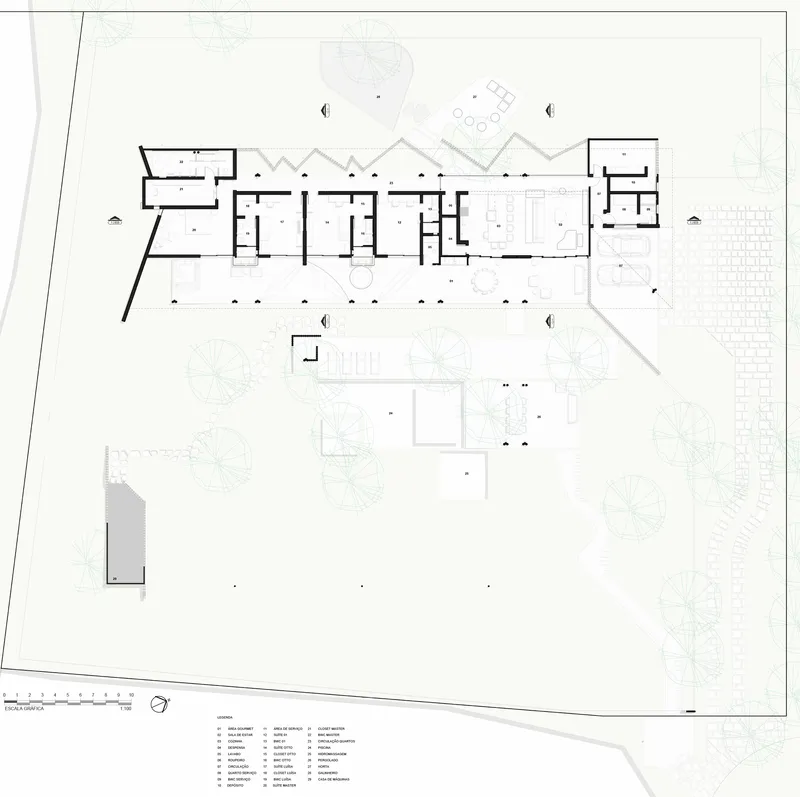
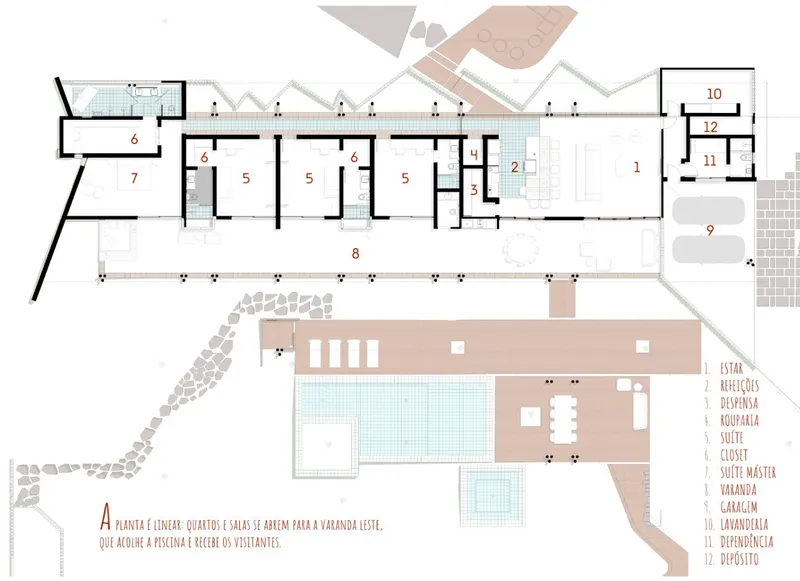
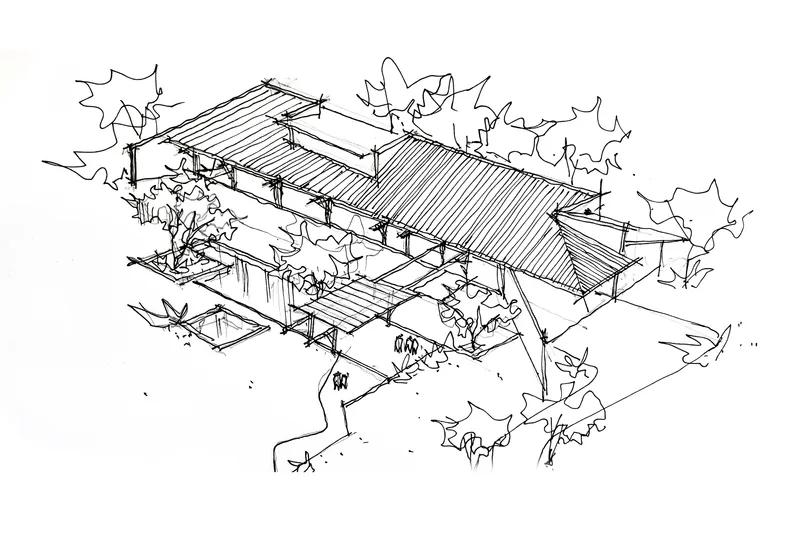
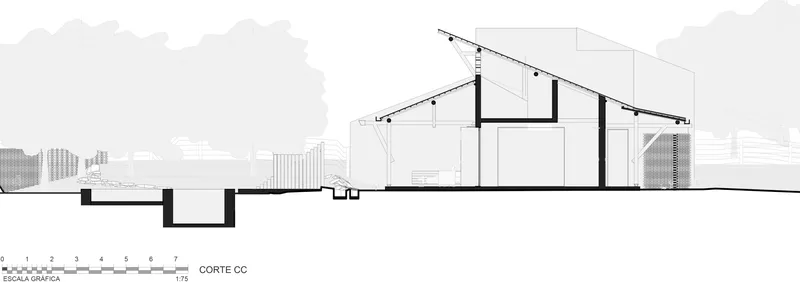
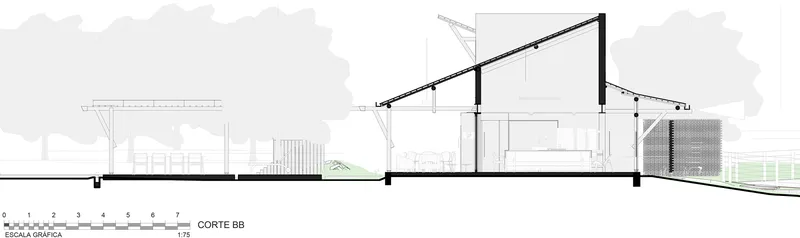
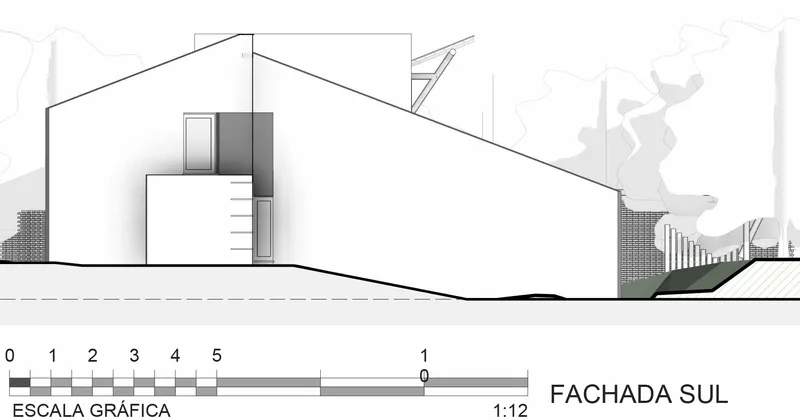
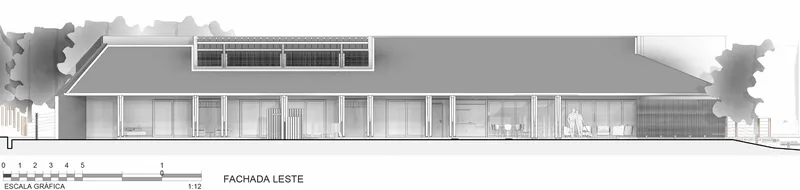
The floor plans confirm what the aerial views suggest: a linear arrangement of rooms with a sawtooth roof profile, organized around a pool courtyard that sits slightly below the main living level. Residential suites, shared spaces, and the pool terrace are clearly annotated, revealing a zoning logic that separates private sleeping quarters from communal areas while keeping both connected to the central void. The sections are the most revealing drawings. They show how the pitched roof volumes create double-height interior spaces with clerestory windows at their ridges, and how the sloping terrain is used to embed the house into the landscape rather than sitting on top of it.
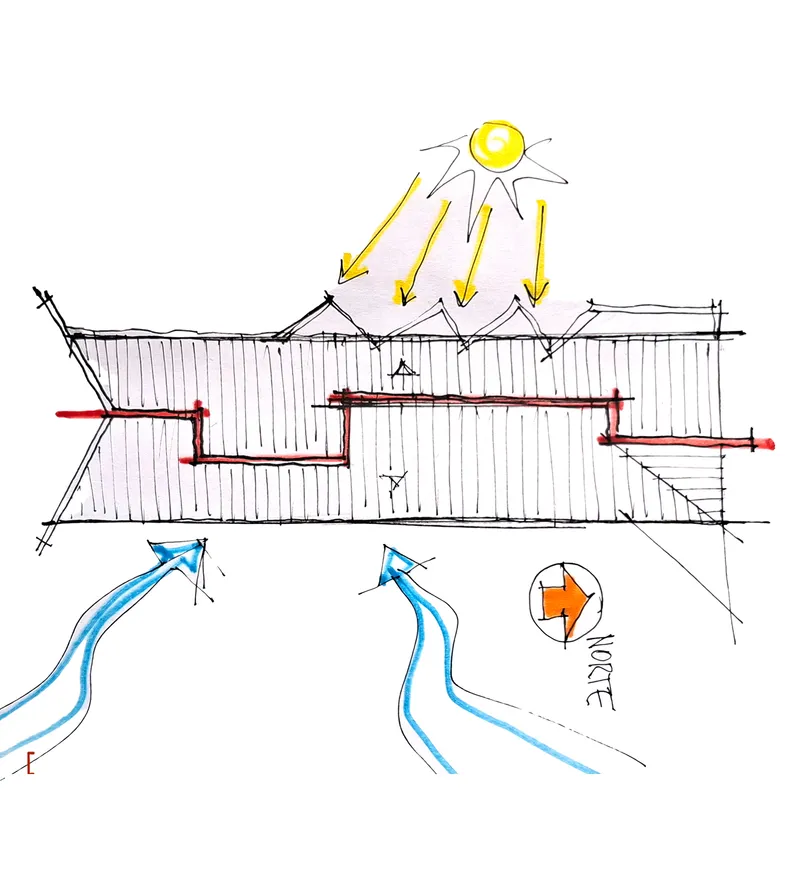
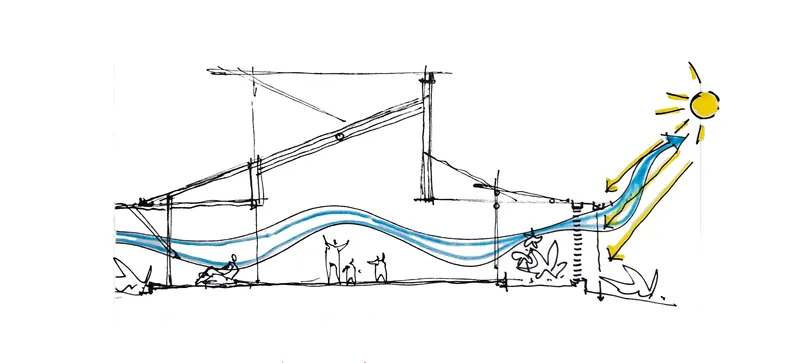
Two bioclimatic sections illustrate the environmental strategy with unusual clarity. Arrows trace the path of natural ventilation through the house, showing air entering at low openings, rising through the heated interior volume, and exiting at high clerestory slots. Sun penetration diagrams demonstrate how the deep eaves block high-angle summer sun while admitting lower winter light. The axonometric sketch pulls all of this together, showing the pitched-roof pavilions as a family of related forms scattered among existing trees, their geometries responsive to both the site and the climate.
Why This Project Matters
Casa Chamego matters because it proves that regional building knowledge, codified decades ago by Armando de Holanda, is not a constraint but a generative framework. Every major design decision, from the sawtooth roof profile to the perforated brick screens to the courtyard organization, derives from principles that prioritize shade, ventilation, and thermal mass over mechanical systems. In a moment when sustainable design often means expensive technology, this house demonstrates that the most effective climate strategies in the tropics are also the oldest.
It also matters as an example of how to build a contemporary house that is legibly of its place without resorting to pastiche. The materials are local, the spatial organization is regional, and the construction techniques are familiar to local builders, yet the result feels precisely calibrated rather than inherited. Pablo Patriota and Cléber Cabral have built a house that any architect working in a hot climate should study, not for its forms but for its logic.
Casa Chamego by Pablo Patriota Arquitetos Associados (lead architects Pablo Patriota and Cléber Cabral), Caruaru, Pernambuco, Brazil. 447 m², completed 2025. Photography by Walter Dias.
About the Studio
Pablo Patriota Arquitetos Associados
Share Your Own Work on uni.xyz
If projects like this are the kind of work you want to make, uni.xyz is a place to publish your own, find collaborators, and enter design competitions.


Popular Articles
Popular articles from the community


U.GA Architects Wraps an Oval Rooftop Pool in Curved Board-Formed Concrete on Busan's Jeollidan-gil
In Busan's Jeonpo-dong, a 454 m² mixed-use block stacks a neighborhood facility, guest rooms and an oval rooftop pool inside spiraling concrete walls.

David Ortega Stacks a Two-Story Mexico City Penthouse Around a Steel Stair and a Pergola-Shaded Roof Terrace
In Colonia Roma, a 300 m² penthouse uses oak joinery, a planted steel stair and a slatted roof pergola to make a new-build apartment feel like a house.

Juan García Correa, John González and Claudia Rueda Sink a Circular Amphitheater into a Manizales Engineering Building
On the La Nubia campus in Manizales, Colombia, the S1 Building folds labs and offices into a hillside of ramped lawns that double as a campus route.

Cube Design Draws an Ecological Corridor Between Two Shenzhen Hills with the Nankai Building
Beside Shenzhen's container docks, the Nankai Building pairs stacked balconies with a climbing green screen to connect two hillsides across its height.

Similar Reads
You might also enjoy these articles


LAVA Architecten Gives Vocational Education a Sawtooth-Roofed Face on a Mechelen School Campus
In Mechelen, Belgium, a 2,053 m² STEM school on a 6×6 m grid turns workshops and classrooms into rooms that can be rearranged as teaching changes.

KEMA Studio Turns a Derelict Marvila Attic into a 60 m² Lighthouse Apartment Above Lisbon
In Lisbon's Marvila district, a rebuilt roof, four skylights and two plywood volumes turn an unlivable attic into a bright home facing the Tagus.

Pixel Gardens: One Repeated Module Stacked Into a Terraced Social Housing Tower for Famagusta
Salem Bader's shortlisted housing tower builds a vertical neighbourhood from one repeated module, offsetting units to carve terraces, light and air.

Bao Huynh Watercolor Atelier: A Serene Art Retreat in Hội An
Bao Huynh Watercolor Atelier in Hội An blends multifunctional art spaces, sustainable design, local materials, and family-friendly living in a serene environment.

Explore Brazilian Architecture Competitions
Discover active competitions in this discipline

Challenge to design a barrier free sports center

Challenge to design an outdoor ice-rink and park

Challenge to design mud housing for contemporary communities
Comments (0)
Please login or sign up to add comments
No comments yet. Be the first to comment!