

Paricatuba House by iapó estúdio: A Container Home Integrated with the Amazon Landscape
Paricatuba House reuses shipping containers to create a rustic Amazon retreat, blending industrial character, passive climate strategies, and immersive riverfront living.


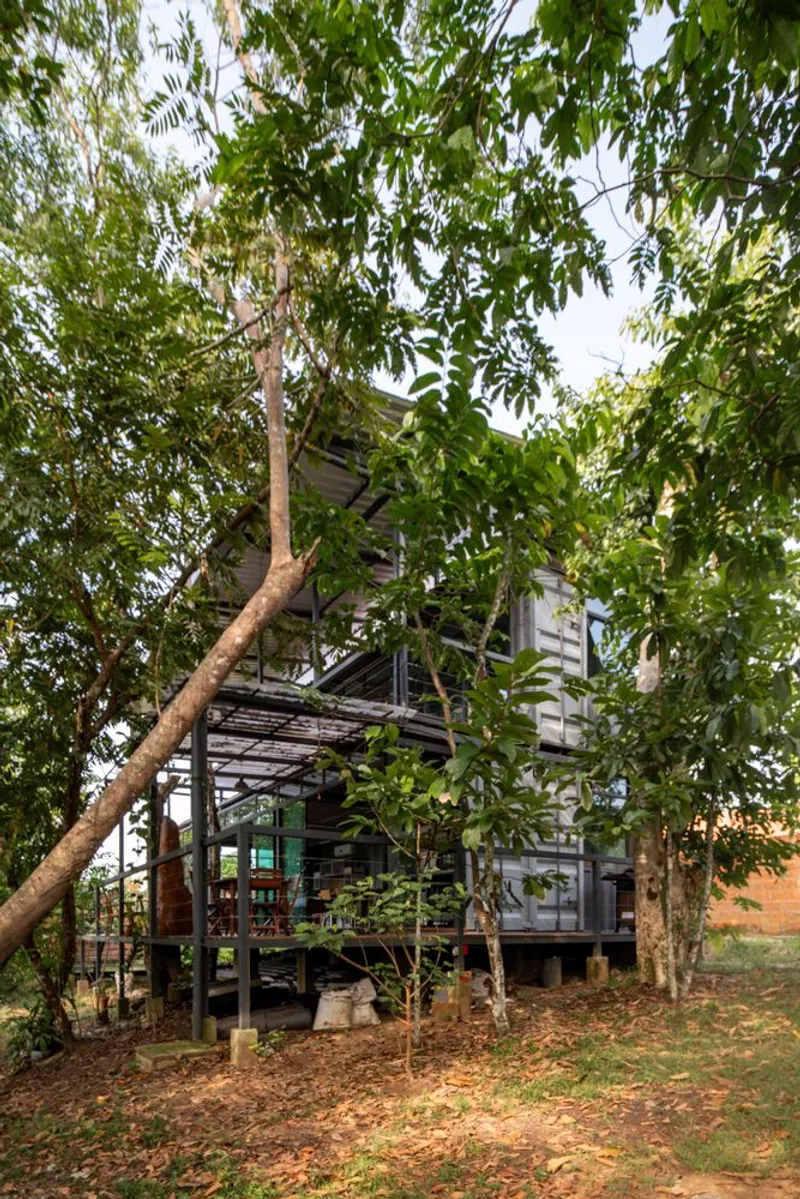
Paricatuba House, designed by iapó estúdio, is a contemporary container house in Brazil that embraces adaptive reuse, environmental comfort, and a deep connection to the Amazonian landscape. Located in Vila de Paricatuba, approximately 40 minutes from Manaus, the project sits within lush vegetation and directly faces the Rio Negro, one of the most striking natural settings in the Amazon region.
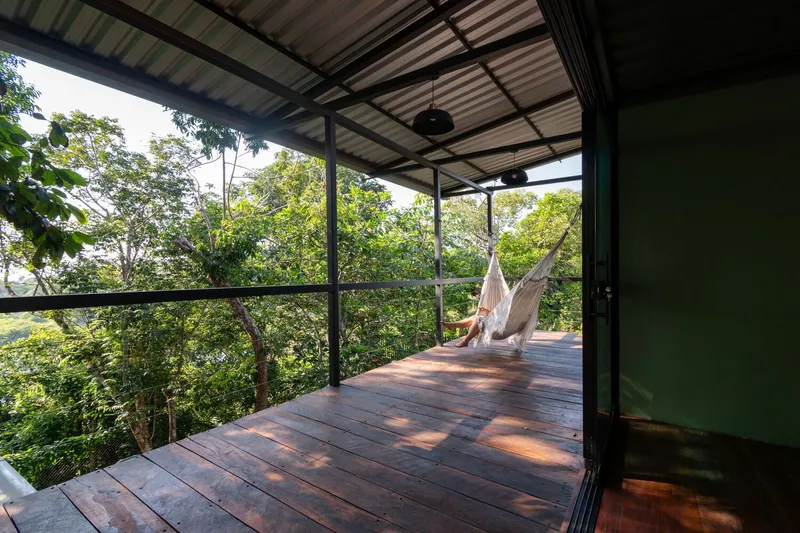
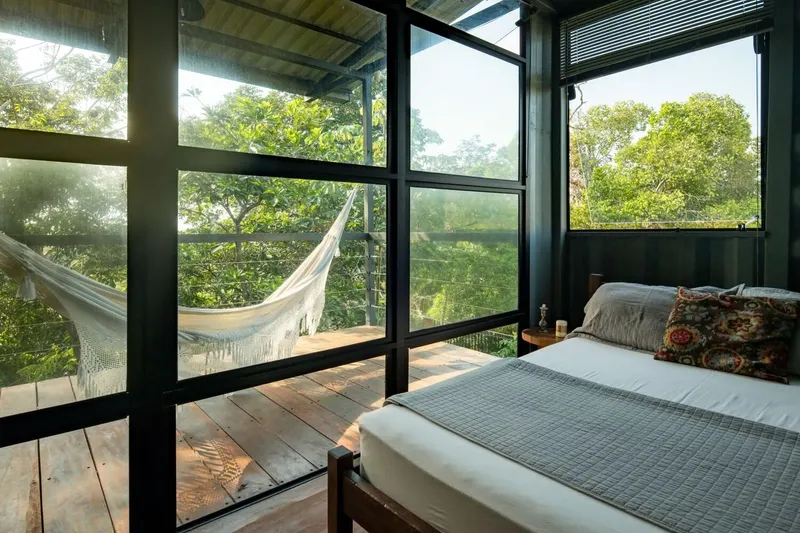
The architectural concept emerged from a specific condition already present on site: three shipping containers stacked on the land at the time of purchase. Rather than removing them, the project was conceived as a renovation and transformation of existing containers, turning industrial structures into a weekend residence that balances rustic aesthetics with climate-responsive design.
Container Architecture Adapted to the Amazon Climate
One of the central challenges of the Paricatuba House was achieving thermal and environmental comfort in a hot, humid climate without erasing the raw identity of the containers. The clients requested a rustic, industrial aesthetic, preserving the authentic “container look” rather than concealing it behind conventional insulation and drywall systems.
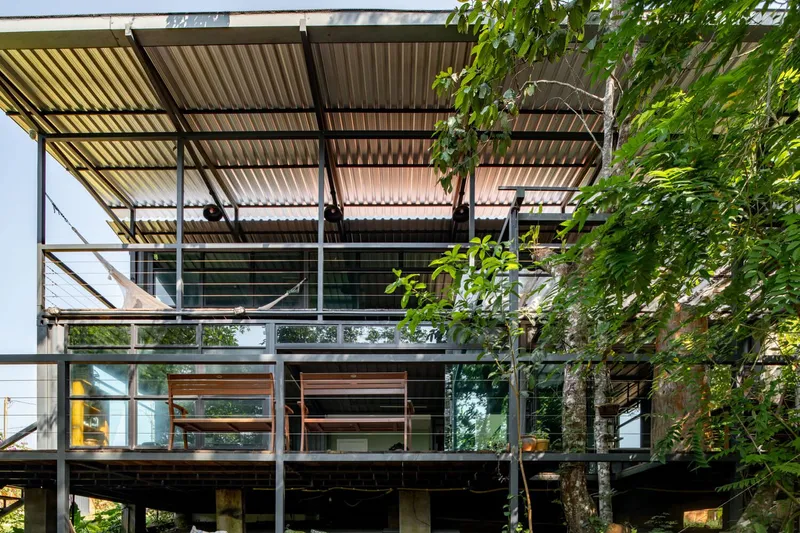
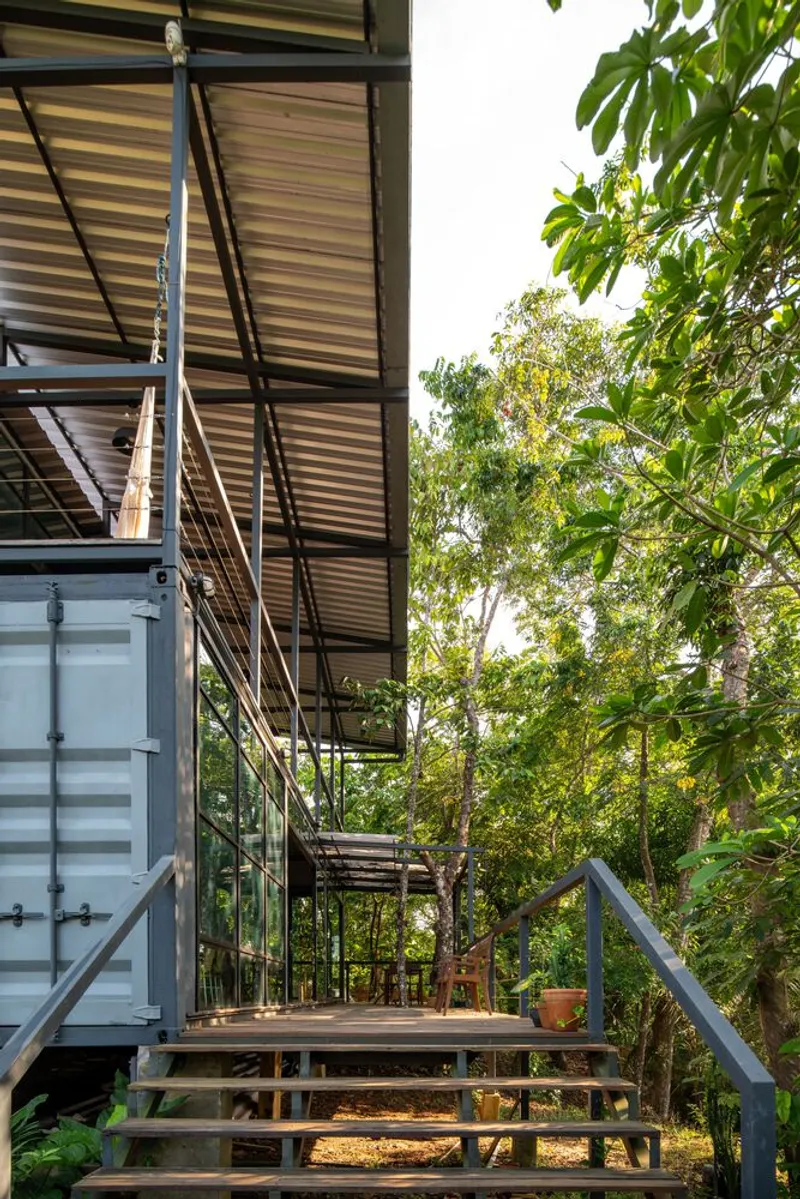
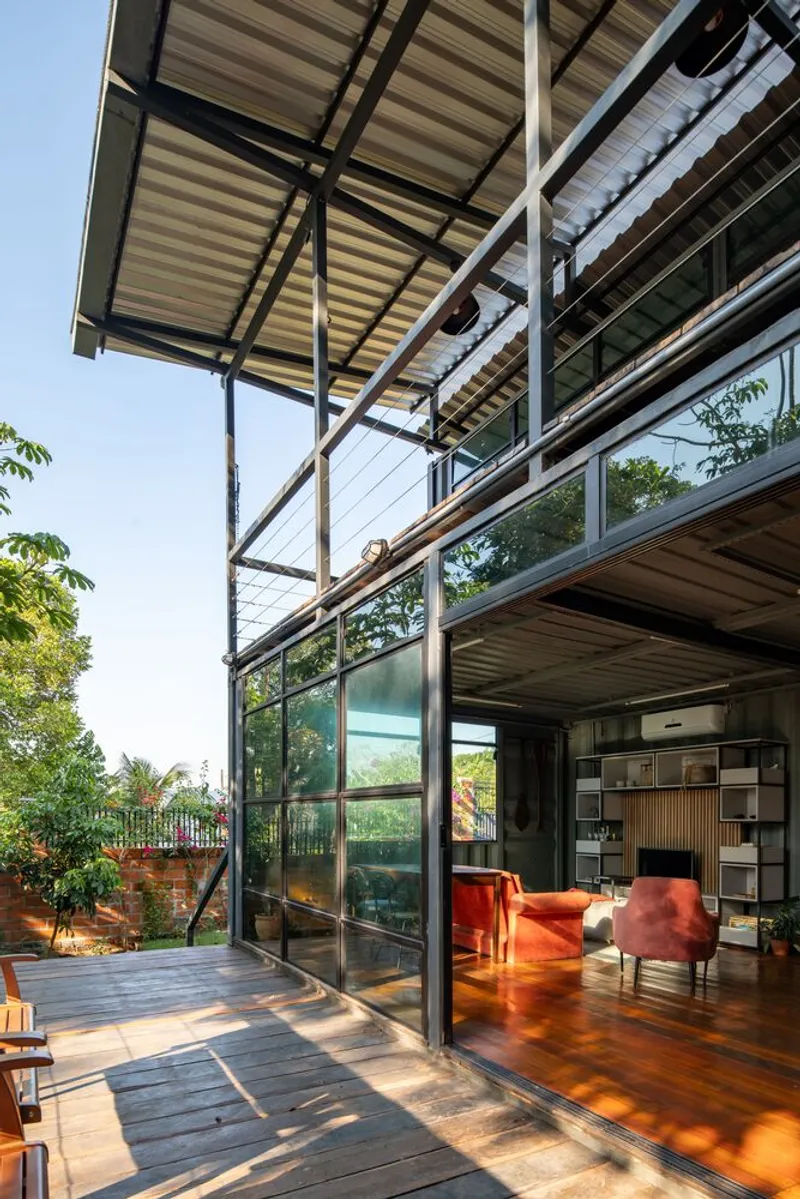
To address this, iapó estúdio developed passive design strategies specifically suited to the Amazon. A large, independent roof with generous overhangs was designed to sit above the containers, shielding them from direct solar radiation while allowing air circulation. This roof becomes a climatic mediator, absorbing heat before it reaches the interior spaces.
Additionally, the west-facing façade received a double-wall system using thermal-acoustic tiles, significantly reducing solar heat gain during the hottest hours of the day. These architectural solutions prioritize passive cooling, which is essential in a region where heat management is the primary concern for residential comfort.
Open Plan Living and Indoor, Outdoor Integration
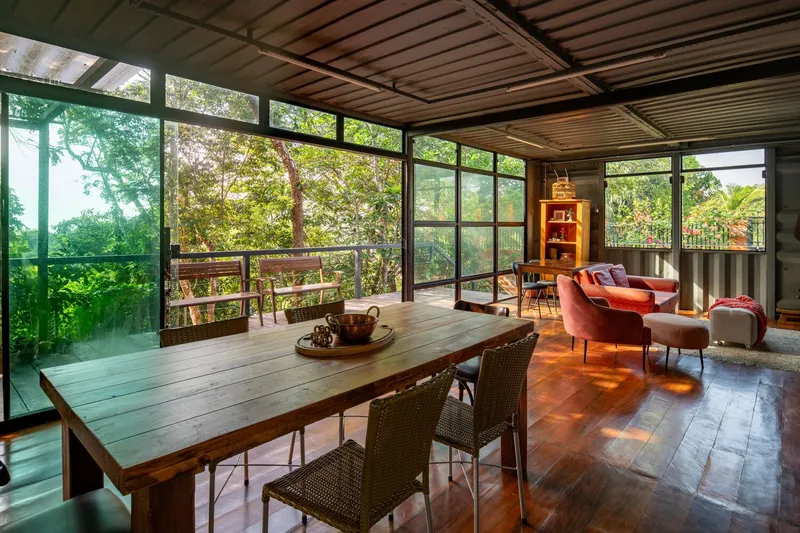
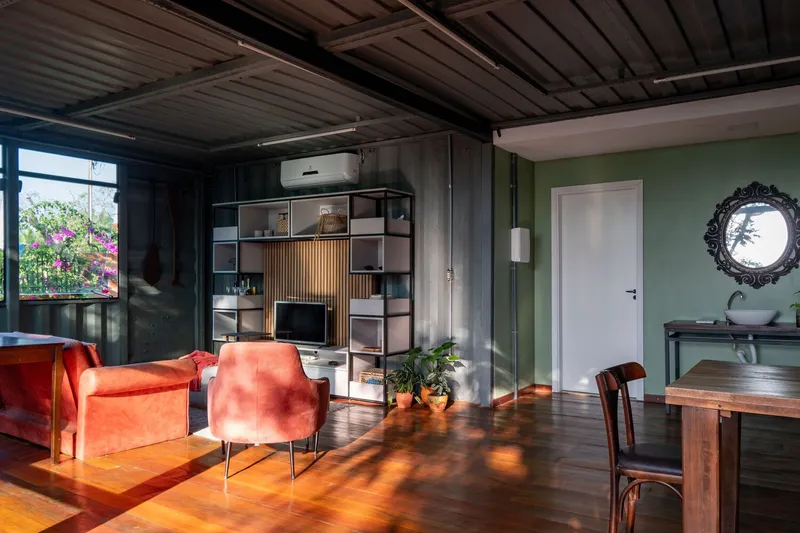
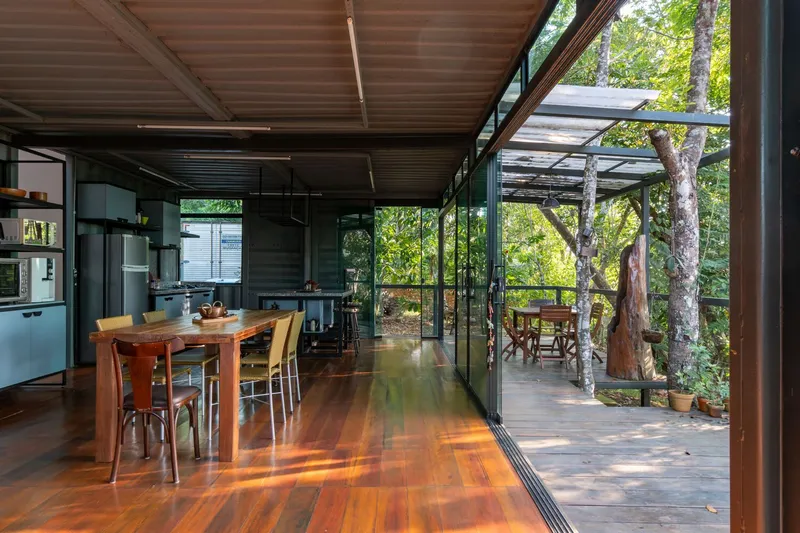
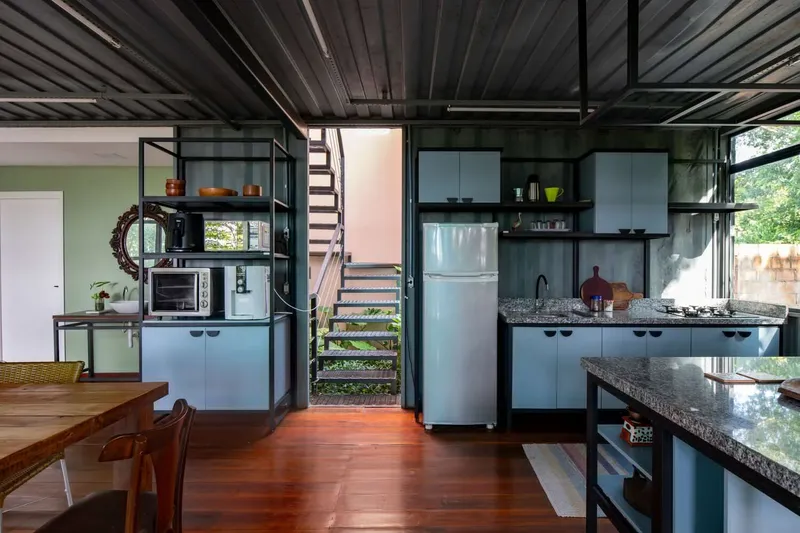
As a weekend house, the program of Paricatuba House is intentionally simple, emphasizing open-plan living spaces and a strong connection to the outdoors. The ground floor is formed by two 12-meter-long containers, fully opened and structurally reinforced to create a single, expansive living area. This space integrates the living room, dining area, and kitchen, extending seamlessly onto a large external deck overlooking the surrounding vegetation and the river.
A masonry volume was introduced adjacent to the containers to house the bathrooms and vertical circulation. This block spans two floors, providing one bathroom per level while also acting as a structural and thermal buffer between the containers and the environment.
Elevated Bedrooms with River Views
The upper floor consists of a third 12-meter-long container, dedicated to private spaces. It accommodates two bedrooms and a home office, all connected to a generous balcony that frames panoramic views of the Rio Negro. This elevated position enhances natural ventilation and reinforces the relationship between the interior spaces and the surrounding landscape.
Large openings and carefully positioned windows allow daylight to penetrate deep into the interiors while maintaining visual continuity with the forest and river beyond.

Embracing Imperfection as Architectural Character
Paricatuba House is also an exploration of architectural authenticity. Rather than masking the containers’ previous life, the project preserves their marks of time, dents, and slight deformations. From certain angles, the structure appears subtly skewed, revealing its industrial origins. These imperfections are not treated as flaws but as defining elements that give the house character, memory, and identity.
The result is a residence that reflects a balance between industrial reuse and natural integration, where architecture does not dominate the landscape but coexists with it.

All photographs are works of Susan Valentim




Popular Articles
Popular articles from the community


The Musturak Paradise: Senior Living Architecture for a Connected Future in Temara, Morocco
The Musturak Paradise reimagines senior living architecture in Temara via private homes, social spaces, culture, community, and shared care.

Co-Life: Senior Housing Design That Reconnects Older Adults With the City
Co-Life reimagines senior housing design through healing gardens, shared streets, workshops, and a sustainable community across generations.

Hill & Cross Opera: Sculptural Opera House Architecture Shaped by Tallinn’s Landscape and Identity
Hill & Cross Opera reimagines opera house architecture in Tallinn through its sculptural hill, civic plaza, glass wave and a luminous cross.

The Earth Pod: 3D Printed Homes for Resilient Refugee Communities
The Earth Pod reimagines refugee housing through 3D printed homes made from clay, combining resilience, self-sufficiency, and rapid shelter.


Similar Reads
You might also enjoy these articles


Hodi-Mandai Geram
Project Function: Preservation and revitalization of the Intangible heritage and socio-spatial identity of the Hodi by Housing, Cultural Memory Center, Sacred Grove, landscape, local tourism economy


Olio Towers: A Mid-Rise for Performers That Fuses Housing, Rehearsal, and Stage
Located blocks from Houston's Theater District, this modular tower stacks living units around a central performance atrium.

Oasis: Modular Green Housing Carved into Dhaka's Urban Fabric
A shortlisted Plugin Housing entry reclaims unauthorized settlements in Dhaka with stepped concrete volumes, green roofs, and ventilation-driven design.

Black Hole: A Floating Megastructure for the Post-Physical Era
Emiliano Mazzarotto envisions a spherical, self-scaling arena where e-sports, digital hotels, and holographic stadiums replace traditional public space.

Explore Housing Competitions
Discover active competitions in this discipline



Challenge to reimagine the Iron Throne


Photograph architecture without architects


Illustrate the lost glory of Angkor Wat - Render Challenge


Design challenge to reuse E-waste
Comments (0)
Please login or sign up to add comments
No comments yet. Be the first to comment!