

Paris Apartment by Wood by Marsh: A Contemporary Renovation Within a Baroque Parisian Landmark
A refined Paris apartment renovation balancing baroque heritage, contemporary interiors, curated art, and modern materials within a protected historic landmark.


Located in the heart of Paris’s historic 4th arrondissement, near the Place de la Bastille, Paris Apartment by Wood/Marsh is a carefully executed interior renovation set within the storied walls of the Hôtel de Sagonne. Originally designed in 1668 by renowned baroque architect Jules Hardouin-Mansart as his personal Parisian residence, the building stands today as one of the city’s most protected heritage landmarks, subject to the highest level of architectural conservation oversight.

Converted from a single aristocratic residence into multiple apartments during the mid-20th century, the building underwent a partial renovation in the 1970s that compromised several original architectural features. Wood/Marsh’s intervention responds to this layered history with restraint and clarity, restoring key historic elements while introducing contemporary architectural language that respects, rather than imitates, the past.

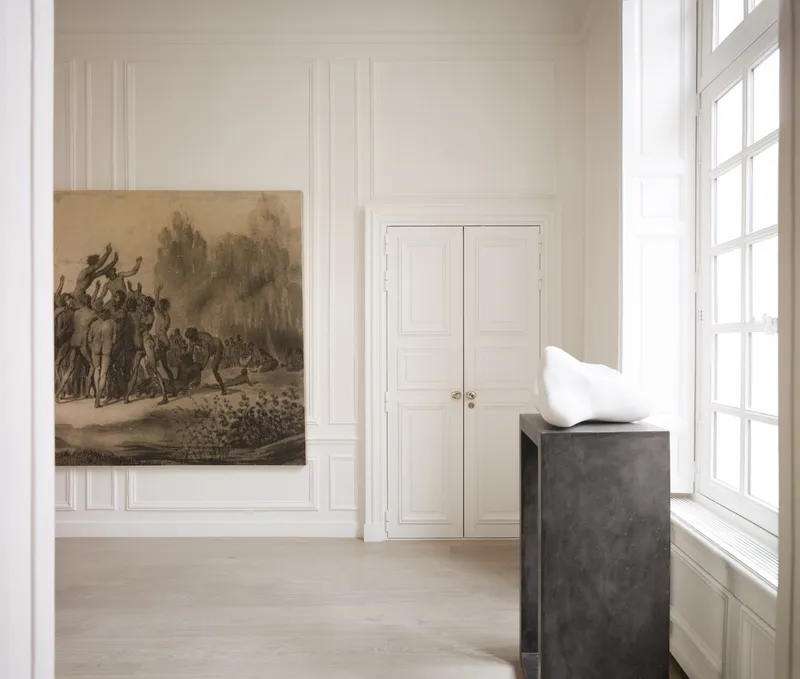
Restoring Heritage Through Subtraction and Precision
The renovation strategy prioritizes removal over replacement, carefully stripping back later additions to reveal the apartment’s original spatial logic and ornamental detailing. Rather than reproducing historic motifs, the architects chose to preserve authentic baroque features where possible, allowing them to coexist with new materials and modern detailing.
This approach establishes a dialogue between heritage conservation and contemporary apartment design, where old and new remain clearly legible. The result is a refined Parisian interior that feels both rooted in history and distinctly current.
Art-Led Interiors and Contemporary Living
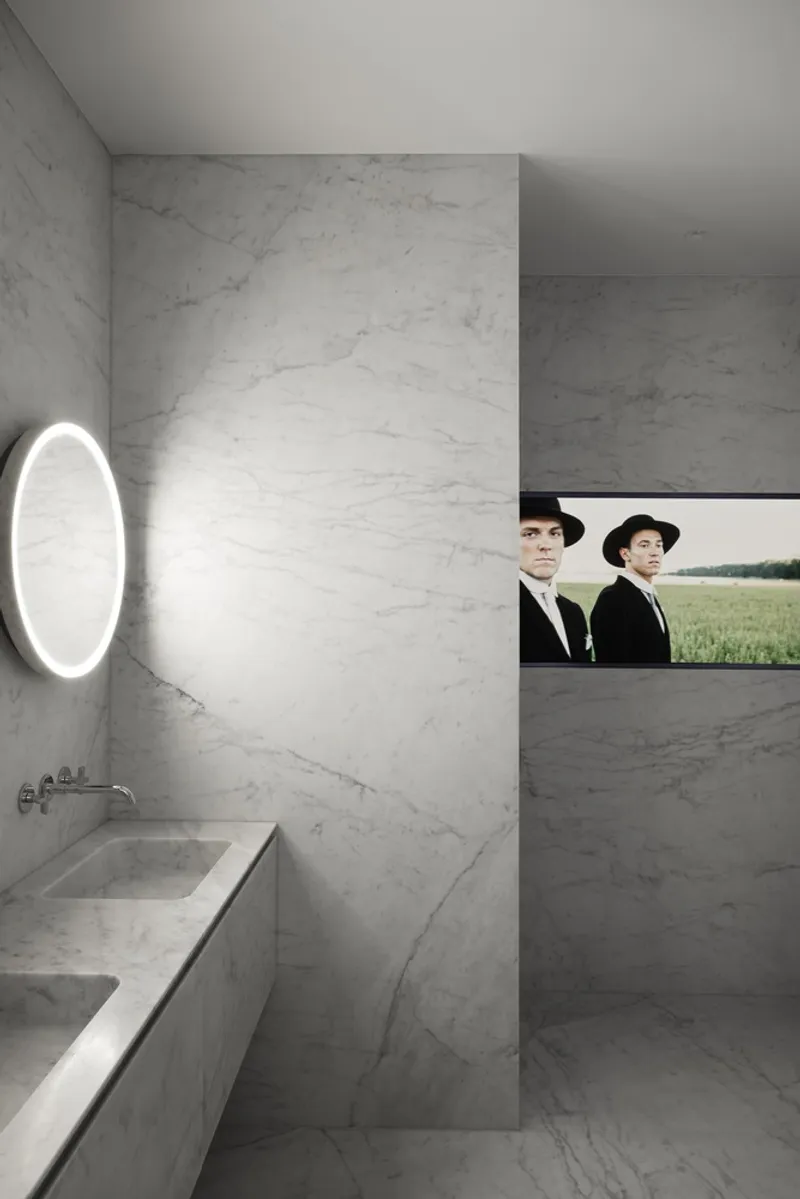
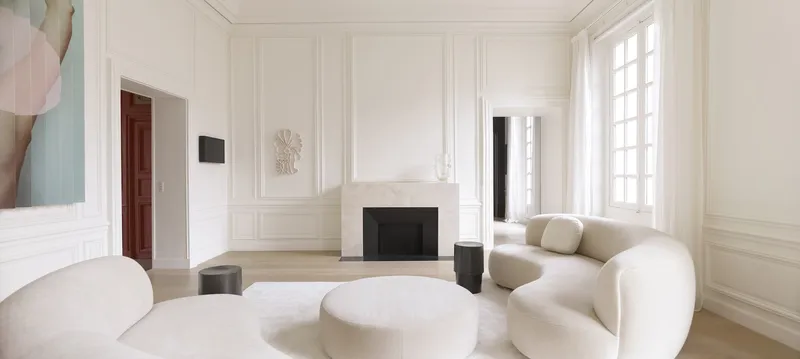
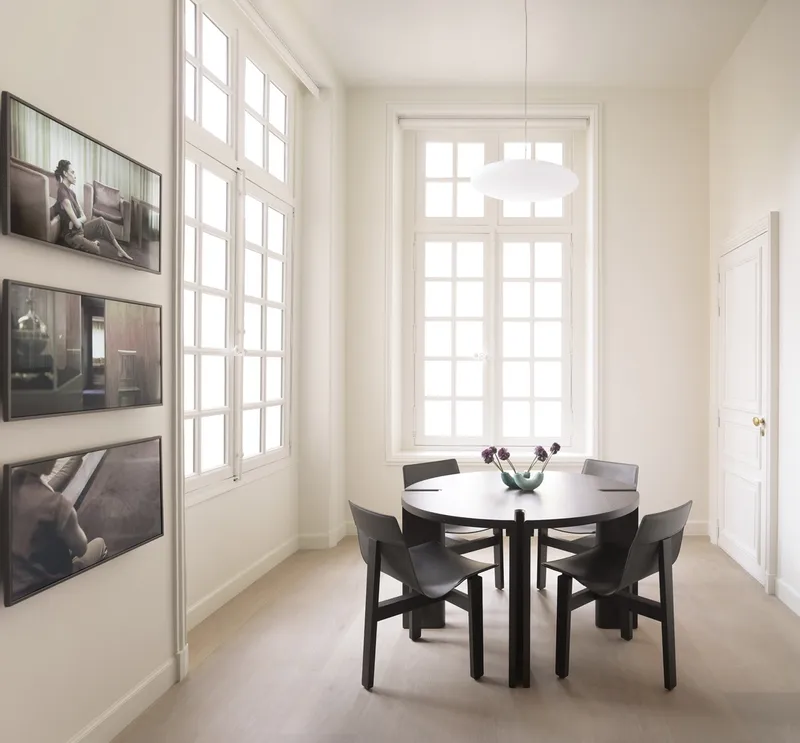
Central to the apartment’s identity is the client’s extensive collection of Australian and international contemporary art, which is integrated seamlessly throughout the space. Traditional artworks sit alongside digital pieces displayed on recessed wall-mounted monitors, reinforcing the project’s balance between classical architecture and modern living.
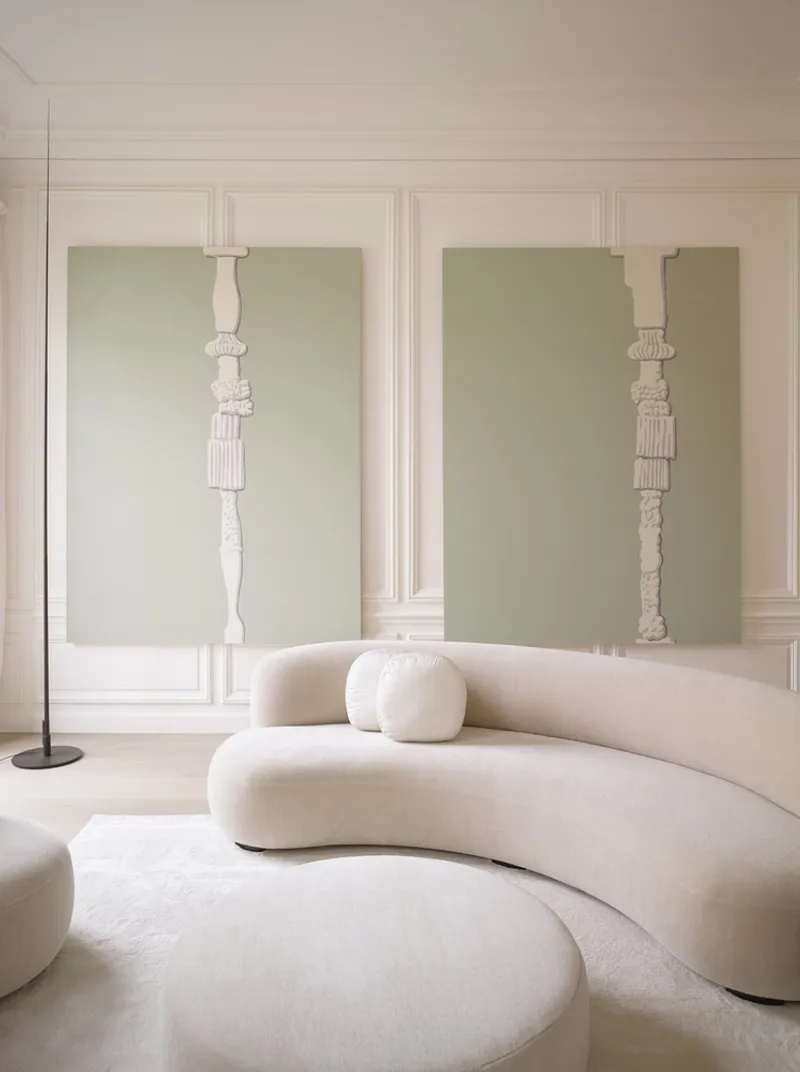
European furniture selections complement the artwork, creating an interior environment that feels curated yet relaxed. A predominantly white color palette runs through much of the apartment, establishing a soft and luminous atmosphere that enhances both natural light and artwork presentation. Organic beige sofas and bold pastel artworks introduce warmth and contrast within the formal living areas.
New timber floorboards extend throughout the apartment, replacing fragmented finishes from earlier renovations. This unifying gesture enhances spatial continuity while subtly grounding the contemporary intervention within the historic shell.

A Sculptural Kitchen as a Contemporary Counterpoint
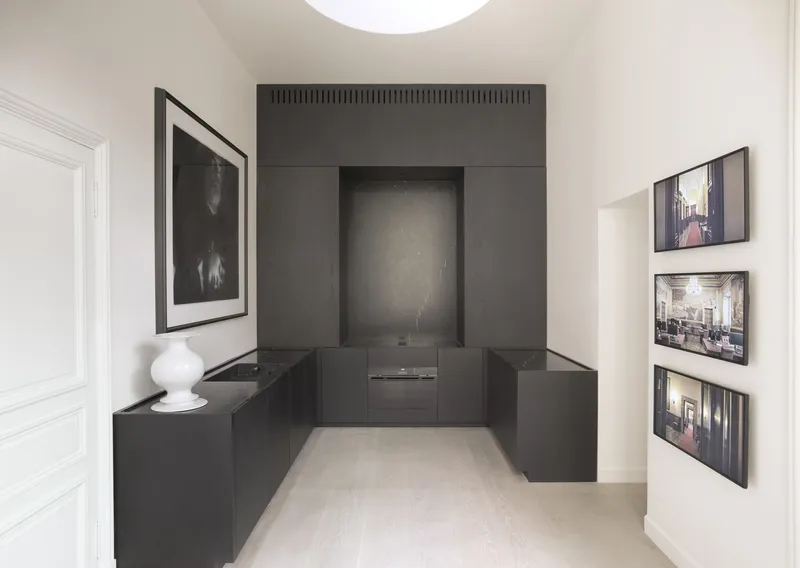
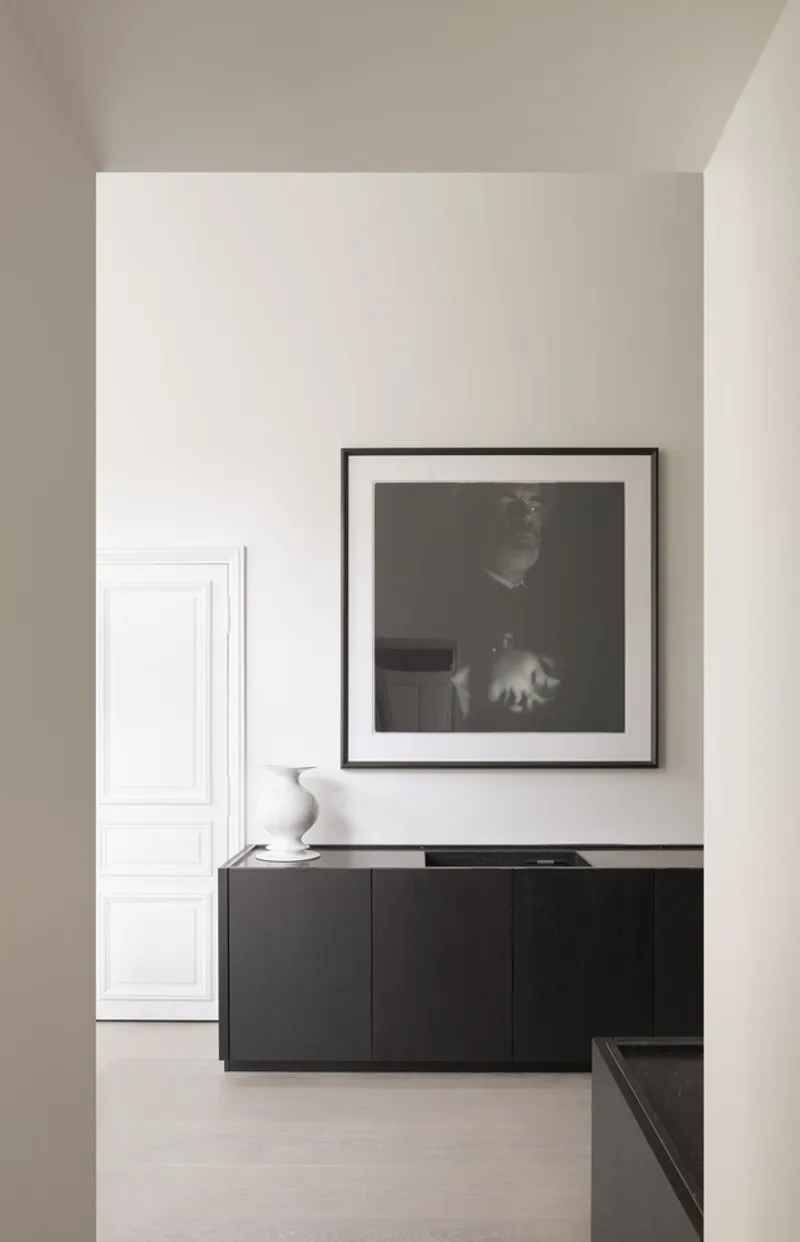
In contrast to the apartment’s lighter living spaces, the kitchen introduces a bold material shift. Clad in black timber and Nero Marquina marble, the space reads as a sculptural insertion within the historic plan. Concealed detailing and integrated appliances create a clean, geometric composition centered around a symmetrical niche.
This contemporary kitchen functions as both a practical workspace and an architectural statement, offering a deliberate contrast to the baroque moldings and ornamental details found elsewhere in the apartment. An informal dining area and framed artwork soften the composition, maintaining the project’s overall balance.
The Dining Room as the Spatial Heart
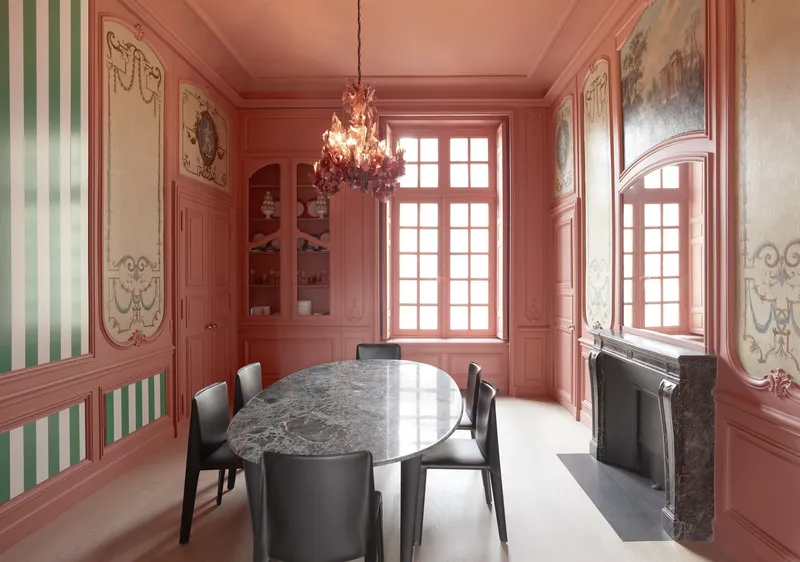
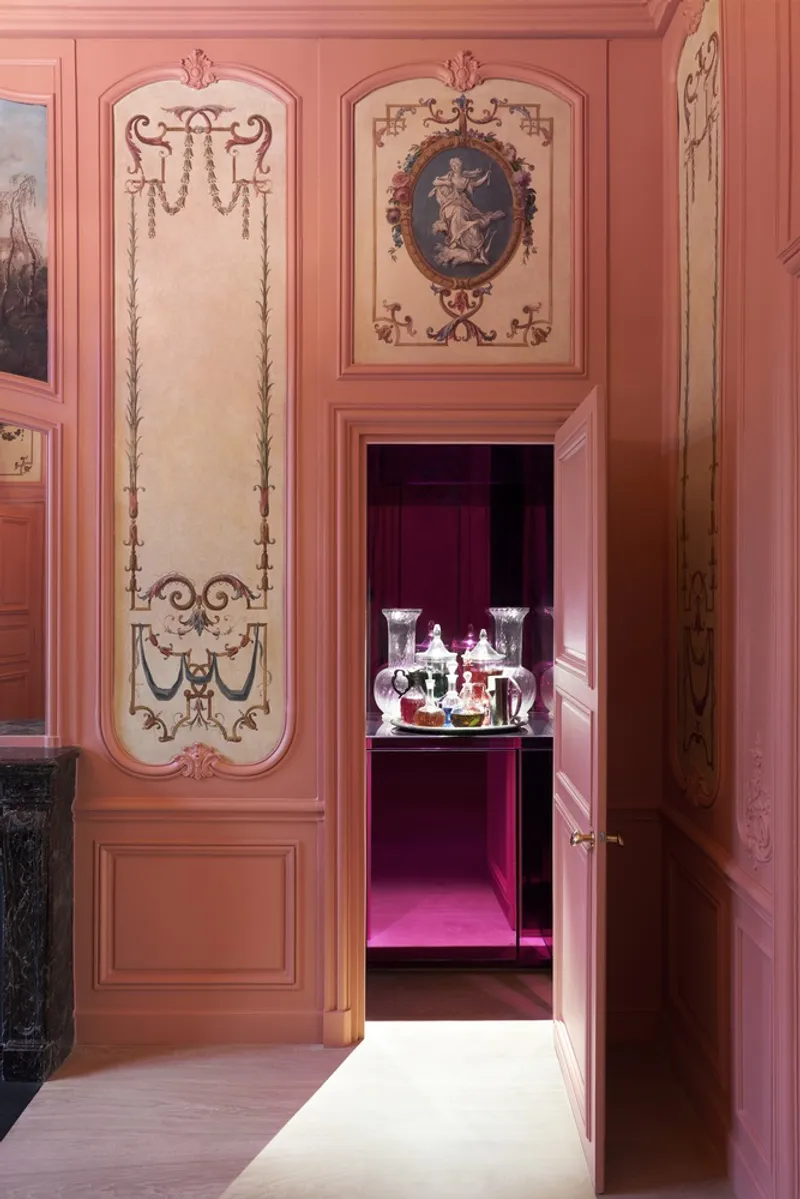
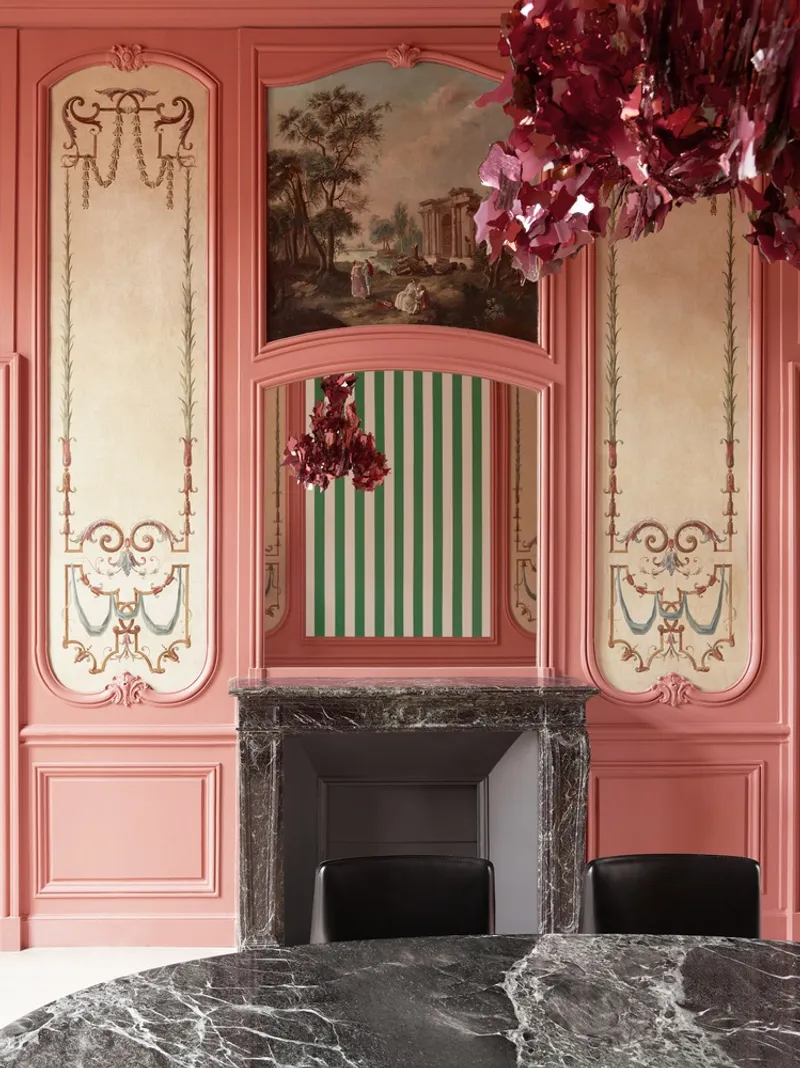
The formal dining room forms the central node of the apartment, with the foyer, kitchen, and living spaces branching outward. Its distinctive salmon-toned walls were inspired by the baroque grotesque forms embedded within the original moldings, subtly accentuating the historic panels.
Suspended above the dining table is a custom chandelier by Nathalie Ziegler Pasqua, which reinforces the room’s sense of ceremony while engaging with its contemporary color palette. A newly introduced wall between the dining space and the master robe conceals a hidden bar lined in magenta mirror, adding an unexpected layer of color and reflection that complements the room’s expressive character.

Intimate Transitions and Private Spaces
A charcoal-toned study acts as a transitional space between the formal living area and the master bedroom. Designed as a visual pause, its darker palette and intimate scale provide privacy while functioning as an informal lounge and retreat within the apartment’s overall sequence.
The master bedroom is conceived as an expansive yet controlled space, with the bed positioned as a central monolithic element that divides the room without disrupting its openness. The adjoining ensuite bathroom employs an innovative construction technique, using just 3 millimeters of white marble bonded to an aluminum honeycomb substrate. This approach delivers a luxurious, durable finish while minimizing structural load, an essential consideration within a centuries-old building.
A Harmonious Dialogue Between Past and Present
Paris Apartment by Wood/Marsh exemplifies a sensitive approach to heritage apartment renovation, where contemporary architecture enhances rather than competes with historic fabric. By combining Parisian architectural history with contemporary Australian design sensibilities, the project achieves a nuanced balance between preservation, modern comfort, and artistic expression.
The result is a refined urban residence that honors the past while confidently engaging with the present, an elegant example of how historic Parisian interiors can be reimagined for contemporary living.
All photographs are works of Tommaso Sartori


Popular Articles
Popular articles from the community


Extended Shell: Retrofitting Kolkata's Balconies as Living Urban Thresholds
A modular retrofit system recovers the social and environmental intelligence of Kolkata's historic verandas for contemporary Park Street residents.

Opera on the Sea: Driftwood Logic Shapes a Timber Opera House on Estonia's Coast
Trevor Orgill's opera house translates the entangled drift of floating timber into a civic building where wood, water, and music converge.

Faces of the Soviet Avant-Garde: Turning Moscow's Street Names into an Open-Air Museum
A network of sculptural installations across a Moscow residential district transforms forgotten architect names into spatial encounters with cultural memor

Tsunami Convergenics: Turning Catastrophic Ocean Forces into Underwater Housing Infrastructure
A speculative underwater settlement off the coast of Onagawa, Japan, treats tsunamis and typhoons as energy sources rather than threats.

Similar Reads
You might also enjoy these articles


Hodi-Mandai Geram
Project Function: Preservation and revitalization of the Intangible heritage and socio-spatial identity of the Hodi by Housing, Cultural Memory Center, Sacred Grove, landscape, local tourism economy


Olio Towers: A Mid-Rise for Performers That Fuses Housing, Rehearsal, and Stage
Located blocks from Houston's Theater District, this modular tower stacks living units around a central performance atrium.

Oasis: Modular Green Housing Carved into Dhaka's Urban Fabric
A shortlisted Plugin Housing entry reclaims unauthorized settlements in Dhaka with stepped concrete volumes, green roofs, and ventilation-driven design.

Black Hole: A Floating Megastructure for the Post-Physical Era
Emiliano Mazzarotto envisions a spherical, self-scaling arena where e-sports, digital hotels, and holographic stadiums replace traditional public space.

Explore French Cultural Renovation Competitions
Discover active competitions in this discipline

Challenge to design luxury tourism on rails

Challenge to reimagine the Iron Throne

Photograph architecture without architects

VR headsets Storefront design competition
Comments (0)
Please login or sign up to add comments
No comments yet. Be the first to comment!