
Parvus Syrtis
Procedures for the Martian Vernacular


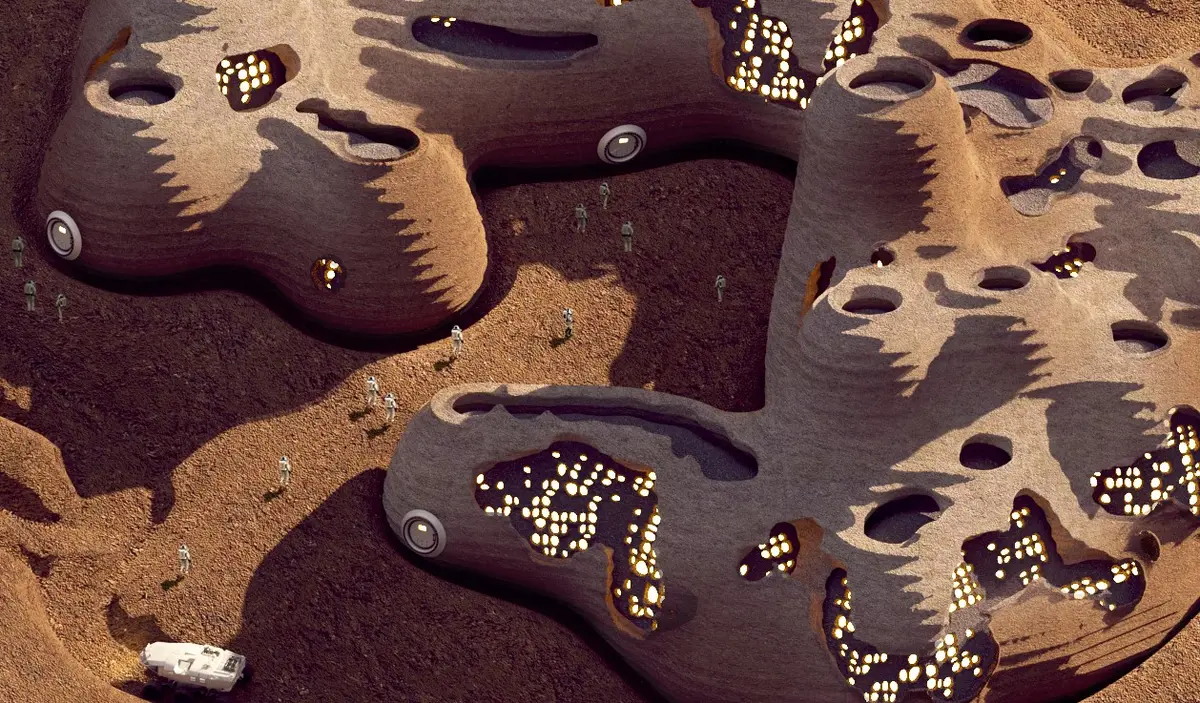
Parvus Syrtis is a Martian crater village that speculates on a future vernacular architecture on Mars through procedural design and rule-based systems that respond to specific site conditions. The use of earth, or in this case regolith, is a key component in the construction of the settlements. In addition to providing structural integrity, protection from radiation and textural identity to the design, it more importantly highlights the possibility of utilising local materials to resourcefully constitute a new architectural language, be it on Mars or Earth. The result is a system of intelligence that offers spatial complexities from autonomous, agent-based robotic construction remotely overseen by future Martian architects. Such a procedural, systematic approach allows for the architecture to expand and adapt to future needs based on the specific conditions of the site, provoking a new formula in which future architects will engage with design problems.
Vernacular Language
Looking into the factors that feed into the making of the Martian vernacular our question was; what will be the new cultural domain created by this architecture represent on a planet where human culture only exists in the forms of expedition devices? With current limitations on construction and material available on Mars in mind, which characteristics could be systemized as a Martian Vernacular to test maximum design differentiation whilst responding to the harsh realities of the planet?
Robots
Due to the communication delay between Earth and Mars, it is often proposed that the swarm of construction robots to be sent before human arrival will need to be intelligent enough so that they can achieve goals in construction rather than following specific instructions remotely sent from Earth. Through a self-replicating machine strategy they would evolve, perform a variety of new tasks and ultimately become capable of reproducing themselves autonomously.
This goal-oriented approach could lay the foundations of a more systematic, rule-based design approach for architects, who, in the absence of initial visits to site and construction management, will have to rely on the robots’ intelligence for the Martian habitat.
Site
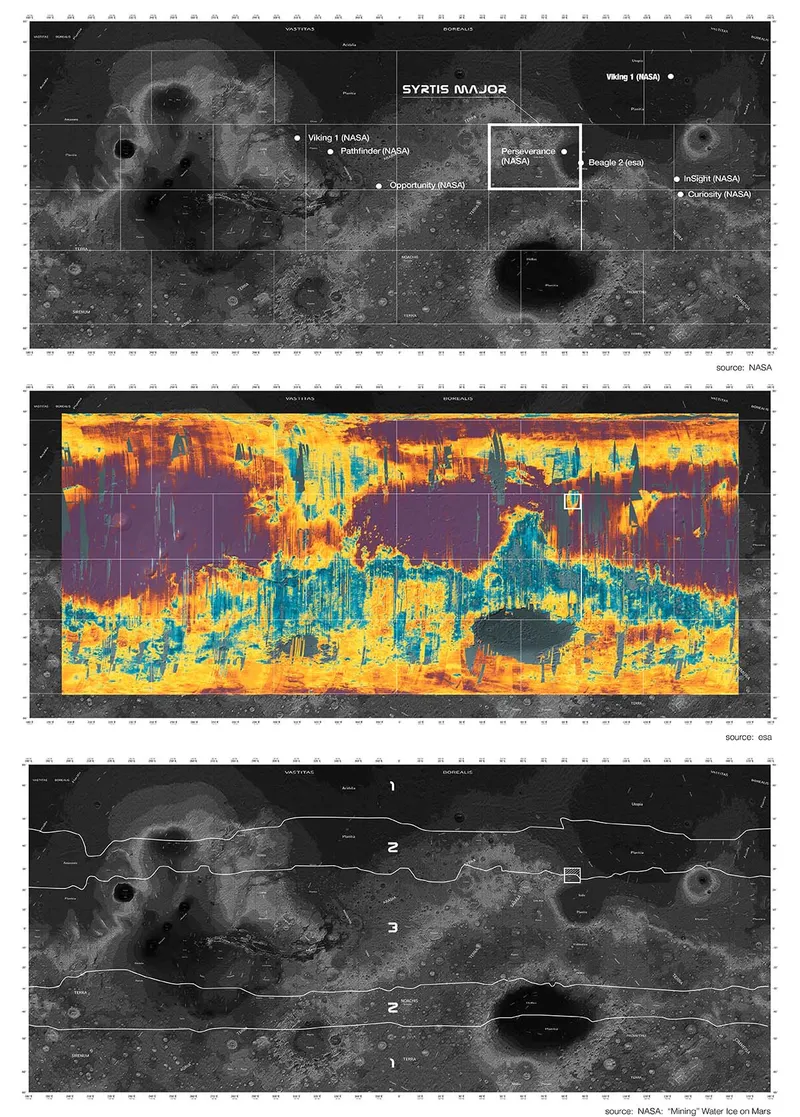
The design process begins with selecting a potential location on the Martian surface with conditions suitable for the construction of the village. Based on its proximity to the landing sites of previous Mars missions by NASA and esa, the region of Syrtis Major is selected as an area of interest for the future crater village. The region represents an area where more scientific studies have been conducted compared to neighbouring areas, allowing the settlements to be more equipped with logistical support for future manned missions. Within Syrtis Major, a specific region with low abundance of dust distribution is selected. As dust storms present potential danger to human health and damage to future architecture and outdoor scientific equipment, the chosen area is considered an ideal location for a crater village.
Design Process
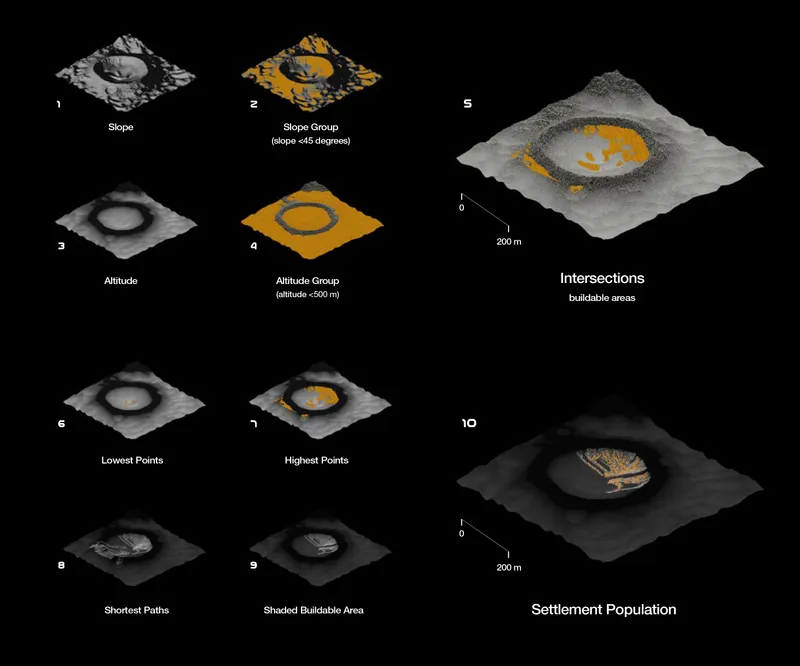
To constitute a set of buildable areas within the surface of an example crater of Parvus Syrtis, procedural tools are used to specify and eliminate certain characteristics within the site. For instance, areas with slopes lower than 45 degrees and those with altitude below 500 metres are intersected and specified as primary buildable areas within the crater. Within the specified buildable areas, a set of shortest paths is then generated between the lowest and highest points of the areas. The paths that lie on the northern side and outside of the crater are eliminated, leaving a final set of settlement areas protected from radiation by the terrain. Finally, multiple points within the shortest path lines are populated with unique settlement clusters which are connected to complete the Parvus Syrtis village masterplan.
After the locations of the clusters are allocated along the generated paths on the terrain of the crater, the organization and construction of the village are executed via autonomous assembly by self-aware 3d printing drones, starting from the top of the village to the bottom of the crater. The regoliths used in the construction process are extracted from a nearby site.
Typologies
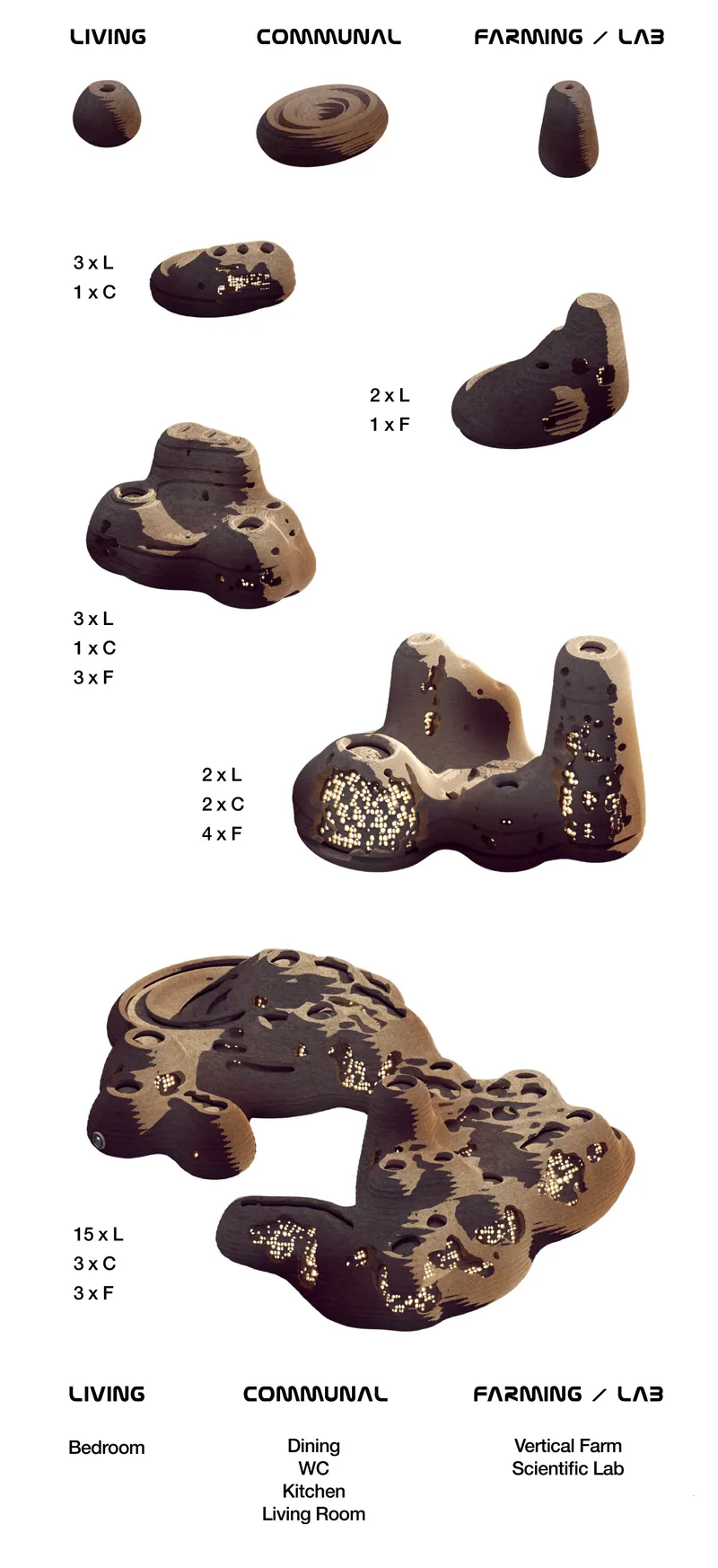
The variations of clusters are made up of three individual typologies essential for life on Mars: Living, Farming/Lab and Communal. The size and programmatic property of each cluster adapts to the function and needs of the inhabitants’ activities within each region of Parvus Syrtis.

Structure
The structure of the settlement consists of two layers of 3D printed regolith shells and a pressurized inflatable shell suitable for life on Mars. The first layer protects the settlement from radiation and dust storms, while the second layer provides structural integrity and openings for views towards the crater. Due to the toxicity of perchlorates present in the Martian regolith, the interior surfaces of the settlement are constructed with protective pressurised inflatable shells. These shells physically connect the interior spaces in each settlement together, as well as the overall system of underground tunnels beneath the village.
Conclusion
Building upon the systematic nature of the early Martian architecture on the horizon, we speculated on the new ways in which architects could engage in designing the future of human presence on Mars through procedural design and rule-based systems that respond to specific sites on the planet.
In doing so, we developed systems of intelligence that will offer spatial complexities which will be organized rather than fully controlled. If humanity were to expand its presence on Mars, designing new habitats can benefit from a systematic approach as architects' traditional engagement with high precision and control in the design process could not be as adaptive as needed for the Martian realities of construction. This could gradually transform the role of the Martian architect into an organizer of complex systems who oversees autonomous choreographies of construction that happen with agent-based robots.
Using procedural design tools, we tested the limits of formal differentiation for the foundations of Martian vernacular architecture that responds to local materiality as well as the extremity of the planet’s environment. We focused on a specific site and developed a set of procedures that will offer the reutilisation of the in-situ material. The proposed procedural design system is constructed to be adaptive enough to offer a generous design divergence. The solutions are a family of design possibilities for the given site, each of which can evolve and expand over time, rather than a fixed, singular proposal.


Popular Articles
Popular articles from the community


U.GA Architects Wraps an Oval Rooftop Pool in Curved Board-Formed Concrete on Busan's Jeollidan-gil
In Busan's Jeonpo-dong, a 454 m² mixed-use block stacks a neighborhood facility, guest rooms and an oval rooftop pool inside spiraling concrete walls.

David Macias Steps a Doorless Stone and Plaster House Down a Tropical Colombian Hillside
In the humid hills of Colombia, Threshold House replaces the front door with an open void and terraces its 850 m² down the slope instead of fighting it.

GROUP A Strips a 1969 Rotterdam Harbor Headquarters to Its Frame and Wraps It in Timber Louvers
In Rotterdam's M4H harbor district, Ferro Offices reuses a 1969 frame, adds one timber storey and reaches BREEAM-NL Outstanding.

LT2A and OPEN Architectes Thread a Brick and Glass High School Through a Wooded Belgian Campus
In Braine-l'Alleud, a 3,000 m² wing for Collège Cardinal Mercier pairs pale brick with a glazed colonnade, deferring to a small chapel and a dense wood.

Similar Reads
You might also enjoy these articles


Vereda Arquitetos Renovates a 40-Square-Meter Apartment Inside Niemeyer's Copan Building
A compact unit in São Paulo's most iconic residential tower gets a material overhaul that pairs exposed concrete with bold blue Formica.

Shakur's House: Exposed Brick as an Interior Organiser in a 168 m² Mashhad Residence
Brick moves indoors in this Mashhad residence, where masonry walls, glass partitions and teal planes sequence a compact home without closing it off.

Day and Night Park: A Time-Based Urban Newsstand in Beijing
A temporary urban newsstand in Beijing blending travel, light, and reading through poetic colors, compact form, and community-focused design.

Modernist Patio Renovation in El Masnou, Barcelona by Oliver Segura Arquitectura + Cebrià Arquitectura
Modernist patio renovation blending tradition and innovation with a movable pool, leveled floors, and Catalan materials in El Masnou.

Explore Space Architecture Competitions
Discover active competitions in this discipline


Comments (0)
Please login or sign up to add comments
No comments yet. Be the first to comment!