

Paseo House of Cantera: Tropical Living in Block
Antumbra Estudio crafts a Colima residence where custom perforated concrete screens, courtyards, and timber detailing respond to tropical climate and artis


Colima sits in a hot, humid pocket of western Mexico where architecture has to do real work against the sun. Cobblestone streets, a culture of handcraft, and an abundance of tropical vegetation set the context for any project here, and the question for a house is always the same: how do you build something that breathes? Antumbra Estudio answers with Casa Paseo de la Cantera, a 360 square meter residence completed in 2024 that uses a custom perforated concrete block screen, deep courtyards, and generous timber framing to negotiate privacy, airflow, and a connection to the street that most gated houses in Mexico forgo entirely.
What makes this project worth studying is not the courtyard typology itself, which is deeply rooted in the region, but rather the specificity of its execution. The perforated screen wall at street level is not off-the-shelf. Each block was hand-placed and appears to have been designed for this project, creating a veil that filters light and air while giving the facade a tactile, almost textile quality. Above it, cantilevered concrete volumes project outward with confidence, and the whole composition reads as a house that is simultaneously open and defended. That tension between porosity and enclosure runs through every room.
The Screen as Street Gesture
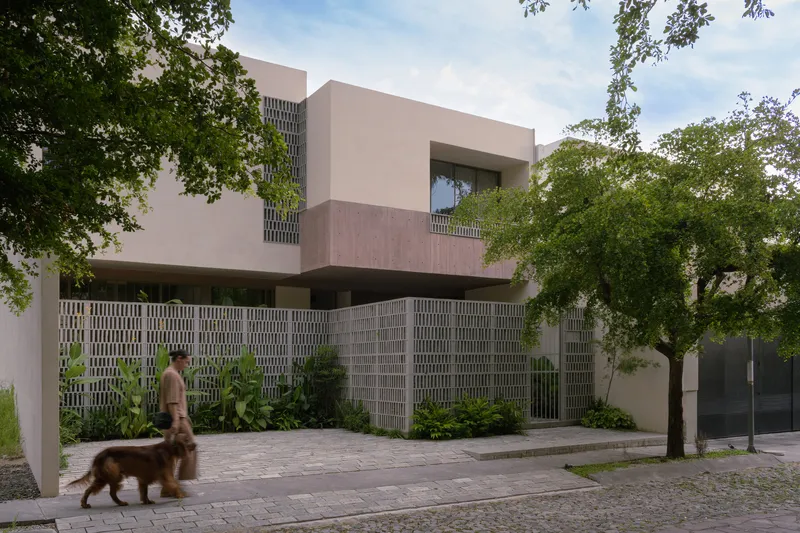
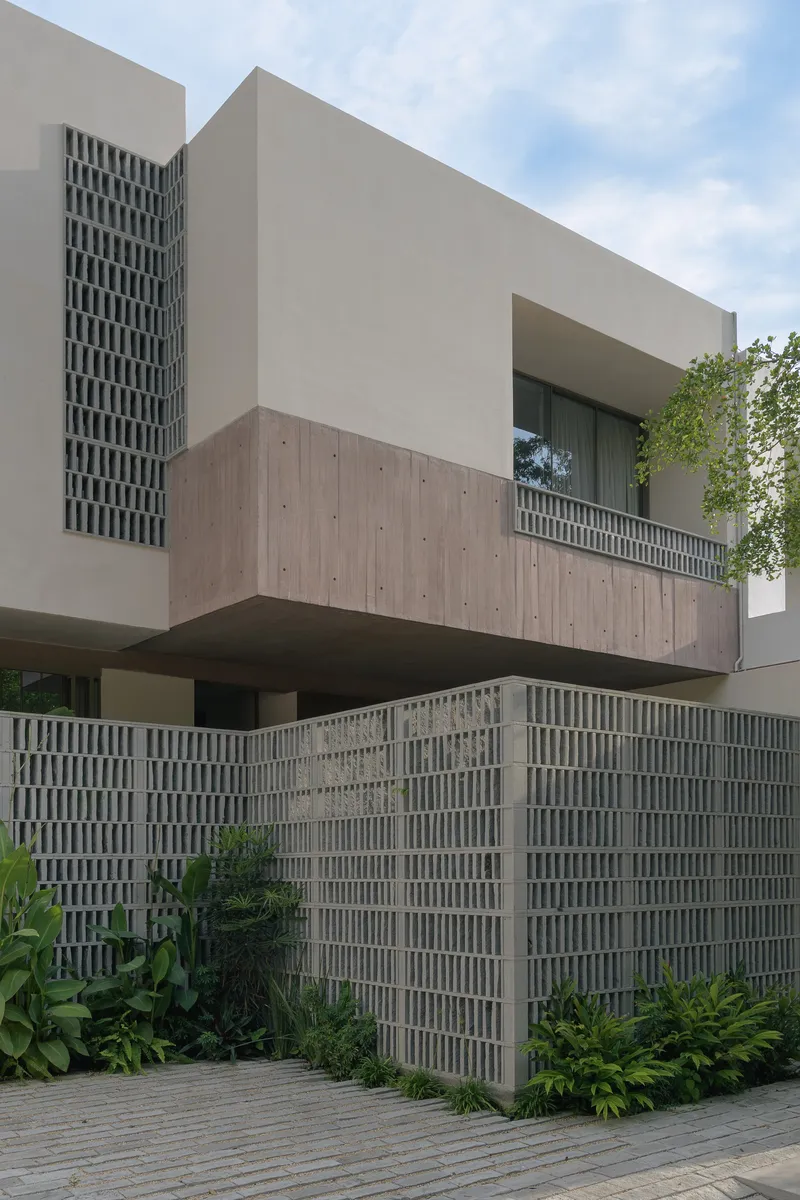
The street facade is the house's strongest move. A perforated concrete block wall occupies the ground plane, its geometric openings filtering tropical light into soft patterns while allowing cross-ventilation from the sidewalk through to the interior courtyards. Above this porous base, a solid cantilevered volume pushes forward, establishing a clear compositional dialogue between mass and void. The result is a facade that engages the public realm without surrendering the privacy residents expect.
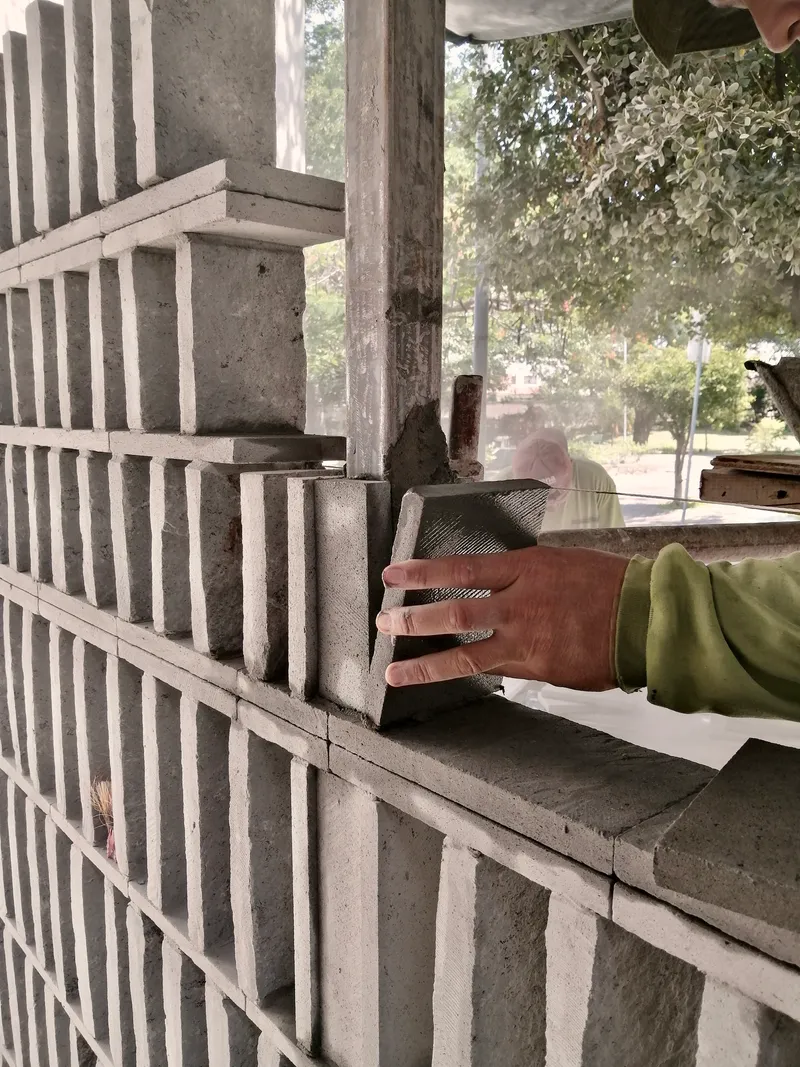
One construction photograph captures a hand placing a single block into the screen wall, trees visible through its openings. It is a small image that reveals a lot: this is handcraft at the scale of architecture, each block positioned to maintain the pattern's rhythm. In a city with a strong artisanal tradition, the decision to make the most public element of the house the most labor-intensive one feels deliberate and generous.
Courtyards That Do the Heavy Lifting


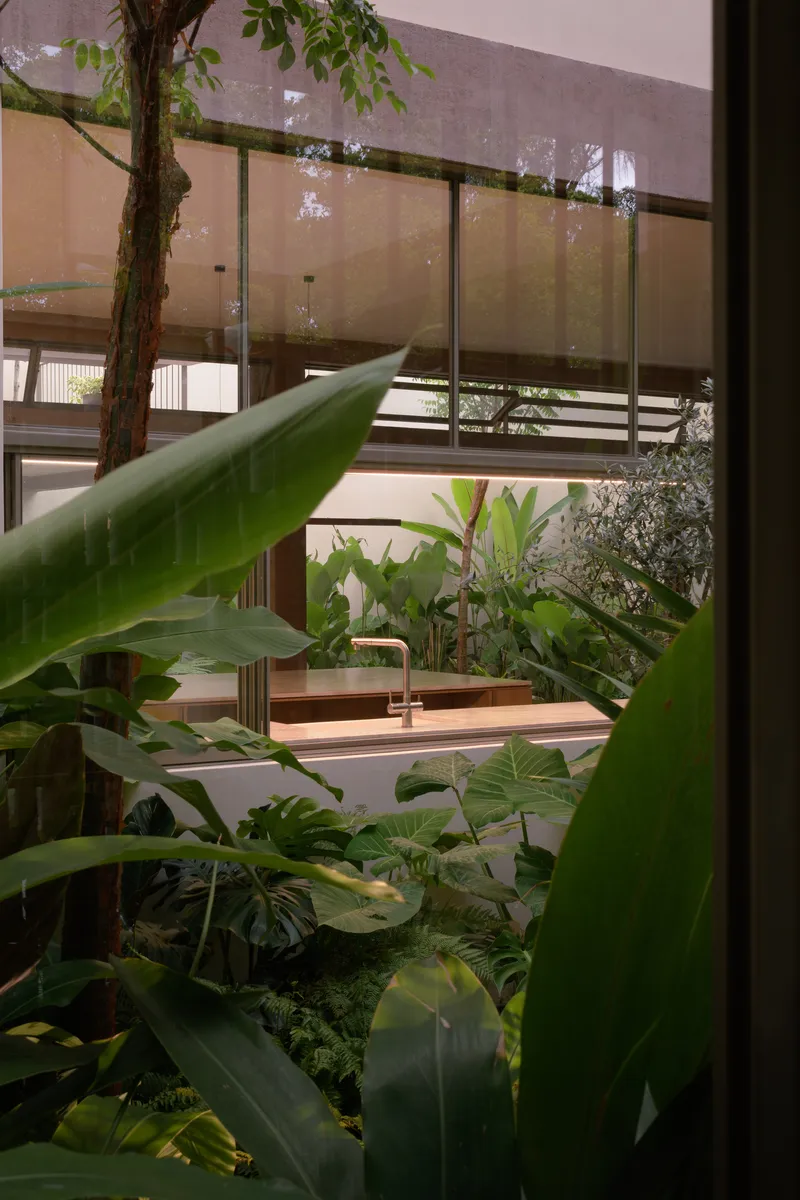
The plan organizes living spaces around multiple courtyards, and these are not decorative. In a tropical climate, they are the building's mechanical system: chimneys that pull hot air upward while drawing cooler air through the ground level. Banana plants, grasses, and other tropical species fill the planted beds, and their transpiration further cools the microclimate. Every major room has direct visual and physical access to at least one of these green pockets.
The cantilevered upper terrace overlooking one courtyard, with its metal railing and potted palms, provides an elevated vantage point that transforms the garden from backdrop to foreground. Steel-framed glazing walls slide open to eliminate the boundary between interior and exterior, a strategy that works year-round in Colima's climate. The courtyards also introduce daylight deep into the plan, reducing the house's dependence on artificial lighting during the day.
Living Between Inside and Out


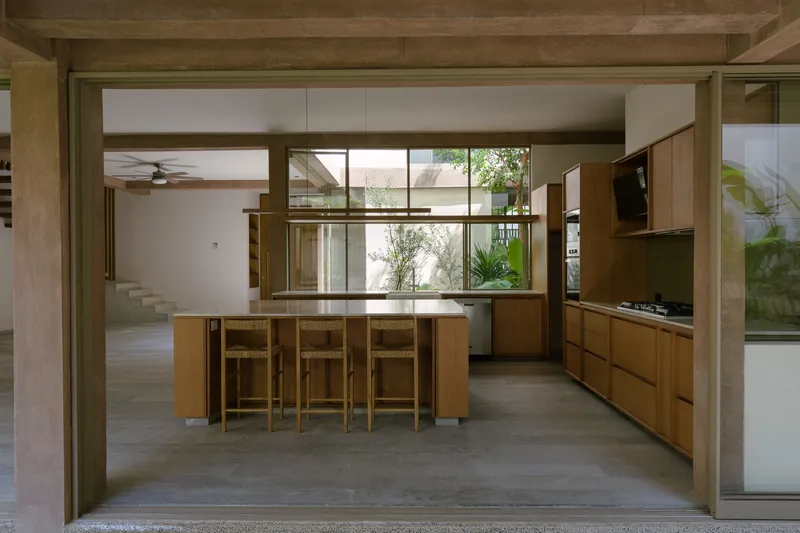
At ground level, the living spaces operate as a continuous landscape. Timber-framed glass doors fold open to internal courtyard gardens where stepping stones cross planted beds of tropical vegetation. The kitchen anchors one end with a timber island under exposed timber beams, its stools oriented toward the garden view. Floor-to-ceiling glazing along the main living area frames banana plants and lawn in a composition that treats landscape as interior finish.
The material palette stays disciplined throughout: poured concrete for structure, timber for warmth and detailing, steel frames for the large glass openings. There is nothing exotic here, just familiar materials used with care. The exposed beams in the covered terrace areas are honest about their structural role while creating a rhythm overhead that modulates the scale of the spaces below.
The Staircase as Spatial Event


Antumbra treats the main staircase not as circulation but as a spatial event. A cantilevered timber stair with vertical slat balustrade occupies a double-height volume, connecting ground and upper levels while allowing light and air to pass through its open structure. The vertical slats create a visual screen that changes in density as you move around it, filtering views to the courtyard beyond.
The covered terrace at the base of the stair, with its exposed concrete beams framing sky and planting, is one of the house's most atmospheric spaces. It functions as an outdoor room that mediates between the formality of the interior and the wildness of the courtyards. The concrete is left raw, the planting is allowed to be lush, and the interplay between the two registers as effortless in the way that only careful design produces.
Private Rooms, Considered Details
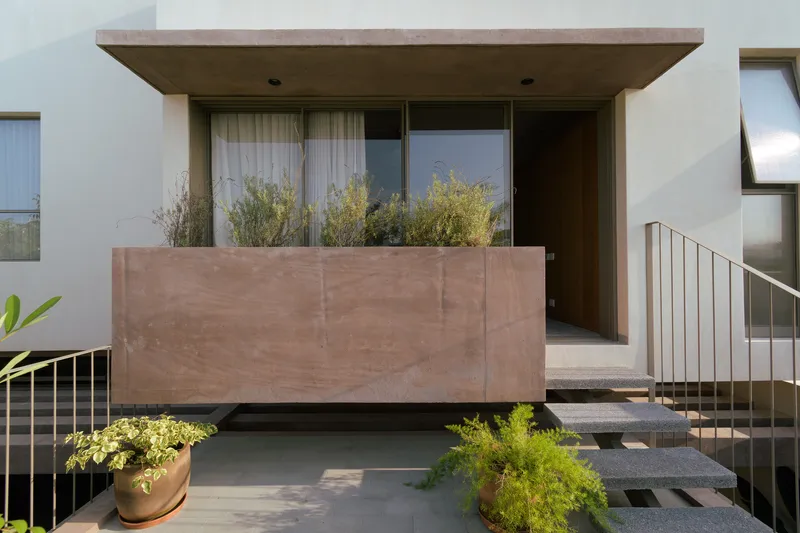
The entry terrace sets the tone for the level of detail sustained throughout the house. A cantilevered planter box filled with ornamental grasses floats beside glazed doors, while concrete steps hover without visible support. It is a sequence that compresses the transition from street to interior into a few carefully composed moments.
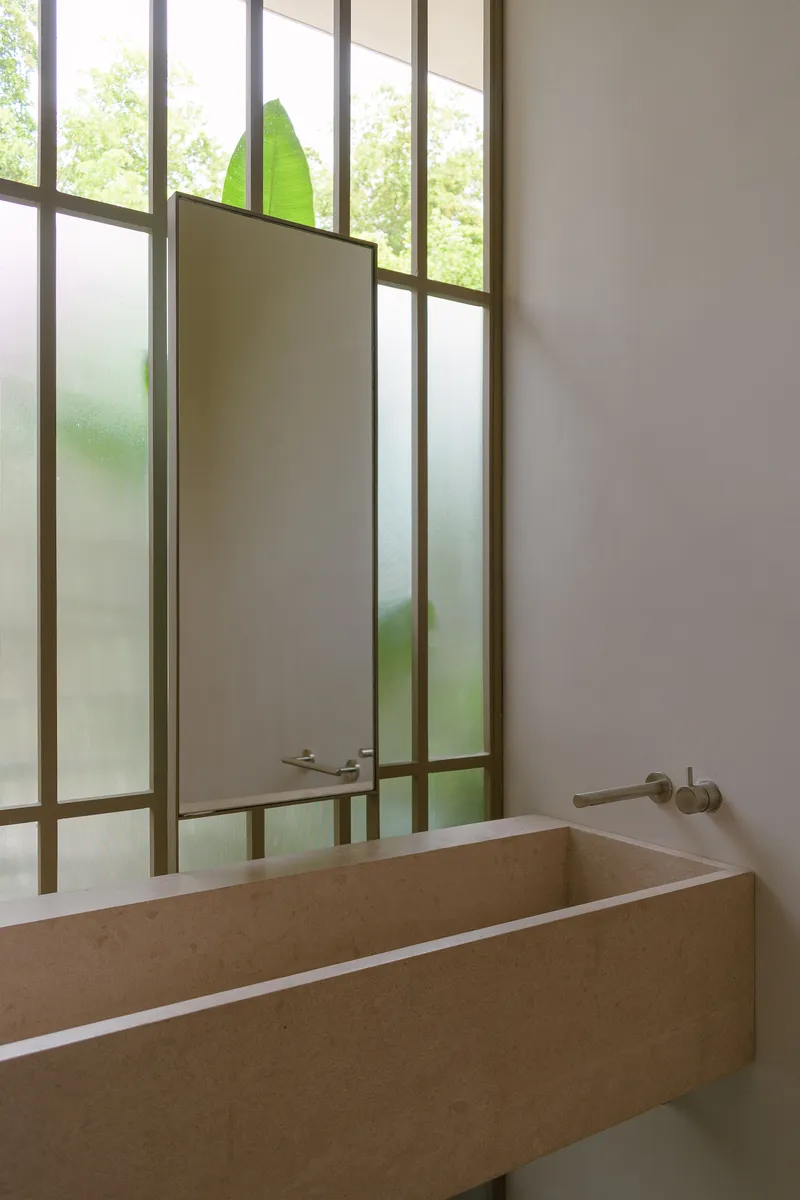
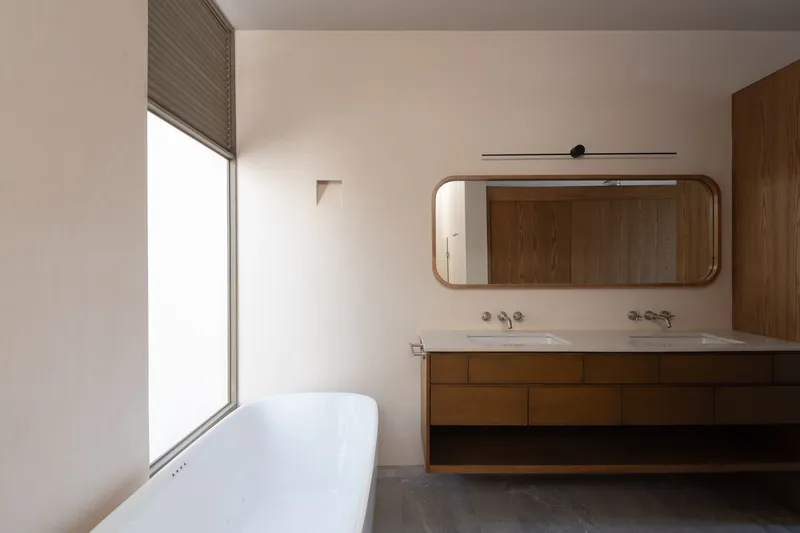
The bathrooms reveal where the budget went. A stone sink sits against a steel-framed translucent glass partition that admits the green glow of foliage from the courtyard beyond, maintaining privacy while refusing to sever the connection to landscape. Elsewhere, a freestanding tub is paired with a timber vanity and a rounded mirror beneath a Roman shade, and the simplicity of the composition relies on the quality of each individual element. These are rooms where material selection replaces ornamentation.
Plans and Drawings
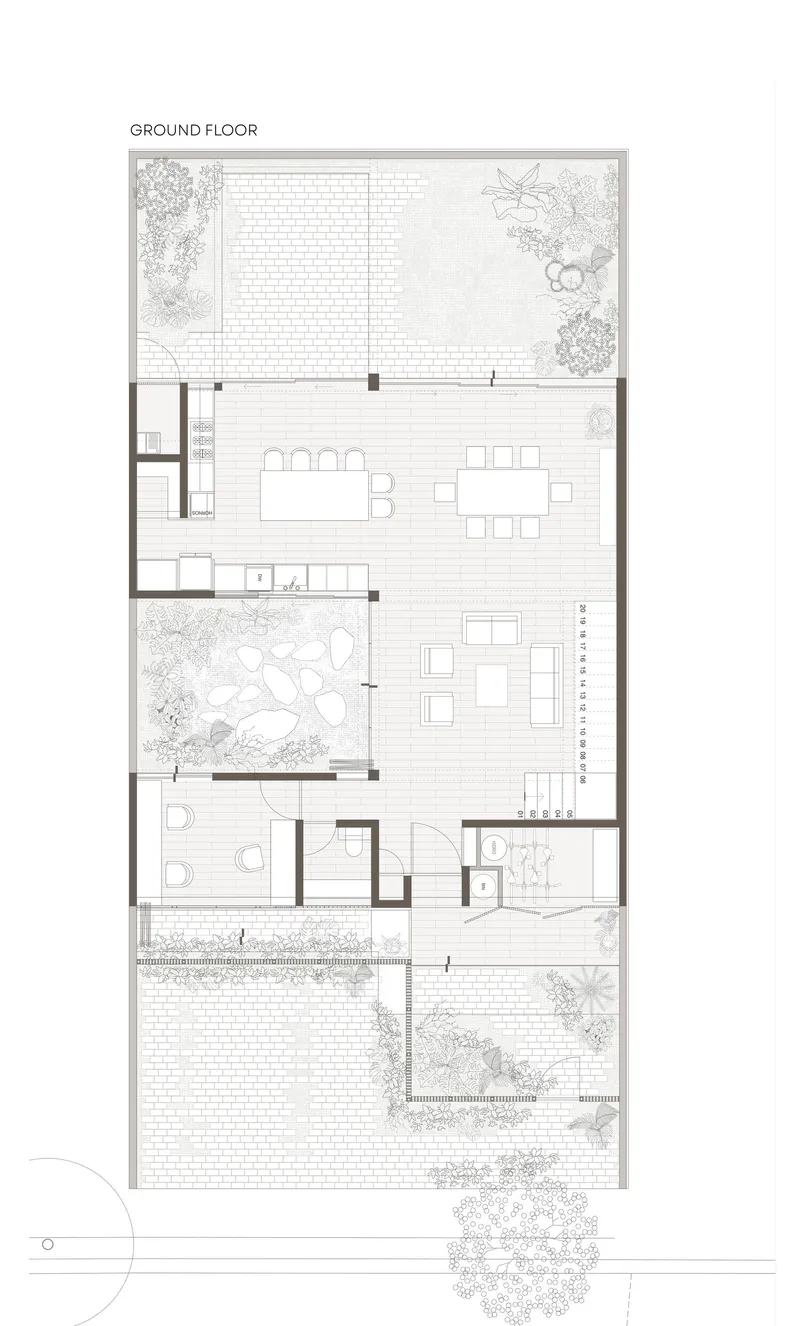


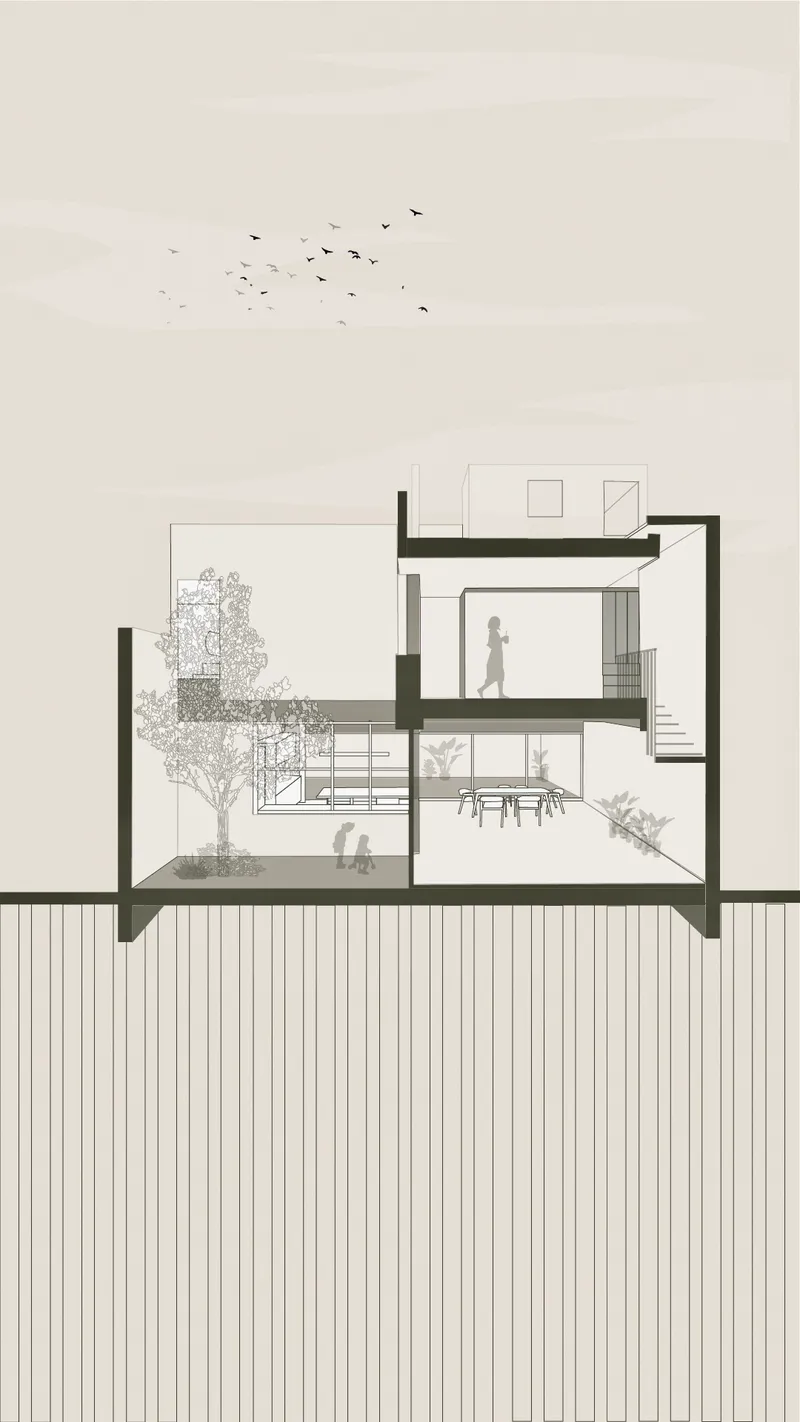

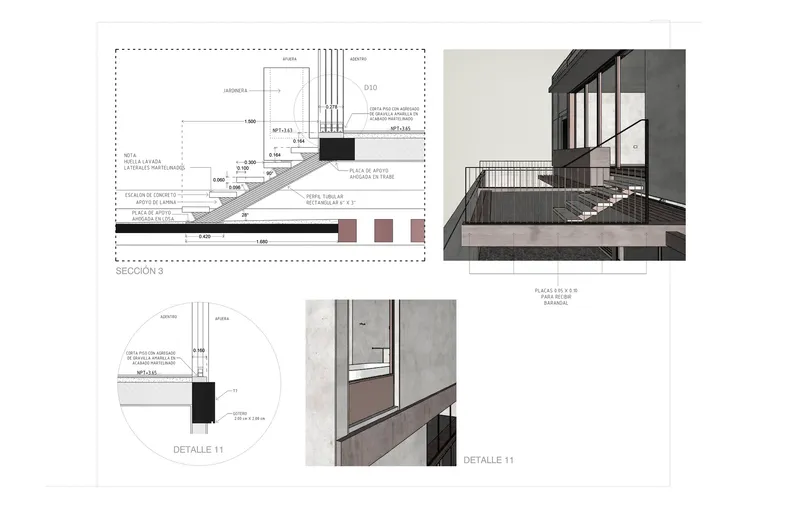

The ground floor plan confirms what the photographs suggest: living areas are organized as a single open zone flanked by courtyards on both sides, so that cross-ventilation is a given rather than a goal. The upper floor redistributes mass into bedroom suites arranged around central circulation and outdoor terraces, each room claiming its own relationship to the sky. The section drawings reveal split-level conditions that are not immediately legible in the photos, with half-level changes creating spatial variety within a compact footprint.
The construction detail drawings are worth lingering on. They show the concrete slab, railing, and glazing connections that give the house its clean lines, and they demonstrate that the apparent simplicity of the facades is the result of carefully resolved junctions. The axonometric of the stepped concrete foundation with vertical timber cladding at the corner exposes the structural logic beneath the project's composed exterior. The inclusion of whimsical birds in several elevation and section drawings is a nice reminder that the architects view this house as part of a living environment, not an abstract composition.
Why This Project Matters
Casa Paseo de la Cantera is a house that takes its climate, its city, and its craft traditions seriously without turning any of them into a costume. The perforated block screen is not a decorative reference to regional masonry; it is a functional environmental device that also happens to be the most visually compelling element on the street. The courtyards are not lifestyle staging; they are the engine that makes the house comfortable without mechanical systems working overtime. Every move has a reason, and the reasons are legible.
For architects working in tropical climates, Antumbra Estudio's approach here offers a model that resists both the hermetic sealed-box tendency of contemporary residential design and the nostalgic impulse to simply replicate traditional forms. The house is contemporary in its spatial ambition and construction technique, but it is grounded in the physical realities of its place. That combination, ambition held accountable by context, is what makes it worth your attention.
Paseo House of Cantera by Antumbra Estudio, Colima, Mexico. 360 m², completed 2024. Photography by Sebastian Anaya / Registro Visual de Arquitectura.
About the Studio
Share Your Own Work on uni.xyz
If projects like this are the kind of work you want to make, uni.xyz is a place to publish your own, find collaborators, and enter design competitions.


Popular Articles
Popular articles from the community

Opera by the Sea Estonia: Three Shells Dissolving Architecture into Tallinn's Coastline
A winning opera house proposal replaces monumental form with interconnected shells that blur the boundary between building, park and Baltic Sea.

Tsunami Convergenics: Turning Catastrophic Ocean Forces into Underwater Housing Infrastructure
A speculative underwater settlement off the coast of Onagawa, Japan, treats tsunamis and typhoons as energy sources rather than threats.

Cloaked Colonization: A Mobile Underwater Habitat That Moves Like a Fish
Micah Abaya's shortlisted EHC Pacific entry reimagines ocean settlement as a dispersed network of self-sustaining architectural organisms.

Extended Shell: Retrofitting Kolkata's Balconies as Living Urban Thresholds
A modular retrofit system recovers the social and environmental intelligence of Kolkata's historic verandas for contemporary Park Street residents.

Similar Reads
You might also enjoy these articles

Bao Huynh Watercolor Atelier: A Serene Art Retreat in Hội An
Bao Huynh Watercolor Atelier in Hội An blends multifunctional art spaces, sustainable design, local materials, and family-friendly living in a serene environment.

Atelier Macri Concept Store Interior Design by CASE-REAL
Atelier Macri store features a "ko" counter, walnut wood details, cork displays, blending retail, gallery, and seamless customer experiences.

Manuel Vargas Izquierdo Stadium and High-Performance Sports Center: Architectural Excellence in Jalpa de Méndez
The Manuel Vargas Izquierdo Stadium blends sustainable design, inclusive sports facilities, and cultural-inspired architecture, revitalizing Jalpa de Méndez’s public spaces.

KAKR Buluh Awar Hall: Revitalizing Community and Ecology Through Bamboo Architecture
Community built bamboo hall revitalizes Buluh Awar village, empowering youth, restoring ecology, celebrating vernacular craftsmanship through sustainable architecture and culture.


Comments (0)
Please login or sign up to add comments
No comments yet. Be the first to comment!