

Pedra House By Stage.AEC
A U-shaped summer house in Brazil, organized around a central pool, blending stone walls, open living spaces, and contemporary rustic design.


A Contemporary Summer Residence Shaped by Stone, Light, and Landscape
Located in Monte Mor, in the interior of São Paulo, Brazil, Pedra House is a summer residence designed by Stage.AEC to accommodate a large family while balancing privacy, comfort, and collective living. Completed in 2023, the 834-square-meter house reinterprets the language of Brazilian countryside homes through a contemporary architectural lens, blending rustic materiality with modern spatial fluidity.
Conceived as a place for gathering, leisure, and seasonal retreat, the house prioritizes openness and outdoor living. Its layout encourages interaction while allowing moments of individuality, responding directly to the climate and lifestyle of the region.
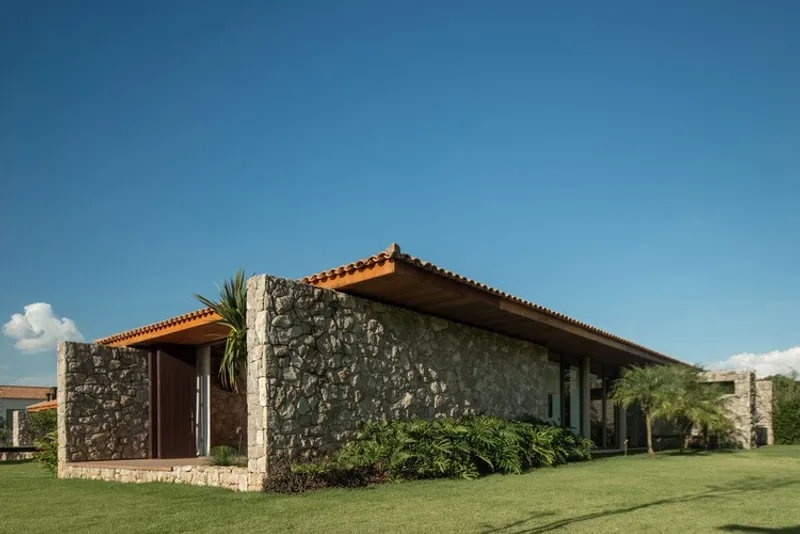
A U-Shaped Plan Organized Around Water
The architectural concept is defined by a “U”-shaped floor plan, which establishes a constant dialogue between the built volumes and the central swimming pool. Acting as the symbolic and functional heart of the house, the pool becomes a plaza-like space, around which daily life unfolds.
This configuration enhances natural ventilation, visual continuity, and spatial clarity, ensuring that every major area of the house maintains a strong relationship with the outdoors. The courtyard typology reinforces a sense of enclosure while preserving openness, creating a protected yet expansive environment.
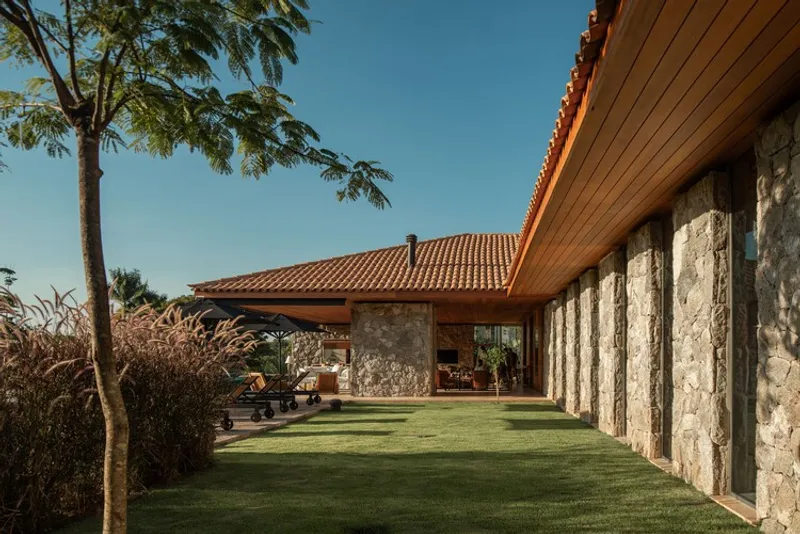
Stone Walls as Structure and Spatial Organizer
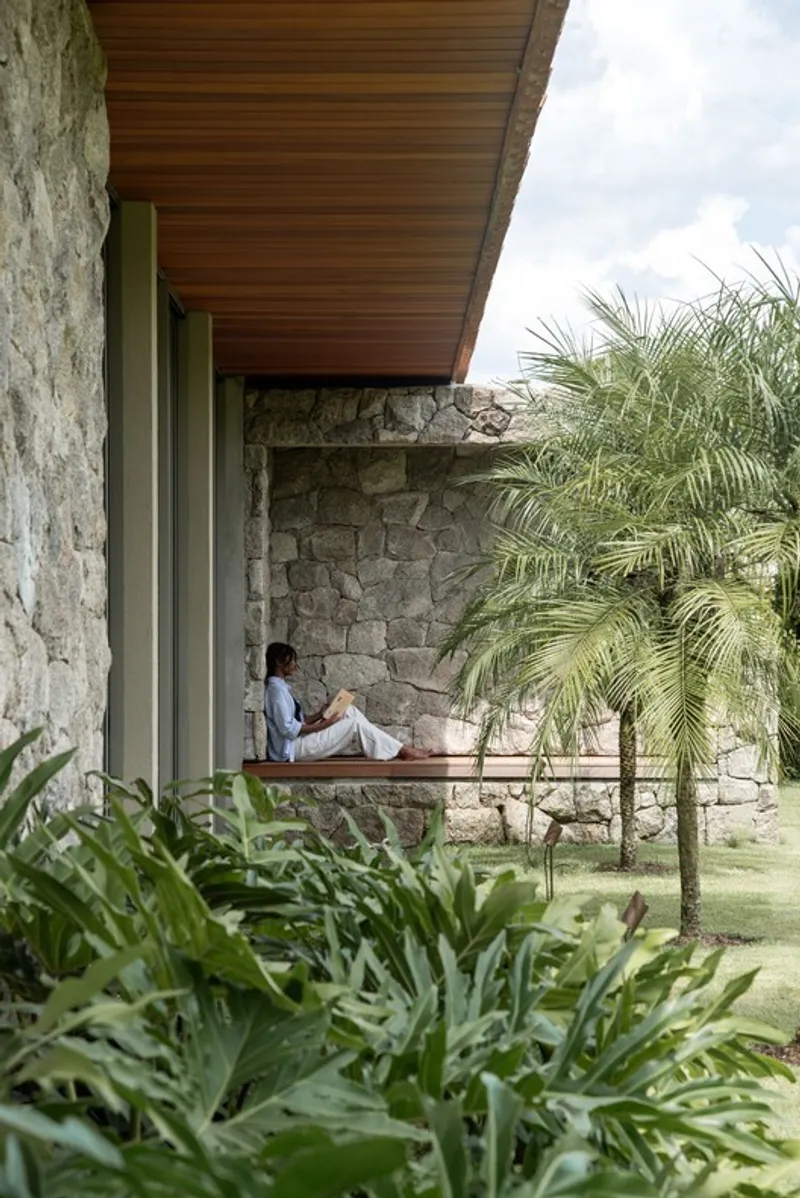
The project begins with the design of four robust soft stone walls, which structure and organize the residence. These elements go beyond mere enclosure: they define circulation, frame views, and establish a seamless connection between interior and exterior spaces. Their material presence introduces a tactile, grounded character that anchors the house to its site.
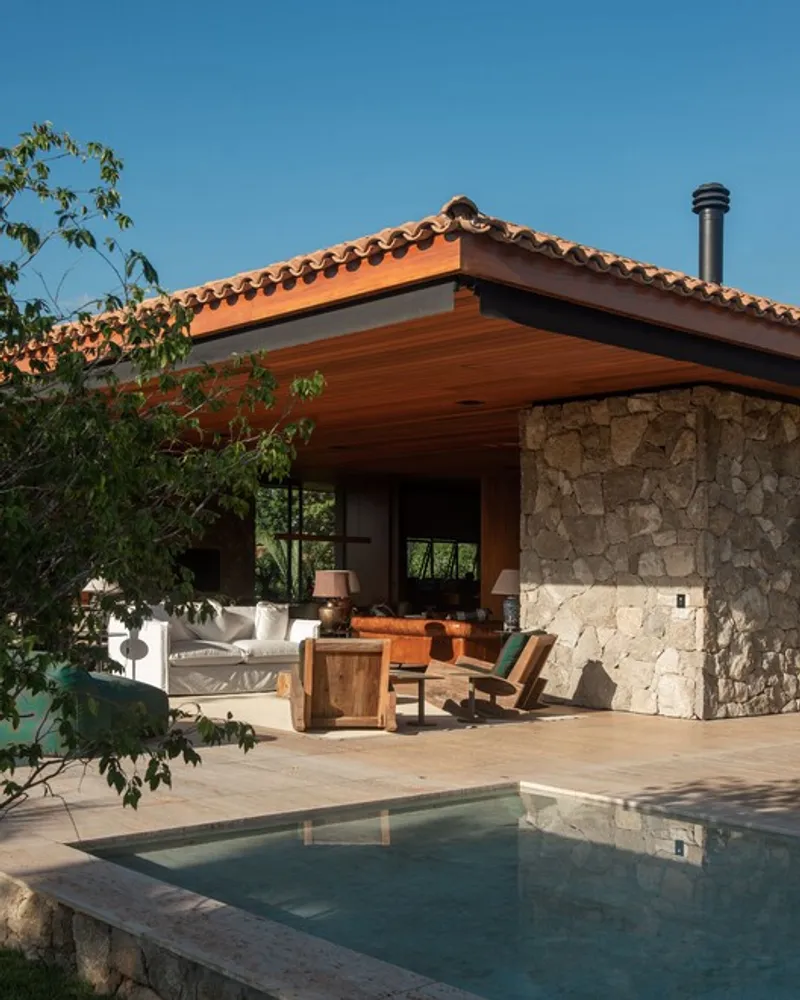
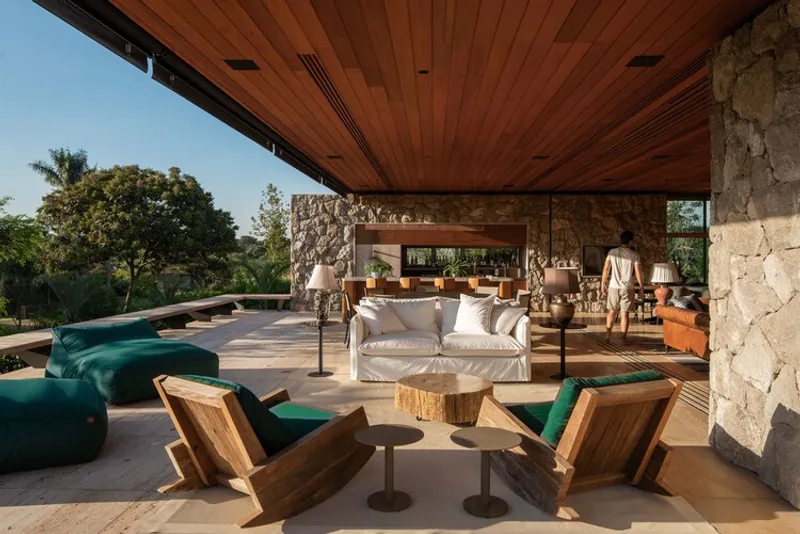
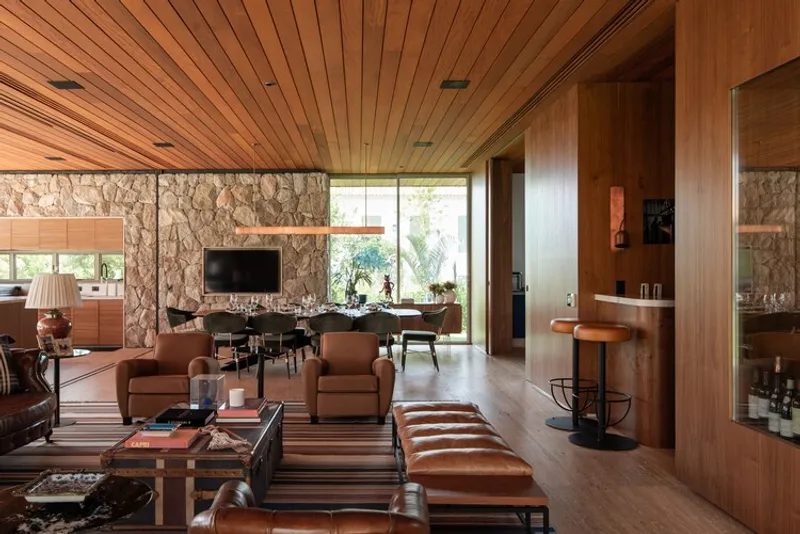
On the right wing: dedicated to social activities: the living room, dining room, and covered veranda unfold as a continuous space, directly connected to the pool area. A metal structural system supports the large roof overhangs, enabling wide, column-free spans that reinforce the sense of openness.
Fully retractable glass frames are embedded within the stone walls, allowing the boundaries between inside and outside to disappear completely. The use of travertine flooring throughout the social areas further enhances visual continuity, extending seamlessly from interior rooms to outdoor terraces.
A Gradual Transition to Private Spaces
A carefully designed promenade, punctuated by strategic openings overlooking the pool, defines the base of the “U” and subtly separates the social and intimate zones. This transitional circulation space enhances spatial hierarchy while maintaining visual connection to the central courtyard.
The left wing houses the private program, including four bedrooms, a master suite, a game room, office, and home theater. While two rooms open toward the pool, the remaining spaces face private landscaped gardens, ensuring tranquility, privacy, and controlled views.
Tradition Reimagined Through Contemporary Design
Symbolically and functionally, the house is organized into three main sectors: social, intimate, and service, each clearly defined yet interconnected. The composition is crowned by three ceramic-tiled roof sections, a mandatory feature of the residential condominium. Rather than treating this as a limitation, the architects embraced the requirement, using it to reference traditional farmhouses while achieving structural lightness and architectural coherence.
This reinterpretation of vernacular elements, combined with contemporary construction techniques and material choices, results in a house that feels both timeless and current.
A House Defined by Materiality, Climate, and Lifestyle
Pedra House exemplifies a Brazilian contemporary residence that responds sensitively to climate, landscape, and family life. Through its thoughtful spatial organization, strong material identity, and seamless indoor-outdoor integration, the project offers a relaxed yet sophisticated environment: designed for gathering, retreat, and long summer days.


Popular Articles
Popular articles from the community


David Ortega Stacks a Two-Story Mexico City Penthouse Around a Steel Stair and a Pergola-Shaded Roof Terrace
In Colonia Roma, a 300 m² penthouse uses oak joinery, a planted steel stair and a slatted roof pergola to make a new-build apartment feel like a house.

Architekt Andreas Gruber Scatters 23 Dark Timber Chalets Across a South Tyrolean Forest Edge
In Molini di Tures, Amonti Chalets breaks a resort into a hamlet of gabled timber houses, with parking, storage and services pushed into the slope.

David Macias Steps a Doorless Stone and Plaster House Down a Tropical Colombian Hillside
In the humid hills of Colombia, Threshold House replaces the front door with an open void and terraces its 850 m² down the slope instead of fighting it.

LT2A and OPEN Architectes Thread a Brick and Glass High School Through a Wooded Belgian Campus
In Braine-l'Alleud, a 3,000 m² wing for Collège Cardinal Mercier pairs pale brick with a glazed colonnade, deferring to a small chapel and a dense wood.

Similar Reads
You might also enjoy these articles


Hodi-Mandai Geram
Project Function: Preservation and revitalization of the Intangible heritage and socio-spatial identity of the Hodi by Housing, Cultural Memory Center, Sacred Grove, landscape, local tourism economy


Olio Towers: A Mid-Rise for Performers That Fuses Housing, Rehearsal, and Stage
Located blocks from Houston's Theater District, this modular tower stacks living units around a central performance atrium.

Oasis: Modular Green Housing Carved into Dhaka's Urban Fabric
A shortlisted Plugin Housing entry reclaims unauthorized settlements in Dhaka with stepped concrete volumes, green roofs, and ventilation-driven design.

Black Hole: A Floating Megastructure for the Post-Physical Era
Emiliano Mazzarotto envisions a spherical, self-scaling arena where e-sports, digital hotels, and holographic stadiums replace traditional public space.

Explore Housing Competitions
Discover active competitions in this discipline

Challenge to reimagine the Iron Throne

Photograph architecture without architects

Illustrate the lost glory of Angkor Wat - Render Challenge

Design challenge to reuse E-waste
Comments (0)
Please login or sign up to add comments
No comments yet. Be the first to comment!