
Park Associati Builds a Quiet Cooperative Housing Block Near Milan's Navigli Canal District
Pichi 12 reinterprets Milanese residential modernism through dry steel construction, clinker-lined loggias, and a courtyard open to the street.


Cooperative housing rarely gets this level of architectural attention. Pichi 12, a 30-unit residential building near Milan's Navigli district by Park Associati, was born from a 2014 competition and built atop a parking structure that had sat unfinished since 2006. The brief called for accessible, high-quality apartments for a diverse community, not luxury condominiums or signature towers. What the studio delivered is a building that treats restraint as a design strategy: white plaster facades, steel dry construction, and loggias hollowed out to produce a shifting pattern of solids and voids across three floors.
The project's real ambition is legibility. Pichi 12 does not try to announce itself. It sits within the urban fabric near NABA and Bocconi University, completing a block that had remained suspended for years. Its vocabulary of clinker tile, anodized aluminum, and corrugated metal is drawn directly from the Milanese residential tradition dating back to the 1940s. But the courtyard, open to the street and centered on a single maple tree, gives the building its social logic: a threshold between private domesticity and the collective life of the neighborhood.
A Facade Built from Material Memory
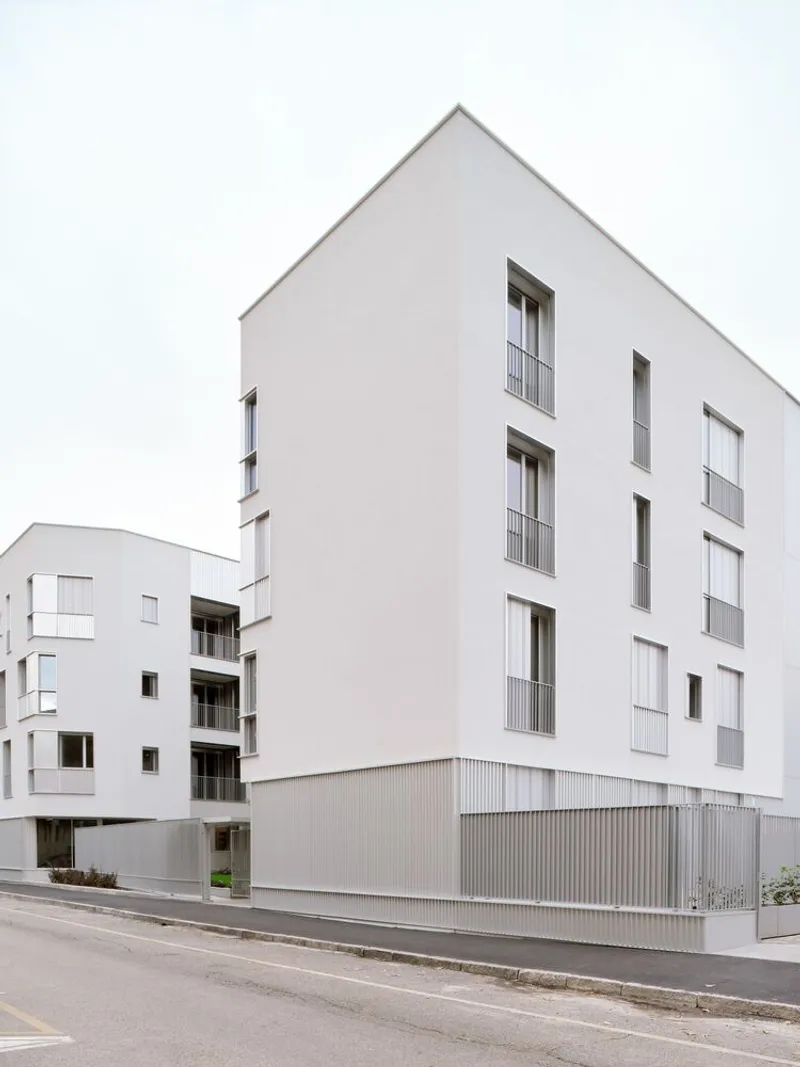
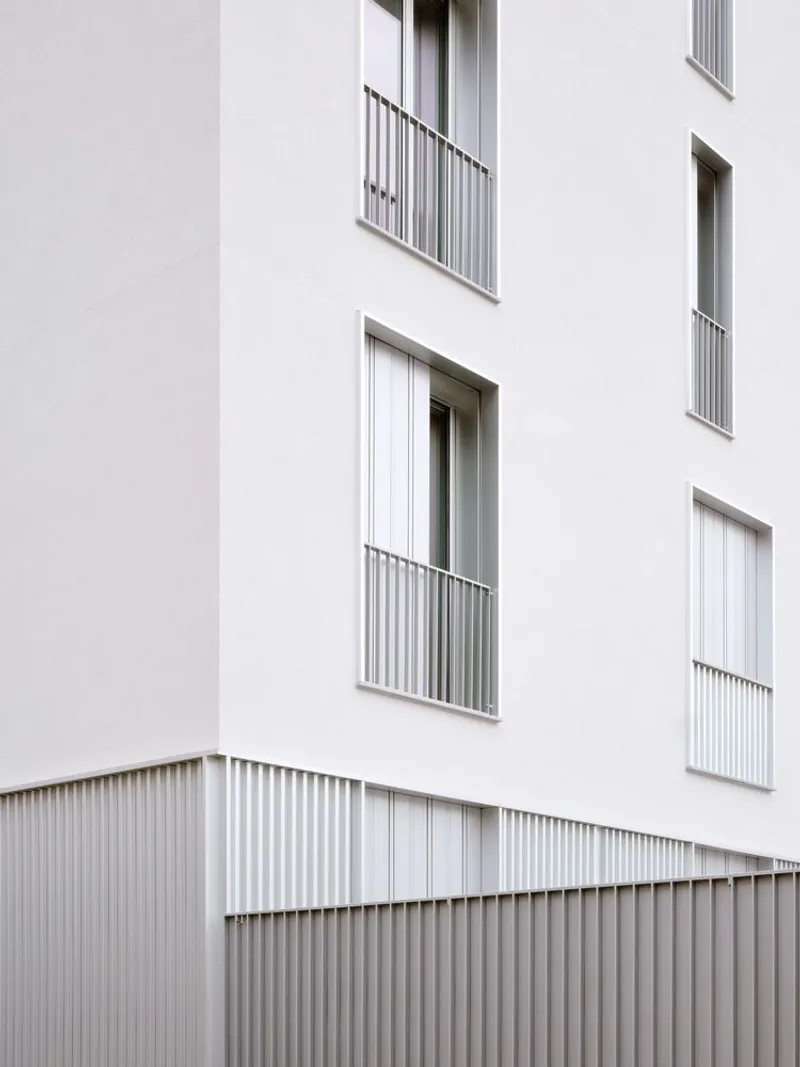
Park Associati's facade strategy is additive rather than monolithic. White plaster volumes are carved away to reveal recessed loggias, their back walls finished in a distinctive aqua green that reads as a quiet counterpoint to the dominant white. Corrugated metal panels line the ground floor and appear intermittently at upper levels, referencing the industrial materiality that runs through so much postwar Milanese housing. The stacked balconies, with their flush French-style railings fixed between the infill wall and thermal insulation using invisible connections, avoid the visual clutter of bolt-on metalwork.
Sheet metal covers the loggias and window surrounds, lending a precision that contrasts with the rougher plaster surfaces. Foldable shutters, nearly invisible when closed, keep the elevation clean. The overall effect is a building that changes character depending on how residents use their outdoor spaces: open shutters and drying laundry animate it, while a closed state returns it to geometric abstraction.
The Courtyard as Urban Filter
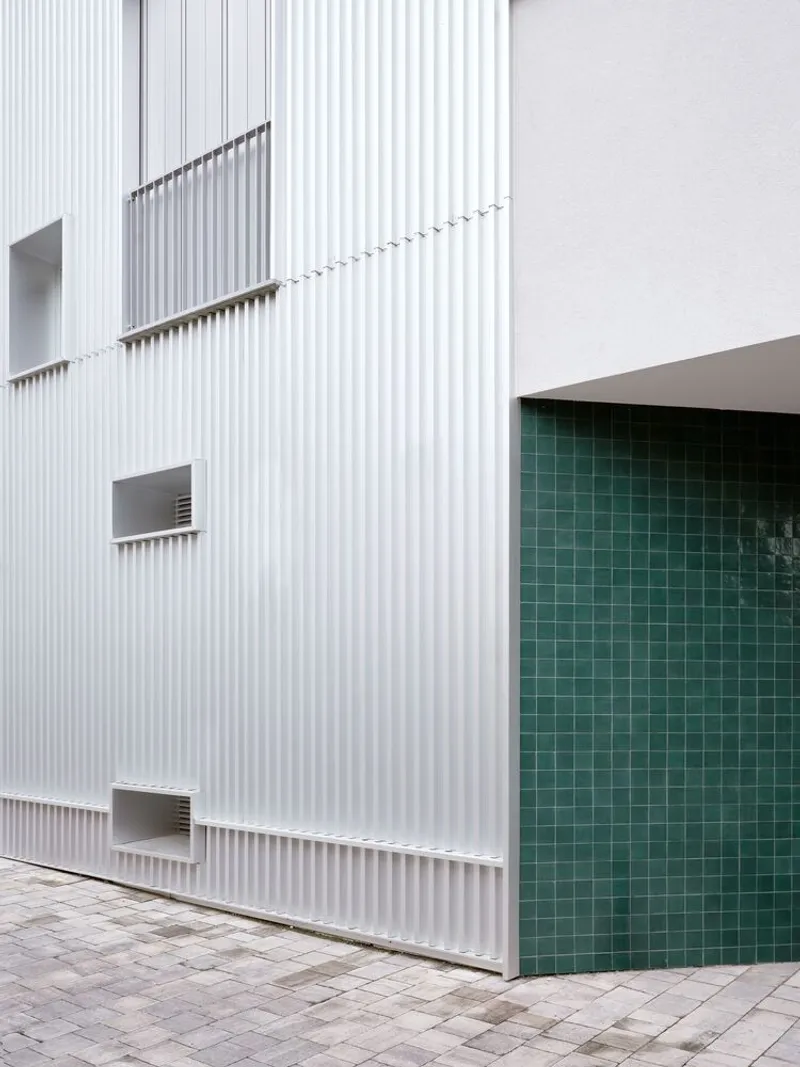
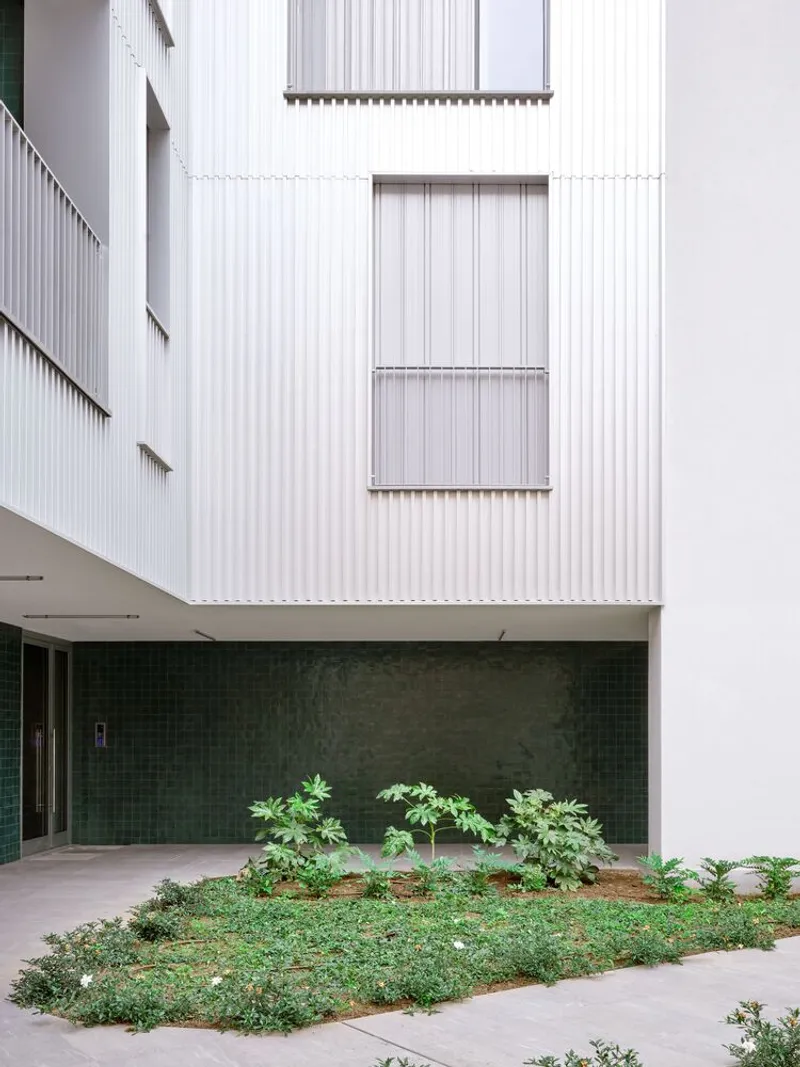
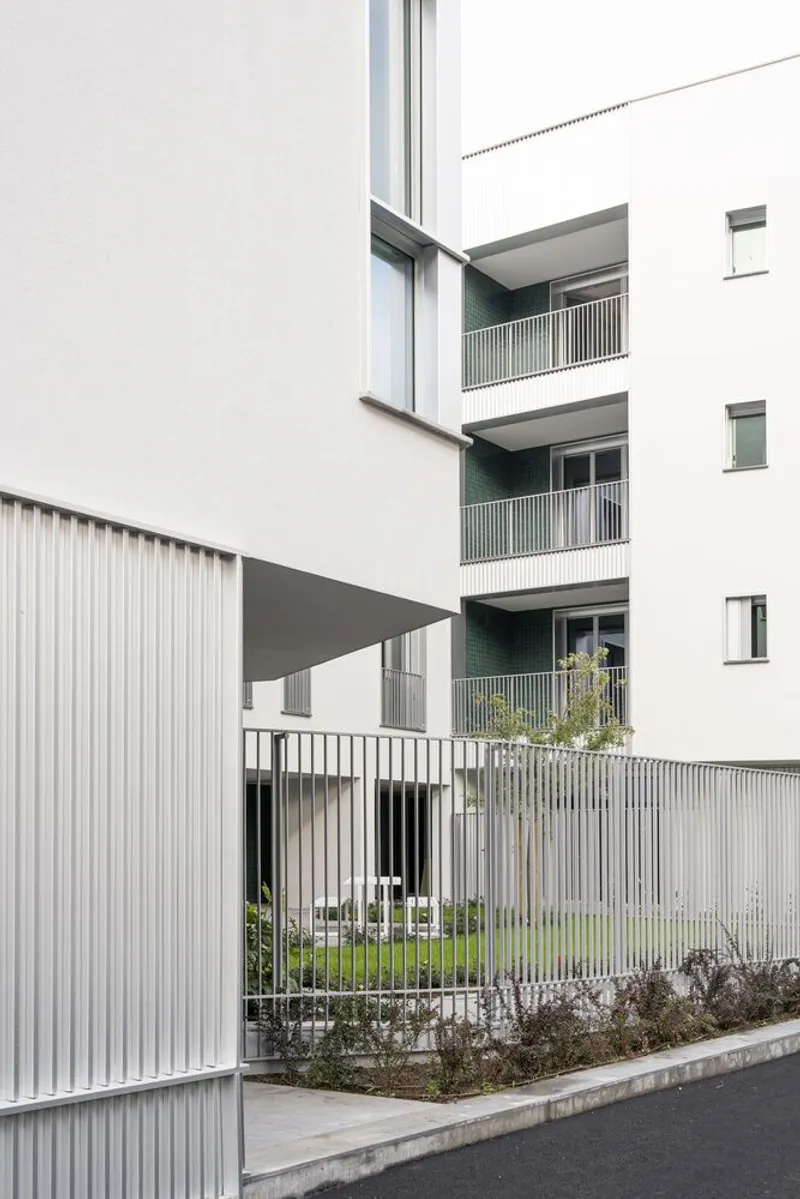
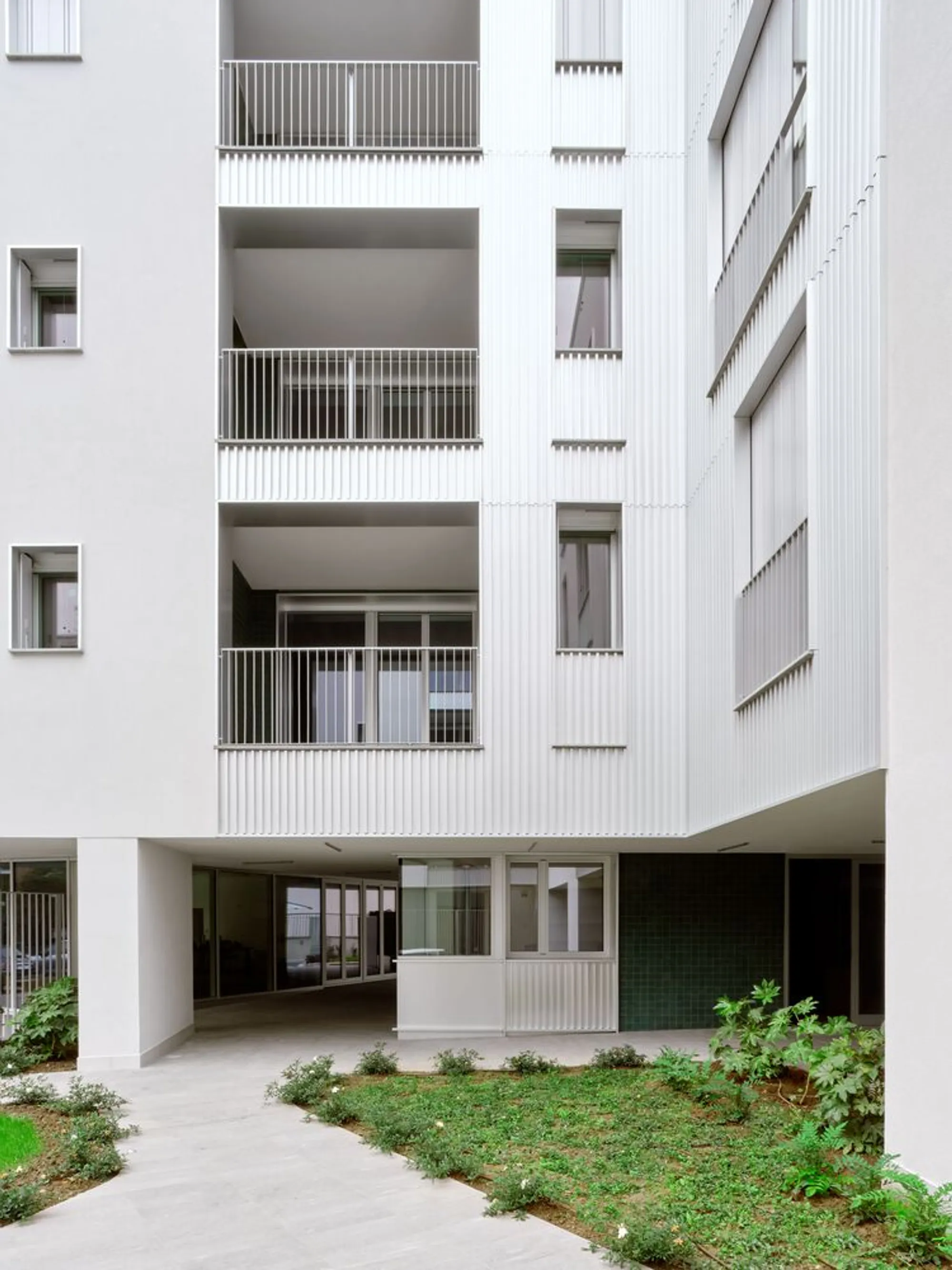
Milan's internal courtyard tradition is centuries old, but most examples are closed, private, and invisible from the street. Pichi 12 inverts that expectation. The courtyard is accessible from ground level, visible from the sidewalk, and planted with a central maple tree surrounded by low beds. It works as a decompression chamber between the density of the neighborhood and the intimacy of individual apartments. Residents on every floor look down into greenery rather than into another wall.
The courtyard walls are lined in dark green clinker tile, a direct tribute to the coating widely used on Milanese facades since the 1940s. The forest green tone pulls the planted landscape vertically, making the ground plane feel taller and the courtyard volume more contained than its modest footprint would suggest. It is a simple move that does a lot of spatial work.
Dry Construction on Top of Existing Infrastructure
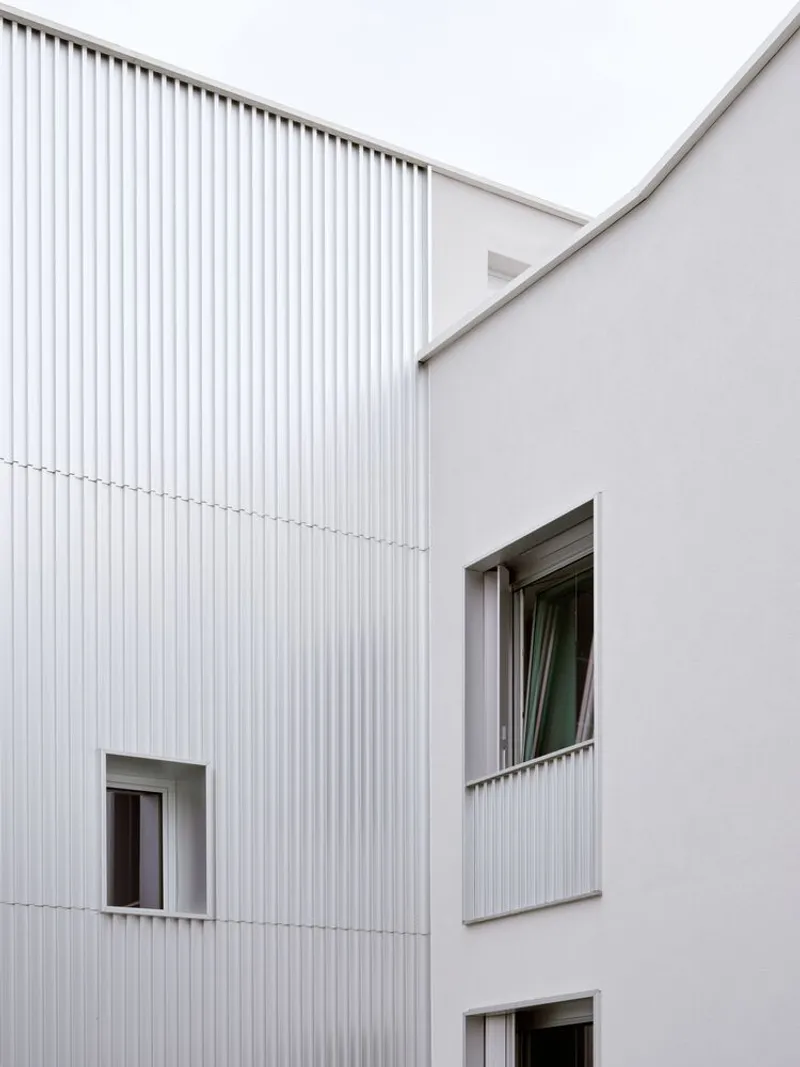
The structural decision that shaped everything else at Pichi 12 was weight. The building sits above a multi-level underground parking garage built between 2003 and 2006. Overloading that existing structure was not an option, so Park Associati adopted a light dry construction system: steel columns and beams with 4,000 square meters of corrugated metal floor slabs completed with in-situ casting. The cladding system follows the same logic, using anodized aluminum sandwich panels for window frames and corner bow windows, and wood-aluminum windows throughout.
Dry construction also accelerated the schedule. For a cooperative commission with limited budgets and impatient future residents, speed was not a luxury but a necessity. The structural approach produced a secondary benefit: the facades could be assembled with greater precision, enabling the flush railing details and invisible shutter mechanisms that give the elevations their clean reading.
Solids, Voids, and the Rhythm of Living
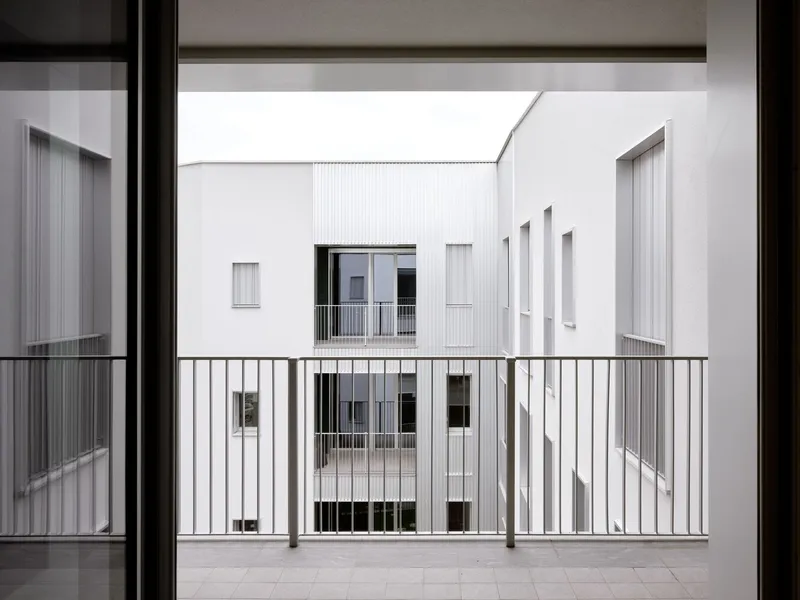
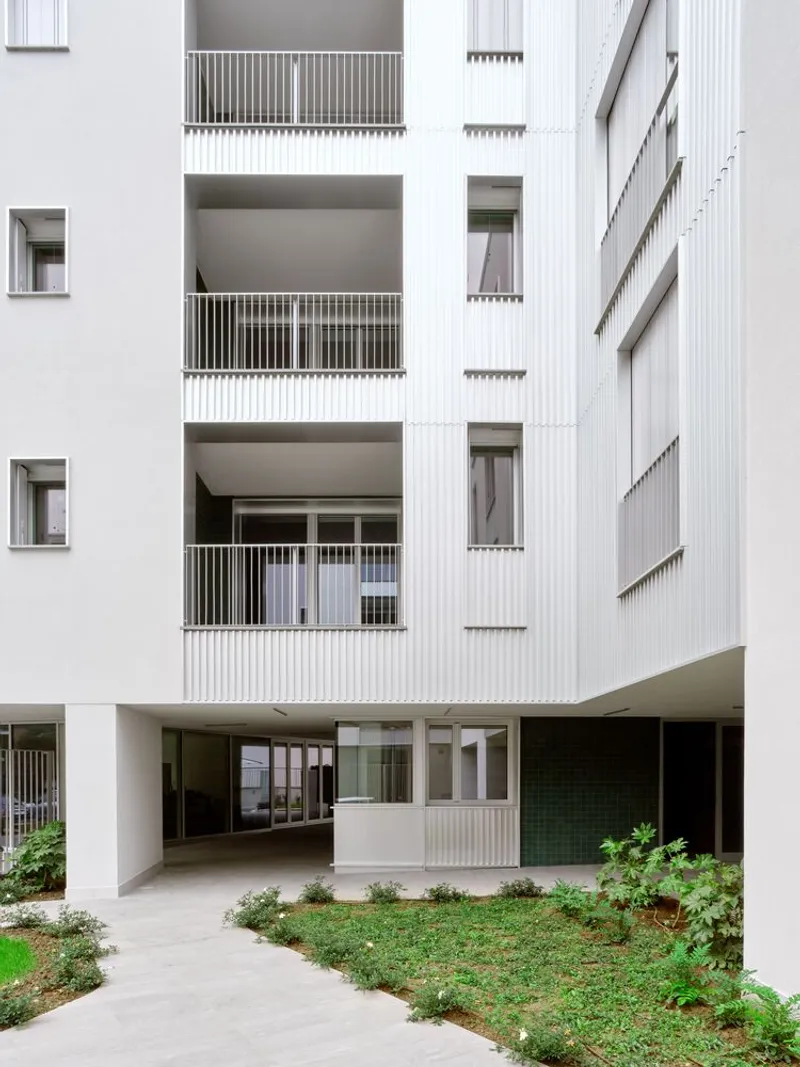
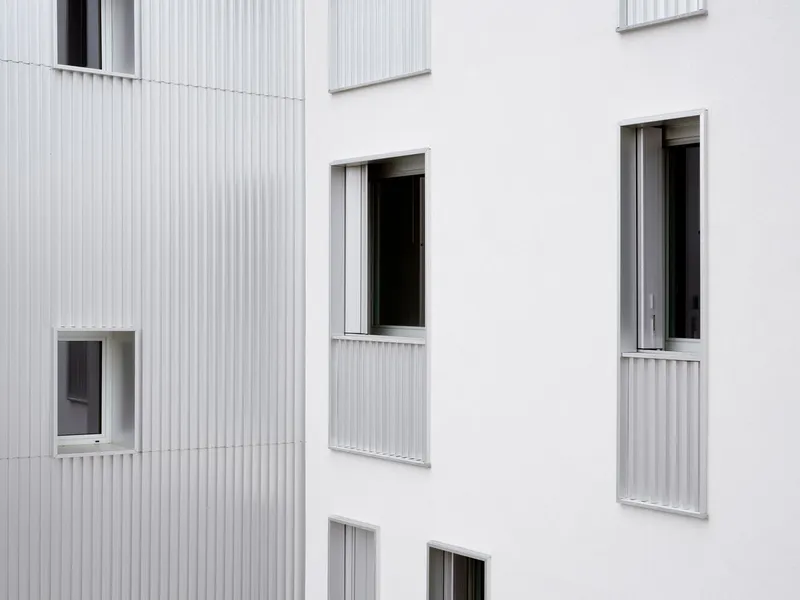
Viewed from a balcony, the courtyard facades reveal their compositional logic most clearly. Windows are scattered rather than gridded, their positions dictated by the interior apartment layouts, which range from studios to four-room units. Some openings are tall and narrow, others wide. Blind walls interrupt the pattern, producing a syncopated rhythm that avoids the monotony typical of social housing blocks. The loggias, hollowed out at irregular intervals, deepen that syncopation by adding shadow and depth.
The ground floor, reserved entirely for communal activities and socializing, keeps the residential program elevated. That decision separates private life from shared life vertically, reinforcing the courtyard's role as a horizontal mediator. The building achieves a Class A energy rating through underfloor heating, centralized cooling, and photovoltaic systems, but it wears those credentials quietly, with no visible solar hardware or technical appendages disrupting the elevations.
Why This Project Matters
Pichi 12 is a case study in what cooperative housing can look like when an architect refuses to treat the brief as a reason to cut corners. Park Associati brought the same material attention and compositional rigor to a 30-unit apartment block that other firms reserve for private villas or commercial headquarters. The "Design for All" accessibility principles, the energy performance, and the dry construction pragmatism are not add-ons; they are embedded in the architectural language from the first sketch.
More broadly, the project offers a counter-argument to the idea that contemporary housing in a city like Milan must either be developer-driven luxury or anonymous infill. There is a middle path: buildings that respect the existing urban grain, draw from local material traditions, and still deliver spatial generosity. Pichi 12 does not claim iconic status, and that is precisely what makes it worth studying.
Pichi 12 Housing by Park Associati, Milan, Italy. 2,244 m². Photographs by Francesca Iovene.
About the Studio
Share Your Own Work on uni.xyz
If projects like this are the kind of work you want to make, uni.xyz is a place to publish your own, find collaborators, and enter design competitions.




Popular Articles
Popular articles from the community

EW PARK: Sustainable Architecture Reimagines the Future of Urban Parking
EW PARK reimagines city parking as a modular wooden tower combining automation, solar energy, electric mobility, and adaptable urban design.

Conexión: Biophilic Design Reimagines High-Rise Living in Hong Kong
Conexión reimagines high-rise living in Hong Kong through biophilic design, green facades, shared spaces, daylight, water and nature within.

The Musturak Paradise: Senior Living Architecture for a Connected Future in Temara, Morocco
The Musturak Paradise reimagines senior living architecture in Temara via private homes, social spaces, culture, community, and shared care.

Riyadh For All: Intergenerational Urban Design for Active Aging in Rabat
Riyadh For All reimagines urban design in Rabat with intergenerational co-living, adaptive courtyards, and Moroccan cultural exchange today.
Similar Reads
You might also enjoy these articles


Hodi-Mandai Geram
Project Function: Preservation and revitalization of the Intangible heritage and socio-spatial identity of the Hodi by Housing, Cultural Memory Center, Sacred Grove, landscape, local tourism economy


Olio Towers: A Mid-Rise for Performers That Fuses Housing, Rehearsal, and Stage
Located blocks from Houston's Theater District, this modular tower stacks living units around a central performance atrium.

Oasis: Modular Green Housing Carved into Dhaka's Urban Fabric
A shortlisted Plugin Housing entry reclaims unauthorized settlements in Dhaka with stepped concrete volumes, green roofs, and ventilation-driven design.

Black Hole: A Floating Megastructure for the Post-Physical Era
Emiliano Mazzarotto envisions a spherical, self-scaling arena where e-sports, digital hotels, and holographic stadiums replace traditional public space.


Explore Housing Competitions
Discover active competitions in this discipline



Challenge to reimagine the Iron Throne


Photograph architecture without architects


Illustrate the lost glory of Angkor Wat - Render Challenge


Design challenge to reuse E-waste
Comments (0)
Please login or sign up to add comments
No comments yet. Be the first to comment!