
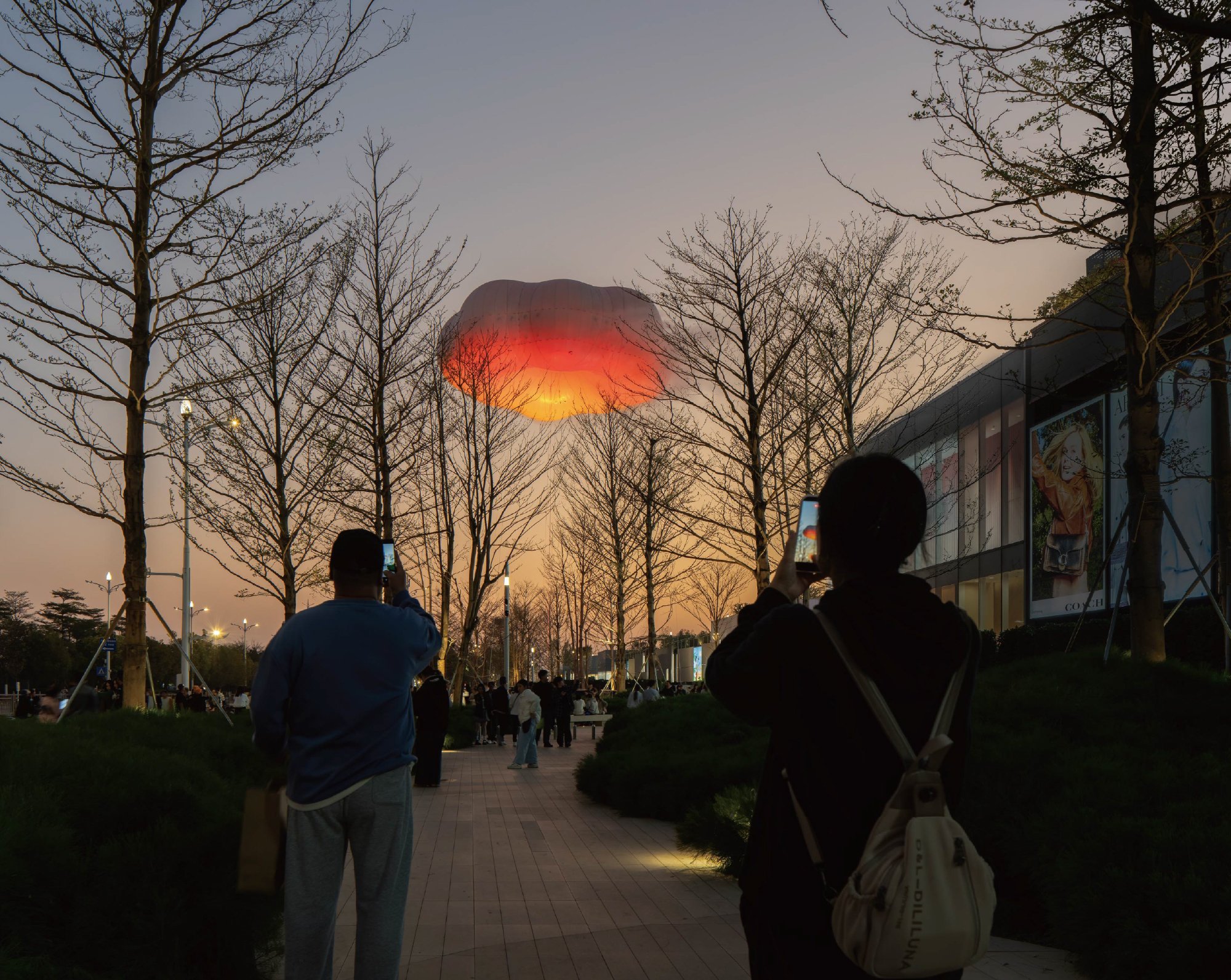
PILLS Floats a Living Cloud Above Dongguan's First Premium Outlet Village
An inflatable IP installation that rises and falls with the day, marking the gateway to MIXC VILLAGE's coastal slow-living district.

At the entrance to MIXC VILLAGE, China Resources Group's first premium outlet development in Dongguan's Binhaiwan New District, a bulbous white form hovers between three and twenty meters above the ground. Designed by PILLS, the installation is not static sculpture but a kinetic, breathing organism: an inflatable air membrane structure that rises and descends on a timed cycle, mists vapor from embedded nozzles, and glows in shifting color as night falls. It is, in effect, a synthetic cloud tethered to earth by hoist cables, and its theatrical behavior is entirely the point.
What makes the project genuinely interesting is not the spectacle itself but the engineering required to sustain it. Eight spherical volumes are merged through 3D modeling into a single continuous ring-like form. A dynamic internal system monitors air pressure and adjusts the helium-to-air ratio in real time as temperature and atmospheric conditions change. Wind sensors automatically lower the structure when speeds exceed safe thresholds. The result is an object that looks effortless, almost childish, but depends on a sophisticated feedback loop between its membrane, its environment, and the cables that keep it from drifting out over the South China Sea.
A Threshold Between City Speed and Coastal Slowness
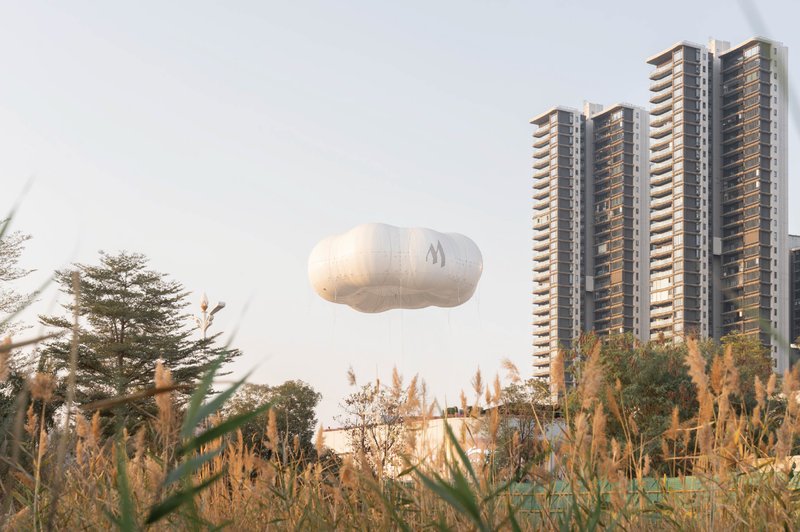
PILLS frames the installation within a narrative called "The Voyage to Fantasy Island," and while the branding language is predictably commercial, the spatial idea behind it is sound. MIXC VILLAGE sits as a white architectural cluster visible from the Guangzhou-Shenzhen Riverside Expressway, positioned as a slow-living island facing the sea across a 10.7-hectare site. The floating form at its gateway is meant to mark a perceptual transition: from the density and velocity of the Pearl River Delta megalopolis to the deliberate pace of a resort outlet.
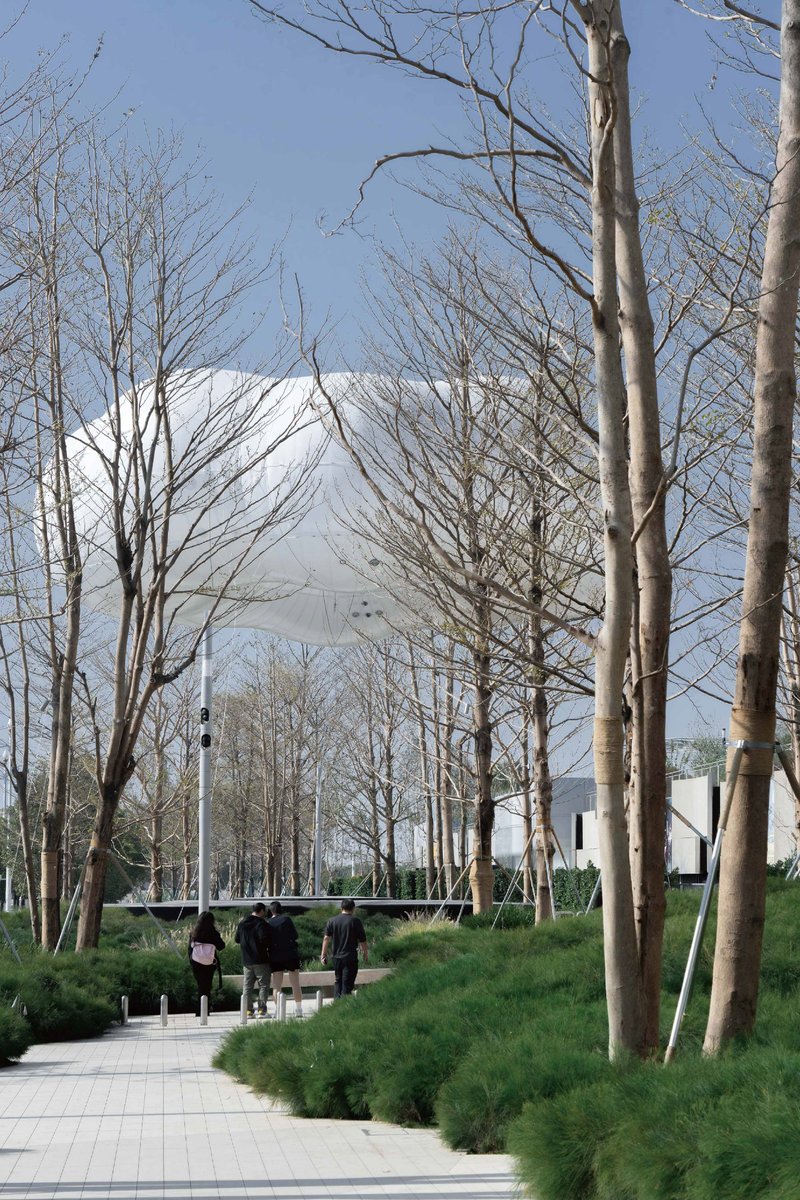
That transition works because the installation is not a sign or a gate but a presence. Visitors walking the paved pathway flanked by bare winter trees and landscaped berms encounter it overhead, an object that refuses to behave like architecture. It does not frame a view or define an edge. It simply hangs there, soft and enormous, inverting the expectation that a threshold should be something you walk through rather than something that floats above you.
The Kinetics of Buoyancy
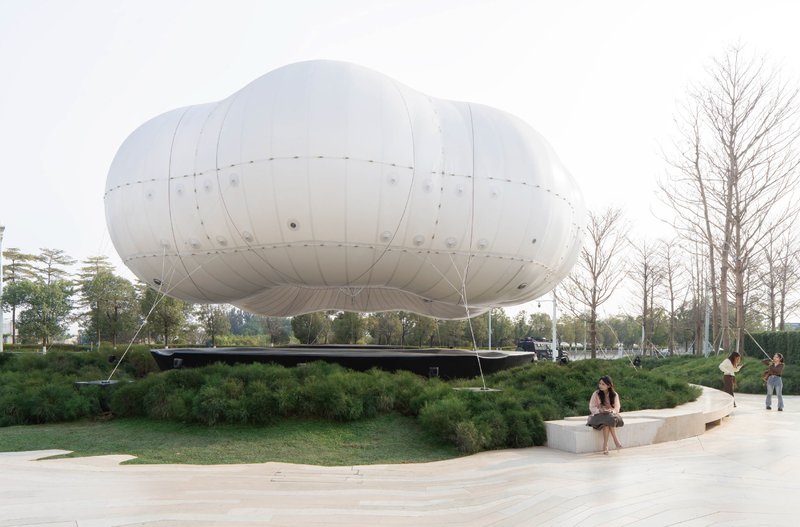
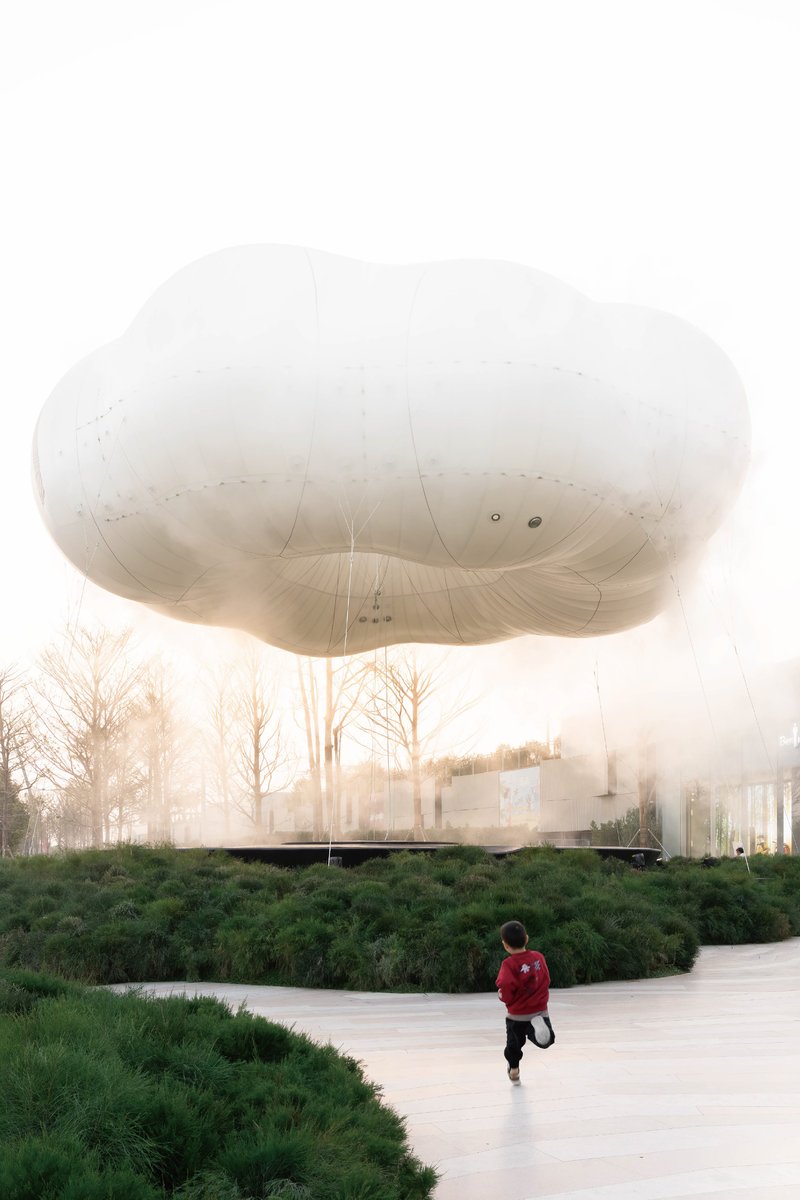
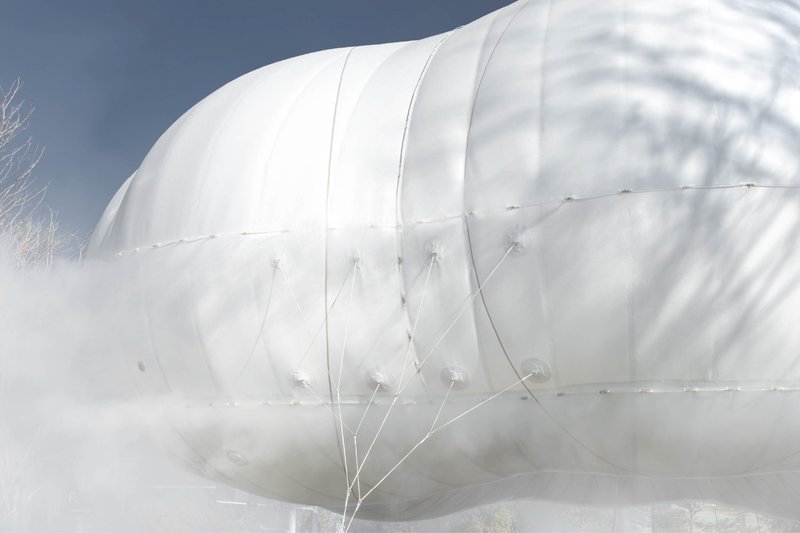
The installation's daily choreography is its most compelling feature. At different times it rests at roughly three, eight, and twenty meters above grade, each altitude producing a fundamentally different relationship with the people below. At three meters it is canopy, intimate, close enough that you can see the seams and tether lines stitching the membrane taut. At twenty meters it becomes landscape element, a white volume competing with residential towers on the horizon.
Central and peripheral hoists coordinate its movement, and the internal helium-air mixture adjusts continuously. Fog and mist sometimes swallow the lower portions of the form, an effect amplified by timed misting systems that release vapor around the base. In these moments the installation genuinely earns its cloud metaphor: it appears to condense out of the humid coastal air rather than being mechanically held in place.
After Dark, a Different Object
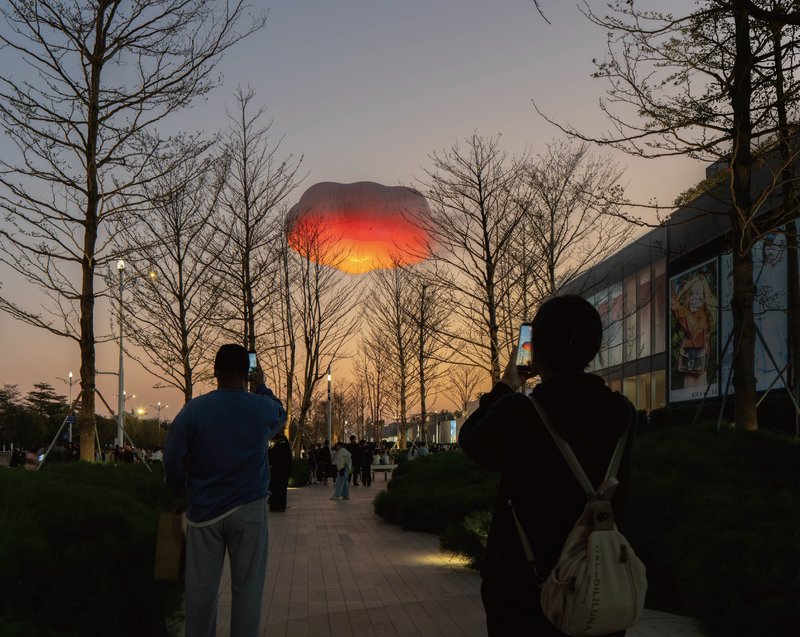
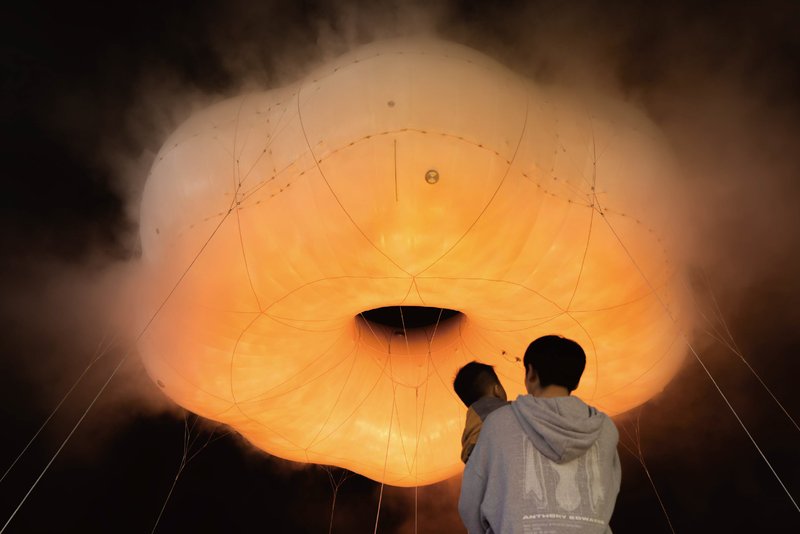
At dusk the membrane shifts from white to a deep glowing orange-red, lit from within by integrated lighting designed in consultation with TS Lighting Design. The transformation is total. Where the daytime object reads as weightless and almost accidentally present, the nighttime version is deliberate, warm, unmistakably theatrical. Silhouetted figures gather below to photograph it, and the installation becomes a beacon visible across the development.
From inside the membrane envelope, the effect is stranger. Looking up, visitors see the seamed canopy structure bathed in amber light, the fabric surface pulled into organic tension by its internal pressure. Looking down through the translucent skin, planted grasses and seated figures appear as if viewed through gauze. It is a space that is not really a space, an interior without walls or floor, defined only by the curved surface overhead and the warm light saturating it.
Fabrication and the Problem of Clean Spectacle
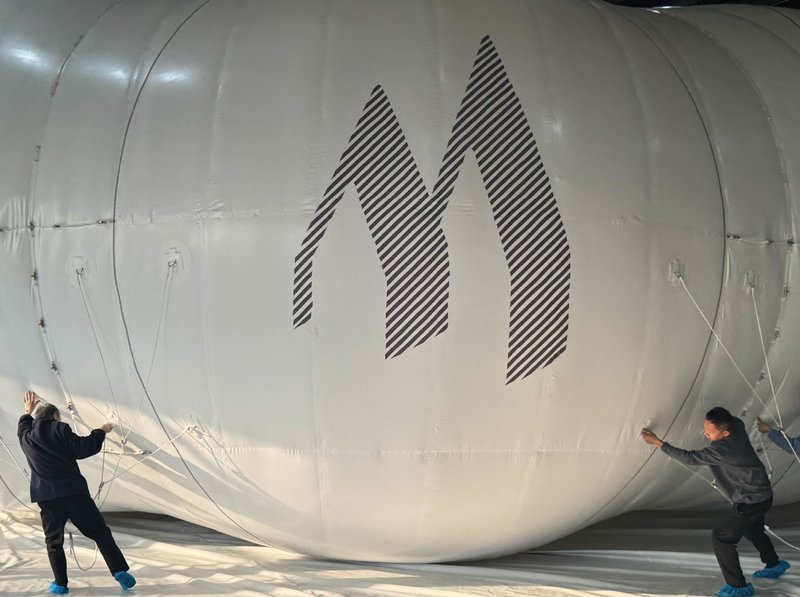
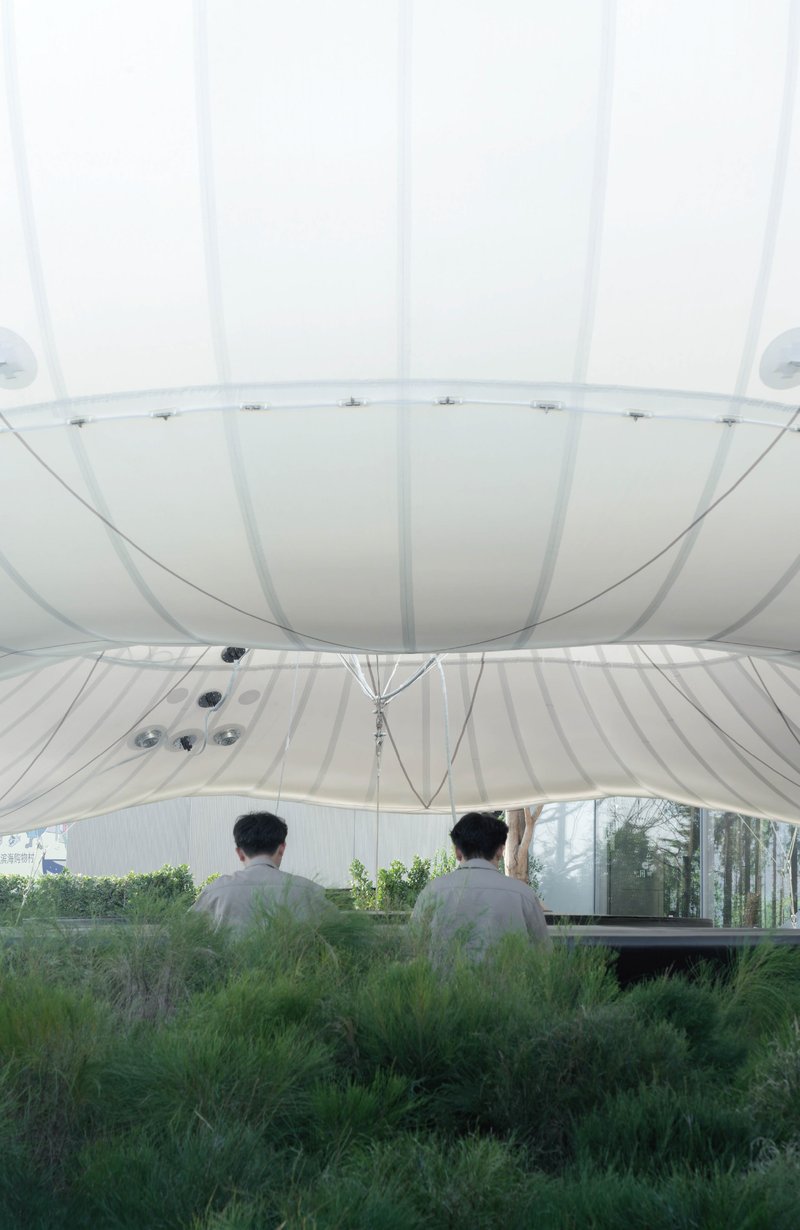
Fabricated by Hangzhou Gauss Inflatable Tech Co., the membrane underwent extensive factory testing before on-site installation. Custom attachment solutions were developed to integrate water pipes, spray nozzles, lighting, and cable anchors while preserving the clean visual appearance that the concept demanded. The challenge is familiar to anyone who has worked with inflatables at this scale: every functional element threatens to compromise the very seamlessness that makes the object legible.
PILLS navigated this by treating the seams and tether points as visible features rather than defects. Close-up, the membrane reads as a constructed thing, taut fabric pulled into curves by forces you can trace. The graphic striping visible inside the spheres during assembly becomes part of the visual language. There is no pretense that this is an actual cloud. It is clearly an artifact, and the honesty of its construction keeps the project from tipping into pure kitsch.
Plans and Drawings
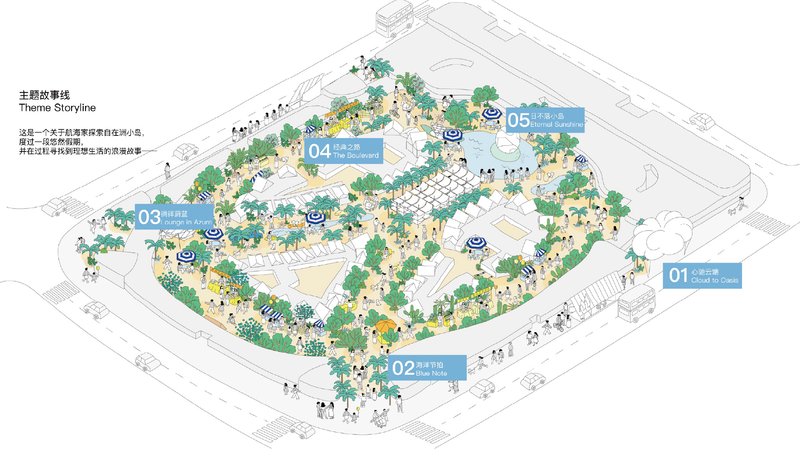
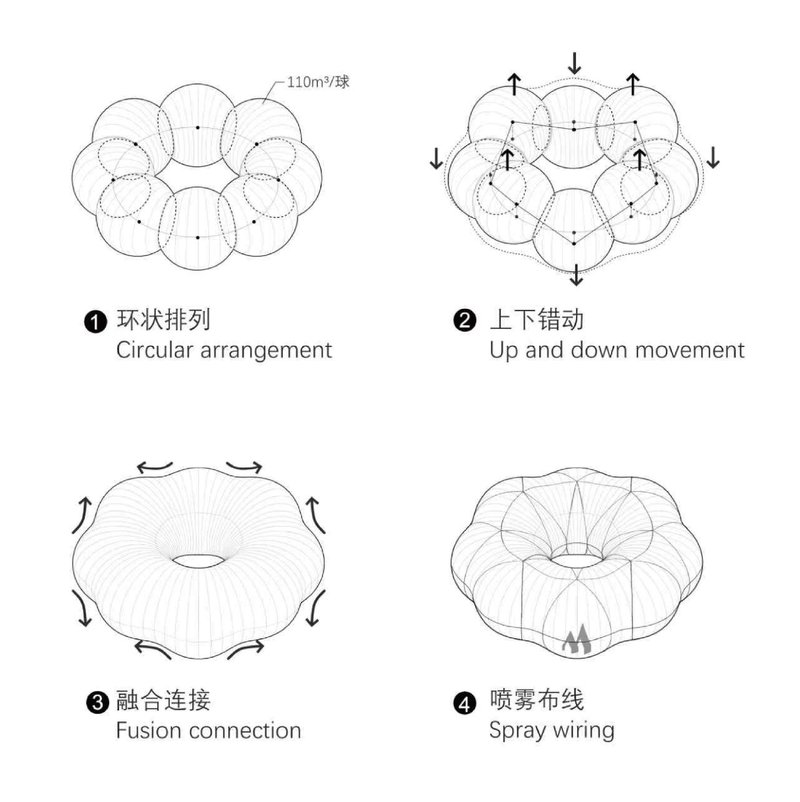
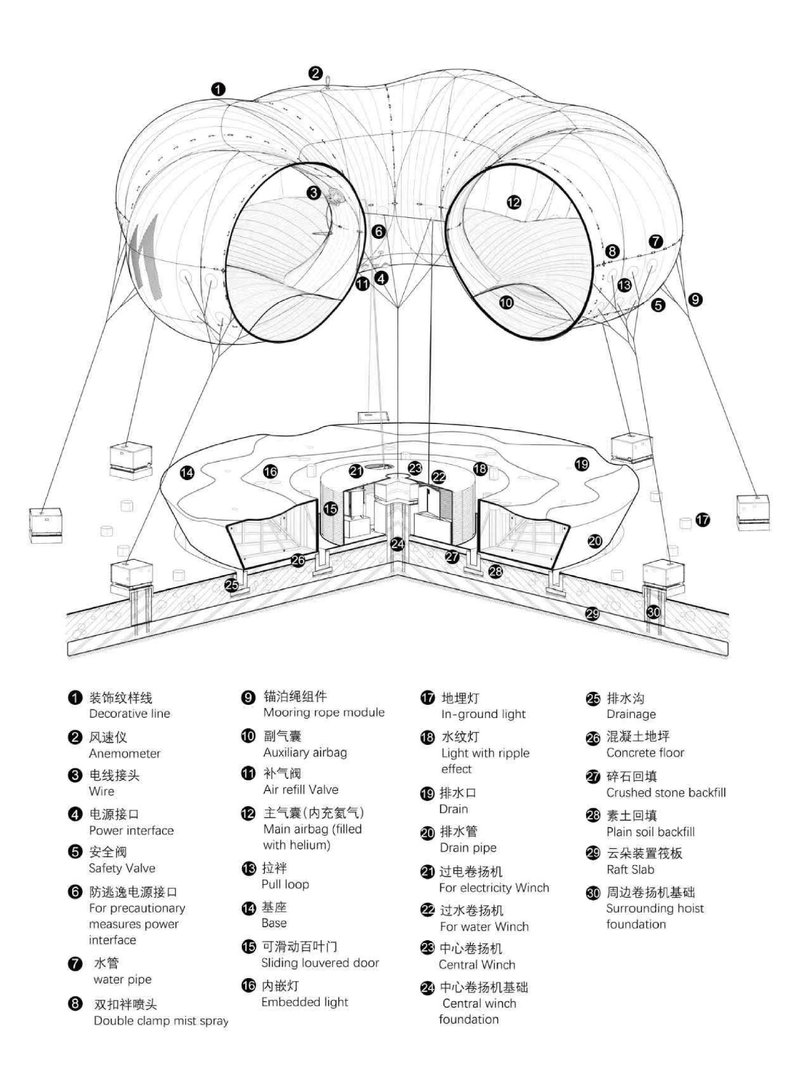
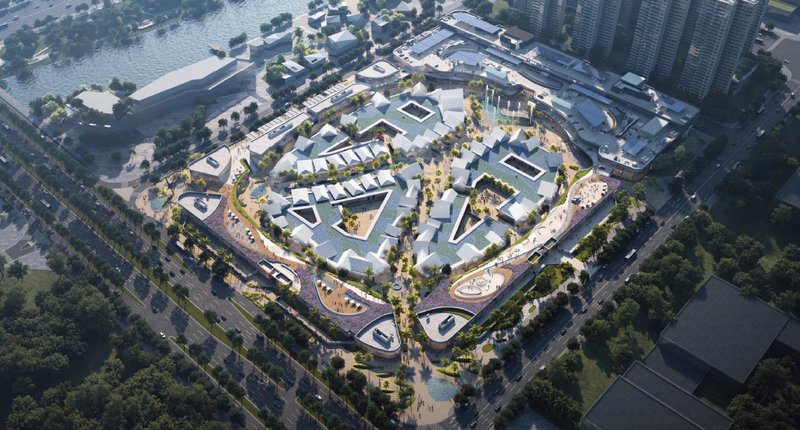
The axonometric site plan reveals the installation's position within the broader MIXC VILLAGE development, a series of white-roofed courtyard buildings surrounded by urban blocks and dense landscaping. The assembly diagram is particularly instructive: eight discrete spheres arranged in a circular plan are progressively merged into the final continuous form through geometric negotiation. The technical axonometric of the membrane structure exposes the internal airbag system and anchoring mechanisms that make the kinetic behavior possible, showing how the clean exterior hides a surprisingly complex interior armature.
Why This Project Matters
Inflatable architecture has a long lineage, from Ant Farm and Archigram through contemporary festival structures, but it rarely operates with this level of environmental responsiveness. The real-time adjustment of buoyancy, the automated wind-response lowering, the timed misting choreography: these move the project from sculptural object to something closer to a cybernetic system. PILLS has built something that negotiates continuously with its site conditions rather than simply resisting them.
Whether this intelligence justifies the commercial context is a fair question. The installation exists to draw attention to a shopping outlet, and its narrative wrapper is marketing copy dressed in architectural language. But the technical ambition is real, and the spatial experience it produces, a soft, shifting threshold between city and sea, between speed and stillness, is more than a billboard could achieve. In the landscape of Chinese commercial placemaking, where spectacle is abundant and genuine spatial invention is rare, that distinction matters.
Dongguan MIXC VILLAGE IP Installation, designed by PILLS, with landscape design by Change Studio and lighting by TS Lighting Design. Dongguan, China. Completed 2025. Photography by Siming Wu and Bo Zhang.
About the Studio
Share Your Own Work on uni.xyz
If projects like this are the kind of work you want to make, uni.xyz is a place to publish your own, find collaborators, and enter design competitions.



Popular Articles
Popular articles from the community

IDIN Architects Wraps a Hua Hin Hotel Around a Private Courtyard to Escape the City
Dusit D2 Hua Hin turns an urban infill site in Thailand's family vacation heartland into a self-contained resort through courtyard planning.
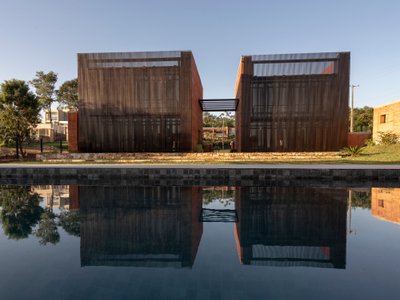
BAUEN Builds Two Rammed Earth Volumes in Paraguay Inspired by the Ovenbird's Nest
In San Bernardino, a house of compacted earth channels the instinct of a constructive bird to shelter life from the Paraguayan summer.
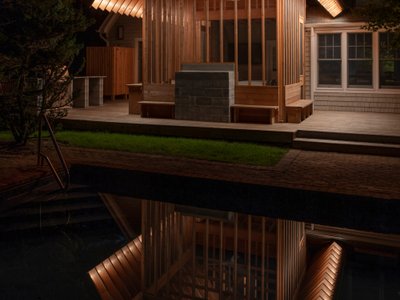
BLDUS Turns a 250-Square-Foot Screened Porch into a Pine Forest Temple in East Hampton
A gabled cedar pavilion mimics the rhythm of surrounding pines, anchoring a 1990s wooded home to its hollow in Long Island.
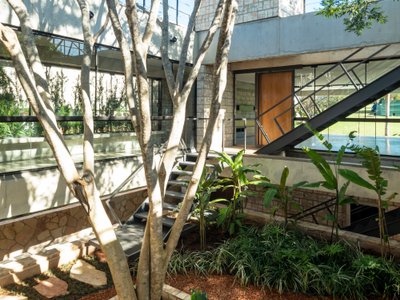
OMCM arquitectos Builds a Summer House in Paraguay from Quarry Waste Blocks and Three Sacred Trees
In the young hillside neighborhood of Altos, a 696-square-meter concrete volume hovers on six pillars around three preserved native Yvyraju trees.


Similar Reads
You might also enjoy these articles

127af Flips a Tiny Bagnolet Rowhouse Upside Down with a Handcrafted Roof Extension
A 55-square-meter terraced house on the edge of Paris gains a luminous upper living floor through lightweight timber and steel.
1.61 Design Workshop Wraps a 600-Square-Meter Café in Vietnam in Sculptural Burgundy Drama
Reden Café & Bistro pairs a helical staircase, mosaic floors, and deep red interiors to rethink Vietnamese hospitality space.

The Unbound Brain: A School Shaped by Cognitive Architecture
Cylindrical learning pods radiate like neurons from a central cortex, turning the floor plan into a spatial model of human thought.
Revival Vernacular Architecture: Rammed Earth Settlements for the Sahara
A modular desert community in Mauritania that fuses passive cooling techniques with earthen construction and local craftsmanship.


Explore Architecture Competitions
Discover active competitions in this discipline




The International Standard for Design Portfolios


The Global Benchmark for Architecture Dissertation Awards


The Global Benchmark for Graduation Excellence

Challenge to design a portable theatre
Comments (0)
Please login or sign up to add comments
No comments yet. Be the first to comment!