
Takahiro Endo Architects Office Stretches a 30-Meter Timber Hall Through a Karuizawa Forest
A multigenerational villa for four families steps down a forested slope, merging communal life with the rhythms of a Japanese mountain town.


Karuizawa sits about 100 kilometers northwest of Tokyo, a highland resort town where dense stands of chestnut, fir, and dogwood obscure neighboring houses from one another. For the family that commissioned this villa, the site is not new territory. They have owned a property here for years, building rituals around the forest: cooling watermelons in a stream in summer, collecting chestnuts in autumn. When the time came to rebuild, Takahiro Endo Architects Office was tasked with designing not just a house but a framework for those rituals to continue across generations.
What Endo delivered is a 194-square-meter timber hall that runs roughly 30 meters along a north-south axis, threading itself into an east-facing slope rather than sitting on top of it. The building accommodates 14 people drawn from four families, yet it avoids the bloated footprint that number might suggest. Instead, individual family rooms appear as whitewashed, gabled volumes nested inside a larger hall structure, a house-within-a-house strategy that gives the whole composition the feeling of a small settlement sheltered under one generous roof. The result is a villa that functions more like a communal camp than a private retreat, which is exactly the point.
A Roof in the Canopy
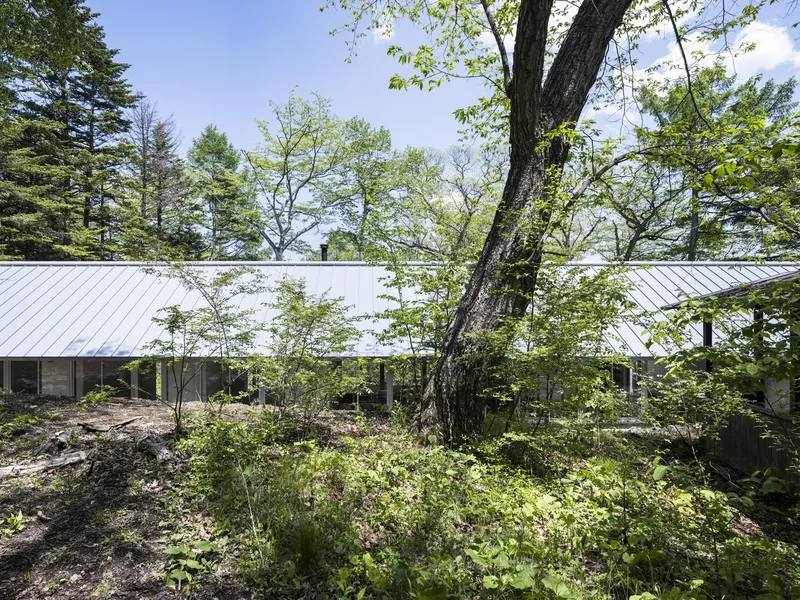
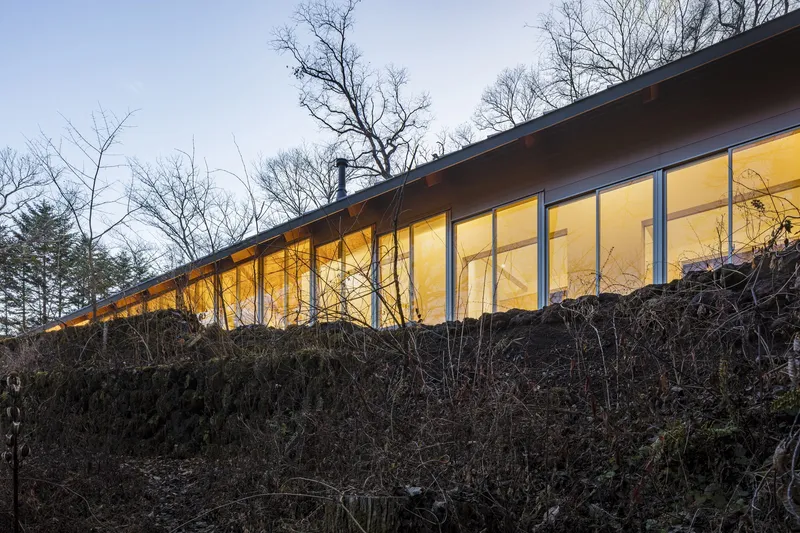
Seen from a distance, the villa barely registers against the mature deciduous trees that surround it. Its long metal roofline slips beneath the canopy like a low, continuous shelf, and the elongated profile means the building reads as a horizontal line rather than a volumetric object. At dusk, the glazed east facade glows from within, revealing the interior structure through the trees. From the steep embankment below, the building looks like a lantern lodged into the hillside.
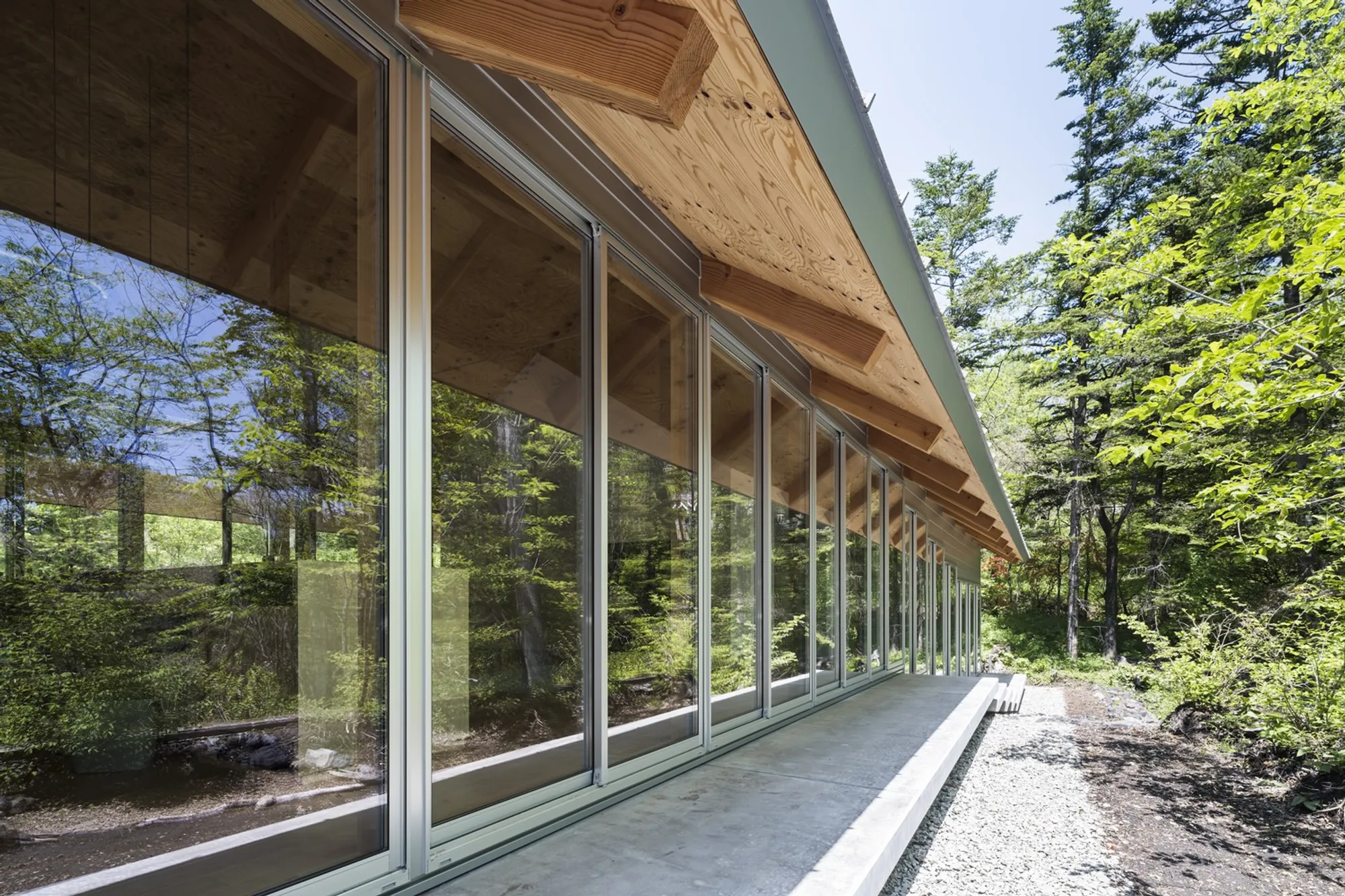
Endo's structural logic is legible here. A large, lightweight outer roof extends outward to shelter verandas and walkways, while a smaller, heavier inner roof anchors the structure against lateral forces. This dual-roof system keeps the perimeter open and airy, avoiding the kind of fortress walls that would sever the interior from its forest context.
Following the Slope
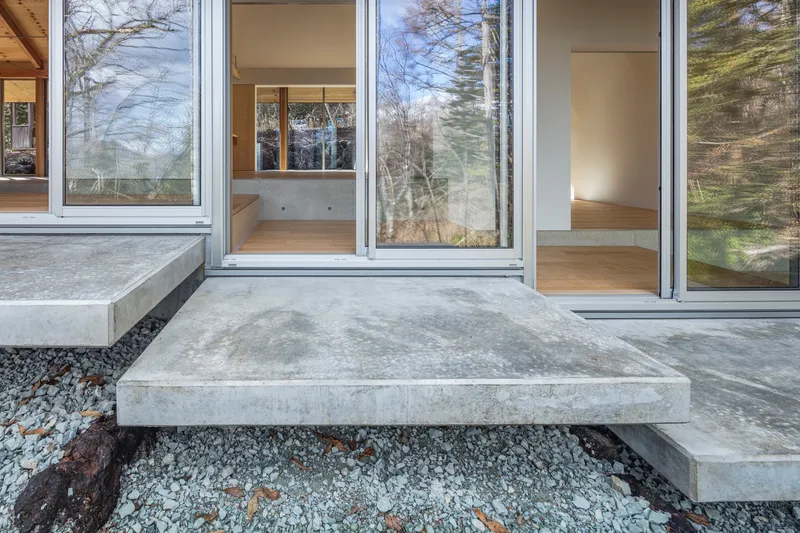
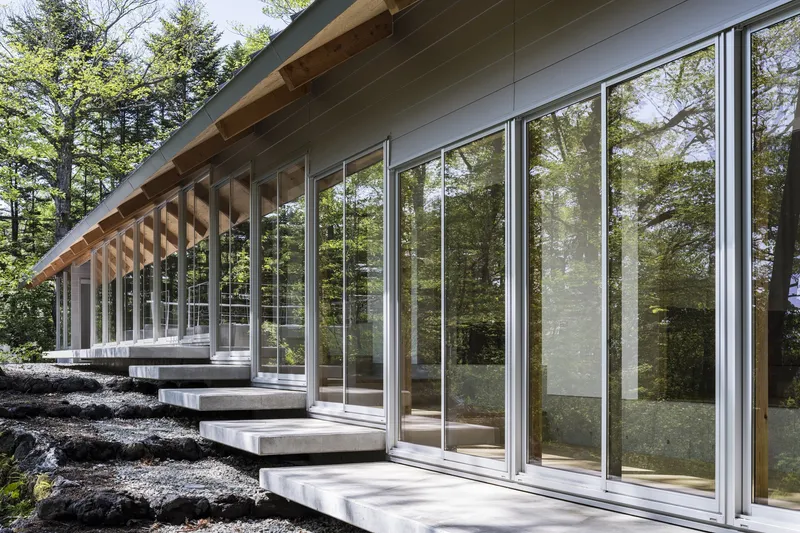
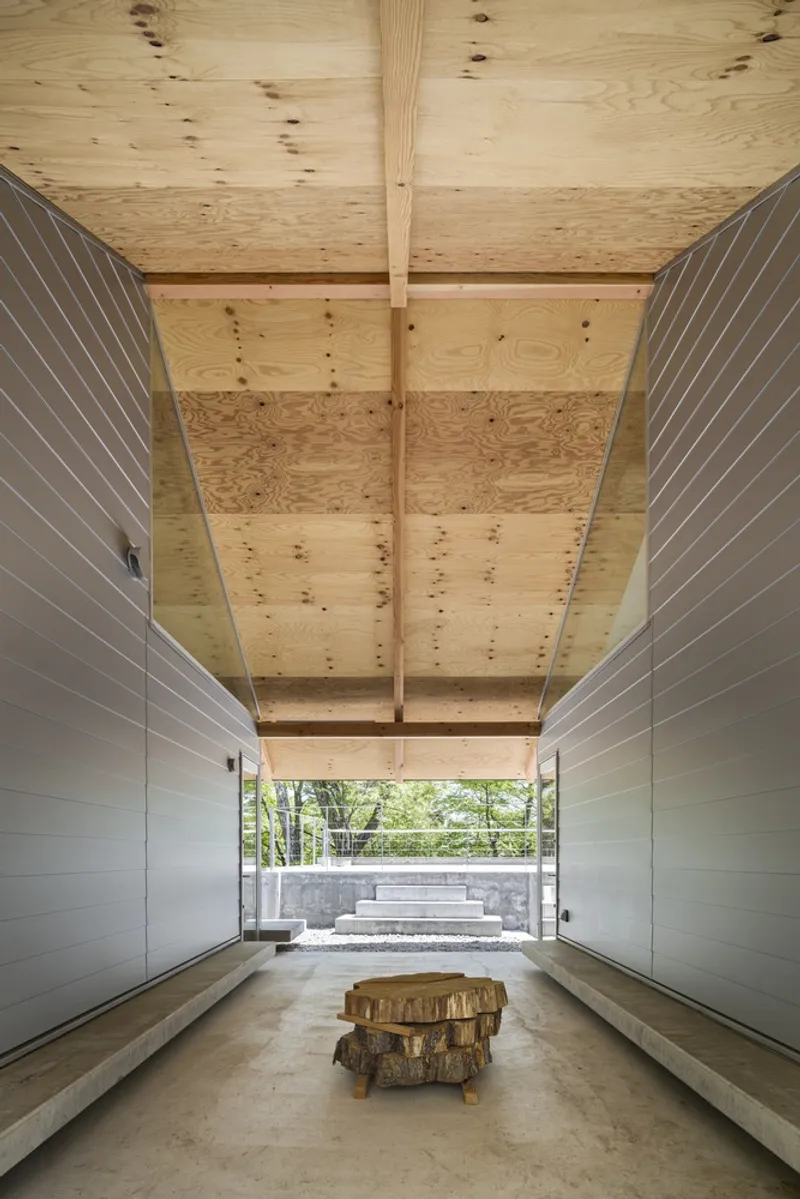
Rather than leveling the site, the design absorbs a one-meter elevation change by stepping the floor down in stages. Concrete platforms set in crushed stone lead to glazed doorways, and an exterior corridor uses concrete pads laid across black volcanic rock to bridge the grade change beneath a deep timber soffit. The exposed concrete foundation is not hidden; it becomes a visible record of the terrain's own geometry, subtly reminding occupants that the building and the ground are not the same thing.
The stepping strategy does more than manage topography. It creates micro-thresholds inside the building, separating zones of activity without walls. Moving from the communal kitchen to a family bedroom means ascending or descending a few treads, a physical cue that registers differently from simply turning a corner.
The Hall and Its Houses
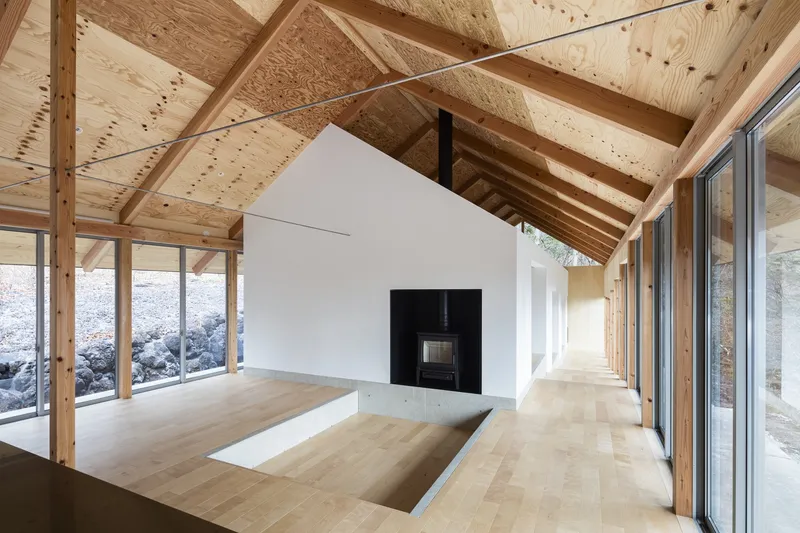
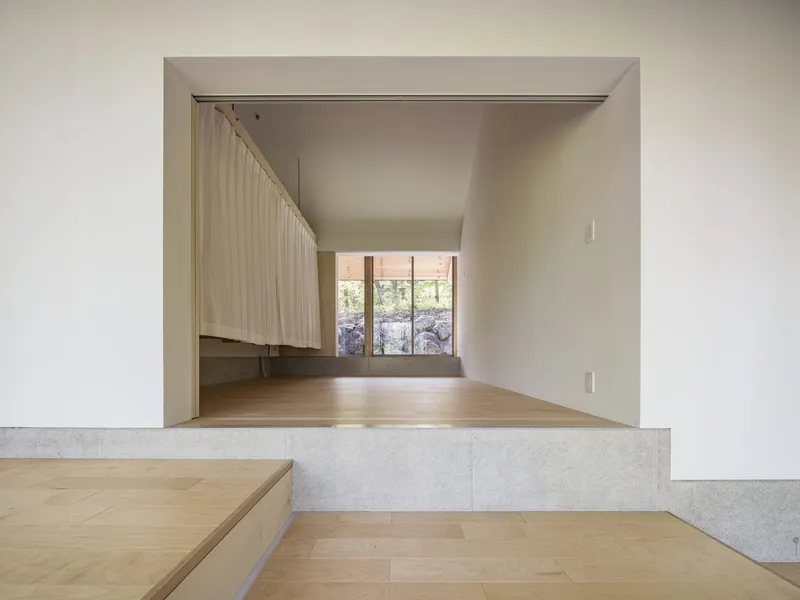
The most compelling spatial idea here is the house-within-a-house organization. Family rooms are inserted into the larger timber hall as discrete white volumes, each capped with its own gabled roof whose underside is clad in plywood panels. The effect is something like a village street under a single canopy. You enter through an open hall at the building's southern end, then move along a corridor on the east facade past communal zones (pantry, kitchen, dining, living room) before reaching the individual family rooms strung along the northern half. One family is separated on the south side of the entrance hall, giving it a degree of autonomy.
The sunken seating area near the black fireplace is a gravitational center. Exposed timber roof trusses soar above the white gabled partition, and the split levels around it create an amphitheater quality. People sit at different heights, in different postures, oriented toward the fire or toward the forest, all within a single room. It is a space calibrated for 14 people to coexist without crowding.
Timber, Concrete, and the Space Between
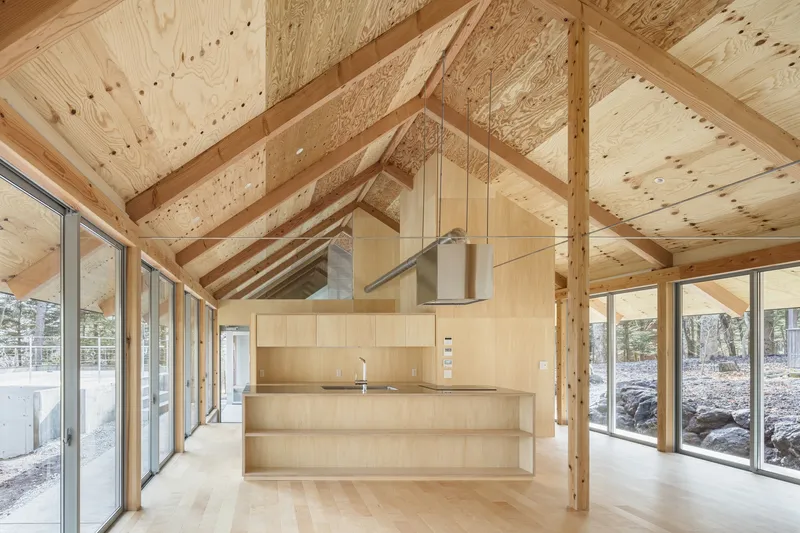
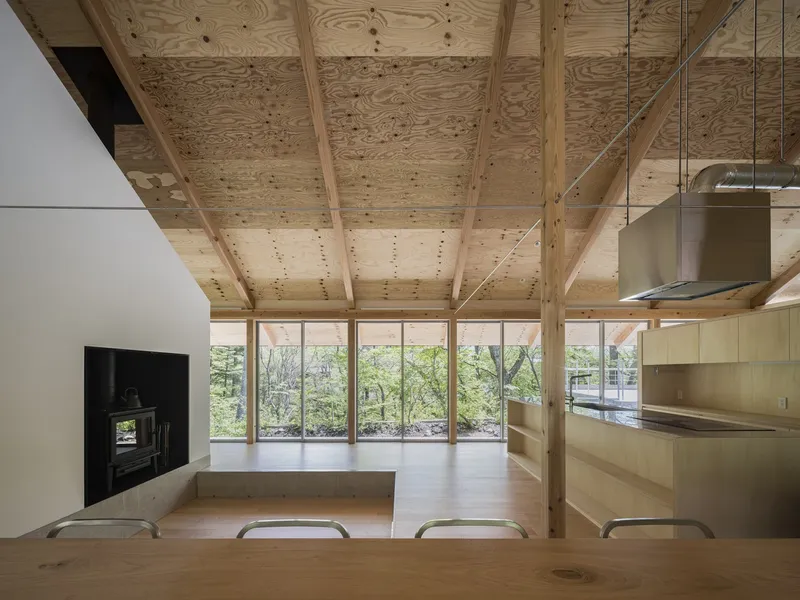
The material palette is restrained but far from monotonous. Timber dominates overhead: exposed rafters, plywood-clad ceilings, and columns that frame views to the exterior without competing with them. The kitchen island sits beneath this canopy of wood, its plywood surfaces continuous with the ceiling above, grounding the cooking zone within the larger hall's rhythm. In the dining area, timber columns act as vertical markers between the interior and the forest beyond the glass, so the boundary between meal and landscape stays deliberately thin.
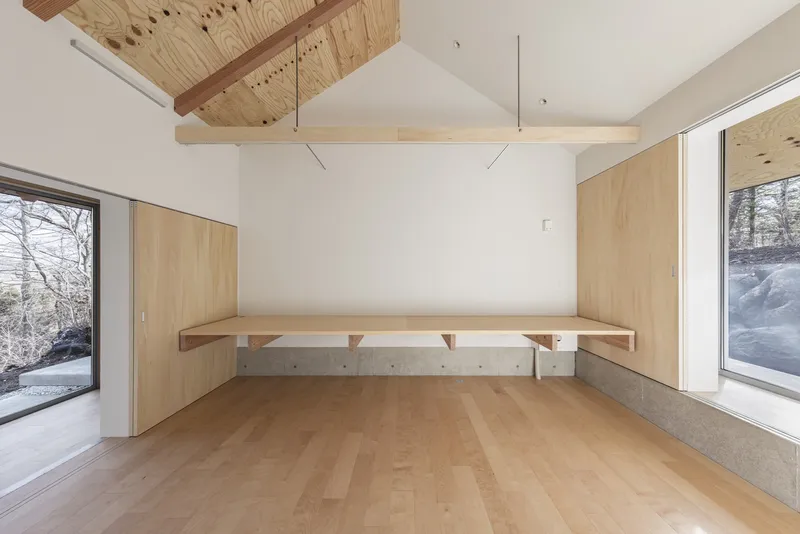
Concrete appears at the ground plane and at strategic cantilevers, particularly at the verandas where it makes the stepped interior levels visible from outside. In one room, a concrete bench runs below the windows, its mass contrasting with the plywood ceiling and white partition above. The juxtaposition is deliberate: concrete signals the earth, timber signals the canopy, and the white gabled volumes signal domestic shelter nested between the two.
Thresholds and Verandas
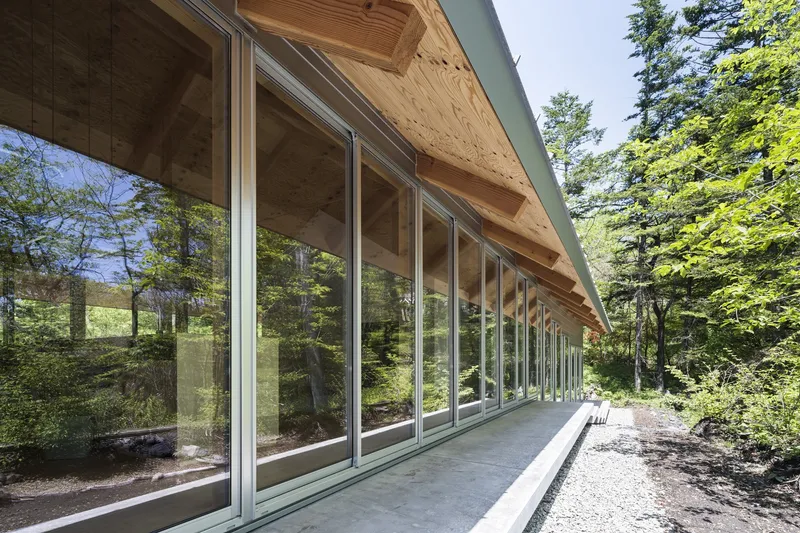
The long glazed east facade is the building's primary interface with the forest. Alternating fixed glazing and sliding aluminum sashes line the corridor, and when the sashes are open, the covered veranda and the interior become a single continuous space. Dappled forest light penetrates deep into the plan, modulated by the rhythm of the timber rafters overhead. The veranda is not ornamental; it serves as entrance, terrace, and laundry-drying space depending on the day's needs.
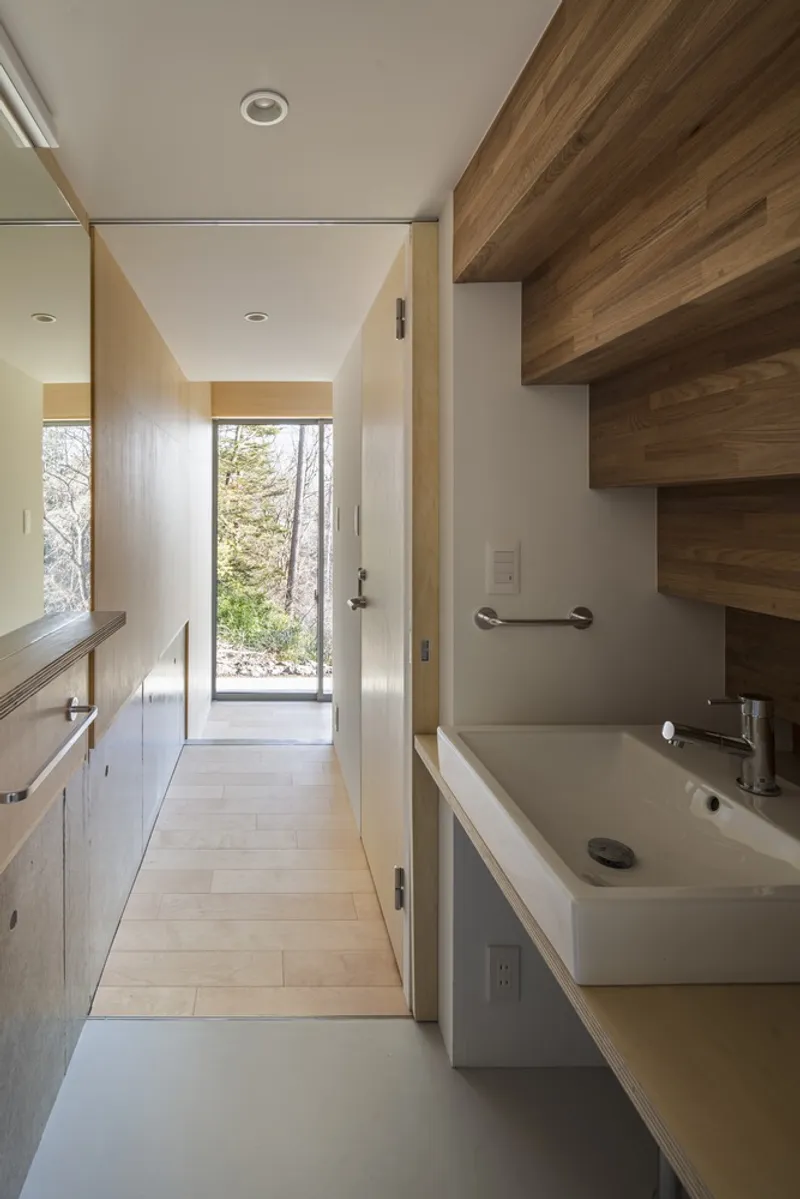
Even the bathroom corridor participates in this logic. Timber stair treads negotiate a level change while a doorway at the far end opens directly to the landscape, so the transition from interior to exterior happens casually, almost without announcement. It is a building that treats the forest not as a view to be framed but as a room to be entered.
Why This Project Matters
The vacation house genre tends to produce two archetypes: the hermetic retreat that seals its occupants in luxury, or the transparent pavilion that prioritizes views over habitation. Endo's Karuizawa villa fits neither template. It is a genuinely communal building, shaped by the specific social structure of four families who gather annually and share domestic labor as a form of togetherness. The architecture responds to that program with a spatial strategy, the nested house-within-a-house, that gives each family identity without fragmenting the collective.
More quietly, the project makes a case for architecture as infrastructure for tradition. The stepped floors, the verandas, the long corridor through the hall: these are not just spatial devices but settings for activities that can be repeated, adapted, and handed down. In a discipline increasingly preoccupied with novelty, a building designed to be returned to, year after year, by people who already know it intimately, is a worthwhile provocation.
Places in Karuizawa Villa by Takahiro Endo Architects Office. Karuizawa, Japan. 194 m². Completed 2022. Photography by Yasuhiro Nakayama.
About the Studio
Share Your Own Work on uni.xyz
If projects like this are the kind of work you want to make, uni.xyz is a place to publish your own, find collaborators, and enter design competitions.




Popular Articles
Popular articles from the community


The Musturak Paradise: Senior Living Architecture for a Connected Future in Temara, Morocco
The Musturak Paradise reimagines senior living architecture in Temara via private homes, social spaces, culture, community, and shared care.

Hill & Cross Opera: Sculptural Opera House Architecture Shaped by Tallinn’s Landscape and Identity
Hill & Cross Opera reimagines opera house architecture in Tallinn through its sculptural hill, civic plaza, glass wave and a luminous cross.

Co-Life: Senior Housing Design That Reconnects Older Adults With the City
Co-Life reimagines senior housing design through healing gardens, shared streets, workshops, and a sustainable community across generations.

The Ocean Hive: Sustainable Architecture for a Self-Sufficient Civilization at Sea
The Ocean Hive imagines sustainable architecture at sea, where modular habitats, algae, wave power and ocean waste sustain a growing colony.


Similar Reads
You might also enjoy these articles


Hodi-Mandai Geram
Project Function: Preservation and revitalization of the Intangible heritage and socio-spatial identity of the Hodi by Housing, Cultural Memory Center, Sacred Grove, landscape, local tourism economy


Olio Towers: A Mid-Rise for Performers That Fuses Housing, Rehearsal, and Stage
Located blocks from Houston's Theater District, this modular tower stacks living units around a central performance atrium.

Oasis: Modular Green Housing Carved into Dhaka's Urban Fabric
A shortlisted Plugin Housing entry reclaims unauthorized settlements in Dhaka with stepped concrete volumes, green roofs, and ventilation-driven design.

Black Hole: A Floating Megastructure for the Post-Physical Era
Emiliano Mazzarotto envisions a spherical, self-scaling arena where e-sports, digital hotels, and holographic stadiums replace traditional public space.


Explore Architecture Competitions
Discover active competitions in this discipline



Challenge to reimagine the Iron Throne


Photograph architecture without architects


Illustrate the lost glory of Angkor Wat - Render Challenge


Design challenge to reuse E-waste
Comments (0)
Please login or sign up to add comments
No comments yet. Be the first to comment!