
Powerhouse Company, Orange Architects, and NEXT Architects Build a Harbor District on Amsterdam's IJ
Five residential buildings and a circular pavilion transform a former industrial waterfront in Amsterdam-Noord into a new neighborhood.


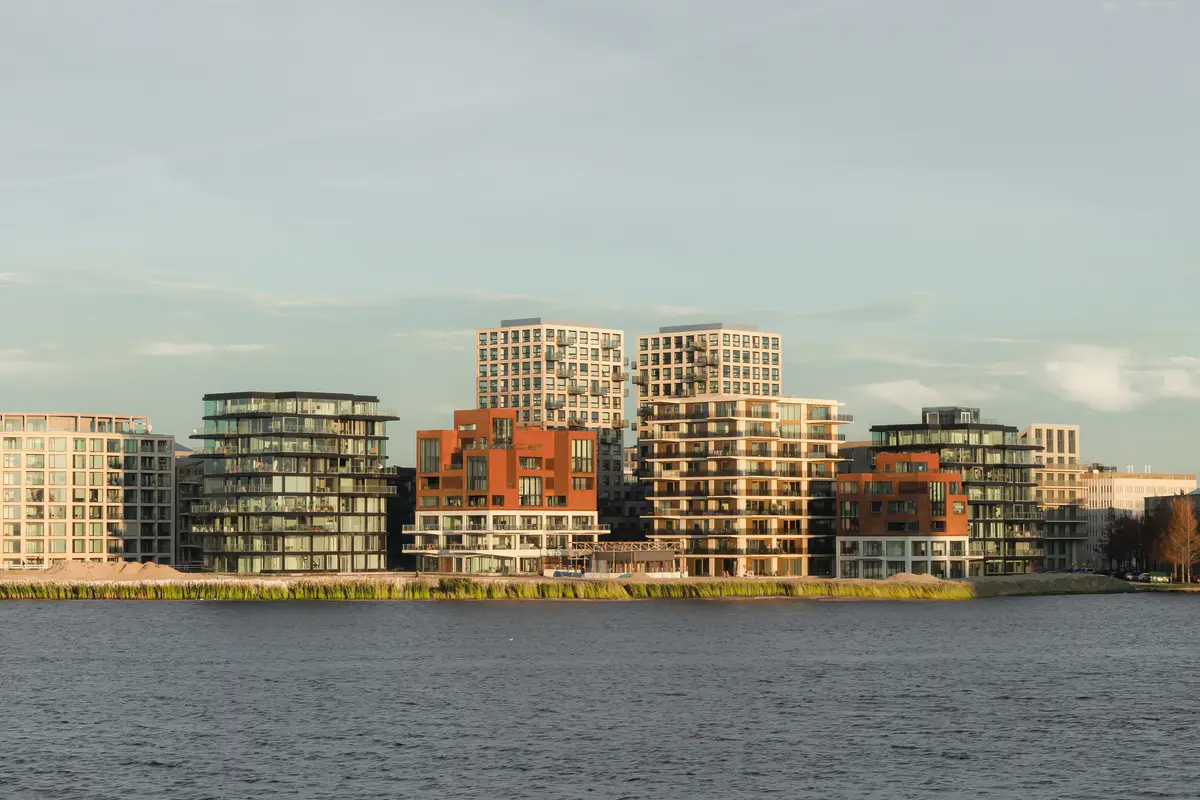
Industrial waterfronts are the great temptation of European urbanism. Every city that has one wants to turn it into a neighborhood, and most of the results look like they rolled off the same rendering farm. KAAP, a cluster of five residential buildings and a circular pavilion on the IJ waterfront in Amsterdam-Noord, could easily have become another generic quay-side development. That it did not is largely down to a collaborative design process: three firms, Powerhouse Company, Orange Architects, and NEXT architects, each brought distinct architectural languages to the table, producing buildings that share a site without sharing an identity.
The ensemble sits at the point where Grasweg cuts diagonally through the orthogonal grid of Buiksloterham, a former shipbuilding district in the throes of a planned transformation into a circular urban quarter. All five volumes are rotated 45 degrees relative to the parking basement below, a structural gymnastics trick that gives every one of the 70 apartments a view of the water. The material choices, concrete, corten steel, pigmented panels, and expansive glass, read as a deliberate catalogue of industrial textures rather than a single brand. It is a project that treats diversity of expression not as disorder but as a design principle.
Corten and Concrete: An Industrial Vocabulary
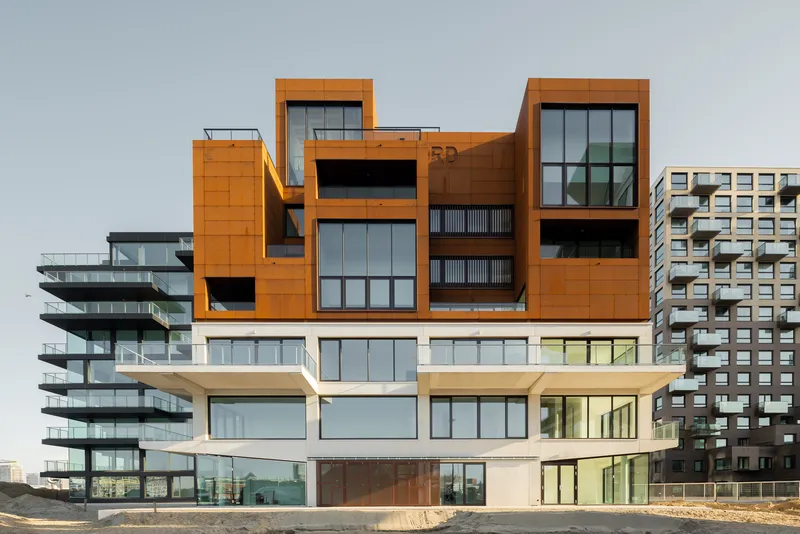
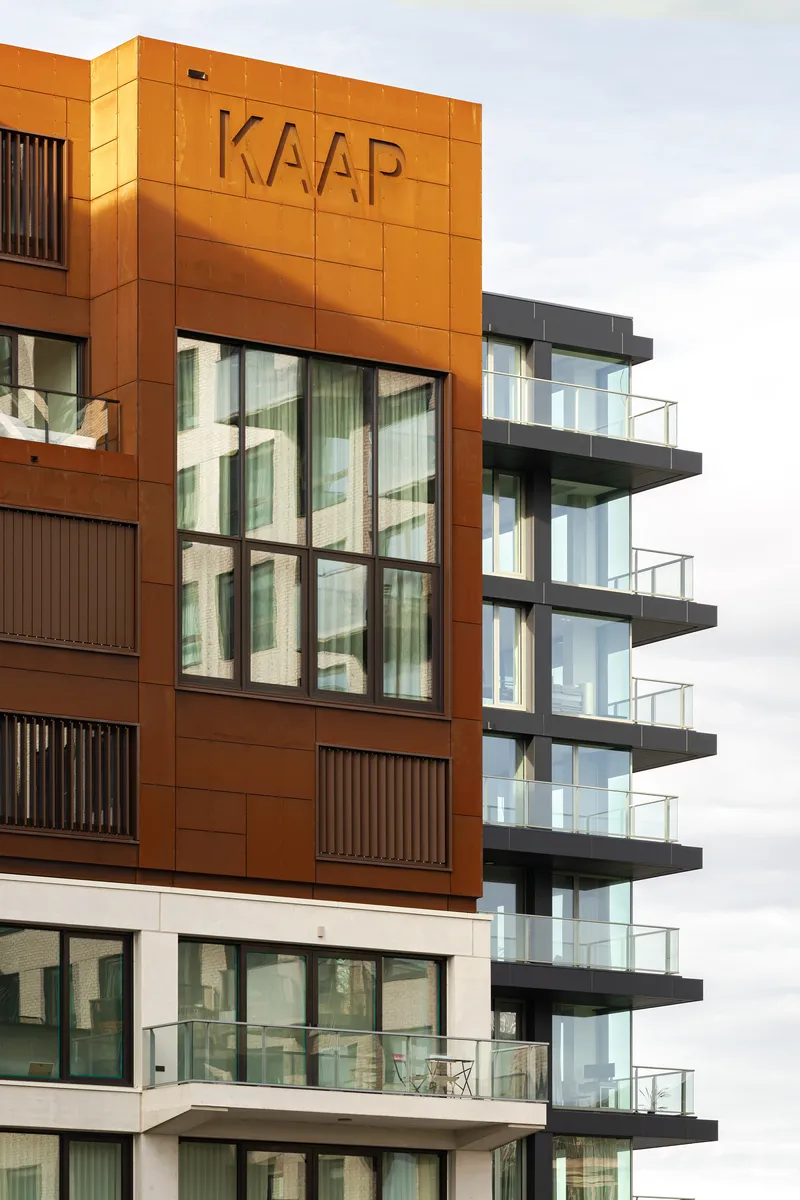
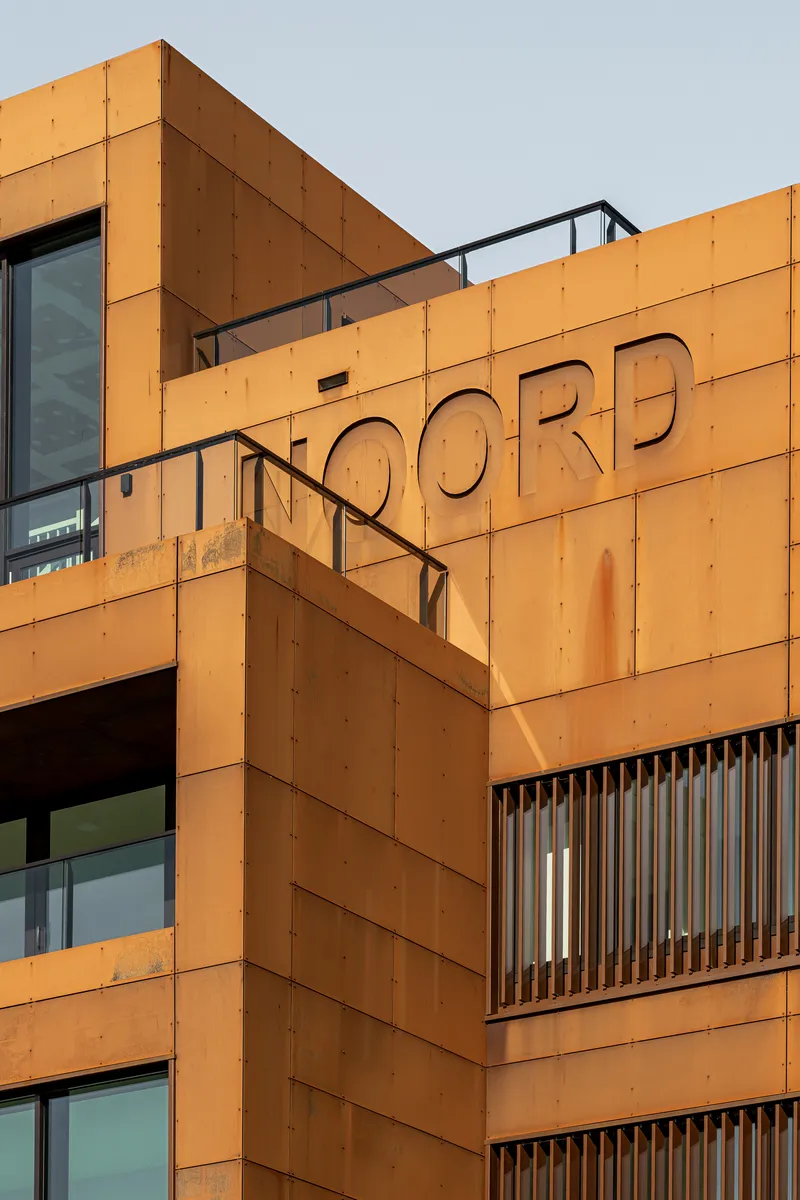
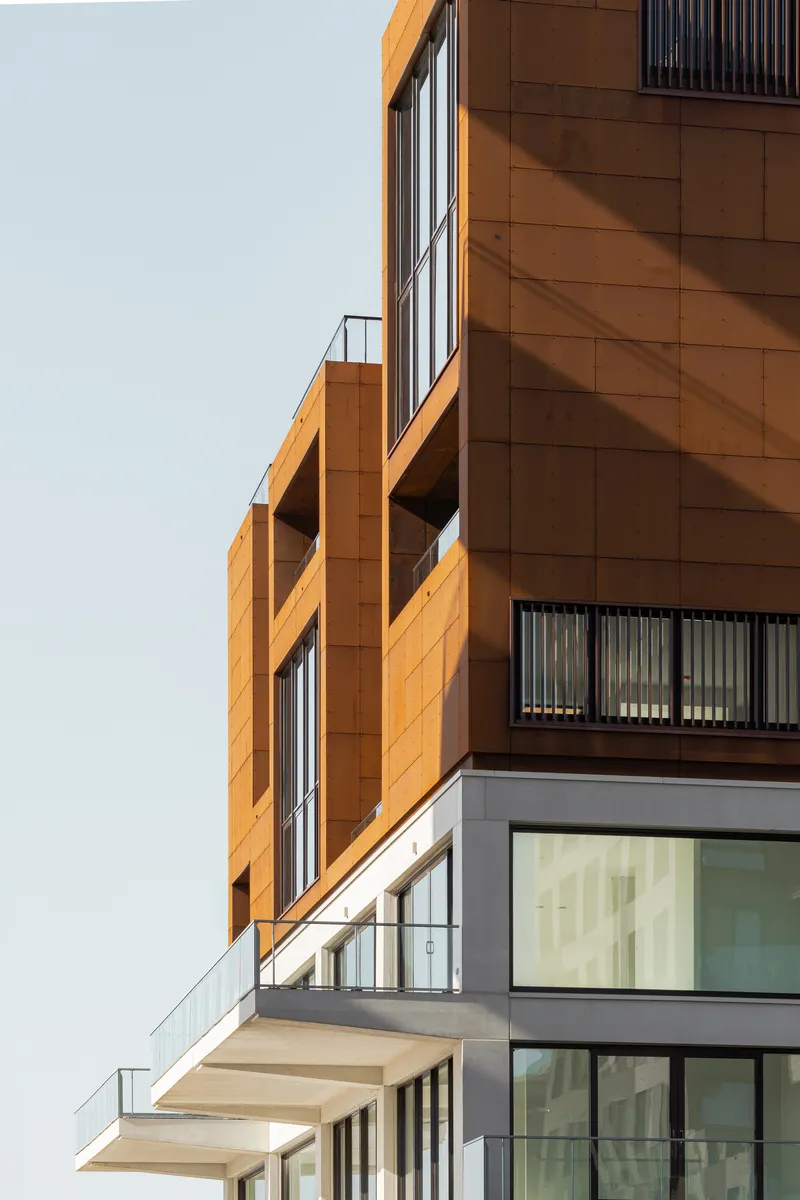
Two of the buildings, Horn and York, sit on white concrete bases and shift to corten steel on their upper floors. The oxidized panels carry embossed lettering and vertical slat screens, a direct nod to the signage and utilitarian surfaces of the shipyards that once occupied this stretch of the IJ. These are not nostalgic gestures; the corten functions as weather protection and privacy screen while establishing a scale and grain that feels grounded in the site's memory.
The transition from pale base to rusted upper volume gives the buildings a legible horizontal datum, separating the commercial ground floor from the residential mass above. It also keeps the street level lighter and more inviting, avoiding the bunker-like bases that plague many waterfront projects.
Stacked Balconies and the Pursuit of Waterfront Life
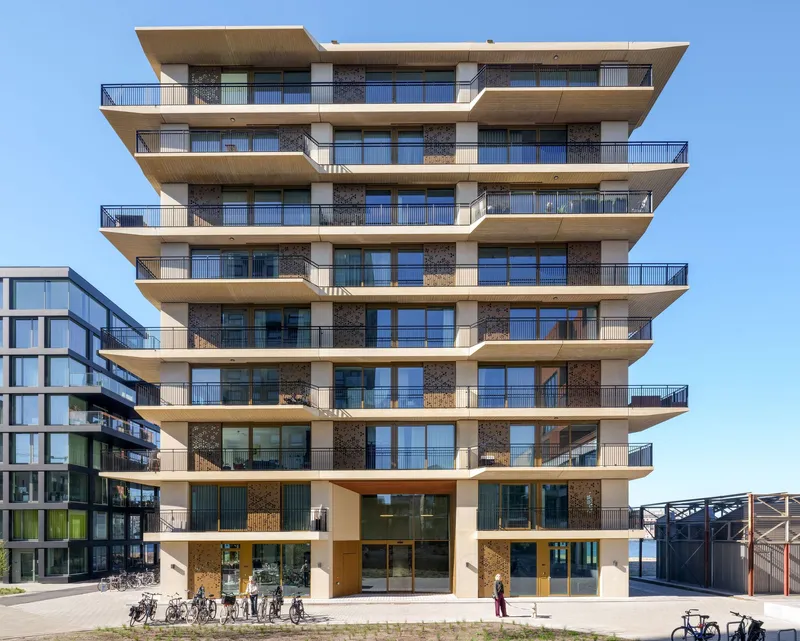
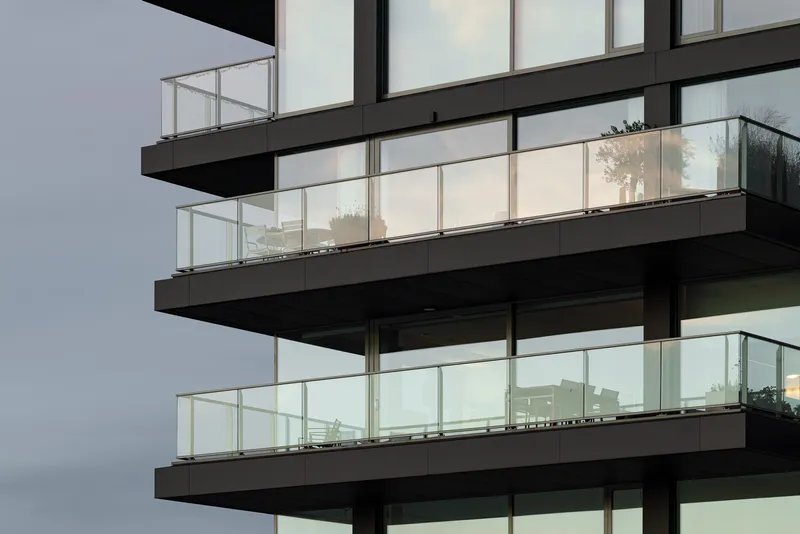
The most visually kinetic element across KAAP is the balcony. Deep, cantilevered, and stacked in staggered rhythms, the balconies give each facade a sculptural depth that changes dramatically with the light. Blanc, designed with alternating balconies that fan out to all sides, treats its 18 corner apartments as panoramic belvederes. The effect at dusk, when interior light spills through floor-to-ceiling glazing onto the projecting slabs, turns each building into a kind of inhabited lantern.
These are not token outdoor spaces. With apartment sizes ranging from 70 to 345 square meters, the larger units pair their open plans with generous roof terraces and double-height windows. The balconies orient toward the IJ, while entrances are placed on the street side, creating a clear threshold between the public realm and the private waterfront outlook.
Dark Glass and Light: The Towers at Twilight
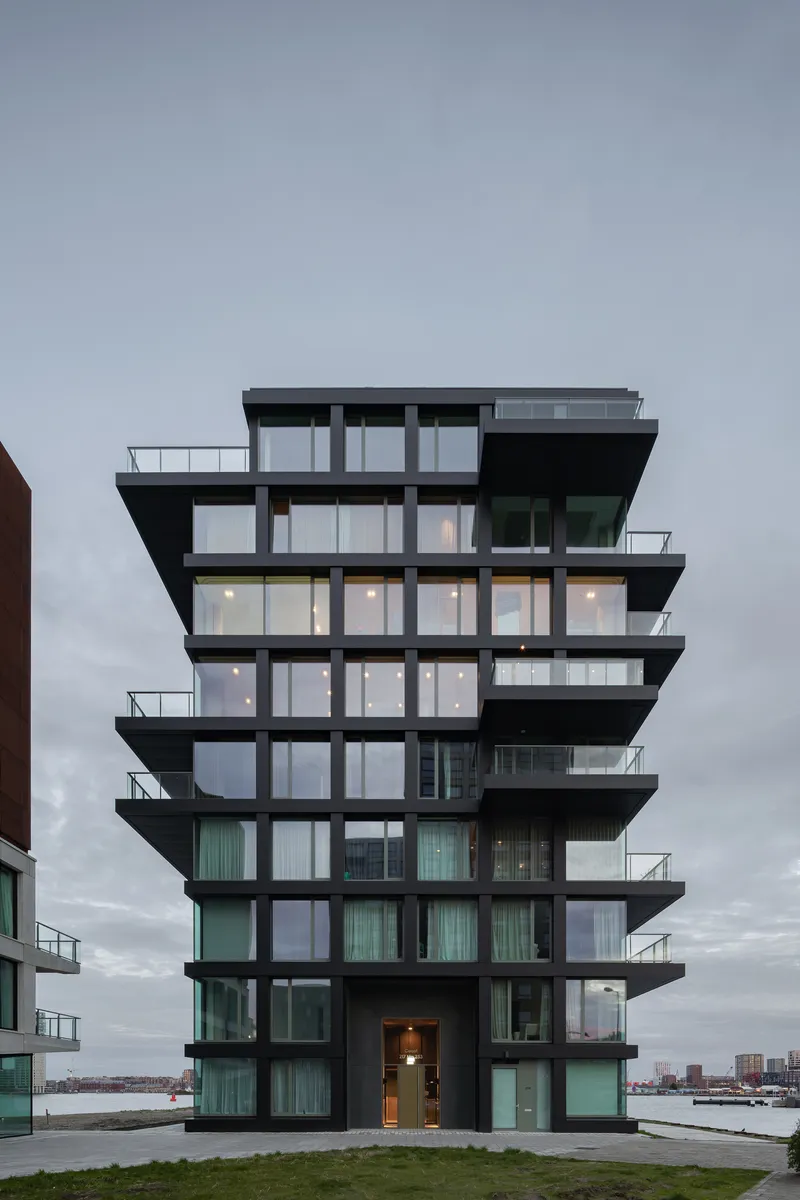
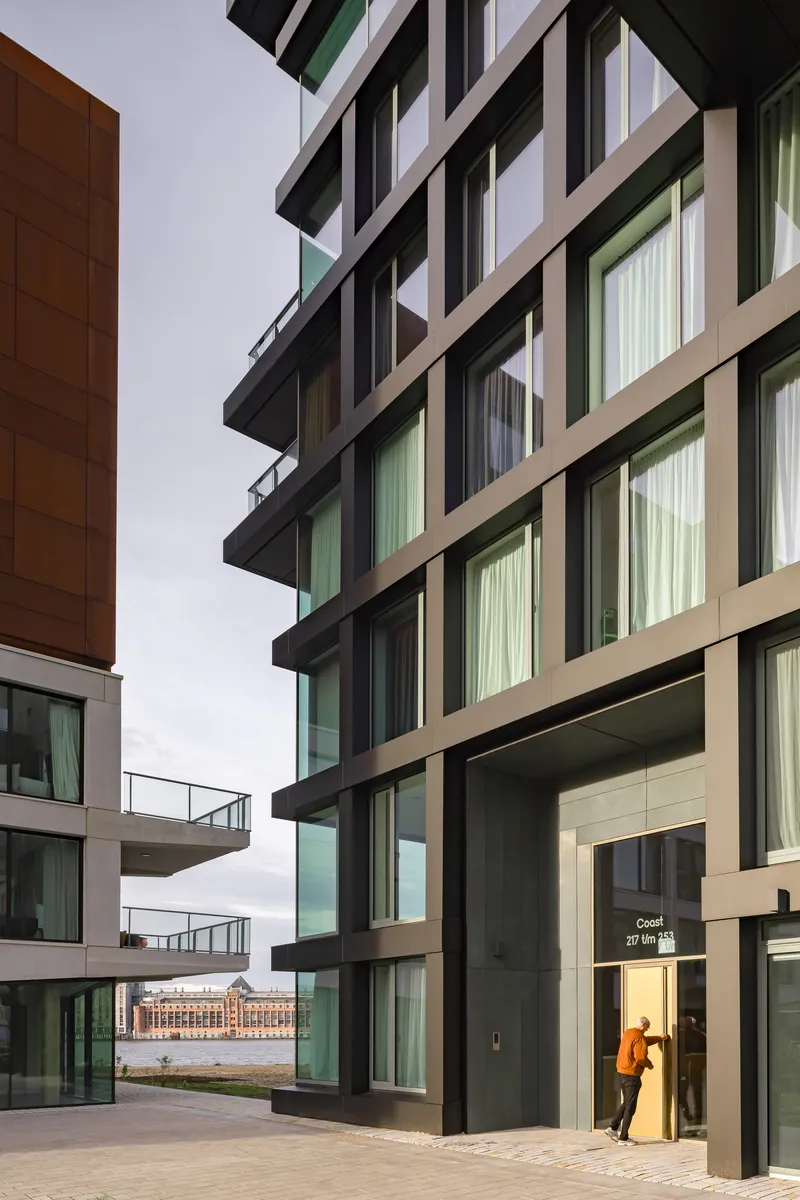
Coast and Verde wear a different skin: glass, black steel, and concrete. Where the corten buildings are warm and tactile, these towers are cooler, more reflective, and more openly metropolitan. The staggered black balconies on the tower facades create a sharp graphic pattern, their dark frames contrasting with the luminous glazing behind them. At ground level, the lobbies are generous and transparent, pulling pedestrian activity into the base of the buildings.
The coexistence of these two material palettes, warm rust and cool glass, within a single development is what keeps KAAP from feeling monotonous. It reads the way a neighborhood built over decades might: varied, but held together by a shared commitment to craft and proportion.
Interior: The Modern Harbor Loft
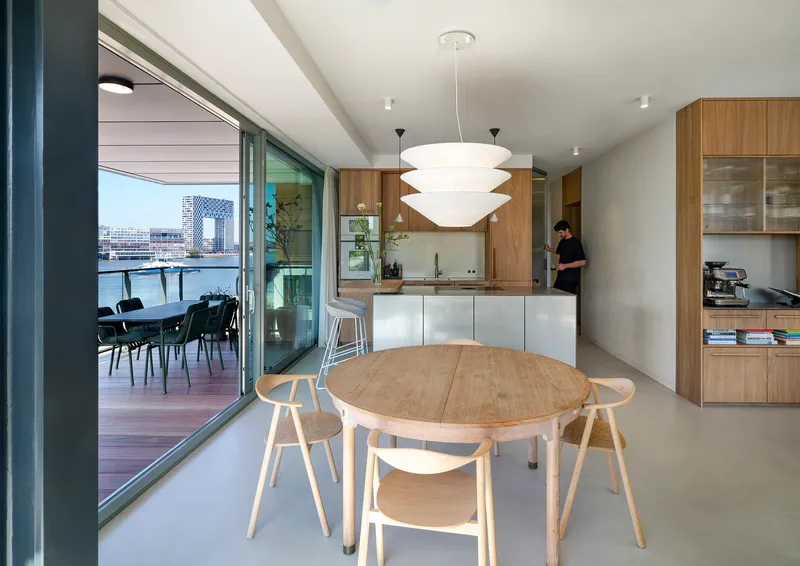
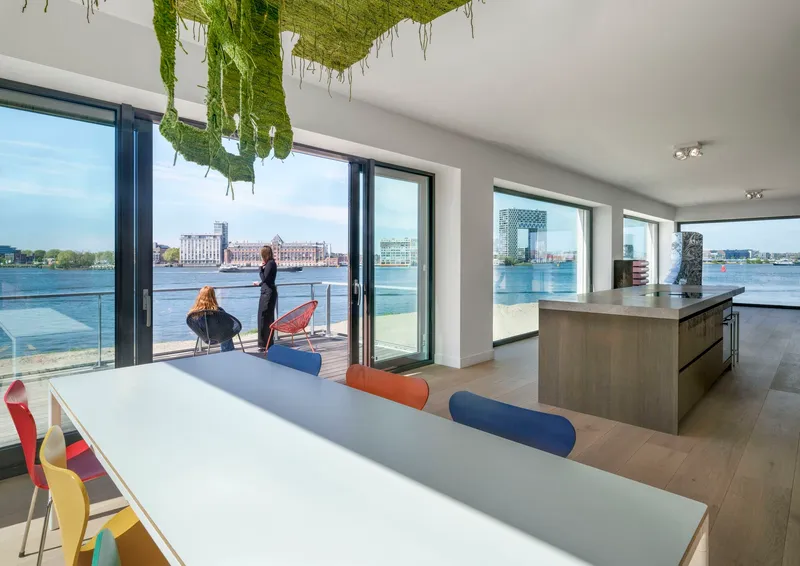
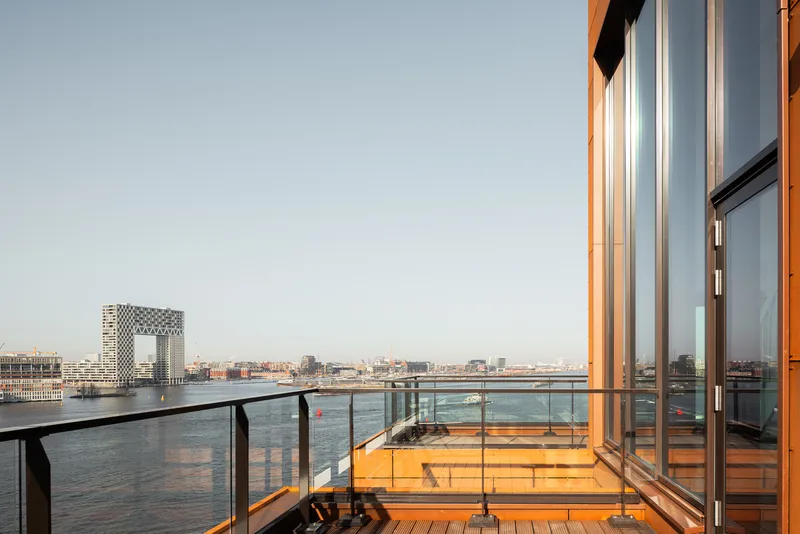
Inside, the apartments deliver on the "modern harbor loft" concept. Open plans flow from kitchen to living area to balcony with minimal interruption. Timber cabinetry, concrete ceilings, and large sliding doors maintain the industrial register without tipping into self-conscious roughness. The interiors photographed here show a deliberate restraint: no feature walls, no showy fixtures, just well-proportioned rooms that trust the water view to do the heavy lifting.
The rooftop terraces deserve particular mention. Finished with timber decking and glass balustrades, they provide unobstructed sightlines across the IJ. For a city where outdoor private space is scarce, these terraces represent a genuine amenity rather than a marketing afterthought.
Perforated Panels and the Question of Privacy
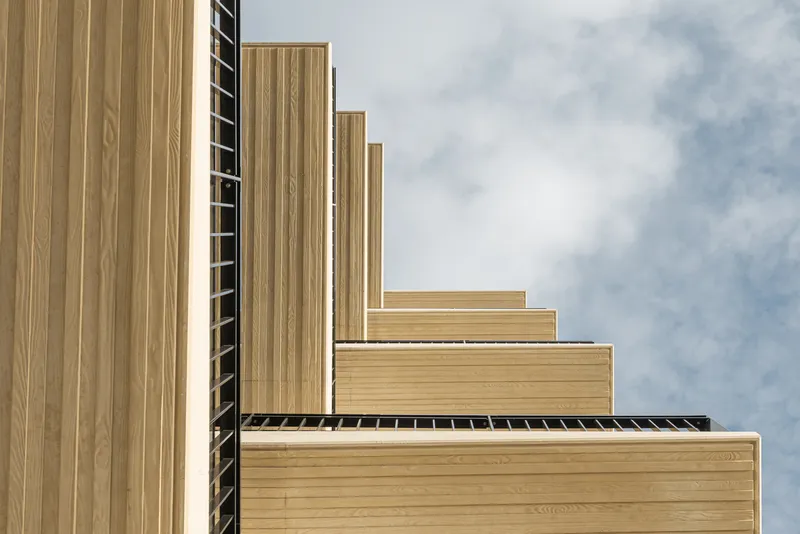
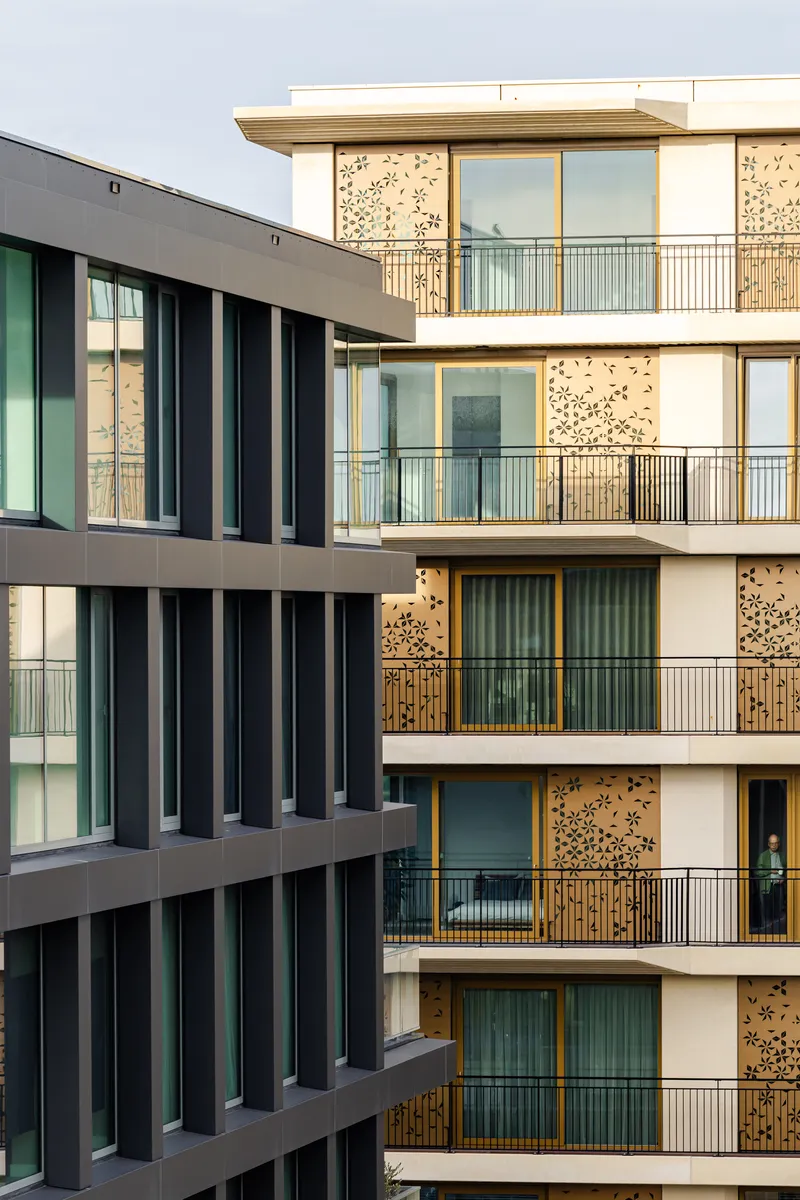
Blanc, clad in yellow-pigmented concrete with perforated panels, solves a familiar waterfront problem: how to give residents expansive views while protecting them from the gaze of neighbors in a dense development. The perforations filter daylight and create a layered facade that shifts in opacity as you move past it. Vertical slat screens on the timber-clad volumes serve a similar function, adding depth and shadow to the facades without closing them off.
The 45-degree rotation of the buildings plays a supporting role here. By angling the volumes away from each other, the architects maximize the gaps between them, allowing light to penetrate and sightlines to extend to the water without the typical face-to-face confrontation of parallel blocks. It is a simple move that resolves several problems at once.
Why This Project Matters
KAAP is not revolutionary. It does not propose a new housing typology or upend the conventions of waterfront development. What it does, and does well, is demonstrate that multi-architect projects can produce coherent neighborhoods rather than architectural beauty pageants. Powerhouse Company, Orange Architects, and NEXT architects each maintained a distinct voice while adhering to a shared material logic rooted in the site's industrial past. The result is a district that feels authored but not branded.
The circular pavilion, built in three months from 92% recycled and bio-based materials sourced from Amsterdam demolition projects, adds a public anchor that prevents the development from becoming a gated enclave. As Buiksloterham continues its transformation from industrial estate to circular urban district, KAAP sets a useful benchmark: specificity of materials, generosity of outdoor space, and the discipline to let multiple design visions coexist without competing for attention.
KAAP, Residential District and Circular Pavilion, designed by Powerhouse Company, Orange Architects, and NEXT architects. Amsterdam, The Netherlands. 16,685 m². Completed 2025. Photography by Jeroen Musch, Sebastian van Damme, and Emile Hoens.
About the Studio
Share Your Own Work on uni.xyz
If projects like this are the kind of work you want to make, uni.xyz is a place to publish your own, find collaborators, and enter design competitions.


Popular Articles
Popular articles from the community

Extended Shell: Retrofitting Kolkata's Balconies as Living Urban Thresholds
A modular retrofit system recovers the social and environmental intelligence of Kolkata's historic verandas for contemporary Park Street residents.
Temporary Home for Dogs: A Reversed Zoo Rethinks Animal Shelter Architecture
In Bucharest, a sinuous corridor and freed landscape flip the logic of containment, designing a shelter that works to make itself unnecessary.

Cloaked Colonization: A Mobile Underwater Habitat That Moves Like a Fish
Micah Abaya's shortlisted EHC Pacific entry reimagines ocean settlement as a dispersed network of self-sustaining architectural organisms.

Tsunami Convergenics: Turning Catastrophic Ocean Forces into Underwater Housing Infrastructure
A speculative underwater settlement off the coast of Onagawa, Japan, treats tsunamis and typhoons as energy sources rather than threats.

Similar Reads
You might also enjoy these articles

Bao Huynh Watercolor Atelier: A Serene Art Retreat in Hội An
Bao Huynh Watercolor Atelier in Hội An blends multifunctional art spaces, sustainable design, local materials, and family-friendly living in a serene environment.

Atelier Macri Concept Store Interior Design by CASE-REAL
Atelier Macri store features a "ko" counter, walnut wood details, cork displays, blending retail, gallery, and seamless customer experiences.

Manuel Vargas Izquierdo Stadium and High-Performance Sports Center: Architectural Excellence in Jalpa de Méndez
The Manuel Vargas Izquierdo Stadium blends sustainable design, inclusive sports facilities, and cultural-inspired architecture, revitalizing Jalpa de Méndez’s public spaces.

KAKR Buluh Awar Hall: Revitalizing Community and Ecology Through Bamboo Architecture
Community built bamboo hall revitalizes Buluh Awar village, empowering youth, restoring ecology, celebrating vernacular craftsmanship through sustainable architecture and culture.

Explore Residential Complex Competitions
Discover active competitions in this discipline

Challenge to design a portable theatre

Challenge to design a portable music platform

Challenge to design an open learning module for the elderly
Comments (0)
Please login or sign up to add comments
No comments yet. Be the first to comment!